Can previous acid etching increase the
bond strength of a self-etching primer
adhesive to enamel?
Abstract: Because a greater research effort has been directed to analyz-ing the adhesive effectiveness of self etch primers to dentin, the aim of this study was to evaluate, by microtensile testing, the bond strength to enamel of a composite resin combined with a conventional adhesive sys-tem or with a self-etching primer adhesive, used according to its original prescription or used with previous acid etching. Thirty bovine teeth were divided into 3 groups with 10 teeth each (n = 10). In one of the groups, a self-etching primer (Clearil SE Bond – Kuraray) was applied in accor-dance with the manufacturer’s instructions and, in the other, it was ap-plied after previous acid etching. In the third group, a conventional adhe-sive system (Scotchbond Multipurpose Plus – 3M-ESPE) was applied in accordance with the manufacturer’s instructions. The results obtained by analysis of variance revealed signiicant differences between the adhesive systems (F = 22.31). The self-etching primer (Clearil SE Bond) presented lower enamel bond strength values than the conventional adhesive sys-tem (Scotchbond Multipurpose Plus) (m = 39.70 ± 7.07 MPa) both when used according to the original prescription (m = 27.81 ± 2.64 MPa) and with previous acid etching (m = 25.08 ± 4.92 MPa).
Descriptors: Tensile strength; Dentin-bonding agents; Dental enamel. Ana Paula Morales Cobra
Carvalho(a)
Míriam Lacalle Turbino(b)
(a) MSc in Orthodontics.
(b) PhD, Associate Professor, Department of
Restorative Dentistry, School of Dentistry, University of São Paulo, São Paulo, SP, Brazil.
Corresponding author:
Ana Paula Morales Cobra Carvalho Rua Cantagalo, 630, apto. 102 São Paulo - SP - Brazil CEP: 03319-000
E-mail: [email protected] or
Introduction
One of the purposes of research & development in Dentistry is to contribute to a better clinical per-formance of dental materials. An increasing amount of research has been conducted with the purpose of developing adhesive systems with better quality and higher bond strengths to enamel and dentin, thus preventing restoration failure.
At present, adhesive systems can be divided into two groups: those that require previous acid etch-ing, and self-etching adhesives.
Bonding to enamel is considered effective and presents high bond strength values.1 Nonetheless, the enamel bonding of self-etching adhesive systems has been questioned.2,3
The enamel surface is lat, without any mechani-cal retention, low wettability and low surface ten-sion, thus being considered a poor substrate for bonding. Acid etching creates microscopic rugosities that provide micromechanical retention and increase surface tension.
Self-etching adhesives are a new concept in adhe-sion because of the acid primer that simultaneously provides acid etching and penetration into enamel and dentin. The effects of self-etching adhesives on enamel have been studied, and they produce a dif-ferent etching pattern from the one produced by conventional adhesive systems in that the former presents a smaller quantity of microporosities.4 A lower degree of acid etching was observed for self-etching adhesives, nevertheless, with satisfactory bond strength values.5
The enamel bond strength of self-etching adhe-sives was lower than that of conventional adhesive systems.6 One in vitroresearch7 observed no statis-tical difference between the enamel bond strength of Clearil Liner Bond 2 and that of conventional adhesive systems with previous acid etching. Obser-vation by scanning electron microscopy showed that the use of conventional adhesive systems resulted in deeper etching patterns.
Because a greater research effort has been di-rected to analyzing the adhesive effectiveness of self etch primers to dentin, the aim of this study was to evaluate, by microtensile testing, the bond strength to enamel of a composite resin combined with a
conventional adhesive system or with a self-etch-ing primer adhesive, used accordself-etch-ing to its original prescription or with previous acid etching. An ad-ditional purpose was to conirm whether previous acid etching can improve the performance of the self-etching primer adhesive.
Material and Methods
Thirty freshly extracted bovine teeth, separated from their root portions, were used in this study since research has conirmed the suitability of their application as a substitute for human enamel in bonding tests.7 The next step was to latten the buc-cal surfaces of the teeth in a water-cooled mechani-cal grinder (Politriz-Buehler, Boston, MA, USA), us-ing 600 grit Al2Ο3 abrasive paper. After this, they were stored in distilled water.
The teeth were divided into 3 groups with 10 teeth each (n = 10), as follows:
Group 1 – Application of Clearil SE Bond (Ku-raray Co., Osaka, Japan), in accordance with the manufacturer’s instructions (10 seconds of irst bottle with acid and primer and 10 seconds of second bottle with adhesive and light polymer-ized for 10 seconds).
Group 2 – Previous enamel etching with 37% phosphoric acid, washing with water, drying, followed by the application of Clearil SE Bond (Kuraray Co., Osaka, Japan), in accordance with the manufacturer’s instructions.
Group 3 – Application of Scotchbond Multipur-pose Plus (3M-ESPE, St. Paul, MN, USA), in ac-cordance with the manufacturer’s instructions (light polymerized for 10 seconds).
The adhesive systems were light polymerized for 10 seconds with a light curing unit (Degulux Soft Start – Degussa Hills, Hanau, Germany) with 550 mW/cm². After that, the Filtek Z-250 (3M ESPE, St. Paul, MN, USA)composite resin was inserted in 4 increments of 1 mm each and light polymerized for 40 seconds. A silicon based impression material (Optosil, Heraeus Kulzer GmbH & Co., KG, Ger-many) was used as a matrix measuring 5 x 5 mm.
In order to obtain the specimens, the teeth were mounted in an acrylic resin base. Then the resin composite and tooth structure were cut with a
dia-•
•
mond disc in the cervico-occlusal and mesiodistal directions. The specimens presented a rectangular cross-sectional area of approximately 1 mm².For this purpose, the Lab Cut 1010 machine (Extec Corp. – Enield, CT, USA)was used with a diamond disc(Extec corp. – Enield, CT, USA), at a speed of 250 rpm for the mesiodistal cut and 125 rpm for the cervico-occlusal cut. Only the 4 central specimens per tooth were used for the microtensile bond test.
The resin composite increments were inserted so that the proportion between the tooth structure and the resin composite length was maintained. Thus, a pattern was created to avoid any inluence that might be caused by different dimensions of the 2 ex-tremities when stress was applied during the micro-tensile test.
The specimens were then ixed with cyanoacry-late adhesive on each side, (Super Bonder Gel, Loc-tite, São Paulo, SP, Brazil) in the Geraldeli device,8 which was used for the microtensile bond test. Thus, the bond area was placed perpendicular to the direc-tion of the stress applied. The specimen device was mounted in the universal test machine Mini Instron model 4442 (Instron – Canton, CT, USA) submit-ting it to stress at a speed of 0.5 mm/min.
After the microtensile test, the fractures at the bond interface were measured with a caliper and then the bond strength values were transformed into MPa. With this methodology, the bond strength val-ues were obtained according to the cross-sectional specimen areas. The values were submitted to statis-tical analysis of variance (ANOVA) and to the New-man-Keuls test.
The original results consisted of 120 bond strength values in MPa related to 30 teeth, with 4 specimens per tooth. Furthermore, only specimens with adhesive fracture were used for the statistics.
Next, the mean of these values was calculated, re-sulting in 30 values, 10 for each group.
Results
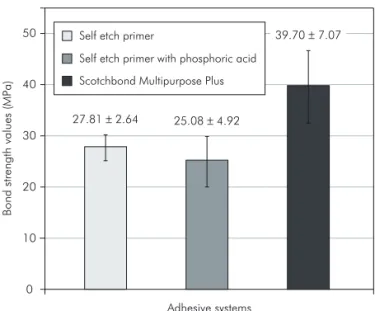
The results obtained by analysis of variance re-vealed signiicant differences between the adhesive systems (F = 22.31). After comparison between the measurements using the Newman-Keuls test, it was observed that the adhesive Scotchbond Multipurpose Plus (m = 39.70 ± 7.07 MPa) presented a higher bond strength value than the self-etching primer Clearil SE Bond. There was no statistically signiicant dif-ference between the self-etching primer Clearil SE Bond applied in accordance with the manufacturer’s instructions (m = 27.81 ± 2.64 MPa) and with pre-vious acid etching (m = 25.08 ± 4.92 MPa). (Table 1 and Graph 1)
Discussion
Because of the increasing application and mar-keting of self-etching primers, it is necessary to con-irm their eficacy in bonding to tooth structures. The acidic primer of these systems promotes selec-tive dissolution of enamel prisms, creating micro-porosities for resin penetration. Some studies with self-etching primers obtained bond strengths lower than or the same as those of conventional one-bottle adhesive systems with previous acid etching. This occurred due to resin failure, because the primer did
Table 1 - Enamel microtensile bond strength values of the two adhesive systems polymerized by halogen light and LED.
Groups Bond strength
Self-etch primer 27.81 ± 2.64 MPa
Self-etch primer with phosphoric acid 25.08 ± 4.92 MPa
Scotchbond Multipurpose Plus 39.70 ± 7.07 MPa
Adhesive systems
B
o
nd
strength
valu
es
(MPa)
50
30 40
20
10
0
39.70± 7.07
27.81± 2.64 25.08± 4.92 Self etch primer
Self etch primer with phosphoric acid
Scotchbond Multipurpose Plus
not penetrate deeply enough between the enamel crystallites and rods. Consequently, the bond be-tween enamel and resin fails after some time of function in the mouth.9,10
Some studies observed that self-etching primers did not create a deep etch pattern, differently from the phosphoric acid application only.3 Empty areas in the hybridized enamel region at the enamel-resin interface were also observed.11
The balance between demineralization depth and extent of monomer penetration of the self-etching primers is the key to a good quality bond between enamel and resin.12
In another study with self-etching primers,13 there was a decreasing quantity of adhesive at the enamel-resin interface, from the resin to the enamel area. Moreover, the deepest areas in the demineral-ized enamel had poor adhesive saturation.
Other studies showed that self-etching primers did not prevent iniltration when applied with previ-ous acid etching.14,15
Due to the large number of studies that have shown lower bond values to enamel for self-etching primers, the purpose of this study was to test the application of Clearil SE Bond with previous acid etching compared with application in accordance with the manufacturer’s instructions, and, after this, to compare the results with those of a conven-tional adhesive system. The purpose was to evaluate whether acid etching could promote higher enamel bond strength. The results showed no signiicant differences between the evaluated patterns. This suggests that even with the larger number of micro-retentions created by acid etching, primer penetra-tion into these microretenpenetra-tions was not effective and did not result in higher bond strength values.
Self-etching primers have limited demineraliza-tion and impregnademineraliza-tion depths because of wet den-tin and the ionic effects of high calcium and phos-phate concentrations, which limit the dissolution of apatite crystals.16 Due to the high mineral content of enamel, this latter effect should be considered when self-etching primers are applied on enamel.16
A recent study17 also tested acid etching before the application of 2 self-etching primers (Clearil SE Bond and Uniil Bond). An increase in enamel bond
strength and a decrease in dentin bond strength were observed.17 The values for Clearil SE Bond ap-plied on enamel were 14.3 MPa for a single appli-cation and 20.5 MPa with previous acid etching.17 In microscopic observations, the tags obtained with Clearil SE Bond without previous acid etching had a lamina-like aspect with porous areas in deminer-alized areas.17 When Clearil SE Bond was applied with previous acid etching for 15 seconds, tags in-iltrated in decalciied areas were also observed, but they were thicker, with a ibrous aspect at their bases, and they were connected.17 Another study by the same authors18 observed a thicker extent of inil-trated tags in enamel after the application of a con-ventional adhesive system with previous acid etch-ing, which indicated a more stable adhesion.
In this study, Clearil SE Bond presented lower bond strength values when compared with the con-ventional adhesive system Scotchbond Multipurpose Plus. These indings were similar to those of another study19 that observed that Scotchbond Multipurpose Plus and Single Bond had higher bond strength val-ues to bovine enamel than the self-etching primer Etch & Prime (similar to Clearil SE Bond).
Some studies have conirmed that self-etching primers had high dentin bond strength values, and that they have good clinical performance.20,21 Never-theless, the self-etching primers have not surpassed conventional adhesives in enamel bond strength tests.
In the related literature, a comparison was also found between the enamel and dentin bond strengths of 3 adhesive systems: a self-etching adhe-sive (Prompt L-Pop); a self-etching primer (Clearil SE Bond), and a conventional adhesive system (Prime & Bond NT). The self-etching adhesive and self-etching primer showed higher enamel bond strengths than that of dentin.9,22
re-ported advantage was that the self-etching primer promoted high bond strength with minimal changes in the enamel surface topography when compared with conventional systems, resulting in an addition-al secondary adhesion.23 Although this is an addi-tional factor to increase bond strength, it is uncer-tain whether this secondary adhesion promoted by self-etching primers has the same long term stability as the bond produced by the micromechanical reten-tion of convenreten-tional adhesive systems.23
There is another study24 that compared the enam-el bond strength of 4 senam-elf-etching adhesives (AdheSE, Adper Prompt L-Pop, Clearil SE Bond, Tyrian SPE/ One Step Plus) with that of a conventional adhesive system (Prime & Bond NT). The pH values of the self-etching solutions and of phosphoric acid were measured with the purpose of relating pH to bond strength.24 The self-etching adhesives Adper Prompt L-Pop and Clearil SE Bond had bond strength val-ues similar to those of the conventional adhesive systems, only when the time recommended by the manufacturer was doubled.24 When the application time of Clearil SE Bond was changed from 30 to 60 seconds, an increase in enamel bond strength was observed.17 It was concluded that the pH of Clearil SE Bond was not acid enough to dissolve
hydroxyap-atite crystallites as deeply, when compared with the dissolution depth obtained with phosphoric acid.24
It could, thus, be argued that, in this study, a previous acid etching did not produce suficient dis-solution of apatite crystals to improve the bond to enamel of the self-etching primer. Moreover, both when the self-etching primer was used according to the original prescription and with previous acid etching, it presented a thin extent of iniltrated tags in enamel, which resulted in unstable adhesion. Therefore, the application of a conventional adhe-sive system in both enamel and dentin is considered safer because of the greater depth of apatite crys-tal dissolution and thicker extent of iniltrated tags, which was conirmed by the higher bond strength values obtained in this study.
Conclusion
The self-etching primer (Clearil SE Bond) pre-sented lower enamel bond strength values than the conventional adhesive system (Scotchbond Multi-purpose Plus), both when applied according to the original prescription and with previous acid etch-ing. Therefore, the previous enamel etching did not improve enamel adhesion of the self-etching primer adhesive.
References
1. Shono T. Pulpal responses to light-cured restorative glass polyalkenoate cements, and ultrastructure of cement-dentin interface. Japan J Conserv Dent. 1995;38:514-48.
2. Ferrari M, Mannocci F, Vichi A, Davidson CL. Effect of two etching times on the sealing ability of Clearfil Liner Bond 2 in class V restorations. Am J Dent. 1997;10(2):66-70. 3. Perdigão J, Lopes L, Lambrechts P, Leitão J, Van Meerbeek
B, Vanherle G. Effects of a self-etching primer on enamel shear bond strengths and SEM morphology. Am J Dent. 1997;10(3):141-6.
4. Cardoso P, Carrilho M, Francci C, Perdigão J. Microtensile bond strengths of one-bottle dentin adhesives. Am J Dent. 2001;14(1): 22-4.
5. Watanabe I. Photocure bonding agents to ground dentin. Jpn J Dent Mater. 1992;11:955-73.
6. Nakanuma K, Arisue K, Kajiwara M, Niinuma A, Murakami Y, Yamazaki M. Evaluation of new types of commercially available adhesive systems – effect of total treatment for enamel and dentin. Japan J Conserv Dent. 1996;39:304-14.
7. Nakamichi I, Iwaku M, Fusayama T. Bovine teeth as possible substitutes in the adhesion test. J Dent Res. 1983;62(10):1076-81.
8. Perdigão J, Geraldeli S, Carmo AR, Dutra HR. In vivo influ-ence of residual moisture on microtensile bond strengths of one-bottle adhesives. J Esthet Restor Dent. 2002;14(1):31-8. 9. Kiremitçi A, Yalçin F, Gökalp S. Bonding to enamel and
dentin using self-etching adhesive systems. Quintessence Int. 2004;35(5):367-70.
10. Miyazaki M, Sato M, Onose H, Moore BK. Influence of ther-mal cycling on dentin bond strength of two-step bonding systems. Am J Dent. 1998;11(3):118-22.
11. Perdigão J, Francci C, Swift EJ, Ambrose WW, Lopes M. Ultramorphological study of interaction of adhesives with car-bamide peroxide bleached enamel. Am J Dent. 1998;11(6):291-301.
13. Miyazaki M, Sato H, Onose H, Moore BK, Platt JA. Analy-sis of the enamel/adhesive resin interface with laser Raman microscopy. Oper Dent. 2003;28(2):136-42.
14. Cardoso PEC, Plácido E, Francci CE, Perdigão J. Microleak-age of Class V resin-based composite restorations using five simplified adhesive systems. Am J Dent. 1999;12(6):291-4. 15. Opdam NJ, Roeters FJ, Feilzer AJ, Verdonschot EH.
Mar-ginal integrity and postoperative sensitivity in Class II resin composite restoration in vivo. J Dent. 1998;26(7):555-62. 16. Yoshiyama M, Carvalho RM, Sano H, Horner JA, Brewer PD,
Pashley DH. Regional bond strengths of resins to human root dentine. J Dent. 1996;24(6):435-42.
17. Torii Y, Itou K, Nishitani Y, Ishikawa K, Suzuki K. Effect of phosphoric acid etching prior to self-etching primer applica-tion on adhesion of resin composite to enamel and dentin. Am J Dent. 2002;15(5):305-8.
18. Torii Y, Itou K, Hikasa R, Iwata S, Nishitani Y. Enamel ten-sile bond strength and morphology of resin-enamel interface created by acid etching system with or without moisture and self-etching priming system. J Oral Rehabil. 2002;29(6):528-33.
19. Gordan VV, Vargas MA, Denehy GE. Interfacial ultrastruc-ture of the resin-enamel region of three adhesive systems. Am J Dent. 1998;11(1):13-6.
20. Hara AT, Amaral CM, Pimenta LAF, Sinhoreti MAC. Shear bond strength of hydrophilic adhesive systems to enamel. Am J Dent. 1999;12(4):180-4.
21. Shimada Y, Senawongse P, Harnirattisai C, Burrow MF, Na-kaoki Y, Tagami J. Bond strength of two adhesive systems to primary and permanent enamel. Oper Dent. 2002;27(4):403-9.
22. Hannig M, Reinhardt KJ, Bott B. Self-etching primer vs. phos-phoric acid: an alternative concept for composite-to-enamel bonding. Oper Dent. 1999;24(3):172-80.
23. Brackett W, Ito S, Nishitani Y, Haisch LD, Pashley DH. The microtensile bond strength of self-etching adhesives to ground enamel. Oper Dent. 2006;31(3):332-7.