Effect of speech therapy and pharmacological
treatment in prosody of parkinsonians
Efeito dos tratamentos fonoaudiológico e medicamentoso na prosódia de parkinsonianos
Luciana Lemos de Azevedo1, Irene Soares de Souza2, Patrícia Marques de Oliveira3, Francisco Cardoso4ABSTRACT
Objective:Parkinsonian patients usually present speech impairment. The aim of this study was to verify the influence of levodopa and of the adapted Lee Silverman Vocal Treatment1
method on prosodic parameters employed by parkinsonian patients.Method:Ten patients with idiopathic Parkinson’s disease using levodopa underwent recording of utterances produced in four stages: expressing attitudes of certainty and doubt and declarative and interrogative modalities. The sentences were recorded under the effect of levodopa (on), without the effect of levodopa (off); before and after speech therapy during the on and off periods.Results:The speech therapy and its association with drug treatment promoted the improvement of prosodic parameters: increase of fundamental frequency measures, reduction of measures of duration and greater intensity.Conclusion:The association of speech therapy to medication treatment is of great value in improving the communication of parkinsonian patients.
Keywords:Parkinson’s disease, speech acoustics, levodopa, attitude, speech therapy.
RESUMO
Objetivo:Pacientes parkinsonianos habitualmente apresentam comprometimento na fala. O objetivo do presente estudo foi verificar a interferência da levodopa e do método Lee Silverman de Tratamento Vocal1 adaptado nos parâmetros prosódicos empregados por parkinsonianos.Método: Dez indivíduos com doença de Parkinson idiopática em uso de levodopa foram submetidos à gravação de enunciados produzidos em quatro momentos: expressando as atitudes de certeza e dúvida e as modalidades declarativa e interrogativa. Os enunciados foram gravados sob o efeito da levodopa (on), fora do efeito da mesma (off); antes e após o tratamento fonoaudiológico, nos períodos on e off. Resultados: O tratamento fonoaudiológico e a associação dos tratamentos fonoaudiológico e medicamentoso promoveram a melhora dos parâmetros prosódicos: aumento das medidas de frequência fundamental, redução das medidas de duração e maior intensidade. Conclusão: A associação do tratamento fonoaudiológico ao medicamentoso é de grande valia na melhora da comunicação dos parkinsonianos.
Palavras-chave:doença de Parkinson, acústica da fala, levodopa, atitude, fonoterapia.
Parkinson’s disease (PD) is a degenerative disorder of the central nervous system that affects mainly the motor sys-tem1. The oral communication disorders are very common
in these individuals and are characterized by monotonous frequency, low intensity variation2, low intensity feeling3,4,
hoarsely-rough-soprous voice, vocal tremor, prosodic insuf-ficiency1,5, articulatory imprecision1,4,5,6,7, disfluency5 and
changes in speech rate4,7. These changes can occur in the
early stages of the disease and increase the intensity and fre-quency of occurrence throughout the duration and course of
the disease8,9. The difficulty in communication can lead to
social isolation3.
Eventually, all patients with PD will be treated with the most effective drug, the levodopa, which is converted to dopamine10. However, some studies2,11found that the effect
of this drug on prosodic aspects of parkinsonian speech is modest, as few prosodic variables were modified after levo-dopa’s use. This indicates that other therapeutic measures such as speech therapy may play a role in the treatment of speech disorders in PD.
1Departamento de Fonoaudiologia, Pontifícia Universidade Católica de Minas Gerais, Belo Horizonte, MG, Brazil;
2Fala - Clínica e Consultoria em Saúde, Belo Horizonte, MG, Brazil;
3Universidade Federal de Minas Gerais, Belo Horizonte, MG, Brazil;
4Departamento de Clínica Médica, Universidade Federal de Minas Gerais, Belo Horizonte, MG, Brazil.
Correspondence:Luciana Lemos de Azevedo; Rua Alagoas, 1314 / sala 1313; 30130-160 Belo Horizonte MG, Brasil; E-mail: [email protected]
Conflict of interest:There is no conflict of interest to declare.
Support:Study carried out at the Federal University of Minas Gerais (UFMG). Belo Horizonte, Brazil. Received 02 June 2014; Received in final form 19 September 2014; Accepted 08 October 2014.
DOI:10.1590/0004-282X20140193
The Lee Silverman Voice Treatment1 (LSVT1) - Lee
Silverman Method of Voice Treatment-is a program of
intens-ive speech treatment for PD patients, presenting as single focus the phonation at high intensity. This reflects indirectly in the improvement of other vocal parameters such as articulation, intonation and emission time12. Such speech rehabilitation is
based on physiological therapy, focusing on glottal efficiency. The present study aimed to study the effect of speech therapy and drug treatments on prosodic parameters employed in the expression of the attitudes expressed in the oral expression in patients with idiopathic PD (IPD).
METHOD
This study was approved by the Ethics Committee in Research of the Universidade Federal de Minas Gerais, according to the sentence no. 001/02. Thus, all subjects involved signed a consent form enabling their participation in the study.
Individuals and corpus
Ten patients with IPD, using levodopa, were selected, being five men ranging from 59 to 88 years of age (mean of 70.8 years) and five women, ranging from 59 to 75 years of age (mean 67.4 years).
All patients were submitted to clinical, audition, neuro-logical and larynx evaluations. For neuroneuro-logical evaluation, the patients selected were the ones who had a diagnosis of IPD (according to the Brain Bank of the Parkinson’s dis-ease Society of the United Kingdom)13and who were among
stages 2-3 on the Hoehn and Yahr scale14.
The patients selected by the above criteria underwent recording of the corpus in a sound-treated room. Individuals were asked to speak three sentences: "I closed the window" (Eu fechei a janela), "I won the pot" (Eu ganhei a panela), "I bought the cinnamon" (Eu comprei a canela). Such sentences were spoken in four stages: expressing attitudes of certainty (AC) and doubt (AD), and declarative (DM) and interrogative modes (IM). To pronounce the sentences a context was added by using the induction method, so that the voice production should be as natural as possible. Parkinsonians were also asked to even speak the prolonged vowel [a].
The corpus was recorded on a Digital Audio Tape Recorder (DAT) Sony Brand, PCM-M1 model, through a headset microphone Leson HD-74, cardioid (unidirectional), laterally positioned two inches from the mouth of the par-kinsonian patient.
The recording was made on two occasions: after abstention of the use of levodopa for a period of 12 hours (time off) and then one hour after administration of the drug (time on).
In the following week, parkinsonian patients begin the speech therapy (individually) using an adaptation of the
LSVT1method. The LSVT1method is an intensive vocal treatment program (16 sessions of 50 minutes during a month, with four sessions per week) for patients with PD, presenting as the sole focus the phonation at high intensity. In the present study, we used an adaptation of this method, making 16 individual sessions of 50 minutes; however, with a frequency of twice a week (instead of four). Thus, the treat-ment shall last two months instead of one month.
Parameters of the analysis
The acoustic analysis were performed from the acoustic analysis WinPitch1programs, of Philippe Martin, version 1.8 and the VoxMetria1, version 2.0, which allowed the analysis of the acoustic parameters of fundamental frequency (F0),
intensity and duration.
The F0parameters analyzed were: highest F0value of the
prominent tonic (PT), lowest F0 value of PT, amplitude of
melodic variation of PT, highest F0 value of unstressed
pre-tonic (UPT) (which comes before the PT), lowest F0
value of UPT, amplitude of melodic variation of the UPT, the highest F0 value of the utterance, the lowest value of F0 of the utterance, composition of the utterance, rate of
change of melodic variation of the PT (composition divided by the duration of the PT), rate of change of melodic vari-ation of UPT (composition divided by the durvari-ation of the UPT), initial F0 of the utterance (taken in the middle of
the vowel [i] the word "I"), F0 value of the UPT (extracted
in the middle of the vowel [a], the UPT), F0 value of the PT (extracted in the middle of the vowel [
e
], the PT), finalF0value of the utterance (taken in the middle of the vowel
[a] of the last word). Regarding the parameter of duration we analyzed: the duration of PT, the duration of the UPT, total duration of the utterance, starting point of the UPT and starting point of the PT. The analysis of the intensity involved the parameters: maximum intensity of the utter-ance, minimum intensity of utterutter-ance, intensity’s variation during the emission (speech) of the sentences, average intensity of the utterance and average intensity of the pro-longed vowel [a]. Measures of intensity and composition of the utterance (F0 variability) were obtained through
VoxMetria1 program and the other measures were extracted from the WinPitch1program.
The analysis of the variables extracted from the acoustic analysis was sub-divided into three comparison groups:
(i) 1) PD OFF x PD LSVTa OFF: to check whether, after speech therapy, any improvement occurred in the employment of prosodic parameters, even without the action of levodopa;
(ii) 2) PD OFF x PD LSVTa ON: in order to check whether, after administration of both treatments, there is improvement in the use of prosodic parameters; (iii) 3) PD ON x PD LSVTa ON: to verify whether, in the
usage (on) and after speech therapy, it is possible to observe improvement in prosody.
The statistical analysis of the data was performed using the MINITAB program. From the mentioned software, the F test was performed in order to determine possible differ-ences between the two comparative groups and between attitudes and modalities.
RESULTS
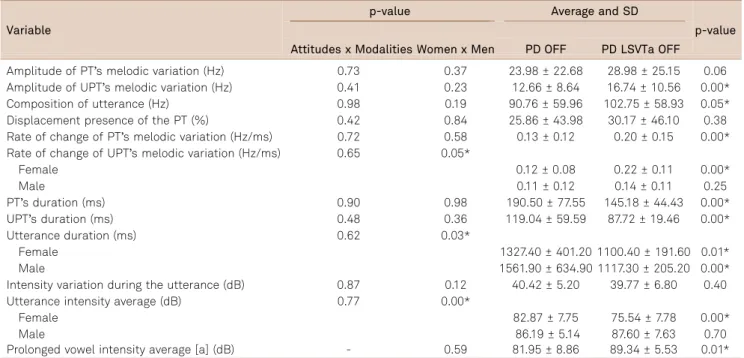
When comparing the groups PD OFF x PD LSVTa OFF, PD OFF x PD LSVTa ON and PD ON x PD LSVTa ON, none statistically significant differences, in the prosodic parameters analyzed between the DM and AC and between the IM and AD were observed (as noted in the first column of Tables 1, 2 and 3). Thus, all sentences were analyzed together for all comparison groups, not taken into account the attitudes, as proposed in the objective of this study.
When we compared the groups, a methodology to verify the existence of any statistically significant difference between men and women for all variables was adopted –
as noted in the second column of the tables. If there were differences, the variable was analyzed separately by gender, and separated values were presented (as noted in the last column of the tables). For variables that showed no statist-ically significant difference between genders, the p-value
resulting from the comparison between the groups consider-ing individuals of both sexes was shown.
When comparing the groups PD OFF and PD LSVTa OFF, the variables that showed statistically significant differences between genders were: change rate of melodic variation of UPT (p = 0.05), duration of the utterance (p = 0.03) and aver-age of intensity of utterance (p = 0.00).
Regarding the variable rate of change of melodic variation of UPT, there was statistically significant difference only in women (p = 0.00), which was greater for PD LSVTa OFF. Regarding the duration of the sentence, there were statist-ically significant differences for women (p = 0.01) and men (p = 0.00), expressed by a reduction in the duration after speech therapy treatment. As for the variable average intens-ity of the utterance, we found statistically significant differ-ence only in women (p = 0.00) with lower average intensity in the PD LSVTa OFF group.
Considering the analysis without gender distinction, we noted a statistically significant difference between PD OFF and PD LSVTa OFF regarding the amplitude of UPT’s melodic variation (p = 0.00), composition of the utterance (p = 0.05) and the rate of change of PT’s melodic variation (p = 0.00), with increased values after speech therapy. The PT and the UPT’s durations were reduced after the adapted LSVT1
(p = 0.00). Regarding the intensity average of the prolonged vowel [a] variable (p = 0.01), an increase was also observed after speech therapy.
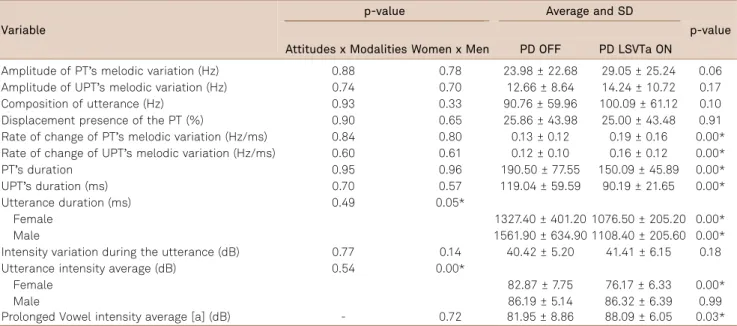
When PD OFF and PD LSVTa ON groups were compared, we found statistically significant difference between genders
Table 1.Significance values (p) when comparing the attitudes and modalities and women and men, and their average and respective standard deviation and significance value (p) in the comparison of data between PD OFF and PD LSVTa OFF groups.
Variable
p-value Average and SD
p-value
Attitudes x Modalities Women x Men PD OFF PD LSVTa OFF
Amplitude of PT’s melodic variation (Hz) 0.73 0.37 23.98 ± 22.68 28.98 ± 25.15 0.06 Amplitude of UPT’s melodic variation (Hz) 0.41 0.23 12.66 ± 8.64 16.74 ± 10.56 0.00* Composition of utterance (Hz) 0.98 0.19 90.76 ± 59.96 102.75 ± 58.93 0.05* Displacement presence of the PT (%) 0.42 0.84 25.86 ± 43.98 30.17 ± 46.10 0.38 Rate of change of PT’s melodic variation (Hz/ms) 0.72 0.58 0.13 ± 0.12 0.20 ± 0.15 0.00* Rate of change of UPT’s melodic variation (Hz/ms) 0.65 0.05*
Female 0.12 ± 0.08 0.22 ± 0.11 0.00*
Male 0.11 ± 0.12 0.14 ± 0.11 0.25
PT’s duration (ms) 0.90 0.98 190.50 ± 77.55 145.18 ± 44.43 0.00* UPT’s duration (ms) 0.48 0.36 119.04 ± 59.59 87.72 ± 19.46 0.00*
Utterance duration (ms) 0.62 0.03*
Female 1327.40 ± 401.20 1100.40 ± 191.60 0.01*
Male 1561.90 ± 634.90 1117.30 ± 205.20 0.00*
Intensity variation during the utterance (dB) 0.87 0.12 40.42 ± 5.20 39.77 ± 6.80 0.40 Utterance intensity average (dB) 0.77 0.00*
Female 82.87 ± 7.75 75.54 ± 7.78 0.00*
Male 86.19 ± 5.14 87.60 ± 7.63 0.70
Prolonged vowel intensity average [a] (dB) - 0.59 81.95 ± 8.86 89.34 ± 5.53 0.01*
LSVTa: Lee Silverman Voice Treatment adapted; OFF: Without the effect of levodopa; PT: Prominent tonic; PD: Parkinson’s disease; UPT: Unstressed
for the variables utterance duration and the utterance intensity average. Regarding the utterance duration variable, we noticed a statistically significant difference for both genders (p = 0.00), expressed by reduced duration in the PD LSVTa ON group. As for the utterance intensity average variable, a statistically sig-nificant difference was observed only in women (p = 0.00), with lower intensity average for PD LSVTa ON.
Performing the analysis without distinction of gender, there was a statistically significant difference (p = 0.00) regarding the rate of change of PT and UPT’s melodic var-iations, both increasing after the combination of speech therapy and drug treatment. Moreover, PT and UPT’s dura-tions were significantly reduced (p = 0.00) after association of the treatments. The intensity average of the prolonged
Table 2.Significance values (p) when comparing the attitudes and modalities and women and men, and their average and respective standard deviation and significance value (p) in the comparison of data between PD OFF and PD LSVTa ON groups.
Variable
p-value Average and SD
p-value
Attitudes x Modalities Women x Men PD OFF PD LSVTa ON
Amplitude of PT’s melodic variation (Hz) 0.88 0.78 23.98 ± 22.68 29.05 ± 25.24 0.06 Amplitude of UPT’s melodic variation (Hz) 0.74 0.70 12.66 ± 8.64 14.24 ± 10.72 0.17 Composition of utterance (Hz) 0.93 0.33 90.76 ± 59.96 100.09 ± 61.12 0.10 Displacement presence of the PT (%) 0.90 0.65 25.86 ± 43.98 25.00 ± 43.48 0.91 Rate of change of PT’s melodic variation (Hz/ms) 0.84 0.80 0.13 ± 0.12 0.19 ± 0.16 0.00* Rate of change of UPT’s melodic variation (Hz/ms) 0.60 0.61 0.12 ± 0.10 0.16 ± 0.12 0.00*
PT’s duration 0.95 0.96 190.50 ± 77.55 150.09 ± 45.89 0.00*
UPT’s duration (ms) 0.70 0.57 119.04 ± 59.59 90.19 ± 21.65 0.00*
Utterance duration (ms) 0.49 0.05*
Female 1327.40 ± 401.20 1076.50 ± 205.20 0.00*
Male 1561.90 ± 634.90 1108.40 ± 205.60 0.00*
Intensity variation during the utterance (dB) 0.77 0.14 40.42 ± 5.20 41.41 ± 6.15 0.18 Utterance intensity average (dB) 0.54 0.00*
Female 82.87 ± 7.75 76.17 ± 6.33 0.00*
Male 86.19 ± 5.14 86.32 ± 6.39 0.99
Prolonged Vowel intensity average [a] (dB) - 0.72 81.95 ± 8.86 88.09 ± 6.05 0.03*
LSVTa: Lee Silverman Voice Treatment adapted; OFF: Without the effect of levodopa; ON: Under the effect of levodopa; PT: Prominent tonic; PD: Parkinson’s
disease; UPT: Unstressed pre-tonic; SD: Standard deviation.
Table 3.Significance values (p) when comparing the attitudes and modalities and women and men, and their average and respective standard deviation and significance value (p) in the comparison of data between PD ON and PD LSVTa ON groups.
Variable
p-value Average and SD
p-value
Attitudes x Modalities Women x Men PD ON PD LSVTa ON
Amplitude of PT’s melodic variation (Hz) 0.87 0.48 22.20 ± 9.61 29.05 ± 25.24 0.01* Amplitude of UPT’s melodic variation (Hz) 0.48 0.16 11.63 ± 7.86 14.24 ± 10.72 0.03* Composition of utterance (Hz) 0.87 0.17 81.88 ± 8.50 100.09 ± 61.12 0.00* Displacement presence of the PT (%) 0.76 0.33 0.24 ± 0.43 0.25 ± 0.43 0.86 Rate of change of PT’s melodic variation (Hz/ms) 0.86 0.25 0.14 ± 0.10 0.19 ± 0.16 0.00* Rate of change of UPT’s melodic variation (Hz/ms) 0.69 0.03*
Female 0.11 ± 0.07 0.18 ± 0.14 0.01*
Male 0.15 ± 0.12 0.15 ± 0.11 0.99
PT’s duration (ms) 0.99 0.06 150.40 ± 44.00 150.09 ± 45.89 0.96
UPT’s duration (ms) 0.90 0.00*
Female 96.82 ± 18.92 84.98 ± 19.02 0.01*
Male 91.38 ± 19.27 95.69 ± 23.02 0.67
Utterance duration (ms) 0.73 0.76 1125.00 ± 222.20 1092.50 ± 205.20 0.24 Intensity variation during the utterance (dB) 0.97 0.73 39.42 ± 5.01 41.41 ± 6.16 0.01* Utterance intensity average (dB) 0.97 0.05*
Female 82.15 ± 7.38 76.18 ± 6.33 0.00*
Male 89.12 ± 7.91 86.33 ± 6.39 0.08
Prolonged Vowel intensity average [a] (dB) - 0.33 84.31 ± 8.21 88.09 ± 6.05 0.14
LSVTa: Lee Silverman Voice Treatment adapted; ON: Under the effect of levodopa; PT: Prominent tonic; PD: Parkinson’s disease; UPT: Unstressed pre-tonic;
vowel [a] variable significantly increased (p = 0.03) after the treatments.
Comparing the PD ON and PD LSVTa ON groups, we observed statistically significant differences between the genders for the variables: change of UPT’s melodic variation, UPT’s duration and utterance intensity average. These vari-ables were statistically significant only in women. The change of UPT’s melodic variation (p = 0.01) was higher in PD LSVTa ON group, while the duration of UPT (p = 0.01) and the intensity average of the utterance (p = 0.00) were lower in PD LSVTa ON group.
Performing an analysis without distinction of gender, there were statistically significant differences in the ampli-tude of PT (p = 0.01) and UPT’s (p = 0.03) melodic variations, for the composition of the utterance (p = 0.00), rate change of PT’s melodic variation (p = 0.00), intensity variation dur-ing the utterance (p = 0.01), with all higher measures in the PD LSVTa ON group.
DISCUSSION
When comparing the PD OFF and PD LSVTa OFF groups, we observed statistically significant differences for variables involving the parameters of frequency, intensity and duration. For F0 variables, it was observed that after speech
ther-apy patients with PD presented higher measures. The improvement in the F0 parameters after treatment with the adapted LSVT1 method is in accordance to several studies reporting the effectiveness of LSVT1
method in improving the intonation15,16,17,18.
Regarding the variables of duration, there was a reduction after speech therapy. This improvement of the prosodic para-meter of duration -even the focus of the LSVT
1
being the prosodic parameter intensity - is due to the fact that the
LSVT1 presents as its central focus the phonation at high intensity, which provides a single organized motor schema that facilitates the generalization on other systems, i.e., reflect-ing on the improvement of other vocal parameters12,14,15,16,17,18.
About the intensity average of the prolonged vowel [a] variable, an increase was also observed after speech therapy. This finding is in agreement with the reports found in the literature, that the LSVT1 has as one of its benefits, an increase in vocal intensity16,17,18,19,20. Importantly, in women
we observed a lower intensity average for the PD LSVTa OFF group, which contradicts the studies cited.
Comparing the PD OFF and PD LSVTa ON groups, there were statistically significant differences between the groups with regard to variables involving the parameters of fre-quency, intensity and duration.
Some studies2,11 found that levodopa might reduce the
duration parameter; possibly because it improves bradykine-sia symptoms, leaving the duration of the production of the
segments lower after the administration of the drug. During a study21it was found that prolonged use of levodopa can
diminish the performance in patients with PD.
The improvement of the three prosodic parameters asso-ciating both treatments (medication and speech therapy) was expected since the levodopa presents this effect in the parameter of duration and the adapted LSVT1 method shows the same effect for the parameters F0and intensity.
When comparing the PD ON and PD LSVTa ON groups, with regard to the F0 parameter, we observed a more
sig-nificant increase of the measures after treatments asso-ciation. These findings highlight the importance of the association of speech therapy to medication in the improve-ment of the communicative performance of parkinsonian patients, given that the measures of F0 were not affected
by levodopa, but by LSVTa2,11,15,16,17.
About the variables of duration there were no differences between the groups compared. This finding is in agreement with those already reported in the present study2,11, showing
that the speech therapy is not as effective in improving the duration parameter as the drug therapy. However, the addi-tion of speech therapy to drug treatment did not signific-antly affect these variables, except for the variable UPT’s duration in women.
Regarding the intensity parameter, the variation of intensity during the utterance increased after treatments association, which ultimately reflects an improvement in the vocal expression of the parkinsonian patient, given that a greater variation in intensity during the utterance (asso-ciated with composition increase) causes an improvement in the characteristic of monotonous speech of these indivi-duals. Importantly, the variable average of intensity of the utterance was lower in PD LSVTa ON for women. One study22 examined the effect of levodopa on breathing and
phonation of individuals with IPD and no significant increase in vocal intensity as a function of levodopa was observed. The use of wind instrument, according to a study23, can optimize the glottal adduction and improve
res-piratory control. In contrast, another study24 found that
voice intensity of IPD patients tends to increase after drug administration.
A recent study25
reported that the Parkinson disease does not make the patient use prosody to express his/her attitudes differently from the control group, however, when the atti-tudes were not taken into account, it was observed that levo-dopa was effective in the improvement of the parameter of duration. This finding reinforces the importance of the asso-ciation of speech therapy to medication aiming to improve the communicative performance of parkinsonian patients.
causes an improvement of the vocal expression of parkinso-nian patients, once we observed an increase of F0measures,
reduction of measures of duration and higher average of vocal intensity in the production of the prolonged vowel [a]. Regarding the comparison between the groups with PD ON x PD LSVTa ON we also observed an improvement in the vocal expression of parkinsonian patients determined, mainly, by increased of the F0measures. However, we also observed a
reduction in the UPT’s duration in women and greater vari-ation in vocal intensity during the production of utterances.
Given that levodopa is effective in improving the dura-tion parameter, the associadura-tion of speech therapy is of great value to improve other prosodic parameters (F0and
intens-ity) in order to enable more efficient communication per-formance for the parkinsonian patient, thus improving his/ her quality of life.
References
1. Silveira DN, Brasolotto AG. Reabilitação vocal em pacientes
com doença de Parkinson: fatores interferentes. Pró-Fono Rev Atual Cientific. 2005;17(2):241-50. http://dx.doi.org/10.1590/S0104-56872005000200013
2. Azevedo LL, Cardoso F, Reis C. Análise acústica da prosódia em
mulheres com doença de Parkinson: efeito da Levodopa. Arq Neuropsiquiatr. 2003;61(4):995-8. http://dx.doi.org/10.1590/S0004-282X2003000600020
3. Coutinho SB, Diaféria G, Oliveira G, Behlau M. Voz e fala de
Parkinsonianos durante situações de amplificação, atraso e mascar-amento. Pró-Fono Rev Atual Cientific. 2009;21:219-24.
4. Soares MFP, Albano EC. Dinâmica da produção da fala em sujeitos
portadores de doença de Parkinson: análise das vogais. In: Caderno de Resumos do IX Congresso Nacional e III Congresso Internacional de Fonética e Fonologia; 27 a 29 nov 2006; Belo Horizonte, Brasil. Belo Horizonte: UFMG; 2006. vol 1, p. 13.
5. Lima SSP, Quagliato EMAB, Cagliari LC, Souza EAP. Linguagem e
isolamento social no mal de Parkinson. Rev Soc Bras Fonoaudiol. 1997;1(1):5-13.
6. Sanabria J, Ruiz PG, Gutierrez R, Marquez F, Escobar P, Gentil M,
Cenjor C. The effect of levodopa on vocal function in Parkinson’s
disease. Clin Neuropharmacol. 2001;24(2):99-102. http://dx.doi.org/ 10.1097/00002826-200103000-00006
7. Jorge TM, Lamônica DAC, Caldana ML. Doença de Parkinson:
transtor-nos da comunicação oral e gráfica. Fono Atual. 2004;7(30):14-25.
8. Pawlas AA, Ramig LO, Countryman S. Perceptual voice and speech
characteristics in patients with idiopathic Parkinson. NCVS Status and Progress Report. 1996;10:79-87.
9. Illes J. Language production in Parkinson’s disease: acoustic and
linguistic considerations. Brain Lang. 1988;33(1):146-60. http://dx. doi.org/10.1016/0093-934X(88)90059-4
10. Hely MA, Fung VS, Morris JG. Treatment of Parkinson’s disease. J. Clin.
Neurosci. 2000;7(6):484-94. http://dx.doi.org/10.1054/jocn.2000.0766
11. Azevedo LL, Cardoso F, Reis C. Análise acústica da prosódia em
mulheres com doença de Parkinson: comparação com controles normais. Arq Neuropsiquiatr. 2003;61(4):999-1003.
12. Fox CM, Ramig LO, Ciucci MR, Sapir S, McFarland DH, Farley BG. The
science and practice of LSVT/LOUD: neural plasticity-principled approach to treating individuals with Parkinson disease and other neurological disorders. Semin Speech Lang. 2006;27(4):283-99. http://dx.doi.org/10.1055/s-2006-955118
13. Hughes AJ, Daniel SE, Kilford L, Lees AJ. Accuracy of clinical
diagnosis of idiopathic Parkinson’s disease: a clinico-pathological
study of 100 cases. J Neurol Neurosurg Psychiatry. 1992;55(3):181-4. http://dx.doi.org/10.1136/jnnp.55.3.181
14. Hoehn MM, Yahr MD. Parkinsonism: onset, progression and
mortality. Neurology. 1967;17(5):427-42. http://dx.doi.org/10.1212/ WNL.17.5.427
15. Dromey C, Ramig LO, Johnson AB. Phonatory and articulatory
changes associated with increased vocal intensity in Parkinson disease: a case study. J Speech Hear Res. 1995;38(4):751-64. http:// dx.doi.org/10.1044/jshr.3804.751
16. Smith ME, Ramig LO, Dromey C, Perez KS, Samandari R. Intensive
voice treatment in Parkinson disease: laryngoestroboscopic findings. J Voice. 1995;9(4):453-9. http://dx.doi.org/10.1016/S0892-1997(05) 80210-3
17. Ramig LO, Countryman S, O’Brien C, Hoehn M, Thompson L. Intensive
speech treatment for patients with Parkinson’s disease: short and long term comparison of two techniques. Neurol. 1996;47(6):1496-504. http://dx.doi.org/10.1212/WNL.47.6.1496
18. Ferreira FV, Cielo CA, Trevisan ME. Medidas vocais acústicas na
doença de parkinson: estudo de casos. Rev CEFAC. 2010;12(5):889-98. http://dx.doi.org/10.1590/S1516-18462010005000020
19. Dromey C, Ramig LO, Johnson AB. Phonatory and articulatory
changes associated with increased vocal intensity in Parkinson disease: a case study. J Speech Hear Res. 1995;38(4):751-64. http:// dx.doi.org/10.1044/jshr.3804.751
20. El Sharkawi A, Ramig L, Logemann JA, Paulosky BR, Rademaker AW,
Smith CH, et al. Swallowing and voice effects of Lee Silverman Voice Treatment (LSVT): a pilot study. J Neurol Neurosurg Psychiatry. 2002;72(1):31-6. http://dx.doi.org/10.1136/jnnp.72.1.31
21. Mourão LF, Aguiar PMC, Ferraz FAP, Behlau MS, Ferraz HB. Acoustic
voice assessment in parkinson’s disease patients submitted to
posteroventral pallidotomy. Arq Neuropsiquiatr. 2005;63(1):20-5. http://dx.doi.org/10.1590/S0004-282X2005000100004
22. Guedes LU, Azevedo LL, Cardoso F, Parreira VF, Reis C. Efeito da
levodopa sobre a respiração e fonação dos indivíduos com doença de Parkinson idiopática. In: Rev Soc Bras Fonoaudiol. 2005;Supl Esp. [Apresentado no 13o Congresso Brasileiro de Fonoaudiologia; 2005; Santos, BR].
23. Rosa JC, Cielo CA, Cechella C. Função fonatória em pacientes com
doença de Parkinson: uso de instrumento de sopro. Rev CEFAC. 2009;11(2):305-13. http://dx.doi.org/10.1590/S1516-18462009000200016
24. Jiang J, Lin E, Wang J, Hanson DG. Glottographic measures before
and after levodopa treatment in Parkinson’s disease. Laryngoscope.
1999;109(8):1287-294. http://dx.doi.org/10.1097/00005537-199908000-00019
25. Azevedo LL, Reis CAC, Souza IS, Cardoso FEC. Prosody and levodopa
in Parkinson’s disease. Arq Neuropsiquiatr. 2013;71(11):835-40.