ARTICLE DOI: Xxxxxxxxxxxxxxxxxxxxx
Translation, cultural adaptation and
psychometric evaluation of the Leganés
cognitive test in a low educated elderly
Brazilian population
Tradução, adaptação cultural e avaliação psicométrica da prova cognitiva de Leganés em
uma população idosa brasileira com baixo nível educacional
Vescia Vieira de Alencar Caldas1, Maria Victoria Zunzunegui2, Aline do Nascimento Falcão Freire3,
Ricardo Oliveira Guerra4
he increased prevalence of dementia around the world has been highlighted as one of the consequences of popu-lation aging. Estimates suggest a worldwide popupopu-lation of about 24 million elderly people with dementia, approximately 60% of whom are living in developing countries1.
1 Master in Physical Therapy by the Federal University of Rio Grande do Norte (UFRN), Natal RN, Brazil; 2 PhD in Epidemiology, Professor at the Preventive Medicine Department of the University of Montreal, Canada; 3 Master in Physical Therapy by the UFRN, Natal RN, Brazil;
4 PhD in Physical Activity and Health Sciences, University of Granada, Spain; Professor at the Physical Therapy Department of the UFRN, Natal RN, Brazil.
Correspondence: Vescia Vieira de Alencar Caldas; Departamento de Fisioterapia; Avenida Senador Salgado Filho, 3.000 – Campus Universitário; 59078-970 Natal RN, Brasil – E-mail: [email protected]
Conflict of interest: There is no conflict of interest to declare.
Received11 May 2011; Received in final form 11 August 2011; Accepted 18 August 2011
ABSTRACT
Objective: To validate the Leganés cognitive test (LCT) for cognitive screening in low educated elderly Brazilians. Methods: The study sample was composed of 59 elderly residents from the city of Santa Cruz, in Brazil, with low schooling levels. Reliability was analyzed with a two-day interval between assessments, and concurrent validity was assessed using the Mini Mental State Examination (MMSE). Results: According to the LCT, the prevalence of dementia was 11.8%. The scale items showed a moderate to strong correlation between domains (p<0.01), and inter-rater reliability exhibited ICC=0.81, 95%CI=0.72–0.88. The factor analysis resulted in two factors: memory and orientation. Interscale agreement was considered poor (k=-0.02), supporting the hypothesis of an educational impact on final MMSE scores. Conclusion: The results suggest that LCT has acceptable levels of reliability for use in low-educated Brazilian elderly.
Key words: cognition, dementia, elderly, education.
RESUMO
Objetivo: Validar a prova cognitiva de Leganés (PCL) para rastreio cognitivo em população idosa brasileira com baixa escolaridade. Méto-dos: A amostra foi composta por 59 idosos residentes no município de Santa Cruz, no Rio Grande do Norte. A confiabilidade foi analisada com intervalo de dois dias entre as avaliações; a validade concorrente foi feita utilizando o Mini-Exame do Estado Mental (MEEM). Resulta-dos: De acordo com a PCL, a prevalência de demência foi de 11,8%. Os itens da escala mostraram correlações de moderada à forte entre os domínios (p<0,01). A confiabilidade intraexaminador foi considerada boa, com ICC=0,81, CI95%=0,72–0,88. A análise fatorial mostrou dois domínios distintos: memória e orientação. A concordância entre a PCL e o MEEM foi considerada ruim (k=-0,02), reforçando a hipótese da influência educacional no escore do MEEM. Conclusão: A PCL apresenta boa confiabilidade para uso em população idosa brasileira com baixo nível de escolaridade.
Palavras-Chave: cognição, demência, idoso, escolaridade.
Many screening tools have been developed to identify the presence of cognitive impairment in the elderly, but their re-sults are partially inluenced by age, education, race, language, sensory limitations, and other systemic processes2,3. In
where education levels are high, which may produce false-positive results when used in low-educated populations4,5.
In order to minimize such problems, several studies have been conducted to adjust cut-of values of existing instru-ments according to education levels, or to design new tools with a lower education impact in their total scores6-9. Cut-ofs
have been proposed in Brazil for some of the main cognitive screening instruments used in elderly10-13.
he Leganés cognitive test (LCT) was originally developed by Spanish researchers in the longitudinal study Envejecer em Leganés (Aging in Leganés) as a cognitive screening scale adapted to low-educated populations14. he LCT assesses
ba-sic cognitive ability functions and it shows strong reliability and validity in the studied populations5.
Using a cognitive assessment scale, which is both easy to administer and not inluenced by education in the Brazilian population, may represent an alternative in preventing the educational biases of existing cognitive assessment scales. hus, this study aims to culturally adapt the LCT order to use it in low educated elderly Brazilians, and to evaluate its psy-chometric properties by examining its reliability and validity.
METHODS
Population and sample
he sample comprised subjects from a study conduct-ed in Brazil and in Canada to culturally adapt and evaluate physical and mental health assessment instruments for later use in a longitudinal study on aging and mobility in Canada, Brazil, and Colombia. his longitudinal study, funded by the Canadian Institutes of Health, seeks to provide greater knowledge on the development of functional disability in el-derly with diferent epidemiological proiles, as well as to ex-plain sex-related diferences in mobility, to guide future com-munity-based prevention strategies. To that end, a pilot study was conducted from October to December, 2009 in the city of Santa Cruz, with a population of 32,000 inhabitants, located 150 km from Natal, the capital of the State of Rio Grande do Norte, in Brazil.
Sample calculation
he sample for this study was calculated to estimate a Cohen’s Kappa of 0.80, with 80% power for a null hypothesis of 0.45, for dichotomous measures of cognitive impairment. A sample of 64 subjects was considered enough to estimate an intraclass correlation coeicient close to 0.80 in a 95% coni-dence interval.
Inclusion criteria
Subjects were required to be from 65 to 74 years-old and they should not exhibit any severe disabilities. Disability was considered severe when the individual was incapable of
performing the following activities unassisted: bathing, get-ting out of bed, eaget-ting, and using the toilet. hose who re-ported diiculties, but managed to perform these activities, were included in the study.
Sampling strategy
A random sample of elderly residents of the community was used. hey were stratiied according to the functional ability into two groups: full and reduced mobility. his cri-terion was established based on two questions in the ques-tionnaire: diiculty of walking 1.5 km and climbing stairs. he ones who reported severe diiculty in at least one of the questions were considered as having reduced mobility. In ad-dition, participants were equally divided according to sex, with 32 men and 32 women stratiied into two age groups: 65–69 years old and 70–74 years old.
Interviewer training
Six interviewers were trained using the same training pattern based on videotapes, protocol instructions, and data forms.
Cognitive assessment instruments
LCT
he LCT is a cognitive screening test developed in 2000 by Zunzunegui et al.14. It was designed to be easy to
adminis-ter and to have no impact of schooling on its inal scores. Test completion does not depend on the ability to write, calculate, draw, or conduct abstract thinking, allowing for an adequate cognitive screening in low-educated populations. It consists on the following areas:
• temporal orientation – date, day of week, time (0–3); • spatial orientation: place and address (0–2);
• personal information: age, date of birth (day/month/ year), mother’s maiden name (0–3);
• naming test: ability to name common objects presented in six drawings (0–6);
• immediate memory – remembering six objects shown in
the drawings. he test starts with the following sentence: “Please tell me the names of the objects you saw in the drawings, and try to remember them because I will ask
you again later”. (0–6);
• late memory – ive minutes after the naming test, the el -derly were asked to recall the objects that were shown
(0–6);
• logical memory – immediate memory of a short story
with six ideas (0–6).
designed and administered in a population with a similar sociodemographic proile, particularly regarding education levels15-17.
MMSE
Two screening instruments for dementia and cognitive impairment were used in the cognitive assessment of sub-jects: the MMSE and the LCT.
he MMSE is a screening test widely used around the world to detect dementia and other cognitive disorders. he scale was validated for the Brazilian population by Bertolucci et al., in 1994, and diferentiated cut-of adjust-ments have been proposed according to education levels. In the present study, the cut-of adapted to the elderly was used,
which classiies individuals with scores below 23/24 as cog -nitively impaired11-13.
Procedures
Translation and cross-cultural adaptation of the LCT
Once authorized by the author, we obtained the original Spanish version of the scale. Back-translation and the bilin-gual method were used for translation and transcultural ad-aptation. Initially, two Spanish translators, aware of the re-search objectives, translated the instrument proposed by Zunzunegui et al.14, seeking content that was both
seman-tically and conceptually equivalent to the original version. Later, both translators worked together and reached a con-sensus between their translations. A copy was made of the consensual translation, generating the irst Portuguese ver-sion of the original instrument.
hen, the Portuguese version was sent to another
transla-tor (Spanish/Portuguese), who had no prior knowledge of the
material to be back-translated. When this new Spanish ver-sion of the instrument was completed, the translators par-ticipating in the study’s irst phase carried out a comparative analysis between this and the original version in Spanish, and the translation of this consensus into Portuguese resulted in the second Portuguese version of the instrument.
he translation of the original text was proofread by re-searchers of the Brazilian version, who were proicient in Spanish and familiar with the contents in its source language, an essential condition for adequate translation.
Data collection
Data were collected in two home visits, where the re-searcher initially informed the elderly on the collection pro-cess. hose who agreed to participate in the study signed a free and informed consent form.
he irst collection day consisted of applying the multidi-mensional questionnaire proposed in the pilot study, assess-ing both direct and self-reported physical health measure-ments through physical performance tests. he cognitive assessment scales (MMSE and LCT) were also administered
on the irst day. After a two-day interval, the elderly were re-evaluated using the same tests applied in the irst collection, with some simpliications. Cognitive performance and de-pression assessments were once again administered on the second collection day, without any changes to the previous procedure. For each subject both collections were made by a same researcher from the trained team, in order to deter-mine intra-observer reliability.
he study was approved by the Research Ethics Committee of the Federal University of Rio Grande do Norte (UFRN), and all participants signed an informed consent be-fore the evaluation.
Data analysis
Descriptive analysis
It was performed using measures of central tendency and dispersion (mean and standard deviation) for continu-ous variables, and absolute and relative frequency distribu-tions were analyzed for categorical variables.
Reliability and validity
he Intraclass Correlation Coeicient was used to de-termine reliability levels. Internal consistency was veriied by using Pearson’s correlation for LCT items, and the factor analysis for the major domains that make up the scale.
In order to analyze instrument validity, Pearson’s correla-tion was used to evaluate MMSE and LCT scores, while the Student’s t-test was used to compare the means. Agreement between both cognitive scales regarding dementia screening was assessed using the kappa coeicient.
All data were analyzed with PASW 17.0, considering a sig-niicance level of p<0.05.
RESULTS
he translation/back-translation processes occurred
without any conlicts between the Portuguese and Spanish LCT items. With regards to cultural adaptation, no com-prehension problems with the inal Portuguese version of the instrument were observed among the studied subjects. herefore, we consider the process of translation and cultural adaptation of the Brazilian version of LCT to be satisfactory.
he study sample was initially composed of 64 elderly, 5 of whom were excluded after the end of data collection due to incomplete questionnaires, resulting in a inal sample of 59 subjects: 30 men and 29 women. Mean age was 69.5±2.9 years-old. Sociodemographic data for the sample are given in Table 1.
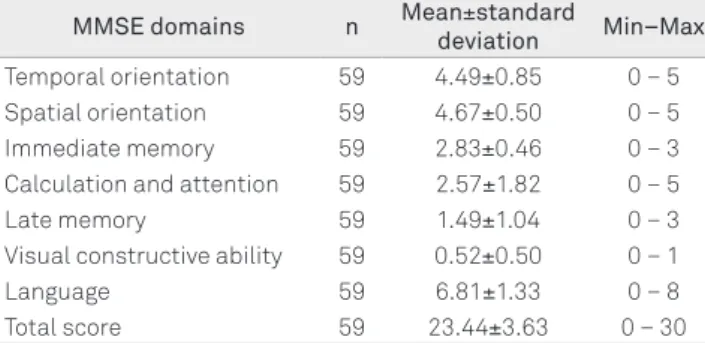
he mean and standard deviation of the cognitive scores obtained for each LCT domain are shown in Table 2. Mean total score on the LCT was 26.3±4.1; this value is above
instrument (22 points). Mean total score on the MMSE was 23.4±3.6, oscillating between the case/no case classiication
proposed by Almeida, in 1998. Descriptive analysis of the MMSE scores is shown in Table 3.
Reliability
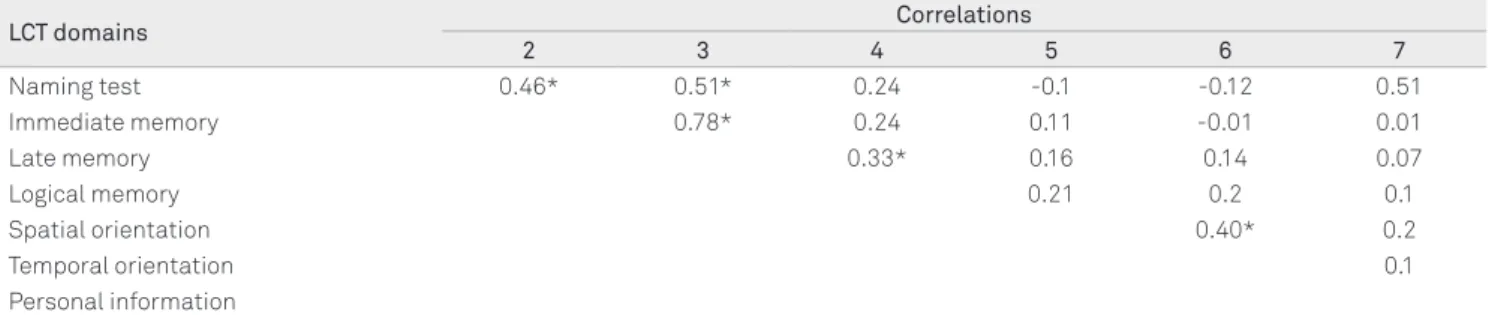
Internal consistency analysis using Pearson’s correla-tion is depicted in Table 4. Signiicant correlacorrela-tions were found between memory and orientation domains (p<0.01). Correlations between immediate and late memory are strong, suggesting learning efect. Reliability analysis showed strong inter-rater reliability, with an ICC=0.81 (95%CI=0.72–0.88).
Concurrent validity
Agreement between both cognitive scales regarding de-mentia screening was considered poor, as evidenced by the low kappa coeicient (k=-0.02), with no signiicant diference.
Construct validity
he LCT factor analysis resulted in two factors: memory and orientation, which explain slightly more than half (57%) of the variance in the resulting score (Table 5). he irst do-main, considered as the Memory Dodo-main, was composed of the following items: naming, immediate memory, late mem-ory and logical memmem-ory. he second domain, consisting of the resulting scores in spatial orientation, temporal orienta-tion and personal informaorienta-tion, refers to what we consider the Orientation Domain.
DISCUSSION
Most cognitive scales are inluenced by individual educa-tion level, making it diicult to screen true positives for de-mentia18. Some authors have indicated a strong education
impact on the total scores of important screening scales, such as the MMSE, even after cut-of adjustments according to education levels19.
he impact of sociocultural aspects, such as education level and environmental contexts, compromises the reliabil-ity and validreliabil-ity levels of current cognitive assessment tools for research in elderly populations. Moreover, the use of cog-nitive assessment tools adapted to the Brazilian reality is ex-tremely important in the clinical ield, since early detection of dementia in the elderly allows for preventive and therapeutic decision-making.
he possibility of conducting this study with an elderly population in a city in Northeast Brazil, whose socioeconom-ic and cultural characteristsocioeconom-ics are so peculiar, provided the necessary conditions to study validity and reliability for the Brazilian context. he successful translation and cultural ad-aptation of the LCT advances the use of such instruments,
Variable Categories n %
Age 65–69 years 26 44.1
70–74 years 32 54.2
Sex Male 30 50.8
Female 29 49.2
Education Illiterate 24 40.7
Literate 35 59.3 Income (In Brazilian Reais) <510 5 8.5
510–1.530 46 78.0 1.531–2.250 4 6.8
>2.251 4 6.8
Depression Yes 30 49.2
No 29 50.8
Basic activities of daily
living Independent 48 81.4
Dependent 11 18.6 Instrumental activities of
daily living Independent 41 69.5
Dependent 18 30.5
Chronic conditions Yes 39 66.1
No 20 33.9
Falls last year Yes 19 32.2
No 40 67.8
Leganés Cognitive Test No impairment 52 88.1 Impaired 7 11.8 Mini Mental State
Examination No impairment 37 62.7
Impaired 22 37.2
Table 1. Clinical and sociodemographic characteristics of the sample.
Source: Data collected by the researchers. Note: 1 US$ ≈ BR$1.65.
LCT domains Mean±standard
Deviation Min–Max
Naming test 5.55±0.98 0 – 6
Immediate memory 5.01±1.18 0 – 6
Late memory 5.20±1.09 0 – 6
Logical memory 3.40±1.93 0 – 6
Spatial orientation 1.93±0.38 0 – 2 Temporal orientation 2.64±0.58 0 – 3 Personal information 2.52±0.56 0 – 3
Total score 26.67 ± 3.30 0 – 32
Source: Data collected by the researchers.
Table 2. Scores of Leganés cognitive test (LCT).
MMSE domains n Mean±standard
deviation Min–Max
Temporal orientation 59 4.49±0.85 0 – 5 Spatial orientation 59 4.67±0.50 0 – 5 Immediate memory 59 2.83±0.46 0 – 3 Calculation and attention 59 2.57±1.82 0 – 5
Late memory 59 1.49±1.04 0 – 3
Visual constructive ability 59 0.52±0.50 0 – 1
Language 59 6.81±1.33 0 – 8
Total score 59 23.44±3.63 0 – 30
Source: Data collected by the researchers.
LCT domains Factor 1 Factor 2
Naming test 0.66 -0.43
Immediate memory 0.83 -0.23
Late memory 0.9 -0.1
Logical memory 0.55 0.26
Spatial orientation -0.29 0.74
Temporal orientation 0.2 0.75
Personal information 0.17 0.38
Table 5. Factor Analysis of Leganés cognitive test (LCT) domains.
Source: Data collected by the researchers.
since it eliminates the cultural bias present in most cognitive assessments. No comprehension problems were observed among the subjects, allowing the instrument to be adminis-tered in a clear and reliable way.
In the present study, we used a sample of young-elderly with no history of falls and independent as to activities of dai-ly living (ADLs). his population was chosen according to the criteria of a longitudinal study jointly conducted by research-ers from three countries. Using a sample of healthy elderly made it diicult to detect cases of dementia, since cognitive decline is directly associated with increased age, disability and institutionalization20. However, even in a situation where
dementia was not signiicantly observed, the results of the study on LCT reliability and validity indicated satisfactory psychometrics, especially regarding reproducibility of the values obtained.
Sociocultural and environmental factors did not alter re-liability, showing similar results to those of the original ones that irst developed and validated the scale. With regard to LCT composition, we observed a moderate to strong corre-lation between items related to memory and orientation do-mains. herefore, LCT produces reliable results because it is a simple and direct measure for evaluating cognitive perfor-mance in the elderly5,14.
According to Herrera et al., the prevalence of dementia among the elderly in Brazil is 7.1%, and may reach 12% for illit-erate elderly21. he use of LCT and MMSE as screening tools in
our study revealed dementia rates of 11.8 and 37.2%, respective-ly, calculated according to an education-based classiication.
Comparing PLC and MMSE cognitive screening results, we found a poor agreement rate (kappa close to zero). Moreover, signiicant diferences between means were observed, suggest-ing discrepancies in classifysuggest-ing individuals with suspected de-mentia, and over-estimation of dementia when administering MMSE to a low-educated population, as found in other stud-ies22. he poorer performance in MMSE domains related to
at-tention, calculation and language mastery reinforces the hy-pothesis of an education impact on total scores.
he LCT, which is based on the construction of its assess-ment items, is an instruassess-ment capable of assessing cognitive function in the elderly with no interference from education lev-els. Using factor analysis for the Brazilian version of LCT, we ob-served that domains related to memory and orientation clus-tered, forming two factors, as proposed in the study where the scale was originally developed. By including both of these im-portant cognitive function domains, LCT can be easily adminis-tered and its validity ensured, since these items are amongst the most sensitive in the early detection of dementia and among the most speciic in functional decline associations8.
Evaluating aspects related to memory and orientation ap-pears to be most adequate for populations with low formal ed-ucation levels23. Memory impairments derive from the process
of cognitive aging, and complaints related to this ability are among the most common in the elderly24. Temporal
orienta-tion, however, is an early and highly speciic marker of cogni-tive problems, besides being less dependent on education than other tasks, such as attention, calculation, spatial orientation, language, and drawing. Temporal orientation is a modiiable
mortality risk predictor that may help in clinical practice; it
could also help promoting health actions for the elderly popu-lation, aimed at reducing mortality by allocating the resources required to maintain and rehabilitate cognitive capacity24.
Based on these results, we believe that the Brazilian ver-sion of the LCT has acceptable levels of reliability for use in low-educated elderly individuals, given that it minimizes the education bias present in most cognitive assessment scales. Finally, we consider that developing screening tools adapted to the Brazilian reality may be a viable alternative to mini-mize or even prevent the education bias observed in the re-sults of cognitive scales validated for Brazil.
LCT domains Correlations
2 3 4 5 6 7
Naming test 0.46* 0.51* 0.24 -0.1 -0.12 0.51
Immediate memory 0.78* 0.24 0.11 -0.01 0.01
Late memory 0.33* 0.16 0.14 0.07
Logical memory 0.21 0.2 0.1
Spatial orientation 0.40* 0.2
Temporal orientation 0.1
Personal information
Source: Data collected by the researchers. *p<0.01.
1. Scazufca M, Menezes PR, Araya R, et al. Risk factors across the life course and dementia in a Brazilian population: results from the Sao Paulo Ageing & Health Study (SPAH). Int J Epidemiol 2008;37: 879-890.
2. Nasreddine ZS, Phillips NA, Bédirian V, et al. The Montreal Cognitive Assessment, MoCA: a brief screening tool for mild cognitive impairment. J Am Geriatr Soc 2005;53:695-699.
3. Folstein MF, Folstein SE, McHugh PR. Mini-Mental State. A pratical method for grading the cognitive status of patients for the clinical. J Psychiatric Res 1975;12:189-198.
4. Salmon DP, Lange KL. Cognitive screening and neuropsychological assessment in early Alzheimer’s disease. Clin Geriatr Med 2001;17:229-254.
5. de Yebenes MJG, Otero A, Zunzunegui MV, Rodrıguez-Laso A, Sanchez-Sanchez F, Del Ser T. Validation of a short cognitive tool for the screening of dementia in elderly people with low educational level. Int J Geriatr Psychiatry 2003;18:925-936.
6. Liu HC, Chou P, Lin KN, et al. Assessing cognitive abilities and dementia in a predominantly illiterate population of older individuals in Kinmen. Psychol Med 1994;24:763-770.
7. Fillenbaum GG, Chandra V, Ganguli M, et al. Development of an activities of daily living scale to screen for dementia in an illiterate rural older population in India. Age Ageing 1999;28:161-168.
8. Senanarong V, Assavisaraporn S, Sivasiriyanonds N, et al. The IQCODE: an alternative screening test for dementia for low educated Thai elderly. J Med Assoc Thai 2001; 84:648-655.
9. Damasceno A, Delicio AM, Mazo DF, et al. Validation of the Brazilian version of mini-test casi-s. Arq Neuropsiquiatr 2005;63:416-421.
10. Atalaia-Silva KS, Lourenço RA. Translation, adaptation and construct validation of the Clock Test Among elderly in Brazil. Rev Saúde Pub 2008;42:2-7.
11. Almeida OP. Mini exame do estado mental e o diagnóstico de demência no Brasil. Arq Neuropsiquiatr 1998;56:605-612.
12. Bertolucci PHF, Brucki SMD, Campacci S, Juliano Y. O Mini-Exame do Estado Mental em uma populacao geral. Impacto da escolaridade. Arq Neuropsiquiatr 1994;52:1-7.
13. Brucki SMD, Nitrini R, Caramelli P, Bertolucci PHF, Okamoto IH. Sugestões para o uso do Mini-Exame do Estado Mental no Brasil. Arq Neuropsiquiatr 2003;61:777-781.
14. Zunzunegui MV, Gutiérrez Cuadra P, Béland F, Del Ser T, Wolfson C. Development of simple cognitive function measures in a community dwelling population of elderly in Spain. Int J Geriatr Psychiatry 2000;15:130-140.
15. Béland F, Zunzunegui MV. El perfil de las incapacidades funcionales en las personas mayores. Rev Gerontol 1995;5:232-234.
16. Zunzunegui MV, Béland F, Llacer A, Leon V. Gender diferences in depressive symptoms among Spanish elderly. Soc Psychiatry Psychiatr Epidemiol 1998;33:195-205.
17. Béland F, Zunzunegui MV. Predictors of functional status in a population of community- dwelling elderly in Spain. Age Ageing 1999;28:153-159.
18. Yancik, R, Ershler W, Satariano W, Hazzard W, Cohen HJ, Ferrucci L. Report of the National Institute on Aging Task Force on Comorbidity. J Gerontol A Biol Sci Med Sci 2007;62:275-280.
19. Alvarado BE, Zunzunegui MV, Dek Ser T, Béland FD. Cognitive decline is related to education and occupation in a Spanish elderly cohort. Aging (Milano) 2002;14:132-142.
20. Oliveira DLC, Goretti LC, Pereira LSM. O desempenho de idosos institucionalizados com alterações cognitivas em atividades de vida diária e mobilidade: estudo piloto. Rev Bras Fisioter 2006;10:91-96.
21. Herrera EJR, Caramelli P, Silveira AS, Nitrini R. Epidemiologic survey of dementia in a community-dwelling Brazilian population. Alzheimer Dis Assoc Disord 2002;16:103-108.
22. Scazufca M, Almeida OP, Vallada HP, Tasse WA, Menezes PR. Limitations of the Mini-Mental State Examination for screening dementia in a community with low socioeconomic status. Eur Arch Psychiatry Clin Neurosci 2009;259:8–15.
23. Dickstein DL, Kabaso D, Rocher AB. Changes in the structural complexity of the aged brain. Aging Cell 2007;6:275–284.
24. Gong G, Rosa-Neto P, Carbonell F, Chen ZJ, He Y, Evans AC. Age- and gender-related differences in the cortical anatomical network. Neuroscience 2009;29:15684-15693.