Prevalence of depressive symptoms
among elderly in the city of
Tremembé, Brazil
Preliminary findings of an epidemiological study
Karolina G. César1, Leonel T. Takada1, Sonia M.D. Brucki2, Ricardo Nitrini3,
Luiz Fernando C. Nascimento4, Maira O. Oliveira5, Camila M.S. Gomes5, Milena C.S. Almeida5,
Fábio H. Porto5, Mirna L.H. Senaha5, Valéria S. Bahia5, Mônica S. Yassuda5, Thaís B.L. Silva5,
Jéssica N. Ianof5, Lívia Spíndola5, Magali T. Schmidt5, Mário S. Jorge5, Patrícia H.F. Vale5,
Mário A. Cecchini5, Luciana Cassimiro5, Roger T. Soares5, Márcia Rúbia Gonçalves5,
Ana Caroline S. Martins5, Elisângela Rocha5, Patrícia Daré5
ABSTRACT. Depression is a heterogeneous mental disease classified as a set of disorders, which manifest with a certain duration, frequency and intensity. The prevalence of depression in the elderly ranges from 0.5 to 16%. Objective: To establish, in an epidemiological study, the prevalence of significant depressive symptoms in the population aged 60 years or older. Methods: Results of a cross-sectional epidemiological study, involving home visits, being carried out in the city of Tremembé, Brazil, were reported. The sample was randomly selected by drawing 20% of the population over 60 years from each of the city’s census sectors. In this single-phase study, the assessment included clinical history, physical and neurological examination, cognitive evaluation, the Cornell scale and the Patient Health Questionnaire for psychiatric symptoms. Scores greater than or equal to 8 on the Cornell scale were taken to indicate the presence of depressive symptoms. Results: A total of 455 elders were assessed, and of these 169 (37.1%) had clinically significant depressive symptoms (CSDS). Depression prevalence was higher among women (p<0.001) and individuals with lower education (p=0.033). The Chi-square test for trends showed a significant relationship where lower socioeconomic status was associated with greater likelihood of depressive symptoms (p=0.005). Conclusion: The prevalence of depressive symptoms was high in this sample of the population-based study and was associated with female gender, low educational level and socioeconomic status. The assessment of the entire population sample must be completed.
Key words: depression, elderly, prevalence.
PREVALÊNCIA DE SINTOMAS DEPRESSIVOS EM IDOSOS NA CIDADE DE TREMEMBÉ, BRASIL: RESULTADOS PRELIMINARES DE UM ESTUDO EPIDEMIOLÓGICO
RESUMO. Depressão é uma doença mental heterogênea classificada como um conjunto de transtornos, que se manifestam numa certa duração, frequência e intensidade. A prevalência de depressão em idosos varia de 0,5 a 16%. Objetivo: estabelecer a prevalência de sintomas depressivos significantes em estudo epidemiológico em população acima de 60 anos. Métodos: Estudo epidemiológico do tipo transversal, no qual estão sendo realizadas visitas domiciliares na cidade de Tremembé, Brasil. A amostra foi aleatória, através do sorteio de 20% da população acima de 60 anos de cada setor censitário do município. Este estudo é de única fase, sendo realizada anamnese, exames físico e neurológico, avaliação cognitiva e aplicação de escalas de Cornell e questionário Patient Health Questionnaire para verificar sintomas psiquiátricos. Foi adotado como critério da presença de sintomas depressivos, pontuação maior ou igual a 8 na escala de Cornell. Resultados: Foram
1MD, PhD Students, Department of Neurology, University of São Paulo. Cognitive and Behavioral Neurology Unit, Department of Neurology, University of São Paulo. 2MD, PhD. Cognitive and Behavioral Neurology Unit, Department of Neurology, University of São Paulo. 3MD, PhD, Full Professor. Professor of Neurology, University
of São Paulo Medical School. Cognitive and Behavioral Neurology Unit, Department of Neurology, University of São Paulo. 4MD, PhD. Professor at University of
Taubaté. 5Tremembé Epidemiologic Study (TES) Group, Department of Neurology, University of São Paulo.
Karolina G. César. Av. Armando Salles de Oliveira 200 – 12030-080 Taubaté SP – Brazil. E-mail: [email protected] Disclosure: The authors report no conflicts of interest.
avaliadas 455 pessoas e destas 169 (37,1%) apresentaram sintomas depressivos significativos clinicamente (SDSC). A maior prevalência foi entre as mulheres (p<0,001) e com escolaridade mais baixa (p=0,033). Quando realizado o teste de qui-quadrado de tendência, houve relação significativa, à medida que diminui o nível socioeconômico, aumenta a chance da presença de sintomas depressivos (p=0,005). Conclusão: A prevalência de sintomas depressivos foi elevada nesta amostra do estudo populacional e com associação com gênero feminino, baixo nível educacional e socioeconômico, mas há necessidade de finalizar toda amostragem.
Palavras-chave: depressão, idosos, prevalência.
INTRODUCTION
D
epression is a major and growing public health problem and is believed to be a leading cause of mental disability.1 People with depression experience symptoms such as feelings of sadness, decreased ener-gy, lack of conidence, negativity, and changes in sleep and appetite; depression is also a predictor of decline in functional abilities.2,3Depression is a heterogeneous mental illness that encompasses a group of disorders, which present with a certain duration, frequency and intensity and are caused by genetic, biochemical, psychological and so-cial/familial factors.4
he prevalence of depression in the elderly popula-tion worldwide ranges from 0.5% in China to 13.8% in the Dominican Republic.5 he combined prevalence of signiicant depressive symptoms and major depressive disorder in elderly Brazilians was found to be 7% in São Paulo6 while depression in the general population was 16.1% in Porto Alegre.2
he aim of this study was to establish the prevalence of signiicant depressive symptoms in an epidemio-logical study conducted to diagnose cognitive disorders in the population aged 60 years or older in the city of Tremembé, state of São Paulo, Brazil.
METHODS
his study is a cross-sectional epidemiological study, in which home visits are being carried out in the city of Tremembé. he city is located in the state of São Paulo, about 140 km from the state capital. According to the population census conducted by the Brazilian Institute of Geography and Statistics (IBGE) in 2011, the city had a population of 40,751 inhabitants, of whom 3,690 were aged 60 years or older.7
Sampling. he initial parameters of the sample were cal-culated for a study of the prevalence of cognitive impair-ment with and without deimpair-mentia, which constituted the primary objective of this study.
We randomly chose 20% of the population over 60 years from each of the city’s sectors, as deined by the
census, to obtain a homogeneous representation of all regions and districts encompassing all socioeconomic and cultural levels within the city. According to the IBGE there are 89 sectors (73 urban and 16 rural) in the city, and participants were chosen based on a list also pro-vided by the IBGE. Seven hundred and thirty individu-als aged 60 years or older were then randomly selected.
Following the selection, letters were sent by mail with an invitation to participate in the study. Subse-quently, a community agent visited the households and scheduled a home visit, if the subjects agreed. he sub-jects or legal guardians were fully informed about the study and signed a consent form.
Only one individual was included from each selected household. Individuals institutionalized in either of the city’s nursing homes were also included in the study fol-lowing randomization, but not all individuals in these institutions were examined, only the individuals ran-domly selected as part of the 20% of their respective census sector.
Exclusion criteria. he study excluded only those who re-fused to participate, as well as those who did not have informants to answer the questionnaires. When the se-lected elder refused to participate, we sought to invite the nearest neighbor aged 60 years or older to take part instead, in order to minimize sample loss and try to maintain the percentage of seniors sampled from each sector.
Census sectors that housed any of the city’s prisons were excluded from the study (sectors 9, 27 and 54). Five sectors (23, 24, 40, 43 and 46) were excluded be-cause population counts and ages in these regions were presumed (no address and/or ages were conirmed by the census). Another three sectors (53, 68 and 76) were excluded for being expansion areas with no residents.
Assessment. his is single-phase study, and therefore history-taking, physical and neurological examination, cognitive assessment, psychiatric evaluation and func-tional activity questionnaires were done in a single visit.
Brief Cognitive Screening Battery (BCSB), Adden-brooke’s Cognitive Examination - Revised (ACE-R) and the Montreal Cognitive Assessment (MoCA). he BCSB assesses naming, learning of 10 line igures and delayed recall, and also includes semantic verbal luency and the clock drawing test.8 he ACE-R is an instrument with high sensitivity and speciicity for detecting mild dementia, and includes the Mini Mental State Exami-nation (MMSE).9,10 he MoCA can be applied relatively quickly and has been used to detect mild cognitive im-pairment, even with normal performance on MMSE.11 For functional evaluation, the IQCODE (Informant Questionnaire on Cognitive Decline in the Elderly)12 with 16 items and the Functional Activities Question-naire were used.13
For the evaluation of psychiatric symptoms two scales were employed: the Cornell depression scale14,15 and Patient Health Questionnaire (PHQ) from the Primary Care Evaluation of Mental Disorders (PRIME-MD).16,17 he Cornell Scale, although initially developed for the diagnosis and monitoring of depression in pa-tients with dementia, is a validated instrument for both demented and non-demented geriatric subjects.18 It is also slightly more complete than the geriatric depres-sion scale,19 also covering issues related to anxiety, be-havioral and sleep changes. he PHQ is useful for the diagnosis of mood disorders, anxiety disorders, somato-form disorders, disorders related to alcohol, and eating disorders; and besides presenting validity similar to the original PRIME-MD, it is considered more eicient.16
A score greater than or equal to 8 points on the Cornell scale was adopted as a diagnostic criterion for clinically signiicant depressive symptoms (CSDS). As there is no consensus in the literature on the PHQ cut-of score for diagnosis cut-of depression or other psychiatric disorders, scores greater than or equal to 5 “yes” were taken to indicate somatic complaints and mood disor-ders; however, at this preliminary stage of the study it was decided not to use this to diagnose CSDS.
Socioeconomic classiication was performed based on a recent classiication by the Brazilian Association of Market Research (ABIPEME).20
Statistical analysis. Statistical analysis was performed us-ing SPSS (Statistical Package for the Social Sciences) ver-sion 17.0. he degree of association between depressive symptoms and age, level of education, and socioeco-nomic status was determined by Pearson’s Chi-square test for the crossed variables. Epi-Info was used to evaluate the association between depressive symptoms and increasing age, education, and socioeconomic level
whereas the Chi-square test was employed for linear trends. Signiicance was set at p<0.05.
he project and the free and informed consent form were approved by the University of São Paulo Research Ethics Committee (protocol 0378/09).
RESULTS
his study is still ongoing and, out of the initial planned sample of 730 subjects, 455 participants have been evaluated to date. Of this total, only ive selected partici-pants were residents of nursing homes. Table 1 shows the sample’s demographic data.
Mean age was 71.19 (±7.91) years with a slight pre-dominance of women (62.7%). Mean years of education was 5.08 (±4.29) years. White individuals were the ma-jority, representing 75.8% of the total; whereas 23.1% were of African descent (18.9% brown and 4.2% black) and only 1.1% were of Asian descent.
Of the total number of subjects evaluated, 207 (45.5%) had subjective memory complaints. Of these, 101 (59.7%) also had depressive symptoms.
A score greater than 5 points on the PHQ was found
Table 1. Sociodemographic characteristics of the study sample.
Variables N Percentage %
Age group 60-64 years 107 23.5
65-69 years 113 24.8
70-74 years 91 20.0
75-79 years 68 14.9
80-84 years 43 9.5
≥85 years 33 7.3
Sex Male 168 36.9
Female 287 63.1
Years of education Zero/illiterate 42 9.2
1-4 years 258 56.7
5-8 years 70 15.4
9-11 years 44 9.7
≥12 years 41 9.0
Socioeconomic level* A1 1 0.2
A2 16 3.5
B1 43 9.4
B2 102 22.3
C1 133 29.0
C2 90 19.7
D 69 15.1
E 1 0.2
for 265 (58.4%) of the subjects examined, showing a sig-niicant prevalence of somatic complaints such as head-aches, spine and joint-related pains, changes in bowel and digestive habits, sleep problems, among others. he mean PHQ score was 5.74 (±3.78), the minimum score was zero and the maximum 18, with a variance of 14.32.
Participants who had a score on the Cornell scale greater than or equal to eight were considered to have CSDS and represented 37.1% of the population stud-ied(169 participants).
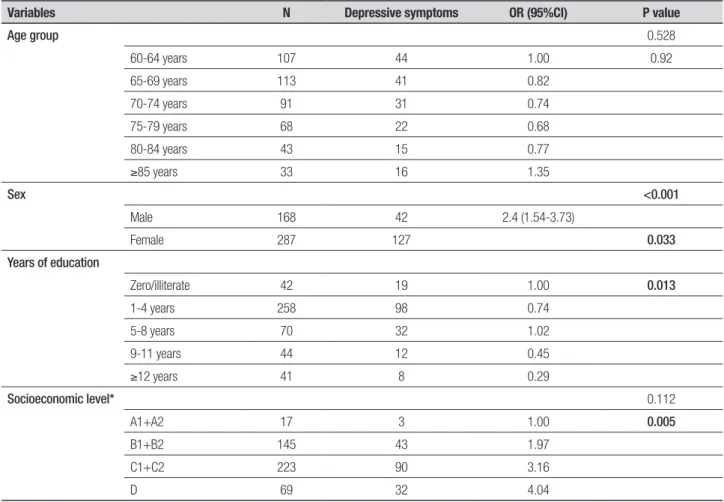
Depressive symptoms were more prevalent among individuals aged 85 years or over (48.5% of this age group); however, there was also a high prevalence among younger elderly aged 60-64 years (41.1% of in-dividuals in this age group). here was no tendency for increase in the presence of depressive symptoms with advancing age (p=0.92). here was no signiicant asso-ciation between CSDS and age (p=0.528).
We found signiicant associations between gender and CSDS (p<0.001), or with education (p=0.033). he prevalence of CSDS was higher among women and
in-dividuals with lower educational levels. he higher the educational level, the lower the tendency of presenting with depressive symptoms (p=0.013).
No signiicant association was found between CSDS and socioeconomic status (p=0.112) on the Chi-square test, but when the Chi-square test for linear trend was used an association between lower socioeconomic status and greater chance of depressive symptoms (p=0.005) was found. he highest prevalence was in class D (46.4%) and class E, in which only one individual evaluated had depressive symptoms. hese results are given in Table 2.
DISCUSSION
In this study, we found a prevalence of 37.1% of depres-sive symptoms among elderly in the city of Tremembé, Brazil. he prevalence was higher than that reported by other studies conducted in Brazil (whose rates ranged from 6.4 to 26.9% in the SABE study,21 16.1% in the city of Porto Alegre2 and 13% in the city of Sao Paulo,6,22 but the caveat is that we assessed depressive symptoms rather than diagnosed the participants with depression.
Table 2. Analysis of the association between depressive symptoms and sociodemographic characteristics.
Variables N Depressive symptoms OR (95%CI) P value
Age group 0.528
60-64 years 107 44 1.00 0.92
65-69 years 113 41 0.82
70-74 years 91 31 0.74
75-79 years 68 22 0.68
80-84 years 43 15 0.77
≥85 years 33 16 1.35
Sex <0.001
Male 168 42 2.4 (1.54-3.73)
Female 287 127 0.033
Years of education
Zero/illiterate 42 19 1.00 0.013
1-4 years 258 98 0.74
5-8 years 70 32 1.02
9-11 years 44 12 0.45
≥12 years 41 8 0.29
Socioeconomic level* 0.112
A1+A2 17 3 1.00 0.005
B1+B2 145 43 1.97
C1+C2 223 90 3.16
D 69 32 4.04
he sample size was calculated to establish the prev-alence of cognitive impairment with and without de-mentia which ranges from 7% to 20%, and therefore in-cludes the prevalence of depression in the elderly which is between 7% and 16%. Hence, we do not believe the sample size was a factor impacting the high prevalence of depressive symptoms found in this population. his high prevalence may be explained by missing yet-to-be-evaluated individuals of higher socioeconomic status, given the sample is not yet complete.
he higher prevalence of depressive symptoms in this study can also be explained by evidence from pre-vious studies showing that elderly individuals tend to have a lower prevalence of major depressive disorders but a higher prevalence of CSDS, compared to young adults. his can be explained by the fact that symptoms in this population may or may not be related to cogni-tive deicits, sensorineural hearing loss, and/or medical co-morbidities with polypharmacy.23-25
Recent publications have shown signiicant variabil-ity in the presence of depressive symptoms among indi-viduals with mild cognitive impairment, ranging from 3% to 63%, and some research has suggested depression can mark a continuum for cognitive impairment initial-ly without, and later with, dementia.26,27
In the present study, the Cornell Scale was used to detect the prevalence of depressive symptoms. Even though some studies have shown the scale can be used in patients with and without dementia, and that scores above 8 deine a diagnosis of depression,14,15,18 there is controversy regarding this score and we therefore chose not to diagnose patients with depression, but rather re-port the presence of depressive symptoms.
he higher prevalence of CSDS in women is in accor-dance with previous studies.6,22,24,28 his can be explained by the fact that women more readily take on their psy-chological problems and talk more openly about them,29 and even accept, more so than men, to participate in population-based studies.
No signiicant association was found between age and depressive symptoms, a result difering from data reported by previous studies showing that the greater the age, the greater the occurrence of depression.2,23-25,27 here was a higher depression prevalence in this study among participants aged 85 years or older, but there was also a high prevalence among younger participants. It is possible the age-depression association was not found because the full study sample has yet to be assessed.
he association between depressive symptoms and low educational levels is in agreement with data from the literature.2,30,31 Subjects with higher levels of edu-cation are better informed, and have better access to health care; and this would also explain the literature data showing higher prevalence of depressive symp-toms among those with lower socioeconomic levels – a inding also observed in this sample when evaluated for trend. However, Barcelos-Ferreira et al.22 failed to ind this association in the city of São Paulo, perhaps ex-plained by the fact that even individuals with lower so-cioeconomic and educational levels can nowadays gain access to information.
In conclusion, these preliminary results for the study population showed a high prevalence (37.1%) of depressive symptoms, and an association with female gender, low educational level and socioeconomic status. As this is a single-phase study, patients with depressive symptoms were not reevaluated to conirm a diagnosis of depression or otherwise. All patients with memory complaints shall be followed, and participants with de-pressive symptoms could also be followed to allow di-agnostic clariication, evaluation of the accuracy of the Cornell scale and PHD, as well as determine the correla-tion between depression and cognitive decline.
Study support. Supported by FAPESP grant number 2012/04815-6. Study conducted in the city of Tremem-bé, state of São Paulo, Brazil by the Department of Neu-rology, University of São Paulo Medical School.
REFERENCES
1. World Health Organization. Equity, social determinants and public health programmes. Geneva, 2010; World Health Organization. 2. Cunha RV, Bastos GA, Del Duca GF. Prevalence of depression and
associated factors in a low income community of Porto Alegre, Rio Grande do Sul. Rev Bras Epidemiol 2012;15:346-354.
3. Potter GG, Steffens DC. Contribution of depression to cognitive impair-ment and deimpair-mentia in older adults. Neurologist 2007;13:105-117. 4. Manual diagnóstico e estatístico de transtornos mentais: DSM-IV. 4ª
edição. Porto Alegre, RS: Artes Médicas; 1995.
5. Albanese E, Lombardo FL, Dangour AD, et al. No association between fish intake and depression in over 15,000 older adults from seven low and middle income countries--the 10/66 study. PLoS One 2012; 7:e38879.
6. Barcelos-Ferreira R, Izbicki R, Steffens DC, Bottino CM. Depressive morbidity and gender in community-dwelling Brazilian elderly: system-atic review and meta-analysis. Int Psychogeriatr 2010;22:712-726. 7. Instituto Brasileiro de Geografia e Estatística - IBGE. Available from:
http://www.ibge.gov.br.
8. Nitrini R, Lefèvre BH, Mathias SC, et al. Neuropsychological tests of simple application for diagnosing dementia. Arq Neuropsiquiatr 1994; 52:457-465.
9. Carvalho VA CP. Brazilian adaptation of the Addenbrooke’s Cognitive Examination-Revised (ACE-R). Dement Neuropsychol 2007;2:212-6. 10. Folstein MF, Folstein SE, McHugh PR. “Mini-mental state”. A
11. Nasreddine ZS, Phillips NA, Bédirian V, et al. The Montreal Cognitive As-sessment, MoCA: a brief screening tool for mild cognitive impairment. J Am Geriatr Soc 2005;53:695-699.
12. Jorm AF. A short form of the Informant Questionnaire on Cognitive De-cline in the Elderly (IQCODE): development and cross-validation. Psy-chol Med 1994;24:145-153.
13. Pfeffer RI, Kurosaki TT, Harrah CH, Chance JM, Filos S. Measurement of functional activities in older adults in the community. J Gerontology 1982;37:323-329.
14. Carthery-Goulart MT, Areza-Fegyveres R, Schultz RR, et al. Versão brasileira da Escala Cornell de depressão em demência (Cornell de-pression scale in dementia). Arq Neuropsiquiatr 2007;65:912-915. 15. Alexopoulos GS, Abrams RC, Young RC, Shamoian CA. Cornell Scale
for Depression in Dementia. Biol Psychiatry 1988;23:271-84. 16. Spitzer RL, Kroenke K, Williams JB. Validation and utility of a
self-re-port version of PRIME-MD: the PHQ primary care study. Primary Care Evaluation of Mental Disorders. Patient Health Questionnaire. JAMA 1999;282:1737-1744.
17. Brucki SMD, Nitrini R. Subjective memory impairment in a rural popula-tion with low educapopula-tion in the Amazon rainforest: an exploratory study. Int Psychogeriatr 2009;21:164-171.
18. Alexopoulos GS, Abrams RC, Young RC, Shamoian CA. Use of the Cor-nell scale in nondemented patients. J Am Geriatr Soc 1988;36:230-236. 19. Almeida OP, Almeida SA. Reliability of the Brazilian version of the
ab-breviated form of Geriatric Depression Scale (GDS) short form. Arq Neu-ropsiquiatr 1999;57:421-426.
20. Associação Brasileira de Pesquisa de Mercado e ABEP - Associação Brasileira de Empresas de Pesquisa. 2008. Available from: http://www. abep.org.
21. Alexandre TS, Corona LP, Nunes DP, Santos JL, Duarte YA, Lebrão ML.
Gender differences in incidence and determinants of disability in activi-ties of daily living among elderly individuals: SABE study. Arch Gerontol Geriatr .2012;55:431-437.
22. Barcelos-Ferreira R, Yoshio Nakano E, Steffens DC, Bottino CM. Quality of life and physical activity associated to lower prevalence of depression in community-dwelling elderly subjects from Sao Paulo. J Affect Disord 2013; pii:S0165-0327(13)00184-5.
23. Hasin D, Link B. Age and recognition of depression: implications for a cohort effect in major depression. Psychol Med 1988;18:683-688. 24. Steffens DC, Fisher GG, Langa KM, Potter GG, Plassman BL.
Preva-lence of depression among older Americans: the aging, demographics and memory study. Int Psychogeriatr 2009;21: 879-888.
25. Castro-Costa E, Dewey M, Stewart R, et al. Prevalence of depressive symptoms and syndromes in later life in ten European countries: the SHARE study. Br J Psychiatry 2007;191:393-401.
26. Panza F, FrisardiV,Capurso C, et al. Late-life depression, mild cognitive impairment and dementia: possible continuum? Am J Geriatr Psychiatry 2010;18:98-116.
27. Richard E, Reitz C, Honig LH, et al. Late-life depression, mild cognitive impairment, and dementia. JAMA Neurol 2013;70:374-382.
28. Almeida Filho N, Lessa I, Magalhães L, et al. Social inequality and de-pressive disorders in Bahia, Brazil: interactions of gender, ethnicity and social class. Soc Sci Med 2004;59:1339-1353.
29. Peluso ETP, Blay SL. Percepção da depressão pela população da ci-dade de São Paulo. Rev Saúde Pública 2008;42:1.
30. Zimmerman FJ, Katon W. Socioeconomic status, depression dispari-ties, and financial strain: what lies behind the income-depression rela-tionship? Health Econ 2005;14:1197-215.