Abstract— In order to describe the relative
predominance of lactate oxidation and fermentation under conditions of biological sulfate reduction, kinetic constants ( max and Ks) were determined. Chemostat cultures under
various conditions were employed. The kinetics of sulfate reduction and lactate utilization were investigated at residence times 1 to 5 d and feed sulfate concentrations of 1.0 to 10.0 g l-1. At low lactate concentration, lower maxand Ks characterized
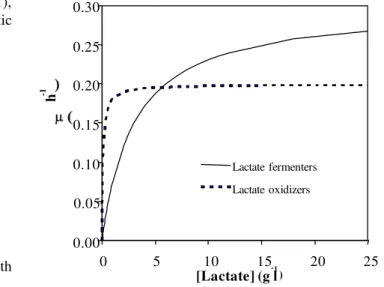
the lactate oxidizers (sulfate reducing bacteria) relative to the lactate fermenters. The kinetic properties of the lactate oxidizers (LO) were max of 0.2 h-1and Ksof 0.6 g l-1 compared
with a max of 0.3 h-1 and Ks of 3.3 g l-1 for the lactate fermenters
(LF). The interaction between lactate oxidizers and lactate fermenters was demonstrated with the use of mathematical models. The LO outcompeted the LF under conditions of low
lactate concentration (≤5 g l-1
) and high sulfide concentration (0.3-0.6 g l-1). Lactate fermenters outcompeted the oxidizers under conditions of excess lactate concentration (>5 g l-1). The predictions by the mathematical models employed were in good agreement with the experimental results obtained for bacterial growth rates. The importance of an understanding of the impact of physicochemical conditions on the metabolic dominance in optimizing biological sulfate reduction (BSR) system, was highlighted in this study.
Index Terms—Acid rock drainage, biological sulfate reduction, fermentation, oxidation
I. INTRODUCTION
cid rock drainage (ARD) generation is a potential hazard to the ecosystem. The release of untreated ARD increases the salinity of receiving water and contributes to environmental deterioration and ecological imbalances. Biological sulfate reduction (BSR), as mediated by sulfate reducers (SRB) has potential for the treatment of ARD. Lactate can be employed as a carbon-source and energy donor for the SRB. Its utilization is associated with advantages in BSR process. The biological treatment of
Manuscript received May 10, 2011; revised July This work was supported by the Cape peninsula University of South Africa, National Research Foundation (NRF), South Africa, and the Claude Leon Foundation.
Oluwaseun O. Oyekola is with the Department of Chemical Engineering, Cape Peninsula University of Technology, P.O Box. 1906, Bellville, South Africa (phone: +27-021-9596799; fax: +27-021-9596323; e-mail: [email protected]).
Robert P. van Hille is with Centre for Bioprocess Engineering Research, Department of Chemical Engineering, University of Cape Town, Private Bag X3, Rondebosch, 7701, South Africa (e-mail: [email protected]).
Susan T.L. Harrison is with Centre for Bioprocess Engineering Research, Department of Chemical Engineering, University of Cape Town, Private Bag X3, Rondebosch, 7701, South Africa (e-mail: [email protected]).
ARD is often mediated by mixed microbial consortia. However, lactate-fed sulfate reducers are prone to competition from other lactate-utilizers in mixed consortia [1]. In a sulfate-fed BSR, sulfate reduction is dependent on lactate oxidation, such that an optimized lactate oxidation results in an optimized BSR process. The competitive interaction is linked to the kinetic properties of the constituting community members as defined by maximum specific growth rate (μmax) and substrate affinity (Ks) [2].
Experimental results presented elsewhere [3]-[4] showed that lactate oxidizing SRB were less active under conditions of high lactate concentrations and dilution rates. Presence of high lactate concentrations encouraged the proliferation of lactate fermenters. These trends were characterized by reduced BSR performance. This phenomenon resulted from the independence of lactate fermentation on sulfate reduction. Hence, reduced BSR efficiency occurs when lactate fermentation prevails.
The present study investigated the hypotheses proposed in previous study [4]. The hypotheses attributed the trends observed in the kinetics of biological sulfate reduction, by mixed cultures, based on the effect of the volumetric sulfate loading rate to be a consequence of shift in lactate metabolism.
Using the kinetic data described in a previous study [4], mathematical model description of the effect of feed substrate concentration on the BSR kinetics was investigated. This modeling approach was used to predict the relative dominance of competing microbial populations, thereby proposing and validating appropriate experimental configurations. To define the operating conditions where lactate oxidation dominates, microbial kinetic parameters were determined in this study. These parameters were used to demonstrate the competition between lactate oxidation and lactate fermentation under biosulfidogenic conditions i.e. biological sulfate reduction. Model values for the bacterial growth rates were compared with the experimental results.
II. MATERIALSANDMETHODS A. Experimental
Laboratory scale chemostat cultures at different residence times (0.5 to 5.0 d) and sulfate concentrations (1.0 to 10.0 g l-1) were employed, using a SRB mixed culture inoculum isolated from the anaerobic pit of a facultative pond treating sewage and adapted to growth on lactate in the laboratory of Prof. John Duncan (Rhodes University, South Africa). Details of the medium composition are described elsewhere [3].
Kinetic Description of the Competitive
Interaction between Lactate Oxidizers and
Fermenters in a Biosulfidogenic System
Oluwaseun O. Oyekola,
Robert P. van Hille, and Susan T.L. Harrison
A
Proceedings of the World Congress on Engineering and Computer Science 2011 Vol II WCECS 2011, October 19-21, 2011, San Francisco, USA
ISBN: 978-988-19251-7-6
ISSN: 2078-0958 (Print); ISSN: 2078-0966 (Online)
The kinetic data employed in determining the kinetic parameters were obtained using the procedure described by [3]. Total dissolved sulfide was estimated spectrophotometrically at 670 nm, following the colour development of methylene blue between the sulfide and colorimetric reagent, N,N-dimethyl-p-phenylenediamine sulfate [5]. Acetate, propionate and lactate concentrations were estimated by HPLC [3]. Sulfate concentration was estimated turbidimetrically as barium sulfate [6]. Bacterial concentration was estimated as dry mass [3].
B. Modeling approach
Lactate was assumed to be the dominant limiting substrate and the steady-state experimental data were used to determine the kinetic constants. The steady-state data were analyzed using the Chen and Hashimoto (Equation 1), Contois (Equation 2) and Monod (Equation 3) kinetic expressions to determine the kinetic constants.
S K S
K
S
s o
s 1
max
(1)
S X K
S
s ''
max
(2)
S K
S
s m ax
(3)
For a continuous culture at steady-state, where cell death is negligible and the feed is sterile, µ = D.
The model description was based on the relationship between the kinetics of bacterial growth and the lactate utilization rate (LUR) (rL) as described by the Pirt Equation
(Equation 4). Analysis led to values of bacterial yield (Yx/s)
and maintenance (ms) coefficients.
s s x L
m Y X r
/
1
(4)
III. RESULTSANDDISCUSSION
The values of the kinetic constants obtained are as follows, lactate oxidizers were characterized by a max of 0.2
h-1and Ksof 0.6 g l-1 compared with a max of 0.3 h-1 and Ks
of 3.3 g l-1 for the lactate fermenters.
The competition between lactate fermenters (LF) and oxidizers (LO) was modeled by integrating the kinetic constants estimated above into the mathematical models employed in this study. The residual lactate concentration in the range 0.0 to 25.0 g l-1. This range of values was based on the lactate concentrations detected in the experiments [4].
As shown in Fig. 1, the lactate oxidizers were the predominant microorganisms, out-competing LF, at low lactate concentrations, ≤ 5.0 g l-1.This can be attributed to the characteristic low Ksof LO. Lower value of Ks implies
higher affinity for lactate by the LO and their consequent ability to thrive under conditions of limiting lactate
concentrations as observed in the experiment where the chemostat cultures were fed with starting sulfate concentration of 1.0 g l-1 [4]. The equivalent feed lactate concentration of 2.22 g l-1 and the detected residual lactate concentrations were in the range 0.015 to 0.029 g l-1, for this experiment [4]. On the other hand, increasing lactate concentrations (> 5 g l-1) is associated with out-competition of the LO by the lactate fermenters. This trend corroborates the hypothesis reported in the previous studies of the shift in lactate utilization pathway from oxidation to fermentation at higher lactate concentrations, vis-à-vis increasing sulfate concentration. This phenomenon resulted in a decrease in biological sulfate reduction. Sulfate conversion decreased in the range 87-40% with increase in starting sulfate concentration in the range 1.0-10.0 g l-1 [4].
Fig. 1: Model description of competition for lactate between lactate fermenters and oxidizers in the current study. Specific growth rate ( ) as a function of lactate concentration.
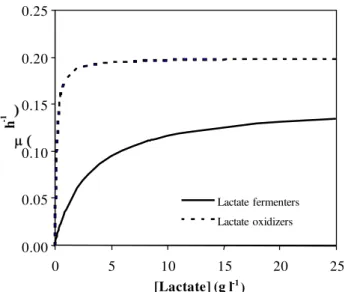
Based on a previous study [7], which showed that the growth of lactate fermenters was repressed by 50% in the presence of 0.165 g l-1 while that of the oxidizer remained unchanged. A second scenario was investigated in this study, such that the maximum specific growth rate, max of
LF obtained was reduced to 0.15 h-1, while the corresponding Ks value of LF (3.3 g l-1) and the kinetic
constants of the LO ( max of 0.2 h-1and Ksof 0.6 g l-1) were
kept constant. The simulation was carried out as previous in the previous scenario, varying the residual lactate concentration in the range 0.0 to 25.0 g l-1. The predominance of lactate oxidation persisted despite increasing concentration of lactate (Fig. 2). The trends observed concurs with the experimental results showing that the bioreactor fed with 10.0 g l-1 exhibited increasing volumetric sulfate reduction rate despite the associated increase in lactate concentrations (8.0-22.3 g l-1). Sulfide concentrations detected in this experiment were in the range 0.3-0.6 g l-1 [4]. Hence the consistent prevalence of LO resulted from the sustained inhibitory effect of sulfide on LF.
[Lactate] (g l-1) 0.00
0.05 0.10 0.15 0.20 0.25 0.30
0 5 10 15 20 25
Lactate fermenters
Lactate oxidizers
-1 h
Proceedings of the World Congress on Engineering and Computer Science 2011 Vol II WCECS 2011, October 19-21, 2011, San Francisco, USA
ISBN: 978-988-19251-7-6
ISSN: 2078-0958 (Print); ISSN: 2078-0966 (Online)
Fig. 2: Model description of the observation at 10.0 gl-1 sulfate in the
presence of high sulfide concentration (0.3 to 0.6 g l-1) inwhich the specific
growth rate ( ) is estimated to be reduced by 50%. Specific growth rate ( ) as a function of lactate concentration.
At starting sulfate concentrations of 2.5 and 5.0 g l-1, the experimental data showed that at high residence times 3-5 d where sulfide concentrations of 0.13-0.53 g l-1 were recorded, increasing volumetric sulfate reduction rates with increasing dilution rates were observed [4]. Conversely, at residence times 1-2 d, associated with sulfide concentrations of 0.014-0.088 g l-1, there was a sharp decline in the volumetric sulfate reduction rates with increasing dilution rates. These experimental observations are in agreement with the simulations carried out herein.
IV. CONCLUSION
In mixed consortia mediating the biological sulfate reduction process, limiting lactate concentrations encourage the proliferation of lactate oxidizers. Hence, consequent enhancement of sulfate removal. On the other hand, the growth of lactate fermenters is encouraged under conditions of higher lactate concentrations. This occurrence would lead to the prevalence of lactate utilization via the fermentative pathway, leading to reduced sulfate removal efficiency. Presence of sulfide inhibits lactate fermentation.
Sulfide stripping, a common practice in acetate- and ethanol-fed BSR reactors, may be unnecessary and unbeneficial for lactate-fed reactors, except at sulfide concentrations inhibitory to the SRB. Furthermore, the findings provided herein will assist in the design of a BSR system mediated by mixed consortia and fed with “high -energy substrates” which are prone to competition.
.
REFERENCES
[1] H.J. Laanbroek, T. Abee, and I.L. Voogd. (1982). Alcohol conversions by Desulfobulbus propionicus Lindhorst in the presence and absence of sulphate and hydrogen. Archives of Microbiology. 133, 178-184.
[2] J. Weijma, J., F. Gubbels, L.W. Hulshoff Pol, A.J.M Stams, P. Lens, and G. Lettinga, G. (2002). Competition for H2 between sulfate
reducers, methanogens, and homoacetogens in a gas-lift reactor. Water Science and Technology. 45, 75-80.
[3] O.O. Oyekola, R. van Hille, and S.T.L. Harrison. (2009). Study of anaerobic lactate metabolism under biosulphidogenic conditions. Water Research. 43, 3345-3354.
[4] O.O. Oyekola, R. van Hille, and S.T.L. Harrison. (2010). Kinetic analysis of biological sulphate reduction using lactate as carbon source and electron donor: effect of sulphate concentration. Chemical Engineering Science. 65, 4771-4781.
[5] Cline, J.D. (1969). Spectrophotometric determination of hydrogen sulfide in natural waters. Limnology and Oceanography. 14: 454-458. [6] Standard methods for the examination of water and wastewater, 14th
ed., American Public Health Association (APHA). APHA, New York, 1975.
[7] H.J. Laanbroek, H.J. Geerligs, A.A.C.M. Peijenburg, and J. Siesling. (1983). Competition for L-lactate between Desulfovibrio, Veillonella, and Acetobacterium species isolated from anaerobic intertidal sediments. Microbial Ecology. 9, 341-354.
0.00 0.05 0.10 0.15 0.20 0.25
0 5 10 15 20 25
[Lactate] (g l-1)
h
-1
Lactate fermenters
Lactate oxidizers
Proceedings of the World Congress on Engineering and Computer Science 2011 Vol II WCECS 2011, October 19-21, 2011, San Francisco, USA
ISBN: 978-988-19251-7-6
ISSN: 2078-0958 (Print); ISSN: 2078-0966 (Online)