STATE PENSION OR PRIVATE PENSION?
MANGRA MĂDĂLINA GIORGIANA
ASSISTANT PROFESSOR PhD, UNIVERSITY OF CRAIOVA, FACULTY OF ECONOMICS AND
BUSINESS ADMINISTRATION, CRAIOVA, ROMANIA,
e-mail:
[email protected]
Abstract:
The lack of sustainability of the public pension system brings into attention the private pension system, either mandatory (Pillar II) or optional (Pillar III). Young employees do not perceive the future in bright colours while seeking solutions to shift from consumption to saving for retirement period. As long as the public pension system is weak, an important milestone for individual savings is represented by the private pension.
Keywords: reform, public pension system, private pension system.
JEL classification: G20, G22.
1. Introduction
The state pension resulting from participation in the social security system has both private and public alternatives for saving in most of the developed countries and some emerging countries; in addition, the elderly are encouraged to postpone retirement, remain on the labor market and contribute to the social security budgets after the standard retirement age, through increases in the benefits due. Romania, with the exception of Bulgaria, is the country with the lowest pension in the EU.
About 6 million Romanians receive state pension while 4.1 million are employed, thus an imbalance being created which is amplified by the fact that only 58% of the working population under the age of 64 is currently employed, mostly by the state.
Labor imbalance determined by the retirees is due to:
- the policy of masking unemployment through early retirement. The huge number of early retirements in the system is due to the system itself, which is not likely to positively encourage the elderly to prolong their active period;
- the number of retirements due to illness in a ratio of 1 to 6 retirees;
- the existence of many luxury retirees.
The effects of early retirements materialize in the inability of state budget to fund the state pension system and it can no longer resist on long-term (approximately 30 years). The impasse comes from the aging of population and extended economic downturn.
2. State pension funds versus mandatory private pension funds
Resuscitation of the pension system would be possible, according to government policies, by putting in practice some urgent actions:
of all pensions by 16%, by eliminating the tax-free threshold, would bring a monthly income of about 60 million lei to the state budget;
- Increasing the retirement age to 65 for men and 60 years for women. Real age of retirement is 55 years in Romania, the lowest in the EU.
Distrust in the current public pension system is obvious especially in the case of young people who pay pension contributions, even if they are aware that, in time, the state will not pay their pensions.
They must, by necessity, take into account the alternative of private pension funds, which are not appreciated by Romanians since the total of private pension funds from Romania is below the European average, reaching 0.7% of GDP.
Private funds represent a system designed and implemented based on the model recommended by the World Bank, which can prove long-term results and their performance should not be judged depending on crisis periods. For some of the EU Member States in Central and Eastern Europe that have implemented mandatory private pension systems, changing the rules for calculating the deficits and debt levels would mean budgetary savings of more than 1% of GDP. By reforming the pension system in EU countries, all transfers of contributions from public budgets for social security to the funds for mandatory private pension are significant, reducing theoretically the budget deficits by more than 1% of GDP, easing the burden of bringing them to the level of 3% of GDP required by the EU.
Romanian State has introduced in 2007 the private pension system to eliminate the pressure on the state social security budget. With the introduction of compulsory private pension system (Pillar II) or optional one (Pillar III) the state's aim was to stimulate economic growth by investing the amounts accrued by the funds and developing the capital markets.
Association of Private Pension Funds in Romania is a professional, non-governmental, independent and apolitical organization with nonprofit purposes and its target is to protect the interests of over 6 million participants in private pension funds, promoting and developing the collaboration and cooperation of private pension funds in Romania. It is affiliated to Pensions Europe-the European Federation of private pension funds and is a member of UGIR, employers' confederation in Romania. APPFR states that it protects millions of people who have entered the mandatory private pension funds, the allocation of those who have joined more funds being made under the law [2].
The private pension system in Romania is regulated by the legal framework and institutions, and the assets of participants, their money, are under the protection of storage banks which, in turn, are supervised by ASF and NBR.
However, Romanians reluctance about joining the private pension fund is derived from the concept that any employee supports the current retirees, based on the solidarity between generations, each employee paying nowadays social security contributions (CAS), related to the public pension system, representing 10.5% of the gross salary. But there are no individual accounts in the state system (Pillar I) and financial investments are not made, the money being paid immediately. Or, the private pension system is aimed at investing the money of private funds' participants on long term, and giving ownership over the private account where the money shall be deposited, i.e. that share of individual contribution owed to the public system, which in 2013 was 4%, and it is reaching 6% in 2016, according to law.
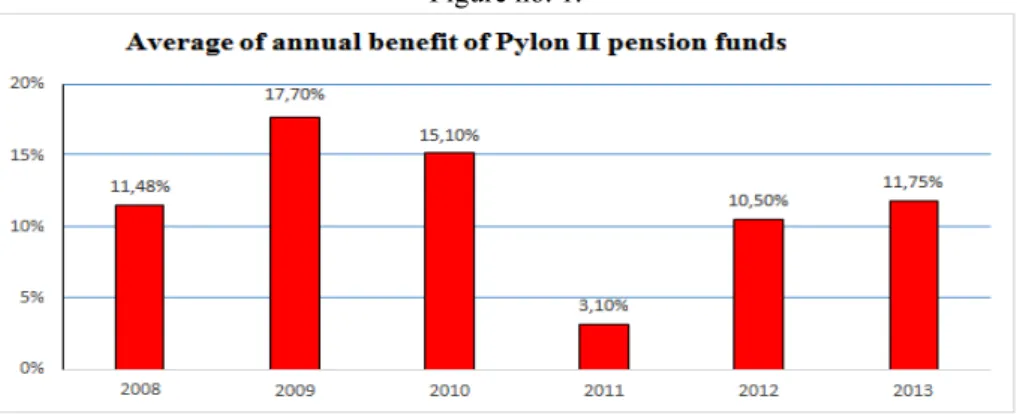
Compulsory private pension funds (Pillar II), from launch in 2008 until now, have recorded an average annual return of 11.5%, the 8 funds benefiting of approximately 6.000.000 participants.
Financial Supervisory Authority stated [3] that, at the end of June 2014, the private pension funds had investments of 957 million lei in companies listed on the Bucharest Stock Exchange, such as ROMGAZ, Electrical, Transgaz, Transelectrica, Nuclearelectrica, Antibiotics, Oil Terminal.
Pillar II, introduced in Romania, offers the following guarantees: - the guarantee of net contributions throughout the period of investment;
- the minimum guarantee relative to the market, which does not allow any fund to have significantly lower performance than the market.
In Romania, the transfers to Pillar II, amounting to 1.32 billion lei in 2009, represent less than 0.3% of GDP. Over 64% of the net assets of Pillar II funds are placed in government securities. If reforming the pension system is achieved by the transfer of contributions from public social security budgets to the Pillar II funds, the following could occur:
- costs of these reforms could be deducted when the budget deficit is calculated, during the first five years. The deduction given is full during the first year of operation of Pillar II and in the next years its share declines gradually from 80 to 20%, and then the transfers from Pillar II are to be considered integrally when the budget deficit is calculated.
- benefits to the private pension system and the economy. The role of private pension funds is to stimulate long term savings and ensure optimal allocation of financial resources and liquidity by investing in the capital market, but also in bonds issued by the state.
considered expenses because they are used for saving and investing in financial instruments, from bonds to shares of stock and others. The positive effect is that the government would not decrease the rate of contribution to the funds so to support public pension budgets and the private economy would be encouraged for the benefit of future retirees.
Association of Private Pension Funds in Romania (APPFR) states that 4.1 million people joined the mandatory private pension funds, the allocation of those who adhered to more funds being made under the law (Law 23/2007 concerning the private pension funds). Mandatory private pension funds (Pillar II) obtained in the first half of 2010 an average return of 9.9%, while the performance for the last 12 months rose to 20.7% according to APPFR. Since its introduction in May 2008 up to date, the funds have annualized an average return of 16.6%. The market net assets reached 3.38 billion lei (773.5 million Euros) at the end of June, up by 4.4% from the previous month. SCPPS (Supervisory Commission of Private Pension System) considers that the nine mandatory pension funds in the market had 5.055.102 participants in June 2010 and, at the end of 2013, the 8 compulsory private pension funds had 6.000.000 participants and managed for their benefit net assets of 13.94 billion RON after APAPR appreciation. The Association of Private Pension Funds in Romania offers a graphic picture of the evolution of both the net assets of pension funds and a graph of the average annual return of pension funds.
Figure no. 1.
Source: www.apapr.ro
Figure no. 2.
Source: www.apapr.ro
Any system of mandatory private pensions (Pillar II) is not enough and it must be supported by a voluntary system. The voluntary saving schemes, through the voluntary private pension funds, have often preceded the introduction of Pillar II.
for retirement, Hungary and Bulgaria have introduced new pension schemes, the so-called Pillar IV, a system that copies the western models of voluntary occupational pensions and is added to Pillar II and III.
Pillar III refers to the voluntary pension system administered by private companies. Unlike Pillar I, voluntary private pension (Pillar III) is an instrument to motivate employees because anyone can contribute with up to 15% of monthly gross income, provided they have at least 90 monthly contributions; no tax is payable for this contribution, each contributor is financially protected and the amount accumulated in the individual account of participant is available to the heirs [5].
Law 204/2006 [6] on voluntary pensions, Fiscal Code and Fiscal Procedure Code provide for the deductibility of contributions to voluntary private pension funds from the base of the payroll tax, up to 400 Euros. The contributions to voluntary private pension funds of employees could be paid, until 2009, only by employers who applied the related tax deduction only to the income tax and not to social contributions.
Voluntary private pension funds (Pillar III) recorded an average return of 6.6% in the first half of 2010, while the earnings in the last 12 months were 15.4%. Since its launch in May 2007 [7] and so far, the voluntary private pension funds recorded an average annualized return of 8.9%. The total quantum of net assets managed by voluntary pension funds reached 264.4 million lei (60.5 million Euros) at the end of June 2010 and the total number of participants attracted by the 13 voluntary pension funds was, at the same date, of 201.908.
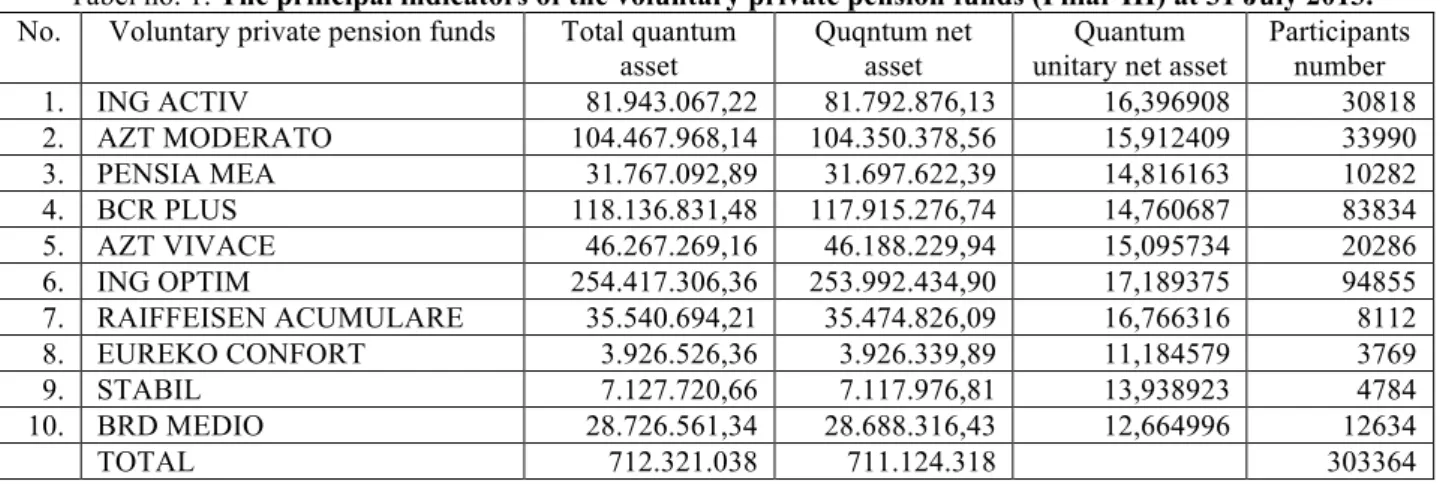
The main statistical data for mid-2013 on the number of participants and net assets, as well as the main indicators of voluntary pension funds, are contained in the following charts.
Figure no. 3.
Source: www.csspp.ro/date-statistice-pilonul-3
Tabel no. 1. The principal indicators of the voluntary private pension funds (Pillar III) at 31 July 2013. No. Voluntary private pension funds Total quantum
asset
Quqntum net asset
Quantum unitary net asset
Participants number
1. ING ACTIV 81.943.067,22 81.792.876,13 16,396908 30818
2. AZT MODERATO 104.467.968,14 104.350.378,56 15,912409 33990
3. PENSIA MEA 31.767.092,89 31.697.622,39 14,816163 10282
4. BCR PLUS 118.136.831,48 117.915.276,74 14,760687 83834
5. AZT VIVACE 46.267.269,16 46.188.229,94 15,095734 20286
6. ING OPTIM 254.417.306,36 253.992.434,90 17,189375 94855
7. RAIFFEISEN ACUMULARE 35.540.694,21 35.474.826,09 16,766316 8112
8. EUREKO CONFORT 3.926.526,36 3.926.339,89 11,184579 3769
9. STABIL 7.127.720,66 7.117.976,81 13,938923 4784
10. BRD MEDIO 28.726.561,34 28.688.316,43 12,664996 12634
TOTAL 712.321.038 711.124.318 303364
Source: www.csspp.ro/date-statistice-pilonul-3
According to the draft of Tax Code implementation rules, the payments made by private funds (single payment or in installments over a maximum of five years) are retirement income and therefore are taxed by a single rate of 16%. On single payments only one non-taxable threshold of 1.000 lei is granted by each fund, given that the same person can contribute to more funds in the case of Pillar III.
3. Conclusions:
Considering the above mentioned, we can draw the following conclusions:
1. Romania, by signing the agreements with the IMF and the European Commission, has committed to reforming the public pension system by: disconnecting the social security point of pension from the evolution of average wage; annual indexation of state pensions with inflation; limitation of potential discretionary increase of state pension; increasing the retirement age to 65 for men and 60 for women; mandatory contributions to the public pension system for public employees who so far were excluded from paying them; adoption of a new law on pensions including clear policies on state pensions.
2. Elaboration of the legislation on mandatory private pensions: regulation by Tax Code of the taxation regime of private pensions, due to those who retire and get a state pension as well; regulation of the manner in which, given that a certain threshold will be maintained taxable, the taxation will be applied separately to each type of pension (Pillar I, II and III) or cumulatively to the sum collected from these three sources.
4. Bibliography:
[1] Law. 19 of 17.03.2000 on the public pension system and other social insurance rights, published in the Official Gazette no.140 of 01.04.2000.
[2] Law. 23/2007 amending and supplementing Law no. 411/2004 on private pension funds, published in the Official Gazette, Part I no. 61 of 25.01.2007.
[3] Capital Magazine, no. 30 (1087) / 2014, p.17.
[4] Mangra M.G., Stanciu M., Stuparu D. - The mandatory pension funds managed by private structures - a viable alternative to the public pension system, The Scientific Bulletin of the "Nicolae Bălcescu" Land Forces Academy, Sibiu no.2 / 2009, pp. 89-95.
[5] Simion Dalia, Tobă Daniel, Barbu Dănuț - Investment in human capital – determinant factor in creating value within modern companies, Annals of Tibiscus University of Timișoara, Economic Sciences Series, 2009, pp. 85-91, ISSN 1582-6333.
[6] Law. 204/2006 on voluntary pensions, published in the Official Gazette, Part I no. 470 of 31.05.2006. [7] Mangra M.G., Stanciu M., Sperdea N.M. - The orientation towards the private pension system - a consequence of the public pension system's unsustanability, The Young Economists Journal, 2010 volume 1, issue 14, pp. 61-68.