ACPD
14, 17479–17526, 2014Cascading moisture recycling
D. C. Zemp et al.
Title Page
Abstract Introduction
Conclusions References
Tables Figures
◭ ◮
◭ ◮
Back Close
Full Screen / Esc
Printer-friendly Version Interactive Discussion
Discussion
P
a
per
|
Discus
sion
P
a
per
|
Discussion
P
a
per
|
Discussion
P
a
per
Atmos. Chem. Phys. Discuss., 14, 17479–17526, 2014 www.atmos-chem-phys-discuss.net/14/17479/2014/ doi:10.5194/acpd-14-17479-2014
© Author(s) 2014. CC Attribution 3.0 License.
This discussion paper is/has been under review for the journal Atmospheric Chemistry and Physics (ACP). Please refer to the corresponding final paper in ACP if available.
On the importance of cascading moisture
recycling in South America
D. C. Zemp1,2, C.-F. Schleussner3, H. M. J. Barbosa4, R. J. Van der Ent5, J. F. Donges1,6, J. Heinke1, G. Sampaio7, and A. Rammig1
1
Potsdam Institute for Climate Impact Research (PIK), Telegraphenberg A 31, 14473 Potsdam, Germany
2
Department of Geography, Humboldt Universität zu Berlin, Berlin, Germany
3
Climate Analytics, Berlin, Germany
4
Instituto de Física, Universidade de São Paulo, São Paulo, S.P., Brazil
5
Department of Water Management, Faculty of Civil Engineering and Geosciences, Delft University of Technology, Delft, the Netherlands
6
Stockholm Resilience Centre, Stockholm University, Kräftriket 2B, 114 19 Stockholm, Sweden
7
Center for Earth System Science (CCST), INPE, Cachoeira Paulista, S.P., Brazil
Received: 12 May 2014 – Accepted: 8 June 2014 – Published: 30 June 2014
Correspondence to: D. C. Zemp ([email protected])
ACPD
14, 17479–17526, 2014Cascading moisture recycling
D. C. Zemp et al.
Title Page
Abstract Introduction
Conclusions References
Tables Figures
◭ ◮
◭ ◮
Back Close
Full Screen / Esc
Printer-friendly Version Interactive Discussion
Discussion
P
a
per
|
Discus
sion
P
a
per
|
Discussion
P
a
per
|
Discussion
P
a
per
|
Abstract
Continental moisture recycling is a crucial process of the South American climate sys-tem. Evapotranspiration from the Amazon river basin contributes to precipitation re-gionally and in the La Plata river basin. Here we present an in-depth analysis of South American moisture recycling. We quantify the importance of “cascading moisture
re-5
cycling”, which describes the exchange of moisture between the vegetation and the atmosphere through precipitation and re-evaporation cycles on its way between two lo-cations on the continent. We use the Water Accounting Model 2-layers (WAM-2layers) forced by precipitation from TRMM and evapotranspiration from MODIS for the period 2001 until 2010 to construct moisture recycling networks. These networks describe the
10
direction and amount of moisture transported from its source (evapotranspiration) to its destination (precipitation) in South America. Model-based calculations of continen-tal and regional recycling ratios in the Amazon basin compare well with other existing studies using different datasets and methodologies. Our results show that cascading moisture recycling contributes about 10 % to the total precipitation over South America
15
and 17 % over the La Plata basin. Considering cascading moisture recycling increases the total dependency of the La Plata basin on moisture from the Amazon basin by about 25 % from 23 to 29 % during the wet season. Using tools from complex network analysis, we reveal the importance of the south-western part of the Amazon basin as a key intermediary region for continental moisture transport in South America during
20
the wet season. Our results suggest that land use change in this region might have a stronger impact on downwind rainfed agriculture and ecosystem stability than previ-ously thought.
1 Introduction
Continental moisture recycling, the process by which evapotranspiration from the
con-25
ACPD
14, 17479–17526, 2014Cascading moisture recycling
D. C. Zemp et al.
Title Page
Abstract Introduction
Conclusions References
Tables Figures
◭ ◮
◭ ◮
Back Close
Full Screen / Esc
Printer-friendly Version Interactive Discussion
Discussion
P
a
per
|
Discus
sion
P
a
per
|
Discussion
P
a
per
|
Discussion
P
a
per
Bras, 1994; van der Ent et al., 2010) is particularly important for the South American hydrological cycle. In the Amazon river basin, between 25 and 35 % of the moisture is regionally recycled (Eltahir and Bras, 1994; Trenberth, 1999; Bosilovich and Chern, 2006; Burde et al., 2006; Dirmeyer et al., 2009). The moisture from the Amazon basin is also exported out of the basin, transported via the South American Low Level Jet
5
along the Andes and contributes to precipitation over the La Plata river basin particu-larly during the wet season (Marengo, 2005; Drumond et al., 2008, 2014; Arraut and Satyamurty, 2009; Dirmeyer et al., 2009; van der Ent et al., 2010; Arraut et al., 2012; Martinez et al., 2014).
Land-use change – in particular deforestation in the Amazon basin – impacts the
10
evapotranspiration rate and affects the water cycle (see review in Marengo, 2006). A resulting reduction in regional moisture supply may have important consequences for the ecosystem stability in the Amazon rainforests (Oyama and Nobre, 2003; Cox et al., 2004; Betts et al., 2004; Hirota et al., 2011; Knox et al., 2011; Spracklen et al., 2012). Downwind, e.g., in the La Plata basin, rainfall reduction may affect rainfed
agri-15
culture (Rockström et al., 2009; Keys et al., 2012). Even if regional impact of changes in precipitation patterns from deforestation has been intensively studied using simula-tions from atmospheric general circulation models with deforestation scenarios (Lean and Warrilow, 1989; Shukla et al., 1990; Nobre et al., 1991, 2009; Werth and Avissar, 2002; Sampaio et al., 2007; Da Silva et al., 2008; Hasler et al., 2009; Walker et al.,
20
2009; Medvigy et al., 2011; Bagley et al., 2014) the magnitude of rainfall reduction and the location of the most impacted regions are still uncertain. Therefore, further advancements in our understanding of the continental moisture recycling in the South American continent are needed.
To identify sources and sinks of moisture and to quantify regional and continental
25
ACPD
14, 17479–17526, 2014Cascading moisture recycling
D. C. Zemp et al.
Title Page
Abstract Introduction
Conclusions References
Tables Figures
◭ ◮
◭ ◮
Back Close
Full Screen / Esc
Printer-friendly Version Interactive Discussion
Discussion
P
a
per
|
Discus
sion
P
a
per
|
Discussion
P
a
per
|
Discussion
P
a
per
|
et al., 2014) and tagged water experiments with a general circulation model (GCM) (Bosilovich and Chern, 2006) or a posteriory with reanalysis data (Sudradjat et al., 2002; van der Ent et al., 2010; Keys et al., 2012) (see a review of the methods in van der Ent et al., 2013; Burde and Zangvil, 2001). In most of existing studies using tagged water experiments, moisture evaporating from a given region is tracked forward
5
in time from the evapotranspiration until it returns to the land surface as precipita-tion. However, precipitating water can be re-evapotranspirated in the same location (re-evaporation cycle) and can be transported to a downwind location where it con-tributes to precipitation. Such exchanges of moisture between the vegetation and the atmosphere through re-evaporation cycles might play a crucial role for the transport
10
of moisture in the Tropics (Spracklen et al., 2012). Adding different types of tracers within a GCM, Numaguti (1999) found that moisture runs on average through more than two re-evaporation cycles between evaporation from the ocean and precipitation in northern Eurasia. In this study we focus for the first time on the following questions:
1. what is the importance of cascading moisture recycling in South America?
15
2. Which are the important intermediary regions for cascading moisture recycling? 3. Which are the key regions where the pathways of cascading moisture recycling
are channeled?
We call “cascading moisture recycling” the process by which evapotranspiration from a specific location on land runs through one or more re-evaporation cycles before it
20
precipitates in another one. On the other hand, “direct moisture recycling” refers to the process by which evapotranspiration is directly transported (without any re-evaporation cycle) from one location on land to another, where it precipitates. We call “intermediary” the location where re-evaporation cycle is occurring. We define a “pathway of moisture recycling” as the set of locations including the starting and the destination locations, as
25
well as the intermediaries.
ACPD
14, 17479–17526, 2014Cascading moisture recycling
D. C. Zemp et al.
Title Page
Abstract Introduction
Conclusions References
Tables Figures
◭ ◮
◭ ◮
Back Close
Full Screen / Esc
Printer-friendly Version Interactive Discussion
Discussion
P
a
per
|
Discus
sion
P
a
per
|
Discussion
P
a
per
|
Discussion
P
a
per
America using the numerical atmospheric moisture tracking model WAM-2layers (Wa-ter Accounting Model-2layers) (van der Ent et al., 2014).
We propose a novel framework to quantify the importance of cascading moisture recycling for the regional climate in South America, and in particular in the Amazon basin and the La Plata basin. In addition, we use tools from complex network theory to
5
improve our understanding of moisture recycling pathways in South America. The po-tential of the complex network approach has been recently shown in climate science. It has been used to detect large-scale related climate anomalies (teleconnections) (Tso-nis et al., 2008; Donges et al., 2009a, b) and to reveal important regions for propagation of extreme events (Malik et al., 2012; Boers et al., 2013). In previous studies, links in
10
the network were usually built according to the strength of the statistically relationships between time series in different locations. In our study, we apply complex network ap-proach for the first time to a network in which the links represent water fluxes.
In Sect. 2.1 we describe the tagged water experiment using the WAM-2layers and we explain how we use it to build moisture recycling networks. We explain the assumptions
15
made in the proposed analysis in Sect. 2.2. We develop new measures in Sects. 2.3 and 2.4 and we present the complex network measures in Sect. 2.5. After comparing the continental and regional recycling ratios with other existing studies in Sect. 3.1, we present and discuss new results on the importance of cascading moisture recycling in Sect. 3.2 and on complex network analysis in Sect. 3.3. Finally, we present an in-depth
20
ACPD
14, 17479–17526, 2014Cascading moisture recycling
D. C. Zemp et al.
Title Page
Abstract Introduction
Conclusions References
Tables Figures
◭ ◮
◭ ◮
Back Close
Full Screen / Esc
Printer-friendly Version Interactive Discussion
Discussion
P
a
per
|
Discus
sion
P
a
per
|
Discussion
P
a
per
|
Discussion
P
a
per
|
2 Methods
2.1 Building moisture recycling networks
2.1.1 Description of the moisture tracking in WAM-2layers
In this study we make use of the Eulerian atmospheric moisture tracking model WAM-2layers V2.3.01 (van der Ent et al., 2014). The actual tracking in WAM-WAM-2layers is
per-5
formed a posteriori with reanalysis and satellite datasets (see input data in Sect. 2.1.2). Evapotranspiration from a certain region of interest is “tagged” and subsequently tracked in the atmosphere by applying water balance principles to each grid cell, con-sisting of a well-mixed upper and lower part. The two-layer approach is simplified com-pared to full-3-D tracking, but was shown to perform comparably well (van der Ent et al.,
10
2013).
WAM-2layers provides the basis for the construction of moisture recycling networks analyzed in the following. To this extent, we performed separate forward tracking runs of evapotranspiration for each continental grid cell in the South American domain (Fig. 4) for the years 2000–2010. The tagged moisture is assumed to be gone when it leaves
15
the domain. We omitted the year 2000 from the results because of model spin-up. The output for the years 2001–2010 are aggregated first to monthly, then to seasonally average imports and exports between all land grid cells. These seasonal averages are used to build two seasonal moisture recycling networks which are assumed to be static for the whole season. This implies that in the proposed analysis, for each season
20
moisture is tracked forward and backward in space but not in time.
2.1.2 Input of WAM-2layers
The input for WAM-2layers are 3 hourly precipitation estimates from the Tropical Rain-fall Measuring Mission (TRMM) based on the algorithm 3B-42 (version 7) (Huffman et al., 2007), 8 days evapotranspiration estimates from Moderate Resolution Imaging
ACPD
14, 17479–17526, 2014Cascading moisture recycling
D. C. Zemp et al.
Title Page
Abstract Introduction
Conclusions References
Tables Figures
◭ ◮
◭ ◮
Back Close
Full Screen / Esc
Printer-friendly Version Interactive Discussion
Discussion
P
a
per
|
Discus
sion
P
a
per
|
Discussion
P
a
per
|
Discussion
P
a
per
Spectroradiometer (MODIS) based on the MOD16 ET algorithm (Mu et al., 2011) as well as 6 hourly specific humidity and wind speed in three dimensions from the ERA-Interim reanalysis product (Dee et al., 2011). We downscaled the MODIS evapotran-spiration to a 3 hourly resolution based on ERA-Interim, as WAM-2layers needs finer temporal resolution in the input data. All data is upscaled to a regular grid of 1.5◦
5
longitude/latitude and covers the South American continent until 50◦S, which is the southernmost latitude covered by TRMM product. In addition, all data is downscaled to 0.5 h as requested by the numerical scheme of WAM-2layers.
Humidity estimation has been improved in the ERA-Interim product in comparison with others reanalysis products (Dee and Uppala, 2008). Precipitation dataset from
10
TRMM are considered reliable over South America and in particular in the Amazonian region where others products perform poorly due to the lack of ground based mea-surements (Franchito et al., 2009; Rozante et al., 2010). TRMM precipitation dataset are shown to represent high frequency variability sufficiently well (Kim and Alexander, 2013). However, it is systematically biased during the dry season in the northeastern
15
coast of Brazil, where precipitation is underestimated (Franchito et al., 2009) and at the junction of Argentina, Paraguay and Brazil, where it is overestimated (Rozante and Cavalcanti, 2008). Evapotranspiration is estimated using a recently improved algorithm (Mu et al., 2011) based on the Penman–Monteith equation (Monteith et al., 1965) and forced by satellite data from MODIS and meteorological reanalysis data. The
qual-20
ity of the evapotranspiration dataset depends on the quality of the input data and the parametrization of the algorithm. The evapotranspiration dataset has been validated with 10 eddy flux towers located in the Amazonian region under various land cover types (Loarie et al., 2011; Ruhoff, 2011).
The long term seasonal average of evapotranspiration and precipitation as well as
25
ACPD
14, 17479–17526, 2014Cascading moisture recycling
D. C. Zemp et al.
Title Page
Abstract Introduction
Conclusions References
Tables Figures
◭ ◮
◭ ◮
Back Close
Full Screen / Esc
Printer-friendly Version Interactive Discussion
Discussion
P
a
per
|
Discus
sion
P
a
per
|
Discussion
P
a
per
|
Discussion
P
a
per
|
System (SAMS) (Liebman et al., 1999; Grimm et al., 2004; Arraut and Satyamurty, 2009). The evapotranspiration is high in the Amazon basin and varies little in time and space. It exceeds the total precipitation in the southern part of the Amazon basin during the dry season, indicating that this region is a net source of moisture for the atmosphere (Fig. 4c). This is in agreement with previous studies demonstrating a maintaining of the
5
greenness of the Amazon forests (Morton et al., 2014) and the absence of water stress during the dry season due to the deep root system which enables the pumping of the water from the deeper water table (Nepstad et al., 1994; Miguez-Macho and Fan, 2012).
We find that, averaged over the full time period, evapotranspiration exceeds
precip-10
itation in northeastern Brazil, in the Atacama Desert and along the Andes. Possible explanations for the imbalance in these arid to semi-arid regions are irrigation or bi-ases in the input data as mentioned above. As this might lead to a bias in moisture recycling ratios due to an overestimation of the contribution of evapotranspiration to local precipitation, we will exclude these grid cells from our analysis.
15
2.1.3 Output of WAM-2layers as a complex network
The output of WAM-2layers is a matrixM={mi j}i,j∈NwithNthe number of grid cells in the continent (N=681). The non-diagonal elementmi j is the amount of evapotranspi-ration in grid celli which precipitates in grid cellj and the diagonal elementmi i is the amount of evapotranspiration which precipitates in the same grid cell (locally recycled
20
ACPD
14, 17479–17526, 2014Cascading moisture recycling
D. C. Zemp et al.
Title Page
Abstract Introduction
Conclusions References
Tables Figures
◭ ◮
◭ ◮
Back Close
Full Screen / Esc
Printer-friendly Version Interactive Discussion
Discussion
P
a
per
|
Discus
sion
P
a
per
|
Discussion
P
a
per
|
Discussion
P
a
per
2.2 Basic assumptions
In order to track moisture forward or backward from a given regionΩwhich can be of any shape and scale (grid cell, basin, continent), we assume that the moisture com-position within the surface reservoir and the atmosphere for each grid cell remains the same. This implies that, in each grid cell, the tagged fraction of precipitation is
lin-5
early proportional to the tagged fraction of evapotranspiration and the tagged fraction of transported moisture:
PΩ
P =
EΩ
E =
mΩ
m , (1)
whereE is the total evapotranspiration,P is the total precipitation,mis the transported
10
moisture towards or from another grid cell, PΩ is the tagged fraction of precipitation, EΩ is the tagged fraction of evapotranspiration andmΩis the tagged fraction of trans-ported moisture towards or from another grid cell. We call “tagged fraction” the share of the moisture originating fromΩin the case of a backward tracking and the share of moisture precipitating overΩin the case of a forward tracking.
15
This assumption is valid under two conditions: (1), evapotranspiration follows directly after the precipitation event or (2), the fraction of tagged moisture in the surface reser-voir and the atmosphere can be assumed to be temporally constant (i.e., in steady state) (Goessling and Reick, 2013). The first condition is usually fulfilled during inter-ception and fast transpiration which are important components of the total
evapotran-20
spiration, particularly in warm climates and for shallow rooted plants (Savenije, 2004). However, in seasonal forests with deep rooted trees, the moisture which is evaporated during the dry season can be hold back for one or several months (Savenije, 2004). The second condition is fulfilled if the soil water at the beginning has the same composition (in term of tagged fraction) as the atmospheric moisture at the end of the season.
ACPD
14, 17479–17526, 2014Cascading moisture recycling
D. C. Zemp et al.
Title Page
Abstract Introduction
Conclusions References
Tables Figures
◭ ◮
◭ ◮
Back Close
Full Screen / Esc
Printer-friendly Version Interactive Discussion
Discussion
P
a
per
|
Discus
sion
P
a
per
|
Discussion
P
a
per
|
Discussion
P
a
per
|
2.3 Moisture recycling ratio
In this section, we define measures to track moisture from a given region forward or backward in space. In the case of a forward tracking, the measures indicate the desti-nation (precipitative sink) of evapotranspiration from the region. In the case of a back-ward tracking, they indicate the origin (evaporative source) of precipitation over the
5
region. We first consider direct moisture recycling only (Sect. 2.3.1). We then track moisture further forward or backward in space through cascading moisture recycling (Sect. 2.3.2). Considered together, the direct and cascading moisture recycling ratios provide a full picture of the sources and sinks of moisture from a region of interest.
2.3.1 Direct moisture recycling ratios
10
We define the direct precipitation recycling ratio as the fraction of precipitation in each grid celli that comes directly from evapotranspiration fromΩ:
ρΩ,i = Pi←Ω
Pi
, (2)
wherePi←Ωis the amount of precipitation ini that is originating from evapotranspiration 15
fromΩ through direct moisture recycling andPi is the total precipitation ini (see also Appendix A1).ρΩ quantifies the dependency on direct moisture recycling from Ω for local rainfall. High values indicate locations which receive moisture (direct precipitative sink) from Ω. We note that ρΩ averaged over all grid cells in Ω gives the regional recycling ratio, i.e, the fraction of precipitation that is regionally recycled (Eltahir and
20
Bras, 1994; Burde et al., 2006; van der Ent and Savenije, 2011).
We also define the direct evapotranspiration recycling ratio as the fraction of evapo-transpiration in each grid celli that contributes directly to precipitation overΩ:
εΩ,i = Ei→Ω
Ei
, (3)
ACPD
14, 17479–17526, 2014Cascading moisture recycling
D. C. Zemp et al.
Title Page
Abstract Introduction
Conclusions References
Tables Figures
◭ ◮
◭ ◮
Back Close
Full Screen / Esc
Printer-friendly Version Interactive Discussion
Discussion
P
a
per
|
Discus
sion
P
a
per
|
Discussion
P
a
per
|
Discussion
P
a
per
whereEi→Ω is the amount of evapotranspiration ini that contributes to precipitation
overΩ through direct moisture recycling and Ei the total evapotranspiration ini (see also Appendix A1).εΩquantifies the local contribution to precipitation overΩthrough direct moisture recycling. High values indicate locations which distribute moisture (di-rect evaporative source) overΩ.
5
IfΩis the entire South American continent,εΩbecomes the continental evapotran-spiration recycling ratio (εc) and ρΩ the continental precipitation recycling ratios (ρc) as defined in van der Ent et al. (2010). Considered together, εc and ρc indicate re-spectively sources and sinks of continental moisture. In this study we neglect possible contributions of moisture in South America from and to other continents, since these
10
contributions to the overall moisture budget are small (van der Ent et al., 2010, Table 2). To study the direct moisture recycling between the Amazon basin and the La Plata basin (defined by the red boundaries in Fig. 7), we useρΩ withΩ being all grid cells covering the Amazon basin (ρAm) andεΩ with Ω being all grid cells covering the La Plata basin (εPl). While ρAm is useful to track moisture from the Amazon basin as
15
a whole,εPlprovides information regarding the spatial heterogeneity of the contribution inside the Amazon basin.
The direct recycling ratios underestimate the strength of the relationship, in term of moisture recycling, between two specific locations. In fact, moisture can be exchanged not only through direct moisture recycling, but also through cascading moisture
recy-20
cling.
2.3.2 Cascading moisture recycling ratios
We define the cascading precipitation recycling ratio as the fraction of precipitation in each grid cell i that is originating from evapotranspiration from Ω through cascading moisture recycling:
25
ρcascΩ,i =P casc
i←Ω
Pi
ACPD
14, 17479–17526, 2014Cascading moisture recycling
D. C. Zemp et al.
Title Page
Abstract Introduction
Conclusions References
Tables Figures
◭ ◮
◭ ◮
Back Close
Full Screen / Esc
Printer-friendly Version Interactive Discussion
Discussion
P
a
per
|
Discus
sion
P
a
per
|
Discussion
P
a
per
|
Discussion
P
a
per
|
wherePicasc←Ω is the amount of precipitation in i that is originating from evapotranspi-ration fromΩ through cascading moisture recycling.ρcascΩ quantifies the dependency on cascading moisture recycling fromΩ for local rainfall. High values indicate the fi-nal destination of moisture fromΩ after one ore more re-evaporation cycles (indirect precipitative sink).
5
We also define the cascading evapotranspiration recycling ratio as the fraction of evapotranspiration in each grid celli which contributes to precipitation overΩthrough cascading moisture recycling as:
εcascΩ,i =E casc
i→Ω
Ei
, (5)
10
whereEicasc→Ω is the amount of evapotranspiration ini that contributes to precipitation overΩthrough cascading moisture recycling.εcascΩ quantifies the local contribution to precipitation overΩ through cascading moisture recycling. High values indicate loca-tions where moisture initially originated (indirect evaporative source) before it is dis-tributed overΩ.
15
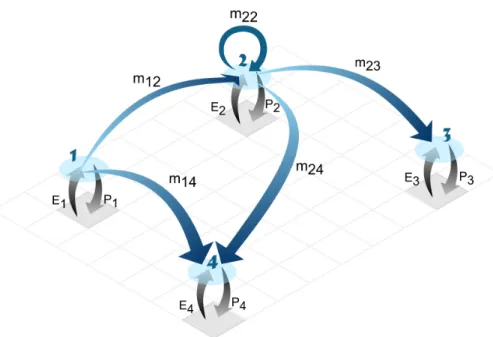
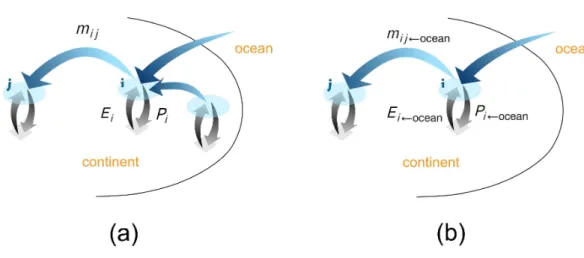
The moisture inflow (resp. outflow) that crosses the border of Ω may be counted several times as it is involved in several pathways of cascading moisture recycling. To avoid this, we only track moisture that crosses the border of Ω. This implies that we consider re-evaporation cycles outsideΩonly (Fig. 2, see also Appendix A2).
To study the cascading moisture recycling between the Amazon basin and the La
20
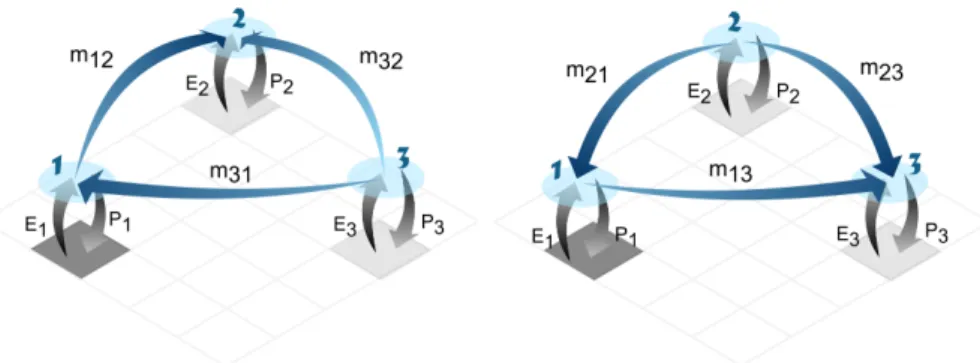
Plata basin, we useρcascΩ withΩbeing all grid cells covering the Amazon basin (ρcascAm ) andεcascΩ withΩbeing all grid cells covering the La Plata basin (εcascPl ). WhileρcascAm con-siders cascading recycling of moisture originating from the Amazon basin (see Fig. 2a), εcascPl provides information regarding the importance of cascading recycling of moisture that has final destination the La Plata basin (see Fig. 2b).
25
ACPD
14, 17479–17526, 2014Cascading moisture recycling
D. C. Zemp et al.
Title Page
Abstract Introduction
Conclusions References
Tables Figures
◭ ◮
◭ ◮
Back Close
Full Screen / Esc
Printer-friendly Version Interactive Discussion
Discussion
P
a
per
|
Discus
sion
P
a
per
|
Discussion
P
a
per
|
Discussion
P
a
per
and high values ofρAm andρcascAm highlight evaporative source regions of precipitation over the La Plata basin.
2.4 Quantifying cascading moisture recycling
In this section, we are interested in the importance of cascading moisture recycling for the total moisture inflow (precipitation) and outflow (evapotranspiration). To quantify
5
this, we forbid re-evaporation of moisture originating from the continent and we estimate the resulting reduction in total moisture inflow (∆Pc) and outflow (∆Ec) (see Appendix B).∆Pc/P is the fraction of precipitation that comes from cascading moisture recycling on the continent, i.e., that has been evaporated at least twice on the continent. It quan-tifies the dependency on cascading moisture recycling for local rainfall.∆Ec/E is the
10
fraction of total evapotranspiration that is involved in cascading moisture recycling on the continent, i.e., that comes from the continent and that further precipitates over the continent. It quantifies the contribution of a specific location to cascading moisture re-cycling. Regions which have a larger∆Ec/E than the 80 percentile (corresponding to 0.27 during the wet season and 0.17 during the dry season) are called "intermediary
15
regions".
In addition, we are interested in the importance of cascading moisture recycling in the intermediary regions for the total moisture in- and outflow. We use the same approach as above. We forbid re-evaporation in the intermediary region of moisture originat-ing from the continent and we estimate the resultoriginat-ing reduction in total moisture inflow
20
(∆Pm) (see Appendix B).∆Pm/P is the fraction of total moisture inflow that comes from cascading moisture recycling in the intermediary region. It can be seen as the fraction of precipitation that comes from the continent and that has been re-evaporated in the intermediary region. It quantifies the dependency on cascading moisture recycling in the intermediary region for local rainfall.
ACPD
14, 17479–17526, 2014Cascading moisture recycling
D. C. Zemp et al.
Title Page
Abstract Introduction
Conclusions References
Tables Figures
◭ ◮
◭ ◮
Back Close
Full Screen / Esc
Printer-friendly Version Interactive Discussion
Discussion
P
a
per
|
Discus
sion
P
a
per
|
Discussion
P
a
per
|
Discussion
P
a
per
|
2.5 Complex network analysis
We investigate important moisture recycling pathways using two measures from com-plex network analysis: clustering coefficient associated with Middleman motifs and be-tweenness centrality.
2.5.1 Clustering coefficient associated with Middleman motifs
5
In complex network theory, motifs are defined as significant and recurring patterns of interconnections that occur in the network (Milo et al., 2002). Here, we are interested in a particular pattern of directed triangles: the Middleman motif (Fagiolo, 2007). In our study, a grid cell forms a Middleman motif if is an intermediary on an alternative pathway to the direct transport of moisture between two other grid cells (Fig. 3).
10
The clustering coefficient is a measure from complex network analysis which mea-sures the tendency to form a particular motif (Fagiolo, 2007). Here, it reveals intermedi-ary locations in cascading moisture recycling pathways, as the alternative to the direct recycling of moisture between sources and sinks. We compute the weighted version of the clustering coefficient associated with Middleman motifs ( ˜C) (Fagiolo, 2007; Zemp
15
et al., 2014) for each grid cell as described in the Appendix C1. A grid cell has a high ˜
Cif it forms a lot of Middleman motifs and if these motifs contribute largely to relative moisture transport. ˜Cis equal to zero if the grid cell forms no Middleman motif at all.
It is worth to note that the Middleman motif considers three interconnected grid cells which corresponds to cascading moisture recycling pathways involving only one
re-20
evaporation cycle. These pathways contribute usually most to moisture transport be-tween two locations. In fact, the amount of moisture transported in a pathway typically decreases with the number of re-evaporation cycles involved in the pathway. Other mo-tifs formed by three or more grid cells linked by moisture recycling exist (Zemp et al., 2014), but are not analyzed here.
ACPD
14, 17479–17526, 2014Cascading moisture recycling
D. C. Zemp et al.
Title Page
Abstract Introduction
Conclusions References
Tables Figures
◭ ◮
◭ ◮
Back Close
Full Screen / Esc
Printer-friendly Version Interactive Discussion
Discussion
P
a
per
|
Discus
sion
P
a
per
|
Discussion
P
a
per
|
Discussion
P
a
per
2.5.2 Betweenness centrality
The betweenness centrality (B) aims to highlight nodes in the network with central position “to the degree that they stand between others and can therefore facilitate, impede or bias the transmission of messages” in the network (Freeman, 1977, p. 36). Here, we use it to reveal intermediary grid cells where cascading moisture recycling
5
pathways are channeled.
To compute it, we first identify for each pair of grid cells the moisture recycling path-ways with the greatest throughput, called “optimal pathpath-ways”. These pathpath-ways can include any number of re-evaporation cycles. As the optimal pathway is usually the direct one (without any re-evaporation cycle), we first had to modify the network such
10
that the optimal pathways involve cascading moisture recycling. To do so, we removed from the network all long-range moisture transport, i.e, occurring over distances larger than 15 geographical degrees. The choice of this threshold does not influence the re-sults qualitatively. Once optimal pathways are identified, we find intermediary grid cells that they have in common (see Appendix C2). A grid cell has a highBif many optimal
15
pathways pass through it, i.e., moisture often cascades in the grid cell, and has aB equal to 0 if none of these pathways pass through it, i.e., moisture never cascades in the grid cell.
2.5.3 Similarities and differences between the betweenness centrality and the
Middleman motif
20
We expect similar spatial patterns in the results of the B (Sect. 2.5.2) and the ˜C (Sect. 2.5.1). In fact, both measures reveal important intermediary grid cells in cascad-ing moisture recyclcascad-ing pathways. However, these two measures are based on different concepts and methods.
1. While theB is based on the optimal pathways, the ˜C relies on particular motifs
25
ACPD
14, 17479–17526, 2014Cascading moisture recycling
D. C. Zemp et al.
Title Page
Abstract Introduction
Conclusions References
Tables Figures
◭ ◮
◭ ◮
Back Close
Full Screen / Esc
Printer-friendly Version Interactive Discussion
Discussion
P
a
per
|
Discus
sion
P
a
per
|
Discussion
P
a
per
|
Discussion
P
a
per
|
2. An implication of (1) is that the ˜Crefers to cascading moisture recycling pathways as alternative to the direct transport of moisture between two locations, while the Bshows locations where cascading moisture recycling pathways are channeled.
3. In the ˜C, only cascading moisture recycling pathways with one re-evaporation cycle are considered. In theB, all number of cycles are possible in the pathways.
5
4. Moisture recycling pathways involving long-range transport are not considered in the calculation of theB.
For these reasons, theBand the ˜Care complementary measures.
3 Results and discussion
3.1 Comparison of continental and regional moisture recycling ratios with other
10
existing studies
The main continental source of precipitation in South America is the Amazon basin, with large heterogeneity in time and space (Fig. 4e and j and Table 2). The southern part of the Amazon basin contributes 80 % to continental precipitation during the wet season but only 40 % during the dry season. As the evapotranspiration in the Amazon
15
basin is high and varies little in space and time (Fig. 4b and g), this observation indi-cates that during the dry season, a high amount of moisture from the southern part of the Amazon basin is advected out of the continent. Using a Lagrangian particle disper-sion model, Drumond et al. (2014) also found a maximum contribution of moisture from the Amazon basin to the ocean during this period.
20
ACPD
14, 17479–17526, 2014Cascading moisture recycling
D. C. Zemp et al.
Title Page
Abstract Introduction
Conclusions References
Tables Figures
◭ ◮
◭ ◮
Back Close
Full Screen / Esc
Printer-friendly Version Interactive Discussion
Discussion
P
a
per
|
Discus
sion
P
a
per
|
Discussion
P
a
per
|
Discussion
P
a
per
season and 35 % during the dry season evaporated from the continent. This difference between seasons is explained by a weaker transport of oceanic moisture associated with the subtropical Atlantic high and by an intensification of the South American Low-Level Jet (SALLJ) which transports moisture in the meridional direction during this season (Marengo et al., 2004). The importance of continental moisture recycling in the
5
La Plata basin during the wet season has been emphasized in Drumond et al. (2008); Martinez et al. (2014). Despite this importance, we find that the ocean remains the main source of moisture in the La Plata basin in agreement with previous studies (Drumond et al., 2008; Arraut and Satyamurty, 2009; Drumond et al., 2014). However, some other studies estimated a higher contribution of moisture from the continent to precipitation
10
over the La Plata basin (van der Ent et al., 2010; Keys et al., 2012; Martinez et al., 2014).
There are uncertainties in the moisture recycling ratios depending on the quality of the datasets used, the assumptions made in the methods and the boundaries used to define the domain (for example in Brubaker et al., 1993, the Amazon region is
15
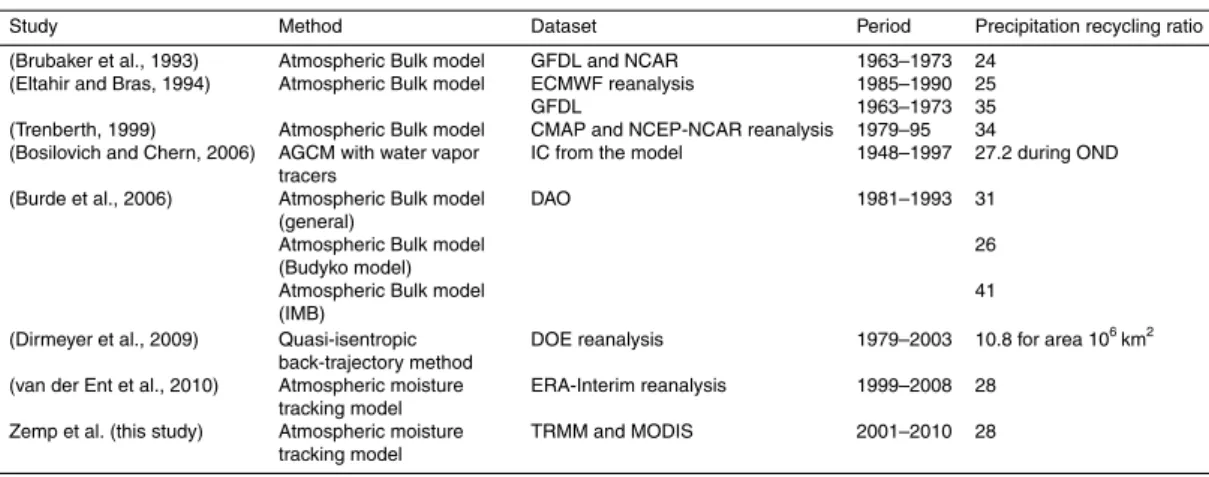
represented by a rectangle). Considering these uncertainties, the regional precipita-tion recycling ratio in the Amazon basin (Table 2) compares well with previous studies using other datasets and methodologies (See Table 1). The spatial patterns of con-tinental moisture recycling ratios (Fig. 4d, i, e and j) are slightly different from those found by (van der Ent et al., 2010, Figs. 3 and 4) due to the differences in the
ver-20
sions of the model (here we use WAM-2layers) and the datasets used. The continental precipitation recycling ratio in the Amazon basin reaching 30 % during the Southern Hemisphere summer is compatible with the estimation of 36.4 % found by Bosilovich and Chern (2006). The maps of direct recycling ratios (Fig. 7c, and g, a and e) are in good agreement with maps of regional recycling ratio presented in previous
stud-25
ies (Eltahir and Bras, 1994, Figs. 4 and 6 and Burde et al., 2006, Figs. 2 and 8 and Dirmeyer et al., 2009 see http://www.iges.org/wcr/, Moisture Sources by Basin).
ACPD
14, 17479–17526, 2014Cascading moisture recycling
D. C. Zemp et al.
Title Page
Abstract Introduction
Conclusions References
Tables Figures
◭ ◮
◭ ◮
Back Close
Full Screen / Esc
Printer-friendly Version Interactive Discussion
Discussion
P
a
per
|
Discus
sion
P
a
per
|
Discussion
P
a
per
|
Discussion
P
a
per
|
land–atmosphere coupling on the hydrological cycles increases during drought years (Bagley et al., 2014), this might influence the output of the atmospheric moisture track-ing model used in this study. Analyztrack-ing these periods separately is ongotrack-ing research.
3.2 Importance of cascading moisture recycling
Continental moisture recycling is of crucial importance for South American precipitation
5
patterns (Fig. 4). We now quantify this importance and identify intermediary and sink regions of cascading moisture recycling.
3.2.1 The dependency on cascading moisture recycling
The share of cascading moisture on total moisture inflow is on average 10 % in the South American continent. Regions which are dependent on cascading moisture
re-10
cycling for local rainfall (Fig. 5a and c) are also dominant sinks of moisture from the continent (Fig. 4d and i).
We note that cascading moisture contributes more to the precipitation over the Ama-zon basin during the dry season (11 % on average, up to 25 % in the western part) compared to the wet season (8 % on average) (Table 2). The inverse situation is
ob-15
served in the La Plata basin, where on average 14 % of the precipitation during the dry season and 17 % during the wet season comes from cascading moisture recycling (Table 2). In Sect. 3.4, we reveal the evaporative source of cascading moisture which precipitates over the La Plata basin and we understand this seasonal variability.
The share of cascading moisture on total moisture inflow reaches up to 50 % in the
20
eastern side of the central Andes (Fig. 5a and c), one of the most vulnerable biodi-versity hotspots on Earth (Myers et al., 2000). However, this latter observation should be considered with caution due to the imbalance of the water cycle in this area which might lead to an estimation of the regional recycling process and thus an over-estimation of the importance of cascading moisture recycling.
ACPD
14, 17479–17526, 2014Cascading moisture recycling
D. C. Zemp et al.
Title Page
Abstract Introduction
Conclusions References
Tables Figures
◭ ◮
◭ ◮
Back Close
Full Screen / Esc
Printer-friendly Version Interactive Discussion
Discussion
P
a
per
|
Discus
sion
P
a
per
|
Discussion
P
a
per
|
Discussion
P
a
per
3.2.2 The contribution of intermediary regions to cascading moisture recycling
The contribution of evapotranspiration from the Amazon basin to cascading moisture recycling in the continent reaches up to 25 % during the dry season in the central part of the Amazon basin and 35 % during the wet season in its southwestern part (Fig. 5b and d). These regions are important intermediaries in cascading moisture recycling
5
pathways.
In order to quantify the importance of these intermediary regions for regional rainfall over the La Plata basin, we quantify the share of the moisture inflow in the La Plata basin that has cascaded in these regions. This share is 8 % during the wet season and 4 % during the dry season. These estimations represent almost half of the share of
10
total moisture inflow that has cascaded in the entire continent during the wet season and one third during the dry season (Table 2). These results mean that the south-western part of the Amazon basin is an important intermediary for cascading moisture transported towards the La Plata basin during the wet season.
3.3 Complex network analysis
15
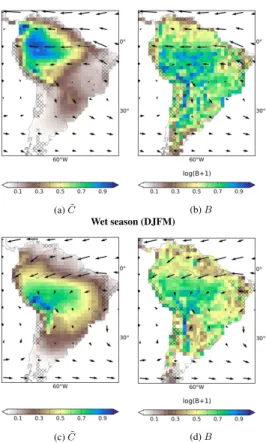
We have shown the importance of cascading moisture recycling for South American moisture transport (see Fig. 5). Using the clustering coefficient associated with the Middleman motif ( ˜C), we are able to identify intermediary locations involved in cas-cading moisture recycling as alternative pathways to the direct transport of moisture. These regions are the central part of the Amazon basin during the dry season and the
20
south-western part of the Amazon basin during the wet season (Fig. 6a and c). This is in good agreement with other measures quantifying the contribution of intermediary regions to cascading moisture recycling (Fig. 5b and d).
The betweenness centrality (B) reveals intermediary regions where cascading mois-ture recycling pathways are channeled. Regions with high B coincide with regions
25
ACPD
14, 17479–17526, 2014Cascading moisture recycling
D. C. Zemp et al.
Title Page
Abstract Introduction
Conclusions References
Tables Figures
◭ ◮
◭ ◮
Back Close
Full Screen / Esc
Printer-friendly Version Interactive Discussion
Discussion
P
a
per
|
Discus
sion
P
a
per
|
Discussion
P
a
per
|
Discussion
P
a
per
|
pathways in the calculating of theB, as we have shown that the incoming moisture over the La Plata basin during the dry season is mainly transported through direct (and thus long-range) moisture recycling pathways (Fig. 5a).
During the wet season, cascading moisture recycling pathways are channeled in the south-western part of the Amazon basin and a narrow band east of the subtropical
An-5
des (Fig. 6d). This observation may be explained by the combined effect of the acceler-ation of the South American Low Level Jet (Vera et al., 2006) and the high precipitacceler-ation and evapotranspiration during the wet season (Fig. 4) allowing for an intensive local exchange of moisture between the vegetation and the atmosphere.
3.4 Direct and cascading moisture recycling from the Amazon basin to the La
10
Plata basin
We have shown the importance of the Amazon basin as the dominant source of con-tinental moisture and the La Plata basin as a central sink region (see Fig. 4). In the following, we further investigate the transport mechanism between the two basins.
In the La Plata basin, 23 % of the precipitation during the wet season and 25 % during
15
the dry season originated from the Amazon basin through direct moisture recycling (Fig. 7c and g and Table 2). This is compatible with the yearly average estimates of 23 % found in Dirmeyer et al. (2009, see http://www.iges.org/wcr/) and 23.9 % found in Martinez et al. (2014). Considering cascading moisture recycling once moisture has left the Amazon basin (Fig. 2a) increases the dependency from 23 to 29 % during the
20
wet season (Fig. 7h and Table 2). As mentioned above, this might be explained by the high evapotranspiration and precipitation allowing for an exchange of moisture on the way, downwind of the Amazon basin, and by the intensification of the SALLJ during this time of the year (Marengo et al., 2004). This result suggests that the impact of deforestation in the Amazonian forest on the moisture supply in the La Plata basin
25
ACPD
14, 17479–17526, 2014Cascading moisture recycling
D. C. Zemp et al.
Title Page
Abstract Introduction
Conclusions References
Tables Figures
◭ ◮
◭ ◮
Back Close
Full Screen / Esc
Printer-friendly Version Interactive Discussion
Discussion
P
a
per
|
Discus
sion
P
a
per
|
Discussion
P
a
per
|
Discussion
P
a
per
The southern part of the Amazon basin is a direct source of precipitation over the La Plata basin, with a direct contribution reaching 15 % of its evapotranspiration during the dry season and 35 % during the wet season (Figs. 7a and 7e). This finding is in agree-ment with Martinez et al. (2014) who found that the southern part of the basin is an quasi-permanent direct source of moisture for the La Plata basin. However, if
cascad-5
ing moisture recycling are considered (Fig. 2b), the entire Amazon basin becomes the evaporative source of moisture over the La Plata basin during the wet season (Fig. 7f). The indirect contribution represents on average 7 % of the total evapotranspiration in the Amazon basin during the wet season (Table 2). This result means that during the wet season, the southern part of the Amazon basin is not only a source of moisture but
10
also an intermediary region where moisture originating from the entire basin cascades on its way to the La Plata basin. This finding is in agreement with other measures show-ing intermediary locations involved in cascadshow-ing moisture recyclshow-ing (see Sect. 3.2).
3.5 Possible impact of land cover change in the intermediary regions
The southern part of the Amazon basin is a key region for moisture transport towards
15
the La Plata basin. It is a source of moisture for precipitation over the La Plata basin all year round and it is in addition an intermediary region for cascading moisture recycling originating from the entire Amazon basin during the wet season (Sect. 3.4).
Land cover change in the southern part of the Amazon basin might weaken continen-tal moisture recycling and might lead to an important decrease in the tocontinen-tal precipitation
20
locally and downwind. Among the affected regions, important impacts would be ob-served in particular in the south-western part of the Amazon basin which has already a high probability to experience a critical transition from forest to savanna (Hirota et al., 2011) and in the La Plata basin which is dependent on incoming rainfall for the agri-culture (Rockström et al., 2009; Keys et al., 2012). In the eastern side of the central
25
ACPD
14, 17479–17526, 2014Cascading moisture recycling
D. C. Zemp et al.
Title Page
Abstract Introduction
Conclusions References
Tables Figures
◭ ◮
◭ ◮
Back Close
Full Screen / Esc
Printer-friendly Version Interactive Discussion
Discussion
P
a
per
|
Discus
sion
P
a
per
|
Discussion
P
a
per
|
Discussion
P
a
per
|
4 Conclusions
In this work we investigated the exchange of moisture between the vegetation and the atmosphere on the way between sources and sinks of continental moisture in South America. We have introduced the concept of “cascading moisture recycling” to refer to moisture recycling between two locations on the continent which involve one or more
5
re-evaporation cycles along the way. We have proposed measures to quantify the im-portance of cascading moisture recycling and to reveal direct and indirect sources and sinks of moisture for a given region. We have used for the first time a complex network approach to identify intermediary regions in the cascading moisture recycling path-ways.
10
Using the atmospheric moisture tracking model WAM-2layers (WAM-2 layers) forced by precipitation from TRMM and evapotranspiration from MODIS in South America, we have shown that even if the amount of water transported through cascading moisture recycling pathways is typically smaller than the one transported directly in the atmo-sphere, the contribution by the ensemble of cascading pathways can not be neglected.
15
In fact, 10 % of the total precipitation over South America and 17 % of the precipitation over the La Plata basin comes from cascading moisture recycling.
The La Plata basin is highly dependent on moisture from the Amazon basin during both seasons, as 23 % of the total precipitation over the La Plata basin during the wet season and 25 % during the dry season comes directly from the Amazon basin. To
20
these direct dependencies, 6 % of the precipitation during the wet season can be added if cascading moisture recycling outside the Amazon basin are considered. During the dry season, the main source of continental moisture over the La Plata basin is the southern part of the Amazon basin. During the wet season, the southern part of the Amazon basin is not only a source region but is also an intermediary region which
25
ACPD
14, 17479–17526, 2014Cascading moisture recycling
D. C. Zemp et al.
Title Page
Abstract Introduction
Conclusions References
Tables Figures
◭ ◮
◭ ◮
Back Close
Full Screen / Esc
Printer-friendly Version Interactive Discussion
Discussion
P
a
per
|
Discus
sion
P
a
per
|
Discussion
P
a
per
|
Discussion
P
a
per
recycling processes and may have stronger consequences for rainfed agriculture and natural ecosystems regionally and downwind as previously thought.
In addition, we showed that the eastern flank of the subtropical Andes – located in the pathway of the South American Low Level Jet – plays an important role in the con-tinental moisture recycling as it channels many cascading pathways. This study offers
5
new methods to improve our understanding of vegetation and atmosphere feedback on the water cycle needed in a context of land use and climate change.
Appendix A: Moisture recycling ratios
In these measures the irregular sizes of the portion of the Earth’s surface covered by the grid cells are taken into account as described in Zemp et al. (2014).
10
A1 Direct moisture recycling ratio
The fraction of precipitation in grid celljthat comes directly fromΩis calculated as:
ρΩ,j =
P
i∈Ωmi j Pj
, (A1)
wheremi jis the amount of moisture which evaporates ini and precipitates injandPjis
15
the precipitation inj. The fraction of evapotranspiration in grid celli which precipitates directly inΩis calculated as:
εΩ,i =
P
j∈Ωmi j
Ei , (A2)
whereEi is the evapotranspiration ini.
ACPD
14, 17479–17526, 2014Cascading moisture recycling
D. C. Zemp et al.
Title Page
Abstract Introduction
Conclusions References
Tables Figures
◭ ◮
◭ ◮
Back Close
Full Screen / Esc
Printer-friendly Version Interactive Discussion
Discussion
P
a
per
|
Discus
sion
P
a
per
|
Discussion
P
a
per
|
Discussion
P
a
per
|
A2 Cascading moisture recycling ratio
To calculate the cascading moisture recycling ratios as defined in Sect. 2.3.2, we cal-culate the individual contributions of cascading moisture recycling pathways consisting ofk re-evaporation cycles (k∈ {1,. . .,n}) which add up to the total cascading moisture recycling contribution. We chose a maximum number of cyclesn=100, while the
con-5
tribution of pathways with number of cycles larger than 3 are close to zero. If we track moisture forward in space, we have to take into account that moisture is lost as runoff on the way during the cascading recycling. This is not the case for moisture backward tracking in space because we quantify the remaining amount of moisture that actually arrives at destination.
10
A2.1 Cascading precipitation recycling ratio
The fraction of precipitation in grid celljthat comes fromΩthrough cascading moisture recycling involving one re-evaporation cycle is:
ρ(1)Ω,j =
P
i6∈Ωmji·ρΩ,i Pj
, (A3)
15
whereρΩj is the fraction of precipitation in j that comes directly from Ω (Sect. A1). Following the same principle as in Eq. (A3), the fraction of precipitation inj that comes fromΩthrough cascading moisture recycling involvingnre-evaporation cycles is:
ρ(Ωn,)j =
P
i6∈Ωmi j·ρ (n−1)
Ω,i Pj
, (A4)
20
ACPD
14, 17479–17526, 2014Cascading moisture recycling
D. C. Zemp et al.
Title Page
Abstract Introduction
Conclusions References
Tables Figures
◭ ◮
◭ ◮
Back Close
Full Screen / Esc
Printer-friendly Version Interactive Discussion
Discussion
P
a
per
|
Discus
sion
P
a
per
|
Discussion
P
a
per
|
Discussion
P
a
per
individual contributions of cascading recycling:
ρcascΩ,j =ρ(1)Ω,j+. . .+ρ(Ωn,)j. (A5)
A2.2 Cascading evapotranspiration recycling ratio
The fraction of evapotranspiration in grid celli that contributes to precipitation overΩ
5
through cascading moisture recycling involving one re-evaporation cycle is:
ε(1)Ω,i =
P
j6∈Ωmi j·εΩ,j·αj Ei
, (A6)
whereεΩ,j is the fraction of evapotranspiration inj which precipitates directly overΩ (Sect. A1) andαj=Ej/Pj. Similarly, the fraction of evapotranspiration ini that
precip-10
itates overΩ through cascading moisture recycling involvingn re-evaporation cycles is:
ε(Ωn,)i =
P
j6∈Ωmi j·ε (n−1)
Ω,j ·αj
Ei , (A7)
whereε(Ωn,−j1) is the fraction of evapotranspiration inj that precipitates overΩ through
15
cascading moisture recycling involvingn−1 re-evaporation cycles. The total fraction of evapotranspiration ini that precipitates overΩthrough cascading moisture recycling is the sum of the individual contribution of cascading recycling:
εcascΩ,i =ε(1)Ω,i+. . .+ε(Ωn,)i (A8)
20
Appendix B: Quantifying cascading moisture recycling
ACPD
14, 17479–17526, 2014Cascading moisture recycling
D. C. Zemp et al.
Title Page
Abstract Introduction
Conclusions References
Tables Figures
◭ ◮
◭ ◮
Back Close
Full Screen / Esc
Printer-friendly Version Interactive Discussion
Discussion
P
a
per
|
Discus
sion
P
a
per
|
Discussion
P
a
per
|
Discussion
P
a
per
|
we inhibit all cascading recycling of moisture from continental origin in the network (see Fig. B1). To achieve this, we derive for each grid cell the evaporation of moisture from oceanic origin (i.e., that has been last evaporated over the ocean) as in Eq. (1):
Ei←ocean= Ei
Pi ·Pi←ocean, (B1)
5
wherePi←ocean is the precipitation from oceanic origin ini (Pj←ocean=Pj−Pj←continent and Pj←continent=P
i∈continentmi j.). Using the same assumption, we get the moisture
transport between each pair of grid cellsi andj that results from evaporation of mois-ture from oceanic origin only:
mi j←ocean= mi j
Ei
·Ei←ocean, (B2)
10
At this stage,mi j←oceancan be interpreted as the evapotranspiration ini which precipi-tates inj and which has been evaporated from the ocean before that (mi j←ocean< mi j). In a second step, we derive the corresponding moisture in- and outflow from or to-wards a given regionΩfor each grid cell:
15
Pj←Ω,o=X i∈Ω
mi j←ocean (B3a)
Ei→Ω,o=X j∈Ω
mi j←ocean. (B3b)
Pj←Ω,o can be interpreted as the precipitation in j originating from the re-evaporation of oceanic moisture in Ω. Similarly, Ei→Ω,o can be seen as the evapotranspiration of
20
oceanic moisture ini which precipitates overΩ.
Thus, are able to derive the corresponding reduction in total moisture inflow towards Ωor outflow fromΩ:
∆Pj←Ω=Pj←Ω−Pj←Ω,o (B4a)
∆Ei→Ω=Ei→Ω−Ei→Ω,o, (B4b)
ACPD
14, 17479–17526, 2014Cascading moisture recycling
D. C. Zemp et al.
Title Page
Abstract Introduction
Conclusions References
Tables Figures
◭ ◮
◭ ◮
Back Close
Full Screen / Esc
Printer-friendly Version Interactive Discussion
Discussion
P
a
per
|
Discus
sion
P
a
per
|
Discussion
P
a
per
|
Discussion
P
a
per
where Pj←Ω=P
i∈Ωmi j is the total precipitation in j originating from Ω and Ej→Ω=
P
j∈Ωmi j is the total evapotranspiration in i which contributes to precipitation over Ω. Thus,∆Pj←Ω is the precipitation in j originating from the re-evaporation of
continen-tal moisture in Ω and ∆Ei→Ω is the re-evaporation of continental moisture in i which precipitates overΩ.
5
IfΩis the entire South American continent (resp. the intermediary region),∆Pj←Ω
be-comes∆Pc(resp.∆Pm) and∆Ei→Ωbecomes∆Ec(resp.∆Em) as defined in Sect. 2.4.
Appendix C: Complex network analysis
C1 Clustering coefficient associated with Middleman motifs
Mathematically, the clustering coefficientCof the grid celli is:
10
Ci = ti Ti
, (C1)
whereti is the number of Middleman motifs thati forms and Ti is the total number of that motif thati could have formed according to its number of incoming and outgoing arrows. To give more weight to a motif involved in the transport of a larger amount
15
of moisture, we assign a weight to each motif. In agreement with Fagiolo (2007), the weight of a motif is defined as the geometric mean of the weights of the three involved arrows. The weighted counterpart of Eq. (C1) is:
˜ Ci = t˜i
Ti, (C2)
20
with ˜ti the weighted counterpart of ti (i.e., the sum of the weights of the Middleman motifs that is formed byi).
ACPD
14, 17479–17526, 2014Cascading moisture recycling
D. C. Zemp et al.
Title Page
Abstract Introduction
Conclusions References
Tables Figures
◭ ◮
◭ ◮
Back Close
Full Screen / Esc
Printer-friendly Version Interactive Discussion
Discussion
P
a
per
|
Discus
sion
P
a
per
|
Discussion
P
a
per
|
Discussion
P
a
per
|
irregular sizes of the portion of the Earth’s surface covered by the grid cells as explained in (Zemp et al., 2014). The numerator of Eq. (C2) can be derived as ˜ti =(PPTP)i i with
P={p1i j/3}i,j∈N andpi jis the weight of the arrow originating fromiand pointing towards j. Here, in order to avoid a strong correlation between the clustering coefficient and the mean evapotranspiration and precipitation, we chose this weight to bepi j=m2i j/(EiPj).
5
The denominator of Eq. (C2) isTi =kiinkioutwherekiin is the number of arrows pointing towardsi andkioutthe number of arrows originating fromi:
kiin=X j6=i
aji, (C3a)
kiout=X j6=i
ai j, (C3b)
10
whereai j =1 if there is an arrow originating fromi and pointing towardsj andai j=0 otherwise. In order to compare the results for the two seasons, we normalize ˜C with the maximum observed value for each network.
C2 Optimal pathways and betweenness
C2.1 Optimal pathway
15
In complex network theory, many centrality measures (e.g. closeness and between-ness) are based on the concept of a shortest path. The shortest path is usually defined as the pathway between nodes which has the minimum cost. In this work, it is defined as the pathway which contributes most to the moisture transport between two grid cells. As this pathway is not necessarily the shortest one in term of geographical distance,
20
we will call it “optimal pathway” to avoid confusion.