Article
Printed in Brazil - ©2013 Sociedade Brasileira de Química0103 - 5053 $6.00+0.00
A
*e-mail: [email protected]
Theoretical Spectroscopic Study of the Conjugate
Microcystin-LR-Europium Cryptate
Júlio G. Santos,a José Diogo L. Dutra,a Severino Alves Junior,b Gilberto F. de Sá,b
Nivan B. da Costa Juniora and Ricardo O. Freire*,a
aDepartamento de Química, Universidade Federal de Sergipe, 49100-000 São Cristóvão-SE, Brazil
bDepartamento de Química Fundamental, Universidade Federal de Pernambuco, 50590-470 Recife-PE, Brazil
Neste trabalho, ferramentas teóricas foram utilizadas no estudo de propriedades espectroscópicas do conjugado microcistina-LR-criptato de európio. O modelo Sparkle/AM1 foi aplicado na previsão da geometria do sistema e o modelo INDO/S-CIS foi utilizado no cálculo das energias dos estados excitados. Os parâmetros de Intensidade foram previstos baseados na teoria Judd-Ofelt e o modelo teórico baseado na teoria das transições 4f-4f foi aplicado no cálculo das taxas de transferência e de retrotransferência de energia, taxas de decaimento radiativo e não radiativo, eficiência e rendimento quânticos. Um estudo detalhado das propriedades luminescentes do conjugado microcistina-LR-criptato de európio foi realizado. Os resultados mostram que o rendimento quântico teórico de 23% está em bom acordo com valores experimentais publicados. Este fato sugere que este protocolo teórico pode ser usado para a concepção de novos sistemas objetivando melhorar as propriedades luminescentes. Os resultados sugerem que este sistema luminescente pode ser um bom conjugado para ser usado no teste ELISA para detecção por fluorescência da microcistina-LR em água.
In this work, theoretical tools were used to study spectroscopic properties of the conjugate microcystin-LR-europium cryptate. The Sparkle/AM1 model was applied to predict the geometry of the system and the INDO/S-CIS model was used to calculate the excited state energies. Based on the Judd-Ofelt theory, the intensity parameters were predicted and a theoretical model based on the theory of the 4f-4f transitions was applied to calculate energy transfer and backtransfer rates, radiative and non-radiative decay rates, quantum efficiency and quantum yield. A detailed study of the luminescent properties of the conjugate Microcystin-LR-europium cryptate was carried out. The results show that the theoretical quantum yield of luminescence of 23% is in good agreement with the experimental value published. This fact suggests that this theoretical protocol can be used to design new systems in order to improve their luminescence properties. The results suggest that this luminescent system may be a good conjugate for using in assay ELISA for detection by luminescence of the Microcystin-LR in water.
Keywords: theoretical prediction, luminescence, Sparkle Model keyword, supramolecular
compounds
Introduction
The research involving luminescent lanthanide systems has grown since the late 80.1 The search of luminescent
lanthanide complexes has been substituted by the study of interesting systems known as metal-organic frameworks (MOF).2-4 However, the interest in lanthanide cryptates
still remains.5-7 This fact can be explained by the possibility
of the potential use of such complexes as luminescent materials, chemical probes and new sensors for biological applications.8
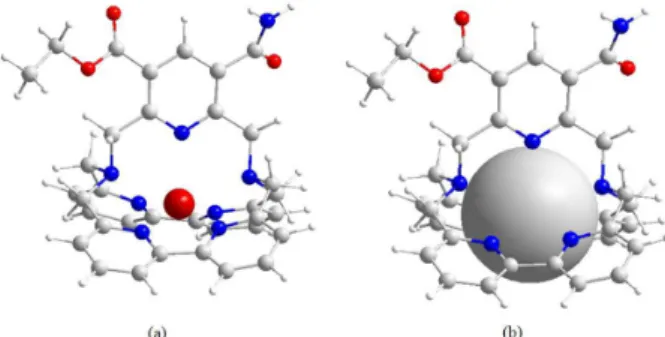
This kind of ligand can encapsulate the lanthanide ion preventing the coordination of molecules having CH, NH or OH bonds This avoids the quenching of the luminescence due nonradiative deactivation via the C–H, N–H or O–H vibrations.9 Figure 1 shows an example of cryptate ligand.
molecules. Figure 1b gives us an idea of the size of this cavity. In this cryptate, for example, it is possible insert a sphere with a radius of 2.3 Å.
In order to become useful this kind of complex as label of biological molecules, the cryptate must have a reactive group for attachment of a biomolecule. In the complex shown in Figure 1, this group linked to pyridine group can be observed. The formation of macromolecular adducts between a lanthanide complex and a biomolecule such as a protein or enzyme could be reached via the formation of either covalent or noncovalent interactions.
In 2004, Vila-Nova et al.10 published the synthesis,
characterization and experimental study of the spectroscopic properties of lanthanide cryptates [Ln⊂(bipy)2py(CO2Et)2]3+
with Ln = Eu3+, Tb3+ or Gd3+. In this work, the authors
observed in solution a quantum yield of luminescence of 25 and 14% for the systems with Tb3+ and Eu3+, respectively.
They concluded that the better resonance between the ligand triplet state and the Tb3+ excited levels can justify
the luminescence of the systems. Moreover, they carried out with the theoretical study of the [Eu⊂(bipy)2py(CO2Et)2]3+
that presented a theoretical quantum yield of 19%. Based on this results, two years later, a new work was published and Vila-Nova et al.8 proposed a
fluorescent-labeled microcystin-LR [Tb⊂(bipy)2py(CO2Et)2]3+ cryptate.
This work was motivated by a tragic accident that happened in the Caruaru City in the Northeast of Brazil in 1996. At that time, 76 of a total of 131 patients dead during a haemodialysis treatment. This accident happened because the water used in the procedure was contaminated with microcystin. This cyanobacterium is very resistant to high temperatures, and when it is present in the water, keeps the toxicity even after boiling. In humans, the microcystins can lead to a higher incidence of liver cancer.11 However, it has a more potent
action when applied directly into the bloodstream than when ingested, explaining the large number of deaths in Caruaru City. As result of this work, Vila-Nova et al.8 obtained
the conjugate Microcystin-LR-terbium cryptate and the spectroscopic study showed that the system is luminescent.
To use the assay ELISA for detection of Microcystin-LR in water by luminescense, the luminescent cryptate must be linked to Microcystin-LR. The concentration of the cyanobacteria is determined by a correlation with the observed luminescence. Thereby, it is fundamental that the cryptates present luminescence in solution. The conjugate obtained by Vila-Nova et al.8 is not appropriated because it
displays low luminescence intensity after the conjugation. In this work, our group used theoretical tools for the study of the luminescent properties of the conjugate Microcystin-LR-europium cryptate aiming to understand details involved in the luminescent process. This detailed comprehension, hereafter, can be used to design new systems with high luminescence, more appropriated for application in assay ELISA.
Methodology
The ground state geometry of the conjugate microcystin-LR-europium cryptate was calculated using the Sparkle/AM1 model,12-14 implemented in the Mopac 2009
package.15 The keywords used in the calculation reported in
this work were: AM1, PRECISE, BFGS, GNORM = 0.25, SCFCRT = 1.D-10 (to increase the SCF (self consistent field) convergence criterion) and XYZ (for cartesian coordinates). The Sparkle/PM316 and Sparkle/PM617
models were also applied and showed similar results to those obtained with the Sparkle/AM1 model.
The Sparkle/AM1 optimized geometry was used to calculate the singlet and triplet excited states using configuration interaction single (CIS) based on the intermediate neglect of differential overlap/spectroscopic (INDO/S) technique18,19 implemented in ZINDO program.20
The intensity parameters Ωλ (λ = 2, 4 and 6 ) were
calculated using the Judd-Ofelt theory21,22 after which the
Ωλ parameters are defined by:
(1)
with
(2)
The Bltp parameter consists of the sum of two terms:
the first term contributes positively and refers only to the forced electric dipole component whereas the second term contributes negatively and refers only to the dynamic coupling component. Details on the parameters of equations 1 and 2 are widely discussed in the literature.23-25
The calculated intensity parameters associated with the singlet and triplet energies and RL values were used to
calculate the energy transfer and backtransfer rates. The RL
values were calculated by:
(3)
with ci being the molecular orbital coefficient of the atom i
contributing to the ligand state (triplet or singlet) involved in the energy transfer, and RL,i corresponding to the distance
from atom i to the Eu3+ ion.
The energy transfer rates are obtained by the sum of two terms: WETemobtained from the exchange mechanism and WETemobtained from the multipolar mechanism. These terms
were calculated by:
(4)
and
(5)
where S is the total spin operator of the lanthanide ion, µZ is the
z component of the electric dipole operator and sm (m = 0, ± 1) is a spherical component of the spin operator (both for the ligand electrons), and σ0 is a distance-dependent screening factor.G is the degeneracy of the ligand initial state and a
specifies a given 4f spectroscopic term, J is the total angular
momentum quantum number of the lanthanide ion.
The quantity F corresponds to the factor dependent
of the temperature, and contains a sum about the Frank Condon’s factors, given by:
(6)
where γL is the ligand state band width-at-half-maximum, and ∆ is the transition energy difference between the donor and acceptor involved in the transfer process.
(7)
The theoretical quantum yield of the 5D
0 level is given
by:
(8)
where is the total radiative decay rate from the
5D
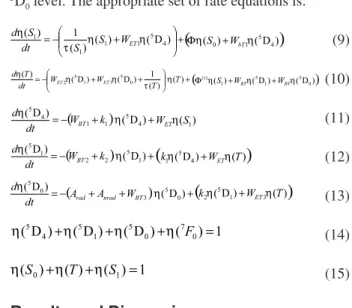
0 level. The appropriate set of rate equations is:
(9)
(10)
(11)
(12)
(13)
(14)
(15)
Results and Discussions
Figure 2 shows the optimized ground state geometry of this structure. It is possible to assume that the europium cryptate was linked to microcystin-LR by a small spacer. The coordination polyhedron of the europium cryptate is formed by seven nitrogen atoms of the polydentate ligand (Figure 1b) and one oxygen atom from the water molecule.
Table 1 presents the intensity parameters Ωλ
(λ = 2, 4 and 6), radiative (Arad) and non-radiative (Anrad)
decay rates, quantum efficiency (η) and quantum yield (q)
values calculated for [Eu⊂(bipy)2py(CO2Et)2]3+cryptate and
for the conjugate microcystin-LR-europium cryptate. The results obtained for [Eu⊂(bipy)2py(CO2Et)2]3+cryptate agree
perfectly with the results published by Vila-Nova et al.10
In the analysis of the results calculated for the conjugate microcystin-LR-europium cryptate, the small values of the Ω2 and Ω4 parameters suggest the occurrence of a chemical
environment weakly polarizable and rigid surrounding the europium trivalent ion. This observation is consistent with the nature of the macrocyclic ligand coordinated to the europium ion. The Arad decay rate is approximately 1/3 of
the Anrad decay rate. This fact justifies the quantum yield
of about 23%.
The ideal energy transfer condition occurs when the excited state of the ligand is about 1500 cm-1 above of the
europium excited state. As can be observed in Table 2, the singlet excited state is about 3000 cm-1 above 5D
4 level.
This fact explains the small S → 5D
4 energy transfer
rate (5.7 × 10⁵ s-1). Taking attention to the excited triplet
energy of the ligand, the differences considering 5D 1 and 5D
0 excited levels are 8366 and 10100 cm-1 respectively.
However, it is possible to assume that the T →5D 1 and
T →5D
0 energy transfer rates are greater than the S → 5D
for the 5D
0 and 5D1 levels, the exchange mechanism
dominates, whereas for the 5D
4 levels, the dipole-dipole
mechanism is the most important one. At first, the energy transfer between the triplet and 5D
0 is forbidden for
both mechanisms, but this selection rule can be relaxed due to the thermal population of the 7F
1 level at room
temperature and via the mixing of the J states due to the
interaction with the ligand field.
In Figure 3, it is presented an energy level diagram showing the most probable channel for the intramolecular energy transfer process. Full lines concern the radiative transitions, whereas the dashed lines concern those associated with non-radiative paths. The curved lines are related to the ligand → lanthanide energy transfer or backtransfer. Typical values of the remaining transfer rates were assumed to be identical to those found for coordination compounds, namely Φ = 104, Φ(1) = 108,
1/τ(S1) = 106 and 1/τ(T) = 105 s−1.26 The energy transfer
rates from the ligand singlet state (S1) to the 5D
4 level and
from the ligand triplet state (T1) to the 5D
1 and 5D0 levels
are summarized in Table 2.
Conclusions
In the present work, it was carried out a theoretical spectroscopic study of the conjugate microcystin-LR-Figure 2. The ground state geometry of the conjugate microcystin-LR-europium cryptate calculated using the semiempirical Sparkle/AM1 model.13
Table 1. Theoretical intensity parameters Ω2, Ω4 and Ω6, radiative (Arad) and non-radiative (Anrad) decay rates, quantum efficiency (η) and quantum yield
(q) values
Intensity parameters / 10–20 cm2
Arad / s–1 Anrad / s–1 η / % q / %
Ω2 Ω4 Ω6
[Eu⊂(bipy)2py(CO2Et)2]3+ 3.96 5.34 0.07 250.7 1046.5 19.3 19.1
Microcystin-LR + [Eu⊂(bipy)2py(CO2Et)2]3+ 5.92 4.70 0.06 299.8 998.9 23.1 22.9
Table 2. Calculated values of intramolecular energy transfer and backtransfer rates for microcystin-LR-europium cryptate
Structure Ligand state / cm–1 4f state / cm–1 R
L / Å Transfer rate / s–1 Backtransfer rate / s–1
Sparkle/AM1 singlet (30522.7) → 5D
4 (27586) 3.97 WET1 = 5.7 × 10⁵ WBT1 = 4.5 × 10⁻¹
triplet (27392.8) → 5D
1 (19027) 5.18 WET2 = 1.5 × 10⁸ WBT2 = 6.2 × 10⁻¹⁰
triplet (27392.8) → 5D
0 (17293) 5.18 WET3 = 3.3 × 10⁷ WBT3 = 2.8 × 10⁻¹⁴
Figure 3. Energy level diagram for the conjugate
europium cryptate. All luminescent properties were calculated using well-established models. The results suggest a quantum yield of luminescence of about 23% for the europium cryptate when conjugate to microcystin-LR protein. The results show that the predicted parameter is in a good agreement with the experimental data. This suggests that the theoretical protocol applied here can be used to design new systems in order to improve their luminescence properties. This luminescent system may be a good conjugate to be used in the ELISA assay for detection by luminescence of the microcystin-LR in water.
Acknowledgments
We appreciate the financial support from the Brazilian agencies, institutes and networks: CNPq, CAPES, FAPITEC-SE, INAMI and RENAMI. The authors also thank Dra. Iara de Fátima Gimenez for the revision of the text.
References
1. de Sá, G. F.; Malta, O. L.; de Mello Donegá, C.; Simas, A. M.; Longo, R. L.; Santa-Cruz, P. A.; da Silva Jr., E. F.; Coord. Chem. Rev.2000, 196, 165.
2. Carlos, L. D.; Almeida Paz, F. A.; Ananias, D.; Chem. Soc. Rev.
2011, 40, 926.
3. Weber, I. T.; Terra, I. A. A.; Melo, A. J. G. D.; Lucena, M. A. D. M.; Wanderley, K. A.; Paiva-Santos, C. O.; Antônio, S. G.; Nunes, L. A. O.; Paz, F. A. A.; de Sá, G. F. ; Júnior, S. A.; Rodrigues, M. O.; RSC Advances2012, 2, 3083.
4. Rodrigues, M. O.; Paz, F. A.; Freire, R. O.; de Sa, G. F.; Galembeck, A.; Montenegro, M. C.; Araujo, A. N.; Alves, S.;
J. Phys. Chem. B2009, 113, 12181.
5. Alzakhem, N.; Bischof, C.; Seitz, M.; Inorg. Chem.2012, 51, 9343.
6. Santos, J. G.; Dutra, J. D. L.; Alves Jr., S.; Freire, R. O.; da Costa Jr., N. B.; J. Phys. Chem. A2012, 116, 4318.
7. Ohtsu, H.; Suzuki, T.; Ohtsuka, H.; Ishii, A.; HasegawaM.;
Monatsh. Chem. 2009, 140, 783.
8. Oliveira, E. J. A.; Vila Nova, S. P.; Alves Jr., S.; Santa-Cruz, P.; Molica, R. J. R.; Teixeira,A.; Malageño, E.; Filho, J. L. L.;
J. Braz. Chem. Soc.2006, 17, 243.
9. Bischof, C.; Wahsner, J.; Scholten, J.; Trosien, S.; Seitz, M.;
J. Am. Chem. Soc.2010, 132, 14334.
10. Vila-Nova, S. P.; Pereira, G. A. L.; Albuquerque, R. Q.; Mathis, G.; Bazin, H.; Autiero, H.; de Sá, G.F.; Alves Jr., S.; J. Lumin.
2004, 109, 173.
11. Chorus, I.; Bartram, J.; Toxic Cyanobacteria in Water: A Guide to their Public Health Consequences, Monitoring and
Management; E & FN Spon: London, 1999, p.416.
12. de Andrade, A. V. M.; da Costa, Jr., N. B.; Simas, A. M.; de Sá, G. F.; Chem. Phys. Lett.1994, 227, 349.
13. Freire, R. O.; Rocha, G. B.; Simas, A. M.; Inorg. Chem.2005,
44, 3299.
14. Freire, R. O.; Costa Jr., N. B.; Rocha, G. B.; Simas, A. M. J.;
Chem. Theory and Comput.2006, 2, 64.
15. Stewart, J. J. P.; MOPAC 2009, Stewart Computational Chemistry: Colorado Springs, USA, 2009.
16. Freire, R. O.; Rocha, G. B.; Simas, A. M.; J. Braz. Chem. Soc.
2009, 20, 1638.
17. Freire R. O. and Simas, A. M.; J Chem Theory and Comput.
2010, 6, 2019.
18. Ridley, J. E.; Zerner, M. C.; Theor. Chim. Acta1976, 42, 223. 19. Zerner, M. C.; Loew, G. H.; Kirchner, R. F.; Mueller-Westerhoff,
U. T.; J. Am. Chem. Soc.1980, 102, 589.
20. Zerner, M. C.; ZINDO Manual QTP; University of Florida:
Gainesville, USA, 1990.
21. Judd, B. R.; Phys. Rev.1962, 127, 750.
22. Ofelt, G.S.; J. Chem. Phys.1962, 37, 511.
23. Malta, O. L.; Ribeiro, S. J. L.; Faucher, M.; Porcher, P.; J. Phys. Chem. Solids1991, 52, 587.
24. Malta, O. L.; Couto dos Santos, M. A.; Thompson, L. C.; Ito, N. K.; J. Lumin.1996, 69, 77.
25. Malta, O. L.; Brito, H. F.; Meneses, J. F. S.; Silva, F. R. G.; Alves Jr., S.; Farias Jr., F. S.; de Andrade, A. V. M.; J. Lumin.
1997, 75, 255.
26. Malta, O. L.; e Silva, F. R. G.; Longo, R.; Chem. Phys. Lett.
1999, 307, 518.
Submitted: November 15, 2012