TEMPORAL VARIATION IN VEGETATIVE DEVELOPMENT OF
Caulerpa scalpelliformis
(CHLOROPHYTA) FROM BALEIA
BEACH, ILHA GRANDE BAY (RIO DE JANEIRO, BRAZIL)
Marcelo Augusto Vasconcelos1, Carolina Leite Queiroga Schubart2 and Maria Teresa Menezes de Széchy1*
1Universidade Federal do Rio de Janeiro – Instituto de Biologia
Departamento de Botânica
(Rua Professor Rodolpho P. Roço, 211, sala A-99, 21941-902 Ilha do Fundão, RJ, Brasil)
2Associação Nacional dos Fiscais Federais do Meio Ambiente
(Ed. Porto do Lago, Lago Norte, Brasília, DF, Brasil) *Corresponding author: [email protected]
A
B S T R A C TCaulerpa scalpelliformis grows on rocky and sandy bottoms at different depths in Jacuacanga Cove,
Ilha Grande Bay, where it can form dense patches. The invasive behavior of this and other species of
Caulerpa is well documented in the literature. This study analyzed the variation of the vegetative development of C. scalpelliformis from Baleia Beach (23°01’63’’S and 44°14’18’’W) in Jacuacanga Cove, from June 2003 to September 2004, including plants from rocky and sandy substrates. Morphometric and dry weight data from the erect and prostrate portions were used. Plants were collected from 20 x 20 cm2 plots (n=3), randomly positioned on the rocky boulders (≅1.5 m depth)
and on contiguous sandy bottom (≅3.0 m depth). During the study period, C. scalpelliformis
occurred on both substrates as a pseudo-perennial species, showing partial loss of the erect portions from winter to spring; the height and dry weight of the erect portions increased from summer to autumn on both substrates. The temporal variation of C. scalpelliformis vegetative development in Baleia Beach was similar to that described for the invasive C. racemosa and C. taxifolia from different geographical regions of the world.
R
E S U M OCaulerpa scalpelliformis cresce sobre substrato rochoso e arenoso a diferentes profundidades na Enseada de Jacuacanga, Baía da Ilha Grande, onde pode formar bancos densos. O comportamento invasor desta e de outras espécies de Caulerpa é bem documentado na literatura. Este estudo analisou
a variação do desenvolvimento vegetativo de C. scalpelliformis da Praia da Baleia (23°01’63’’S e
44°14’18’’W), Enseada de Jacuacanga, de junho de 2003 a setembro de 2004, considerando plantas do substrato rochoso e do fundo de areia. Dados morfométricos e de peso seco das porções prostrada e ereta foram usados. Plantas foram coletadas em quadrados de 20 cm de lado (n=3), posicionados aleatoriamente sobre o substrato rochoso (profundidade ≅ 1,5 m) e sobre o substrato arenoso (profundidade ≅ 3,0 m). Durante o período de estudo, C. scalpelliformis ocorreu nos dois substratos como espécie pseudo-perene, mostrando perda parcial das porções eretas do talo do inverno para a primavera; altura e massa seca das porções eretas mostraram tendência de aumento do verão para o outono nos dois substratos. A variação temporal do desenvolvimento vegetativo de C. scalpelliformis
na Praia da Baleia foi similar à descrita para C. racemosa e C. taxifolia, espécies invasoras em
diferentes regiões do mundo.
Descriptors: Brazil, Caulerpales, Chlorophyta, Invasive species, Rocky shores, Sandy bottom, Temporal variation, Vegetative development.
Descritores: Bioinvasão, Brasil, Caulerpales, Chlorophyta, Costões rochosos, Substrato arenoso, Variação temporal, Desenvolvimento vegetativo.
I
NTRODUCTIONCaulerpa scalpelliformis (R. Br. ex Turner) C. Agardh (Chlorophyta, Ulvophyceae) has been recorded since 1965 in the tropical regions of the Brazilian coast, where its distribution extends from the states of Piauí to Espírito Santo (JOLY et al., 1965;
the species had become established in the area. Its invasive behavior was characterized by its ability to replace Sargassum vulgare C. Agardh, the dominant species on Ilha Grande Bay rocky shores. Figueiredo and Tâmega(2007),in a survey of the diversity ofthe macroalgae of Ilha Grande Bay carried out in the summer of 2003 and winter of 2004, also found C. scalpelliformis on Biscaia Beach, in Jacuacanga Cove, and onMacacos Island near Ilha Grande.
Caulerpa scalpelliformis is also recognized as an introduced and invasive species in the Mediterranean Sea (VERLAQUE, 1994; ERTAN et al., 1998) and in Australia (DAVIS et al., 1997). Other species of Caulerpa J. V. Lamour., such as C. taxifolia (H. West in Vahl) C. Agardh and C. racemosa (Forssk.) C. Agardh, are considered invasive species in the Mediterranean Sea (BOUDOUREQUE et al., 1995; BELLAN-SANTINI et al., 1996; PIAZZI et. al., 2001; CECCHERELLI et. al., 2002; BALATA et al., 2004; PIAZZI;BALATA, 2009), in Australia (MODENA et. al., 2000) and along the Californian coast, USA (WILLIAMS; GROSHOLZ, 2002), because of their high rates of growth and dispersal. The invasive capability of seaweed species is related to their resistance to herbivores, growth rate, vegetative reproduction, and successful adhesion to different substrates, among other attributes (VALENTINE et al., 2007). Invasive Caulerpa species show high rates of vegetative development, which can be analyzed by measuring the growth of their erect and prostrate portions (MEINESZ et al., 1993; MEINESZ et al., 1995; PIAZZI et al., 2001; RUITTON et al., 2005; CEBRIAN, BALLESTEROS, 2009). They are able to cause disturbance to the communities they invade (MEINESZ; HESSE, 1991; VILLÈLE;VERLAQUE, 1995) because of their high biomass and density (PIAZZI et al., 2001; THIBAUT et al., 2004; KLEIN; VERLAQUE, 2008).
The marine habitats that are most susceptible to the introduction of exotic benthic species are those near ports and those subject to intense and constant commercial navigation. On the other hand, in areas that are not located near ports, the vectors for the introduction of exotic species are related to non-commercial shipping and to tourist activities such as fishing and aquatic recreation (HEWITT et al., 2007). In Ilha Grande Bay, in addition to the presence of two operating ports, a shipyard, mariculture structures, and many fishing villages, there is intense shipping activity related to tourism (CREED et al., 2007). Therefore, Ilha Grande Bay is considered to be a favorable environment for the introduction of exotic species (PAULA, CREED, 2004).
This study aimed to describe the temporal variation of the vegetative development of C. scalpelliformis, growing on the rocky and sandy substrates of Baleia Beach.
M
ATERIAL ANDM
ETHODSBaleia Beach is situated on Ponta Leste (23°01’63’’S – 44°14’18’’W), between Biscaia and Paraíso Beaches in Jacuacanga Cove, Ilha Grande Bay, Angra dos Reis municipality, Rio de Janeiro state. Jacuacanga Cove receives domestic sewage from Monsuaba village, a growing residential center (personal observation).
Access from the mainland to Baleia Beach is restricted due to the construction of private residences along the somewhat steep coastal strip; however, this beach is frequently visited by motorboats engaged in tourism and fishing, looking for sheltered waters. The narrow, sandy belt of Baleia Beach is bordered by an extensive strip of rocky boulders that extends from the supralittoral zone to the shallow sublittoral zone.
From June 2003 to September 2004, sampling was carried out along a 20 m horizontal length of the sublittoral zone on the left side of the sandy belt of the Baleia Beach, including the rocky boulders (rocky substrate) and the contiguous sandy bottom (sandy substrate). This location was chosen based on the previous record of Caulerpa scalpelliformis patches, both on the rocky substrate, where it was intermingled with Sargassum vulgare, and on the sandy bottom (FALCÃO; SZÉCHY, 2005).
On the rocky and sandy substrates, three randomly positioned plots of 20 x 20 cm2 were
sampled by snorkeling at two to three month intervals. The rocky substrate plots were positioned ata water depth of approximately 1.5 m, and the sandy substrate plots were approximately 3.0 m deep during high tides. The plots were scraped and the material collected was stored in individual plastic bags containing a 4% formaldehyde solution.
The vegetative development of Caulerpa scalpelliformis growing on both substrates was analyzed in the different seasons using both morphometric and dry weight data related to the erect and prostrate portions. The erect portions were constituted of the laminae and their stipes, and the prostrate portions were constituted of the stolons and their rhizoidal pillars (Fig. 1).
For each plot, Caulerpa scalpelliformis was separated from other organisms. Fifteen-centimeter-long fragments of C. scalpelliformis stolons were haphazardly chosen for the morphometric analysis (n=5). For each C. scalpelliformis fragment, the height of the erect portions (n=5) and the length of the rhizoidal pillars (n=5) were measured.
The temporal variation in the height and dry weight of the erect portions, the length of the rhizoidal pillars and the dry weight of the prostrate portions of Caulerpa scalpelliformis were described, in graph form, using mean and standard deviation values (n=75, 3 plots x 5 fragments x 5 measures for each fragment). Two-way analysis of variance (ANOVA) was used for comparing the total dry weight of Caulerpa scalpelliformis (erect portions and prostrate portions considered together, n=3), using the type of substrate and the seasons of the years as factors, with p<0.05 as the level of significance. This variable showed equal variance (test of equal variance, p= 0.53) and normal distribution (test of normality, p= 0.33) (SIGMASTAT® 3.5, 2006).
R
ESULTSCaulerpa scalpelliformis occurred throughout the year on the rocky and sandy substrates at Baleia Beach, Ilha Grande Bay.
The height of the erect portions of Caulerpa scalpelliformis from the rocky substrate reached a maximum (12.5 cm) in winter 2003. This variable showed a gradual increase from autumn to winter in 2003, and from summer to autumn in 2004. A gradual decrease was observed from winter to spring in both years (Fig. 2A).
The dry weights of the erect portions of Caulerpa scalpelliformis from the rocky substrate varied, on average, from 2.07 g.400 cm-2 in autumn
2003 to 13.40 g.400 cm-2 in winter 2004, when the
maximum value was reached (16.50 g.400 cm-2). This
variable increased from autumn to winter in 2003 and 2004, and decreased from winter to spring in both years (Fig. 2B). The increase in the dry weights of the erect portions from autumn (mean= 2.99 g.400 cm-2)
to winter 2004 (mean= 13.10 g.400 cm-2) did not
coincide with the variation in the heights of the erect portions in the same period.
Fig. 2. Temporal variation of the erect portions of Caulerpa scalpelliformis
growing on rocky substrate at Baleia Beach, Ilha Grande Bay, from autumn 2003 to spring 2004. 2A- Height of the erect portions (n=75, mean ± standard deviation); 2B- Dry weights of the erect portions (n=3, minimum, median and maximum values).
The height of the erect portions of Caulerpa scalpelliformis from the sandy substrate reached a maximum (15.0 cm) in autumn 2003. This variable showeda gradual increase from spring 2003 (mean= 2.29 cm) to winter 2004 (mean= 6.62 cm). A decrease was observed from autumn (mean= 7.36 cm) to winter 2003 (mean= 2.95 cm) and from winter (mean= 6.62 cm) to spring 2004 (mean= 3.20 cm) (Fig. 3A).
The dry weights of the erect portions of Caulerpa scalpelliformis from the sandy substrate varied, on average, from 1.37 g.400cm-2 (autumn
2003) to 6.19 g.400 cm-2 (winter 2003), when the
maximum value was reached (7.45 g.400cm-2). This
variable increased from autumn to winter in both years, and decreased from winter to spring 2003 (Fig. 3B). The mean values of the dry weights of the erect portions of C. scalpelliformis in winter and spring 2004 were similar, and did not coincide with the decrease in the heights of the erect portions for this period. The maximum value for the dry weights of the erect portions was recorded in winter 2003, but did not coincide with the peak in the heights of the erect portions in autumn 2003. On the other hand, both variables behaved similarly in winter 2004, when the height of the erect portions (6.6 cm) and the dry weight of the erect portions (6.19 g.400 cm-2) reached
their maximum values in that year. Fig. 1. Caulerpa scalpelliformis from Ilha Grande Bay:
Fig. 3. Temporal variation of the erect portions of Caulerpa scalpelliformis
growing on the sandy substrate at Baleia Beach, Ilha Grande Bay, from autumn 2003 to spring 2004. 3A- Height of the erect portions (n=75, mean ± standard deviation); 3B - Dry weights of the erect portions (n=3, minimum, median and maximum values).
On both substrates, the maximum values of the dry weights of the erect portions occurred in the winters of both years. In contrast, the height of the
erect portions tended to increase from summer to autumn in 2004.
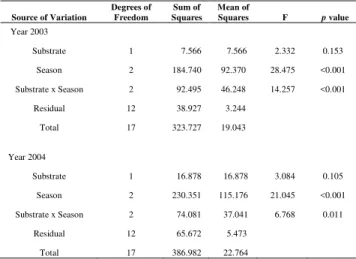
The total dry weights of Caulerpa scalpelliformis growing on both substrates in the different seasons were compared separately for 2003 and 2004. There was a significant interaction between substrate and season; but season was the most important factor for explaining the variation of the dry weight in each year (Table 1).
The length of the rhizoidal pillars of Caulerpa scalpelliformis from the rocky substrate varied, on average, from 1.05 cm (autumn 2004) to 1.70 cm (autumn 2003), but no temporal variation was detected (Fig. 4A).
An increase in the dry weights of the prostrate portions of Caulerpa scalpelliformis from the rocky substrate from autumn to spring in 2003, and a gradual increase from autumn to spring in 2004 were observed (Fig. 4B). The dry weights of the prostrate portions varied, on average, from 1.00 g.400cm-2
(autumn 2003) to 7.31 g.400 cm-2 (spring 2003).
The length of the rhizoidal pillars of Caulerpa scalpelliformis from the sandy substrate varied, on average, from 1.10 cm (autumn 2004) to 1.92 cm (winter 2004). No clear temporal variation was observed (Fig. 5A).
The dry weights of the prostrate portions of Caulerpa scalpelliformis from the sandy substrate varied, on average, from 0.75 g.400cm-2 (autumn
2003) to 5.39 g.400 cm-2 (spring 2004). There was an
increase from autumn to winter2003, and a gradual increase from autumn to spring 2004. From winter to spring 2003, a gradual decrease was apparent (Fig. 5B).
Table 1. Results of two-factor analysis of variance (ANOVA) of total dry weight of Caulerpa scalpelliformis from Ilha Grande Bay,
studied in 2003 and 2004. Factors: Substrate (rock and sand) and season (n=3).
Source of Variation
Degrees of Freedom
Sum of Squares
Mean of
Squares F p value
Year 2003
Substrate 1 7.566 7.566 2.332 0.153 Season 2 184.740 92.370 28.475 <0.001 Substrate x Season 2 92.495 46.248 14.257 <0.001
Residual 12 38.927 3.244 Total 17 323.727 19.043
Year 2004
Substrate 1 16.878 16.878 3.084 0.105 Season 2 230.351 115.176 21.045 <0.001 Substrate x Season 2 74.081 37.041 6.768 0.011
Residual 12 65.672 5.473
D
ISCUSSIONIt was possible to define a temporal pattern of variation for the vegetative development of Caulerpa scalpelliformis on Baleia Beach. This pattern was evident in the development of the erect portions, and can be summarized as follows: a gradual increase in the population from summer to autumn, and a gradual decrease in the population from winter to spring. Similar temporal patterns have been described for other invasive Caulerpa species in other countries in different geographical regions (MODENA et al., 2000; CAPIOMONT et al., 2005). However, C. scalpelliformis populations did not show a clear temporal pattern in the development of the prostrate portions. Similarly to our results, no temporal pattern
was found in the development of the prostrate portions of C. taxifolia in the Mediterranean Sea (MEINESZ et al., 1995).
Taking into account both the height and the dry weight of the erect portions of the plants on sand and rock, the decreasing trend from winter to spring suggests the occurrence of senescence and the subsequent loss of the erect portions, mainly the tallest and oldest ones. The complete or partial loss of the erect portions of C. scalpelliformis may express intrinsic characteristics of the population, such as the age and the physiological state of the thalli, and may also result from extrinsic abiotic and biotic factors. Among the multiple abiotic factors, we may highlight the impact of storms, which are more severe and frequent in Ilha Grande Bay during the winter period Fig. 4. Temporal variation of the prostrate portions of
Caulerpa scalpelliformis growing on the rocky substrate at Baleia Beach, IIha Grande Bay, from autumn 2003 to spring 2004. 4A- Length of the rhizoidal pillars (n=75, mean ± standard deviation); 4B- Dry weight of the prostrate portions (n=3, minimum, median and maximum values).
Fig. 5. Temporal variation of the prostrate portions of
(PEREIRA, 1994). These storms may result in greater fragmentation of C. scalpelliformis thalli (SANTELICES, 1977). Although the occurrence of necrosis of C. scalpelliformis thalli has not been dealt with in this study, our results suggest that necrosis and senescence of the erect portions are expected to occur during winter, as in other species. Meinesz and Hesse (1991) and Meinesz et al. (1995) reported that necrosis in C. taxifolia thalli occurred throughout the year, mainly during winter. According to Klein and verlaque (2008), in Caulerpa racemosa populations from different European regions, the number of erect portions decreases during winter, reinforcing the idea of a period of senescence. The study of necrosis and senescence in populations of Caulerpa species is, therefore, fundamental for the understanding of their temporal variation and competitive strategy in benthic communities, including the C. scalpelliformis populations in Ilha Grande Bay.
The loss of erect portions during winter seems to be quickly counterbalanced from spring to autumn, suggesting that Caulerpa scalpelliformis is able to regenerate and produce new erect portions continuously, during most of the year. This feature was more pronounced in the sandy-substrate population, where the height of the erect portions increased approximately 100% from spring 2003 to winter 2004. This behavior is similar to that observed for C. taxifolia and C. racemosa populations in the Mediterranean region (MEINESZ et al., 1995; MODENA et al., 2000; PIAZZI et al., 2001). The influence of abiotic factors such as temperature, light and salinity on the growth and physiology of Caulerpa species has been investigated in laboratory-controlled cultures (GACIA et al., 1996; GILLESPIE et al., 1997; FRIEDLANDER et al., 2006; WEST; WEST, 2007; BURFNEID; UDY, 2009). However, no physiological data on C. scalpelliformis have yet been published.
At Baleia Beach, Caulerpa scalpelliformis plants were observed throughout the 16-month study, in all the sampling periods, although there was a partial loss of the erect portions in the winter–spring period. This observation suggests that C. scalpelliformis is a pseudo-perennial species (MEINESZ et al., 1995). This seems to be a characteristic life form for the genus, because other species of this genus have also been described as pseudo-perennials, such as C. prolifera (Forssk.) J.V. Lamour. (CHAPMAN; CHAPMAN, 1976), C. racemosa (RUITTON et al., 2005) and C. taxifolia (MEINESZ et al., 1995; THIBAUT et al., 2004).
In the present study, in the light of the data for total biomass, no preference of Caulerpa scalpelliformis for rocky or sandy substrates was detected. The factors of substrate type and season showed a significant interaction in affecting the
biomass variation of C. scalpelliformis, but the season was the most important factor during the two years analyzed. To define the influence of substrate type and other factors on the vegetative development of the species in the study area, populations of other locations in Ilha Grande Bay should be monitored, and manipulative experiments should be undertaken. In agreement with a previous study in the area (FALCÃO; SZÉCHY, 2005), C. scalpelliformis is able to grow and form dense populations in the shallow sublittoral zone of rocky shores of Baleia Beach, and also on the adjacent sandy bottom. The adaptation to colonize different substrates is a characteristic feature of the genus. The ability to grow on different types of rocks and sand, as well as on benthic organisms, has been mentioned for C. taxifolia and C. racemosa (MEINESZ et al., 1993; MEINESZ et al., 1995; DAVIS et al., 1997; MODENA et al., 2000; THIBAUT et al., 2004).
fragmentation as a possible means of vegetative reproduction and as a dispersal vector has been demonstrated for other Caulerpa species (CECCHERELLI; CINELLI, 1999; SMITH; WALTERS, 1999; KHOU et al., 2007).
Due to the disturbances occurring in marine ecosystems and to the economic issues related to bioinvasions, eradication programs developed especially for exotic Caulerpa species have been employed in some countries. Some of these eradication programs have been criticized because the techniques applied to kill or remove the invasive Caulerpa species, such as the alteration of the osmotic conditions through the addition of salts to the seawater, and the destruction of the species patches through sucking pumps, may also be harmful to other organisms (GLASBY et al., 2005; ANDERSON, 2007). However, some eradication programs, such as that used in California (ANDERSON, 2005), have been successful in controlling invasive Caulerpa species. This success of the California program is explained by the early discovery of the species in the new environments, at the beginning of its colonization process, and by the existing, adequate knowledge of the biological features of the species. One of the biological features that have to be understood to permit the effective monitoring of potentially invasive species is the temporal variatin of the populations, includingtheir growth and reproduction patterns.
The methodology applied in this study, concerning the sampling frequency and the number and size of the sampling units, was recently applied for studying the temporal and spatial variability in populations of Caulerpa racemosa var. cylindracea in the Mediterranean Sea, by Ruitton et al. (2005) and Cebrian and Ballesteros (2009). We considered that the sampling frequency and sample size adopted were sufficient for describing the temporal variations of the population studied on Baleia Beach. On the other hand, this sample size is open to re-evaluation, should methodological standardization be required for future studies in other localities. In this regard, financial support and substantial research effort are necessaryto continue the study of the biological aspects of C. scalpelliformis on the Brazilian coast. Enhancing our basic knowledge of invasive species of Caulerpa and other seaweeds is the surest way to enable us to develop eradication or management programs which could also be applied in Ilha Grande Bay.
A
CKNOWLEDGMENTSThe authors´ thanks are due to Cristina Falcão, who provided the first sample of the species from Baleia Beach, in 2001 and to Marcelo Damm and Leandro de Oliveira Dias, for their assistance during the treatment of the samples.
R
EFERENCESANDERSON, L. W. J. California’s reaction to Caulerpa taxifolia: a model for invasive species rapid response.
Biol. Invasions, v. 7, p 1003-1016, 2005.
ANDERSON, L. W. .J. Control of invasive seaweeds. Bot. mar., v. 50, p. 418-437, 2007.
BALATA, D.; PIAZZI, L.; CINELLI, F. A comparison among assemblages in areas invaded by Caulerpa taxifolia and Caulerpa racemosa on a subtidal Mediterranean rocky bottom. Mar. Ecol., v. 25, p. 1-13, 2004.
BELLAN-SANTINI, D.; ARNAUD, P. M.; BELLAN, G.; VERLAQUE, M. The influence of the introduced tropical alga Caulerpa taxifolia on the biodiversity of the Mediterranean marine biota. J. mar. biol. Ass. U.K., v. 76, p. 235-237, 1996.
BOUDOURESQUE, C. F.; MEINESZ, A.; RIBEIRA, M.; BALLESTERO, E. Spread of the green alga Caulerpa
taxifolia (Caulerpales:Chlorophyta) in the
Mediterranean: possible consequences of a major ecological event. Scient. Mar., v. 59, p. 21-29, 1995. BURFNEID, D. D.; UDY, J. W. The effects of light and
nutrients on Caulerpa taxifolia and growth. Aquatic Bot., v. 90, p. 105-109, 2009.
CAPIOMONT, A.; BREUGNOT, E.; DEN HAAN, M.; MEINESZ, A. Phenology of a deep-water population of
Caulerpa racemosa var. cylindracea in the northwestern
Mediterranean Sea. Bot. mar., v. 48, p. 80-83, 2005. CEBRIAN, E.; BALLESTEROS, E. Temporal and spatial
variability in shallow- and deep-water populations of the invasive Caulerpa racemosa var. cylindracea in the Western Mediterranean. Estuar. coast. Shelf Sci., v. 83, p. 469-474, 2009.
CECCHERELLI, G.; CINELLI, F. The role of vegetative fragmentation in dispersal of the invasive alga Caulerpa taxifolia in the Mediterranean. Mar. Ecol. Prog. Ser., v.182, p 299-303, 1999.
CECCHERELLI, G.; PIAZZI, L.; BALATA, D. Spread of introduced Caulerpa species in macroalgal habitats. J. expl mar. Biol. Ecol., v. 280, p. 1-11, 2002.
CHAPMAN, V. J.; CHAPMAN, D. J. Life forms in the Algae. Bot. mar., v. 19, p. 65-74, 1976.
CREED, J. C.; OLIVEIRA, A. E. S.; PIRES, D. O.; FIGUEIREDO, M. A. O.; FERREIRA, C. E. L.; VENTURA, C. R. R. BRASIL, A. C. S.; YOUNG, P. S.; ABSALÃO, R. S.; PAIVA P. C.; CASTRO, C. B.; SEREJO, C. S. RAP Ilha Grande – um levantamento da biodiversidade: histórico e conhecimento. In: CREED, J.
C.; PIRES, D. O.; FIGUEIREDO, M. A. O. (Org.). Biodiversidade marinha da Baía da Ilha Grande. Brasília: MMA/SBF. 2007. p. 41 – 64.
DAVIS, A. R.; ROBERTS, D. E.; CUMMINS, P. Rapid invasion of a sponge-dominated deep-reef by Caulerpa scalpelliformis (Chlorophyta) in Botany Bay, New South Wales. Austr. J. Ecol., v. 22, p. 146-150, 1997. ERTAN, Ö. O.; TURNA, I. I.; CORMACI, M. A new record
FALCÃO, C.; SZÉCHY, M. T. M. Changes in shallow phytobenthic assemblages in southeastern Brazil, following the replacement of Sargassum vulgare
(Phaeophyta) by Caulerpa scalpelliformis. Bot. mar., v. 48, p. 208-217, 2005.
FIGUEIREDO, M. A. O.; TÂMEGA, F. T. S. Macroalgas marinhas. In: CREED, J. C.; PIRES, D. O.;
FIGUEIREDO, M. A. O. (Org.) Biodiversidade marinha da Baía da Ilha Grande. Brasília: MMA/SBF.2007. p 153 – 180.
FRIEDLANDER, M.; KOSOV, Y.; KERET, G.; DAWES, C. Production of rhizoids by Caulerpa prolifera in culture.
Aquatic Bot., v . 85, p. 263-266, 2006.
GACIA, E.; RODRÍGUEZ-PRIETO, C.; DELGADO, O.; BALLESTEROS, E. Seasonal light and temperature responses of Caulerpa taxifolia from the northwestern
Mediterranean. Aquatic Bot., vol. 53, p. 215-225, 1996. GILLESPIE, R. D.; MEINESZ, A.; CRITCHLEY, A. T.
Growth responses of Caulerpa taxifolia (Ulvophyceae, Chlorophyta) from the South African aquarist trade. A potential invasive of South African coastal waters. S. Afr. J. Bot. , v. 63, p. 480-483, 1997.
GLASBY, T .M.; CREESE, R. G.; GIBSON, P. T. Experimental use of salt to control the invasive marine alga Caulerpa taxifolia in New South Wales, Australia. Austr. Biol. Conserv., v. 122, p. 573-580, 2005. HEWITT, C. L.; CAMPBELL, M. L.; SCHAFFELKE, B.
Introductions of seaweeds: accidental pathways and mechanisms. Bot. mar., v. 50, p. 326-337, 2007. JOLY, A. B.; CORDEIRO-MARINO, M.;
YAMAGUISHI-TOMITA, N.; UGADIM, Y.; OLIVEIRA F0, E.C. DE;
FERREIRA, M. M. Additions to the marine flora of Brazil. Arq. Est. Biol. Mar. Univ. Ceará, v. 5, p. 65-79, 1965.
KHOU, M.; PAUL, N. A.; WRIGHT, J. T.; STEINBERG, P. D. Intrinsic factors influence the attachment of fragments of the green alga Caulerpa filiformis. J. expl
mar. Biol. Ecol., v. 352, p. 331-342, 2007.
KLEIN, J.; VERLAQUE, M. The Caulerpa racemosa
invasion: a critical review. Mar. Pollut. Bull., v. 56, p. 205-255, 2008.
MEINESZ, A.; HESSE, B. Introduction et invasion de l’algue tropicale Caulerpa taxifolia em Méditerranée Nord-occidentale. Oceanol. Acta, v. 14, p. 415-426, 1991.
MEINESZ. A.; DE VAUGELAS, J.; HESSE, B.; MARI, X. Spread of the introduced tropical green alga Caulerpa taxifolia in northern Mediterranean waters. J. appl Phycol., v. 5, p. 141-147, 1993.
MEINESZ, A.; BENICHOU, L.; BLACHIER, J.; KOMATSU, T.; LEMÉE, R.; MOLENAAR, H.; MARI, X. Variations in the structure, morphology and biomass of Caulerpa taxifolia in the Mediterranean Sea. Bot. mar., v. 38, p. 499-508, 1995.
MITCHELL, G. J. P.; NASSAR, C. A. G.; MAURAT, M. C. S.; FALCÃO, C. Tipos de vegetação marinha da Baía do Espírito Santo sob influência da poluição. Espírito Santo, Brasil. Publ. ACIESP, v. 71, p. 202-214, 1990. MODENA, M.; MATRICARDI, G.; VACCHI, M.;
GUIDATTI, P. Spreading of Caulerpa racemosa
(Forsskal) J. Agardh (Bryopsidaceae, Chlorophyta) along the coasts of the Ligurian Sea. Cryptogam. Algol., v. 21, p. 301-304, 2000.
NUNES, J. M. DE C. Catálogo de algas marinhas bentônicas do estado da Bahia, Brasil. Acta Bot. Malacitana, v. 23, p. 5-21, 1998.
OLIVEIRA, E. C. DE; SILVA, B. N. T. DA; AMANCIO, C .E. Fitobentos (macroalgas). In: LOPES, R.M. (Ed.), Informe sobre as espécies exóticas invasoras marinhas, Brasília: MMA/SBF 2009. p 111 – 142. PAULA; A. F. de; CREED, J. C. Two species of the coral
Tubastraea (Cnidaria, Scleractinia) in Brazil: a case of accidental introduction. Bull. mar. Sci., v. 74, p. 175-183, 2004.
PEREIRA, C. S. Metereologia. In: IKEDA, Y. (Coord.). Diagnóstico ambiental oceânico e costeiro das regiões sul e sudeste do Brasil. v. 2. Rio de Janeiro: Petrobrás, 1994. P. 243-234.
PIAZZI, L.; BALATA, D. Invasion of alien macroalgae in different Mediterranean habitats. Biol. Invasions, v. 11, p. 193-204, 2009.
PIAZZI, L.; BALATA, D.; CECCHERELLI, G.; CINELLI, F. Comparative study of the growth of the two co-occurring introduced green algae Caulerpa taxifolia and Caulerpa racemosa along the Tuscan coast (Italy,
western Mediterranean). Cryptogam. Algol., v. 22, p. 459-466, 2001.
RUITTON, S.; VERLAQUE, M.; BOUDOURESQUE, C. F. Seasonal changes of the introduced Caulerpa racemosa
var. cylindracea (Caulerpales, Chlorophyta) at the
northwest limit of its Mediterranean range. Aquatic Bot., v. 82, p. 55-70, 2005.
SANTELICES, B. Water movement and seasonal algal growth in Hawaii. Mar. Biol., v. 43, p. 225-235, 1977. SMITH, C. M.; WALTERS, L. J. Fragmentation as a strategy
for Caulerpa species: fates of fragments and implications for management of an invasive weed. Mar. Ecol., v. 20, p. 307-319, 1999.
THIBAUT, T.; MEINESZ, A.; COQUILLARD, P. Biomass seasonality of Caulerpa taxifolia in the Mediterranean
Sea. Aquatic Bot., v. 80, p. 291-297, 2004.
VALENTINE, J. P.; MAGIEROWSKI, R. H.; JOHNSON, C. R. Mechanisms of invasion: establishment, spread and persistence of introduced seaweed populations. Bot. mar., v. 50, p. 351-360, 2007.
VERLAQUE, M. Inventaire des plantes introduites en Méditerranée: origines et répercussions sur l’environnement et les activités humaines. Oceanol. Acta, v. 17, p. 1-23, 1994.
VILLÈLE, X.; VERLAQUE, M. Changes and degradation in a Posidonia oceanica bed invaded by the introduced tropical alga Caulerpa taxifolia in the North western Mediterranean. Bot. mar., v. 38, p. 79-87, 1995. WEST, E. J.; DAVIS, A. R.; BARNES, P. B.; WRIGHT, J.
T. The role of recreational activities in creating fragments of invasive Caulerpa taxifolia. J. expl mar. Biol. Ecol., v. 376, p. 17-25, 2009.
WEST, E. J.; WEST, R. J. Growth and survival of the invasive alga, Caulerpa taxifolia, in different salinities
and temperatures: implications for coastal lake management. Hydrobiologia, v. 577, p. 87-94, 2007. WILLIAMS, S. L.; GROSHOLZ, E. D. Preliminary reports
from the Caulerpa taxifolia invasion in southern California. Mar. Ecol. Prog. Ser., v. 233, p. 307-310, 2002.