Original Ar
tic
Study conducted at the Maternity Hospital Mário Totta, Complexo Hospitalar Santa Casa, for the Graduate Specialization in Speech-Language Pathology and Audiology, Institute of Psychology, Universidade Federal do Rio Grande do Sul – UFRGS – Porto Alegre (RS), Brasil.
Conflict of interests: None
(1) Graduate Specialization in Speech-Language Pathology and Audiology, Institute of Psychology, Universidade Federal do Rio Grande do Sul – UFRGS – Porto Alegre (RS), Brasil.
(2) Undergraduate Program in Speech-Language Pathology and Audiology, Centro Universitário Metodista IPA – Porto Alegre (RS), Brasil.
(3) Department of Speech-Language Pathology and Audiology, Universidade Federal de Ciências da Saúde de Porto Alegre – UFCSPA – Porto Alegre (RS), Brasil.
(4) Undergraduate Program in Speech-Language Pathology and Audiology, School of Dentistry, Universidade Federal do Rio Grande do Sul – UFRGS – Porto Alegre (RS), Brasil.
Correspondence address: Erissandra Gomes. R. Ramiro Barcelos, 2492, Rio Branco, Porto Alegre (RS), Brasil, CEP: 90035-000. E-mail: erifono@ hotmail.com
Received: 5/4/2012; Accepted: 1/8/2012
breastfeeding
Influência do ambiente hospitalar nos aspectos relacionados ao
aleitamento materno
Ana Maria de Oliveira Beck1, Karine de Oliveira Assunção2, Lisiane de Rosa Barbosa3, Erissandra Gomes4
ABSTRACT
Purpose: To investigate the influence of hospital environment on aspects related to breastfeeding and communication on the mother/ newborn interaction during the breastfeeding process. Methods: This consisted on a cross-sectional study composed by 34 dyads: 18 in rooming-in care and 16 in intermediate/medium care units of a public hospital. Each dyad was observed at the time of breastfee-ding, and data were analyzed considering the aspects standardized by UNICEF for breastfeeding. Verbal and nonverbal communica-tion modes were observed. Results: Comparison of variables showed significant associacommunica-tions between hospital environment and the position of the mother in relation to the newborn and mother stimulation and vocalization to the neonate, with favorable percentage for the dyad that was in rooming. The other variables did not differ. Conclusion: Important conditions for the establishment of breastfee-ding and communication between mother and newborn are influenced by the location of the dyad, especially the hospital environment.
Keywords: Breast feeding; Communication; Mother-child relations; Rooming-in care; Intensive care units, neonatal
INTRODUCTION
Breastfeeding (BF) is the proper, natural and efficient way to provide the nutrients needed for growth and development of the newborn (NB)(1-3). During breastfeeding, it is important
that the mother and the newborn establish a knowing and communicative relationship as they learn to connect with one another. The touch, warmth, and visual and auditory contacts that breastfeeding provides constitute an important affective and cognitive stimulation(4,5). In the 80’s and 90’s the emotional
aspect of breastfeeding was exalted as the basis of
psycholo-gical development of attachment, and it was also indicated as early nonverbal communication between mother and child(6,7).
When, after birth, the mother and the newborn are together, a series of sensory, hormonal, physiological, behavioral and immunological events are initiated, many of which positively contribute to the creation and strengthening of the bond, as well as of communication(6-8). The perception of the mother,
both in relation to the child and to her caring ability, influences not only the quality of the interaction but also the bond(7,9,10).
The fact that the NB establishes early contact with the mother also influences the duration of breastfeeding, the temperature control of the NB, glucose levels and crying control(11-15).
Besides the advantages mentioned above, BF allows cra-niofacial growth and development and, consequently, the myo-functional system development by stimulation of muscle tone, maturation of the temporomandibular joint and promotion of a favorable dental occlusal condition. The myofunctional stability provided by breastfeeding contributes to reducing the prevalence of inadequate oral habits, prevents occlusal alterations and favors orofacial praxis(13,14).
MCU). The role of the Speech-Language Pathologist in both places is to propitiate to NB a safe, functional and pleasant feeding, which will favor early hospital dismissal and overall NB development(16,17). Likewise, helping mothers to feel calm
and secure about the contact and the act of breastfeeding is another of the speech-language pathologist actions(18,19).
In RO, the healthy NB, shortly after birth, remains beside his mother in the same environment until dismissal and the site fosters BF and the bond between mother and NB(6,7,20,21). High-,
medium- or low-risk NB with medical conditions that require special care are admitted to ICU/MCU. This usually compli-cates the initial contact of the newborn with the mother and brings possible restrictions related to the feeding process(11,17,22).
Considering the above, the purpose of this study was to determine whether hospital environment, in this case rooming and ICU/MCU, interferes with BF and communication (verbal and nonverbal) aspects during the mother/newborn interaction in the breastfeeding process.
METHODS
This research consisted on a cross-sectional study com-posed by 34 mother/newborn dyads who were hospitalized in 18 rooming and 16 ICU/MCU of the Mário Totta Maternity Hospital, Complexo Hospitalar Santa Casa, Porto Alegre (RS), Brazil. This Maternity Hospital is recognized by UNICEF as a Child Friendly Hospital. The study was approved by the Research Ethics Committee of the Complexo Hospitalar Santa Casa, under protocol number 148/10, and all mothers agreed to participate by signing a Free and Informed Consent Form.
The following inclusion criteria were applied: term NB according to the Classification of Gestational Age based on the Capurro method; newborn between first and third day of life; Apgar score at five minutes of at least eight; exclusive breastfeeding. NB with genetic, cardiac and neurological disorders or other medical condition that could interfere with the results were withdrawn from the study. Mothers who had already received Speech-Language Pathology guidance or who refused to participate in the study were also not included in the sample. During data collection, none of the mothers refused to participate.
First, the medical records of the NB were examined and the protocols of sample characterization were completed. Data were collected regarding identification of NB (name, registra-tion, date of birth, time of birth, gender, Apgar scores, weight, length, gestational age) and mother (name, age, education, profession, prenatal care, number of pregnancies, number of births, abortion, breastfeeding, pregnancy complications, mode of delivery). Each mother/newborn dyad was observed during breastfeeding and, soon after, the protocol was completed. The instrument used was developed by the authors of the current study based on published protocols(2,23). The
follow-ing aspects were evaluated: position of the mother in relation to the newborn; handle; suction; aspect of the breast; nipple; position of the newborn in relation to the mother; and mother/ newborn communication (verbal and nonverbal) during BF interaction. A random drawing was carried out to determine which mother/newborn dyads that were in rooming would
be observed. At ICU/MCU, a convenience sample was used because only few NB met the inclusion and exclusion criteria established for the study.
Data were tabulated and analyzed using specific software for statistical analysis – Statistical Package for Social Scien-ce (SPSS) for Windows, version 17.0. Mean and standard deviation for quantitative variables and absolute and relative frequency for qualitative variables were calculated. The Chi-square and the Fisher’s exact test were used for verification of a significant association between qualitative variables. The maximum significance level was set at 5%.
RESULTS
The following data was obtained regarding maternal aspects and gestational data from the 34 dyads: the average age of mothers was 25+8.2 years; 24 (70.6%) mothers had prenatal care, with the average number of visits of 6,0+2.9; the average number of pregnancies was 2.1; for 16 (47%) mothers this was their first pregnancy; 23 (67.6%) underwent vaginal delivery; 34 (100%) infants were born full-term and 25 (73.5%) were male.
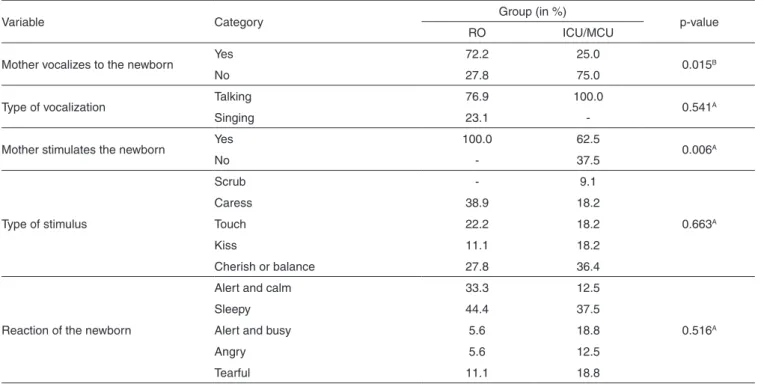
The results of the comparison between variables related to breastfeeding were obtained considering the two hospital settings (rooming versus ICU/MCU) (Table 1). The results of the comparison of variables related to the stimulus received by the newborn at the time of breastfeeding were also obtained considering the two different environments (rooming versus ICU/MCU) (Table 2).
No differences between the two settings were found when comparing the demographic variables that characterized the samples. This demonstrates that the sample was homogeneous and that the differences are related to where the dyads were located.
DISCUSSION
The contact between mother and NB has a primary im-portance after the delivery. The World Health Organization recommends BF within the first hour of life(2,15). One should
avoid the mother/newborn separation because it can harm BF and rapprochement(15,20,24). Maternal care provided during these
first acts form the basis of emotional life and relationship of the newborn(2,7,24).
During pregnancy, both the mother and the father idealize the newborn and create expectations of a perfect child. Only after birth the gap between the imaginary of parents and the real NB is discarded(7,25). When there is some complication
with the NB and separation of the dyad is required, these mothers need to realize the grief of that imaginary child and may present some difficulties in building the bond. This fact favors distancing of mothers, which may result in a shorter time with the NB directly interfering in the perpetuation of the bond between them(11,22,25,26). In the current study, mothers
Table 1. Between-groups comparison of variables related to breastfeeding
Variable Category Group (in %) p-value
RO ICU/MCU
Position of the mother in relation to the newborn
Tranquil 72.2 18.8
0.012A
Tense 11.1 37.5
Insecure 16.7 31.3
Inattentive - 12.5
Handle Correct 88.9 93.8 0.990A
Incorrect 11.1 6.3
Suction Slow and deep 50.0 6.,5 0.464B
Rapid with clicks 50.0 37.5
Breast aspect
Healthy nipples 72.2 81.3
0.660A
Sensitive nipples 16.7 12.5
Cracked nipples with treatment 11.1
-Cracked and untreated nipples - 6.3
Nipple
Inverted 5.6
-0.999A
Plan 5.6 6.3
Protruding 88.9 93.8
Position of the newborn in relation to the mother
Newborn is next to the mother and searches for the breast 72.2 56.3
0.475A
Newborn is next to the mother and does not search for the breast 27.8 43.8
A Fisher’s Exact Test (p≤0.05)
B Chi-square test (p≤0.05)
Note: RO = rooming; ICU/MCU = intermediate care unit/medium care unit
Table 2. Between-groups comparison of stimulus-related variables
Variable Category Group (in %) p-value
RO ICU/MCU
Mother vocalizes to the newborn Yes 72.2 25.0 0.015B
No 27.8 75.0
Type of vocalization Talking 76.9 100.0 0.541A
Singing 23.1
-Mother stimulates the newborn Yes 100.0 62.5 0.006A
No - 37.5
Type of stimulus
Scrub - 9.1
0.663A
Caress 38.9 18.2
Touch 22.2 18.2
Kiss 11.1 18.2
Cherish or balance 27.8 36.4
Reaction of the newborn
Alert and calm 33.3 12.5
0.516A
Sleepy 44.4 37.5
Alert and busy 5.6 18.8
Angry 5.6 12.5
Tearful 11.1 18.8
A Fisher’s Exact Test (p≤0.05)
B Chi-square test (p≤0.05)
Note: RO = rooming; ICU/MCU = intermediate care unit/medium care unit
The hospitalization of a NB in a unit with greater care and specific devices can promote emotional imbalance of NB and mothers. This disruption creates emotional conflict, anxiety, inattention, stress, insecurity and comes up the sense of loss
caused by the separation of the dyad(26). It is necessary that
the mother, even if unconsciously, goes through the stages of denial, grief, anger and acceptance(26,27). It is not only the
receiving the heat and the smell of the mother and shall be alone after months in the intrauterine environment(26).
The maternal behavior varies among mothers – i.e., some verbalizes more than others, regardless of contact with the newborn. One should take into consideration the environment and the emotional state and verify whether these data do not preclude the mother to interact with the NB(23). This report
agrees with the current research, which shows that mothers of newborns hospitalized in ICU/MCU are more insecure and stressful and this may influence their communicative behavior.
The importance of how the maternal breast is offered and how the NB requests are met through the maternal voice and caresses should be highlighted. A more intimate connection between mother and newborn is established from situations tri-ggered by the process of breastfeeding, meeting the emotional needs of both, offering and building irreplaceable moments of attachment(28). The NB has the need of postures that maintain
body contact such as fondling, touching, kissing and hugging. These are considered behaviors that reinforce attachment and generally demonstrate the existence of affection, which is essential in the process of bond creation. They also facilitate early interactions between mother and newborn leveraging the maternal ability to understand and interact with the NB. If there are any breaks in this protective environment, the NB may have difficulties in emotional development(29).
Touch is the most important aspect of nonverbal
communi-cation. It is through touch that the mother can transmit feelings of empathy and safety while handling the NB(30). According to
the results presented on this study, all mothers in RO stimulated their newborns. The same was not observed in the ICU/MCU. Mothers in RO spend more time with the newborns and feel more prepared to take care of them. They are able to understand the signals of the NB and, therefore, have more communication acts with them. Mothers in ICU/MCU, on the other hand, demonstrate insecurity, which can interfere with their expectations and with the understanding of the needs of newborns affecting, therefore, the communication process.
CONCLUSION
According to the results obtained, one can see the influence of hospital environment in the breastfeeding process regarding the variables position of the mother in relation to the newborn and communicative aspects (vocalization and stimulation of the newborn). When compared to ICU/MCU, RO showed to be a more favorable environment. Breastfeeding and commu-nication established between mother and newborn generate interactional exchanges, but the environment in which the dyad is inserted should also be taken into account as in the hospital environment these interactions may undergo changes and generate an adaptive behavior.
RESUMO
Objetivo: Verificar a influência do ambiente hospitalar nos aspectos relacionados ao aleitamento materno e à comunicação na inte-ração mãe/neonato durante o processo da amamentação. Métodos: Estudo transversal, com 34 díades: 18 internadas em alojamento conjunto e 16 internadas em unidades de cuidados intermediários/médios de um hospital público. Cada díade foi observada no mo-mento da oferta da mamada e os dados foram analisados considerando os aspectos padronizados pela UNICEF para o aleitamo-mento materno. Foi verificada a comunicação verbal e não verbal estabelecida. Resultados: Na comparação das variáveis estudadas, houve associação significativa para a posição da mãe em relação ao neonato e para as variáveis mãe estimula e mãe vocaliza para o neonato, com percentual favorável para a díade que se encontrava em alojamento conjunto. As demais variáveis não apresentaram diferenças. Conclusão: Condições importantes para o estabelecimento da amamentação e da comunicação entre mãe/neonato são influenciadas pelo local onde se encontra a díade, especialmente o ambiente hospitalar.
Descritores: Aleitamento materno; Comunicação; Relações mãe-filho; Alojamento conjunto; Unidades de terapia intensiva neonatal
REFERENCES
1. Nascimento MB, Issler H. Aleitamento materno fazendo a diferença no desenvolvimento da saúde e nutrição do recém-nascido a termo e pré-termo. Rev Hosp Clin. 2003;58(1):49-60.
2. United Nations Children’s Fund (UNICEF). Breastfeeding management and promotion in a baby-friendly hospital: an 18-hour course for maternity staff. New York: UNICEF; 1993.
3. Baptista GH, Andrade AH, Giolo SR. Fatores associados à duração do aleitamento materno em crianças de famílias de baixa renda da região sul da cidade de Curitiba, Paraná, Brasil. Cad Saúde Pública. 2009;25(3):596-604.
4. Paiva SS, Galvão MT, Pagliuca LM, Almeida PC. Non-verbal mother-child communication in conditions of maternal HIV in an experimental environment. Rev Latino-Am Enfermagem. 2010;18(1):41-7.
5. Bystrova K, Ivanova V, Edhborg M, Matthiesen AS, Ranjsö-Arvidson AB, Mukhamedrakhimov R, et al. Early contact versus sepsration: effects on mother-infant interaction one year later. Birth. 2009;36(2):97-109. 6. Rosa R, Martins FE, Gasperi BL, Monticelli M, Siebert ER, Martins
NM. Mãe e filho: os primeiros laços de aproximação. Esc Anna Nery Rev Enferm. 2010;14(1):105-12.
7. Bowlby J. Primórdios do comportamento do apego. In: Bowlby J. Apego e perda: apego. 3a ed. São Paulo (SP): Martins Fontes; 2002. p. 329-69. 8. Vasconcelos SG, Galvão MT, Almeida PC, Pagliuca LM. Comunicação
mãe-filho durante amamentação natural e artificial na era AIDS. Rev Rene. 2010;11(4):103-9.
infants. Infant Metal Health Journal. 2000;21(6):495-509.
10. Pridham K, Lin CY, Brown R. Mothers’ evaluation of their care giving for premature and full-term infants through the first year: contributing factors. Res Nurs Health. 2001;24(3):157-69.
11. Andrade AF, Cruz I. A participação dos pais nos cuidados ao recém-nascido internado na unidade de terapia intensiva neonatal para favorecer a formação do vínculo pais-bebê – prática de enfermagem baseada em evidência. Journal of Specialized Nursing Care. 2008;1(1):3-7.
12. Perez-Escamilla R, Pollitt E, Lönnerdal B, Dewey KG. Infant feeding policies in maternity wards and their effect on breastfeeding success: an analystical overview. Am J Publ Health.1994;84(1):89-97.
13. Araújo MF, Ferreira AB, Gondim KM, Chaves ES. A prevalência de diarréia em crianças não amamentadas ou com amamentação por tempo inferior a seis meses. Cienc Cuid Saúde. 2007;6(1):76-84.
14. Chantry CJ, Howard CR, Auinger P. Full breastfeeding duration and associated decrease in respiratory tract infection in US children. Pediatrics. 2006;117(2):425-32.
15. Boccolini CS, Carvalho ML, Oliveira MI, Leal MC, Carvalho MS. Fatores que interferem no tempo entre o nascimento e a primeira mamada. Cad Saúde Pública. 2008;24(11):2681-94.
16. Calado DF, Souza R. Intervenção fonoaudiológica em recém-nascido pré-termo: estimulação oromotora e sucção não-nutritiva. Rev CEFAC. 2012;14(1):176-81.
17. Santana MCCP, Goulart BN, Chiari BM, Melo AM, Silva EH. Aleitamento materno em prematuros: atuação fonoaudiológica baseada nos pressupostos da educação para promoção da saúde. Ciênc Saúde Coletiva. 2010;15(2):411-7.
18. Costa AS, Azevedo MF, Fukuda Y. Evolução da resposta da cabeça em direção ao som, em crianças, no primeiro semestre de vida. Pró-Fono. 2000;12(2):21-9.
19. Lipay MS, Almeida EC. A fonoaudiologia e sua inserção na saúde pública. Rev Ciênc Med Campinas. 2007;16(1):31-41.
20. Pasqual KK, BracciallI LA, Volponi M. Alojamento conjunto: espaço concreto de possibilidades e o papel da equipe multiprofissional. Cogitare Enfermagem. 2010;15(2):334-9.
21. Faleiros FT, Trezza EM, Carandina L. Aleitamento materno: fatores de influência na sua decisão e duração. Rev Nutr. 2006;19(5):623-30. 22. Campos AC, Cardoso MV. O recém-nascido sob fototerapia: a percepção
da mãe. Rev Latino-Am Enfermagem. 2004;12(4):606-13.
23. Xavier C. Atuação Fonoaudiológica em berçário: aspectos teóricos e práticos na relação mãe bebê. In: Andrade CR. Fonoaudiologia em berçário normal e de risco. São Paulo: Lovise; 1996.
24. Cruz DC, Sumam NS, Spíndola T. Os cuidados imediatos prestados ao recém-nascido e a promoção do vínculo mãe-bebê. Rev Esc Enferm USP. 2007;41(4):690-7.
25. Vanz AP, Ribeiro NR. Listening to the mothers of individuals with oral fissures. Rev Esc Enferm USP. 2011;45(3):596-602.
26. Camargo CL, La Torre AP, Oliveira AF, Quirino MD. Sentimentos maternos na visita ao recém-nascido internado em unidade de terapia intensiva. Ciênc Cuid Saúde. 2004;3(3):267-75.
27. Reichert AP, Lins RN, Collet N. Humanização do cuidador da UTI neonatal. Rev Eletr de Enferm. 2007;9(1):200-13.
28. Delgado SE, Helpern R. Aleitamento materno de bebês pré-termo com menos de 1500 gramas: sentimentos e percepções maternos. Arq Med. 2004;7(2):5-28.
29. Pilotto DT, Vargens OM, Progianti JM. Alojamento conjunto como espaço de cuidado materno e profissional. Rev Bras Enferm. 2009;62(4):604-7.