Brazilian Journal of Physics, vol. 34, no. 3A, September, 2004 781
Dissipative and Fluctuating Dynamical Description
of Nuclear Reactions
V. de la Mota, F. S´ebille, and C. Bonilla
Subatech, 4 rue A. Kastler, BP 20722 44307 Nantes cedex 03, FranceReceived on 11 September, 2003
We address the description of nuclear dynamics at intermediate energies within the DYWAN model. New fluctuation-dissipation aspects are discussed and confronted with experimental results in nucleus-nucleus and in nucleon-nucleus reactions. We show that the implemented treatment of fluctuations provides with a convenient tool to investigate the main characteristics of particle and light clusters emission in the intermediate energy range.
1
Introduction
In this work we present an approach for the description of nuclear dynamics: thedywanmodel which has been devel-opped in the spirit of the projection methods of statistical physics (PM) [1] and on the wavelet theory (WT) [2]. Af-ter a brief description in Sec. 2 of our approach, we present in Sec. 3 two kind of calculations, one of them concerns dissipation aspects in heavy-ion collisions at intermediate energies, the other, nucleon and light cluster emission in nucleon-nucleus reactions in the same energy range.
2
Background
PM are at the origin of the physical formulation, which consists essentially in the extended time-dependent Hartree-Fock (ETDHF) equation,
iρ˙= [h(ρ), ρ] +iI(ρ) (1) derived with the assumption that only one-body observables are relevant for the description of the system. Hereρis the one-body density matrix,h(ρ)is the one-body hamiltonian and I the collision kernel.
The WT provides the resolution schemes for the above equa-tion of moequa-tion. Wavelets are nonstaequa-tionnary bases. A fam-ily of wavelets is obtained by translating and expanding the generating function, called mother (or analysing) wavelet:
Ψa,b(x) =
1
√
aΨ( x−b
a )
whereaandbare, respectively, the compression and trans-lation parameters. This property permits to perform an anal-ysis of the signal at different scales.
Expanding in wavelets the single-particle (s.p.) wave-functions it can be shown, from Eq. (1), that the dynamics is generated by the evolution of the moving wavelets in the mean-field between two transitions. This evolution is given
in terms of a system of coupled equations of motion [3] for the centroids and the widths of wavelets. Since the orthog-onality of wavelets is conserved in time, Pauli blocking is ensured all over the dynamical evolution.
In order to go beyond the one-body description, in a first time, we look for the least biased many-body wave-function, compatible with the information contained in our ETDHF equation. Indeed, due to the orthonormality prop-erties of s.p. wave-functions and wavelets, the most general N-body wave-function takes the form of a linear combina-tion of Slater determinant of wavelets. The correpondig N-body density operator can be written, in the random phase approximation, as a statistical mixture of N-body Slater de-terminants of non-stationary wavelets as follows:
DN(t) =
K
|aK(t)|2 M,M′
bMb∗
M′|ΘM ><ΘM′| (2)
Here,|ΘM > is a Slater determinant of wavelets, bM =
det(ci
λ)and theciλare the coefficients of the decomposition of s.p. wave-functions on the wavelets basis. The subse-quent evolution, at the N-body level, is given by DN(t), which is treated by means of a Montecarlo procedure, in consistency with the simulation of the master equation. This procedure introduces some degree of stochasticity in the treatment of N-body information, in a similar way as stochastic models.
3
Results
In the following, the local Zamick force [4] and the free nucleon-nucleon cross-sectionσnnhave been implemented in numerical calculations.
782 V. de la Mota, F. S´ebille, and C. Bonilla
0 10 20 30 40 50 60
0 0.2 0.4 0.6 0.8 1 1.2
Ar(27MeV/n)+Ag
θ
LF(degree)
Vrec/Vcm DYWAN model (Zamick force)
DATA
Landau−Vlasov model (Gogny force) Landau−Vlasov model (Zamick force)
0 10 20 30 40 50 60
0 0.2 0.4 0.6 0.8 1 1.2
Ar(44MeV/n)+Ag
θ
LF(degree)
Vrec/Vcm DYWAN model (Zamick force)
DATA
Landau−Vlasov model (Gogny force) Landau−Vlasov model (Zamick force)
Figure 1. Normalized recoil velocity of heavy fragments as a function of the light fragment angle in Ar+Ag reactions at 27MeV/n (top) and 44MeV/n (bottom).
Nevertheless, we observe the following main differ-ences:
- the semi-classical (s.c.) LV results are sensitive to the ef-fective force only at the highest incident energy, where for the non-local force, relative velocities are higher and as a consequence the stopping power is less important.
- dywan results are in better agreement with the data, the reason being the spreading of the s.p. wave-functions which takes place in the overlap region, and which will contribute to increase the deflection angle of the light partner.
From these results we do not have to conclude that the dy-wan model, with the Zamick force, gives the right descrip-tion of the reacdescrip-tion dynamics. They underline the impor-tance of quantum effects, which need to be taken into ac-count before undertaking the study of more sophisticated effects like in-medium and surface effects.
In Ref [5] proton double-differential cross-sections in n+208
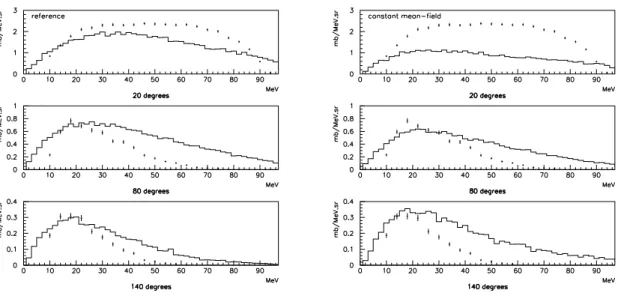
Pb reaction at 96 MeV/n have been calculated for some selected angles. The results are globally correctly re-produced. For energies between 20 and 100 MeV out-of-equilibrium effects are strong: an important anisotropy ap-pears in spectra. These results suggest that the role of the mean-field at these energies cannot be neglected.
In Fig. 2 the importance of self-consistency is inves-tigated in proton double differential cross-sections for the same reaction as above. On the left is the usual
self-consistent calculation whereas on the right a calculation with a frozen mean-field is reported. We observe that the role of the self-consistent field is essential to keep a bet-ter agreement with the experimental results. The results ob-tained with a constant (initial) mean-field underestimate the data.
4
Conclusions
The DYWAN model has been developped to describe HIC and nucleon induced reactions at intermediate energies. The motivation was the understanding of the decay mechanisms in those reactions and to learn about the properties of very far from equilibrium nuclear matter (stability limits, frag-ment formation, vaporization, ...).
Brazilian Journal of Physics, vol. 34, no. 3A, September, 2004 783
Figure 2. Proton double differential cross section for208P b(n, xp)reaction at 96 MeV. The left panel is the reference self-consistent calculation, in the right is a simulation without self-consistency. Experimental data is represented by crosses.
Thedywanmodel can then make qualitative and quan-titative predictions in nuclear reactions at intermediate en-ergies, and this gives the possibility to investigate differ-ent dynamical aspects, as the role of the self-consistency in nucleon-nucleus collisions. This fact constitutes an impor-tant constraint for the concerned models. Finally, our results underline the fact that quantum structure has to be taken into account, in order to investigate properly more refined phys-ical aspects (as those related with surface and in-medium effects). This work is in progress.
References
[1] R. Balian, Y. Alhassid, and H. Reinhardt, Phys. Rep1311 (1986).
[2] A. Grossmann, J. Morlet, T. Paul, Ann. Inst. Poincar´e45, 293 (1986).
[3] B. Jouault, F. S´ebille, and V. de la Mota, Nucl. Phys. A628, 119 (1998).
[4] L. Zamick, Phys. Lett. B45, 313 (1973).