0103 - 5053 $6.00+0.00
Article
* e-mail: [email protected], [email protected]
Characterization of Natural Brazilian Clays and their Utilization as Catalysts in the
Coiodination of Alkenes with Water and Alcohols
Raul A. S. Villegas
a, José Luiz do Espírito Santo Jr.
b, Marcio C. S. de Mattos*
,a,
Mônica R. M. P. de Aguiar*
,band Alcides W. S. Guarino
ca
Instituto de Química, Universidade Federal do Rio de Janeiro, CP 68545, 21945-970 Rio de Janeiro - RJ, Brazil
b
Instituto de Química, Universidade do Estado do Rio de Janeiro, 20550-013 Rio de Janeiro - RJ, Brazil
c
Escola de Ciências Biológicas, Departamento de Ciências Naturais, Universidade Federal do Estado do Rio de Janeiro, 22290-240 Rio de Janeiro - RJ, Brazil
As argilas naturais brasileiras F-101, F-117 e caulim foram caracterizadas através de análises química e textural, difração de raios X e RMN no estado sólido de 27Al e 29Si. A argila F-101 é uma
esmectita, a F-117 é uma estrutura interestratificada contendo esmectita, caulinita e mica como argilominerais. O caulim é essencialmente uma caulinita. As argilas F-101 e F-117 são catalisadores mais eficientes para a coiodação de estireno e ciclo-hexeno com água e álcoois para produzir iodoidrinas eE-iodo-éteres, respectivamente, comparadas ao caulim e a argila montmorilonita K-10.
The natural Brazilian clays F-101, F-117 and kaolin were characterized by chemical and textural analysis, XRD, and 27Al and 29Si MAS-NMR. The F-101 clay is a smectite, while F-117 is an
interstratified structure with smectite, kaolinite and mica as clay-minerals. Kaolin is mainly kaolinite. F-101 and F-117 clays were more efficient catalysts for the coiodination of styrene and cyclohexene with water and alcohols to produce iodohydrins and E-iodoethers, respectively, than the kaolin and montmorillonite K-10 clay.
Keywords:natural clays, characterization methods, catalysis, coiodination, green chemistry
Introduction
The successful application of heterogeneous catalysis in organic reaction has been one of the most fruitful areas of green chemistry. Clay-minerals are aluminosilicates with layered structure that present a wide use in organic synthesis1 and exhibit specific features such as high
versatility, gain in yield and / or selectivity, low cost etc.2
The electrophilic halogenation of alkenes to produce vicinal dihaloalkanes is a well-known reaction in organic chemistry.3 However, when the halogenation of the alkene
is carried out in a nucleophilic solvent (water, alcohols, carboxylic acids, nitriles, etc), difunctionalized products (halohydrins,E-haloethers,E-haloesters, etc) are obtained. This process is termed ‘cohalogenation’ and provides useful products for diverse synthetic applications.4
Besides the large applicability in organic synthesis, the recent discovery of the bioactivity of naturally occurring organohalogen compounds has increased the interest in such compounds.5 Furthermore, organic iodides
are widely used as auxiliaries in radiodiagnosys.6
In contrast to other halogens, the simple iodination of an alkene is very slow and hence, the coiodination of alkenes is only effective using alternate sources of eletrophilic iodine.7 An Indian group published the
coiodination reactions of styrene and indene mediated by EPZ-10® (a commercial clay zinc prepared from
montmorillonite and ZnCl2)8 and recently we published
an effective coiodination of some alkenes with water mediated by clay-minerals and obtained the corresponding iodohydrins in good yields.9
Experimental
General
All chemicals are commercially available (Aldrich) and were used without further purification. K-10 was purchased from Aldrich, F-101 and F-117 clays (crushed) were donated by “Bentonit do Brasil” (Brazilian Co.) and kaolin was donated by CETEM (Rio de Janeiro, Brazil).
Characterization of the clays
The chemical compositions of the clays were determined by X-ray fluorescence using a Philips 1480 with Rh tub. The X-ray diffractions (XRD) of oriented samples were conducted using a Bruker AXS D5005 diffractometer equipped with a proportional counter and pulse height analyzers Ni filtered by CuKD radiation (40 kV/35 mA), diffraction patterns collected at a scanning rate of 0.05º (2T) min-1 in the interval of 3º to 50º (for F-101,
F-117 and K-10 clays) or by CoKD radiation (35 kV/40 mA), diffraction patterns collected at a scanning rate of 0.02º (2T) min-1 in the interval of 5º to 80º (for kaolin).
Textural analysis of clays were performed from the nitrogen adsorption isotherms on an ASAP 2000 at 333 K (to avoid collapse in the framework of the clay-mineral) using the multipoint BET method. Solid state NMR measurements (MAS-NMR) were carried out on a Bruker DRX-300 spectrometer operating at a Bo of 7.05 Tesla, corresponding to a Larmor frequency of 78.2 MHz for aluminium and 59.6 MHz for silicon. Samples were spun in zirconia rotors equipped with Kel-F caps, at speed of 12 kHz. A short pulse of 7 ms was used and the recycle time was 0.3 s, for
27Al, while the 29Si pulse was of 10 Ps and its recycle time
was 2.0 s. The 27Al chemical shifts were referenced using a
solid sample of AlCl3.6H2O (G = 0 ppm), while the 29Si
signal positions were referenced using a secondary standard of kaolin (G = -91.5 ppm) in relation to TMS.
Characterization of reaction products
HRGC (high-resolution gas chromatography) analysis were performed on a HP-5890-II gas chromatograph with FID by using a 30 m (length), 0.25 mm (ID) and 25 Pm (phase thickness) RTX-5 silica capillary column and He (flow rate 50 cm/s) as carrier gas (split 1:20). Mass spectra (MS) were obtained on a Hewlett-Packard HP5896-A HRGC-MS using electron impact (70 eV). 1H and 13C NMR
were acquired on a Bruker DRX-300 (300 MHz and 75 MHz, respectively) or on a Bruker AC-200 (200 MHz and 50 MHz, respectively) spectrometers for CDCl3 solutions
with TMS as internal standard. IR spectra were recorded on a Perkin Elmer 1600 FT-IR or on a Nicolet 740 FT-IR spectrometers (NaCl film).
Typical procedure for cohalogenation reactions of styrene and cyclohexene
To a stirred suspension of the alkene (5 mmol) and the clay (0.2 g) in dioxane (15 cm3) / water (2 cm3) or in the
appropriated alcohol (15 cm3) was added iodine (10 mmol)
in small portions at room temperature (25 - 30 oC). After 24
h, the clay was filtered off, Et2O (10 cm3) was added and
the organic layer was washed with a saturated solution of Na2S2O3 (3 x 5 cm3). The organic extract was dried
(anhydrous Na2SO4) and filtered through a small column of SiO2. The solvent was evaporated on a rotatory evaporator and then concentrated under reduced pressure (267 Pa) and 50 oC (bath) to give the pure product as a
colorless or light orange oil. The analytical data for the products are in accordance with those previously reported.10
2-Iodo-1-phenylethanol
1H NMR G 2.80 (d, 1H, OH, J4.4 Hz), 3.36-3.51 (m,
2H), 4.81-4.84 (m, 1H), 7.36 (m, 5H). 13C NMR G 15.3,
73.8, 125.6, 128.2, 128.5, 141. IR Qmax/cm-1: 3410 (broad),
3029, 2956, 2892, 1175, 1055, 845, 764, 700. MS m/z 248
(M+), 231, 217, 121, 81 (100%).
1-Ethoxy-2-iodo-1-phenylethane
1H NMR G 1.15-1.22 (t, 3H, J 7.0 Hz), 3.27-3.30 (m,
2H), 3.37-3.44 (m, 2H), 4.38-4.44 (dd, 1H), 7.26-7.35 (m, 5H).13C NMR G 11.1, 15.3, 65.2, 82.0, 126.4, 128.7, 128.8,
140. IR Qmax/cm-1: 3055, 2968, 1558, 1490, 1376, 1170,
1070, 762, 698. MS m/z 276 (M+), 149, 135 (100%), 107,
79, 51.
1-Isopropoxy-2-iodo-1-phenylethane
1H NMR G 1.10 (d, 3H), 1.21 (d, 3H), 3.27 (d, 2H), 3.53
(m, 1H), 4.47 (t, 1H), 7.23-7.41 (m, 5H). 13C NMR G 11.5,
21.4, 23.2, 70.4, 79.6, 126.2, 127.8, 128.5, 141.4. IR Qmax/ cm-1: 3060, 2966, 2879, 1171, 1118, 1091, 1064, 763,
699. MS m/z 290 (M+), 231, 149 (100%), 107, 104, 79.
1-t-Butoxy-2-iodo-1-phenylethane
1H NMR G 1.08 (s, 9H), 3.12-3.20 (d, 2H), 4.52-4.57
(dd, 1H), 7.20-7.28 (m, 5H). 13C NMR G 13.5, 28.8, 31.4,
1556, 1337, 1188, 1127, 1068, 699, 667. MS m/z 231 (M+
-Ot-Bu), 163, 107 (100%), 104, 77, 57.
trans-2-Iodocyclohexanol
1H NMR G 1.20-1.53 (m, 4H), 1.76-1.96 (m, 1H),
1.99-2.20 (m, 2H), 2.45 (br s, 1H), 3.65-3.76 (m, 1H), 3.95-4.15 (m, 1H, J 9.48 Hz). 13C NMR G 22.4, 28.0, 33.7, 38.6, 43.3, 76.0. IR Qmax/cm-1: 3385, 2934, 1447, 1355, 1161, 1067,
952. MS m/z 226 (M+), 170, 155, 127, 99, 81 (100%) .
trans-1-Ethoxy-2-iodocyclohexane
1H NMR G 1.24 (t, 3H, J 7.00 Hz), 1.30-1.61 (m, 4H),
1.7-2.2 (m, 3H), 2.37-2.48 (m, 1H), 3.32 (m, 1H), 3.60 (m, 2H), 4.04 (m, 1H, J 8.9 Hz). 13C NMR G 15.8, 23.9, 27.4, 31.6, 36.2, 38.1, 65.0, 82.0. MS m/z 254 (M+), 127, 81
(100%), 57.
trans-1-Isopropoxy-2-iodocyclohexane
1H NMR G 1.16 (d, 3H, J 6.15 Hz), 1.23 (d, 3H, J 6.15
Hz), 1.28-1.57 (m, 4H), 1.79-2.14 (m, 4H), 3.38 (m, 1H), 3.78 (m, 1H), 4.02 (m, 1H, J 8.9 Hz). 13C NMR G 22.8, 23.4, 24.0, 27.4, 33.2, 37.2, 38.4, 71.5, 80.7. IR Qmax/cm-1: 2970,
2934, 2858, 1447, 1377, 1366, 1166, 1117, 1087, 661. MSm/z 268 (M+), 225, 141, 98, 81 (100%).
trans-1-t-Butoxy-2-iodocyclohexane
1H NMR G 1.18 (s, 9H), 1.30-1.60 (m, 4H), 1.70-2.10
(m, 4H), 3.60 (m, 1H), 4.10 (m, 1H, J 8.0 Hz). 13C NMR G
23.9, 27.4, 29.4, 31.2, 36.6, 38.7, 67.1, 82.7. MS m/z 282
(M+), 267 (100%), 209, 155, 81.
Results and Discussion
Characterization of the clays
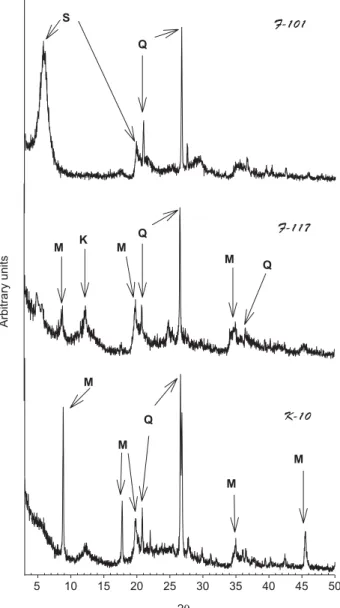
Figure 1 shows the XRD patterns of F-101, F-117 and K-10 clays. The F-101 clay shows a strong reflection at 15.23 Å (2T = 5.78º), which indicates the presence of smectite.11 In addition, this sample shows a peak at 3.30 Å
(2T = 27.05º) corresponding to D-quartz.12 On the other
hand, the XRD patterns of the natural clay F-117 show several peaks: 8.76 Å (2T = 10.15º) and 6.46 Å (2T = 13.69º) suggesting the presence of mica and kaolinite respectively and 3.18 Å (2T = 28.06º) indicating the presence of
D-quartz. In addition, the broad weak peak corresponding to smectite in F-117 clay suggests that this clay mineral is not the main component and its structure is disarranged.13
These results indicate that F-117 clay is an interstratified clay and F-101 clay presents a sole kind of clay mineral (smectite). K-10 showed a very weak and broad reflection d(001) in 2T = 6.0° (d = 14.7 Å), suggesting the presence of clay mineral of smectite group. The reflections in 2T = 9.00o (d= 10,0 Å) and 2T = 18.0° (d = 4,92 Å) suggest the
presence of a clay-mineral of the mica group. Claver et al.
identified K-10 as an acid treated montmorillonite with a partially destroyed structure.14According to Cseri et al.,
K-10 was activated with mineral acid at high temperature and this treatment results in ion exchange, dealumination, and extraction of iron and manganese.15 As seen in Figure
2, the XRD patterns of kaolin indicates that kaolinite is the only clay-mineral component of the clay.16
Table 1 shows the results of the chemical analysis of the clays. The results of chemical analysis showed that the
amount of K ion in F-117 clay (2.83) is greater than in F-101 clay, suggesting the existence of illite in the former.17
As observed, both F-101 and F-117 clays show iron contents around 10% and Mg cation presented in both clays in the octahedral layer. This conclusion was based on a previous report of Guarino, in which the Mg cation amount was not altered in the homoionic clays studied.11
On the other hand, the low content of elements different from Si, Al and Fe in kaolin suggests it is a 1:1 clay, as other kaolinitic clays.18
The results of textural properties of the smectites are summarized in Table 2. Both F-101 and F-117 clays exhibit analogous hysteresis, characteristic of mesoporous solids.11
Although the pore diameter were similar too, the K-10 clay presents greater surface area than the other clays.
Figure 3 and Table 3 show the 27Al MAS-NMR spectra
of clays. The 27Al NMR spectrum of F-101 clay shows a
broad peak at 56.4 ppm due to tetrahedral Al ions and another one at -5.1 ppm which can be attributed to octahedral Al sites. In a previous paper, it was observed that tetrahedral Al sites were not present in the structure of this clay12 as it was expected to be from the composition of
feldspar, which was not detected by XRD as it presents low crystallinity.11 On the other hand, the F-117 clay presents
a peak at 61.4 ppm attributed to tetrahedral Al sites. All Al is hexacoordinated (structural) in kaolin and the percentage of AlIV in acid commercial K-10 (18.4%) is
greater than in the others Brazilian natural clays, probably due to the acid-high temperature treatment of this clay.15
Moreover, the AlVI is smaller in K-10 due to its disarranged
framework.
Figure 4 shows the 29Si MAS-NMR spectra of the clays.
The region of Q3(nAl) in the spectra of F-101 and F-117
clays, detected between -70 and -93 ppm, presents a peak that indicates the presence of Si of the clay framework.12 Table 2. Textural parameters of clays
Clay Surface Area (m2/g) Especific External Area (m2/g) Pore Diameter(Å) Micropore Volume (cm3/g)
F-101 104 6 9 4 6 0.015
F-117 108 9 4 6 2 0.006
K-10 254 238 5 5 0.005
Table 1. Chemical analysis of clays
Clay SiO2 Al2O3 Fe2O3 MgO Na2O K2O CaO TiO2 others
F-101 66.19 17.10 10.11 3.21 0.42 0.45 1.42 1.10
-F-117 59.57 22.28 11.31 2.25 0.01 2.83 0.72 1.03
-Kaolin 53.09 42.47 2.49 - - 0.02 0.01 1.74 0.17
K-10 77.76 15.60 3.10 1.27 0.40 0.78 0.11 0.58 0.40
Figure 2. XRD patterns of kaolin.
Figure 3. 27Al MAS-NMR of clays.
Table 3.27Al MAS-NMR of clays
Clay G (ppm) Assignment Relative Area (%)
F-101 5.1 AlVI 94.5
56.4 AlIV 5.5
F-117 -3.0 AlVI 95.6
61.4 AlIV 4.4
Kaolin -2.2 AlVI 100
K-10 2.1 AlVI 81.6
compounds or iodohydrin in the case of the reaction with the bulk t-butanol.
The natural Brazilian clays F-101 and F-117 showed better yields, while K-10 clay was intermediate and kaolin was the worst. As kaolin presents an invariable basal distance and K-10 clay has its framework disarranged by previous acid-treatment,13 our results support the need of a
well-defined variable basal distance, which is present in F-101 and F-117 clays. Besides, the iron contents of F-101 and F-117 clays are greater than the other ones and Fe3+ is
known to catalyze coiodination reactions.7,19 On the other
hand, the same reactions in the absence of any catalyst led to the same products in considerably lower yields.
Conclusions
The characterization of natural Brazilian clays showed that F-101 clay is constituted of only one clay-mineral (smectite), while F-117 clay is an interstratified clay. The use of these clays as catalysts in coiodination reactions present great advantages over traditional methods,7,8 such
as inexpensive material, mild reactions conditions and minimal environmental impact. Considering the environmental issues that require the substitution of toxic catalysts by more friendly solid catalysts and the advantages of the heterogeneous catalysis in terms of easy work up procedures, our methodology agrees with the green chemistry approach.20
Acknowledgments
We thank CNPq and FAPERJ for financial support; Bentonit do Brasil for the kind donation of 101 and F-117 clays, CETEM for the donation of kaolin; NUCAT-COPPE and Laboratório RMN IQ/UFRJ for the analyses of the clays. RASV and JLESJr thank CAPES and PIBIC/ UERJ, respectively, for fellowships. We also thank Rosane A.S. San Gil (IQ/UFRJ) for useful discussions
The signal attributed to D-quartz and amorphous silica, Q4(0Al), observed in the range from -106 to -130 ppm, is
also presented in both natural Brazilian clays. K-10 clay shows a Q4(0Al) peak more defined than the matural clays,
suggesting it has more amorphous silica than the others. As expected, kaolin exhibits a signal at -91.3 ppm related to structural Si, not been detected quartz nor amorphous silica.
Utilization of clays in coiodination reaction of alkenes
The results of the reactions of coiodination of styrene and cyclohexene with water and alcohols in the presence of clays are summarized in Scheme 1 and Table 4. These reactions were carried out at room temperature by stirring together the alkene, iodine and the clay in the appropriated solvent (aqueous dioxane or alcohols). The reaction products were analyzed by HRGC and characterized by spectroscopic methods. It was observed a sole product in each reaction (iodohydrin or E-iodoether) with no detectable amount of any other products, such as diiodo
Table 4. Yields of products according to Scheme 1
Product R Clay
None F-101 F-117 Kaolin K-10
H 59% 94% 96% 77% 79%
Et 31% 92% 91% 65% 76%
i-Pr 30% 89% 89% 59% 68%
t-Bu 19% 76% 74% 40% 64%
H 28% 90% 86% 52% 79%
Et 27% 90% 93% 63% 70%
i-Pr 23% 90% 92% 60% 71%
t-Bu 17% 72% 72% 37% 50%
References
1. Varma, R.S.; Tetrahedron2002,58, 1235.
2. Vaccari, A.; Appl. Clay Sci.1999,14, 161.
3. De la Mare, P.B.D.; Electrophilic Halogenation, Cambridge
University Press: London, 1976.
4. Sanseverino, A.M.; da Silva, F.M.; Jones Jr., J.; de Mattos,
M.C.S.;Quim. Nova2001,24, 637.
5. Gribble, G.W.; Acc. Chem. Res.1998,31, 141. Gribble, G.W.;
Chemosphere2003,52, 289.
6. Seevers, R.H.; Counsell, R.E.; Chem. Rev.1982,82, 575.
Hamant, S.; Mathieu, J.P.; Morin, C.; Trimcev, I.; Vidal, M.;
Bioorg. Med. Chem. Lett.1994,4, 1687.
7. de Mattos, M.C.S.; Sanseverino, A.M.; J. Chem. Res. (S)1994,
440.
8. Mahajan, V.A.; Shinde, P.D.; Gajare, A.S.; Karthikeyan, M.;
Wakharkar, R.D.; Green Chem. 2002,4, 325.
9. Villegas, R.A.S.; de Aguiar, M.R.M.P.; de Mattos, M.C.S.;
Guarino, A.W.S.; Barbosa, L.M.; Assumpção, L.C.F.N.; J. Braz.
Chem. Soc.2004,15, 150.
10. Styrene derivatives, trans-2-iodo-cyclohexanol and trans
-1-ethoxy-2-iodocyclohexane: Sanseverino, A.M.; de Mattos,
M.C.S.; Synthesis 1998, 1584. trans
-1-Isopropoxy-2-iodocyclohexane: Horiuchi, C.A.; Nishio, Y.; Dan, G.;
Takanori, F.; Kiji, S.; Chem. Lett.1991, 607. trans-t
-Butoxy-2-iodocyclohexane: Glover, S.A.; Goosen, A.; Tetrahedron
Lett.1980,21, 2005.
11. Guarino, A.W.S.; PhD Thesis, Universidade Federal do Rio de
Janeiro, Brazil, 1999.
12. Guarino, A.W.S.; San Gil, R.A.; Polivanov, H.; Menezes,
S.M.C.;J. Braz. Chem. Soc.1997,8, 581.
13. Grim, R.E.; Clay Mineralogy, 2nd ed, McGraw-Hill: New York,
1968.
14. Claver, C.; Fernández, E.; Català, R.M.; Medina, F.; Salagre,
P.; Sueiras, J.E.; J. Catal.2001,201, 70.
15. Cseri, T.; Bekassy, S.; Figueras, F.; Cseke, E.; de Menorval,
L.C.; Dutartre, R.; Appl. Catal. A: General1995,132, 141.
16. Santos, P.S.; Ciência e Tecnologia de Argilas, Edgard Blucher:
São Paulo, 1989, vol. 1.
17. The name illite does not refer to a single mineral species, but the most common representative of which is a potassium-rich 2:1 layer type with small amounts of interstratified smectite
(Reynolds, R.C.; Interstratified Clay Minerals In Crystal
Structures of Clay Minerals and their X-ray Identification;
Brindley, G.W.; Brown, G. eds., Mineralogical Society: London, 1980).
18. Ponde, D.; Borade, H.B.; Sudalai, A.; Ravindranathan, T.;
Deshpande, V.H.; Tetrahedron Lett.1996,37, 4605. Upadhya,
T.T.; Daniel, T.; Sudalai, A.; Ravindranathan, T.; Sabu, K.R.;
Synth. Commun.1996,26, 4539.
19. de Mattos, M.C.S.; Sanseverino, A.M.; J. Chem. Res. 2004,
638.
20. Anastas, P.T.; Warner, J.C.; Green Chemistry: Theory and
Practice, Oxford University Press: Oxford, 2000.
Received: July 9, 2004