Short Report
0103 - 5053 $6.00+0.00
*e-mail: [email protected]
Synthesis and Stereochemical Assignment of Methyl 3-(3-hydroxyphenoxy)acrylate
via cis-trans
Photoisomerization
Mirela Inês de Sairre, Luiz Felipe N. Araújo, Rosangela da Silva, Paulo Marcos Donate,*
Cristina A. Silvério and Laura T. Okano
Departamento de Química, Faculdade de Filosofia, Ciências e Letras de Ribeirão Preto da Universidade de São Paulo, Avenida Bandeirantes 3900, 14040-901 Ribeirão Preto - SP, Brazil
3-(3-Hidroxi-fenoxi)acrilato de metila (2), um novo e importante material de partida para inúmeras reações e um precursor potencial do produto natural 3-(3-hidroxi-fenoxi)-2-propenal (1), foi sintetizado a partir de resorcinol e propiolato de metila. A configuração trans da dupla ligação presente no composto 2 foi confirmada através de uma reação de fotoisomerização.
Methyl 3-(3-hydroxyphenoxy)acrylate (2), a new and important starting material for several reactions and a potential precursor of the natural product 3-(3-hydroxyphenoxy)-2-propenal (1), was synthesized from resorcinol and methyl propiolate. The trans configuration of the double bond present in 2 was confirmed through a photoisomerization reaction.
Keywords: methyl 3-(3-hydroxyphenoxy)acrylate, 3-(3-hydroxyphenoxy)-2-propenal, photoisomerization reaction, synthesis
Introduction
The phytochemistry of Artemisia has been extensively investigated in the last few years.1,2 This medicinal plant
produces highly oxygenated sesquiterpenes that can be applied to the treatment of malaria.1 Examples of such
compounds are the potent anti-malarial drug artemisinin and its derivatives, which can be isolated from the aerial parts of Artemisia annua L.2 However, their natural
occur-rence is very low, which has led to intensive research efforts toward the production of new biotechnological strategies or synthetic ways to enhance their production.1,2 Apart from
highly oxygenated sesquiterpenes, several other aromatic compounds such as coniferaldehyde derivatives and 5-alkyl resorcinols have also been isolated from Artemisia annua L.3 It has also been reported4 that Artemisia subdigitata Mattf. contains flavonoids, coumarins, substituted phenols, and a number of compounds that have not been previously
described, like 3-(3-hydroxyphenoxy)-2-propenal (1)
shown in Figure 1.
Thecis to trans photoisomerization of organic mole-cules has found large application in biochemical processes;5
e.g., the photon signal transduction of rhodopsin in the visual process.6 The interconversion of cis- to trans-olefins
is a thermodynamically spontaneous process but, in the absence of radical initiators, this conversion usually occurs very slowly at room temperature. Light absorption by ole-fins leads to a photoisomerization process. Sometimes, the more stable isomer can be transformed into the less stable one upon light irradiation. This process can proceed either
via the P,P* singlet (S1) or triplet (T1) excited states. Any of the isomers can be formed when the molecule returns to the ground state (S0), because both the S1-p state and the T1-p state have a perpendicular geometry. The barrier of the isomerization process is lowered when there is conjugation of the carbon-carbon double bond with a heteroatomic P-system.5 The mechanism of acrylate isomerization is
dependent on the presence of other compounds in the solu-tion, such as nucleophiles7 or radicals.8
The goal of this paper is to report a short synthetic route for the preparation of methyl 3-(3-hydroxyphenoxy) acrylate (2), a new and potential precursor of the natural
from Artemisiaspecies. Because it was not possible to obtain the correct configuration of the acrylate double bond in the ester derivative 2 from the magnitude of the vicinal coupling constant of the NMR spectra, a simple cis-trans
photoisomerization experiment was used to produce the
cis isomer. The photoisomerization reaction was followed by NMR and UV-Vis spectroscopic measurements from time to time. Determination of the configuration of the initial synthetic natural product and an estimation of the
trans-cis interconversion rate were obtained from the ex-perimental data.
Results and Discussion
Compound 2 was synthesized from commercial
resorcinol (1,3-dihydroxybenzene). Initially, resorcinol and triphenylphosphine were dissolved in dichloromethane. A solution of methyl propiolate in dichloromethane was slowly added to this solution, and the mixture was kept un-der stirring for 24 h at room temperature.9 The residue was
purified by column chromatography on silica gel. Analysis by1H and 13C NMR spectroscopy revealed that the product
was a mixture of compounds 2 and 3 with yields of 65% and 15%, respectively (Scheme 1).
Yavari, Hekmat-Shoar and Zonousi9 performed
reactions between substituted phenols and dimethyl
acetylenedicarboxylate (DMAD) in the presence of tri-phenylphosphine under reflux in dichloromethane, and they obtained coumarins in good yields. They assumed that the addition of triphenylphosphine to the acetylenic ester followed by protonation would result in an interme-diate vinyltriphenylphosphonium salt. The formation of coumarins should occur by an eletrophilic attack of this vinyltriphenylphosphonium species on the aromatic ring and further intramolecular lactonization.
It has been reported10 that the coumarin ring could not
be produced in a reaction similar to the one described in this work, but it was produced through a process carried out under milder conditions. An unusual O-conjugate addi-tion reacaddi-tion of the phenol to methyl propiolate must have occurred in our case,11-13 furnishing compounds 2 and 3.
Usually, the O-conjugate addition is not very common for most enolate conjugate addition reactions. However, in our work, O-addition was especially favored because the
Scheme 1. Synthesis of compounds 2 and 3.
Scheme 2. Proposed reaction mechanism for the preparation of compound 2.
nucleophile is stabilized and the electrophile has a hard leaving group.
A reasonable mechanism for this addition reaction9,11-13
is shown in Scheme 2. The first step of the process involves a Michael addition of triphenylphosphine to the propiolate, thus generating an active phosphonium intermediate (4). This latter species undergoes a subsequent addition of the phenoxide in a 1,4-fashion, followed by elimination of triphenylphosphine, to afford compound 2.
Derivative 2 was prepared and its structure was iden-tified spectroscopically. However, the determination of the alkene configuration was not possible. Typically, the stereochemical assignment of the acrylate double bond is based on the magnitude of the vicinal coupling constant (J) of the corresponding hydrogens in the 1H NMR spectra.
The range for trans and cisisomers are, respectively, 12 to
18, and 6 to 12 Hz. The value measured for compound 2
was 12.1 Hz, making an unequivocal attribution extremely difficult.14
Therefore, in order to correctly assign the stereoche-mistry of the double bond of compound 2, we carried out a photoisomerization reaction (Scheme 3). The photoisomer-ization experiment was carried out in a rotating “merry-go-round” reactor using a 400 W medium pressure mercury lamp.15 A solution of 2 was prepared in deuterochloroform,
and placed into two quartz cuvettes. The first cuvette was a resonance tube and the second one a UV-Vis spectroscopic cell. Both quartz cuvettes were inserted into the photoreac-tor. At appropriate time intervals, the rotating “merry-go-round” was stopped; the cuvettes were withdrawn from the reactor and allowed to cool down to room temperature. The
1H NMR and UV-Vis spectra were registered. Then both
cuvettes were replaced at the same time into the photoreac-tor and the irradiation process was resumed.
The UV absorption spectra of the trans and cis isomers of compound 2 (Figure 2) are very similar, so very little information could be obtained from the spectrophotometric analysis.
Scheme 3. Photoisomerization of compound 2.
Figure 2. UV spectra of compounds 2 (trans dotted line and cis full line) in acetonitrile.
Figure 3.1H NMR spectra: (A) Isomer 2a; (B) Mixture of isomers (2a+2b), after 12 h of irradiation.
However, after 12 h of irradiation, the formation of
isomer2bwas observed in the 1H NMR with 25% yield
(Figure 3).
Figure 3A shows the 1H NMR spectrum of compound
irradiation. The J values measured between H-2 and H-3
(Scheme 3) show that the double bond of the isomer 2b
formed after irradiation has a cis configuration (J6.9 Hz),
so the double bond of compound 2a must have a trans
configuration (J 12.1 Hz). Changes in the chemical
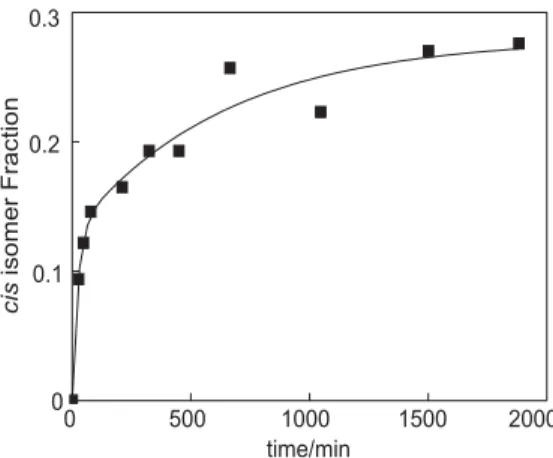
shift of hydrogens H-2 and H-3 for each isomer were also noted after the induced isomerization. Analyses of the integration values for H-2 or H-3 showed that formation of the cis isomer (Figure 4) is slow under our experimental conditions. A trans-cis interconversion rate of 6.7r10-5 s-1 was estimated.
After the irradiation reaction was completed, the mixture of the two isomers (2a and 2b) was stored at low
temperature for several months. The 1H NMR spectrum
of this mixture was then registered, showing that the cis
isomer is highly stable. No interconversion took place during this period.
Conclusions
This work demonstrates the successful synthesis of
methyl 3-(3-hydroxyphenoxy)acrylate (2), a new
com-pound that is a potential precursor of the natural product
3-(3-hydroxyphenoxy)-2-propenal (1). By means of a
photoisomerization reaction, we confirmed that the double bond present in 2 is trans (isomer 2a).
Experimental
General experimental procedures
Dichloromethane and the common reagents resorcinol (1,3-dihydroxybenzene), triphenylphosphine and methyl propiolate are commercially available. Column chromato-graphy separation was performed with silica gel 60 (70-230 mesh, Merck). All 1H and 13C NMR spectra were recorded
at 400 and 75 MHz, respectively, using a Bruker DPX-400
instrument and chloroform-d (CDCl3) or methyl-d3
alcohol-d (CD3OD) as solvent; chemical shifts are in ppm downfield from a tetramethylsilane internal standard. UV-Vis absorption spectra were measured on a Hitachi U-3000 UV-Vis spectrophotometer. IR (KBr) spectra were measured on a Perkin Elmer Spectrum RX IFTIR System, and the most intense or representative bands are reported (in cm-1). GC-MS analyses were performed by EI ionization
at 70 eV on a Shimadzu GC/MS QP-2010 spectrometer. Elemental analyses were performed with a Carlo Erba instrument EA-1110. The rotating “merry-go-round” a pparatus used a Hanovia 400 W medium pressure mercury lamp, together with a cooling immersion well.
Methyl (2E)-3-(3-hydroxyphenoxy)acrylate (2a) and dimethyl (2E, 2’E)-3,3’-[1,3-phenylene-bis(oxy)] diacrylate (3)
A solution of methyl propiolate (0.1651 g, 1.96 mmol) in dichloromethane (5 mL) was slowly added (10 min) to a stirred solution of triphenylphosphine (0.3430 g, 1.31 mmol) and resorcinol (0.1440 g, 1.31 mmol) in di-chloromethane (30 mL), cooled to 5oC. The ice bath was
removed, and the reaction mixture was stirred at room tem-perature for 24 h. The solvent was removed under reduced pressure, and the residue was purified by column chroma-tography on silica gel, using n-hexane and ethyl acetate in a 7:3 ratio as eluent, to afford a mixture of compounds 2a
(0.1651 g, 65%) and 3 (0.0546 g, 15%).
Analytical data for compound 2a
1H NMR (CDCl
3, 400 MHz) D 7.81 (d, 1H, J 12.1 Hz),
7.18 (t, 1H, J 8.3 Hz), 6.69 (ddd, 1H, J
1 1.0 Hz, J2 2.3 Hz,
J3 8.3 Hz), 6.59 (m, 2H), 5.60 (d, 1H, J 12.1 Hz), 3.75 (s,
3H).13C NMR (CDCl
3, 75 MHz) D 168.7 (C), 159.5 (CH),
157.5 (C), 156.9 (C), 130.6 (CH), 112.2 (CH), 109.6 (CH), 105.4 (CH), 101.5 (CH), 51.7 (CH3). IR N/cm-1: 3394 (O-H),
3056 (C-H, aromatic), 1718 (C=O, ester), 1654 (C=C); 1266 (C-O). MS: m/z (relative intensity) 194 (M+, 98%),
163 (86), 135 (100), 121 (22), 107 (50), 94 (25), 81 (18), 69 (66), 65 (51), 53 (29). Anal. Calc. for C10H10O4: C, 61.85; H, 5.19; O, 32.96. Found: C, 61.62; H, 4.98; O, 33.40.
Analytical data for compound 3
1H NMR (MeOD, 400 MHz) D 7.77 (d, 2H, J 12.1 Hz),
7.35 (t, 1H, J 8.3 Hz), 6.89 (dd, 2H, J1 2.4 Hz, J2 8.3 Hz), 6.84 (t, 1H, J
1 2.3 Hz), 5.51 (d, 2H, J 12.1 Hz), 3.52 (s, 6H). 13C NMR (MeOD, 75 MHz) D 168.0 (C), 158.8 (CH), 157.4
(C), 131.5 (CH), 114.1 (CH), 107.8 (CH), 102.4 (CH), 50.9 (CH3). IR N/cm-1: 3072 (C-H, aromatic), 1714 (C=O, ester),
1652 (C=C), 1260 (C-O). MS: m/z (relative intensity) 278 (M+, 85%), 247 (49), 219 (78), 215 (31), 205 (15), 187
(100), 163 (39), 147 (16), 131 (18), 118 (31), 108 (47), 92 (18), 77 (17), 69 (18), 64 (26), 59 (47), 53 (15). Anal. Calc. for C14H14O6: C, 60.43; H, 5.07; O, 34.50. Found: C, 60.81; H, 5.12; O, 34.07.
Acknowledgments
The authors thank Fundação de Amparo à Pesquisa do Estado de São Paulo (FAPESP) and Conselho Nacional de Desenvolvimento Científico e Tecnológico (CNPq) for financial support; Dr. Cláudio Francisco Tormena (IQ-UNICAMP), Dr. Timothy John Brocksom (DQ-UFSCar) and Dr. Gil Valdo José da Silva (DQ-FFCLRP-USP) are acknowledged for useful discussions.
References
1. Haynes, R. K.; Curr. Top. Med. Chem.2006,6, 509; Geldre, E. V.; Vergauwe, A.; Eeckhout, E. V.; Plant Mol. Biol.1997,33, 199. 2. Liu, C. Z.; Zhao, Y.; Wang, Y. C.; Appl. Microbiol. Biotechnol.
2006,72, 11; Bilia, A. R.; Malgalhaes, P. M.; Bergonzi, M. C.;
Vincieri, F. F.; Phytomedicine2006,13, 487.
3. Sy, L.-K.; Brown, G. D.; Phytochemistry1999,50, 781; Brown, G. D.; J. Nat. Prod.1992,55, 1756.
4. Shatar, S.; Altantsetseg, S.; Dung, N. X.; Ngoc, P. H.; Klinkby, N.; Leclercq, P. A.; J. Essential Oil Res.2002,14, 99; Shi, Y.; Li, Y.; Zhang, H.; Gaodeng Xuexiao Huaxue Xuebao1992,13, 1258.(CA 118:98083)
5. Dugave, C.; Demange, L.; Chem. Rev.2003,103, 2475. 6. Kakitami, T.; Kawatsu, T.; Kimura, A.; Yamada, A.; Yamoto,
T.; Yamamoto, S.; J. Biol. Phys.2002,28, 367. 7. Clauss, R.; Hinz, W.; Hunter, R.; Synlett1997,1, 57.
8. Garcia-Exposito, E.; Gonzales-Moreno, R.; Martin-Vila, M.; Muray, E.; Rife, J.; Bourdelande, J. L.; Branchadell, V.; Ortuno, R. M.; J. Org. Chem.2000,65, 6958.
9. Yavari, I.; Hekmat-Shoar, R.; Zonousi, A.; Tetrahedron Lett.
1998,39, 2391.
10. Oyamada, J.; Kitamura, T.; Tetrahedron 2006,62, 6918 and references cited therein; Valizadeh, H.; Shockravi, A.; Tetrahedron Lett.2005,46, 3501 and references cited therein; Davies, S. G.; Mobbs, B. E.; Goodwin, C. J.; J. Chem. Soc., Perkin Trans. 11987, 2597; Sethna, S.; Phadke, R.; Org. React.1953,7, 1-58. 11. Trost, B. M.; Dake, G. R.; J. Am. Chem. Soc.1997,119,
7595.
12. Tae, J.; Kim, K-O.; Tetrahedron Lett.2003,44, 2125. 13. Hanédanian, M.; Loreau, O.; Taran, F.; Mioskowski, C.;
Tetrahedron Lett.2004,45, 7035.
14. da Silva, R.; Donate, P. M.; da Silva, G. V. J.; Pedersoli, S.; Alemán, C.; J. Braz. Chem. Soc.2005,16, 626.
15. CRC Handbook of Organic Photochemistry; Scaiano, J. C., ed.;
CRC Press: Florida, 1989, vol. 1.
Received: May 15, 2007
Published on the web: January 28, 2008