Artigo
*e-mail: [email protected]
APPLICATION OF SULFONIC ACID FUNCTIONALIZED NANOPOROUS SILICA (SBA-Pr-SO3H) FOR THE
PREPARATION OF 4,6-DIARYLPYRIMIDIN-2(1H)-ONES
Ghodsi Mohammadi Ziarania,*, Masoumeh Azizia, Parvin Hajiabbasia and Alireza Badieib aDepartment of Chemistry, Alzahra University, Vanak Square, P.O. Box 1993893973, Tehran, Iran bSchool of Chemistry, College of Science, University of Tehran, Tehran, Iran
Recebido em 09/05/2014; aceito em 22/01/2015; publicado na web em 05/03/2015
In this work, we report the Biginelli-type reaction between various aldehydes, acetophenones and urea systems in the presence of sulfonic acid functionalized silica (SBA-Pr-SO3H) under solvent-free conditions, which led to 4,6-diarylpyrimidin-2(1H)-ones derivatives. SBA-Pr-SO3H with a pore size of 6 nm was found to be an eficient heterogeneous solid acid catalyst for this reaction which led to high product yields, was environmentally benign with short reaction times and easy handling.
Keywords: Biginelli-type reaction; green synthesis; heterogeneous SBA-Pr-SO3H catalyst.
INTRODUCTION
The multi-functionalized dihydropyrimidinones (DHPMs) and dihydropyrimidines synthesis in a Biginelli or Biginelli-like three-component-coupling reaction are of considerable interest.1-9
In addition, it also provides an eficient access to the corresponding pyrimidines which are found in a broad variety of biologically active molecules and shown biological and therapeutic activities10,11 such
as antitumoral agents12-17 and HIV inhibitors.18,19 Some of biological
active dihydropyrimidinone compounds were represented in the Scheme 1, for example, lucytosine is an antibacterial and antifun-gal active compound, monastrol is a drug which inhibit vitamin Eg5 formation, nifedipine is a Ca regulator drug utilized for blood
pressure treatments, and batzclladine B is a dihydropyrimidinone core containing natural product derived from marines which is anti HIV virus drug.20-23
Solid acid catalysts such as ordered mesoporous materials24,25
have outstanding properties such as their environmental compatibility in terms of less toxicity of waste, reusability, simplicity in handling, non-corrosiveness and ease of isolation of the products in terms of heterogeneity. Thus, the surface of SBA-15 was modiied by acidic
functional groups (e.g., -SO3H) to prepare nano-solid acid catalyst
that was gratefully used in organic synthesis.26
As mentioned in our recent studies in the application of SBA-Pr-SO3H,
27-30 among different catalysts used for these Biginelli-type
reactions such as Bi(TFA)3, 31 H
2NSO3H, 32 I
2,
33 nanocomposites
ZrO2-Al2O3-Fe3O4,
34 iron,35,36 and manganese-containing periodic
mesoporous organosilica37 we used sulfonic acid functionalized silica
(SBA-Pr-SO3H) as an eficient heterogeneous catalyst to prepare
4,6-diarylpyrimidin-2(1H)-ones derivatives in excellent yields. EXPERIMENTAL
All chemicals were obtained commercially and utilized without further puriication. IR spectra were recorded from KBr disk using a FT-IR Bruker Tensor 27 instrument. Melting points were measured by using the capillary tube method with an electro thermal 9200 apparatus. The 1H NMR (250 MHz) was recorded on a Bruker DPX
at 250 MHz using TMS as an internal standard. Gas chromatography--mass spectrometry (GC-MS) analysis was achieved on an Agilent 6890-5973 GC/MS detector. Also, SEM analysis was performed on a Philips XL-30 ield-emission scanning electron microscope operated at 16 kV while Transmission electron microscopy (TEM) analysis was performed on a Tecnai G2 F30 at 300 kV.
Preparation of SBA-15-Pr-SO3H
The modiied SBA-Pr-SO3H used as a solid acid catalyst in the
following reaction was synthesized and functionalized according to our previous report.38
General procedure for the preparation of 4,6-diarylpyrimi-din-2(1H)-ones derivatives (4a-4i): The SBA-Pr-SO3H (0.05 g) was
activated in vacuum at 100 °C and then cooled to room temperature. The aromatic aldehydes 1 (1 mmol), acetophenones 2 (1 mmol) and urea 3 (1 mmol), and SBA-Pr-SO3H (0.05 g) were heated at 110 ºC for the appropriated time, as mentioned in Table 2. The completion of the reaction was monitored by TLC. The mixture was cooled to room temperature, the crude product was dissolved in hot ethanol and then the catalyst was removed by iltration. Ultimately, pure crystals of compounds 4a-4i were obtained from iltrates.
4,6-Diphenyl-pyrimidin-2(1H)-one (4a): IR (KBr, νmax): 3420, N
H NH
OH
S H3C
EtO2C
N H
NO2
COOEt EtOOC
N H
N NH2
F
O
Flucytosine Monastrol
Nif edipine
Batzclladine B
N NH
O O H
N H2N
NH
(CH2)6 O
O NH
N N
N H
H (CH2)6CH3
3285, 3084, 3005, 2894, 2856, 2741, 1618, 1577, 1495, 1455, 1397, 1338, 1069, 823, 681 cm-1. 1H NMR (250 MHz, CDCl
3): δ 7.50-7.61
(m, 7H, ArH& H-5), 8.13-8.16 (m, 4H, ArH), 12.07 (s, 1H, NH). 13C
NMR (100 MHz, DMSO-d6): δ 164.9, 157.0, 133.2, 132.3, 128.9,
128.0, 100.8, 56.0.39 EI-MS: 248 (M+), 171, 94, 77.
4-(4-Chlorophenyl)-6-phenyl-pyrimidin-2(1H)-one (4b): IR (KBr, νmax): 3423, 3385, 3104, 3058, 3002, 2892, 2743, 1614, 1568,
1490, 1437, 1391, 1333, 1089, 990, 821, 765, 683 cm-1. 1H NMR (250
MHz, CDCl3): δ 7.49 (d, J = 7.5 Hz, 2H, ArH), 7.52-7.62 (m, 4H, ArH
& H-5), 8.12 (d, J = 7.5 Hz, 2H, ArH), 8.18 (d, J = 7.5 Hz, 2H, ArH), 12.17 (s, 1H, NH). 13C NMR (100 MHz, DMSO-d
6): δ 160.2, 144.9,
135.6, 129.0, 127.7, 109.6.39 EI-MS: 282 (M+), 171, 111, 94, 77.
4-(4-Methylphenyl)-6-phenyl-pyrimidin-2(1H)-one (4c):39IR
(KBr, νmax): 3410, 2794, 1674, 1592, 848, 773 cm
-1. 1H NMR (400
MHz, DMSO-d6): δ 8.11-8.20 (m, 4H, ArH), 7.49-7.60 (m, 6H,
ArH), 2.36 (s, 3H, CH). 13C NMR (100 MHz, DMSO-d
6): δ 142.1,
131.9, 129.9, 129.3, 128.0, 128.0, 21.5;. EI-MS: 262 (M+), 247, 171,
94, 92, 77.
4-(3-Methylphenyl)-6-phenyl-pyrimidin-2(1H)-one (4d): IR (KBr, νmax): 3423, 3293, 3093, 3005, 2897, 1618, 1491, 1339, 1202,
1154, 1070, 991, 808, 774, 692 cm-1. 1H NMR (250 MHz, CDCl 3):
δ 2.39 (s, 3H, CH3), 7.49 (d, J = 7.5, 2H, ArH), 7.53-7.58 (m, 4H,
ArH & H-5), 7.91-8.12 (t, 2H, ArH), 8.14 (d, J = 5.75 Hz, 2H, ArH), 12 (s, 1H, NH). EI-MS: 262 (M+), 247, 171, 94, 77.
4-(4-Hydroxyphenyl)-6-phenyl-pyrimidin-2(1H)-one (4e):39 IR
(KBr, νmax): 3331, 3300, 2928, 1659, 1616, 779 cm
-1. 1H NMR (400
MHz, DMSO-d6): δ 11.88 (hr, s, lH, NH), 10.21 (s, lH, OH), 8.08
(m, 4H, ArH), 7.56 (d, J= 7.2 Hz, 3H, ArH), 7.42 (s, lH, ArH), 6.91 (d, J = 8.8 Hz, 2H, ArH) 13C NMR (100 MHz, DMSO-d
6): δ 161.0,
131.5, 129.7, 128.9, 127.6, 115.7. EI-MS: 264 (M+), 247, 171, 94, 77.
4-(4-Methoxy-phenyl)-6-phenyl-pyrimidin-2(1H)-one (4f): IR (KBr, νmax): 3320, 3096, 1615, 1513, 809, 744 cm
-1. 1H NMR (400
MHz, DMSO-d6): δ 8.09 (tri, 2H,ArH), 7.99 (d, J=7.6 Hz, 2H, ArH),
7.59 (d, J= 5.2 Hz, 3H, ArH), 7.39 (d, J= 8.0 Hz, 2H, ArH), 7.14 (m, lH, ArH), 2.48 (s, 3H, CH). 13C NMR (100 MHz, DMSO-d
6):
δ 162.3, 131.5, 129.5, 128.9, 127.7, 117.4, 55.6. EI-MS: 278 (M+),
247, 171, 108, 94, 77.
4-(Phenyl)-6-(4-Methylphenyl)-pyrimidin-2(1H)-one (4g): IR (KBr, νmax): 3436, 3280, 3096, 3005, 2901, 2745, 1616, 1512, 1459,
1338, 1180, 919, 808, 774, 691 cm-1. 1H NMR (250 MHz, CDCl 3): δ
2.38 (s, 3H, CH3), 7.35 (d, J = 7.5 Hz, 2H, ArH), 7.51-7.58 (m, 4H,
ArH & H-5), 8.05 (d, J = 7.5 Hz, 2H, ArH), 8.13 (d, J = 7.5 Hz, 2H, ArH), 12 (s, 1H, NH). EI-MS: 262 (M+), 247, 171, 94, 77.
4-(4-Chlorophenyl)-6-(4-nitrophenyl)-pyrimidin-2(1H)-one (4h): IR (KBr, νmax): 3412, 3192, 2921, 1612, 1548, 1515, 1456, 1348
cm-1. 1H NMR (300 MHz, DMSO-d
6): δ 6.90-7.83 (m, 9H, ArH &
H-5), 9.98 (s, 1H, NH). EI-MS: 327 (M+), 247, 171, 77.
4-(Chlorophenyl)-6-(4-Methoxyphenyl)-pyrimidin-2(1H)-one (4i):31 IR (KBr) 3429, 3 100, 289 0, 1617, 1582, 810, 600 cm-1; 1H
NMR (CDCl3, 200 M Hz) δ 3.8 (s, 3H, OCH3 ), 7.09 (d, J =8.4 Hz,
2H, Ar), 7.53 (s, 1H, =CH-), 7.61 (d, J = 8.09 Hz, 2H, Ar), 8.17 (m, 4H, Ar), 1 2.0 (br, 1H, NH); 13C NMR (CDCl
3, 50 MHz) δ 100.4,
115.1, 115.4, 128.8, 129.7, 129 .9, 130.2, 130.4, 130.7, 131.2, 137.1, 160.7, 163.0.
RESULTS AND DISCUSSION
In continuation of our interest in the developing of green me-thodologies and the synthesis of diverse heterocyclic compounds of pharmaceutical importance, we report herein the synthesis of some 4,6-diarylpyrimidin-2(1H)-ones 4a-4i derivatives under neat condition. Thus, a three-component reaction of aromatic aldehydes 1, acetophenones 2 and urea 3, in the presence of sulfonic acid functionalized silica (SBA-Pr-SO3H) as catalyst at 110 ºC, has been
shown to give 4,6-diarylpyrimidin-2(1H)-ones derivatives 4a-4i in excellent yields (Scheme 2). However, 3,4-dihydropyrimidin-2(1H )--ones has been prepared40 from the reaction of aromatic aldehydes,
aromatic ketones, and urea using a Lewis acid (FeCl3•6H2O-TMSCl)
as catalyst; but we did not ind 3,4-dihydropyrimidin-2(1H)-ones in our investigation. In addition, the crucial role of catalysis, solvent effects, mechanisms, kinetics and etc. in the Biginelli reactions are discussed in the recently published articles.41-45
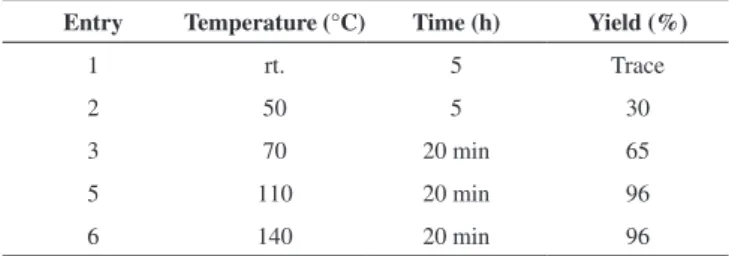
As can be seen in Table 1, we found that the yield of 4a impro-ved and the reaction time was shortened when the reaction would proceed at 110 °C under solvent free condition (entries 1-5). After optimization of the reaction condition, the generality of this method was demonstrated with respect to six different aromatic aldehydes and four acetophenones, and the results were summarized in Table 2. On the base of our investigation, we also ind out that the nature of substitute groups in the aldehydes or ketones has no signiicant effect in this reaction. Completion of the reaction was monitored by TLC, the crude product was dissolved in hot ethanol, the heterogeneous solid catalyst was removed by simple iltration, and the pure crystals of the desired products (4a-4i) were obtained and characterize by IR, mass spectrometric analysisand 1H & 13C NMR spectroscopic
analyses. The acid catalyst can also be reused without signiicant loss of activity by simple washing subsequently with diluted acid solution, water and acetone.
According to proposed mechanism in Scheme 3, the condensa-tion of aryl aldehyde 1 and urea 3 catalyzed by SBA-Pr-SO3H lead
+
O
H2N NH2
1 3 4 (a-i)
O
CH3
R2 +
2
Solvent-free, 110 °C SBA-Pr-SO3H H
O
R1 N
H N
O R2
R1
Scheme 2. Synthesis of 4,6-diarylpyrimidin-2(1H)-ones using SBA-Pr-SO3H as catalyst
Table 1. Optimization of different conditions in the synthesis of compound 4a
Entry Temperature (°C) Time (h) Yield (%)
1 rt. 5 Trace
2 50 5 30
3 70 20 min 65
5 110 20 min 96
to the preparation of iminium intermediate 7 that followed by the nucleophilic addition of acetophenones 2 to give the intermediate 8, which consequently undergoes the ring closure by the nucleophilic attack of the amine onto the carbonyl group. Subsequently proton transfer, dehydration and oxidation results in the formation of adduct compound 4.
As illustrated in the Table 3, comparison of the effectiveness of various catalysts used in the synthesis of 4,6-diarylpyrimidin-2(1H )--ones derivatives is shown the advantages of current methodology. The simplicity, low reaction time and high yields of products under a green condition are resulted from the eficiency of sulfonic acid func-tionalized silica (SBA-Pr-SO3H) as a heterogeneous nano catalyst.
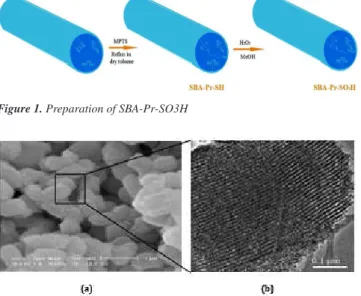
As preparation of SBA-Pr-SO3H is illustrated in Figure 1, the
calcined SBA-15 silica was functionalized with (3-mercaptopropyl)
trimethoxysilane (MPTS) and then, the thiol groups were oxidized to sulfonic acid by hydrogen peroxide. Different methods such as TGA, BET and CHN methods were employed to analyze the surface of the catalyst which was demonstrated that the organic groups (propyl sulfonic acid) were immobilized into the pores.29
The SEM and TEM images of SBA-Pr-SO3H are illustrated in
Figure 2. Uniform particles about 1 µm is shown in the SEM image (Figure 2a) as the same for SBA-15. It could be ind out that morpholo-gy of solid was saved without change during the surface modiication. Also, the TEM image (Figure 2b) shows the parallel channels as the pores coniguration of SBA-15, indicating that the pore of modiied catalyst was not collapsed. Nanopore size of SBA-Pr-SO3H act as
a nano-reactor in the syntheses of 4,6-diarylpyrimidin-2(1H)-ones compounds.
Table 2. Synthesis of 4,6-diarylpyrimidin-2(1H)-ones
Entry R1 R2 Product Time (min) Yield (%) mp (°C) mp (Lit)
1 H H 4a 20 96 231-234 227-228 [45]
2 4-Cl H 4b 25 93 260-262 258-260 [32]
3 4-Me H 4c 35 97 288-291 287-290 [32]
4 3-Me H 4d 40 97 275-278
-5 4-OH H 4e 20 91 258-260 264-265 [45]
6 4-OMe H 4f 30 97 257-260 244-245 [45]
7 H 4-Me 4g 30 92 285-289
-8 4-Cl 4-NO2 4h 30 94 309-311 308-310 [32]
9 4-Cl 4-OMe 4i 30 93 310-312 312-314 [32]
O H Ar
N H
NH Ar'
Ar
O
1
3 Ar
OH
N NH2
O H
SBA-Pr-SO3H
Ar
OH2
N NH2
O H
-H2O
Ar
N NH2
O H
H
SBA-Pr-SO3H
-H2O
H Ar
Ar' O -H
+
3 NH
Ar
H2N
O
Ar' O
2
-H+
-3 +3
Ar N N
O
NH2
H O
NH2
H
SBA-Pr-SO3H
HO -H2O N
H NH Ar'
Ar
O H
Ar
O Ar'
+H+
-H+
2
5 6 7
8
9
10 11
12
SBA-Pr-SO3H
Scheme 3. Proposed mechanism for the synthesis of adduct compound 4
Table 3. Comparison of different conditions for the synthesis of 4,6-diarylpyrimidin-2(1H)-ones derivatives
Entry Catalyst Condition Time (min) Yield (%) Year Ref.
1 I2 neat/ 140ºC 1.20-2.15 h 60-96 2009 [33]
2 H2NSO3H neat/ 70ºC 15-60 91-99 2008 [32]
3 Bi(TFA)3 neat/ 70ºC 30-85 60-95 2007 [31]
Figure 1. Preparation of SBA-Pr-SO3H
Figure 2. SEM image (a) and TEM image (b) of SBA-Pr-SO3H
CONCLUSION
In conclusion, a mild and eficient protocol for the synthesis of 4,6-diarylpyrimidin-2(1H)-ones derivatives has been developed through a one-pot Biginelli reaction under neat condition according to green chemistry using SBA-Pr-SO3H as a nano reactor with the pore
size of 6 nm. In addition, the results are shown that the reaction takes place easily in the nano-pores of catalyst.46 The attractive features
of this simple procedure are short reaction time, excellent yields, simple workup, the reusability of catalyst, and non-chromatographic puriication of products.
SUPPLEMENTARY MATERIAL
The spectral data is available in .pdf format at http://quimicanova. sbq.org.br/ with free access.
ACKNOWLEDGEMENTS
We gratefully acknowledge the financial support from the Research Council of Alzahra University and the University of Tehran. REFERENCES
1. Kappe, C. O.; Acc. Chem. Res. 2000, 33, 879.
2. Bose, D. S.; Fatima, L.; Mereyala, H. B.; J. Org. Chem. 2003, 68, 587. 3. Kappe, C. O.; Roschger, P.; J. Heterocycl. Chem. 1989, 26, 1555. 4. Karimi, B.; Mobaraki, A.; Mirzaei, H. M.; Zareyee, D.; Vali, H.;
Chem-CatChem 2014, 6, 212.
5. Oliverio, M.; Costanzo, P.; Nardi, M.; Rivalta, I.; Procopio, A.; ACS Sustainable Chem. Eng. 2014, 2, 1228.
6. Alvim, H. G. O.; de Lima, T. B.; de Oliveira, H. C. B.; Gozzo, F. C.; de Macedo, J. L.; Abdelnur, P. V.; Silva, W. A.; DaSilveira Neto, B. A.; ACS Catal. 2013, 3, 1420.
7. Sahu, P. K.; Sahu, P. K.; Gupta, S. K.; Agarwal, D. D.; Ind. Eng. Chem. Res. 2014, 53, 2085.
8. Pramanik, M.; Bhaumik, A.; ACS Appl. Mater. Interfaces 2014, 6, 933.
9. Shen, Z. -L.; Xu, X. -P.; Ji, S. -J.; J. Org. Chem. 2010, 75, 1162. 10. Voronina, T. A.; Gordiichuk, G. N.; Andronati, S. A.; Garibova, T. L.;
Zhilina, Z. I.; Khim.-Farm, Z.; Pharm. Chem. J. 1981, 15, 495. 11. Nagaraj, A.; Reddy, C. S.; J. Heterocycl. Chem. 2007, 44, 1181.
12. Carraro, F.; Pucci, A.; Naldini, A.; Schenone, S.; Bruno, O.; Ranise, A.; Bondavalli, F.; Brullo, C.; Fossa, P.; Menozzi, G.; Mosti, L.; Manetti, F.; Botta, M.; J. Med. Chem. 2004, 47, 1595.
13. Manetti, F.; Santucci, A.; Locatelli, G. A.; Maga, G.; Spreaico, A.; Serchi, T.; Orlandini, M.; Bernardini, G.; Caradonna, N. P.; Spallarossa, A.; Brullo, C.; Schenone, S.; Bruno, O.; Ranise, A.; Bondavalli, F.; Hoffmann, O.; Bologna, M.; Angelucci, A.; Botta, M.; J. Med. Chem. 2007, 50, 5579.
14. Lacotte, P.; Buisson, D. -A.; Ambroise, Y.; Eur. J. Med. Chem. 2013, 62, 722.
15. Lauro, G.; Strocchia, M.; Terracciano, S.; Bruno, I.; Fischer, K.; Pergola, C.; Werz, O.; Riccio, R.; Bifulco, G.; Eur. J. Med. Chem. 2014, 80, 407. 16. Escande, V.; Garoux, L.; Grison, C.; Thillier, Y.; Debart, F.; Vasseur, J.
-J.; Boulanger , C.; Grison, C.; Appl. Catal., B 2014, 146, 279. 17. Lacotte, P.; Puente, C.; Ambroise, Y.; ChemMedChem 2013, 8, 104. 18. Mugnaini, C.; Alongi, M.; Togninelli, A.; Gevariya, H.; Brizzi, A.;
Manetti, F.; Bernardini, C.; Angeli, L.; Tai, A.; Bellucci, L.; Corelli, F.; Massa, S.; Maga, G.; Samuele, A.; Facchini, M.; Clotet-Codina, I.; Armand-Ugón, M.; Esté, J. A.; Botta, M.; J. Med. Chem. 2007, 50, 6580.
19. Mai, A.; Artico, M.; Rotili, D.; Tarantino, D.; Clotet-Codina, I.; Armand-Ugon, M.; Ragno, R.; Simeoni, S.; Sbardella, G.; Nawrozkij, M. B.; Samuele, A.; Maga, G.; Este, J. A.; J. Med. Chem. 2007, 50, 5412. 20. Pandiarajan, K.; Chitra, S.; Tetrahedron Lett. 2009, 50, 2222. 21. Mayer, T. U.; Kapoor, T. M.; Haggarty, S.; King, R. W.; Schreiber, S. L.;
Mitchison, T. J.; Science 1999, 286, 971.
22. Boumoud, T.; Boumoud, B.; Rhouati, S.; Belfaitah, A.; Debachea, A.; Mosset, P.; Acta Chim. Slov. 2008, 55, 617.
23. Rovnyak, G. C.; Atwal, K. S.; Hedberg, A.; Kimball, S. D.; Moreland, S.; Gougoutas, J. Z.; Reilly, B. C. O.; Schwartz, J.; Malley, M. F.; J. Med. Chem. 1992, 35, 3254.
24. Díaz, I.; Márquez-Alvarez, C.; Mohino, F.; Pérez-Pariente, J.; Sastre, E.; J. Catal. 2000, 193, 283.
25. Maheswari, R.; Shanthi, K.; Sivakumar, T.; Narayanan, S.; Appl. Catal., A 2003, 248, 291.
26. Burri, D. R.; Jun, K. W.; Kim, Y. H.; Kim, J. M.; Park, S. E.; Yoo, J. S.; Chem. Lett. 2002, 212.
27. Mohammadi Ziarani, G.; Badiei, A.; Dashtianeh, Z.; Gholamzadeh, P.; Hosseini Mohtasham, N.; Res. Chem. Intermed. 2012, 39, 3157. 28. Mohammadi Ziarani, G.; Badiei, A.; Khaniania, Y.; Haddadpour, M.;
Iran J. Chem. Chem. Eng. 2010, 29, 1.
29. Lashgari, N.; Mohammadi Ziarani, G.; Badiei, A.; Gholamzadeh, P.; Eur. J. Chem. 2012, 3, 310.
30. Mohammadi Ziarani, G.; Badiei, A.; Shakiba Nahad, M.; Hassanzadeh, M.; Eur. J. Chem. 2012, 3, 433.
31. Khosropour, A. R.; Baltork, M. I.; Ghorbankhani, H.; Catal. Commun. 2006, 7, 713.
32. Heravi, M. M.; Ranjbar, L.; Derikvand, F.; Alimadadi, B.; Mol. Divers. 2008, 12, 191.
33. Ren, Y. R.; Cai, C.; Monatsh. Chem. 2009, 140, 49.
34. Wang, A.; Liu, X., Sua, Z.; Jing, H.; Catal. Sci. Technol. 2014, 4, 71. 35. Zhang, L.; Zhang, Z.; Liu, Q.; Liu, T.; Zhang, G.; J. Org. Chem. 2014,
79, 2281.
36. Ramos, L. M.; Guido, B. C.; Nobrega, C.; Corrêa, J. R.; Silva, R. G.; de Oliveira, H. C. B.; Gomes, A. F.; Gozzo, F. C.; DaSilveira Neto, B. A.; Chem. Eur. J. 2013, 19, 4156.
37. Elhamifar, D.; Shábani, A.; Chem. Eur. J. 2014, 20, 3212.
38. Kidwai, S.; Saxena, S.; Khalilur, M.; Thukral, S. S.; Eur. J. Med. Chem. 2005, 40, 816.
39. Hui, W.; Xiu-mei, C.; Yu, W.; Ling, Y.; Hai-qiang, X.; Hua-hong, X.; Li-ling, P.; Rui, M.; Cai-hui, Y.; J. Chem. Res. 2008, 12, 711.
41. Alvim, H. G. O.; Lima, T. B.; de Oliveira, A. L.; de Oliveira, H. C. B.; Silva, F. M.; Gozzo, F. C.; Souza, R. Y.; da Silva, W. A.; DaSilveira Neto, B. A.; J. Org. Chem. 2014, 79, 3383.
42. Clark, J. H.; Macquarrie, D. J.; Sherwood J.; Chem. Eur. J. 2013, 19, 5174.
43. Medeiros, G. A.; da Silva, W. A.; Bataglion, G. A.; Ferreira, D. A. C.; de Oliveira, H. C. B.; Eberlin, M. N.; DaSilveira Neto, B. A.; Chem. Commun. 2014, 50, 338.
44. Souza, R. O. M. A.; da Penha, E. T.; Milagre, H. M. S.; Garden, S. J.; Esteves, P. M.; Eberlin, M. N.; Antunes, O. A. C.; Chem. Eur. J. 2009, 15, 9799.
45. Ramos, L. M.; Tobio, A. Y.; dos Santos, M. R.; de Oliveira, H. C. B.; Gomes, A. F.; Gozzo, F. C.; de Oliveira, A. L.; DaSilveira Neto, B. A.; J. Org. Chem. 2012, 77, 10184.