Short Report
0103 - 5053 $6.00+0.00
*e-mail: [email protected]
Inluence of Different Protecting Groups on the Regioselectivity of the
Hydrotelluration Reaction of Hydroxy Alkynes
Juliana M. Oliveira,a Dayvson J. Palmeira,a João V. Comassetob and Paulo H. Menezes*,a
aDepartamento de Química Fundamental, Universidade Federal de Pernambuco, CCEN, UFPE,
Av. Prof. Luiz Freire, s/n, 50670-901 Recife-PE, Brazil
bInstituto de Química, Universidade de São Paulo, USP, Av. Prof. Lineu Prestes, 748,
05508-900 São Paulo-SP, Brazil
A inluência de grupos protetores na síntese régio- e estereosseletiva de teluretos vinílicos preparados a partir de BuTeNa e álcoois propargílicos e homopropargílicos demonstrou que o eter de silício TIPS é útil como grupo régio-dirigente. A aplicação da metodologia na síntese de um fragmento do (±)-Seselidiol, um produto natural, demonstrou a aplicabilidade da metodologia desenvolvida.
The inluence of protecting groups on the synthesis of regio- and stereodeined vinyl tellurides derived from the reaction of BuTeNa and propargylic- or homo-propargylic alcohols showed that TIPS silyl ether is useful as a regiodirecting group. The application of the methodology to the synthesis of a fragment of (±)-Seselidiol, a natural product, demonstrated the applicability of the new methodology.
Keywords: hydrotelluration, alkynes, seselidiol, regioselectivity
Introduction
The hydrometalation of alkynes is a common method for the preparation of functionalized alkenes. Usually, the reaction proceeds in a syn fashion to yield the corresponding
E-alkene via a four-membered ring concerted mechanism.1 The hydrotelluration reaction differs from the other hydrometalations, since it proceeds by an anti addition leading to the corresponding Z-vinyl telluride, which is stereochemically stable, since no isomerization to the E
isomer has been reported to date.2 This characteristic makes the hydrotelluration reaction a very important method for the generation of Z-alkenes (starting from alkynes), which are not easily accessible by other methodologies.
Allylic alcohols containing a stereodeined double bond are important synthetic intermediates.3 These compounds can be easily prepared when hydroxyl-alkynes are subjected to hydrotelluration conditions. The
Z-isomer is usually obtained in good yields together with the corresponding regioisomer. These, can be separated by column chromatography. Early studies dealing with
the inluence of the structure of the hydroxyl alkyne on the regioselectivity of the reaction were performed and different regioisomeric ratios were obtained.4 Later, Comasseto and co-workers5 have studied the inluence of some protective groups in the reaction.
Results and Discussion
We describe herein the results obtained in the hydrotelluration reaction of protected propargylic and homo-propargylic alcohols. In an initial approach propargyl alcohol 1 was converted into its TBS,62; TIPS,73; TBPS,8 4; MEM,95; and THP,106 derivatives according to literature procedures. All compounds were obtained in good yields and puriied by distillation. Compounds 1-6 were then subjected to hydrotelluration conditions11 to yield the corresponding regioisomeric vinyl tellurides A and B.
The regioisomeric ratio was determined by 1H NMR and conirmed by 125Te NMR and gas chromatography as shown on Figure 1.
Scheme 1. RO
BuTeTeBu
NaBH4, EtOH
conditions, 3 h TeBu
RO
RO
TeBu +
1-6 A B
R = H, TBS, TIPS, TBPS, MEM, THP
Figure 1. Vinyl telluride 1 (a) 1H NMR (300 MHz, CDCl
3, parts) and (b)
125Te NMR (94.6 MHz, CDCl
3) prepared according to Scheme 1. The ratio of
regioisomers A and B in both spectra is the same.
Table 1. Inluence of temperature on the formation of vinyl tellurides A and B prepared via Scheme 1
Entry Alkyne A:B d(ppm) 125Te NMR (CDCl
3) Yield (%)
a
25 oC 78 oC A B
1 1, R = H 56:44 56:44 287.9 366.1 72 (78)
2 2, R = TBS 70:30 85:15 292.9 378.6 89 (90)
3 3, R = TIPS 82:18 88:12 298.6 387.7 88 (87)
4 4, R = TBDPS -b 86:14 308.1 394.3 0 (80)
5 5, R = MEM 64:36 79:21 301.4 402.2 88 (80)
6 6, R = THP 55:45 76:24 305.9 400.1 85 (87)
The inluence of the protective group is remarkable. When bulky groups such as TBS and TIPS were used (Table 1, entries 2 and 3) better regioselectivities were observed. The THP and MEM ethers gave lower regioselectivities when compared with the silyl groups (Table 1, entries 4 and 5).
In spite of the widespread use of bulky groups in organic chemistry, there are few attempts at quantifying the intuitive concept of bulkiness.12 The screening action of a bulky group on an atom could be described by an angle.13 This concept of cone angle was applied to silyl groups and the cone angles found for TIPS, θ = 160°, and TBS, θ = 139°.14 In other words, the bulkiness of TIPS seems to be of the correct magnitude as to exhibit a good compromise between useful steric effects (rather than electronic factors) to give the desired regioisomer.
The inluence of the temperature on the reaction was also studied. When the hydrotelluration reaction was performed at 0 oC the formation of the corresponding vinyl tellurides A and B was not observed for all substrates. This fact might be due to the lower reactivity of the involved species at this temperature. When the reaction was performed at 25 oC, under controlled conditions, the observed regioselectivities were lower if compared with the results obtained under relux conditions.
The two regioisomeric tellurides A and B were obtained under different conditions, with vinyl telluride A predominating at higher temperature. This fact should indicate that the telluride A might be the thermodynamic product. Therefore, vinyl telluride B would be the kinetic product (or the product of kinetic control) since it should be formed faster at lower temperatures. To test this hypothesis, a 55:45 mixture of tellurides A and B were stirred in EtOH under relux during 2 h. No change in the ratio of the
products was observed, even when an additional amount of sodium borohydride was added.
The effect of the distance of the hydroxyl moiety from the triple bond, as well as the inluence of a substituted propargylic alcohol on the ratio of the products were also studied (Scheme 2). The results are depicted in Table 2.
Lower regioselectivities were observed for the unprotected alcohols (Table 2, entries 1 and 2). However, better regioselectivities were observed when TIPS was used (Table 2, entries 3 and 4). It is interesting to note that when 9 was used as the alkyne source; only one regioisomer was obtained (Table 2, entry 3).
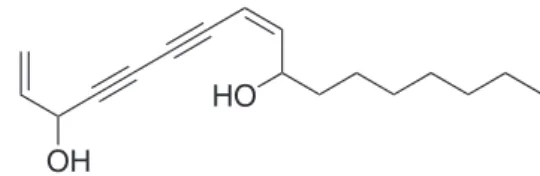
The methodology was then applied for the diastereoselective synthesis of the double bond present in (±)-Seselidiol (Figure 1) a natural product isolated in 0.0085% yield from the roots of Seseli mairei Wolff (Umbelliferae) and used as herbal remedies for human inlammation, swelling, rheumatism, pain, and common cold in folk Chinese medicine.15 It also showed signiicant cytotoxicity in KB, P-388, and L-1210 tumor cells (ED50 < 10 µg mL-1).16 The absolute stereochemistry of the stereogenic centers in Seselidiol is not known, and to date no total synthesis of the natural product has been attempted.
Our approach for the synthesis of Seselidiol started with 1-octanol 11 which was oxidized into the corresponding
Table 2. Inluence of temperature on the formation of vinyl tellurides prepared via Scheme 2
Entry Alkyne n C:D d(ppm) 125Te NMR (CDCl
3) Yield (%)
a
25 oC 78 oC C D
1 7, R = H 0 -b 77:23 301.9 338.3 0 (70)
2 8, R = H 1 -b 58:42 357.6 274.1 0 (65)
3 9, R = TIPS 0 85:15 100:0 279.1 - 65 (80)
4 10, R = TIPS 1 63:37 82:18 358.8 286.9 62 (78)
aChromatographic yields (the yield between parenthesis corresponds to the reaction at 78oC); bProducts not observed at this temperature.
Scheme 2.
BuTeTeBu
NaBH4, EtOH
conditions, 3 h TeBu
TeBu +
7-10
RO ( )n RO ( )n RO
C D
( )n
Figure 2. (±)-Seselidiol HO
aldehyde 12 using PCC.17 Addition of ethynylmagnesium bromide to 12 at room temperature18 gave alcohol 13 which was converted into its TIPS ether derivative 14 (Scheme 3).
Hydrotelluration of 14 using the developed methodology gave the corresponding Z-vinyl telluride 15 as a single isomer determined by 1H, and conirmed by 125Te NMR and gas chromatography in 90% yield (Scheme 4).
It is noteworthy that when the hydrotelluration reaction was performed without TIPS as the protective group a mixture of 78:22 of the two regioisomers were observed.
Conclusions
In summary, the methodology presented is shown to be useful for the synthesis of regio- and stereo-deined vinyl tellurides, the TIPS group being successfully used as a regio-directing group. The application of the methodology to the synthesis of a natural product was performed in order to demonstrate its applicability. Finally, the methodology offers future possibilities in the development of new organometallic approaches to the compounds containing
Z-double bonds. The completion of the synthesis of (±)-Seselidiol and its asymmetric version are ongoing in our laboratory and will be reported in a due course.
Acknowledgments
The authors gratefully acknowledge CNPq and FACEPE for inancial support. The authors also thank to CNPq for their fellowships.
Supplementary Information
Supplementary information, with extra experimental and characterization data, is available free of charge at http://jbcs.sbq.org.br, as PDF ile.
Scheme 3. (i) PCC, CH2Cl2, 3 h, 0 oC (55%); (ii) ethynylmagnesium bromide, THF, 25 oC, 12 h (50%); (iii) TIPSCl, imidazole, DMF, 25 oC, 12 h (85%).
( )5
OR
HO O ( )5
11 12
i ii
13, R = H
iii
14, R = TIPS
Scheme 4.
BuTe
TIPSO 14
only isomer 15
BuTeTeBu
NaBH4, EtOH reflux, 5 h
References
1. Eisch, J. J. In Comprehensive Organic Synthesis; Trost, B. M., Fleming, I., eds.; Pergamon Press: Oxford, 1991, Vol. 8, p. 733; Pelter, A.; Smith, K.; Brown, H. C. In Borane Reagents; Academic Press: London, 1988; Smith, K.; Pelter, A. In Comprehensive Organic Synthesis; Trost, B. M., Fleming, I., eds.; Pergamon Press: Oxford, 1991, Vol. 8, p. 703; Schwartz, J.; Labinger, J. A.; Angew. Chem., Int. Ed. 1976, 15, 333; Labinger, J. A. In Comprehensive Organic Synthesis; Trost, B. M., Fleming, I., eds.; Pergamon Press: Oxford, 1991, Vol. 8, p. 667.
2. Zeni, G.; Lüdtke, D. S.; Panatieri, R. B.; Braga, A. L.; Chem. Rev. 2006, 106, 1032; Nogueira, C. W.; Zeni, G.; Rocha, J. B. T.; Chem. Rev. 2004, 104, 6255.
3. Johnson, R. A.; Sharpless, K. B. In Comprehensive Organic Synthesis; Pergamon Press: Oxford, UK, 1990, Vol. 7; Finn, M. G.; Sharpless, K. B. In Asymmetric Synthesis; Morrison, J. D., ed.; Academic Press: New York, 1985, Vol. 5; Burns, C. J.; Martin, C. A.; Sharpless, K. B.; J. Org. Chem. 1989, 54, 2826. 4. Stefani, H. A.; Cardoso, L. D. G.; Valduga, C. J.; Zeni, G.;
Phosphorus, Sulfur Silicon Relat. Elem. 2001, 171, 421; Perin, G.; Jacob, R. G.; Dutra, L. G.; de Azambuja, F.; Dos Santos, G. F. F.; Lenardão, E. J.; Tetrahedron Lett. 2006, 47, 935. 5. Raminelli, C.; Da Silva, N. C.; Dos Santos, A. A.; Porto, A. L.
M.; Andrade, L. H.; Comasseto, J. V.; Tetrahedron 2005, 61, 409.
6. Chaudhary, S. K.; Hernandez, O.; Tetrahedron Lett. 1979, 20, 99; Bennett, F.; Knight, D. W.; Fenton, G.; J. Chem. Soc. Perkin Trans. 1 1991, 1543.
7. Cunico, R. F.; Bedell, L.; J. Org. Chem. 1980, 45, 4797. 8. Nicolaou, K. C.; Pavia, M. R.; Seitz, S. P.; J. Am. Chem. Soc.
1981, 103, 1224.
9. Kremers, J. A.; Meijer, E. W. J. Org. Chem. 1994, 59, 4262. 10. Miyashita, M.; Yoshikoshi, A.; Grieco, P. A.; J. Org. Chem.
11. Barros, S. M.; Dabdoub, M. J.; Dabdoub, V. M. B.; Comasseto, J. V.; Organometallics 1989, 8, 1661; Zeni, G.; Formiga, H. B.; Comasseto, J. V.; Tetrahedron Lett. 2000, 41, 1311.
12. Ruecker, C.; Chem. Rev. 1995, 95, 1009.
13. Tolman, C. A.; Chem. Rev. 1977, 77, 313; Imyanitov, N. S.; Sov. J. Coord. Chem. Engl. Transl. 1985, 11, 663.
14. Panek, J. S.; Prock, A.; Eriks, K; Giering, W. P.; Organometallics 1990, 9, 2175.
15. “Chung Yao Ta Tsu Dim” (Dictionary of Chinese Medicine), Shanghai Science and Technology Publishing Co., 1978, Vol. 1, 909.
16. Hu, C-Q.; Chang, J-J.; Lee, K-H.; J. Nat. Prod. 1990, 53, 932. 17. Piancatelli, G.; Scettri, A.; D’Auria, M.; Synthesis 1982, 245;
Kasmai, H. S.; Mischke, S. G.; Blake, T. J.; J. Org. Chem. 1995, 60, 2267.
18. Skattebol, L.; Jones, E. R. H.; Whiting, M. C.; Org. Synth. 1959, 39, 56; Rinaldi, P. L.; Levy, G. C.; J. Org. Chem. 1980, 45 , 4348.
Received: June 17, 2009 Web Release Date: November 26, 2009
Supplementary Information
0103 - 5053 $6.00+0.00*e-mail: [email protected]
Inluence of Different Protecting Groups on the Regioselectivity of the
Hydrotelluration Reaction of Hydroxy Alkynes
Juliana M. Oliveira,a Dayvson J. Palmeira,a João V. Comassetob and Paulo H. Menezes*,a
aDepartamento de Química Fundamental, Universidade Federal de Pernambuco, CCEN, UFPE,
Av. Prof. Luiz Freire, s/n, 50670-901 Recife-PE, Brazil
bInstituto de Química, Universidade de São Paulo, USP, Av. Prof. Lineu Prestes, 748,
05508-900 São Paulo-SP, Brazil
GENERAL REMARKS
All reactions were conducted in lame dried glassware under nitrogen. All solvents were puriied before use. THF was dried by distillation from sodium benzophenone ketyl. CH2Cl
2 and DMF were dried by distillation from CaH2. All
other commercially available reagents and solvents were used as received.
1H NMR data were recorded at 300 MHz using a
Varian UNITY PLUS spectrometer. 1H NMR chemical
shifts are reported as delta (d) units in parts per million (ppm) relative to residual CHCl
3 (7.26 ppm). Coupling
constants (J) were reported in Hertz (Hz). 13C NMR data
were recorded at 75 MHz using a Varian UNITY PLUS spectrometer. 13C NMR chemical shifts were reported as
delta (d) units in parts per million (ppm) relative to the central line of CDCl3 (77.0 ppm). 125Te NMR data were
obtained at 94.6 MHz using diphenyl ditelluride as an external reference (422.0 ppm). Typical parameters were as follows: acquisition time equal to 0.64 second, pulse of 45°, spectral window of 43.9 kHz; and line broadening equal to 5.0 Hz; a good compromise value because although a greater line broadening would improve the signal-to-noise ratio of the tellurium spectra, which would also imply in less signal resolution.
Low resolution mass spectra were obtained using a Shimadzu QP-5050a Spectometer (70 eV) using helium 4.5 as a carrier gas and a DB-5 column (30 m × 0.25 μm). Reactions were monitored by thin-layer chromatography on 0.25 mm E. Merck silica gel 60 plates (F254) using UV light and vanillin as visualizing agents. Column chromatographic puriications were performed using Silica Gel 60 (230 - 400 mesh) unless indicated otherwise.1 All
compounds puriied by chromatography were suficiently
pure for use in further experiments, unless indicated otherwise.
Dibutylditelluride (BuTeTeBu)11
A 2 L round-bottomed flask was flamed dry and equipped with a 250 mL pressure equalized dropping funnel. Tellurium metal (40.2 g, 315 mmol, dried at 85 ºC prior to use in an oven) was suspended in dry THF (1 L) and cooled to 0 oC. The addition funnel was charged
with n-butyllithium (360 mmol, 144 mL of a 2.5 mol L-1
solution in hexanes). The n-butyllithium was added dropwise. After the addition was complete, the ice bath was removed and the reaction mixture was stirred at room temperature for 60 min. A saturated solution of ammonium chloride (450 mL) was then added slowly. The reaction was stirred at room temperature for about 3 h while open to the atmosphere (O2). The organic layer was isolated
and the aqueous layer was extracted with ethyl acetate (1 × 300 mL). The combined organic phases were dried over anhydrous magnesium sulfate and iltered through a pad of Celite. Concentration in vacuo provided 50.7 g (87%) of dibutylditelluride as a red oil which was used directly without further puriication. 1H NMR (300 MHz, CDCl
3)
δ 3.10 (t, J 7.80Hz, 2H), 1.80 - 1.60 (m, 2H), 1.46-1.30 (m, 2H) , 0.92 (t, J 7.50 Hz, 3H). 13C NMR (75 MHz, CDCl
3)
δ 35.6; 24.5; 13.3; 4.21. IR (ilm) ν
max/cm-1: 2955, 2921,
2868, 1457, 1175.
General Procedure for Protection of Propargyl Alcohol with R
3SiCl
To a round-bottomed lask under argon was added DMF (2 mL), imidazole (1.70 g, 25 mmol), and propargyl alcohol
(0.56 g, 0.58 mL, 10 mmol). The mixture was stirred and R3SiCl [TBSCl, TIPSCl, TBDPSCl] (12 mmol) was slowly added. The mixture was stirred for 12 h, diluted with CH2Cl2 (20 mL) and quenched with water (20 mL). The organic phase was washed with 3% HCl (10 mL), saturated NaHCO3 (20 mL) and inally water. The organic phase was then dried over MgSO4, iltered and concentrated in vacuo. The pure silyl ether was distilled from the residue under reduced pressure.
tert-butyldimethyl(prop-2-ynyloxy)silane (2)
1.64 g (65%); (bp 40 oC, 8 mmHg) 1H NMR (300 MHz,
CDCl3) d 4,20 (d, J 1.8 Hz, 2H); 2,15 (t, J 2,7 Hz, 1H);
0,88-0,80 (m, 9H); 0,13-0,10 (m, 6H). 13C NMR (75 MHz,
CDCl3) d 81.0; 73.88; 53.01; 26.07; 18.23; −5.1.
triisopropyl(prop-2-ynyloxy)silane (3)
1.45 g (68%); (bp 110 oC, 20 mmHg) 1H NMR (300
MHz, CDCl3) d 4,37 (d, J 2,4 Hz, 2H); 2,38 (t, J 2,7 Hz, 1H); 1,11-1,04, (m, 21H). 13C NMR (75 MHz, CDCl
3) d
81.40; 72.58; 51.72; 17.85; 11.90.
tert-butyldiphenyl(prop-2-ynyloxy)silane (4)
1.37 g (50%); 1H NMR (300 MHz, CDCl
3) 7,80-7,35
(m, 10H); 4,32 (d, J 2,4 Hz, 2H); 2,39 (t, J 2,1 Hz, 1H); 1,07 (s, 9H). 13C NMR (75 MHz, CDCl
3) d 135.54; 134.78;
132.86; 129.54; 80.1; 73.02; 52.42; 26.08; 19.10.
(but-3-yn-2-yloxy)triisopropylsilane (9)
1.81 g (80%); 1H NMR (300 MHz, CDCl
3) 4.60 (dq, J
6.5, 1.7 Hz, 1H); 2.38 (d, J 2.4 Hz, 1H); 1.46 (d, J 6.4 Hz, 3H); 1,07 (m, 21H). 13C NMR (75 MHz, CDCl
3) d 86.7,
71.2, 58.8, 25.5, 18.1, 17.8, 12.2.
triisopropyl(pent-4-yn-2-yloxy)silane (10)
1.90 g (80%); 1H NMR (300 MHz, CDCl
3) d 4,07 (m,
1H); 2,96 (dd, J 8.1 Hz, J 2.7 Hz, 2H); 1,98 (t, J 2.7 Hz, 1H); 1,29 (d, J 5.7 Hz, 3H); 1,07 (m, 21H). 13C NMR (75
MHz, CDCl3) d 82.2; 73.1; 68.6; 31.4; 24.4; 18.5; 13.1.
3-(2-methoxyethoxy)prop-1-yne (5)
To a round-bottomed lask under argon was added diisopropylamine (5.0 mL, 35.7 mmol) and propargyl alcohol (0.84 g, 0.87 mL, 15 mmol). The mixture was stirred at room temperature and MEMCl (1.91 mL, 16.8 mmol) was slowly added. The mixture was stirred for 12 h, diluted with CH2Cl2 (20 mL) and quenched with water (20 mL). The organic phase was washed with 3% HCl (10 mL), saturated NaHCO3 (20 mL) and inally water (3 × 20 mL). The organic phase was then dried over MgSO4, iltered and concentrated in vacuo. The residue was distilled
under reduced pressure (bp 100 oC, 15 mmHg) to yield
0.68 g (50%) of the title compound. 1H NMR (300 MHz,
CDCl3) d 4,78 (m, 2H); 4,22 (dd, J 2.4 Hz, J 1.2 Hz, 2H); 3,69 (m, 2H); 3,53 (m, 2H); 3,36 (t, 3H); 2,41 (dt, J 7.2 Hz,
J 2.4 Hz, 1H). 13C NMR (75 MHz, CDCl
3) d 54.53; 58.93;
66.69; 67.09; 74.52; 79.23; 95.55.
2-(prop-2-ynyloxy)tetrahydro-2H-pyran (6)
To a round-bottomed lask under argon was added PPTS (0.29 g, 0.9 mmol), propargyl alcohol (0.56 g, 0.58 mL, 10 mmol) and CH2Cl2 (10 mL). The mixture was stirred at room temperature and DHP (1,40 g, 1.68 mL, 10 mmol) was slowly added. The mixture was stirred for 3 h, diluted with CH2Cl2 (20 mL) and washed with water (3 x 20 mL). The organic phase was then dried over MgSO4, iltered and concentrated in vacuo. The residue was distilled under reduced pressure (bp 80 oC, 25 mmHg)
to yield 1.54 (85%) of the title compound. 1H NMR (300
MHz, CDCl3) d 4,73-4,70 (m, 1H); 4,26 (dd, J 2.7 Hz, J
1.2 Hz, 2H); 3,65–3,60 (m, 2H); 2,39 (dt, J 7.2 Hz, J 2.4 Hz, 1H); 1,62-1,60 (m, 2H); 1,56-1,50 (m, 4H). 13C NMR
(75 MHz, CDCl3) d 18.90; 25.33; 30.1; 53.88; 61.87; 73.93; 79.68; 96.71.
Representative Procedure for the Hydrotelluration of Alkynes 1-10
The appropriate alkyne (0.5 mmol) and dibutylditelluride (90 mg, 0.25 mmol) were dissolved in absolute ethanol (4.0 mL) at room temperature. Finely powdered sodium borohydride (26 mg, 0.7 mmol) was added in portions to the above solution. Additional sodium borohydride was added as necessary to maintain a yellow color (indicative of the butyltellurolate anion). The solution was heated to relux for 5 h and cooled to room temperature. The reaction mixture was then poured into a saturated solution of sodium bicarbonate (20 mL) and diluted with EtOAc (20 mL). The organic layer was isolated and washed with water (50 mL) and brine (50 mL) before drying over anhydrous magnesium sulfate. The organic phase was iltered, concentrated in vacuo, and submitted to 1H and 125Te NMR analysis without further puriication.
Synthesis of 1-octanal (12)
To a round-bottomed lask equipped with an addition funnel was added PCC (21.6 g, 100.2 mmol) and CH2Cl2 (100 mL). The solution was cooled to 0 oC and 1-octanol
pressure (bp 90 oC, 80 mmHg) to yield 10 g (78%) of the
title compound as a colorless oil. The data of the obtained compound match with the literature.
Synthesis of (+/-)-dec-1-yn-3-ol (13)
To a round-bottomed lask under argon and equipped with an addition funnel was added magnesium turnings (1.22 g, 51 mmol) and THF (30 mL). The mixture was stirred and 1-bromoethane (5.45 g, 50 mmol) was slowly added.In another lask under argon containing THF (20 mL) at −78oC dry acetylene gas was introduced through
a gas-inlet tube (which reaches the bottom of the lask and is bent at the outer end for downward delivery) over 0.5 h period. The reaction was warmed up to room temperature and the solution of ethylmagnesium bromide was transferred via canula to this lask. The mixture was then cooled to 0 oC and 12 (3.20 g, 25 mmol) was added
over a 45 min period. The mixture was then stirred for an additional 12 h and after this period slowly quenched with saturated NH4Cl. Ethyl ether (100 mL) was added and the organic phase was washed with saturated NH4Cl.
The aqueous phase was extracted with ethyl ether (3 x 100 mL) and the combined organic phases were dried over MgSO4, iltered and concentrated in vacuo. The residue was distilled under reduced pressure (bp 105 oC,
0.5 mmHg) to yield 1.88 g (49%) of the title compound as a colorless oil. The data of the obtained compound match with the literature.2
Synthesis of (+/-)-(dec-1-yn-3-yloxy)triisopropylsilane (14)
To a round-bottomed lask under argon was added DMF (1 mL), imidazole (0.17 g, 2.5 mmol), and 13 (0.154 g,
1 mmol) the mixture was stirred and TIPSCl (0.23 g, 1.2 mmol) was slowly added. The mixture was stirred for 24 h, diluted with CH2Cl2 (20 mL) and quenched with water (20 mL). The organic phase was washed with 3% HCl (10 mL), saturated NaHCO3 (20 mL) and inally water. The organic phase was then dried over MgSO4, iltered and concentrated in vacuo. The residue was puriied by silica
gel chromatography (hexanes) to yield 0.27 g (88%) of the title compound. 1H NMR (300 MHz, CDCl
3) d 4,54
(td, J 4.5 Hz, J 2.1, 1H); 2,33 (d, J 2.1 Hz, 1H); 1,71 (q, J
7.5 Hz, J 4.5 Hz, 2H); 1,45-1,20 (m, 10H); 1,10 (m, 21H); 0,90 (t, 3H). 13C NMR (75 MHz, CDCl
3) d 84.43; 72.65;
65.42; 46.96; 29.66; 28.72; 26.90; 23.05; 22.15; 17.81; 14.09; 12.27. GC/MS m/z (rel. Int. %) 267 (100); 225 (8) 211 (10); 169 (81); 157 (9); 131 (39); 103 (46); 75 (34); 61 (17); 59 (13); 57 (9); 43 (8); 41 (9).
Synthesis of (+/-)-(Z)-(1-(butyltellanyl)dec-1-en-3-yloxy) triisopropylsilane (15)
Compound 14 (0.31 g, 1 mmol) and dibutylditelluride (0.18 g, 0.5 mmol) were dissolved in degassed ethanol (5.0 mL) at room temperature. Finely powdered sodium borohydride (53 mg, 1.4 mmol) was added in portions to the above solution. Additional sodium borohydride was added as necessary to maintain a yellow color (indicative of the butyltellurolate anion). The solution was heated to relux for 12 h and cooled to room temperature. The reaction mixture was then poured into a saturated solution of sodium bicarbonate (30 mL) and diluted with EtOAc (20 mL). The organic layer was isolated and washed with water (50 mL) and brine (50 mL) before drying over anhydrous magnesium sulfate. The organic phase was iltered, concentrated in vacuo. The residue was puriied by silica gel chromatography (hexanes) to yield 0.44 g (90%) of the title compound. 1H NMR (300 MHz, CDCl
3)
d 6.62 (d, J 9.6 Hz, 1H); 6.23 (dt J 9.6 Hz, J 1.8 Hz, 1H); 4.22-4.16 (m, 1H); 2.71-2.58 (m, 2H), 1,80-1,68 (m, 2H), 1,44-1.34 (m, 2H), 1.44-1.27 (m, 10H), 1.35-1.25 (m, 2H), 1.20-1.00 (m, 21H), 0,95-0.85 (m, 6H).13C NMR (75 MHz,
CDCl3) 143.53; 101.49; 75.73; 38.00; 34.09; 31.82; 29.79; 24.90; 24.86; 22.65; 18.11; 14.10; 13.40; 12.36; 7.03. 125Te
NMR (94.6 MHz, CDCl3) 274.3. GC/MS m/z (rel. Int. %) 498 (M+) (5); 455 (17); 397 (9); 323 (5); 311 (11); 267
(100); 157 (15); 131 (32); 115 (30); 103 (29); 95 (25); 87 (28); 81 (31); 75 (79); 73 (41); 67(35); 61 (50); 59 (66); 57 (52); 55 (39); 45 (16); 43 (35); 41 (60).