*e-mail: [email protected]
Characterization of Ceramic Seeds with Samarium-153 for Use in Brachytherapy
Eduardo Sarmento Valentea,b*, Ethel Mizrahy Cuperschmida, Tarcísio Passos Ribeiro de Camposa
a
Programa de Pos-graduação em Ciências e Técnicas Nucleares,
Universidade Federal de Minas Gerais – UFMG, Belo Horizonte, MG, Brazil
bComissão Nacional de Energia Nuclear – CNEN,
Centro de Desenvolvimento da Tecnologia Nuclear – CDTN, Belo Horizonte, MG, Brazil
Received: June 2, 2010; Revised: January 28, 2011
Ceramic seeds were synthesized by the sol-gel technique with Si:Sm:Ca. One sample was irradiated in the TRIGA nuclear reactor IPR-R1. After irradiation, the seeds were submitted to instrumental neutron activation analysis to determine the 153Sm concentration in weight. The same irradiated seed sample was submitted to gamma
spectrometry analysis to determine all existing radionuclides as well as its individual activities. A second sample was submitted to ICP-AES atomic emission spectrometry. A third sample was submitted to X-ray fluorescence spectrometry to determine qualitative chemical composition. The measured activity was due to 153Sm with a
well-characterized gamma spectrum. The X-ray fluorescence spectrum demonstrates that there is no discrepancy in seed composition. Maximum range of beta particles from 153Sm were evaluated, as well as the total dose and dose
rate on its range´s volume. The results are relevant for investigation of the viability of producing 153Sm radioactive
seeds for use in brachytherapy.
Keywords: ceramic seed, radioactive seed, samarium, radiotherapy
1. Introduction
Cancer affects great part of the world population. Therefore, any techniques for controlling neoplastic tissues must be carefully investigated. One of the efficient methods of treatment is brachytherapy1 which implants radioactive seeds into the tumor giving
a high local radiation dose, capable of eliminating tumoral cells and preserving the surrounding healthy tissue.
The radioactive seeds for brachytherapy currently used on clinical applications are made of a 0.8 mm diameter, and 5 mm length titanium pipe filled with 59.4 d half-live I-125, decaying by electron capture, followed by X-ray and 35.5 keV gamma photon emissions. The required number of seeds, their dimension, and the permanence into the tumor complicates its implantation. Therefore, the development of new ways of tumor implants applying radioactive devices is justified. Attention shall be paid to β radiation emitters that, besides having a higher linear transference of energy have limited range. Most of the energy is, then, delivered into the tumor2.
The isotope Sm-152 incorporated in ceramics synthesized through sol-gel route, can improve brachytherapy, since the seeds can be produced in suitable dimensions3,4. After neutron activation,
the produced radionuclides, Sm-153, will decay by high energy β
particle emission coupled with γ radiation of 103 keV. These suitable properties suggest that those seeds shall be investigated deeply since they may provide an efficient brachytherapy for various types of tumor in close future.
2. Materials and Methods
A set of seeds synthesized by the sol-gel technique were produced with Sm incorporated, composed of SiO2, Sm2O3 and CaO. The nuclide precursor Sm-152 was provided by Sm(NO3)3, supplied by Alfa Aesar (Johnson Mattehy Company) with 99.8% purity. Those seeds were chemically characterized by X-ray fluorescence technique
in a JEOL-JXA-8900RL spectrometer. A crystallographic analysis was made by X-rays difratometry, as well. Afterwards, samples were irradiated in the research reactor IPR1-100 kW. Induced activity, gamma spectrometry and Sm concentration were performed. Also, the activity of all possible radionuclides on the seed has been investigated. Dimensional characterization and electronic microscopy image was taken from the set of seeds.
In the preparation of ceramic seeds by sol-gel technique5, natural
Samarium was added in order to achieve concentration of 20% in weight. As the sol-gel technique involves physical transformations in the material it is important to verify the final weight concentration of Sm in the seeds.
Three seeds containing Sm-152 were irradiated in the TRIGA type 100 kW research reactor, IPR-R1 in an irradiation position with neutron fluxes of 2.8 × 10¹² n/(cm2.s) (thermal) and 2.6 × 10¹¹ n/(cm2.s)
(epithermal)6. It is important to consider the epithermal neutron flux
in induced activity calculation because the neutron absorption cross section for both elements in this range of energy is higher than that for thermal neutrons. The induced activity was, therefore, obtained to a large extent through the epithermal neutron flux. The induced seed activity is given by the expression7:
(
)
(
) (
)
(
(– . ))
(– . )[ ]
0
. .
. . . . 1 – .
A t d
y th y epi
m N
A I e e Bq
A
λ λ
Θ
= σ Φ + Φ
(1)
where m is the mass of the element to be irradiated in grams, the factor
Θ is isotopic abundance of target nucleus, A is the atomic mass of
the element, NA is the Avogadro’s number, Φth is the thermal neutron
flux, Φepi is epithermal neutron flux, σγ is the neutron capture cross section of the target nucleus in cm2, I
γ is the resonance integral for the
epithermal neutron flux of the target nucleus in cm2, λ is the decay
constant of the produced radionuclide, t is the time of irradiation in
seconds and d is the time to decay after irradiation in seconds.
DOI: 10.1590/S1516-14392011005000006
Valente et al.
Another set of seeds was immersed in 15 mL vials fi lled with SBF (simulated body fl uid) and left for 20 days to verify its solubility in such fl uid. The vials were kept at room temperature (25 °C) and were shaken once a day.
3. Results
3.1. The sol-gel route for ceramic seeds synthesis
The seeds were produced by the sol-gel route described in details in Hench and West5 composed by the substances and amounts
presented in Table 1.
3.2. Dimensional characterization
A set of 20 seeds with Samarium was prepared. The average dimensions obtained are:
• 0.75mmdiameter;and • 1.6mmlength.
One can observe the smaller diameter and length of the seeds compared to the I-125 seeds. The implantation tool for these smaller seeds may be reduced on diameter minimizing the effect of needling the tumor avoiding the spread of cancerous cells to the blood vessels and production of metastasis.
Figure 1 presents the seeds, after synthesis.
3.3 Electronic microscopy image
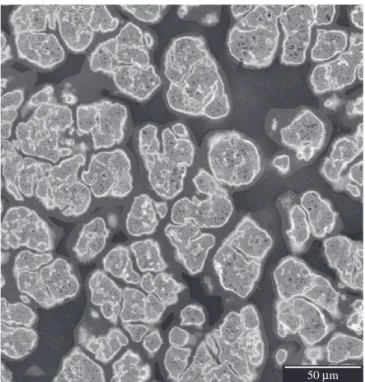
Electronic microscopy image of cross-section of the seed was taken using the X-ray diffractometry spectrometer JEOL-JXA-8900RL, in which the physical aspect of the seeds can be observed (Figure 2).
Figure 3 shows an enlarged detail of the seed.
Table 1. Substances used in sol-gel route for ceramic seeds synthesis.
Substance Weight (g)
Tetraetil Ortosilicate – Si(OC2H5)4 1.49 Hydrated Calcium Nitrate – Ca(NO3)2.4H2O 0.73 Deionized water – H2O 1.03 Nitric Acid solution – 2N – HNO3 0.17 Samarium Nitrate 0.65
Figure 1. Ceramic seeds with samarium after synthesized by sol-gel route.
Figure 2. Electronic microscopy of the cross-section of the ceramic seed.
Figure 3. Enlarged electronic microscopy of the cross-section o the ceramic seed.
3.4. Chemical characterization of the seeds
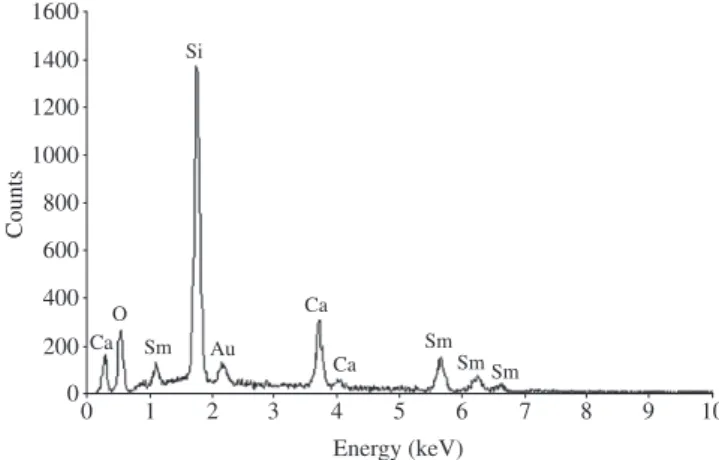
The chemical characterization of the seeds was made using the X-ray fl uorescence spectrometry in JEOL-JXA-8900RL spectrometer. The presence of the chemical elements Samarium, Calcium, Silicon and Oxygen was evident, uniformly distributed throughout the seed as shown in the spectra collected in different points of the sample, distributed on the cross-section surface of the seed. The amplitude of
Characterization of Ceramic Seeds with Samarium-153 for Use in Brachytherapy
the corresponding peaks of each element points out, comparatively, the concentration of the element in the analyzed point. The elements Oxygen, Samarium, Calcium and Silicon keep constant peak amplitude throughout the seed, on all points randomly selected on the cross section surface. Figure 4 shows one of the X-ray emission spectra obtained for the seeds. The other spectra were so similar to each other that its presentation is unnecessary. The Gold element only appears as an artifact due to the conducting fi lm laid over the sample to make it thermally conductive.
3.5. Crystallographic characterization of the seeds
Crystallographic analysis of ceramic seeds made by X-ray diffraction revealed an amorphous structure with some vestiges of crystalline phase. The spectrum obtained in this analysis is shown in Figure 5, in which one can observe the peak in the angle of 31°, indicating the possible presence of samarium crystalline phase. In the rest of the spectrum, nothing is evidenced but amorphism.
3.6. Determination of Samarium concentration in the seeds
In the preparation of the ceramic seeds by sol-gel technique, natural Samarium in 20% elemental weight concentration was added following stoichiometric balance. As the sol-gel technique involves physical transformations in the material it is important to verify the fi nal amount of Sm in each seed. For this purpose neutron activation analysis (INAA) and atomic emission spectrometry (ICP-AES) had been used. The results of the analysis are shown in Table 2.
3.7. Induced activation and gamma spectrometry
The activity related to Sm-153 in each seed calculated by the expression (1) in comparison to the measured value are shown in Table 3.
As expected, the gamma spectrometry analysis demonstrates that the highest activities in the seeds are due to Sm-153 radionuclide.
The gamma radiation spectrum of seed sample is shown in Figure 6 where peaks of higher activity correspond to the energies of gamma radiation emitted by Sm-153. Other expected radionuclides, such as 31Si, 145Sm, 155Sm, 41Ca, 49Ca, have short half-life or their
precursor nuclides have low neutron capture cross section.
The two fi rst peaks on Samarium spectrum are X-rays emitted by the element Eu-153 to witch Sm-153 decays after β emission.
The spectrum above 120 keV is intentionally suppressed because all measurable peaks were detected bellow that region.
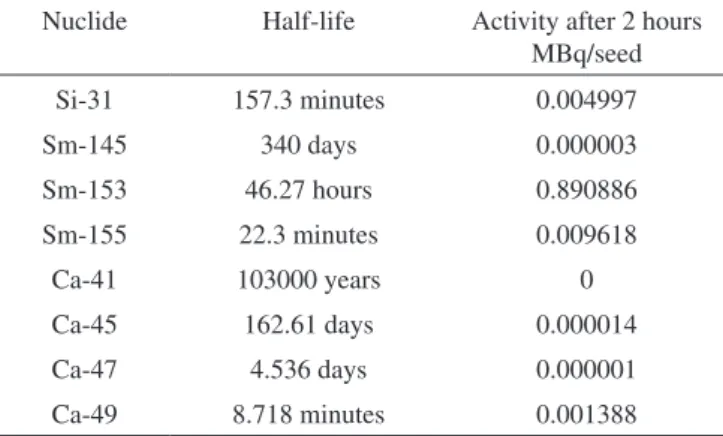
Table 4 shows the calculated activity of the expected nuclides present on the seeds where it can be observed that they are very small compared with those of the desired nuclides.
4. Discussion
The use of Sm-153 in brachytherapy is very attractive due to its nuclear characteristics that are: β particle emission with maximum energy of 803 keV, 103 keV gamma radiation emission and half-life of 46.2 hour6. Activation can be achieved in low neutron fl ux reactor
if enriched Sm-152 is used.
Physic and chemical characteristics of the ceramic seeds produced by the sol-gel route are suitable for use in brachytherapy: small dimensions, chemical and mechanical stability. Solubility experiments in SBF (simulated body fl uid) demonstrated that they are not soluble in the fi rst 20 days of immersion. This characteristic assures that it will not spread radioactive material in the body when implanted. Its amorphous characteristics points out to a possible solubility in long term immersion in SBF. This is an advantage as it can be completely absorbed after radioactivity has decayed.
Figure 4. X-ray fl uorescence spectrum of the ceramic seed.
Figure 5. X-ray diffractometry spectrum of the ceramic seed.
Table 2. Samarium concentration in weight in the seeds.
Sample Concentration (%) – INAA
Sample Concentration (%) – ICP-AES Sm-1A 19 ± 1 Sm-1 18.6 ± 0.4 Sm-2A 19 ± 1 Sm-2 17.5 ± 0.4 Sm-3A 18 ± 1 Sm-3 20.2 ± 0.4
Table 3. Experimental and calculated activities of the seeds.
Activity per seed MBq (mCi)
Number of seeds Sm-153 14.6 ± 0.74 (0.39 ± 0.02) - calculated 6 Sm-153 39.6 ± 0.8 (1.07 ± 0.02) - measured 6
The difference between the theoretical and measured values for the seed’s activities is due to position of the seeds in the reactor core as well as to the difference in the value of the neutron fl ux adopted in calculations and the real value.
The sol-gel route showed to be suitable for producing such seeds as it involves low temperatures and simple handling when compared with other ceramic producing process.
Valente et al.
Figure 6. Gamma radiation spectrum of Sm-153.
Table 4. Calculated activity of other expected radionuclides present on the seeds.
Nuclide Half-life Activity after 2 hours MBq/seed Si-31 157.3 minutes 0.004997
Sm-145 340 days 0.000003
Sm-153 46.27 hours 0.890886 Sm-155 22.3 minutes 0.009618
Ca-41 103000 years 0
Ca-45 162.61 days 0.000014
Ca-47 4.536 days 0.000001
Ca-49 8.718 minutes 0.001388
Acknowledgements
The authors are thankful to the Universidade Federal de Minas Gerais and to the Centro de Desenvolvimento da Tecnologia Nuclear for allowing the accomplishment of this work in the scope of their professional and academic activities. They are also thankful to the colleagues, Andréa Vidal Ferreira, Ângela Maria Amaral, Geraldo Frederico Kastner, Robson Cota de Oliveira, Luciana Batista Nogueira and to the team of operators of IPR-R1 reactor for the elaboration of the analysis, for preparing the seeds and for the expressed opinions and the offered suggestions during the elaboration of this work.
References
1. Cember H and Johnson TE. Introduction to health physics. United States of America: Mc Grow Hill; 2009. 843 p.
2. Silva GXO, Campos TPR, Siqueira SL and Maciel MB. The surgical viability and radiological monitoring of brain implants of bioactive microseeds in animal model. Brazilian Archives of Biology and Technology. 2005; 48:109-113. 3. Roberto WS, Pereira MM and Campos TPR. Structure and dosimetric
analysis of biodegradable glasses for prostatic cancer treatment. Artifi cial Organs. 2003; 27:420-424.
4. Roberto WS, Pereira MM and Campos TPR. Analysis of bioactive glasses obtained by sol-gel processing for radioactive implants. Materials Research. 2003; 6:123-127.
5. Hench LL and West JK. The Sol-Gel Process. American Chemical Society.
1999;90(1): 33-72.
6. Zangirolami DM. Fluxo neutrônico a 100kW nos terminais de irradiação do reator TRIGA IPR-R1 [Master Degree Monografy]. Belo Horizonte: Curso de Ciências e Técnicas Nucleares, Universidade Federal de Minas Gerais; 2009. 7. Valente ES and Campos TPR. Gamma spectrometry and chemical
characterization of ceramic seeds with Samarium-153 for oncological implant. In: Proceedings of the International Nuclear Atlantic Conference – INAC. 2007; Santos, SP.