*e-mail: [email protected], [email protected]
1. Introduction
The last two decades have witnessed increasing research interest in amorphous ferromagnetic microwires. Especially, much attention has been turned to the development of potential structural and function materials with magnetic bistability1, giant magneto impedance (GMI) effect2-4, electromagnetic shielding (EMS)5 by using a variety of alloy microwires. Amorphous structure for ribbons, ilms or BMGs are formed due to the high rapid quench rate of ~106 K/s which ensures the excellent mechanical6,7 and magnetic characteristics. Melt-extracted amorphous microwires with diameters of 20~60 μm have outstanding soft magnetic characteristics8 due to small sizes and amorphous state. The microstructure and magnetic properties of the melt-extracted microwires can be tailored by optimizing composition design or the fabrication process9,10. Compare with amorphous ribbons, ilms or bulk metallic glasses (BMGs), amorphous microwires show the superior magnetocaloric effect (MCE) due to their wire shape and fabricating process. The magnetocaloric melt-extracted microwires with a nominal composition of Gd55Al25Co20 show a large magnetic entropy change (–ΔSm) of 9.7 J·kg–1·K–1 at 100 K[9], which is larger than that of its BMG counterpart (8.8 J·kg–1·K–1)11. The melt-extracted Gd-rich amorphous microwires have good mechanical adaptability for they are easy to be illed as different shapes, which can render them to be applied in the multifunctional ields of MCE-based refrigeration.
For improving the magnetocaloric properties and solving problems related to the practical applications of Gd-based amorphous microwires in magnetic refrigeration (MR), it is necessary to investigate their mechanical properties and fracture reliability. We have obtained a tensile fracture strength of ~1200 MPa and fracture reliability of ~800 MPa in melt-extracted Gd55Al25Co20 microibers9, and also reported the fabrication of Zr-containing Gd-rich wires with a tensile fracture strength of ~1450 MPa and fracture reliability of ~1200 MPa[12]. So we aim to fabricate the more high-quality Gd60Al20Co20 melt-extracted amorphous microwires and investigate the tensile mechanical properties and fracture reliability of these Gd-rich microwires when used as MCE materials. The fracture reliability was evaluated by using Lognormal and Weibull statistic distribution method inally.
2. Experimental Procedure
The melt-extraction technique was introduced for fabricating the microwires with a nominal composition of Gd60Al20Co20. A uniform master ingot with raw materials Gd (99.5%), Al (99.99%) and Co (99.99%) was irstly fabricated by vacuum arc melting, and an alloy rod with a diameter of 10 mm was obtained by suction casting. Then the rod was placed in a boron nitride (BN) crucible and re-melted by a high frequency induction furnace. Finally, the melt was extracted by a copper wheel with a diameter of 320 mm and 60º knife-edge and the wires were formed under their surface tension and natural gravity. The constant
Tensile Properties and Fracture Reliability of Melt-extracted Gd-rich Amorphous Wires
Hongxian Shena, Dawei Xinga, Huan Wangb, Jingshun Liuc, Dongming Chena, Yanfen Liua,
Jianfei Suna*
aSchool of Materials Science and Engineering, Harbin Institute of Technology, Harbin 150001, China bInstitute for Composites Science and Innovation – InCSI, College of Materials Science and
Engineering, Zhejiang University, Hangzhou 310027, China
cSchool of Materials Science and Engineering, Inner Mongolia University of Technology, Hohhot 010051, China
Received: September 9, 2014; Revised: September 30, 2015
Gd60Al20Co20 amorphous wires with smooth surfaces and circular cross-sections were fabricated by a melt-extraction technique. The mechanical properties of the extracted microwires were evaluated by tensile tests and their fracture reliability was estimated by using Lognormal and two- or three- parameter Weibull analysis, respectively. The microwires exhibit a tensile fracture strength ranging from ~788 to ~1196 MPa, with a mean value of 1008 MPa and a standard variance of 121 MPa. Lognormal method of statistical analysis presents that the average stress of microwires is ~1012 MPa. Weibull statistical analysis indicates that the two-parameter tensile Weibull modulus is 8.5 and the three-parameter Weibull modulus is 5.3 with a threshold value ~365 MPa for as-extracted amorphous microwires. Our results show that the extracted Gd-based wires possess excellent tensile properties and high fracture reliability, with a high potential for applications in and magnetic refrigeration.
Tensile Properties and Fracture Reliability of Melt-extracted Gd-rich Amorphous Wires
2015; 18(Suppl. 1) 67
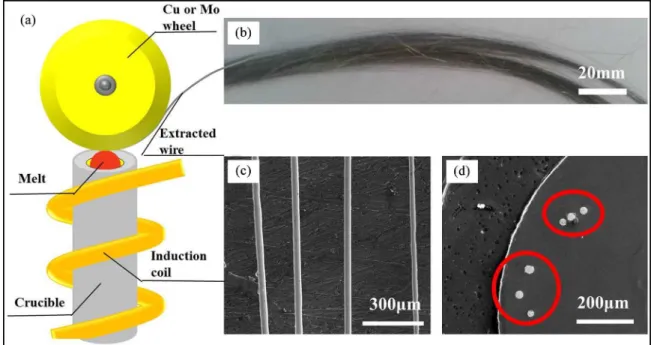
linear velocity of Cu wheel rim was ixed at 30 m/s and the chosen feeding rate of the molten alloy was 10-15 μm/s[13]. The melt-extracted process and the morphology of fabricated wires with high-quality are schematically shown in Figure 1. All the morphologies of wire-surface and fracture-surface after tensile test were observed on a ield emission scanning electron microscope (SEM-Helios Nanolab600i) at 20 kV. The structural characteristics of the wires were identiied by X-ray diffraction (XRD) test obtained by a D/max-rb with Cu Kα radiation and a differential scanning calorimeter (DSC) at a heating rate of 20 K/min. The mechanical measurements of the as-cast wires were taken on a special Instron Tensile Tester (Type: Instron-5500R1185). Special clamps were designed for wire shape samples and a mini-force sensor (the measuring range of 0~50 N) for small loading specimens were used for the tensile measurements.
3. Results and Discussions
3.1. Structural characterization
A cooling rate of ~ 106 K/s was achieved due to the intense heat transfer between cooling medium and liquid metal stream during fabrication process, resulting in the formation of amorphous or nanocrystalline structure of the wires. As shown in Figure 2a, a typical broad halo in XRD pattern was observed near the angle of ~ 33o and no other obvious peaks was detected, demonstrating the full amorphous nature of the wires.
As shown in Figure 2b, an obvious endothermic reaction resulting from the glass transition (super-cooled liquid region) and followed by a several obvious exothermic peaks due to crystallization appear in the DSC curve, which further indicates the amorphous feature of the micro-ibers and
demonstrates a complex multi-step crystallization process. As marked with the orange and green arrows, the glass transition temperature (Tg) and starting temperature of irst
crystallization peak (Tx1) were determined as ~574 K and ~600 K respectively. The temperature region of glass transition (ΔTx) is thus calculated as ~26 K (ΔTx = Tx1 – Tg), displaying the glass forming ability (GFA). Both the XRD pattern and DSC curve demonstrate that the Gd-based amorphous microwires can be fabricated by melt-extraction technique.
3.2. Mechanical properties
Specimens were designed for the wire tests as shown in the inset of Figure 3a. All the strain-stress curves of measured wires are plotted in Figure 3a and it was noted that all the specimens showed brittle behavior, i.e. all the wires fail catastrophically without any plasticity. Moreover, these amorphous microwires displayed a scattering of the tensile fracture strengths (σF) ranging from ~788 to ~1196 MPa. In order to conveniently compare, we have re-plotted all the strain-stress curves by using the values of σF from the smallest to largest, as shown in Figure 3b. The average tensile fracture strength and standard deviation were statistically calculated to be ~1008 MPa and ~121 MPa respectively. The distribution of the strength-limiting laws is considered as resulting in the strengths variation of these amorphous microwires as mentioned above, and these laws cause the apparition of metallic cores, casting pores, inclusions or surface irregularities in the ibers which were introduced during the fabrication process. It should be noticed that the severe deterioration of mechanical properties (including tensile strength and fracture reliabilities) occurs due to the existence of these laws, thus resulting in their limited application in MR systems.
The fracture reliability is vital factor in the practical applications for the brittle microwires due to their wider degree of scatter in σF values compared with that of ductile materials. Further to conirm the safety of brittle materials in engineering, the statistical methods are commonly employed and performed to describe the distribution of fracture stresses. Among which, Log-normal distribution method is usual for describing the failure strengths of brittle microwires and the cumulative probability function is shown as below14:
( )
lnLN f
1
P 1 erf
2 s 2
σ κ
−
= +
(1)
where PFLN shows the cumulative distribution that displays the probability of failure behavior at a given uniaxial stress σ or lower, κ is the mean and s represents the standard deviation of the natural log of the fracture stress values.
Further to calculate the PFLN, a set of data is obtained in Figure 3b and shown as σ1<σ2<···σN<···<σN. Thus the probability of failure PILN at a uniaxial given stress σ
I can be calculated by using the following expression (median rank value):
. .
LN i
i 0 3 P
N 0 5
− =
+ (2)
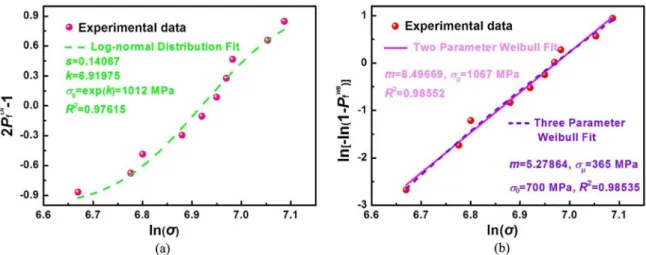
where the valus of κ and σ are obtained by fitting experimental data (ln(σ), 2 PFLN -1) which is plotted in Figure 4a and the value of R2=0.98 shows a well-itting result. The average stress (at κ=6.92) is calculated up to ~1012 MPa and the value is extremely close to the average stress value of ~1008 MPa.
Moreover, Weibull distribution is more commonly introduced to evaluate the brittle materials than above mentioned Log-normal distribution method and the cumulative probability function is expressed as follows15,16:
Figure 2. (a) XRD pattern and (b) differential scanning calorimeter (DSC) curve of melt-extracted Gd60Al20Co20 microwires.
Tensile Properties and Fracture Reliability of Melt-extracted Gd-rich Amorphous Wires
2015; 18(Suppl. 1) 69
exp
m WB
f V V
0
P 1 σ σµ d
σ − = − − ∫ (3)
where PFWB described Weibull cumulative distribution and deined the same as PFLN, V indicates the volume of the wire specimen, σμ is the threshold value of the maximum or ultimate fracture stress, σ0 described the Weibull scale parameter (or characteristic stress) when the PFWB is 63.2% and m is the parameter known as Weibull modulus (or shape geometric parameter) which displays the variability of failure strength. While σμ≠0, Equation 3 is rewritten by:
(
)
(
)
ln ln WB ln ln 0
f
1
m m
1 P µ
σ σ σ
= − − − (4)
and it also named three-parameter Weibull model (TrPWM) and when σμ=0, Equation 3 is rearranged to two-parameter Weibull model (TPWM):
( )
( )
ln ln WB ln ln 0
f
1
m m
1 P σ σ
= − − (5)
For TPWM, the values of m, σ0 are obtained as 8.5, 1067 MPa respectively by linear itting experimental data (ln(σ), ln[-(1-ln PFWB)]) and the results show an excellent itting for R2=0.99. Moreover, the values of m, σ
0 and σμ are calculated to be 8.5, 700 MPa and 365 MPa respectively for TrPWM by non-line itting experimental data (ln(σ), ln[-(1-ln PFWB)]). The result also indicates a nearly consistent itting of TrPWM for R2=0.99. Though the itting curves are quite close as shown Figure 4b, the itting with three-parameter version (marked by violet dash line) follows the trend of the data much better than that with the two-parameter one marked by (red solid line).
It should be focused that Weibull modulus m actually described the reliability of tested specimens, namely a large value of m value represents a low degree of scatter for fracture
strength and hence high reliability of applied materials. The m value calculated in our present work is larger than that of GdAlCoZr microwires12 and A707 steel welds17, while smaller than that of Gd55Al25Co20 melt-extracted microibers9, Mg-based amorphous microwires18 under tensile condition and Zr-based19, Mg-based20 BMGs under compressed condition. In a word, the melt-extracted Gd60Al20Co20 amorphous microwires with high law/damage tolerance and reliability, combined with their excellent functional properties, makes them as potential substitute materials in MR applications.
3.3. Fracture morphology
Figure 5 illustrates two typical fracture morphologies observed in the tested specimens with two different diameters of ~20 μm and ~40μm. The angle between the stress axis and fracture surface varies from 52o to 82o with the diameter of the microwire increases from ~20 μm to ~40 μm, as displayed in Figures 5a and 5b. Pronounced shear bands appear in small-sized specimen, as shown in inset of Figure 5a, showing a typical fracture characteristic of amorphous alloys. The characteristic of the fracture is also relected by the fracture morphology shown in Figure 5c which shows two pronounced regions: the relatively smooth zone (which is denoted featureless zone) induced by shear slip and the vein-pattern zone produced by the rupture of the remaining part after the initial shear displacement21.
In comparison, Figure 5d shows the clear cross-section of a perpendicular fracture for the relatively larger diameter specimen, which is similar to the low-strength fracture surface of Mg-based wires. The crack originated at one of the surface irregularities formed during the fabricated process, and moved radially away from a semicircular ‘‘mirror”, leaving elongated markings along the crack propagation paths to form ‘‘hackle regions”, and inally resulted in the fracture of the wire. This larruping fracture morphology and relatively large angle between the stress axis and fracture surface caused by a low amorphization degree owing to the lower solidiication rate during fabrication process with large diameters. However, there is almost no obvious tensile plasticity detected in all tested samples, nearly indicating their brittle nature.
4. Conclusions
The mechanical properties and fracture reliability of melt-extracted Gd60Al20Co20 amorphous microwires were systematically investigated. The tensile fracture strengths of tested wires vary from ~788 to ~1196 MPa, and their mean values and standard deviation were calculated to be ~1000 MPa and 121 MPa, respectively. The wires exhibited a brittle fracture characteristic and the average stress of 1012 MPa is obtained by Log-normal itting. The larger values of Weibull modulus of 8.5 and 5.3 calculated by two-parameter or three-parameter Weibull non-line itting method respectively, pronounced high law/damage tolerance and reliability of the melt-extracted Gd-based amorphous wires. Therefore,
the more excellent tensile property and higher fracture reliability together with their excellent previously reported magnetocaloric property of the Gd-based wires make them potential materials for magnetic refrigeration applications.
Acknowledgements
This work was inancially supported by National Natural Science Foundation of China (NSFC) under grant Nos. 51371067. J.S. Liu acknowledges the inancial support provided by the National Natural Science Foundation of China (NSFC) under grant Nos. 51401111 and 51561026, Natural Science Foundation of Inner Mongolia Autonomous Region of China under grant Nos. 2014BS0503.
Figure 5. Fracture morphologies of melt-extracted Gd60Al20Co20 amorphous microwires with diameters of (a) ~20μm (the inset gives the local magniied image of (a)) and (b) ~40 μm for side-view. (c) and (d) show the cross-section images of (a) and (b).
References
1. Qin FX and Peng HX. Ferromagnetic microwires enabled multifunctional composite materials. Progress in Materials Science. 2013; 58(2):183-259. http://dx.doi.org/10.1016/j. pmatsci.2012.06.001.
Tensile Properties and Fracture Reliability of Melt-extracted Gd-rich Amorphous Wires
2015; 18(Suppl. 1) 71
3. Wang H, Qin FX, Xing DW, Cao FY, Peng HX and Sun JF. Fabrication and characterization of nano/amorphous dual-phase finemet microwires. Materials Science and Engineering B. 2013; 178(20):1483-1490. http://dx.doi.org/10.1016/j. mseb.2013.09.010.
4. Chen DM, Xing DW, Qin FX, Liu JS, Wang H, Wang XD, et al. Correlation of magnetic domains, microstructure and gmi effect of joule-annealed melt-extracted Co68.15Fe4.35Si12.25B13.75Nb1Cu0.5 microwires for double functional sensors. Physica Status Solidi A: Applications and Materials Science. 2013; 210(11):2515-2520. http://dx.doi.org/10.1002/pssa.201329246.
5. Zhang Z, Wang C, Zhang Y and Xie J. Microwave absorbing properties of composites filled with glass-coated Fe69Co10Si8B13 amorphous microwire. Materials Science and Engineering B. 2010; 175(3):233-237. http://dx.doi.org/10.1016/j.mseb.2010.07.034. 6. Wang H, Qin FX, Xing DW, Cao FY, Wang XD, Peng HX, et al.
Relating residual stress and microstructure to mechanical and giant magneto-impedance properties in cold-drawn co-based amorphous microwires. Acta Materialia. 2012; 60(15):5425-5436. http://dx.doi.org/10.1016/j.actamat.2012.06.047. 7. Liao WB, Zhao YY, He JP and Zhang Y. Tensile deformation
behaviors and damping properties of small-sized Cu-Zr-Al metallic glasses. Journal of Alloys and Compounds. 2013; 555:357-361. http://dx.doi.org/10.1016/j.jallcom.2012.12.110. 8. Liu JS, Cao FY, Xing DW, Zhang LY, Qin FX, Peng HX, et al.
Enhancing GMI properties of melt-extracted co-based amorphous wires by twin-zone joule annealing. Journal of Alloys and Compounds. 2012; 541:215-221. http://dx.doi.org/10.1016/j. jallcom.2012.05.126.
9. Shen HX, Wang H, Liu JS, Xing DW, Qin FX, Cao FY, et al. Enhanced magnetocaloric and mechanical properties of melt-extracted Gd55Al25Co20 micro-fibers. Journal of Alloys and Compounds. 2014; 603:167-171. http://dx.doi.org/10.1016/j. jallcom.2014.03.053.
10. Bingham NS, Wang H, Qin FX, Peng HX, Sun JF, Franco V, et al. Excellent magnetocaloric properties of melt-extracted Gd-based amorphous microwires. Applied Physics Letters. 2012; 101(10):102407. http://dx.doi.org/10.1063/1.4751038. 11. Du J, Zheng Q, Li YB, Zhang Q, Li D and Zhang ZD. Large
magnetocaloric effect and enhanced magnetic refrigeration in ternary gd-based bulk metallic glasses. Journal of Applied Physics. 2008; 103(2):023918. http://dx.doi.org/10.1063/1.2836956.
12. Qin FX, Bingham NS, Wang H, Peng HX, Sun JF, Franco V, et al. Mechanical and magnetocaloric properties of gd-based amorphous microwires fabricated by melt-extraction. Acta Materialia. 2013; 61(4):1284-1293. http://dx.doi.org/10.1016/j. actamat.2012.11.006.
13. Wang H, Xing DW, Wang XD and Sun JF. Fabrication and characterization of melt-extracted co-based amorphous wires. Metallurgical and Materials Transactions A: Physical Metallurgy and Materials Science. 2010; 42(4):1103-1108. http://dx.doi. org/10.1007/s11661-010-0459-0.
14. Sharpe WN Jr, Pulskamp J, Gianola DS, Eberl C, Polcawich RG and Thompson RJ. Strain measurements of silicon dioxide microspecimens by digital imaging processing. Experimental Mechanics. 2007; 47(5):649-658. http://dx.doi.org/10.1007/ s11340-006-9010-z.
15. Weibull W. A statistical distribution function of wide applicability. Journal of Applied Mechanics. 1951; 18(3):293-297.
16. Han Z, Tang LC, Xu J and Li Y. A three-parameter weibull statistical analysis of the strength variation of bulk metallic glasses. Scripta Materialia. 2009; 61(9):923-926. http://dx.doi. org/10.1016/j.scriptamat.2009.07.038.
17. Zhou J and Soboyejo W. A statistical approach to the prediction of brittle fracture in heat-affected zones of A707 steel welds. Materials and Manufacturing Processes. 2004; 19(5):921-947. http://dx.doi.org/10.1081/AMP-200030653.
18. Zberg B, Arata ER, Uggowitzer PJ and Löffler JF. Tensile properties of glassy mgznca wires and reliability analysis using weibull statistics. Acta Materialia. 2009; 57(11):3223-3231. http://dx.doi.org/10.1016/j.actamat.2009.03.028.
19. Gao HL, Shen Y and Xu J. Weibull analysis of fracture strength for Zr55Ti2Co28Al15 bulk metallic glass: tension-compression asymmetry and porosity effect. Journal of Materials Research. 2011; 26(16):2087-2097. http://dx.doi.org/10.1557/jmr.2011.210. 20. Zhao YY, Ma E and Xu J. Reliability of compressive fracture
strength of Mg-Zn-Ca Bulk metallic glasses: flaw sensitivity and weibull statistics. Scripta Materialia. 2008; 58(6):496-499. http://dx.doi.org/10.1016/j.scriptamat.2007.10.052. 21. Wang H, Xing DW, Peng HX, Qin FX, Cao FY, Wang GQ, et al.