295
Metallurgy and materials
Metalurgia e materiais
Evaluation of the milling
efficiency increase of AISI 52100
steel using niobium carbide
addition through high energy
ball milling
Abstract
The AISI 52100 is a tool-type steel and is more often used in industry for the production of bearings. After the end of its life cycle, it is discarded or remelted, but both processes are considered expensive. Thus, the possibility of reusing this material through the powder metallurgy (PM) route is considered advantageous, since it trans-forms a waste into another product. To obtain the starting powders, the AISI 52100 steel scrap was submitted to a process of high energy ball milling, which was milled pure and with 1 and 3 % of niobium carbide (NbC) additions. Those additions were performed with the intention of increasing the milling eficiency of the steel, through formation of a metal-ceramic composite with a ductile-fragile behaviour. To determine the morphology and particle size, scanning electron microscopy (SEM) and particle size distribution tests were used. The results indicated that with the carbide addition, a signiicant increase in the milling eficiency was achieved, being possible to obtain nanoparticles after 20 hours of milling time.
Keywords: AISI 52100 steel; high energy ball milling; carbide; nanoparticle. http://dx.doi.org/10.1590/0370-44672014680189
Bruna Horta Bastos Kuffner
Mestranda em Engenharia de Materiais, Universidade Federal de Itajubá - UNIFEI, Instituto de Engenharia Mecânica Itajubá – Minas Gerais – Brazil [email protected]
Wellington Silvio Diogo
Doutorando em Materiais para Engenharia, Universidade Federal de Itajubá - UNIFEI, Instituto de Engenharia Mecânica Itajubá – Minas Gerais – Brazil [email protected]
Daniel Assis Amancio
Doutorando em Engenharia Mecânica, Universidade Federal de Itajubá - UNIFEI, Instituto de Engenharia Mecânica Itajubá – Minas Gerais – Brazil [email protected]
Geovani Rodrigues
Professor Doutor em Engenharia de Materiais, Universidade Federal de Itajubá - UNIFEI, Instituto de Engenharia Mecânica Itajubá – Minas Gerais – Brazil [email protected]
Gilbert Silva
Professor Doutor em Engenharia Biomédica, Universidade Federal de Itajubá - UNIFEI, Instituto de Engenharia Mecânica Itajubá – Minas Gerais – Brazil [email protected]
1. Introduction
The AISI 52100 is a high carbon, chrome, and manganese steel which inds applications in bearings due to its high strength and resistance to rolling contact fatigue (Li & Wang, 1993; Umbrello et al., 2004). In their service life, bearings
are subjected to complex multi-axial stress states that change periodically in combi-nation with high operational tempera-tures (Chakraborty et al., 2009; Young
& Badeshia, 2004). They must sustain relatively large contact stresses during
the extremely high number of cycles that are submitted (Dommarco et al., 2004;
Christ et al., 1992). One of the methods
To improve the mechanical proper-ties of steels produced by powder metal-lurgy, the creation of a metal-ceramic
applications, such as great hardness, great toughness, extremely high young’s modulus and high melting temperature
tion in the particle’s size in comparison with traditional milling (Lu & Lai, 1998; Suryanarayana, 2001).
2. Materials and Methods
The material used in this research was the AISI 52100 steel from the process of hot rolling as a round bar, the same material used to produce bearings. This workpiece had 100 mm of diameter and passed through the step of machining at slow speed and without the use of
lubrica-tion to avoid oxygen and oil-soluble con-tamination. With the procedure described, it was possible to obtain the AISI 52100 steel in the form of scraps, which were used subsequently in the milling process.
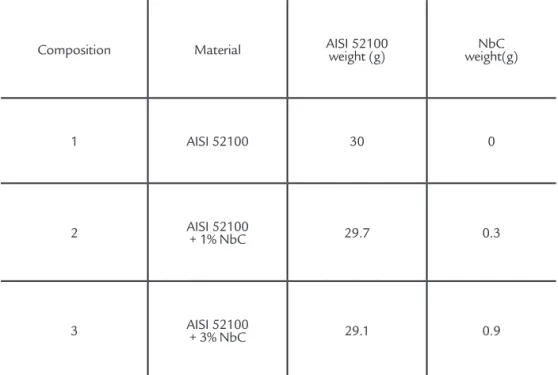
The scraps were milled pure and with 1% and 3% of NbC addition
(Table 1). The milling was realized using high energy ball milling in a planetary ball mill during the milling times of 5, 10, 15 and 20 hours in an inert argon atmosphere to avoid oxidation of the powders, at a milling speed of 350 rpm and a mass/sphere relationship of 1:10.
Composition Material AISI 52100 weight (g) weight(g)NbC
1 AISI 52100 30 0
2 AISI 52100 + 1% NbC 29.7 0.3
3 AISI 52100 + 3% NbC 29.1 0.9
Table 1
Mixtures composition
The characterization of the raw materials and their compositions was real-ized using a scanning electron microscope Carl Zeiss EVO MA15. In the
second-ary electron (SE) mode, the particle size variation and morphology were analyzed. Using the back scatter electron (BSD) and energy dispersive x-ray (EDS) modes,
the carbide distribution was evaluated. Particle size distribution was performed in a Malvern Mastersizer 2000 particle size analyzer.
3. Results and Discussion
The initial characterization of the AISI 52100 steel scraps and the niobium carbide are shown in Figures 1 and 2. It can be observed that the AISI 52100
steel scraps from the machining pro-cess showed a mean size of 1200 µm (Figure 1).
Figure 2 shows the
297 Figure 2
NbC powder
It can be observed in Figure 3a that after 5 hours of milling, the scrap of the pure AISI 52100 steel main-tained its morphology and dimension
in comparison with the scrap before the milling process (Figure 1). By in-creasing the milling time to 20 hours, the scraps of the AISI 52100 steel were
transformed into particles with angular morphology and medium-sized particles located between 5 and 40 µm as shown in Figure 3b.
Figure 1 AISI 52100 steel scrap
Figure 3 Pure AISI 52100 steel milled for
(a) 5 hours (b) 20 hours
When milling the AISI 52100 steel for 5 hours with a 3% NbC addition, it was observed that there was no change in the particle morphology. However, noted was a signiicant reduction in the particles size of the AISI 52100 steel in comparison
with the milling process using 1% of NbC addition (Figure 4a). In this condi-tion, the particles present sizes between 20 and 170 µm (Figure 5a). Maintaining the NbC percentage at 3% and milling during 20 hours, the AISI 52100 steel
formed clusters with approximately 300 µm with medium-sized particles located in nanometric scale (Figure 5b). In addition, a greater homogeneity was observed in the nanoparticle volumes when compared to the steel milled with 1% of NbC.
The carbide distribution was evalu-ated under the scanning electron micro-scope (SEM) using the energy dispersive x-ray (EDS) mode (Figure 6). It was
ob-served that the NbC particles were located homogeneously on the surface of the steel particles. The NbC particles were identi-ied in Figure 6 by its chemical elements
(C and Nb). In Figure 6a, the brighter dots represent the carbon element, and in Figure 6b, the brighter dots represent the niobium element.
(a) (b)
Figure 6
Identification of the NbC chemical elements (a) Carbon (b) Niobium
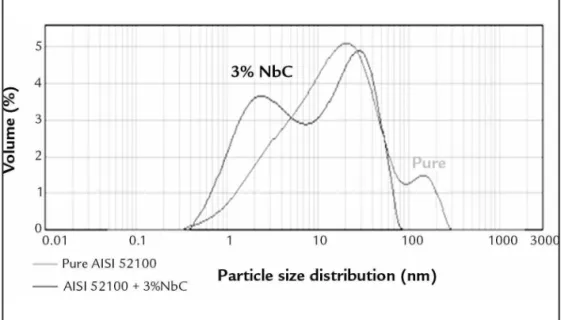
The results of the particle size distribution test are shown in Figure 7. It is possible to observe that the curve presented a bimodal distribu-tion. When milled with the niobium
carbide addition, the steel particles presented greater volume in the range of 1 nm up to 4 nm and that of 10 nm up to 40 nm. When milled with-out NbC addition, the steel particles
presented a greater volume in the range of 2 nm up to 80 nm and that of 100 nm up to 200 nm, showing an increase in the milling eficiency with the carbide addition.
Figure 5
AISI 52100 steel with 3% of NbC addition milled for (a) 5 hours (b) 20 hours
(a) (b)
Figure 4
299 AMRIOU, T., BOUHAFS, B., AOURAG, H., KHELIFA, B., BRESSON, S.,
MA-THIEU, C. FP-LAPW investigations of electronic structure and bonding me-chanism of NbC and NbN compounds. Physica B: Condensed Matter, v. 325, p. 46-56, 2003.
CHAKRABORTY, J., BHATTACHARJEE, D., MANNA, I.A. Development of ultraine bainite + martensite duplex microstructure in SAE 52100 bearing ste-el by prior cold deformation. Scripta Materialia, v. 61, n. 6, p. 604-607, 2009. CHRIST, H. J., SOMMER, C., MUGHRABI, H., VOSKAMP, A.P.,
BESWICK,J.M., HENGERER, F. Fatigue behaviour of three variants of the roller bearing steel SAE 52100. Fatigue & Fracture of Engineering Mate-rials& Structures, v. 15, n. 9, p. 855-870, 1992.
DOMMARCO, R. C., KOZACZEK, K.J., BASTIAS, P.C., HAHN, G.T., RU-BIN, C.A. Residual stresses and retained austenite evolution in SAE 52100 steel under non-ideal rolling contact loading. Wear, v. 257, n. 11, p. 1081-1088, 2004.
EIGEN, N., KLASSEN, T., AUST, E., BORMANN, R., GARTNER, F. Produc-tion of nanocrystalline cermet thermal spray powders for wear resistant coa-tings by high energy milling. Materials Science and Engineering A, v. 356, n. 1-2, p. 114-121, 2003.
ESPER, F. J., SONSINO, C. M. Fatigue design for PM components: Manual for design and production engineers. International Journal of Fatigue, v. 18, n. 2, p. 149, 1996.
GERMAN, R. M. Powder metallurgy of iron and steel. New York: John Wiley & Sons, 1998. 496p.
GUBERNAT, A., ZYCH, L. The isothermal sintering of the single-phase non--stoichiometric niobium carbide (NbC1−x) and tantalum carbide (TaC1−x).
Journal of the European Ceramic Society, v. 34, p. 2885-2894, 2014.
6. References
Figure 7 AISI 52100 steel particles size distribution
without and with 3% of NbC addition
4. Conclusions
When using the high energy ball milling process, it was possible to obtain powders of the pure AISI 52100 steel and
also those with NbC additions. However, with the NbC additions, it was observed that there was a signiicant increment
in the milling eficiency, which enabled the obtainment of powders close to the nanometric scale.
5. Acknowledgements
This work was inancially sup-ported by CNPq and FAPEMIG. We would also like to thank the
compa-nies Villares Metals and Hermann C. Stark for the material donations and the UNIFEI characterization’s
Performance Materials, v. 3, p. 7-27, 1996
RHEE, S. I., NAM, S. W., HAGIWARA, M. Effect of TiBp particle reinforce-ment on the creep resistance of near a titanium alloy made by blended elemen-tal powder meelemen-tallurgy. Journal of Alloys and Compounds, v. 359, n. 1-2, p. 186-192, 2003.
SELVAKUMAR, N., MOHAN, A.R., NARAYANASAMY, R. Experimental investigation on workability and strain hardening behavior of Fe–C–0.5Mn sintered composites. Materials and Design, v. 41, p. 349-357, 2012.
SURYANARAYANA, C. Mechanical alloying and milling. Progress in Materials Science, v. 46, n. 1-2, p.1-184, 2001.
SUSTARSIC, B., JENKO, M., GODEC, M., KOSEC, L. Microstructural inves-tigation of NbC-doped vacuum-sintered tool-steel-based composites.Vacuum, v. 71, n. 1-2, p. 77-82, 2003.
TRUEMAN, A. R., SCHWEINSBERG, D.P., HOPE, G.A.A study of the effect of cobalt additions on the corrosion of tungsten carbide/carbon steel metal matrix composites.Corrosion Science, v. 41, n. 7, p. 1377-1389, 1999.
UMBRELLO, D HUA, J., SHIVPURI, R. Hardness-based low stress and frac-ture models for numerical simulation of hard machining AISI 52100 bearing steel. Materials Science and Engineering A, v. 374, n. 1-2, p. 90-100, 2004. WANG, L. L., JIANG, J. S. Preparation of a-Fe2O3 nanoparticles by high-energy
ball milling. Physica B, v. 390, n. 1-2, p. 23-27, 2007.
YOUNG, C. H., BADESHIA, H.K.D.H. The strength of mixtures of bainite and martensite. Materials Science and Technology, v. 10, p. 209-214, 1994. YUSOP, M., ZHANG, D., WILSON, M. Microstructure and magnetic
proper-ties of nanostructured Al2O3–20 vol.% Fe70Co30 composite prepared by high energy mechanical milling. International Journal of Modern Physics B, v. 23, n. 6-7, p. 1383-1388, 2009.