APPLICATION OF SOCIAL NETWORK ANALYSIS
FOR INFORMATION TO THIRD SECTOR PUBLISHING HOUSE
Marcos Luiz Mucheroni
Gonçalo Costa Ferreira
Universidade de São Paulo (USP) Brazil
ABSTRACT
This paper presents and discusses some of the results of practical application of Social Network Analysis for Information (SNA) to a nonprofit organization, the publishing house Cidade Nova. The article starts by presenting the empirical and methodological options and refers the social networks basic terminology, after which the research procedures are detailed. Lastly, results from the actors Information Social Network (ISN) and from the complete ISN (where alters are included) are presented, to which were used degree, closeness and betweenness centralities, the strength of weak ties of Granovetter and the lambda (λ) set measures.
Keywords: Flow Information; Information Social Network (ISN); Social Network
Analysis (SNA).
1 INTRODUCTION
reciprocating', in other words, by reciprocity processes in network traffic and social appropriation of information (MARTINS, 2008; BRUNI; ZAMAGNI, 2010).
Additionally, it seems an evidence that producers of information and knowledge rarely work isolated, but embedded in large networks, where "[…] the information emerging from the practices of professional and social actors interact and when they come in - the network - begin to not be natural therefore will become collective" (TOMAÉL; MARTELETO, 2006, p.89). The network can then be used to study the processes of collective production of meaning and knowledge, the system of positions and interactions of the actors of these processes, the struggles for power informational prestige, social and symbolic capital.
For the dynamic characteristic of social networks, this article is leaded to a epistemological framework and the concept of information means information exchange process as a permanent flow of material and symbolic elements of knowledge, tacit or explicit, in that social context "in-form" the spirit of the actor (CAPURRO; HJØRLAND, 2007; MUCHERONI; GONÇALVEZ, 2011). The information´s perspective used in this work is seeking dialogue with two natures of social ties conceptions: reciprocity and social networking. According to Marteleto, the combination generates information networks and information flow, and in his words, "[...] when a 'information-system', which generates memory and registry, has remained in time and local coloring, it seems to give rise to an 'information-flow', fluid, rhizomatic, entangled in the movements of networks, devices and channels of communication and technical information" (MARTELETO, 2007).
2 PRACTICAL APPLICATION OF SOCIAL NETWORK ANALYSIS FOR INFORMATION (SNAI) IN ORGANIZATIONS
the meeting of people (of all ages, social, religious) among themselves and with their intimate true, good and beautiful thoughts" (CIDADE NOVA, company mission).
The choice of this organization as locus for the practical application of Social Network Analysis for Information (SNAI) was due primarily to four factors, namely: 1) the fact that the business is dedicated to be an information and knowledge company, 2) its small size and 'organic' which would allow the study of their entire network, 3) its principles and mission, since the publishing has a structure and organizational dynamics, a priori, characterized by the phenomena of networks and 4) personal relationships that one of the authors of this work has with managers and employees of the organization, a priori, would enable the successful development of the research project, as happened.
The subjects researched were information, in this context defined as a process of continuous exchange, flow of elements as material and symbolic knowledge, tacit or explicit, that in social context 'in-form' the spirit of the actor and Social Network Information (SNI), defined as a set of persons, with any pattern of contacts or interactions, between who is established various types of relations through which several information flows circulate.
The methodology used was the Social Network Analysis (SNA) applied to RSI publisher's Cidade Nova. The SNA is a multidisciplinary methodological tool (sociology, psychology, anthropology and mathematics) that established a new paradigm in research on social structure, and "[…] tries to understand the implications of the relationship patterns in a network for the development and performance of this network" (GUARNIERI, 2009). The SNAI as a methodology to study the phenomena of information was presented and discussed by Mathews (2005, p.27/61).
Data collection was done through a process of sending questionnaires into Excel spreadsheets for each of the actors. These spreadsheets were later returned already filled with assessments of actors about the information on the company and their relationships, which concerned the performance of their duties in connection with the work within the organization.
To the extent that, the construction of questionnaires always uses some language that, by nature, is always limiting, had from the beginning is the awareness that it is not possible to construct a questionnaire totally free of constraints and guidelines implied, although unwanted and undesirable. So with the conscious goal of the issues that were not driving the answers, or at least those issues could influence the lowest degree possible answers and seeking to provide full autonomy to the actor, the questionnaires were constructed from questions suggested by several authors in the literature referenced subjected to an interactive process of fine tuning, semantics and syntax, between author and advisor.
Since this is a third sector company that seeks to promote reciprocity and runs in free flow allowing all actors and even alters feel part of the relationship, the analysis of organizational social networks was considered important by the company itself, factor extremely important since the openness and willingness of the company to the analysis was critical to this work. The names of the actors were chosen in conjunction with the company and replaced at the time of analysis for acronyms since the company itself wanted to make it clear to all employees that their only goal was functioning as this environment of collaboration and reciprocity.
3 BASIC TERMINOLOGY OF SOCIAL NETWORKS
The SNA uses some specific terms and expressions, hence has its own terminology.
Actors are social agents in which focuses SNA.
Channels are a communication link, undirected, between one actor and another actor or alter. It is considered that there is a communication channel between A and B where there is at least one relationship between A and B, i.e. A indicates B, B indicates A, or A and B indicate each other. The existence of a channel denotes possibility of biunivocal relationship. The channel can be established in person and / or remotely.
Relationships are a directed link between one actor and another actor or alter. The direction of the arc is given by the relationship.
A flow is the event that is manifested in a relationship. For ex: work, sending information, advice, etc.
Totals relations are the set of all directed links indicated by the actors. Relations between actors are the set of directed links between actors. A Complete RSI is a Social Network Information where nodes are actors and alters. An RSI of Actors is a Social Network Information were there are only actors.
4 SEARCH PROCEDURES
This research project is divided in two parts and aims to investigate, on one hand, the way members of the Cidade Nova evaluate information (Part 1), and secondly, diagnose RSI information processes that underlie the Cidade Nova (Part 2), which covers part about this job.
The questionnaire was developed in an Excel spreadsheet emailed to 38 internal and external collaborators, then the objectives and methodology of the research project were explained by the author and tutor to employees at a meeting convened by the President of Cidade Nova, in which they reiterated the importance of truthfulness and accuracy of responses, further the confidentiality.
In Part 2 of the questionnaire, the employee was asked to consider the universe of people who are part and relate to the Cidade Nova, and were asked to answer four questions, indicating four types of relationships (named Q1, Q2 , Q3 and Q4), in a maximum of 10 people by relationship type:
Q2. ‘People who you demand / receive information on your day-to-day work’;
Q3. ‘People who you demand / receive essential information to your work’; and
Q4. ‘People who you relies for advice before making important decisions in your work’.
Note that, in this block, is not induce any responses to specific information, i.e., it was the interpretation of the employee if it is about any verbal or physical format, explicit or implied.
In the third block, it was imposed the restriction of considering only non-verbal information, and only physical format as computer files, books, newspapers, magazines, etc.. They were asked to answer three questions (Q5, Q6 and Q7), indicating more three types of relationship, also a maximum of 10 entities by type of relationship:
Q5. ‘People, information systems, databases and documents that you demand / receive information in day-to-day work’;
Q6. ‘People, information systems, databases and documents that you demand / receive information essential to’; and
Q7. ‘People, information systems, databases and documents to which you provide information’.
Finally, the fourth block requested the characterization of all gear ratios of Q1 to Q7, i.e., all information sources which could be people, documents and information systems. This characterization of relationship was made indicating for each of these relationships the level of each of the following parameters: frequency (1. Daily, 2. Weekly, 3. Monthly, 4. Quarterly, 5. Less common); Proximity (1. beside, 2. Same floor 3. Another floor 4. Another building, 5. Another city) Relevance (1. Very relevant, 2. relevant 3. Shortly material, 4. Not relevant) Accessibility (1. Very accessible, 2., 3. Average, 4., 5. Not accessible) and influence (1. lot of influence, 2., 3. average influence, 4., 5. not influent).
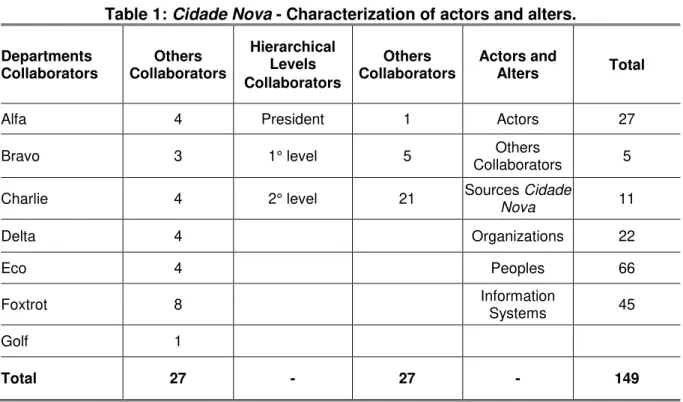
27 employees responded to Part 2) with the distribution department (coded) and hierarchical level in Table 1.
Table 1: Cidade Nova - Characterization of actors and alters.
Departments Collaborators
Others Collaborators
Hierarchical Levels Collaborators
Others Collaborators
Actors and
Alters Total
Alfa 4 President 1 Actors 27
Bravo 3 1° level 5 Collaborators Others 5
Charlie 4 2° level 21 Sources NovaCidade 11
Delta 4 Organizations 22
Eco 4 Peoples 66
Foxtrot 8 Information Systems 45
Golf 1
Total 27 - 27 - 149
In their responses to the blocks on the RSI, these 27 actors nominated five other employees of Cidade Nova, 11 internal sources of information to Cidade Nova, 22 organizations with which these actors are related, 66 people that individually are related as actors and 45 information systems where information is exchanged. These agents are called alters relationship, totaling 149 and are also detailed in Table 1.
The questionnaire responses were stored and organized in Excel files. At this stage, we proceeded to apply the methodology of SNA through the construction of several adjacency matrices, the construction and calculation of measures and indicators of network design and graph making use Excel, Ucinet and NetDraw, being two latest tools specific to SNA.
5 PRESENTATION AND DISCUSSION OF SOME RESULTS OF SNAI IN CIDADE NOVA
responded to the questionnaire are therefore the 27 players on the RSI which named 149 alters.
Table 2: Cidade Nova - Questionnaires Part 2: numbers and rates of responses.
Collaborators Selected Responses %
Internal Collaborators 24 23 96%
External Collaborators 14 4 29%
Total 38 27 71%
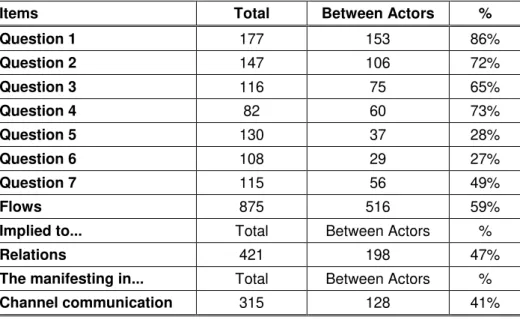
Were referred 875 flows between these actors and between actors and alters, which implied the existence of 421 relationships that were manifested in 315 channels, as shown in Table 3.
Table 3: Cidade Nova - Questionnaires, Part 3: number of flows, channels and relationships.
Items Total Between Actors %
Question 1 177 153 86%
Question 2 147 106 72%
Question 3 116 75 65%
Question 4 82 60 73%
Question 5 130 37 28%
Question 6 108 29 27%
Question 7 115 56 49%
Flows 875 516 59%
Implied to... Total Between Actors %
Relations 421 198 47%
The manifesting in... Total Between Actors %
Channel communication 315 128 41%
5.1 The RSI Actors
network (Q7). The term 'information' in the context of the questions is used to trigger the device's individual cognitive actor and mobilizes it to make use of 'its definition' of information, perchance, different to 'information' object of this research referred to permanent exchange process flow of material and symbolic knowledge elements, explicit or tacit, in that social context in-form the spirit of the actor. Thus, in accordance with the concepts used in this study, all issues networks, networks of actors and networks of actors and alters (completed ones) are RSI.
In an organizational network analysis, identification of roles, positions of the actors and understanding of the network structure are extremely important, and the SNA often reveals "[…] real differences between the structure and the ideal organization chart, showing also the degree of rapport between different groups in an organization" (GUARNIERI, 2008).
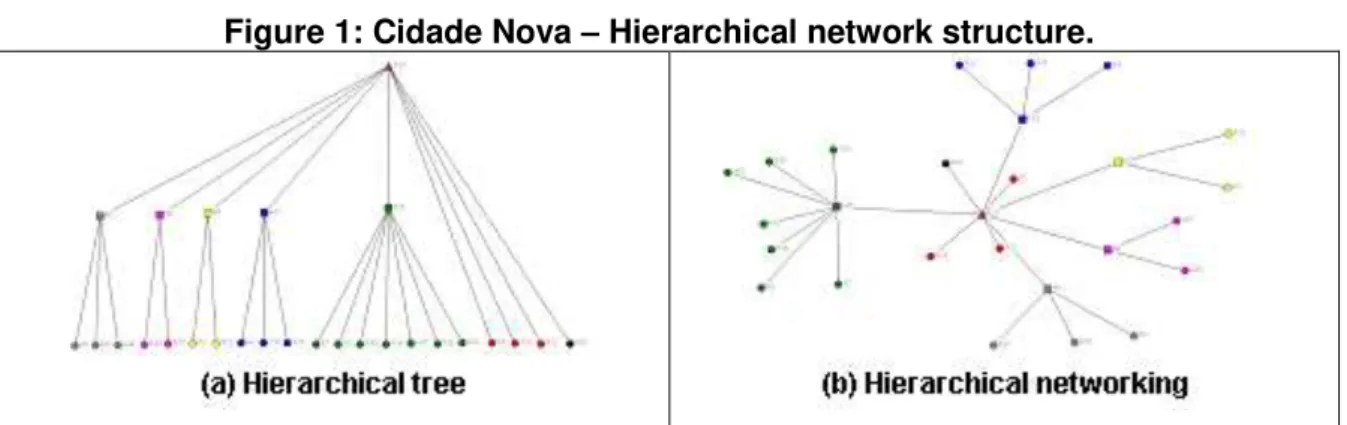
Thus, the first network that matters, to which is always important to make comparisons to other networks, is the hierarchical network structure of the Cidade Nova, which can be seen in Figure 1, tree format (a) or network format (b), where the highest point in the first, and most central point in the second, is the most important point in the optic command and control of the organization, in this case, the president of the Cidade Nova.
Figure 1: Cidade Nova – Hierarchical network structure.
'incoming', it means prestige. The more relations an actor has, the greater the power of this actor, and the number of relationships that an actor have affects how quickly and how he gets information. The greater the number of ratios, greater the chance of listening to something (WASSERMAN; FAUST, 1994, p.178; HANNEMAN, 2001, p.63). This measure, like all other measures presented in this study, was calculated for the three types of network actors of Cidade Nova analyzed here: the network of communication channels, the network of relationships and network flows.
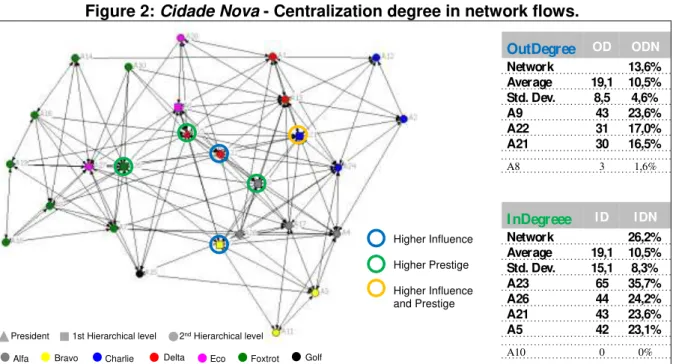
The degree values of network flows are generally low, and correspond to a low use network flows potential by most actors. The president is not one of the most influential actors in this network showing in some level delegation of tasks and information, although it is prominently (65 flows in total flows of 182 possible questions = 7 x 26 'other' actors) the actor with greater prestige network flows, which may reflect the fact that he is reference to validate information and business performance (Figure 2).
Figure 2: Cidade Nova - Centralization degree in network flows.
President 1st Hierarchical level 2nd Hierarchical level
Higher Influence Higher Prestige Higher Influence and Prestige
I nDegreee I D I DN
Network 26,2%
Average 19,1 10,5%
Std. Dev. 15,1 8,3%
A23 65 35,7%
A26 44 24,2%
A21 43 23,6%
A5 42 23,1%
A10 0 0%
OutDegree OD ODN
Network 13,6%
Average 19,1 10,5%
Std. Dev. 8,5 4,6%
A9 43 23,6%
A22 31 17,0%
A21 30 16,5%
A8 3 1,6%
Delta
Charlie Golf
Alfa Bravo Eco Foxtrot
actors do not relate proactively. Another analyst department Foxtrot A8 has levels of influence, outdegree values, well below the average, but at the same time is a point where relationships and flows appear in appreciable levels. Might be an actor whose function is final step(s) of a process(es) and whose integration with the organization may be revised, or someone who, perchance, did not feel motivated enough to indicate their relationship and whose motivation deserves attention from people management point of view . The president (A23) and managers Charlie (A21) and Foxtrot (A26) are prevalent in all measures of power and prestige, although only A21 has differentiated influence on network flows. Analyzing other employees of the 1st hierarchical level, the manager Bravo (A9) has great influence in networks of relationships and flows, but a prestige low, hereby is not part of the group with greater power; the manager Eco has a prestige relatively high in network flows, whereas Alfa manager (A5) holds no particular influence or prestige.
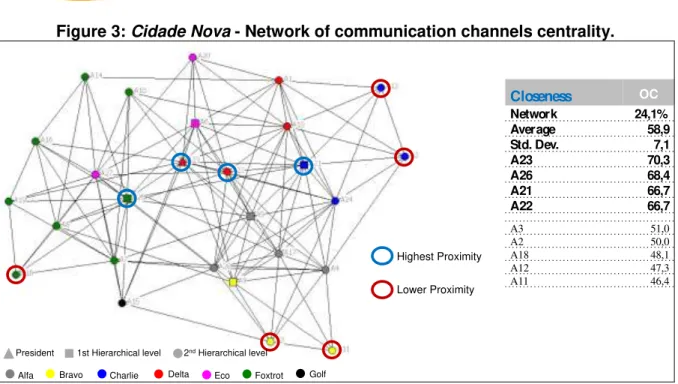
Figure 3: Cidade Nova - Network of communication channels centrality.
Closeness OC
Network 24,1%
Average 58,9
Std. Dev. 7,1
A23 70,3
A26 68,4
A21 66,7
A22 66,7
A3 51,0
A2 50,0
A18 48,1
A12 47,3
A11 46,4
Highest Proximity
Lower Proximity
President 1st Hierarchical level 2nd Hierarchical level
Delta
Charlie Golf
Alfa Bravo Eco Foxtrot
In that respect, the president (A23), managers Foxtrot (A26) and Charlie (A21) and analyst A22 Delta are the most central and therefore the actors with greater autonomy and independence. In contrast, analysts A2 and A12 Charlie, A3 and A11 to A18 of Foxtrot Bravo have the lowest levels of autonomy, being dependent on a small number of actors to be able to access the entire network (Figure 3). However, the developer of 2nd level department Foxtrot A10 is another actor who is not part of the most central group in the network of communication channels, but has high out-closeness in networks of relationships and flows, therefore, A10 depends less on the hierarchy than any other actor to get to the other actors. It is a particular analyst who has power and ability to reach all other actors in the network and therefore high potential to influence and to 'in-form'. Coincidentally, A10 is one of two players (the other is also an analyst Foxtrot, A16) that both networks, relations and flows, is less likely to be achieved.
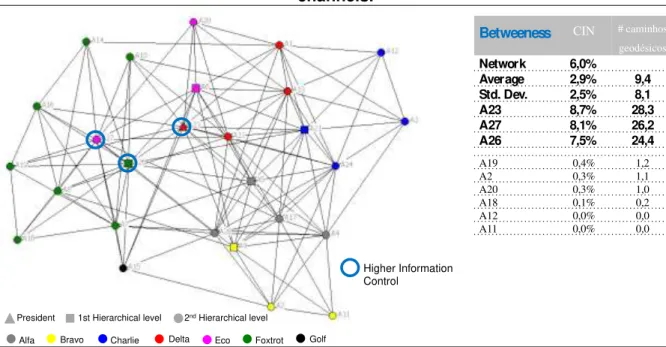
on the network, characterizing the power to control information and the path they're traveling through (WASSERMAN; FAUST, 1994, p.188; HANNEMAN, 2001, p.66).
Figure 4: Cidade Nova - Centralization of intermediation in network communication channels.
Higher Information Control
Betweeness CIN # caminhos
geodésicos
Network 6,0%
Average 2,9% 9,4
Std. Dev. 2,5% 8,1
A23 8,7% 28,3
A27 8,1% 26,2
A26 7,5% 24,4
A19 0,4% 1,2
A2 0,3% 1,1
A20 0,3% 1,0
A18 0,1% 0,2
A12 0,0% 0,0
A11 0,0% 0,0
President 1st Hierarchical level 2nd Hierarchical level
Delta
Charlie Golf
Alfa Bravo Eco Foxtrot
The actors A23 (President), A26 (manager Foxtrot) and A27 (Eco analyst) are those with greater ability to control information, from the point of view of network communication channels, a network whose degree of centralization brokering is fairly low (6.0%), implying that most non-geodesic paths are controlled by specific actors (Figure 4).
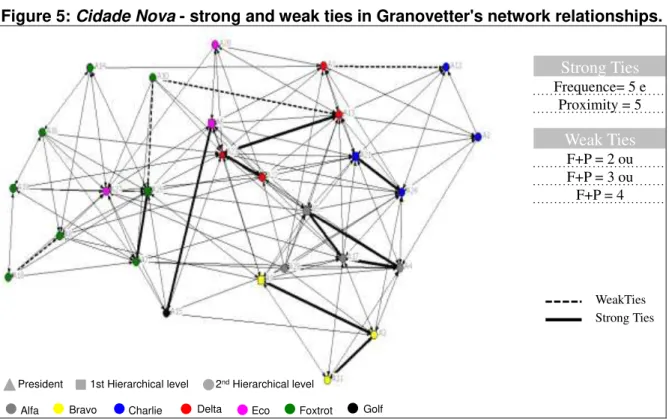
Figure 5: Cidade Nova - strong and weak ties in Granovetter's network relationships.
Strong Ties Frequence= 5 e
Proximity = 5
Weak Ties F+P = 2 ou F+P = 3 ou F+P = 4
WeakTies Strong Ties
President 1st Hierarchical level 2nd Hierarchical level
Delta
Charlie Golf
Alfa Bravo Eco Foxtrot
5.2 The Complete Cidade Nova's RSI
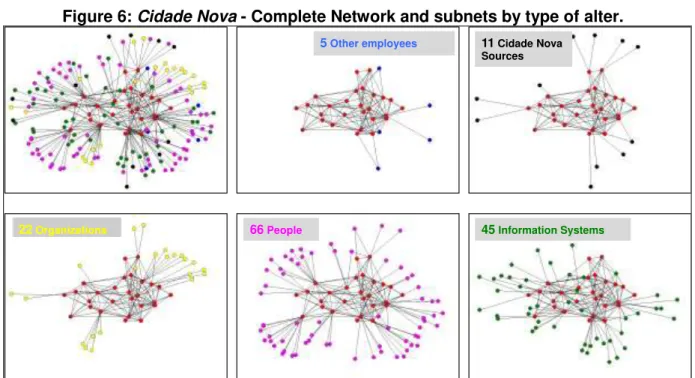
The complete networks are networks that include actors and alters, being an alter an entity, not an actor, indicated by at least one actor. In the case of the Cidade Nova, were referred five types of alters, namely 'Others Collaborators', 'Cidade Nova's Information Sources ', 'Organizations', 'Other People' and 'Information Systems'. The 27 actors in the Cidade Nova's RSI named 149 alters, with whom they have 315 channels of communication which reveal 421 relationships since there were 875 of flows reported in the questionnaires.
Figure 6: Cidade Nova - Complete Network and subnets by type of alter.
11 Cidade Nova Sources
22 Organizations 66 People 45 Information Systems 5 Other employees
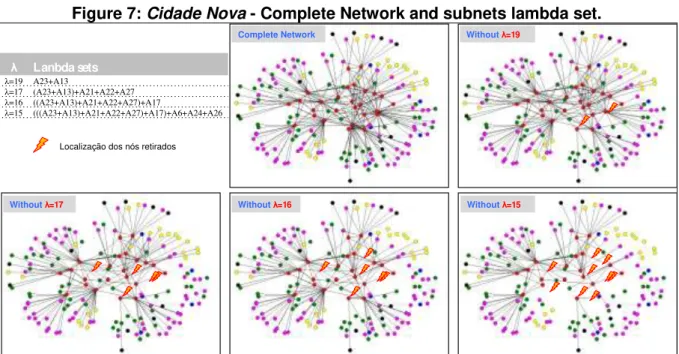
Figure 7: Cidade Nova - Complete Network and subnets lambda set.
λ Lanbda sets
λ=19 A23+A13
λ=17 (A23+A13)+A21+A22+A27 λ=16 ((A23+A13)+A21+A22+A27)+A17
λ=15 (((A23+A13)+A21+A22+A27)+A17)+A6+A24+A26
Complete Network Without λ=19
Without λ=17 Without λ=16 Without λ=15
Localização dos nós retirados
In the complete RSI the most important bridge is made by the president, A23, and the analyst Delta, A13, which is particularly important in relations with alters, in this case, in relations with external entities to the organization. Employees Charlie, Delta and Echo, A21, A22, and A27 respectively, assume some roles and positions in the network of actors, make up with A23 and A13 the second most important bridge. Managers Echo and Foxtrot, A6 and A26, are not part of the group of six actors whose relations when taken up have most disruptive capacity. They are only in the group with the fourth highest delta value. Managers A5 and A9 are not part of the most important bridges which indicates that the power of these actors in the internal RSI finds no reflection in alters RSI (Figure 7).
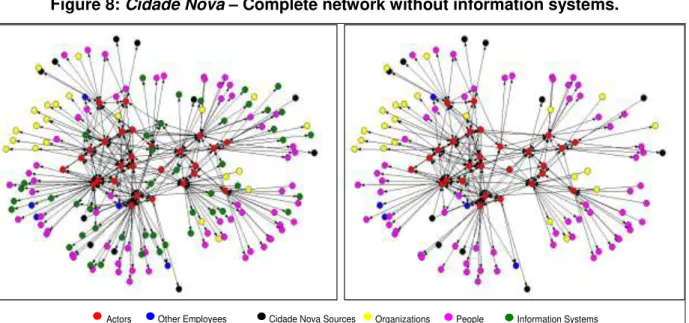
Figure 8: Cidade Nova– Complete network without information systems.
Actors Other Employees Cidade Nova Sources Organizations People Information Systems
Figure 9: Cidade Nova - Centrality Degree in complete network.
Actors Othre Employees Cidade Nova Sources Organizations People Information Systems
Degree D DN
Network 18,5%
Average 3,6 2,0%
Std. Dev. 6,4 3,7%
A23 35 20,0%
A26 33 18,9%
A21 30 17,1%
A6 26 14,9%
A7 26 14,9%
A13 23 13,1%
A27 22 12,6%
A16 21 12,0%
A17 21 12,0%
A22 19 10,9%
A24 18 10,3%
A8 17 9,7%
A3 16 9,1%
A5 15 8,6%
A9 14 8,0%
A4 12 6,9%
A15 12 6,9%
A28 12 6,9%
A1 11 6,3%
A18 11 6,3%
A11 9 5,1% A20 9 5,1% A2 8 4,6% SI10 7 4,0% A10 6 3,4% A14 6 3,4%
Degree Continuation...
A19 6 3,4% SI46 6 3,4% A12 5 2,9% B2 4 2,3% B3 3 1,7% P23 3 1,7% P37 3 1,7% SI37 3 1,7% SI4 3 1,7% SI44 3 1,7% SI9 3 1,7% B1 2 1,1% CN4 2 1,1% O4 2 1,1% O5 2 1,1% P33 2 1,1% P6 2 1,1% SI36 2 1,1% SI6 2 1,1% SI7 2 1,1% SI8 2 1,1% B4 1 0,6% B5 1 0,6% CN1 1 0,6% CN10 1 0,6% CN11 1 0,6% CN2 1 0,6%
... ... ...
Node’s size relative toNode’s Degree
Within a total of 149 alters, in Table 4 below there is a list of 25 most relevant ordered by number of flows. The Table also shows the number of channels by alter that coincides with the number of relationships whereas in the channels with actors and alters there are only univocal relations, from actors to alters. Although in most cases, a larger number of channels correspond to a larger number of flows, the alter which has a greater number of flows is B2 (other collaborator 2), whereas the Internet (SI10) is the alter which actors establish greater number of channels.
Only four alters (Contributor 2, Internet, WinBooks 23 and person 23) receive more than 10 streams each; the following list (Subscribers, Other 3 and Site Contributor Reuters) have only five flows each; the fact that there are many alters with very few flows denotes that there is a great dispersal of relations. From 45
newspaper. The importance of Internet and its services may therefore be gauged by the sum of all these Information Systems.
Table 4: Cidade Nova - 25 most relevant alters.
ALTERS # Chanels # Flows
B2 Other Employee 2 4 13
SI10 Internet 7 12
SI46 WinBooks 6 11
P23 Person 23 3 11
P6 Subscribers 2 5
B3 Other Employee 3 3 5
SI37 Site Reuters 3 5
O4 Caixa Econômica Federal 2 4
P33 Person 33 2 4
P37 Person 37 3 4
SI44 Twiter 3 4
SI9 Google 3 4
B5 Other Employee 5 1 3
O5 Câmara Brasileira do Livro 2 3
B1 Other Employee 1 2 3
SI36 Site Publishnews 2 3
SI6 Facebook 2 3
SI7 Newspaper Folha de São Paulo 2 3
SI8 Newspaper Folha S.Paulo online 2 3
SI4 Newspaper Estado de São Paulo 3 3
B4 Other Employee 4 1 2
CN1 Cidade Nova Database 1 2
CN10 Cidade Nova Magazine 1 2
CN11 Site Cidade Nova 1 2
CN4 Blog Inédito 2 2
Other Employees
Cidade Nova Sources
Organizations
People
Information Systems
From 66 people, only four (6%) were in the TOP25, being the 'Subscribers' appearing with only five flows. From this data we can infer something from the point of view of the organization's business that deserves careful consideration: very little contact is made with customers or, alternatively, these are not the 'top of mind' of the vast majority of the actors when they reflect on their work. The five ‘other employees’ comprise the TOP25 which underscores its importance to the organization, while within the 22 organizations mentioned, only two (1%) appear in that same group.
flows, i.e., those who receive five or more flows, and also the organization that protrudes in this analysis.
Figure 10: Cidade Nova: Centralization of the main alters in the complete network.
represents Flow direction
Person 23
I nternet WinBooks
27 Actors
149 Alters
between Actors
Channels Total 315 128 41%
Relationships Total 421 198 47%
Flows Total 875 516 59%
Other Empl. 3
Caixa Econômica
Federal
Subscribers Actors
Other Employees Cidade Nova Sources Organizations People
Information Systems
Other Empl. 2
Site Reuters
6 FINAL CONSIDERATIONS
This paper showed up and offered some interpretations of the results of SNAI in a third sector organization, Cidade Nova publishing house. The inclusion of analytical graphs serves to the purpose of highlighting some important aspects of visual dynamics and topology of Cidade Nova's RSI, but also has a purpose of seek and extend the possibilities in individual cognitive interpretation of RSI, appealing to different perceptions and sensations that the own esthetic of social network transmits to every analyst, every individual.
second suggestion is the inclusion of more links in the network of actors. It is suggested to use the snowball method (HANNEMAN, 2001, p.8) and apply the questionnaire to alters most cited, allowing the identification of these relationships with actors earlier and extending the RSI to other agents in the information processes of the Cidade Nova.
REFERENCES
BRUNI, L.; ZAMAGNI, S. Economia civil: eficiência, equidade, felicidade publica.
São Paulo: Cidade Nova, 2010.
CAPURRO, R.; HJORLAND, B. O conceito de informação. Perspectivas em
Ciência da Informação, Belo Horizonte, v.12, n.1, p.148-207, 2007.
CIDADE NOVA. Available: <http://www.cidadenova.org.br/>.
GUARNIERI, F. Análise de redes sociais. 2009. Available:
<http://www.slideshare.net/fhguarnieri/anlise-de-redes-sociais-teoria-e-prtica>.
HANNEMAN, R. A. Introduction to social network methods. 2001. Available:
<http://faculty.ucr.edu/~hanneman/networks/nettext.pdf>.
LEMIEUX, V.; OUIMET, M. Análise estrutural das redes sociais. Lisboa: Instituto
Piaget, 2004.
MARTELETO, R. M. Informação, redes e redes sociais: fundamentos e
transversalidade. Informação & Informação, Londrina (PR), v.12, n. esp., 2007.
MATHEUS, R. F. Método de análise de redes sociais de informação associadas
a processos organizacionais. Belo Horizonte: UFMG, 2005. Dissertação (Mestrado
em Ciência da Informação) – Escola de Ciência da Informação, Universidade Federal de Minas Gerais.
MUCHERONI, M. L.; GONÇALVES, R. O conceito ontológico fenomenológico da informação: uma introdução teórica. In: ENCONTRO NACIONAL DE PESQUISA E PÓS-GRADUAÇÃO (ENANCIB), 12., Brasília, 2011. Anais... Brasília, 2011.
MARTINS, P. H. As redes sociais, o sistema de dádiva e o paradoxo
sociológico. Recife: UFPE, 2008.
TOMAÉL, M. I.; MARTELETO, R. M. Redes sociais: posição dos atores no fluxo da informação. Encontros Bibli: Revista Eletrônica de Biblioteconomia e Ciência da
WASSERMAN, S.; FAUST, K. Social network analysis: methods and applications.
Cambridge: Cambridge University Press, 1994.
Marcos Luiz Mucheroni
Escola de Comunicação e Artes Universidade de São Paulo (USP) E-Mail: [email protected] Brazil
Gonçalo Costa Ferreira