PROBLEMY TRANSPORTU Volume 4 Issue 3 Part 1
Marin MARINOV
Instituto Superior Técnico - CESUR at Technical University of Lisbon Av. Rovisco Pais, 1049-001 Lisboa, Portugal
Corresponding author. E-mail: [email protected]
RAIL AND MULTIMODAL FREIGHT: A PROBLEM-ORIENTED SURVEY
(PART II-2)
Summary. This paper includes the Part II-2 of the series of problem-oriented surveys on rail and multimodal freight transportation services, which aim is to reveal the current situation in this sector and raises looming questions for discussion. The particular objective of Part II-2 is to discuss recently published works and documents dedicated to Multi-actor chain management and control, Mode choice and pricing strategies, Intermodal transportation policy and planning as well as Miscellaneous. It should be noted that this paper is a problem oriented survey and does not explicitly focus on the available scientific instrumental that has been applied in dealing with rail and multimodal freight. However, throughout the description methods and concepts are addressed, where it is of interest.
:
-
(
II-2)
. !" # " II-2 $% #&$$ '&() #*+( -(&$#+ $&( ++,- ()%(&( , '( .#++,- /# #%+(0(&(/+,* $ *1 $*(0 +,* 2&1%('#&# (% *, 3# ( (&,- ( ($ (*, " (),'( % # 1.1! $ 1 3$! 4 (* # (&#$'(0+ (( # 1!.$# ('&( ,0 () 1/0#+$ . '#3$5$"# 3# " $ II-2 ( ($ (*, " (), () 10$ +#0 +( $%0 ++,# & )( , $ 0( 1*#+ ,, '( .#++,# 1'& #+$! $ (+ &( ! *+(2(% #++,*$ 3#' *$, *(0 +(*1 ,)(&1$3#+( (6 '( $ $ #, $+ #&*(0 +(6 & + '(& +(6 & #2$$ $ & %+( (&(++#*1 ' +$&( +$!. 1/+( ( *# $ , " ( 0 ++ & )( # '&() #*+(-(&$#+ $&( ++,* ()%(&(*, (+ +# ( �( "$ # $ !"$ # +( + 0( 1'+(* + 1"+(* $+ &1*#+ &$$, ( (&,6 *(/# ), '&$*#+#+ /# #%+(0(&(/+(*1 $ *1 $*(0 +(*1 5& - 1, (0+ ( ()& . # '( *# (0 * ('$ +$ $'(0-(0 * #%0#, 20#4 ('� # $+ #&# .
1. MULTIMODAL FREIGHT TRANSPORTATION
In a few papers we have provided discussions on current states and concepts of rail freight transportation issues. We believe the rail freight modes are the backbone of providing freight transportation services, especially in providing long distance services (but not only) and therefore we wish to better understand the role of rail in the multimodal freight transportation framework and communicate our findings.
After previously discussing (refer to [1]) Drayage, Rail haul, Transhipment and Standardisation, here we continue our discussion with Multi-actor chain management and control, Mode choice and pricing strategies, Intermodal transportation policy and planning as well as Miscellaneous, as follows:
1.1. Multi-actor chain management and control
Intermodal freight transportation service is provided by a multi-actor chain. This phenomenon falls within the supply chains. According to [2] and later cited in [3] “A supply chain is defined as a set of three or more organizations directly linked by one or more of the upstream and downstream flows of products, services, finances, and information from a source to a customer, and supply chain management is defined as the systemic, strategic coordination of the traditional business functions and the tactics across these business functions within a particular company and across businesses within the supply chain, for the purposes of improving the long-term performance of the individual companies and the supply chain as a whole.”
Therefore, some of the main questions within the context of Multi-actor chain management and control, not in particular order, are: Who fulfils the systemic, strategic coordination of the intermodal functions? Who sets the tactics across these intermodal functions within the intermodal chains so that long-term performance improvements would be experienced by all actors involved? What is the coordinating mechanism in the intermodal chain? What is the management structure in the intermodal chain? Who is responsible for the management of this multi-actor chain? What is the optimal management structure? How the management is currently executed and is this practice appropriate? Who is responsible for what, meaning how the responsibilities are shared by the actors involved? What is the risk of failure and how this risk is shared by the actors involved? What is the procedure in case of failure? Who controls the execution of the intermodal service? How the control is currently executed and is this practice appropriate? Who solves the frontline operational conflicts, when such conflicts occur?
The success of intermodal freight transportation service is seen as a fully integrated supply system that fulfils seamless operations, both domestically and internationally. Otherwise, the intermodal freight transport has no chance to compete with direct truck transport from door-to-door, e.g. for market shares.
Realizing this critical issue, the European Commission in its Freight Transport Logistic Plan (see [4]) based on extensive consultations with stakeholders has put forward a series of actions to promote:
Advanced information and communication technologies (ITC) to contribute towards co-modality by improving infrastructure, traffic and fleet management, facilitating a better tracking and tracing of goods across the transport networks and better connecting businesses and administrations; Sustainable quality and efficiency seen in finding practical solutions to bottlenecks, qualifications of logistics personnel and training, establishing a core set of indicators of measuring and recording performance in intermodal chains, determining the requirements for data on freight transport logistics;
Simplification of transport chains involving:
o Simplification of administrative compliance by establishing a single window (single access
point) and one stop-administrative shopping for administrative procedures in all modes;
o Establishing a single transport document for all carriage of goods, irrespective of mode;
o Assess the need for introduction within the EU of a standard (fall-back) liability clause and
o Start developing European standards, in line with existing legislation, international
conventions and international standards, in order to facilitate the secure integration of transport modes in the logistic chain.
All actions in the Freight Transport Logistic Plan of the European Commission sounds promising but we have not seen a clearly defined coordinating/controlling mechanism; we have not seen management structures for intermodal freight transport chains.
The high level of cost efficiency that can be achieved through intermodal freight transportation services due to the existence of economies of scale is a big driving force that encourages the freight transport providers to fulfil intermodal services. It should be noted that within the context of intermodal freight chain there is a danger, however. As regarded in [5] “The danger, however, is that in the pursuit of profit, often the players in the chain focus on their own business segment and not on the seamless flow of goods through the system. … This originates from the fact that intermodal transport involves a number of players with their own strategies and business goals, some of which may even conflict with the objectives of the systems.”
There have been studies dedicated to study the economic powers that each player in the chain posses. There have been concepts that the most powerful one should take the leadership. Would not such a situation impose restriction on and make dependent the weaker player by the powerful players? This sounds more as an obligation and acting under constraints than integration and cooperation (either vertical or horizontal). It should be noted that when actors acting on their own even within a fully integrated intermodal freight transportation system in terms of information flows, technologies, etc., this situation will force the whole system to experience “diseconomies of scale” (i.e., a huge amount of average costs in long run) because of instabilities in the chain seen in conflicts between the players, not synchronized operations, not synchronized businesses. Consequently, a few questions are: What is the right concept to follow? Where and how should the rail freight mode play in this game?
These very important questions remain to be debated over and over in the forthcoming future. An ongoing integrated project within the EU’6th FP – FREIGHTWISE/A Management Framework for Intelligent Intermodal Transport appears to provide answers to some of the afore-made questions. As reported in [6] “The FREIGHTWISE approach is based on results from several projects in previous Framework Programmes that aimed at making intermodal transport more efficient. Based on these results, the FREIGHTWISE goal is to provide a blueprint reference architecture) for the development of an effective management and IT infrastructure for setting up, monitoring, and managing intermodal chains. This infrastructure will support the interaction with other service partners in the chain, but also with external actors such as traffic management services, customs offices, and other relevant public bodies. More information about the pace and the progress of FREIGHTWISE can be found at: http://freightwise.info/cms/ (checked on February, 23, 2009).
1.2. Mode choice and pricing strategies
There have been many studies on model choice. The employed criteria have been Cost and Quality of service provided. It has been seen that shippers give the intermodal road-rail service lower marks than the road transport, but higher marks to the intermodal road-rail service than rail freight service. Since this the reality and the freight transportation service by rail has not improved, so then one should start by looking at its competitive advantage again. It appears that the benefits of the rail freight transport mode are not understood. One should start looking again at the transport market and conduct “Competitor Analyses” by considering social factors in order to understand the value of rail freight transport and its competitive advantage in the market.
Next, actions should be retaken to encourage shippers to shift more of their freight from road to rail. Here, pricing policy and strategy would play a significant role, or in other words what are the right tariffs for providing the freight transportation service? In terms of intermodal services, should every transport mode announce its price for providing its part of the service to a third body and then this body stipulates the price for the whole service? Should the price be stipulated through a negotiation process during which every operator has to show its market power? What is the right pricing strategy and on what basis should the tariffs be stipulated? Should the principle of “willingness to pay” be exercised any longer? Such questions remain unanswered and therefore further effort is required.
In terms of rail freight administration there has been a broadly applied pricing structure basing upon toll per tonne transported depending on commodity type. Nowadays this pricing structure is considered as an obsolete pricing strategy, because it was said that such a tariff does not provide the necessary flexibility of the rail freight operator to act in the transport market and hence it makes him less competitive.
New pricing structures are currently discussed and implemented into practice (see e.g., [7] and [8]). The new rail freight pricing structure aims to implement real and efficient Open Access to infrastructure in line with EU policy in the sector and is seen in Toll per Train, irrespective of load, taking account of speed and peak or off peak transit. It is thought that this new simplified pricing structure provides competitive prices that allows all rail freight operators to optimize their trainloads.
Such a pricing structure is quite simplified indeed. When there are border crossing operations should the customer pay an extra toll in order to cover the operating costs of such operations? How about the toll for transhipment in the terminals? Should the terminals function as airports and what is the strategy for the accommodation fee? Shall one consider a strategy in which the customer should be tolerated and benefited when he wants to shift his freight from road to rail? Should the customer pay less in such a case?
1.3. Intermodal transportation policy and planning
As per the EU’s freight transport agenda: Boosting the efficiency, integration and sustainability of freight transport in Europe (see [9]), the set of European policy initiatives introduced recently is constructed on the principles of Co-modality, Intelligent Transport Systems (ITS), Green corridors and User orientation. Given are the following explanations:
Co-modality requires improving the efficiency, interoperability and interconnectivity of rail, maritime, inland waterway transport, air, road transport and related hubs to achieve their full integration in a seamless door-to-door service;
Intelligent Transport Systems offer a way to improving transport and cargo management, and increasing the utilisation of available infrastructure;
the concept of Green corridors gives further substance to the objective to integrate environmental, as well as safety and security concerns in the design and operation of infrastructure on the trans-European transport network;
finally, User requirements need to become the focus of the future.
More details about the actions being undertaken by the European Commission are given in the Commission’s Freight Transport Logistics Action Plan (see [4]). We have mentioned some of these actions above, so we shall not repeat them again. The critical issue, from practice perspective, is that the outlined actions need to be accompanied by work on a long-term perspective, undertaken jointly with the Member States, in order to establish a common basis for investment in tomorrow's freight transport systems and this is where the European Commission encounters problems.
was generated (see [12]) on appropriate indicators of rail freight activities and market shares in which argued is that there is no single clear alternative form of measurement by which rail’s progress towards meeting policy targets and objectives can realistically be assessed and therefore the current situation is certainly in need of improvement so that a better understanding of the issues can be gained and progress measured. It has been also argued that there is a need for introduction of alternative forms of measurement that better reflect rail’s role in the non-bulk market, such as a specific focus on the number and share of containers and swapbodies carried in the intermodal market. In conclusion, the discussions opened in [11] and [12] are good foundations and of interest for further analyses, ideas and thus contributions at this front.
Next, provided in [13] is a methodology for assessing the potential of a specific policy measures to produce a modal shift in favour of intermodal transport within identified areas. Under the notion Intermodal Transport, Road and Rail combination is understood. The methodology there presented was developed within the SPIN Research Project of the European Commission, consists of three steps (i.e., a toolbox called the macro-scan, which assesses the potential for modal shift, a sensitivity analysis and the policy action plan) and with ex-ante evaluation of proposed transport policies allows identifying appropriate policy measures that will produce a greater impact (higher potential) for modal shift to intermodal transport.
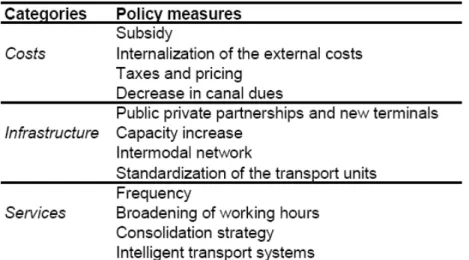
An assessment framework has been discussed in [14] to perform an ex-ante and ex-post analysis of current and potential policy measures to stimulate the use of intermodal transport in Belgium. The focus is on three categories of policy measures, as shown in Fig. 1 [14]. It appears that this is an ongoing research project and therefore we shall not comment more on this article. Instead we shall wait to hear more from the authors.
Fig. 1. Categories of Policy Measures
$ . 1. #2(&$$ & #2$"# $-*#&('&$ $6
Regarded in [15] is that at the micro level of the community or residents along particular freight routes, the notion of tonnes or even tonne-kilometres is not meaningful to how they themselves recognize the freight task and therefore attempted is to assess the development of a Freight Exposure Index constructed from an appropriate basket of freight metrics, focussing on two forms for constructing freight exposure indices: an arithmetic weighted sum of metrics within the index or a production function approach with exponential weights assigned to the changes in the metrics in the index.
providing meaningful information about the progress achieved (or otherwise) subject to policy geared and actions undertaken; level of operation in a single facility as well as in a network; quality of the service provided. This new package of measurement forms should allow us to better monitor, analyse and uptake the role of rail in freight transportation market.
1.4. Miscellaneous
We shall use this category to raise a few questions for discussion about an appropriate concept in studying freight transportation services by rail systems, either individually considered or being part of multimodal/intermodal chain.
Generally speaking, as capacity of a rail system increases the dwell time of freight trains decreases (for the same demand). There are limited possibilities for physical expansions of rail systems’ capacity, however, if one shall not consider government interventions seen in infrastructure realisations. Therefore, increasing rail systems’ capacity is a management task that relies upon how to reduce all activities or lost times that do not contribute to the customer-value-added, meaning identification and elimination of “waste”, and hence to ensure a sustained increase of processing capability. Continuous quality improvements in rail systems’ performance can be pursued by establishing steadily higher productivity level targets and better control of the operating process with freight trains. However, how could the product be seamlessly produced subject to maximum processing capabilities of the system and where should the control take place, are questions that still remain open for discussion. Recalling the fact that the rail system (it appears to hold for any inter-/multimodal freight transportation system) is a production system, one thing should become clear, whether the system is thought of as a “Pull or Push production system”.
Let us note the following: “No matter how wrong the forecast or how great the demand, the system cannot be overwhelmed beyond its capacity”… “the output of a production line is an increasing but bounded function of work in process (WIP) and while flow time begins to grow almost linearly beyond a certain point, it is pointless to add more work to a system that is already saturated” (refer to [16]). Consequently, the concept in examining processing capabilities of rail freight system should be based on these findings. The number of freight trains/freight cars/containers/small boxes/loading units/carrying units/etc. (say, freight transportation items) in the transportation system at any time cannot exceed its true processing capacity. Therefore, there is no point to keep sending freight trains or any freight transportation unites to be served by a system over a certain period if this system is already saturated. Therefore, the number of inbound freight transportation items should be controlled up to a sharply defined upper bound instead of pushing everywhere in the system throughput line. Largely, this will ease the system production control and will further guarantee a seamless operation executed by the system. Thus, we believe that the freight transportation systems (uni-modal, intermodal or multimodal) should be seen as production systems with limited WIP.
In the real world, production systems that limit WIP are classified as pull production systems. Definitions on pull and push production systems are provided in e.g.. They propose:
• A pull production system is one that explicitly limits the amount of work in process that can be in the system
• By default, this implies that a push production system is one that has no explicit limit on the amount of work in process that can be in the system
Pull production systems have already proven their benefits (see e.g., [16], [17], [18]):
• The pull production systems regulate WIP, which has a positive effect seen in shorter processing cyclic times
• The pull production systems regulate the production flows, which has a positive effect seen in smoother operating processes and a steadier output
• The pull production systems experience cost reduction by controlling WIP level. The focus is on equalizing the setups, smoothing assembly line, coordinating worker breaks, etc.
In most cases, the end result of implementing the pull concept is a more efficient system with lower costs. In terms of freight transportation systems the benefits of the pull concept may be experienced by limiting and controlling the number of freight transportation items in process. This can be accomplished by specifying a sharply defined upper bound that replicates the true processing capability of the system in question. If this bound is not violated, the pull concept holds and problems are not expected to occur.
Next, consider the “Waste” vs. Customer-Value-Added concept which is based on reduction of “waste” defined as any step on process that from customer point of view does not add value to the product. Indisputably, all operations with freight transportation items add value to the final product. “Waiting” and “idle” do not add value to the final product. Generally, operating time (service time or Time in Service) depends on the number of available resources and amount of WIP in the systems. Queueing time (waiting time or Time in Queue) depends on the arrival processes of freight transportation items (the number of items to be served and their arrival pattern) as well as the characteristics of these items requiring service.
Freight transportation items stand idle when they cannot be accommodated by the freight transportation systems because these systems are oversaturated (i.e., their true processing capacity is violated) and suffer processing incapability to seamlessly serve the inbound items. So, in such situations the freight transportation items stand idle somewhere in the network just waiting for the next systems to be able to accommodate them. Preventing freight transportation items from standing idle, and therefore, eliminating idle times because of oversaturated freight transportation systems, should be one of the prime targets at tactical management level.
2. SYNTESIS AND A FEW QUESTIONS FOR DISCUSSION
In synthesis, questions for discussion are specified, as follows:
1. It has been argued, within the context of multimodal freight chain that there is a danger. In the pursuit of profit, often the players in the chain focus on their own business segment and not on the seamless flow of goods through the system. Each player has own strategies and business goals, some of which may even conflict with the objectives of the systems. How should we deal with such phenomena? What is the right concept to follow? Where and how should the rail freight mode play in this game? We would like to know more about what the risk of failure in providing the service is, what the failures are, what the types of risk are and how this risk is deployed and shared over the actors involved in the chain.
2. Shippers give the intermodal road-rail service lower marks than the road transport, but higher marks to the intermodal road-rail service than rail freight service. Since this is the reality and the freight transportation service by rail has not improved, it appears that the benefits of the rail freight transport mode are not understood. Should we start looking again at the transport markets and conduct “Competitor Analyses” by considering social factors in order to understand the value of rail freight transport and its competitive advantage, then? 3. In encouraging shippers to shift more of their freight from road to rail, one should not forget
strategies shall be investigated as well (On road pricing, the interested reader is encouraged to consult [19]). Peak versus Off-peak tariffs for different case, both real and virtual, will be scrutinised and further researched.
4. In terms of Multi-/Inter- modal policy and planning, the matter under discussion appears to be on appropriate forms of measuring: alternative freight transportation activities, the rail’s role in the transport market, intermodal policy assessments, etc. These new forms of measurement will have to supplement the existing indicators by providing meaningful information about the progress achieved (or otherwise) subject to policy geared and actions undertaken; level of operation in a single facility as well as in a network; quality of the service provided. This new package of measurement forms to come in the future, should allow us to better monitor, analyse and uptake the role of rail in freight transportation market.
5. Push or Pull Production Concept, what is the question? - Either individually considered or within the multimodal freight transportation system in dealing with rail (or any other transportation system identified to have a limited capacity) one should implement the concept of Lean Thinking and Pull Production system which explicitly limits the Work in Process by controlling the input (i.e., the work items). This way, continuous improvements accompanied with costs’ reduction shall be experienced.
References
1. Marinov M.: Rail and Multimodal Freight: A Problem-Oriented Survey (Part II-1). Transport Problems, vol. 4, nr 2, 2009, pp. 73-83.
2. Mentzer J. T. and DeWitt W. et al.: A Unified Definition of Supply Chain Management, Working paper, University of Tennessee, Knoxville, 1999.
3. DeWitt W. and Clinger J.: Intermodal Freight Transportation, Transportation in the New Millennium, A1B05: Committee on Intermodal Freight Transport, 2000, TRB.
4. COM.: Commission of the European Communities, Communication from the Commission, Freight Transport Logistics Action Plan, Brussels, 18.10.2007, 607 final.
5. Farnsworth G., Davidson T., and Matthews N.: Sydney’s Intermodal System: Development of a business plan for an open access intermodal terminal in Sydney, Discussion Document, Part 2 – Summary of Stakeholder Interviews and International Literature, Sea Freight Council of NSW, 2007.
6. Källström L., Gustafsson I., Poersch R., and Fischer D.: Introducing FREIGHTWISE - A Management Framework for Intelligent Intermodal Transport, BMT Transport Solutions GmbH, Germany, 2007.
7. Eurotunnel: New pricing structure to re-launch rail freight, NEWS, 23, 0ctober, 2007.
8. Eurotunnel: Traffic and Revenue figures: a remarkable year, NEWS, Eurotunnel, 15 January, 2008.
9. COM: Commission of the European Communities, Communication from the Commission, The EU's freight transport agenda: Boosting the efficiency, integration and sustainability of freight transport in Europe, Brussels, 18.10.2007, 606 final.
10.Bontekoning Y. M., Macharis C., Trip J.J.: Is a new applied transportation research field emerging?––A review of intermodal rail–truck freight transport literature, Transportation Research Part A 38, 2004, pp. 1– 34.
11.Woodburn A.: The non-bulk market for rail freight in Great Britain, Journal of Transport Geography 14, 2006, pp. 299–308.
12.Woodburn A.: Appropriate Indicators of Rail Freight Activity and Market Share: A review of UK practice and recommendations for change, Transport Policy 14, 2007, pp. 59–69.
14.Pekin E., Caris A., Crépin T., Macharis C., Jourquin B., JANSSENS G.: Integrated Decision Support Tool for Intermodal Freight Transport, Nectar Cluster Meeting, 2008, on Freight Transport and Intermodality (available online at: http://hdl.handle.net/1942/8352, consulted on February, 23, 2009).
15.Hassall K.: Freight Exposure and How to Measure it, in the Proceedings of the TRANSLU’08, 2008, Bucharest, Romania.
16.Hopp W. and Spearman M.: Commissioned Paper: “To Pull or Not to Pull: What is the Question?”, Manufacturing & Service Operations Management, Vol. 6, No. 2, 2004.
17.Hopp W. and Spearman M.: Factory Physics: Foundations of Manufacturing Management, 2nd Edition, McGraw-Hill, Boston, 2001.
18.Cheng T. and Podolsky S.: Just-in-Time Manufacturing: An Introduction, Chapman & Hall, London, UK, 1993.
19.Zunder T. and Ibanez N.: Road Pricing and Freight - European and National Strategies, Bestufs, 2004, (paper available at http://www.bestufs.net/articles.html, consulted on February, 23, 2009)