FUNDAÇÃO GETULIO VARGAS
ESCOLA DE ADMINISTRAÇÃO DE EMPRESAS DE SÃO PAULO
ANTONIO AUGUSTO DE MIRANDA GRIECO
DOES SO CIAL CAPITAL DI ME NSIO NS FOSTE R INNO VATI ON CAPABIL ITIES ?
SÃO PAULO 2017
ANTONIO AUGUSTO DE MIRANDA GRIECO
DOES SO CIAL CAPITAL DI ME NSIO NS FOSTE R INNO VATI ON CAPABIL ITIES ?
Proposta de Tese apresentada à Escola de Administração de Empresas de São Paulo da Fundação Getúlio Vargas, como requisito para obtenção do título de Doutor em Administração de Empresas.
Campo de Conhecimento:
Gestão de Operações e Competitividade Orientadora:
Prof(a). Dr(a). Susana Carla Farias Pereira
SÃO PAULO 2017
Grieco, Antonio Augusto de Miranda.
Does social capital dimensions foster innovation capabilities? / Antonio Augusto de Miranda Grieco. - 2017.
100 f.
Orientador: Susana Carla Farias Pereira
Tese (doutorado) - Escola de Administração de Empresas de São Paulo.
1. Capital social (Sociologia). 2. Desenvolvimento organizacional. 3.
Administração de empresas. I. Pereira, Susana Carla Farias. II. Tese (doutorado) - Escola de Administração de Empresas de São Paulo. III. Título.
ANTONIO AUGUSTO DE MIRANDA GRIECO
DOES SO CIAL CAPITAL DI ME NSIO NS FOSTE R INNO VATI ON CAPABIL ITIES ?
Tese apresentada à Escola de Administração de Empresas de São Paulo da Fundação Getúlio Vargas, como requisito para obtenção do título de Doutor em Administração de Empresas.
Campo de Conhecimento:
Gestão de Operações e Competitividade Orientador(a)
Prof(a). Dr(a). Susana Carla Farias Pereira
Banca examinadora:
Prof(a). Dr(a). Susana Carla Farias Pereira (orientadora) FGV-EAESP
Prof. Dr. Felipe Mendes Borini ESPM- PMDGI
Prof. Dr Júlio Figueiredo ESPM- PMDGI
_____________________________________ Prof. Dr. Diógenes de Souza Bido
Ducci & Buddy, one day I might not be here , remember always to go till the end. I made it for you!
AGRADECIMENTOS
Agradeço a todos meus colegas, professores e família por todo o suporte durante a construção da Tese!
ACKNOWLEDGMENTS
ABSTRACT
Innovation is considered one of the key capabilities required for organizations to achieve success. Previous research has claimed that social capital influences innovation capabilities, yet not the extent of its dimensions (cognitive, relational and structural). This study addressed this research gap by a survey performed among ANPEI (Research and Development Nacional Association of Innovative Companies) members, specifically innovation managers from Brazilian and multinational companies from several sectors, operating in Brasil. 440 innovation managers from 220 companies during the period from December/2016 and January/2017 participated. An instrument with 24 items was designed to measure the independent and dependent variables. A web-based survey was created on QuestionPro Platform, to disseminate the survey through a link and collect data easily. The software SmartPLS 3 was used to treat the data as main analysis tool. It estimates PLS path models for the empirical validation of Theoretical model. The results showed that both cognitive, relational and structural dimensions of social capital affect positvelly the generation of innovation capability, but we found out that the structural social capital has a higher impact on the generation of innovation capability. We verified that R&D also affects positevly in the generation of Innovation Capability.
RESUMO
A inovação é um dos principais recursos para alcançar o sucesso nas organizações. Por meio de estudos anteriores, sabe-se que o capital social influencia as capacidades de inovação da firma, todavia ainda não foi medido o impacto de suas dimensões cognitiva, relacional e estrutural na capacidade de inovação da empresa. Este estudo aborda esta lacuna de pesquisa por uma pesquisa realizada com os membros da ANPEI (Associação Nacional de Pesquisa e Desenvolvimento de Empresas Inovadoras), especificamente os gerentes de inovação, de empresas Brasileiras e multinacionais de diversos. Participaram da pesquisa 440 gerentes de inovação de 220 empresas no período de dezembro 2016 e janeiro 2017. Um instrumento com 24 itens foi projetado para medir as variáveis independentes e dependentes. A pesquisa foi criada na plataforma QuestionPro. A pesquisa foi disseminada através de um link e coletar dados com facilidade. O software SmartPLS 3 foi usado para tratar os dados como principal ferramenta de análise. Ele calculou Path coefficients para a validação empírica do modelo teórico. Os resultados confirmam que tanto as dimensões cognitivas, relacionais e estruturais do capital social afetam positivamente a geração da capacidade de inovação, mas descobrimos que o capital social estrutural tem um maior impacto na geração de capacidade de inovação. Verificamos que a existência de R & D também afeta de forma positiva a geração de Capacidade de Inovação.
LIST OF FIGURES
Figure 1. Integrated model of innovation ... 22
Figure 2. A model of innovation capability ... 23
Figure 3. Differentiation innovation Capability and innovation outputs ... 44
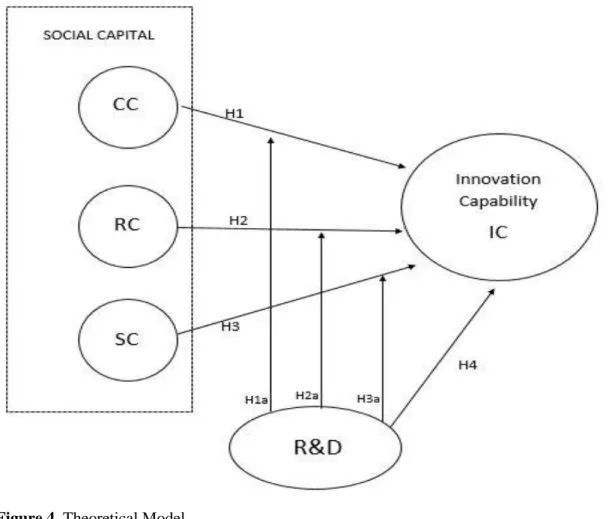
Figure 4. Theoretical Model ... 48
Figure 5. Research Model ... 51
Figure 6. Output software G*POWER 3.1.9.2 - minimum sample size required ... 55
Figure 7. Structural model assessment procedures ... 64
Figure 8. Structural Model Innovation Capability ... 66
Figure 9. Output SmartPLS 3.0 - 179 observations (appendix) ... 99
LIST OF TABLES
Table 1 - Cognitive social capital and innovation capability literature synthesis ... 33
Table 2 - Relational social capital and innovation capability literature synthesis... 36
Table 3 - Structural social capital and innovation capability literature synthesis ... 39
Table 4 - Cognitive Capital Measures ... 52
Table 5 - Relational Capital Measures ... 52
Table 6 - Structural Capital Measures ... 53
Table 7 - Innovation Capability Measures ... 53
Table 8 - Patents ... 58
Table 9 - Descriptive Statistics and Correlations among Latent Variables ... 60
Table 10 - Crossloadings ... 61
Table 11 - Latent variables statistics ... 62
Table 12 - Statistical T-student ... 63
Table 13 - Statistical Results of the structural model and hypotheses testing ... 67
Table 14 - Results of the hypotheses testing and significant differences between company size 1 and company size 2... 68
Table 15 - Descriptive Statistics of indicators (Appendix) ... 100
Table 16 - Descriptive Statistics of constructs (Appendix) ... 100
Table 17 - Final Research Questionnaire - Portuguese (Appendix) ... 101
Table 18 - Final Research Questionnaire - English (Appendix) ... 101
Table 19 - Companies associated to ANPEI (Appendix) 1/3 ... 102
Table 20 - Companies associated to ANPEI (Appendix) 2/3 ... 103
LIST OF GRAPHS
Graph 1 - Crosstab R&D Department x Company Size ... 57 Graph 2 - Sector ... 58 Graph 3 - Patents x Company Size ... 59
TABLE OF CONTENTS TABLE OF CONTENTS ... 13 1 INTRODUCTION ... ……10 2 THEORETICAL FOUNDATIONS ... 18 2.2 Innovation Capability ... 21 2.3 Social Capital ... 23
2.3.1 Cognitive Social Capital ... 30
2.3.2 Relational Social Capital ... 34
2.3.3 Structural Social Capital ... 37
2.4 Innovation And R&D ... 40
2.5 Theoretical Model ... 48
3 METHODOLOGY ... 51
3.1 Structural Model ... 51
3.2 Measurement / Construct Operationalization ... 52
3.3 Results - Data Collection And Sampling ... 56
3.4 Data Analysis And Quality Of Measurement Model ... 59
3.5 Structural Model Assessment ... 63
4 DISCUSSION ... 69
4.1 Addicional Discussions ... 71
4.2 Theoretical Implications ... 73
4.3 Managerial Implications ... 74
4.4 Future Research Directions ... 75
4.5 Limitations ... 76
5 CONCLUSION ... 77
REFERENCES ... 78
14
1 INTRODUCTION
Innovation is one of the key capabilities in achieving prosperity in an organization and is a critical source of competitive advantage in an increasingly changing environment (Dess & Picken, 2000; Tushman & O’Reilly, 1996). According to Mone, Mckinley and Barker (1998) innovation capability is the most important determining factor for firm performance. Innovation capability, or firm innovativeness, is a set of organizational practices (Peng, Schroeder, & Shah, 2015), grounded in processes, systems and organizational structure, which can be applicable to product and process innovation (Lin, 2007; Chen, 2009; Hogan, Soutar, McColl-Kennedy, & Sweeney, 2011).
The present research associates innovation capability to social capital. Social Capital is a set of resources routed in relationships with many dimensions. Social capital has three dimensions: Cognitive, Relational and Structural (Landry, Amara, & Lamari, 2002). Pérez-Luño, Cabello-Medina, Carmona-Lavado and Cuevas-Rodríguez (2011) showed that several studies had investigated social capital as a single dimension construct. However, they also proposed that researchers deepen the understanding of social capital dimensions’ influence on innovation capabilities. Similary in 2013, Yu claimed that future research should continue investigating how social capital can enhance innovation, and more recently in 2014, Yang, Chou and Chiu suggested an empirical examination of social capital and its effect on innovation as a potential area of research.
Companies have been depending more and more on external collaboration in order to increase their innovation capabilities (Goes, 1997). One of the most important mechanisms for achieving external collaboration in the innovation processes is “social capital” (Edquisit, 1997; Moran, 2005). Furthermore, literature on innovation agrees that collaboration with partners promotes innovation and the social capital within this network can provide innovation capabilities to firms (Tsai, 2001; Nielsen, 2005). Social Capital theory is extensive, but it mainly articulates that networks and relationships are valuable resources and they provide “credentials” to institutions (Bourdie, 1986).
15
Reinforcing this idea, Cousins, Lamming, Lawson, and Squire (2008), as well as Oke, Prajogo and Jayaram (2013) proposed that building relationships with key partners would increase the effective exchange of knowledge that fosters innovation. That is what Chesbrough called “open innovation” in 2003.
Scholars often agreed on the fact that a firm could leverage resources through relationships with partners. Carmona-Lavado, Cuevas-Rodríguez and Cabello-Medina (2010) have suggested that there is a clear positive influence of social capital on value creation due to collaborative efforts. Fernandes (2013), studying innovation across the supply chain, suggested that innovation can initiate at the firm, with suppliers becoming involved afterwards in order to help with development of the idea: occasionally, though, innovation is proposed by suppliers. Therefore, innovation capability is part of a multi- directional flow process that may arise in the firm or in a partner.
The body of knowledge, which relates social capital and innovation capabilities, has evolved, claiming that social capital fosters innovation capabilities. However, these theoretical constructions have failed to specify either the dimensions of social capital that promote innovation capabilities (Yam, Guan, Pun & Tang, 2004; Aramburu, Sàenz, & Blanco, 2013; Turi & Harmaakorpi, 2005; Wu & Sivalogathasan, 2013; Zheng Wei, 2008, Crescenzi, Gagliardi, & Percoco, 2011; Lebedeva, Osipova, & Cherkasova, 2013; Kemper, Schilke, & Brettel, 2013) or to measure the impact of social capital dimensions on the creation of innovation capabilities (Landry, Amara, & Lamari, 2002; Kaasa, 2007; Aziz, Sherzod, & Zaur, 2014).
In 2011, Villena, Revilla and Choi presented an article that divided the construct social capital in three dimensions and examined the relationship between its dimensions and value creation. This article divided social capita into three dimensions: cognitive social capital, relational social capital and structural social capital. It presented new results that showed a new perspective. They proposed that too much social capital could also deter value creation in the firm-partner relations and defined social capital as an asset that stems from access to resources made available through social relations. They also specified the dimensions of social capital that impact on value creation. Likewise Villena et al. (2001), Goryunova (2013) and Jiang, Aulakh and Krishnan (2014) worked with the dimensions of social capital suggesting that they promote different types of relations and consequently distinct innovation capabilities.
16
Notwithstanding, these articles did not measure the impact of cognitive, relational and structural dimensions of social capital on innovation capabilities.
Using a survey to provide empirical support, this research aims to measure the impact of social capital dimensions on innovation capability. Therefore, the gap to be covered in this research is measuring each social capital dimension's impact on the generation of innovation capability.
The main question is:
What is the impact of social capital dimensions on innovation capability?
This research recognizes the origin of social capital being the complex relations between individuals representing their firms, which unfold into meandering relationships defined by entangled knowledge sharing, power tensions and elements of trust (Cousins, Lawson & Squire, 2006; Ketchen, & Hult, 2007). It is also important to remark that the “relations” studied in this research consist of a set of dyads between firm and its partners, not on the network as a whole.
Thus, The General Goal of the research is:
Measure the impact of social capital dimensions on innovation capability. The specific objectives of this research are:
Test not only the direct effect of research and development on the generation of innovation capability but also its moderating effect on the relations between social capital dimensions and innovation capability. Research and development (R&D) is “a systematic activity combining both basic and applied research, objecting discovering solutions to problems or creating new goods and knowledge. Sometimes it is centralized in a function, sometimes it is distributed along the company (Brouwer & Kleinknecht, 1996). This study, as a specific objective aims to understand which has the higher effect size R&D centralized or moderating social capital dimensions and innovation capability.
These results allow substantial comparisons that constitute an important managerial contribution, helping managers contrast the innovation capability generated by means of social capital, research and development, and by the moderating effect of research and development.
17
To the best of our knowledge, looking at the literature, we did not identify any research that studied the impact of social capital dimensions isolatedly on innovation capability in the same model, this way representing a progress in this theory.
Theoretical Contribution
This research is singular and distinct from previous studies that examine social capital and innovation capability because it does not present social capital as a single dimension. In this study, it is as if we apply a magnifying glass to social capital, unfolding its three dimensions, minutely, to measure their influence on innovation capability. In addition, unveiling the impact of each dimension separately on the generation of innovation capability constitutes a novelty for the development of this theory.
This study initiates, analyzing the theory behind social capital, innovation, research and development and innovation capability to beaddressed in the section 2 “Theoretical Foundations”.
18
2 THEORETICAL FOUNDATIONS
This chapter will describe the theoretical domain, which this study presents, starting with the defition of capability, the types of capabilities, innovation capability, then moving on to social capital and finally to innovation and research and development. This theoretical basis will then be broadened, in order to show the positive or negative effects of each dimension of social capital on innovation capability.
2.1 Capabilities
As one of the main phenomena addressed in this study, Innovation Capability, to be explored in section 2.3, is a phenomenon that bears elements of both operational and organizational capabilities besides practices (Chong-Em & Xu Lin (2008). So, it is crucial to define, explain and differentiate these concepts clearly. Wheelwright (1984) illustrates that competitive priorities help firms achieve its objectives, saving resources. The theoretical structure of competitive priorities has been used to characterize the notion of capabilities. Größler and Grübner (2006), Rosenzweig and Easton (2010) explain that capability is the ability of a firm to compete.
In addition, capabilities involve social processes and are influenced by factors including firm history (Teece, Pisano, & Shuen, 1997), actions of decision makers at the individual, group, and firm levels (Rothaermel & Hess, 2007) and the firm's learning process (Schreyogg & Kliesch-Eberl, 2007). In this sense, capabilities transcend the procedural and technological boundaries that define operational practices, and become institutionalized (Leonard-Barron, 1992; Zucker, 1977). In other words, while a practice is not organizationally specific, a capability is.
In contrast to capabilities, which cannot be transferred, operational practices are able to be transferred to the benefit and assistance of other firms. Wu, Melnyk and Swink (2012, p. 123) assert that operational practices are specific activities aimed at achieving specific objectives (Flynn, Schroeder, & Sakakibara, 1995). The authors define operational capabilities
19
as stemming from resources such as technology, operational practices, social interaction, organizational structure and culture (Wu, Melnyk & Swink 2012, p. 126). While the adoption of practices focuses upon improving processes and learning from competitors, developing capabilities produces idiosyncratic routines, customizes processes, and results in distinctive skill sets that are (ideally) differentiated from the capabilities offered by competitors. According to Wu, Melnyk and Flynn, operational practices are situational, generic and highly structured sets of activities (2012, p. 123) that can be transferred across organizations and industries to help operations management personnel in distinct organizations to address similar operational problems. These practices include specific procedures, organizational arrangements, protocols, tools, techniques, and other ways of achieving aims. Operational practices are also typified by standardized procedures that are easy to articulate and well-defined (Flynn, Schroeder, & Sakakibara, 1995).
It is possible to classify capabilities as organizational capabilities and operational capabilities; Wu, Melnyc and Flynn 2010, defined capabilities as a broader construct comprised of these subsets. Organizational Capabilities are “information-based tangible and intangible processes that are firm specific and developed over time through complex interactions among the firm’s resources” (Amit & Schoemaker, 1993). Collins (1994) stated that organizational capabilities derive from “socially complex routines that determine the efficiency with which firms physically transform inputs into outputs”, and as resources are not infinite assets, innovative firms search for capabilities outside their boundaries as well (Chesbrough, 2003). Reinforcing the idea proposed by Chesbrough (2003), GröBler and Grübner (2006) emphasize that the resources are something that a firm has access to, rather than something it can do. Access to resources does not create competitive advantage, but rather the potential of competitive advantage. Wu, Melnyk and Swink (2012, p. 125) define operational capabilities as “[…] firm-specific sets of skills, processes, and routines, developed within the operations management system, that are regularly used in solving its problems through the means of configuring its operational resources”. In other words, they are ingrained in the social capital of the firm. Operational capabilities are “firm-specific sets of skills, processes and routines, developed within the operations management system, that are regularly used in solving its problems through configuring its operational resources” (Wu, Melnyc, & Flynn, 2010).
It is important to explain in depth where innovation capability originates, because this research attempts to understand the generation of innovation capabilities. For this reason,
20
we should explore some different definitions of innovation capability and its relationship with organizational capabilities.
Firm innovativeness, nominated innovation capability in this study can be defined as an organizational capability (Martínez-Roman, Gamero, & Tamayo, 2011). Organizational capability is a high-level routine or collection of routines that, together with implementing input flows, confers upon an organization’s management a set of decision options for producing significant outputs of a particular type (Winter, 2000). Grant (1991) describes organizational capabilities as verbs, because they focus on the way in which resources are used through actions; without organizational capabilities, a resource may lose its value over time (Coates & Mcdermott, 2002).
Organizational capabilities reside in corporate structures and processes, corporate culture, and networks of employee and inter-organizational relationships. They derive from distinct behavioral patterns that are complex in nature and that involve both internal and external processes. Related to that, Bottazzi, Dosi, Lippi, Pammolli and Riccaboni (2000), Hofer and Schendel (1978) and Schreyogg and Kliesch-Eberl (2007) describe organizational capability as related to the transformation of inputs into outputs. Additionally, Harreld, O’Reilly and Tushman. (2007) explained organizational capability as embedded organizational processes or routines that are focused on coordination, learning and transformation. Organizational capabilities are useful to a firm “because they cannot be transferred to other firms the way that some resources can”, providing “a potential source of competitive advantage”. (Wu, Melnyc, & Flynn 2010, p. 724).
To clarify the differences between these concepts of practice and capability, Wu, Melnyc and Flynn (2010), in the article Operational capabilities: the secret ingredient, presented how capabilities and practices work together in a kitchen: “A kitchen’s operational capabilities are its capacity to leverage the staff’s skill sets to deploy resources in creating dishes that reflect the restaurant’s history, style of cooking, and the preferences of its customers”. (Wu, Melnyc & Flynn 2010, p. 726). On the other hand, operational practices can be seen as essentially recipes, or guides, providing generic instructions on how various resources can be combined to create a meal. However, although many kitchens may have the same chocolate mousse recipe, there is no guarantee that the results will all taste the same because a recipe only provides basic guidance about how to combine resources. It does not capture the impact of less
21
tangible factors, such as the freshness and quality of the ingredients or skill in setting the stove’s flame at the proper height. (Wu, Melnyc & Flynn 2010, p. 726).
2.2 Innovation Capability
Innovation capability shares some aspects of “organizational capability”, some of “operational capabilities”. Innovation capability constitutes the skills and knowledge needed to effectively absorb, master and enhance existing technologies and to create new ones (Romjin & Albadejo, 2002). It can also be defined as the continuous improvement of the overall capabilities and resources that the firm possesses to explore and exploit opportunities for developing new products to meet market needs (Koc, 2007). This way, innovation capability is a dynamic capability, as such cannot be easily copied.
Chong-Em & Xu Lin (2008) believe that innovative capability lies in a firm’s capacity for gaining access to, developing and implementing innovative technologies for design and manufacture. Chen (2009) describes innovation capability as grounded in the processes, systems and organizational structure of a firm, which can be applicable to the product or process innovation activities.
Innovation capability can also be defined as the integrative process of applying the collective knowledge, skills and resources of the firm to perform innovation activities pertaining to technical innovations (products and or services and processes), and non-technical innovations (managerial, market, and marketing) (Weerawardena & Mccoll-Kennedy 2002). More recently, Hogan et al. (2011), endorsed Weerawardena and Mccoll-Kennedy’s (2002) comprehensive understanding of innovation capability and define it as a firm's ability, relative to its competitors, to apply the collective knowledge, skills, and resources to innovation activities relating to new products, processes, services, or management, marketing or work organization systems, in order to create added value for the firm or its stakeholders. This definition considers not only a broader range of innovation activities, but also their performance implications. The authors also called attention to innovation capability as focused on the firm’s
22
partners; this approach to innovation capability would result in a company providing customers with exclusive services and products that fits their needs.
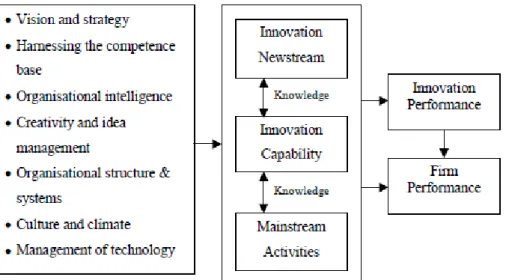
According to the Canadian Supply Chain Sector Council [CSCSC] (2015), a firm partner can be a supplier, the distributor, a retailer or even the customer, meaning that the partner can be anywhere in the supply chain, from suppliers to customers. The partnership can be enhanced, for instance, by assimilating knowledge, as explained by Lawson and Samson (2001). Considering the ideas of the authors here cited, innovation capability is not just the ability to be successful at running a business stream, or to manage mainstream capabilities. Innovation capability is about synthesizing operating paradigms and is formed from the interactions between partners and firm, and the character of these relations, by means of social capital.
In the section dedicated to innovation, this study differentiates clearly innovation capabilities from innovation outputs. To iniciate this distinction, and to help make clear how innovation capability functions within the innovation process as a whole, two models proposed by Lawson and Samson (2001) are provided. First Lawson and Samson (2001, p. 383) (figure 1) suggest an integrated model of innovation:
Figure 1. Integrated model of innovation
Source: “Developing innovation capability in organisations: a dynamic capabilities approach” the Lawson, B. and Samson, D. (2001), International Journal of Innovation Management. 5(3), 377-400.
Lawson and Samson (2001) show in their model that innovation capability generate innovation outputs. Lawson and Samson (2001, p. 388) also developed a model of innovation
23
capability, associating it with some dimensions as organizational intelligence, organizational structure, et cetera (figure 2):
It is important to remark that some of these dimensions are part of the social capital construct, as organizational structure & systems, culture and climate.
Figure 2. A model of innovation capability
Source: “Developing innovation capability in organisations: a dynamic capabilities approach” the
Lawson, B. and Samson, D. (2001), International Journal of Innovation Management. 5(3), 377-400.
In summary, Innovation Capability can be thought of as innovation “skills”: the routines and processes employed to produce innovation outputs. The basic principle that gets together social capital and innovation capability is that social capital allows an enterprise’s innovative capability to be increased by borrowing or imitating innovations devised by their partner (Hacklin, Marxt, & Fahrni, 2006). Bearing in mind that innovation capability is not a sufficient condition to increase firm performance per se (Ngo & O'Cass, 2012), and must be properly exploited in order to have this effect. As Social capital can increase innovation capability; the following section deepen social capital and its dimensions understanding.
2.3 Social Capital
Social capital is an extremely broad concept that was first used in community studies for neighborhood networks (Nahapiet & Ghoshal, 1998). The central proposition of the
24
social capital theory hinges on the premise that networks of relationships are an extremely valuable resource, providing “credentials” to institutions (Bourdie, 1986). Some authors such as Putnam (1995) refer to social capital as a set of resources routed in relationships with many dimensions.
Despite authors attributing the origin of the concept of social capital to the nineteenth century, with the studies of Toquecville on democracy in America that highlight an essential and distinctive components of social capital in relation to other democracies (Fukuyama, 2000; Franco, 2001), the concept that forms the basis of this work can be traced to Bourdieu (1980). This is for two reasons: the comprehensive and systematic way in which the concept was adopted by him, and the possibility to combine the theoretical concept with the attention to social processes and economic innovation present in the definition he gives. Bourdieu (1980) also presents social capital as the "aggregate potential and actual funds linked to possession of a durable network of relationships more or less institutionalized familiarity and mutual recognition" In this perspective, there are two elements that make up social capital: the social relationships allowing access to resources and the quantity and quality of these resources. In contrast to Putnam (1993), Bourdieu does not attribute the formation of social capital to a dependency trajectory in a given community or region. Cultural values and inherited social structures do not determine capital, since they are the result, rather than cause, of actions.
In addition to that, Granovetter (1992) approach to Social Capital talks of structural and relational embeddedness, concerning properties of the network as a “whole” and describing an impersonal configuration of linkages between people or units. Some other authors such as Woolcock and Narayan (2000, p. 226) describe social capital as a person’s family, friends, and associates, constituting an important asset: it that can be called on in crisis, enjoyed for its own sake, or leveraged for material gain. The absence of social ties can have an equally strong impact. Office workers, for example, may fear being left out of the loop on important decisions; ambitious professionals recognize that getting ahead in a new venture typically requires an active commitment to networking. Social capital has costs as well as benefits; social ties can be a liability as well as an asset (Woolcock & Narayan, 2000, p. 226).
There are four distinct perspectives in social capital research: the communitarian view, the networks view, the institutional view, and the synergy view. Woolcock and Narayan (2000, p. 239) explain these four perspectives: the communitarian (local) view, which
25
recognizes the community as a social asset; the networks view, which investigates enterprise zones and bridges social divides; the institutional view (political and legal) which emphasizes transparency and accountability, and lastly the synergy view (community networks) which investigates co-production, complementary participation linkages and enhancing capacity. This research falls within the Synergic domain, because it deals with how firm and its partners interactions co-produce and enhance innovation capabilities.
Social capital is not given nor established a priori by existing social relations, but is the accumulation of intentional actions (Bourdieu, 1980). This relates directly to the objetives of this work: the relevance of social capital in the generation of innovation capability, where social capital leverages learning and leads to knowledge that generates innovation capabilities. Knowledge together with learning are important constructs in the process of generating innovation capability. The systematic component present in the innovation process is the creation of knowledge. The process of knowledge creation is closely related to technological innovation, in that it allows a company to "reform or revolutionize the pattern of production by exploiting an invention or a technological possibility in a manner not attempted before, to produce new merchandise or a new way of producing an existing commodity, opening a new source of supply of materials or a new distribution point for goods through the reorganization of an industry" (Schumpeter, 1961).
Following Bourdieu's definition, Lin (2001) asserts that social capital can be defined as the overlapping resources in a social structure that are accessed or mobilized into action, with pre-defined purposes. Given how individuals invest in social relations, and through which they gain access to resources in order to increase expected instrumental stock returns, and that these results are practical and measurable. Thus, capital is a kind of relational asset, and differs from collective assets such as standards, trust and culture. Putnam (1993) claims that norms, trust and culture are factors that exist within social and institutional environment. They facilitate the emergence of social capital, or an investment in social capital, but should not be confused with share capital.
Additionally to that, Bourdieu (1980) also says that "social capital’ is never completely independent of the fact that the exchanges establishing the inter-recognition assume [that actors have] knowledge of a minimum homogeneity "objective". In studies on social networks, two actors are considered structurally equivalent if they have identical ties with all
26
other actors in the network (Wasserman & Faust, 1994). Structural equivalence concerns positions (how the actors are embedded in a network relations) and the roles of actors (patterns of relationships between actors or positions). The homogeneity 'objective' to which Bourdieu refers can be seen as a manifestation of structural equivalence. Regarding centrality, the central actor is defined as that who is involved in many links, or more links than the other actors in the network (Wasserman & Faust, 1994). Centrality is often associated with greater access to and control over resources circulating within the network (such as valuable information). In relation to capital, then, Bourdieu points out that centrality is not distributed symmetrically between group members.
Previous studies show that the development of social capital can be observed in four aspects: stability, closure, interdependence, and interaction. According to Camps and Marquès (2011, p. 9), stability is the length of time that members of a group have had to develop their relationships. The greater the stability, the greater the potential to build stocks of social capital in the three dimensions. Stability promotes the creation of networks and relationships, allows people to share experiences which encourage the same vision and a shared language, and also facilitates the creation of trust, norms and obligations (Misztal, 1996; Arregle, Hitt, Sirmon, & Very, 2007). Closure refers to the existence of dense social network boundaries that distinguish members of a group from non-members; (Bourdieu, 1994; Etzioni, 1996), and within which all actors have relationships with each other. (Camps & Marquès, 2011, p. 9). Interdependence refers to shared goals and the concern for the success of the business that members of a collective have, as well as the cooperation needed in order to accomplish their own objectives (Camps & Marquès, 2011, p. 10). Interaction concerns the frequency with which members of a network communicate with each other; it reflects the quantity, quality and strength of the relationships among them (Camps & Marquès, 2011, p. 10).
The importance of external ties has already been studied by several renowned authors who emphasize that social capital strengthens supplier relations, resulting in value gain (Asanuma, 1985; Baker, 1990; Dore, 1983; Gerlach, 1992; Helper, 1990; Smitka, 1991; Uzzi, 1997; Romo & Schwartz, 1995; Kraatz, 1998; Loury, 1992; Nahapiet & Ghoshal, 1998; Pennar, 1997; Schiff 1992; Woolcock, 1998). Cousins, Lamming, Lawson, and Squire (2008) and Oke, Prajogo and Jayaram (2013) show that constructing relationships with key supply chain partners will increase the effective exchange of knowledge and create a strategic relationship with supply chain partners. This study will also restrict itself to treating social capital as the shared
27
assets, processes and resources found in a relationship between agents, which depend on the quality of this relationship and on mutual trust, rather than treating it in the procedural sense, as occurring in rigidly defined, contract-based arrangements.
A dilemma faced in making sense of social capital refers to a tautological problem. If, says Coleman (1988), social capital is defined by its function and perceived by its results, to what extent it is formed in order to produce such results? This tautology is incompatible with the construction of a theory, because causal factors are being confused with effects (Lin, 2001). In this sense, sometimes capital mingles with trust, cooperation and cultural values. And cultural values may lead to trust. In this reading, trust cannot be based on social networks and chains of mutuality of capital. According to Zucker, trust can be based on an institutional framework, tied to the existence of formal structures in society, regardless of momentary preferences and the actions of individuals (Zucker, 1986).
There are multiple ways to categorize social capital into dimensions to be explored next. Social capital can also be categorized into at least one of the three categories that follow: intellectual capital (knowledge), human capital (skills and abilities of stakeholders) and organizational capital (processes and documents) (Carmona-Lavado, Cuevas-Rodríguez, & Cabello-Medina 2010; Reed, Lubatkin, & Srinivasan, 2006; Wright, Dunford, & Snell, 2001; Subramaniam & Youndt, 2005).
Nahapiet and Ghoshal (1998) in their seminal work propose three dimensions of social capital: structural, cognitive and relational; Villena, Revilla, and Choi (2011) also operationalized social capital with the same three dimensions. Cognitive capital, in the form of shared culture and congruent goals, provides a shared vision through which committed parties gain a better understanding of the behavioral norms and common goals within the relationship. Relational capital focuses on the link of personal relationships decision makers of the partnering firms have developed with each other through a history of interactions. Structural social capital recognizes the advantages derived from the configuration of the network of contacts within a given social structure. The structural dimension affects communication and information flow within the organization by facilitating access to broader sources of information and improving information quality, relevance and timeliness. (Nahapiet & Ghoshal, 1998). The cognitive dimension facilitates the combination and exchange of knowledge among different parts. The
28
relational dimension comprises trust, norms, obligations and identification. (Camps & Marquès, 2011, p. 11-12).
As well as Pérez-Luño, Cabello-Medina, Carmona-Lavado, & Cuevas-Rodríguez (2011), have proposed that a social capital approach to innovation includes not only the quantity of partners and structure of network, but also the cognitive, the relational and the structural social capital. In brief, the structural dimension consists of the patterns of social interactions, and the trength of ties, among the members of a collective (Pearson, Carr, & Shaw, 2008; Camps & Marquès, 2011, p. 8). The cognitive dimension is the bundle of resources that provide shared representations, interpretations, and systems of meaning among parties (Nahapiet & Ghoshal, 1998). In other words, the cognitive dimension refers to “the way members perceive their reality” (Camps & Marquès, 2011, p. 8). The relational dimension comprises the resources created through personal relationships, including trust, norms, obligations, and identity (Nahapiet & Ghoshal, 1998).
As can be seen on the research of Villena, Revilla and Choi (2011), social capital approach for innovation capability reveals some interesting aspects; It is recognized some potential arguments contrary to the notion that social capital necessarily provides only benefits. Another argument is that, once knowledge is codified, social capital may represent a waste of resources and even an obstacle to radical innovation (Pérez-Luño et al., 2011). This occurs because codified knowledge is path dependent, based on past experiences and thus is less novel in character and unlikely to encourage the generation of new ideas (Polanyi, 1966). It means building social capital may represent unnecessary investment and at the same time could hamper radical innovation. (Pérez-Luño et al., 2011). However, according to Carmona-Lavado, Cuevas-Rodríguez and Cabello-Medina (2010) there is a positive influence of social capital on innovation capability due to collaborative effort. These authors did not measure the effect, but their studies suggest a positive relationship. According to Villena, Revilla and Choi (2011), social capital can create value, but too much social capital could also deter value creation in the firm-partner relations. They postulated that the overabundance of social capital may be seen as a double-edged sword, while other authors have previously shown that it is possible for social capital to generate an “over socialization” effect as described by Granovetter (1985), making social networks closed to the new, and tend just to reproduce consolidated routines instead of seeking new solutions to problems. As Lawson and Lorenz accordingly claimed (1999), holding knowledge may adversely affect the ability to learn. In this situation, practices and routines
29
restrict the creation of knowledge. Closed social networks can hinder the search for new solutions, creating an atmosphere of savior-faire where contributors are reluctant to offer new ideas as they attempt to maintain appropriacy, as well as allowing access to a proliferation of counterproductive, redundant information (Burt, 2001; Lin, 2001).
Maskell (2000) argues that social capital facilitates and deepens relations among people who belong to partner’s relationship, causing parties to learn to work together: an important condition for the creation of innovation capability. Moreover, knowledge is considered the result of interactions between partners. Social capital reduces coordination costs among partners: agreements are met, reliable information is passed on, and employees share more knowledge. The reduction of coordination costs between the partners is the result of a reduced tendency towards opportunistic behavior, and the shorter time required for the establishment of cooperative relations in regions with a higher stock of social capital (Maskell, 2000).
Subramantian and Youdt (2005) suggest a link between social capital and innovation capability, with regard to how certain exogenous events can stimulate an organization’s intellectual capital and in turn generate different types of innovation. From an emprirical point of view, some studies seek to directly relate the impact of social capital on innovation capability (Landry, Amara, & Lamari 2002; Nahapiet & Ghoshal, 1998). In order to put a magnifying glass on this phenomenon, this research operationalize social capital, breaking it down dimensions into its three foundational dimensions: structural, relational and cognitive.
From the one of the most cited articles on social capital (Adler & Kwon, 2002), the tensions between internal and external ties on the firms are highlighted. As this study will focus on firm itself and on its partners (external agents to the firm), the conceptualization of social capital and its dimensions fits with the objectives of the research.
Social capital dimensions can be a powerful concept when operationalized, rendering it a necessary reference when analyzing of social interactions in innovation partnerships. Given that social capital is multidimensional construct, it is only possible to base hypotheses on the concept if we consider the three dimensions of social capital offered by Nahapiet and Ghoshal definition (1998).
30
The following itens, 2.3.1, 2.3.2, 2.3.3 deepen the understanding of each dimesion of social capital, summarize the theory in a table and propose a hypothesis.
2.3.1 Cognitive Social Capital
Cognitive social capital refers to the resources that provide a common vision (Tsai & Ghoshal, 1998): an alignment of goals, culture and interests, and an understanding between partners of the behavioral norms within the relationship. Herein, the role of social relations lies in determining whether it is possible to align business philosophies and achieve better terms of negotiation that cause buyers and suppliers to strive towards shared goals (Villena, Revilla, & Choi, 2011, p. 562). Parties seeking to increase their competitiveness in the short and long terms should thus be dedicated to developing some similarities in organizational cultures, and push towards shared goals that mutually benefit their relationship (ibid). The cognitive dimension of social capital is shared narrative (myths, stories and metaphors that provide powerful ways to share meanings). Emergency narratives shared within a community have been shown to favor the creation and transfer of new interpretations of events, facilitating the transfer of knowledge (Nahapiet & Ghoshal, 1998).
Conversely, the lack of cognitive social capital may produce conflict as well as opportunistic behaviors in the supplier (Ouchi, 1980) which have a negative effect on productivity. Further, a lack of similar culture and compatible aims have been said to detract from the development and implementation of innovative strategies, because of the time and effort spent resolving disputes (Holcomb & Hitt, 2007). Therefore, innovation capability can be seen to depend on cognitive social capital: shared values and goals are particularly important in relation to innovative activities, given the higher level of risk that these investments involve (Villena, Revilla, & Choi, 2011). Conversely, however, Villena, Revilla and Choi have found that an overabundance of cognitive social capital produces negative outcomes in the business partners’ relationship, with the formation of what they call collective blindness (p. 564): parties become less likely to consider alternative views and critically examine the existing relationship. This closed attitude, or groupthink (p. 564) could hamper a firm’s ability to create novel approaches.
31
The notion that acquired cognitive social and knowledge enhances innovation capability has been reinforced by numerous authors such as (Calantone, Cavusgil, & Zhao, 2002; Hult, 2002; Hult, Hurley, & Knight, 2004; Lu & Shyan, 2004; Song & Thieme, 2006). They suggest that cognitive social capital and knowledge sharing among departments influences firm’s innovativeness; this intra-organizational activity promotes the innovation process (Aragón-Correa, García-Morales, & Crodón-Pozo, 2007). Further, Hsieh and Tsai (2007) assert the importance of classifying this knowledge. The types of knowledge they refer to are embedded, explicit and tacit. Embedded knowledge refers that which is locked within processes, products, culture, routines, artifacts, or structures (Horvath, 2000; Gamble & Blackwell, 2001). Explicit knowledge is formalized and codified, and is sometimes referred to as ‘know-what’ (Brown & Duguid, 1998). Tacit knowledge, or know-how (Brown & Duguid, 1998) was originally defined by Polanyi in 1966; it is sometimes referred to as ‘know-how’ and refers to intuitive knowledge that is largely experience based and is thus hard to define with precision.
Through the cognitive dimension, we can attempt to track the formation of a common speech by process through which meaning is constructed in the interaction of the parts involved, although this is challenging to analyze. As knowledge is developed through linguistically formulated concepts, shared vocabulary and communication codes contribute to the formulation of new concepts, and so propel innovation.
It is unequivocal that innovation capability has shown more intensely when there are robust formal and informal social networks within high technology clusters (Francis & Bessant, 1999; Kuppers & Pyka, 2002; Morone & Taylor 2001). This section seeks to establish the theoretical relationship between social capital and innovation capability by offering examples of partners’ networks that are intrinsically linked to the dimension of cognitive social capital and knowledge. More specifically, social capital facilitates interaction between the actors in innovation processes (companies, centers research, universities, business associations, financial institutions etc.) contributing to the increase of knowledge sharing in companies that participate in innovation partnerships. Innovation partnerships to be defined deeper is composition that forms creative power of social cooperation (Corsani, 2003).
In order to facilitate the understanding of the cognitive dimension, this author has chosen sen to present the information in a table, showing the definition of the constructs, the most cited articles related to the construct, the methodology of these articles and an brief
32
description of its results. This table consists of five columns. The first column presents the dimensions of social capital, and the second offers definitions of these constructs. The third column offers a short description of the results obtained in the most import studies regarding to the generation of innovation capability. The column shows the methodology of these articles and the last one presents the authors who have conceptualized each construct.
There are constructs that assist in the formation of innovation capabilities and others that hamper. For instance, a lack of cultural similarities and compatible goals may not only trigger conflicts that result in frustration and have negative effects on performance (Inkpen & Tsang, 2005; Lei & Pitts, 1997), and by extension, restricts innovation capability.
Table 1 organizes and condenses a large amount of data that helps to develop a deep and broad understanding of social capital. This table brings together previous studies that that emphasize that, social capital concerns more than a link between actors; it describes the characteristics of relations, and is a concept with broader scope.
33
Table 1 - Cognitivesocial capital and innovation capability literature synthesis
Source: The author
34
Cosidering what has been set out, we can propose the folowing Hypothesis:
H1: There is a positive relationship between cognitive social capital and innovation capability
2.3.2 Relational Social Capital
Relational social capital relates to trust, obligations, respect and friendships that actors have developed with each other through a history of interactions (Granovetter, 1985; Kale & Singh 2000; Nahapet & Ghoshal, 1998). It can be thought of as the strength of the relationships parts have with each other, while the cognitive aspect represents the strength of their commitment to aligning cultures and goals. When trust is developed, decision makers communicate more openly, behave in a more transparent manner towards each other (Blau, 1964) and are less concerned about the other parts potential to act in an opportunistic way (Blau, 1964; Jarillo, 1988). It becomes important for firms to protect their reputation as a trustworthy business partner, who would not exploit the other party even if the opportunity arose (Sabel, 1993).
For the relational dimension, interpersonal trust contributes to the creation of knowledge in contexts where there is great uncertainty and ambiguity. This is because actors are kept connected through expectations and common beliefs rather than a clarity of purpose and sense of certainty about the results of the joint action. Obligations and expectations represent a commitment to undertake some activity in the future. They are not figured in terms of a transaction, but in a similar commitment to plans or the generalized reciprocity of which speaks Putnam (1993).
As has been seen, in the relational dimension, personal relationships between individuals are examined, considering issues such as interpersonal trust, norms and sanctions on behavior, obligations and expectations with a correlation to what Putnam calls general reciprocity, identity and identification. Relational assets allow for the flow of and access to useful information that exists in strategic nodes within social networks; they are a social credential through which individuals or groups access resources present in networks, and so enhance a user’s identity and recognition in a particular social space (Lin, 2001).
35
Relational social capital encourages cooperation, whereas its lack increases uncertainty and potentially causes partners to withhold resources from each other (Dyer & Chu, 2003; Perrone, Zaheer, & Mcevily, 2003; Uzzi, 1997). This form of social capital encourages actors to cooperate beyond contractual provisions (Villena, Revilla, & Choi, 2011), to take additional risks, and increases their willingness to explore new opportunities (Ring & Van de Van, 1992): all features which could increase firm innovativeness. Further, when undertaking explorative activities (e.g. the development of a new product), a greater level of trust, respect and reciprocity is needed given the higher difficulty in monitoring (Mayer & Schoorman, 1995; Das & Teng, 1998) as well as the increased risk involved.
In order to facilitate the understanding of the relational dimension, this author has chosen to categorize the data in a table as done previously for the cognitive dimension of social capital.
36
Table 2 - Relationalsocial capital and innovation capability literature synthesis
37
Therefore we may elaborate the following Hypothesis:
H2: There is a positive relationship between Relational social capital and innovation capability.
2.3.3 Structural Social Capital
While the cognitive dimension refers to resources that provide representations, interpretations and meanings shared between the parties (including language and shared codes) and the relational social capital relates to the strength of connections between parties, the structural dimension contributes to the creation of knowledge through the network links that provide access to resources and network configuration with regard to its structural characteristics (density, connectivity and centrality).
The structural dimension concerns access to distinct sources of information and knowledge, while the relational dimension can be considered as a level of confidence that determines the quality of relationships (Walker, Kogut, & Shan, 1997). Both
Structural and relational social capital are essential for enhancing learning because they encompass the extension of contacts and the variety of content shared and exchanged between the actors. (Walker, Kogut, & Shan, 1997).
Structural social capital concerns existence and pattern of these connections, which allow a flow of information and exist within an over-arching social structure. Information volume, diversity and reliability are seen as key factors. A structure that encourages high frequency (dense) interactions and multiple connections among contacts allows information to be more easily available and accessible (Burt, 1992). The reliability of information can be tested and confirmed due to the wealth of similar information possessed by both partners, and information diversity is assured by possessing a number of heterogeneous contacts (Villena, Revilla, & Choi 2011, p. 563).
To reiterate, the structural dimension refers to the pattern of connections between actors and the degree of connectivity existing within this network of relationships. Multiplexity
38
is a key concept that can be brought to bear on this dimension. Multiplexity means content exchanged in interactions, and refers to the variety of links and content that are exchanged between the actors, and to the ways in which members manage their resources to cooperate. Most multiplexity tends to develop a commitment to collective action. It points to the importance of considering organizations as exchange systems (Pattison & Lazega, 1999).
A firm’s innovativeness could be enhanced, then, by the free flow of ideas facilitated by a high degree of structural social capital. An absence of structural social capital, then, makes obtaining relevant information and disseminating it within and between organizations more difficult. It has been suggested, however, that when overly developed, structural social capital results in an abundance of irrelevant or redundant information, and becomes counterproductive (Coleman, 1990; Koka & Prescott, 2002), creating a situation where information cannot be processed properly, causing stress and confusion and making decision making more difficult (O’Reilly, 1980; Grover, Lim, & Ayyagari, 2006).
In order to facilitate the understanding of the relational dimension, this author has chosen to categorize the data in the table 3 as done previously for the cognitive and relational dimension of social capital.
39
Table 3 - Structural social capital and innovation capability literature synthesis
Source: The author
A firm that encourages strong connections between its staff and partners allows for faster resolution of problems and a greater synchronization of efforts (Dyer & Nobeoka, 2000; Heide & Miner, 1992; Uzzi, 1997).
40
This way, we propose the the following Hypothesis:
H3: There is a positive relationship between Structural social capital and innovation capability.
2.4 Innovation And R&D
The term innovation has a broad range of definitions. Schumpeter (1934) defined it as “novel outputs, new markets, new organizational structure”. Innovation is linked to competitive advantage and this way it is related to the resource-based view (Basterretxea & Martínez, 2012). Accordingly, Kim, Kumar and Kumar (2012, p. 296) assert that “innovation refers to new applications of knowledge, ideas, methods, and skills that can generate unique capabilities and leverage an organization’s competitiveness”, basing this principle on the thinking of Anderson Anderson, Potocnik, & Zhou, (2008) and Daft (1978). Offering a more focused definition, The Oslo Manual, Organization For Economic Co-Operation And Development [OCDE] (2005) defines innovation as “the implementation of a new or significantly improved product (good or service), or process, a new marketing method, or a new organizational method in business practices, workplace organization or external relations”. This study will provide a working definition for innovation: the production or adoption, assimilation and exploitation of a value-added novelty in the economic and social sphere; the renewal and enlargement of products, services, and markets; development of new methods of production, and the establishment of new management systems (Drucker, 2002; Hammel, 2004; Davila, Epstein, & Shelton 2007; Tidd, Bessant, & Pavitt, 2008). Innovation can be more summarized as “processes and outcomes of the implementation of new ideas that create value” (Grieco, 2012).
According to Dosi (1982), innovation has four fundamental properties:
a) Uncertainty. The existence of techno-economic problems whose solutions are unknown. There is always an element of uncertainty concerning the outcome of innovations.
41
b) Increasing dependence on new technological opportunities caused by scientific development (science-based). This is particularly true in the case of knowledge intensive sectors.
c) Increasing formalization of research and development (R&D) activities, and their implementation within integrated manufacturing companies.
d) ‘Learn by doing’. Learning through informal activities, by finding solutions to production problems and making efforts to meet customer needs.
Nelson and Winter (1982) offered a similar argument, but added that the results of an innovation are not entirely predictable from the outset. Uncertainty can be reduced, but not eliminated from the innovation process. This research, in its specific objects focuses on the formalization of research and development (R&D) activities and its on the generation of innovation capability.
The notion that technological opportunities are highly dependent on scientific development should be viewed with a caveat, considering the importance of tacit knowledge to the process of innovation (Teece, 1986). Scientific knowledge is encoded and formalized and may be transmitted by other means than socialization: in this sense, although innovation is grounded in scientific knowledge it is important to clarify that tacit knowledge is also relevant in the early stages of development in an industry, before standards have been established and the dominant design set (Dunning, 2000). Given the complexity and fragmentation of knowledge required to “process” innovation, it is increasingly a collaborative process in which the company (especially in the case of a small firm) depends on a wider institutional and social network to increase its innovative skills (like skilled workers, suppliers, customers, technical institutes and training entities) (Cooke & Morgan, 1996). This increasingly a collaborative process makes use of innovation partners. Innovation partners can be defined as those with heterogeneous actors that produce innovations with two key dimensions: structural and relational (Hacklin, Marxt, & Fahrni, 2006). And when attention is paid to the creation of knowledge within the company, external sources of information and knowledge acquire greater weight by enhancing the activities and processes carried out internally in the company. It can
42
be said that not only the company itself, but the all the partners become an object of concern to company management.
Besides the four fundamental proprieties, innovation takes two main forms: technological and non-technological. Technological innovation is the adoption of new technologies that are integrated into products or processes (Yonghong Zigang, Kaijin 2005) or technical knowledge (Daft, 1978; Gaertner et al., 1984). It applies to a bottom-up approach where lower level technicians are involved (Daft, 1978) and it is protected by intellectual property laws (Hoffman & Hegarty, 1993). This technical innovation is linked to research and development (R&D) (Ettlie, Bridges, & O’Keefe, 1984).
This study analyzes and compares the results of innovation capability which emerge from social capital dimensions and test them separately with and without the moderator effect of research and development department, from now on nominated R&D. This study, as a specific object, also analyses the direct impact of R&D on innovation capability. And it is important to remark that sometimes R&D are also called innovation division (Sundbo,1997). This way, in order to be accurate, the present research foresee this multiple naming possibilities in its questionnaire.
It is important to remark that R&D is “a systematic activity combining both basic and applied research, and aimed at discovering solutions to problems or creating new goods and knowledge. R&D may result in ownership of intellectual property such as patents (Coombs, Narandren, & Richards, 1995; Brouwer & Kleinknecht, 1996). R&D activities differ from institution to institution. There are two preferred models: an R&D department with engineers, developing new products, or an R&D with industrial scientists, applying research in scientific and or technology. (Santarelli & Piergiovanni, 1995). Both approaches generally refer to in house R&D activities, but this research will address the kind of R&D that may be presented not only by in house R&D activities, but also the R&D partners (Renner , Czarnitzki & Spielkamp, 2009). This research tests both the moderator effect of R&D on social capital dimensions and the direct effect of R&D.
As mentioned previously, innovation does not only constitute technological development, and can also take the form of organizational innovation: the application of new ideas to improve organizational structures and systems, and processes pertaining to the social
43
structure of an organization (Weerawardena, 2003; Damanpour, 1987). This is triggered by internal needs for structuring and coordination (Daft, 1978; Gaertner et al., 1984), and employs a top-down approach where upper level managers commit to relevant activities (Daft, 1978), and is diffused by a specialized agency (Teece, 1980).
This research will address Innovation Capability, so it is important to differentiate it from Innovation outputs. Innovation capabilities are distinct from innovation outputs, such as products, for example. Innovation capability forms the basis of innovation output. Innovation capability is the “competence”, the faculty, the means by which the innovation outputs are generated. Innovation outputs can be defined as the results achieved by means of innovation capability. In summary, Innovation Capability can be thought of as innovation “skills”: the routines and processes employed to produce innovation outputs. And innovation outputs is can be a product innovation, a process innovation or a business model innovation. The first relates to creating an entirely new product or service while the second corresponds to new methods of delivering existing products or services (Kim, Kumar, & Kumar, 2012, p. 296). Business model innovation somehow is an organizational innovation, but in a different way from what it was described before. Business Model Innovation is the development of new, unique concepts supporting an organization's financial viability, including its mission, and the processes for bringing those concepts to fruition.
Innovation outputs can be classified by “intensity”, as incremental (new to the firm, to a specific customer) or radical (new to the world) (OECD, 2005). Incremental innovation refers to minor changes to existing technologies in terms of design, function, price, quantity, and features in order to meet the needs of existing customers (Garcia & Calantone, 2002; De Propris, 2002). This incremental innovation focuses on refining, broadening, enhancing, and exploiting current knowledge, skills, and technical trajectory (Gatignon, Tushman. Smith, & Anderson 2002). These different classifications of innovation (product, processes, business model) and (incremental, radical) are complementary. Generally incremental innovation is less intense and it is more linked to products while business model innovation is more intense and is classified as radical innovation Ettlie, Bridges, & O’Keefe (1984).