53 Alfa, São Paulo, v.62, n.1, p.53-71, 2018
FOREIGN STUDENTS AND THEIR LEARNING SPANISH PROCESS: FIRST HINT OF TRANSLANGUAGING
Jaddy Brigitte NIELSEN NIÑO*
■ ABSTRACT: This article is about the study of translanguaging in the sociolinguistic
performance in a group of 22 foreign students who acquire Spanish as a foreign language in a Colombian University. This article explains translanguaging as a strategic resource that refers to the combination of changes so happens, from the translation, changing code-switching and language-switching, for that reason it is defined in the process of learning a language other than the mother tongue, in this case Spanish. Data were collected through direct observation recorded in a field journal. Semi-structured interviews were conducted from the sample of participants and artifacts were used by the students in their learning process of the Spanish lessons. Data were analyzed inductively by certain categories of analysis from the concepts, issues and relationships, in order to give optimal answer to research questions. Concluding that translanguaging is a phenomenon that greatly influences the development of the foreign language.
■ KEYWORDS: Translanguaging. Spanish in Colombia. Strategic resource. Students. Teachers
of languages.
Introduction
Learning and teaching a foreign language and the complex multicultural processes that take place in the contexts in which they occur need to be adequately understood through careful study. One of the most deserving phenomena of study in these contexts is the use of the mother tongue in the processes of learning a foreign language by teachers
and trainees. It is impossible to think that adult people who already effectively manage
their own language do not use it to learn a new language, but we know that there are diametrically opposed ideas about the usefulness and the goodness of doing so. There are foreign language teachers who think that the mother tongue is only a source of interference and an obstacle to the foreigner’s learning and banish their use within the classroom; And there are those who believe that, as acquired linguistic knowledge,
* Corporación Universitaria Minuto de Dios (UNIMINUTO). FUNIFELT International Foundation, Academic
Department Zipaquirá – Colombia. [email protected]
the mother tongue can greatly facilitate the learning of the foreigner and must be an essential element in the process.
More in the background of this discussion are the problems related to the cultural content of language learning. Those who defend the unique use of the foreign language in the contexts of their learning usually overlook the fact that the use of the foreign language brings with it the content of the culture of those who speak it. This cultural content can prevail if it is handled in a unique way and restricts the use of the mother
tongue, the cultural comparison consequences, affect in the learner its own cultural knowledge and consequently also its identity. The reflection on how to make the
learning of a foreign language result in truly additive processes (LAMBERT, 1974), both linguistic and cultural, is at the centre of the pedagogical decisions that are faced for a foreign language teacher day by day.
This study focuses in particular on the strategic processes used by learners and teachers of Spanish as a foreign language in a context in which this new language is necessary to live in community. For this purpose, the researchers investigate what
happens with the native languages of the apprentices in three different types of Spanish
classes that are taught for foreign students at Universidad Nacional de Colombia, Bogota. It is observed the use that these students make of their mother tongues and the attitudes and pedagogical actions of the teachers in relation to this use; it is also
inquired about the effectiveness of practices involving the use of the mother tongue
in the classroom. To carry out this study, the concept of translanguaging is mainly used, a concept which has been developed during the last years in various educational contexts where the reference point is English and the population under study has been mostly children between the ages of 3 and 17 years. It is a process that has not yet been investigated in Latin America in depth and in which the teaching-learning of Spanish as a foreign language has not been taken as a research context.
The article is organized as follows. In section two (2), describes the research methodology that was carried out; and, in section three (3) some of the partial results obtained. Finally, section four (4) presents the conclusions derived from this research study.
Extraction of terms from the background
The approach of Translanguaging as a concept in literature is still very scarce,
and therefore its definition remains vague. In recent years an attempt has been made to conduct research on this subject in the field of education, and especially studies in
basic and secondary education in the United States and Europe. The use of the term part of Wales, in 1980, when it was decided to teach lessons in the classroom using
two languages, the Welsh mother tongue and the official English language, in order to achieve learning more effective from English. This pedagogical use that related the two
English. Over time the experts saw the need to write it in a more understandableway, for what was called translanguaging. Although there is a translation established in
a document in Argentina called translanguage “characterized by the flexible use of more than one language to adjust the interaction to the recipients” (Subsecretaría
de Educación, 2016) the term has not been formalized by governmental educational entities in Latin America, omitting for its part the sociocultural aspect of the individuals, therefore in this investigation it is called translanguaging.
In this study, translanguaging is defined as a strategic resource that is strengthened
within multilingual classrooms, allowing the development of the student’s linguistic abilities in both languages (language of instruction-language of origin) based on a
significant pedagogical approach that enhances the multiple practices pedagogical and
discursive in which individuals (students and teachers) participate in order to generate lasting learning and a natural contextualization of the multicultural environment in
which they find themselves (LEWIS, 2012; LI, 2011; LI; HUA, 2013; WILLIAMS,
1994, 1996).
In this way the translanguaging is not simply a mixture of linguistic forms of diverse languages or dialects, since it really implies a variety of articulations and negotiations of the language and developed in social spaces, besides the linguistic identities are not static or monolithic, on the contrary they are dynamic and complex (NIELSEN, 2017).
For this reason, Williams (2002) coined the term translanguaging as the transition from one language to another within the classroom, in order to reinforce and increase the understanding of two languages in use by the student. Then, Williams (2012) determines that the process of translanguaging should focus on the students and not the teachers, but without excluding that it is a process that must be controlled by the latter. From this approach, six years later the term translanguaging had generated impact among educators and experts in both North America and Europe especially in
bilingual education classrooms. Taking as reference a particular case, García (2009a)
considers that translanguaging should be used by emerging bilinguals to make decisions about the language they learn and organize their previous knowledge; In other words, translanguaging can become a mechanism for the construction of knowledge with
others and mediation between linguistic groups. In subsequent works García (2009b) focuses on the study of different immigrant communities in New York City where he
believes that if there is no use of translanguaging it is impossible to generate assertive communication.
However, García (2011) states that he does not agree that translanguaging is designated as a simple pedagogical practice. The author defines the term translanguaging as a pedagogical strategy that should be constructed starting from four specific objectives: the first of them is that the students “translanguajeen” in academic contexts, without any
limit; the second is to make use of materials and resources that help the student in the
learning process in order to identify the difference between the languages, to develop
solid bilingual processes; thirdly, it is about students constructing consolidated learning
of the specialty; and finally translanguaging should be the opportunity to practice the
languages learned both at home and at school.
At the same time, García (2013) is totally in agreement with people who use a
certain language as a negotiation of knowledge and situations, but at the same time
they have to think about the language or the language of instruction. García (2013) defines translanguaging as the decisions of bilingual practices with meaning from the
perspective of the speaker, but which in turn involves all students and teachers in the
use of those bilingual or multilingual discursive practices in a natural and “meaningful” way. “That manages to generate learning and teaching in the different classrooms.
In this way, translanguaging in education can be defined as a process by which
teachers and students engage in discursive practices that include linguistic processes to substantially maintain communication and appropriate knowledge of the concepts developed.
Thus, it can be said that the teaching of a language should depend less on the grammatical structures and yet provide the student the opportunity to have lasting learning without the need to demonstrate the learning of a foreign language mechanically or isolated from the reality in which students live. This means that teachers must take on the role of facilitator and that in turn they should encourage their students to use
the language of instruction more frequently. According to García (2014), teachers must be able to identify the use of different linguistic practices that impact on students in
the classroom, this also allows understanding when, how, where and why students are making use of said practices and for what purpose.
The translanguaging has also been studied in some European nations, including the United Kingdom, where a study was conducted with Asian students who had to make constant use of English. Li (2011) who was a university professor and who belonged to the Department of Applied Linguistics of the University of London, conducted a case study with three young Asians living in London, United Kingdom, also as an initial characteristic the ages of young people ranged from the 19 and
20 year olds, all of them were in their first year as undergraduate students in a
mathematics program at one of the universities in London. To carry out the research, the information was collected through semi-structured interviews, observations and recordings of all the social interactions these students had with their families,
classmates and off-campus.
In the analysis of this study, the university professor was able to identify that Asian youth mixed the use of the two languages (English-Chinese) when interacting
with people of the same origin or of other nationalities, even several of them affirmed
that they chose to study Mathematics because, although they did very well to speak
English, they found it difficult to write it. On the other hand, they were creative with
the use of language, an example that was given in this research, was the use of Chinese
interjections in English, that is, young Asians said all the time Cake seller! That upon
dé) which to them sounded similar to English when it says My God! But they preferred to use the literal translation from Chinese to English. However, Asians as a rule when they are in a country where the linguistic code is completely different change their
original names according to the context so that others can pronounce it, for example, in this investigation it was evidenced that one of them was called 張龍 (Zhānglóng) and in the English translation is Long John, but his relatives and friends from the foreign country knew him as John.
This study determines that being multilingual generates networks and spaces that
help to build social ties with different people and even mixing languages generates
a multilingual identity, if it is done naturally because multilingualism does not mean
being able to speak different languages separately, but easily unfold among them. In
conclusion, the term translanguaging is determined as the use between structures and
linguistic systems that go beyond the mere definition, because it was useful to create a social space for multilingual speakers in different dimensions such as personal,
historical and attitudinal, as well as includes a range of linguistic performances of multilingual speakers with purposes that transcend the combination of structures, the alternation between systems, the transmission of information, the representation of values, identities and social relations.
In addition, taking the previous study as a reference; two years later Li and Hua
(2013), studied translanguaging in the multilingual practice used by transnational
individuals; That is, foreign subjects who move to a different nation of their own. In particular, students with different Asian ethnicities, as a result this research focuses on
a group of university students, including the three students of the previous study and two more that have been part of a multilingual and transnational academic network with
different members of the London community. In addition, the collection of information
from this study is carried out through student narratives and ethnographic observations,
with the aim of exploring aspects such as the process of socio-cultural identification of
students, the interactions between their linguistic ideologies and policies, multilingual practices and what they have learned since they have been part of this type of social and academic networks.
This study recognizes the ability of transnational individuals to mobilize their
linguistic resources and the re-construction of different relationships and meanings within a specific social context, in this case London. In turn, it enhances the creative
qualities of the mixture of languages, hybridization and miscegenation that can occur
in this context (LI; HUA, 2013). For this reason, the term translanguaging is taken as reference, which is defined as the best form, both of the natural dynamics of the use
of the language and multilingual practices of various kinds, as well as the ability of
the speaker to redefine the information for mobilize their linguistic resources and thus
create new social spaces.
importance of the translanguaging concept with a view to developing bilingualism not
only in specific communities, but also regionally and globally.
In the first instance, Baker et al. (s.f.) rely on Williams (1996) to discuss how to use the term within the educational setting. It defines translanguaging as a pedagogical
theory and as a cognitive process that implies the exchange in the use of two languages to achieve important educational results. As a pedagogical theory, translanguaging allows the use of diverse cognitive processing skills in the development of communication skills. Baker et al. (s.f.) mention, for example, cognitive assimilation and accommodation in comprehension processes, and the selection and storage of information in memory, essential for communication. Based on the above, translanguaging is a much more complex process than simply translating from one language to another, which is limited to the parallel recognition of words.
Williams (1994, 1996) had recognized the phenomenon of translanguaging as a pedagogical practice by indicating that the use of two languages generates a bilingual
classroom in which students receive information through the first language and then
through the second. In fact, the National Assembly of Wales, according to Williams (2012), had the intention of generating bilingual students from early childhood, that is, from kindergartens to primary school, considering that the implementation of translanguaging as a pedagogical practice was really a method appropriate for children
to acquire or maintain proficiency in their two languages. In this way true bilingualism
was developed, more than the mere teaching of a foreign language.
Baker (2011) establishes four educative advantages of this process conceptualized
by Williams: first, he considers the specific purpose of translanguaging as promoting
deeper and more complex understandings of a certain topic from the establishment of the Zone of Near Development (ZDP) by Vygotsky (1978); indicates that this purpose
is met if the first language is used as a mediator for new learning and as a basis for prior
knowledge in a relationship of interdependence between languages that establishes
a true support scaffolding for the learning of the new language; It also indicates that the higher the level of proficiency in the second language, the more linguistic transfer
will be possible.
Secondly, Baker (2011) states that translanguajear is a pedagogical practice that can
help the advancement of the less developed language especially in oral communication and reading and writing in academic context, thus giving way to a true bilingualism. As a third instance, Baker (2011) speaks of translanguaging as a facilitator of links between home and school through cooperation between both contexts, since the educational
community can provide materials and support resources in the first or second language;
Creese and Blackledge (2010) also endorse the idea that translanguaging is a
flexible bilingual pedagogy, especially for learning and teaching based on contextual
perspectives, that is, one that establishes links between the social, cultural, community and linguistic domains that characterize to each of the students. In this case the authors
add that the flexible bilingual pedagogy is of great importance, because it allows
responding to the local needs of the context, strengthening the language of origin together with the language of instruction, both outside and inside the classroom.
Stathopoulou (2013a) considers Interlingua mediation as a practice of translanguaging. In his doctoral thesis, he distinguishes mediation based on the standards established in the Common European Framework of Reference for Languages (CEFR),
defined as “professional translation and interpretation”, of a mediation that must
correspond to active participation in intercultural communicative events. The author,
referring to the term translanguaging since the affirmation of Guerra (2004), relates it to literacy practices in different languages and dialects learned in different cultural
contexts. Translanguaging, then, not only involves managing the linguistic repertoire of two languages (linguistic competence), but also being competent in the communicative management of languages (communicative competence). Stathopoulou (2013b) also
indicates that translanguaging can be used with students of different levels of linguistic
competence.
This is where two different contexts that serve as background are included, since they make use of translanguaging in the educational system and specific bilingual
programs. Mr. Williams (2002) is retaken together with a work team that was part of the National Assembly of Wales at that time, generated a document that focused on the development of bilingualism through a skill called translanguaging. It is argued that this type of skill is used in everyday life and in turn can be part of the entire education
system in which students are exposed to effectively change the language code from
one language to another.
The skill called translanguaging according to the author offers wide possibilities in the development of two languages effectively, that is why for a person who is an active bilingual, translanguaging is defined in this aspect as a natural form of development
and strengthening of two languages Simultaneously, at the same time it generates a deeper understanding of languages and the environment, but Williams (2002) in turn asserts that few teachers are willing to try to use two languages in a single class session through said ability.
each teacher, without discriminating the academic level, becomes a language teacher and has to be able to control the teaching process through situations that enrich and develop the languages.
Accordingly, a research group from the University of the City of New York known in North America as The City University of New York-New York State Initiative on Emergent Bilinguals (CELIC; SELTZER, 2011) and that will be named from now on
their acronym CUNY-NYSIEB, they have generated a collaborative project with the Research Institute for the Study of Languages in urban society in 2011 that offers a
guide for educators who focus especially on New York schools, located in the United
States of America. It is important to clarify that the members of this project work
focused on the translanguaging through a teaching guide where it is explained how
translanguaging can help with the specific aspects in the investigation especially in the
learning-teaching of the language.
With all that said, especially by the members of CUNY-NYSIEB they emphasize
the Council of School Officials of the North American State (CCSSO), which is an
entity that generates the basic academic standards for teaching in elementary and secondary schools, especially. The entity seeks to generate high quality in English
categorized as the art of language and ELA literacy through learning objectives. These objectives describe what a student should know and be able to do at the end
of each grade of primary and secondary school, through a regulation that ensures that all students achieve high school graduation with the knowledge and skills necessary to succeed both in the university and in the daily life, regardless of where they live or their origin. This regulation is governed for forty-three states of the District of Columbia consisting of four territories and the Department of Defense to the Educational Activity determined in its acronym in English as DoDEA, it is worth clarifying that this regulation has been voluntarily adopted by educational institutions that have Progress was made especially in the Basic Education Core as reported by the Common Core State Standards Initiative (2013).
Therefore, Celic and Seltzer (2011) who are members of the CUNY-NYSIEB
project, within the teaching guide have not only included the aforementioned regulations
but also include some sections where they explain the process step by step involving the strategies of translanguaging in practice, through examples of how teachers in their teaching practices use some strategies in their lessons and provide an academic context where these strategies can be applied. Undoubtedly, Celic (2012) considers that the translanguaging strategies are necessary because they allow generating a stepped
learning that helps the bilingual students, but at the same time the author affirms that
it is a way of promoting the bilingualism of the students when they use the language in its entirety as a learning resource. In addition, it can be seen through the development of thinking, social and attitudinal skills.
In fact, Witt (2012), who is one of the members of the CUNY-NYSIEB project, complements the idea through the evaluation rubrics, so that teachers can reflect on the
Strengths and weaknesses through gradual incorporation into schools and sessions taught within classrooms. This rubric has eleven (11) characteristics that teachers
must take into account in their teaching practice, but in this project only those that
are consistent with the unit of study will be selected. Taking as reference that they are purely qualitative characteristics where it allows teachers and specialists on educational policies to examine teaching practices, curricula, class lessons, among others. In short, the proposed guide goes beyond conceptualization and the educational needs of the context.
Now, it cannot be determined that the act of translanguaging develops only through
the change of linguistic code, defined in English as code-switching and explained
by Nilep (2006) as the practice of selection or alteration of linguistic elements in order to contextualize the talk within the interaction process. The same happens with
another linguistic concept focused on language such as translation, defined by Crystal
(1992) as the process or result of converting the expressions of one language to the expressions of another, in order that the meanings correspond to each other. While the change of linguistic code and translation are essentially linguistic concepts, the translanguaging goes further. Kano (2012) through her doctoral thesis conducts a study on translanguaging as a pedagogical process and tool for students who are learning to write in English within the context of New York, the author states that
the study proposes a definition of translanguaging as a complex process that includes
changes in the linguistic modes and also the change of the codes, in other words, the translanguaging implies the code change (code-switching), the translation, the language change (language-switching) and the combination of the three. This theory is developed because the results of the study showed that the translanguaging act that the students practiced included the previous concepts.
Materials and methods
This study is framed within the qualitative research approach, since it is based on a logic and an inductive process, that is to say that they go from the particular to the general, starting from an exploration and detailed description of the unit of study (the
class of Spanish For foreigners) to generate a theoretical perspective on the subject of this research. The purpose of this is, as indicated by Hernández Sampieri, Fernández and Baptista (2010), in “rebuilding” a reality as observed by the participants in some
classes framed in the basic level of Spanish for foreigners at Universidad Nacional de
Colombia in Bogotá, educational context that has been previously defined.
niche, in this case the classrooms. Such data deal with the contexts in which the various interactions, activities, values, ideologies and expectations of all participants (teachers, students and even the researcher) in those determined school scenarios take place (TORRES, 1988).
This research method will allow the description of the elements that are framed within the social processes, which will be analysed in a functional way, thus giving an explanation of how certain parts of the culture and the educational system interrelate
within a certain time And in specific situations, to finally be able to describe the learning
and teaching of the Spanish that interests.
To achieve these objectives, it is necessary to frame the observation in four dimensions according to Goetz and Lecompte (1988): the first one is the inductive
one, in which part of the data collection, through the observations of some classes with a Time period of seven (7) months and are taught by Colombian teachers within the campus of Universidad Nacional de Colombia, and theory is built on translational. Next is the generative dimension, centred on the discovery of constructs and propositions from various sources of evidence, which in this case will be the
observational notes, records of the teaching activity, document files and artefacts
discovered by the researcher in the classes during the period of observation. The
constructive dimension is the third, where a classification and ordering of the data
is developed, so that the constructs and categories of analysis can be generated.
Finally, a subjective dimension will be taken into account in order to describe the cultural and behavioural patterns of the group investigated, with the final purpose of reconstructing the specific categories that the participants use for the conceptualization
of translanguaging in Spanish.
In turn, this study takes as a reference the foreign students who attend at Universidad Nacional de Colombia, located Bogota, and take Spanish courses in person there. This university is a public higher education institution, in which foreign students have access to Spanish classes through the Extension program of the Department of Foreign
Languages known as the DLE, the Department of Foreign Relations identified as DRE and also Through the Office of International Relations – ORI, all of them belonging
to Bogota.
It is worth noting that Universidad Nacional de Colombia, Bogotá, has an approximate population of between 120 and 180 foreign students who are linked to
these three different programs offered by the University, and their Spanish language
ranges from basic, intermediate and advanced.
With all of the above, the author have identified that of the 180 foreign students, 80 of them were registered in the courses offered in total, but for the present study,
data were used of three (3) teachers and twenty-two (22) foreign students attending
Regular form to the courses offered since these courses were not obligatory nor did
purposes of the study. This unit of study has been selected because they meet the established criteria such as:
• Active participation and constant stay in at least one of the courses selected for this research.
• Acceptance of the signed consent on the part of the participants.
• Foreign students whose mother tongue is different from Spanish. • Teachers directly linked to the National University of Colombia.
• Teachers who have a work stay within the university for more than three (3) years.
The data were collected by means of direct observation that was recorded in a
field diary, it was contemplated what happened within the context studied and the facts
were recorded on the same one whose characteristic is the reduction of the interactions between the Researcher and unit of study. This allowed the study to focus attention, not instructively, but rather the possibility of generating analysis, prosody, kinetics and interaction. Goetz and Lecompte (1988, p.154) argue that the kinetic aspects are really useful “when the focus of research is on the use of classroom space or the patterns of
teacher-student interaction”.
Semi-structured interviews were also carried out with the participants, these
interviews were applied in the two groups of participants: the first one comprised five
teachers in order to determine the actions or procedures that the teachers carried out to enhance the learning of the Spanish and the following group is for foreign students with the aim of describing the procedure they use to learn Spanish within a Colombian educational context.
Finally, documents (guides, workshops, etc.) used by the students in their process of learning Spanish were collected. These allow us to know sources of information that are very valuable within the research and to identify the antecedents of the context where the study is based on.
Results and discussion
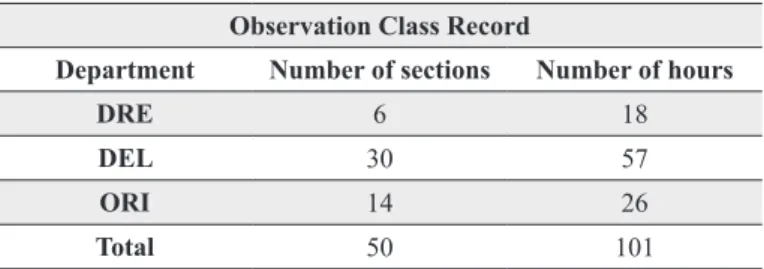
In this study, each of the Departments from Universidad Nacional de Colombia, such as the DLE, DRE and ORI, will be described from this moment on, making use of the previously proposed acronyms (see Table 1). This in turn allows the number of sessions and hours of the observation record to be determined during the 7 months. It
should be noted that when observing each of the classes have been recorded in the field
Table 1 – Class Observation Record.
Observation Class Record
Department Number of sections Number of hours
DRE 6 18
DEL 30 57
ORI 14 26
Total 50 101
Source: Classified by Departments from Universidad Nacional de Colombia.
In the same way, interviews were conducted randomly with foreign students, who in some cases were asked in English or Spanish so that they would feel comfortable and calm in answering each of the previously established questions, since the interview has four types of questions: eight (8) general, two (2) examples, two (2) structural and three (3) of contrast. For this reason the interview script was validated, which allowed some
modifications in the contrast questions, since all interviewees had never previously had contact with Spanish. In the first eight (8) general questions it was identified that the participating students were enrolled in different programs of the University such as: Mechanical Engineering, Industrial Engineering, Architecture and Human Sciences,
in addition several of them were of American origin United States), Asian (China) and European (Belgium, Germany, Netherlands and France) in turn commented that they had a stipulated period of time to remain in Colombia from six (6) months to one (1) year.
On the other hand, the students were questioned as to why they decided to study in
Colombia, and among them they found different answers such as: some of them have a
sentimental relationship with a Colombian / a, their parents have settled in the country, Universidad Nacional de Colombia has an international exchange program to conduct
research stays between the National University and European Universities. Here it is evident that the human being establishes basic social contacts innately. As Harris (2007,
p.19) puts it, social contact is framed in “the socially learned way of life found in human
societies and encompassing all aspects of social life, including thought and behavior”.
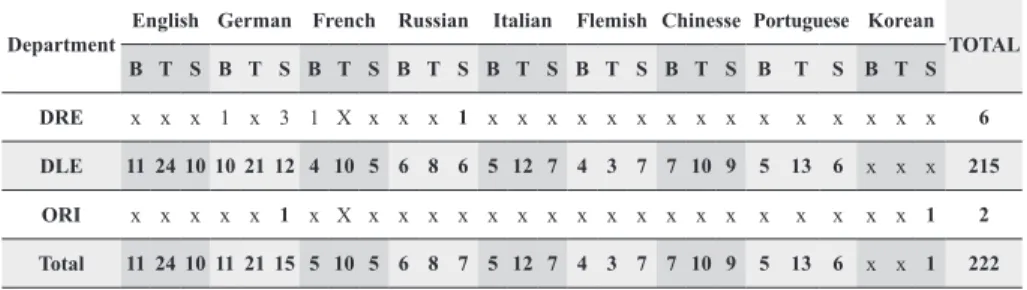
In a second moment, I was able to show a total of 437 occasions in the classroom that correspond to the use and promotion of the student’s mother tongue, use of the
language of instruction that corresponds to Spanish and finally use of English as a third
The previous data confirm the answers given by the students in the interview,
since they assured that several of the teachers are very recursive in the moment of
teaching, especially the foreign students confirmed that one of the teachers speaks
many languages being one of the Main resources in the learning-teaching of Spanish because it allows the teacher to explain easily by emphasizing the languages of origin of foreign students. In addition, the guides that were delivered during the development
of the classes serve as a complement to a specific topic and the annotations on the
board in several languages in order to explain the complex words of a text and even games related to grammar and vocabulary allowed a connection between the language of instruction and the mother tongue.
Table 2 – Record of use of the mother tongue in the classes.
Department
English German French Russian Italian Flemish Chinesse Portuguese Korean
TOTAL
B T S B T S B T S B T S B T S B T S B T S B T S B T S
DRE x x x 1 x 3 1 X x x x 1 x x x x x x x x x x x x x x x 6
DLE 11 24 10 10 21 12 4 10 5 6 8 6 5 12 7 4 3 7 7 10 9 5 13 6 x x x 215
ORI x x x x x 1 x X x x x x x x x x x x x x x x x x x x 1 2
Total 11 24 10 11 21 15 5 10 5 6 8 7 5 12 7 4 3 7 7 10 9 5 13 6 x x 1 222
Source: Classified by Departments from Universidad Nacional de Colombia.
Finally, in the ORI according to the data that I was able to register, it was evidenced that there were only 2 occasions in which the students made use of their native languages, in this case German and Korean. These data allow a comparison between classes according to the answers given by foreign students who have been
able to enrol alternately in the three or two courses offered by the Departments
from Universidad Nacional de Colombia as a free option in the learning process
From Spanish to foreigners. For the great majority of foreign students who were
in levels I and II of Spanish as a foreign language and who were also interviewed,
they considered that it is necessary to have specific class lessons, systematized and
that allow them to help to feel good learning Spanish in Colombia, on the contrary, make some recommendations and suggestions to one of the Spanish courses, since
in the great majority they have decided to leave the classes given in that course since
they felt uncomfortable because the basic level of Spanish in The ones they met and several of the proposed activities do not allow them to participate actively because they omit their native languages.
For a better understanding, a table has been designed (see Table 2) in which I have
classified the information minutely, making use of some acronyms for clarity to the
• Teacher equivalents to T.
• Student equivalents to S.
• Both equivalents to B.
This last acronym allows show the number of occasions in which there was an interaction between the student (s) and the teacher in the moment of using or promoting the mother tongue of the students as the case may be. In turn, I have inserted in the table
there is an x in order to indicate that no record was found according to the classification
I have done.
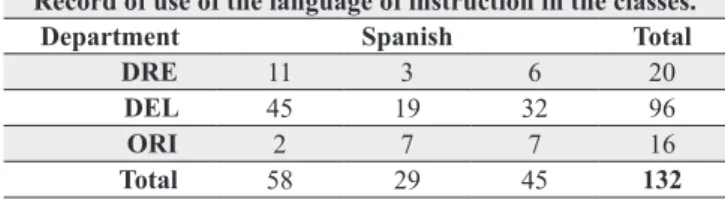
As a second aspect, in the use of the language of instruction, I registered 132 occasions of which in the DRE has a total of 20 occasions in which the interaction in
Spanish prevails between the student and the teacher, as for the DLE I identified 96
occasions In which also the interaction between the teacher and the student in Spanish. On the other hand, in the ORI, I recorded 16 occasions of which the use of Spanish as a language of instruction by the teacher and also by the student prevails in isolation (see Table 3).
Table 3 – Record of use of the language of instruction in the classes.
Record of use of the language of instruction in the classes.
Department Spanish Total
DRE 11 3 6 20
DEL 45 19 32 96
ORI 2 7 7 16
Total 58 29 45 132
Source: Classified by agencies of the National University of Colombia.
Although opportunities for language use are not so frequent compared to the use
and promotion of the foreign language of the mother tongue, the vast majority of them
stated in the interview to the question whether they believe that their level of Spanish has improved since they arrived in Colombia stated that before they came they did not speak anything and in two months approximately that they are in the country and can understand what most Colombians speak, bearing in mind that it is a large percentage
of Colombians in the country who do not speak another language fluently Outside their
mother tongue because in the country for every ten citizens, one speaks perfectly the English language according to some information given by the Minister of Commerce, Industry and Tourism in Colombia (MinCiT, 2010).
In addition, students state that the Spanish courses offered by Universidad Nacional de Colombia have largely helped them not only because they are the first
a great empathy with teachers because they consider that they make a huge attempt to include everyone in learning because several of them is not limited to correct
from a “Is wrong” but explains the reasons and gives opportunities in the midst of
correction. Many foreign students even consider it a space for them to ask questions about the correct use of grammar, to solve doubts about a concept, to practice with people who have the same level of knowledge of the language and to know others
People of different nationalities.
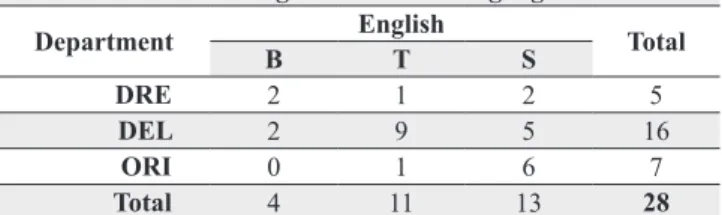
Finally, in this study I managed to record the use of a third language within the classroom that both teachers and students had in common, that language was English. I found a total of 27 occasions of use, of which in the DRE is recognized 5 occasions of use, in the DLE with 15 and ORI with 7 occasions respectively. Apparently the teachers of each of the units use the Spanish in the process, but as a language bridge
there is this third language, there is a great difference in the frequency of use between
the languages of origin of the students and the language of instruction.
Table 4 – Record of use of English as a third language in classes.
Record of use of English as a third language in classes
Department English Total
B T S
DRE 2 1 2 5
DEL 2 9 5 16
ORI 0 1 6 7
Total 4 11 13 28
Source: Classified by agencies of the National University of Colombia.
According to reports provided by the European Union and the British Council
(2000) in the world there are three types of English speakers, the first of who speak
English as a mother tongue whose population lives in a country where English is
spoken as a first language, being the main means of communication. On the other
hand, there are those who use English as a second language, Crystal (1997) reported that 377 million speakers of English as a second language have been calculated in countries where they determine that they should not only know their language of origin but Must also be competently communicative an additional language in this case English, evidenced in government plans and educational curricula in their countries.
Conclusion
In this study it is evident that the vast majority of foreign students are from the
group of people who learned English as a second language because there are a high
percentage of students whose nationalities are different from the North American, British and / or Australian. As a result, participants confirmed in the answers given in the interviews that English is a required language in all classrooms at different academic
levels (primary-secondary and university) in their countries of origin.
Accordingly, many times the communication between the foreign students attached to the programs without regard to nationality or accentuation was mediated by their mother tongues. Even one of the reasons why foreign students were motivated to learn
Spanish in the different spaces offered by the University was because they consider
that Spanish is the second language spoken in the world, and this allows them to communicate with Latin Americans not only In a formal way, but also informal when
traveling to different places in South America, because today it is not enough to speak a single language or even two because they confirm that many colleagues and friends
speak three to four languages.
In identifying the mother tongues of the students, the promotion of these languages by the teacher, the use of the language of instruction and the level of frequency, it is evident that the language is a fundamental tool that allows the internalization and practice of the community Learning.
Acknowledgement
I would like to express sincere gratitude to Dr. Claudia Lucia Ordoñez from Universidad Nacional de Colombia, for the commitment, advice, guidance and sharing his technical expertise in the completion of this research. I also would like to thank Dr. Antonio Salvador Jimenez for his advices, thanks to the whole departments at Universidad Nacional de Colombia for sharing the result and time of this research as basis in identifying the improvement of the existing processes of the foreign students who are part of the university programs in Bogota.
NIELSEN NIÑO, J. Foreign students and their learning Spanish process: first hint of Translanguaging. Alfa, São Paulo, v.62, n.1, p.53-71, 2018.
■ RESUMEN: El presente artículo tiene como propósito estudiar el uso de translanguaging en el
de aprendizaje de una lengua distinta a la materna, en este caso el español. Se recogieron los datos por medio de la observación directa, se realizaron entrevistas semiestructuradas a los participantes y se recolectaron algunos documentos que utilizaron los estudiantes en su proceso de aprendizaje del español. Los datos se analizaron de manera inductiva por medio de categorías de análisis determinadas desde los conceptos, temas y relaciones, con el fin de dar respuesta óptima a las preguntas de investigación. Concluyendo que el translanguajeo es un fenómeno que influye grandemente en el desarrollo de la lengua extranjera.
■ PALABRAS CLAVE: Translanguajeo. Español. Colombia. Recurso Estratégico. Estudiantes
Extranjeros.
REFERENCES
ÁLVAREZ-GAYOU, J. L.; SAMPIERI, R.; MENDOZA, P. Metodología de la Investigación. México: McGraw-Hill, 2008.
BAKER, C. Translanguaging: origins and development from school to street and beyond. Educational Research and Evaluation, p.1-16, 2011.
BAKER, C.; LEWIS, G.; JONES, B. Translanguaging: origins and development from school to street and beyond. Educational Research and Evaluation, 1-16, [n.p.], [s.d.].
CELIC, C. Translanguaging: strategies for the Classroom. NYSIEB Seminar. New York: CUNY-NYSIEB, 2012. p.1-30.
CELIC, C.; SELTZER, K. Translanguaging: a CUNY-NYSIEB Guide for educators. New York: CUNY-NSY, 2011.
COMMON CORE STATE STANDARDS INITIATIVE. About the Standards. Washington D.C, United States of America, 2013.
CREESE, A.; BLACKLEDGE, A. Translanguaging in the bilingual classroom: a pedagogy for learning and teaching. The Modern Language Journal, p.103-115, 2010.
CRYSTAL, D. An encyclopedic dictionary of language and languages. Oxford, UK: Blackwell, 1992.
_______. English as a Global Language. Cambridge: Cambridge University Press. 1997.
GARCÍA, O. Bilingual Education in the 21st Century: a global perspective. Oxford: Wiley-Blackwell, 2009a.
_______. Education, multilingualism and translanguaging in the 21st century. In:
_______. Theorizing translanguaging for educators. In: CELIC, C.; SELTZER, K. Translanguaging: a CUNY-NYSIEB Guide for Educators. New York: CUNY-NYSIEB, 2011. p.1-6.
_______. Reimagining Bilingualism in Education for the 21st Century. NALDIC (National Association for Language Development in the Curriculum). London: NALDIC, 2013. p.4-11.
_______. TESOL Translanguaged in NYS: Alternative Perspectives. NYS TESOL Journal, p.2-10, 2014.
GOETZ, J.; LECOMPTE, D. Etnografía y Diseño Cualitativos en Investigacion Educativa. Madrid: Ediciones Morata, 1988.
GUERRA, J. Emerging representations, situated literacies, and the practice of transcultural repositioning. In: BALESTER, V.; KELLS, M. Latino/a Discourses: on
language, identity, and literacy in education. Portsmouth: Heinemann, 2004. p.7-23. HARRIS, M. Teorías de la cultura en la era postmoderna. Barcelona: CRITICA S. L., 2007.
HERNANDEZ SAMPIERI, R.; FERNÁNDEZ, C.; BAPTISTA, M. Metodología de la investigación. México: McGraw-Hill, 2010.
KANO, N. Translanguaging as a process and a pedagogical tool for japanese students in an English writing course in New York. 2012. 218 f. Dissertation Thesis (Bilingual Education) – Columbia University, Columbia, 2012.
LAMBERT, W. Culture Factors in Learning. In: MEADE, A. I. Culture and language as factors in learning and education. Bellingham: Western Washington State College, 1974.
LEWIS, H. Body Language: a Guide for Professionals. India: SAGE Publications, 2012.
LEMKE, L. Foreword. In: WELLINGTON, J.; OSBORNE, J. Language and literacy in science education. Buckingham: Open University Press, 2001.
LI, W. Moment analysis and translanguaging space: discursive construction of identities by multilingual Chinese youth in Britain. Journal of Pragmatics, p.1222-1235, 2011.
LI, W.; HUA, Z. Translanguaging identities and ideologies: creating Transnational space through flexible multilingual practices amongst Chinese University Students in
the UK. Applied Linguistics, p.516-535, 2013.
NIELSEN, J.B. El Translanguajeo como recurso estratégico para el proceso de enculturación en el idioma español colombiano: Estudio etnográfico con estudiantes extranjeros y profesores de la Universidad Nacional de Colombia.2018. 341 f. Mexico
(Unpublished PhD thesis) Doctorado en Educación, Universidad Internacional Iberoamericana, UNINI, 2018.
STATHOPOULOU, M. Task dependent interlinguistic mediation performance as translanguaging practice: the use of KPG data for an emporically based study. 2013. 279 f. PhD Thesis – Faculty of English Language and Literature, University of Athens, Athens, 2013a.
_______. Investigating Mediation as Translanguaging Practice in a Testing Context: towards the development of Levelled Mediation Descriptors. Language Testing in Europe: time for a New Framework, 2013b. p.209-217.
SUBSECRETARÍA DE EDUCACIÓN. Actividades sugeridas para el abordaje del Cuaderno de trabajo para el aula de Inglés de 4° EP. Retrieved 10 10, 2016, from Buenos
Aires Educación. Available in: <http://servicios2.abc.gov.ar/lainstitucion/organismos/
lenguasextranjeras/plurilingue/propuesta_4ep/propuesta_4ep_imagenes.pdf>. Access
date: 3 nov. 2014.
TORRES, J. La investigación etnográfica y la reconstrucción crítica en educación.
In: GOETZ, J.; LECOMPTE, M. Etnografía y diseño cualitativo en investigación educativa. España: Ediciones Morata S.A., 1988. p.11-21.
VYGOTSKY, L. Mind in society: the development of higher psychological processes.
Cambridge, MA: Harvard University Press, 1978.
WILLIAMS, C. Arfarniad o ddulliau dysgu ac addysgu yng nghyd-destun addysg uwchradd ddwyieithog. Bangor: University of Wales, 1994.
_______. Secondary education: teaching in the bilingual situation. In: LEWIS, G.; WILLIAMS, C. The language Policy: takings stock. Wales: CAI, 1996.
_______. A language gained: a study of language immersion at 11-16 years of age. Bangor: School of Education, 2002.
_______. Extending Bilingualism in the Education System. Retrieved November 3, 2012, from Education and lifelong learning committee. Available in: <http://www.
assemblywales.org/3c91c7af00023d820000595000000000.pdf>. Access date: 3 nov.
2014.
WITT, D. Strategies for Translanguaging. New York: CUNY-NY, 2012.
Received in March 26, 2017