A Metrics Plan Proposal To Monitor User Involvement And
Participation In ERP Implementation Projects
Jose Esteves
Universidad Politécnica de Catalunya, Barcelona, Spain [email protected]
Joan Pastor
Universidad Internacional de Catalunya, Barcelona, Spain [email protected]
Josep Casanovas
Universidade Politécnica de Catalunya, Barcelona, Spain [email protected]
Abstract
ERP implementation success is influenced by a large number of factors, which most of the times are difficult to measure objectively. User involvement and participation is one of the most cited critical success factors in ERP implementation projects, and one of the most critical ones for the their satisfactory outcome. This study attempts to define a set of metrics for monitoring user involvement and participation within ERP implementation projects by using the Goals/Questions/Metrics method. The results of this work are twofold. First, a literature review is presented on the user involvement and participation topic as related with ERP implementation projects. And second, a Goals/Questions/Metrics preliminary plan is proposed to monitor and control user involvement and participation within ERP implementation projects.
Keywords: Enterprise Resource Planning, critical success factors, metrics, GQM, ERP
implementations, user involvement, user participation.
1 Introduction
Despite the benefits that can be achieved from a successful Enterprise Resource Planning (ERP) system implementation, there is already evidence of failure in projects related with ERP implementations [Davenport 1998; Scott 1999]. Too often, project managers focus on the
technical and financial aspects of a project and neglect to take into account the non-technical issues. To solve this problem, some researchers are using a critical success factors (CSFs) approach to study ERP implementations [Esteves and Pastor 2001]. However, little has been done in relation to the management and the operationalization of these CSFs. Usually, the metrics proposed in the ERP implementation methodologies are related with milestones and costs aspects. This is particularly due to the fact that these methodologies follow the common definition of project success: on time and on budget.
Project evaluation is critical to understand, control and monitoring the CSFs of an ERP implementation project that makes it either a success or a failure. ERP project success is influenced by a large number of factors, and most of the times it is difficult to measure them objectively. User involvement and participation is one of the most cited CSFs in ERP implementation projects [Bancroft et al. 1998, De Bruin 1997, Gibson and Mann 1998, Sumner 1999, Kale 2000]. User involvement and participation will result in a better fit of user requirements achieving better system quality, use and acceptance (Esteves and Pastor 2000). The terms user involvement and user participation have been commonly used interchangeably in the Information Systems (IS) literature [Barki and Hartwick 1994], but here we attempt to clarify both concepts. [Kappelman and McLean 1991] hypothesized that information systems success is indirectly influenced by user participation and mediated by user involvement. The most accepted model of user involvement, user participation and system use was developed and tested by [Barki and Hartwick 1994].
This research-in-progress study attempts to provide a set of metrics to control and monitor user involvement and participation in ERP implementation projects in order to help managers achieve success in their projects. According to [Jurison 1999, p. 28] the purpose of project control is: "to keep the project on course and as close to the plan as possible, to identify problems before they happen and, implement recovery plans before unrecoverable damage is done". [Sandoe et al. 2001, p. 164] pointed out that "having both business and project measures to show progress may be the momentum that keeps the project on track at critical times and keeps the project motivated to meet deadlines". As a result of this study, we are interested in a small, combined set of metrics to help managers understand the situation of the ERP project. We used the Goals/Question/Metric (GQM) method to develop this set metrics. The result of the application of this method is a GQM plan. The GQM plan is a document that contains the goals, questions, and metrics for a measurement program [Solingen and Berghout 1999], in this case an ERP implementation project. The first phase of the study focus on the definition of a set of metrics for user involvement and participation.
This paper is organized as follows. First, we present the research methodology used. Next, we present background in user involvement and participation and the GQM method. Then, we present the GQM plan proposed. Finally, we present some conclusions and further work.
2 Research Approach
The purpose of this study is to develop a set of metrics to control and monitor user involvement and participation issues in ERP implementation projects in order to achieve success. We used the GQM method to develop a measurement plan. The steps of our research study were:
Literature review related with user involvement and participation topic.
Definition of goals related with user involvement and participation in ERP implementation projects.
Definition of questions associated for each goal. Definition of metrics associated to each question. Definition of the preliminary GQM plan.
A literature review of user involvement and participation topic and ERP implementations was made in order to acquire knowledge related with this CSF. The information provided by the literature was the main source of information. We used the concept of preliminary GQM plan due to the fact that the final GQM plan must be validated by the project team that is going to use it. Here, we only provide a proposal for this plan.
3 User Involvement and Participation Background
In the IS literature the terms user involvement and user participation have frequently been used to mean the same thing. However, Barki and Hartwick [1989, 1994] claimed that the two concepts are different, and thus need to be defined separately:
User involvement is defined to as “a psychological stage of the individual, and defined as the importance and personal relevance of a system to a user [Hartwick and Barki 1994, p. 441], i.e., their attitude toward the development process and its product (the IS itself) and,
User participation is defined as the observable behavior of users in the IS development and implementation, i.e., the set of operations and activities performed by users or their
representatives during the IS development process [Hartwick and Barki 1994] and activities during the system implementation [Kappelman and McLean 1991].
Kappelman and McLean [1991] mention the term “user engagement” to include both user participation (the behavior) and user involvement (the attitude). Thus, according to their account, user engagement is “used to refer the total set of user relationships toward IS and their development”.
3.1 User Involvement
Many reasons have been given to involve users in IS implementation projects. User involvement is predicted to increase user satisfaction and acceptance [Ives and Olson 1984] by: developing realistic expectations about system capabilities, providing an arena for bargaining and conflict resolution about design issues, leading to system ownership by users, decreasing user resistance to change, and committing users to the system. Kappelman and McLean [1991] suggested that: user involvement is something distinct from, although associated with, user participation and, that the psychological state of user involvement may be more important than user participation in understanding IS success.
An important aspect related with user involvement is user perceived control. Baronas and Louis [1988, p. 114] stated that “by involving end-user in decisions relating to implementation, workers may become more invested in the success of the implementation and more satisfied with the system through the social-psychological mechanism of perceived control”. Personal control has been defined in terms of choice, predictability, responsibility, and ability to reduce or get relief from an unpleasant condition. Baronas and Louis [1988] suggested that:
1. Systems implementation is likely to be experienced by nontechnical users as a period of transition during which users make sense of and cope with various differences between old and new systems and their anticipations of these differences;
2. Systems implementation is likely to represent a threat to user’s perceptions of control over work.
Traditionally, the assumption in terms of user involvement is that if the organizational structure of an IS project is in place and appropriate committee meetings attended, their integration and coordination will occur. However, as Amoako and White [1997, p. 41] state “unlike the technical side of project management, these activities are very loosely defined, and very often include no mechanisms for the integration that will achieve the desired results”. Therefore, there
is the need for the distinction between structural integration and effective management of the involvement process. Characteristics such as user expertise, degree of organizational decentralization, project complexity, users previous experience with IS could determine the degree of their involvement.
Kappelman [1995] divides user involvement in user process involvement and user system involvement. User process involvement refers to the psychological identification of users with the process of IS development (i.e. their subjective attitude toward the IS development task). In addition, user system involvement refers to the psychological identification of users with respect to the information system itself (i.e. their subjective attitude toward the product of development).
3.2 User Participation
According to Briolat and Pogman [2000], “user participation is advocated in order to discover users’ needs and points of view, validate specifications, and hence build better information systems for the organization”. Participation reflects what specific behaviors are performed, how many of these behaviors are performed, and how often they are performed [Barki and Hartwick 2001]. The role of user participation in organizational activity can be viewed from the perspective of two different behavioral theories [Ives and Olson 1984]. These theories are planned organizational change and participative decision-making. The implementation of a new IS often implies a planned change in the way that an organizational unit pursues its objectives. Participative decision-making emphasizes the role of individuals in working groups. Ives and Olson [1984] also outlined how user participation (at that time they named it user involvement) can improve system quality by: providing a more and complete assessment of user information requirements, providing expertise about the organization the system is to support, avoiding development of unacceptable or unimportant features, improving user understanding of the system.
Mckeen and Guimarães [1994] shown that user participation has a positive relationship with user satisfaction. They also argued that four factors affect this relationship: task complexity, system complexity, user influence and user-developer communication. Barki and Hartwick [2001] define four dimensions of user participation:
Responsibility – the performance of activities and assignments reflecting overall leadership or accountability for the project.
User-IS relationship – the performance of development activities reflecting users’ formal review, evaluation, and approval of work done by the IS staff.
Hands-on-activity – the performance of specific physical design and implementation tasks.
Communication activity – activities involving formal or informal exchanges of facts, needs, opinions, visions, and concerns regarding the project among the users and between users and other project stakeholders.
Based in a meta-analysis study, Pettingell et al. (1988) concluded that by including users in definition and design stages increases their perception of the value of the system the most. Jiang et al. [2002] suggest that preproject partnering help to involve users during the project and motivate them in order to achieve project success. Preproject partnering refers to a work philosophy in which system stakeholders work together before the project begins [Cowan et al. 1992]. The purpose of preproject partnering is to build a foundation among stakeholders for collaboration. In addition to identifying key stakeholders and their objectives, partnering emphasizes the activities of identifying potential conflict areas, providing a process for resolution of conflict, and incorporating a continuous improvement component in the project process. These results show the importance of involve users before the project starts and then in all the Implementation phases.
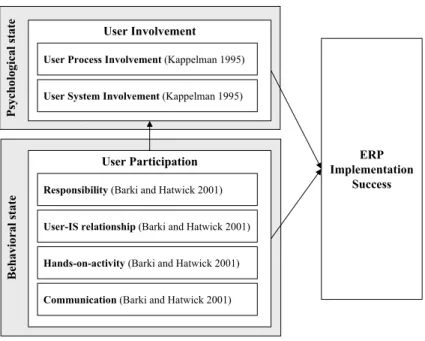
Figure 1 presents a summary of the constructs proposed by different authors for user involvement and participation. These constructs are the basis for the development of our metrics program.
Behavioral s tate Psycholo gica l sta te ERP Implementation Success User Participation User Involvement
Responsibility (Barki and Hatwick 2001) User Process Involvement (Kappelman 1995) User System Involvement (Kappelman 1995)
User-IS relationship (Barki and Hatwick 2001) Hands-on-activity (Barki and Hatwick 2001) Communication (Barki and Hatwick 2001)
Figure 1 – Constructs proposed by different authors for user involvement and participation.
3.3 User Involvement/Participation in ERP context
In this section we try to understand user involvement and participation in an ERP context. We focus on why user involvement and participation is important and how it could be done. These are some of the main reasons to involve users: maximize user acceptance, improve system functionality and, better ERP configuration. Organizations intending to implement an ERP system must be willing to dedicate some of their best employees to the project for a successful implementation [Bingi et al. 1999]. Bingi et al. [1999] mention that these employees should not only be experts in the company’s processes but also be aware of the best business practices in the industry. They should exhibit the ability to understand the overall needs of the company and should play an important role in guiding the project efforts in the right direction. These employees can play different roles in the project, some will integrate the project team, others will be key-users and some others will be end-users that you will help in specific moments according to the project needs. As Baronas and Louis [1988] mentioned, users perceived IS implementations as a period of transition during which personal control is threatened. This aspect is often detected in ERP implementation projects since in most cases these implementations are associated to changes in their working routines. This threat may cause conflicts during the ERP implementation project and resistance to ERP system acceptance.
According to Amoako and White [1997], user involvement and participation management requires at least two forms of two-way communication: Communication between the various team members (inwards communication), and communication between project team and user or management groups (outwards communication). This two-way communication must inform users of project changes that might affect their activities, and users must get adequate feedback on their concerns. It requires also telling and showing users that their input is valued, used and will be sought constantly, i.e. must be that they committed with the project. Amoako and White [1997] also suggest a set of guidelines in order to manage user involvement and participation. User participation deals with the topics related to the management of their time and activities within the organization, and managers must decide how much effort these users dedicate to their normal activities and to the project, and when they do both things. Most organizations cannot afford the effort of completely sacrificing these users toward ERP project needs. Some project managers also argue that the involvement and participation of users delays the accomplishment of task schedules. Therefore, and due to time pressures, most of them decide to avoid the use of users. Esteves and Pastor [2001] studied the relevance of user involvement and participation along the phases of a SAP implementation project with the ASAP methodology and their conclusion is that user involvement and participation is more critical in design, realization and preparation phases. These are the phases where their know-how is important to achieve a good fit of the ERP system to organizational needs.
A task where users must be specially involved is in the definition of forms and reports. Project team members must get user requirements, then customize forms and reports, and finally get user acceptance [Welti 1999]. As Welti [1999] says, this one is a time-consuming task most of those documents represent the company image to the customer. He suggests that forms and reports should be discussed and settled with the user in the realization phase.
In order to understand the involvement and participation of users in ERP implementation projects, we analyzed a typical implementation methodology, in this case the accelerated SAP methodology (ASAP) and its related tasks. ASAP is the methodology that is used to perform a rapid implementation of the SAP R/3 system. Other vendors provide this type of methodologies such as Baan (Dynamic Enterprise Modeler) and QAD (Qwizard). Table 1 represents the different stakeholder roles in a SAP implementation project and the five SAP implementation phases. The ASAP methodology is structured in phases, work packages, activities and tasks. For each role we quantified the number of work packages (wp) that role is defined as “involved” in each phase.
In none of the phases, end-users are directly expressed as needed, except the figure of the business process owner. Power (or key) users are involved in all phases except phase one, project preparation phase. The purpose of this phase is to provide initial planning and preparation of the SAP project. The steps of this phase help identify and plan the primary focus areas to be considered such as: objectives, scope, plan and definition of project team. Both, business process owners and power users are more involved in the third and fourth phases, when the system is parameterized and tested, whereas in the second phase their role is to help in business process modeling and redesign.
ERP implementation project roles
Proj ec t Preparat ion (5 wp) Busi ness bl ueprint (7 wp) R ea li zat ion (17 wp) Fina l Preparat ion (6 wp) Go & Live ( 2 wp) Project manager 4 6 11 5 2 Project sponsor 2 2 2 1 2 Steering committee 2 3 4 1 Project team 2 2 7 3 1
Business team leader 3 4 13 4 1
Technical team leader 4 4 11 5
Consultants 4 11 4 1
IT professional (different functions) 2 11 2
End-user
Power user 1 7 3 1
Business process owner 1 8 1
Key site sponsors 1 1
Line manager 1
Core change team 3 3 2 1 1
Extended core change team 2 1 1
Project risk manager
ABAP developer 4
Development manager 4
SAP reviewer 2 1 1 1
SAP project manager 2
Help desk provider 1 1 1
Documentation and training developers 1 1 Table 1 – Roles used along a SAP implementation project.
The lack of involvement of end-users in the ERP implementation project (especially in definition and design phases) contradicts the need to ensure that users participate in these tasks in order to improve user acceptance and achieve project success. Usually, ERP methodologies are more worried with the system implementation and they presuppose that end-users will
accept the ERP system. The rest should be provided by implementation consulting methodologies.
4 A GQM Preliminary Plan
Next, we present an overview of GQM approach and then, we describe each of the components of the GQM preliminary plan: goals, questions and metrics. For each goal the following aspects are described: goal description and its refinement into questions, and finally, refinement from questions to metrics.
4.1 GQM Method Overview
The GQM approach is a mechanism that provides a framework for developing a metrics program. It was developed at the University of Maryland as a mechanism for formalizing the tasks of characterization, planning, construction, analysis, learning and feedback. GQM does not provide specific goals but rather a framework for stating measurement goals and refining them into questions to provide a specification for the data needed to help achieve the goals [Basili et al. 1994]. The GQM method was originally developed by V. Basili and D. Weiss, and expanded with many other concepts by D. Rombach. The GQM method contains four phases: planning phase, definition phase, data collection phase and interpretation phase (for more details see [Solingen and Berghout 1999]). The GQM top-down approach assists managers and developers not only in knowing what data to collect but also in understanding the type of analysis needed when the data is in hand [Pfleeger et al. 1997].
The definition phase is the second phase of the GQM process and concerns all activities that should be performed to formally define a measurement program. One of the most important outcomes of this phase is the GQM plan. A GQM plan or GQM model documents the refinement of a precisely specified measurement goal via a set of questions into a set of metrics. Thus, a GQM plan documents, which metrics are used to achieve a measurement goal and why these are used - the questions provide the rationale underlying the selection of the metrics. Definition phase has three important steps:
Define measurement goals - Measurement goals should be defined in an understandable way and should be clearly structure. These measurement goals should be relevant to the business, represent strategic goals from management, and support high priority processes of the organization [Solingen and Berghout 1999].
Define questions - Questions should be defined to support the interpretation of measurement goals. Questions are a refinement of measurement goals from an abstract level to an operational level, which is more suitable for interpretation. By answering questions, one should be able to conclude whether a measurement goal is reached. As [Solingen and Berghout 1999] refers, the questions should be defined at an intermediate level of abstraction between the metrics and the measurement goals. The refinement process has two main parts: knowledge acquisition and measurement planning. In knowledge acquisition part the GQM team tries to capture the project team’s current knowledge and represent it in quantitative and qualitative models. The measurement planning is the part in which the team documents the GQM refinement and corresponding measurement procedures.
Define metrics - Once measurement goals are refined into a list of questions, metrics should be defined that provide all the quantitative information to answer the questions in a satisfactory way. The metrics defined must ensure that sufficient information should be available to answer the questions.
4.2 Goals of the GQM Preliminary Plan
In our case of users involvement and participation, the definition of the measurement goals was made using the template provided by [Basili et al. 1994]. A GQM goal is described according to a template with five dimensions that express the object to be measured, the purpose of measurement, the measured property of the object (quality focus), the subject of measurement (viewpoint), and the measurement’s context (environment). We defined two measurement goals based in our CSF, user involvement and user participation:
Goal 1
Analyze: User participation
For the purpose of Monitoring
With respect to ERP implementation project From the viewpoint of Project Team
In the context of ERP implementation project
Goal 2
Analyze: User involvement
For the purpose of Monitoring
With respect to ERP implementation project From the viewpoint of Project Team
4.3 Questions
For each measurement goal we defined a set of questions (see tables 2 and 3). To define these questions we made an extensive literature review on user involvement and participation topic (see section 3). The questions of user participation measurement goal are based in the [Hartwick and Barki 2001] survey. We adapted this survey to the context of an ERP implementation project. The question for measurement goal two is related with user involvement and they arose from the literature review we made on the topic and especially on the instrument operationalized by [Zaichowsky 1985].
Questions
Responsibility 1. How much responsibility did users have for estimating project and systems costs?
2. How much responsibility did you have for requesting additional funds to cover unforeseen time/costs overruns?
3. How much responsibility did you have for managing the project (e.g. staffing the project team, calling and running meetings, report to senior manager, etc.)? 4. How much responsibility did you have for overall success of the project and
the system?
5. How much responsibility did you have for initiating the project?
6. How much responsibility did you have for determining system objectives? 7. How much responsibility did you have for estimating project and system
benefits?
8. What specific behaviors are performed? 9. How many of these behaviors are performed? 10. How often they are performed?
User-project team relationship
11. Did the project team draw up a formal agreement of work to be done during the project?
12. Were you able to make changes to the formal agreement concerning work to be done by the project team during the project?
13. Did you sign off the formal agreement concerning work to be done by the project team during the project?
14. Did you formally evaluate an information requirements analysis developed by the project team concerning the system?
15. Did you formally review work done by the project team concerning the system?
16. Did you formally accept and sign off work done by the project team concerning the system?
17. Did you formally review an information requirements analysis developed by the project team concerning the system?
18. Did you formally evaluate work done by project team concerning the system? 19. Did you approve project timetables?
Hands-on
activities 21. Did you [design; help to design; have nothing to do with designing] input/output forms? 22. Did you [design; help to design; have nothing to do with designing] screen
layouts?
23. Did you [design; help to design; have nothing to do with designing] report formats?
24. Did you [prepare; help prepare; have nothing to do with preparing] users manuals?
25. Did you [design; help to design; have nothing to do with designing] the user-training program?
26. Did you [train; help train; have nothing to do with training] other users to use the system?
27. Did you [design; help to design; have nothing to do with designing] system security procedures?
28. Did you [set; help set; have nothing to do with setting] system access priorities?
29. Did you [determine; help determine; have nothing to do with determining] data access privileges?
30. Did you participate in testing activities? Communication
activities 31. How often did you communicate informally with other users concerning the project? 32. How often did you exchange facts, opinions, and visions concerning the
project with other users?
33. How often did you discuss your reservations and concerns regarding the project with other users?
34. How often did your communicate informally with the project team concerning the project?
35. How often did you exchange facts, opinions, and visions concerning the project with project team?
36. How often did you discuss your reservations and concerns regarding the project with the project team?
37. How often did the project team discuss their reservations and concerns regarding the project with you?
38. How often did you communicate informally with senior management concerning the project?
39. How often did you exchange facts, opinions, and visions concerning the project with senior management?
40. How often did you discuss your reservations and concerns regarding the project with senior management?
41. How often did senior management discuss their reservations and concerns regarding the project with you?
Table 2 - The definition of questions for user participation measurement goal. Questions
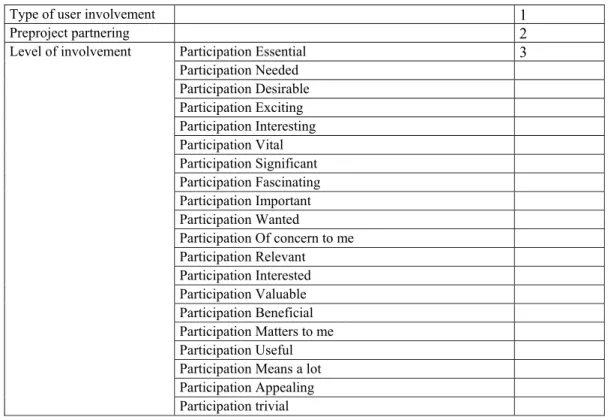
Involvement 1. What is the type of involvement for each user? 2. There were preproject partnering activities? 3. What is the level of involvement?
4.4 Metrics Description
In this section we show the relationship between the questions defined above the metrics (see tables 4 and 5). We also represented graphically the relationships (see figure 2).
Responsibility for project estimation 1
Responsibility for estimating costs 1
Responsibility for requesting additional funds to cover unforeseen
time/costs overruns 2
Responsibility for managing the project 3 Responsibility for overall success of the project 4 Responsibility for initiating the project 5 Responsibility for determining system objectives 6 Responsibility for estimating project and systems benefits 7
Types of behaviors performed 8,9
Responsibility
Estimated duration of behavior 10
User’s participation in project plan 11 Changes made by users to project plan 12
Participation in project sign off 13
Participation in evaluation of information requirements analysis 14 Participation in sign off of information requirements analysis 16
Participation in review meetings 17,18,19
User-project team relationship
Participation in support meetings 15,20
Participation in forms design 21
Participation in screens layout 22
Participation in reports format 23
Participation in user manuals preparation 24
Participation in training plan 25
Participation as trainer 26
Participation in systems security procedures 27 Participation in system access priorities 28 Participation in data access privileges 29 Hands-on
activities
Participation in testing activities 30
Communication between users 31,32,33
Communication between users and project team 34,35,36, 37 Communication
activities
Communication with senior managers 38,39,40,41 Table 4 - The relationship between questions and metrics for user participation.
Type of user involvement 1 Preproject partnering 2 Participation Essential 3 Participation Needed Participation Desirable Participation Exciting Participation Interesting Participation Vital Participation Significant Participation Fascinating Participation Important Participation Wanted Participation Of concern to me Participation Relevant Participation Interested Participation Valuable Participation Beneficial Participation Matters to me Participation Useful Participation Means a lot Participation Appealing Level of involvement
Participation trivial
Table 5 - The relationship between questions and metrics for user involvement.
Currently, we are working on the metrics description. For each metric we are defining the following aspects: what they are measuring, when they must be measured, what possible values they could have, who will measure it, what medium is used for data collection. We created a special form for the metrics description. The definition for all the metrics is provided in table 3. Most of the metrics proposed are direct measurements except the metrics related with percentages.
4.5 Interpretation of Metrics
[Hartwick and Barki 2001] analyzed the questions in terms of the different user roles in a project. They concluded that the role that users play on team was found to have a strong impact on overall participation, as well on each of the four participation dimensions. It is expected that users that are members of the project team have more participation than nonmembers, both overall and on each of the four dimensions. Users that become the project managers are expected to have more participation than members overall, but not similarly to other dimensions. For the responsibility dimension the difference between managers and team members was much greater than the difference observed for the other three dimensions.
5 Conclusions
This study attempts to define a first set of metrics for user involvement and participation in ERP implementation projects. User involvement and participation is cited as one of the most relevant CSFs in ERP implementation projects. We think these metrics have two important proactive characteristics: metrics help to detect deviations from the project plan and to act before damage is made, and second, these metrics can have the effect of motivating and encouraging top managers in the involvement and commitment with the ERP project. The results of this work are twofold. First, a GQM plan to monitor and control ERP implementation projects is presented and second, a literature review on user involvement and participation on ERP implementation projects.
The purpose of this study is not to describe an exhaustive list of metrics. Instead, we intend to present a form to develop these metrics in future ERP implementation projects and provided the first set of metrics that should be extended and adapted according to the specific needs of ERP implementation projects.
This study only provides the first step to propose a set of metrics for user involvement and participation, i.e., the definition of these metrics. Next steps are the validation and interpretation of these metrics. Two possible kinds of validation methods can be applied: case study or control experiments [Calero et al. 2001]. We would like to remark that we accept that this GQM preliminary plan will be subject to changes during the next steps of the research due to new information gathered and experience gained in the feedback sessions. Another aspect is the importance of knowing the relevance of each CSF along the stages of an implementation project [Esteves and Pastor 2001] due to the fact that this information can help managers to know when they should put more attention to specific metrics in each stage. Currently, we are developing an application for the management of the metrics defined here. Further research will attempt to define metrics to other CSFs defined in the literature of ERP implementation projects.
6 References
Amoako, K., White, K., When is User Involvement not User Involvement? The Executive’s Journal, 13(4), summer 1997, p. 40-46.
Bancroft, N., Seip H., Sprengel, A. "Implementing SAP R/3". Second edition, Manning Publications, 1998.
Barki, H., Hartwick, J., Rethinking the Concept of User Involvement, MIS Quarterly, 13(1), March 1989, pp. 53-63.
Barki, H., Hartwick, J., Measuring User Participation, User Involvement, and User Attitude, MIS Quarterly, 18(1), 1994, pp. 59-82.
Barki, H., Hartwick, J., Communications as a Dimension of User Participation, IEEE Transactions on Professional Communication”, 44(1), March 2001, pp. 21-35.
Baronas, A., Louis, M., Restoring a Sense of Control during Implementation: How User
Involvement Leads to System Acceptance, MIS Quarterly, March 1988, pp. 111-124.
Basili, V., Rombach, H., Tailoring the Software Process to Project Goals and Environments", Department of Computer Science, University of Maryland, ACM, 1987.
Basili V., Caldera C., Rombach H., Goal Question Metric Paradigm, Encyclopaedia of Software Engineering (Marciniak J. editor), vol. 1, John Wiley & Sons, 1994, pp. 528-532.
Bingi, P., Sharma, M., Godla, J., Critical Issues Affecting an ERP Implementation, Information Systems Management, 16(3), summer 1999.
Briolat, D., Pogman, J. User Involvement Influence on Project Productivity in a Rad
Environment: a Quasi-experiment, European Software Control and Metrics Conference,
Munich, April 2000.
Calero, C., Piattini, M., Genero, M., Method for Obtaining Correct Metrics, Third International Conference on Enterprise Information Systems, July 2001, pp. 779-784.
Cowan, C., Gray, C., Larson, L., Project Partnering, Project Management Journal, 22(4), 1992, pp. 5-11.
Davenport, T.,.Putting the Enterprise into the Enterprise System, Harvard Business Review, July-August, 1998, pp. 121-131.
Davis, G., Strategies for Information Requirements Determination, IBM Systems Journal, 21(1), 1982, pp. 4-30.
De Bruin, P., Unpublished 1997 Sapphire conference notes, in Gibson and Mann 1997.
Esteves, J., Pastor, J., Towards the Unification of Critical Success Factors for ERP
Implementations, 10th Annual BIT conference, Manchester, UK, November 2000.
Esteves, J., Pastor, J., Analysis of Critical Success Factors Relevance along SAP
Implementation Phases, Americas Conference on Information Systems, 2001.
Gibson, J., Mann, S., A qualitative examination of SAP R/3 implementations in the Western
Cape, research report, dept. of information systems, University of Cape Town.
Hartwick, J., Barki, Explaining the Role of User Participation in Information System Use,
Management Science, 40(4), April 1994, pp. 440-465
Hirschhmein, R.,User experience with an assessment of participative systems design, MIS quarterly, Dec. 1985, pp. 295-304.
Ives, B., Olson, M., User Involvement and MIS Success: A Review of Research, Management Science, 30(5), pp. 586-603.
Jiang, J., Chen, E., Klein, G.,The Importance of Building a Foundation for User Involvement in
Information System Projects, Project Management Journal, 33(1), pp. 20-26.
Jurison, J., Software Project Management: The Manager's View, Communications of the Association for Information Systems, 2(17), September 1999.
Kale, V., Implementing SAP R/3: The Guide for Business and Technology Managers, Sams Publishing, 2000.
Kappelman, L., McLean, E., The Respective Roles of User Participation and User Involvement
in Information Systems Implementation Success, International conference on information
systems, New York, 1991, pp. 339-348.
Kappelman, L., Measuring User Involvement: A Diffusion of Innovation Perspective, The Data Base for Advances in Information Systems, 26(2/3), May/August 1995, pp. 65-86. Mckeen, J., Guimarães, T., The Relationship Between User Participation and User Satisfaction:
An Investigation of Four Contingency Factors, MIS Quarterly, 18(4), December 1994,
pp. 427-452.
Nah, F., Lau, J., Kuang, J., Critical Factors for Successful Implementation of Enterprise
Systems, Business Process Management Journal, vol. 7, nº. 3, 2001, pp. 285-296.
Pfleeger, S., Jeffery, R., Curtis, B., Kitchenham, B., Status Report on Software Measurement, IEEE Software, March/April 1997, pp. 33-43.
Sandoe, K., Corbitt, G., Boykin, R., Enterprise Integration, John Wiley & Sons, 2001.
Sioukas, A., User Involvement for Effective Customization: An Empirical Study on Voice
Networks, IEEE Transactions on engineering Management, 42(1), pp. 39-49.
Solingen, R., Berghout, E., The Goals/Question/Metric Method: A Practical Guide for Quality
Improvement of Software Development, McGraw-Hill, 1999.
Scott, J., The FoxMeyer Drug's Bankruptcy: Was it a failure of ERP?, Americas Conference on Information Systems, Milwaukee, USA, 1999.
Sumner, M., Critical Success Factors in Enterprise Wide Information Management Systems
Projects, Americas Conference on Information Systems, Milwaukee, USA, 1999.
Welti, N., Successful SAP R/3 Implementation: Practical Management of ERP Projects, Addison-Wesley, 1999.
Zaichowsky, J., Measuring the Involvement Construct, Journal of Consumer Research, 12, 1985, pp. 341-352.