i
BUILDING CONSUMER-BRAND RELATIONSHIP
THROUGH MOBILE MARKETING
Heloísa de Jesus Costa
Master thesis
in Marketing
Advisor:
Nuno Reis Teixeira, MSc in Marketing, Invited Lecturer on Master in Marketing courses at INDEG/ISCTE Business School
ii “They may forget what you said, but they will never forget how you made them feel.” Carl W. Buechner
i
ABSTRACT
In an extremely competitive Era, in which the need of value creation for the clients emerge, brands appear to be a fundamental asset for companies and the emotional relationships that are built with consumers are their fundamental source of differentiation. The new interactive media that born of technology and allow new ways for customers and brands to communicate seem to promote that relationship.
A research in Generation Y (people aged between 18 and 35 years old) in Portugal was made using an online survey being obtained 238 valid answers. The objective of this research was the analysis of the impact of mobile marketing (use of mobile phones as marketing communication media) in the strength of consumer-brand relationship.
The interaction with brands through mobile devices do not originate in the respondents perspective positive consumer-brand relationships, however it was obtained for a specific group of consumers.
The brand experience that is felt along the interaction is a factor that influences the strength of consumer-brand relationship, as also the value of communication – it was proved that emotional communications are associated with stronger consumer-brand relationships. The tool of interaction is also an influencer factor, pull-based mobile marketing actions empowered the consumer-brand relationship more than push-based mobile marketing actions.
The research also allowed to conclude that the strength of consumer-brand relationship has influence in future interactions intentions with the brand, namely in services that imply the providing of personal data.
Key-Words: Mobile Marketing; Consumer-brand Relationship; Brand Experience; Communication Value
ii
RESUMO
Numa Era de competitividade em que a necessidade de criação de valor para o cliente urge, as marcas afiguram-se como os principais activos de uma empresa e as relações emocionais que criam com os consumidores são a sua principal fonte de diferenciação. As novas formas de interação entre marcas e consumidores derivadas das novas tecnologias dão indícios de fomentar e fortalecer essa relação.
Foi realizada uma investigação junto da Geração Y (jovens entre os 18 e 35 anos) em Portugal através de um inquérito online de onde foram obtidas 238 respostas válidas. O objetivo desta investigação era a análise do impacto do mobile marketing (uso de telemóveis enquanto meio de comunicação em marketing) na relação consumidor-marca.
A interação com as marcas através dos dispositivos móveis não deu origem a relações consumidor-marca extremamente positivas em termos absolutos, no entanto, para um nicho de consumidores foi possível verificar o contrário.
A experiência de marca sentida aquando da interação revelou-se um factor com influência na força da relação, assim como o valor da comunicação – comunicações emocionais originam relações consumidor-marca mais fortes. A forma de interação é também factor influenciador, sendo que as ações de comunicação pull parecem aumentar a força da relação em comparação com as ações push.
A investigação permitiu também concluir que força da relação influencia as intenções de interação futuras com a marca, nomeadamente através de serviços que implicam o fornecimento de dados pessoais do cliente.
Palavras-chave: Mobile Marketing; Relação consumidor-marca; Valor da Comunicação; Experiência de Marca
i
INDEX
INTRODUCTION ... 1
Part I - Contextualization ... 3
LITERATURE REVIEW ... 3
1. From branding to the brand personality ... 3
1.1. Brands in the Marketing context ... 3
1.2. Branding ... 4
1.3. Brand experience ... 5
1.4. Brand equity ... 5
1.5. Brand personality ... 6
2. Moving to a relationship paradigm ... 6
2.1. Consumer-brand relationship ... 7
2.2. The role of emotions in consumer-brand relationship building ... 8
2.3. Importance of consumer-brand relationships ... 9
2.4. Why consumers enter into consumer-brand relationships ... 10
2.5. Consumer-brand relationship metric ... 11
2.6. Interaction in building consumer-brand relationships ... 12
3. Marketing Communications ... 13
3.1. Integrated Marketing Communications ... 13
3.2. Tone of voice in Marketing Communication ... 14
3.3. Relationship communication ... 14
3.4. Communication as an integrative element in brand relationships building . 15 3.5. New paradigms in communication ... 16
4. Mobile Marketing ... 17
4.1. Mobile Marketing definition ... 17
4.2. Mobile Marketing and IMC ... 19
4.3. Mobile Marketing’s tools for customer interaction... 20
4.4. Mobile Marketing unique characteristics ... 23
4.5. Permission-based mobile marketing ... 25
4.6. Mobile phones as emotional devices ... 26
4.7. Building consumer-brand relationships through Mobile Marketing ... 26
5. Mobile Marketing in the world and in Portugal ... 27
ii
5.2. Consumer’s patterns use of Smartphone ... 28
5.3. Mobile Phone, more than a phone call device ... 29
5.4. Mobile Phones and brand communication ... 30
5.5. Consumer utilization of mobile marketing tools ... 31
5.6. Mobile Marketing in Portugal ... 32
6. Generation Y – the empowered consumer ... 33
7. Objectives of the research... 34
METHODOLOGY ... 37
1. Methodological choices ... 37
2. Population and sampling ... 38
3. Instrument construction, scales and research variables ... 40
4. Data collection ... 42
5. Data analysis procedures ... 44
Part II – Results and analysis ... 45
1. Socio-demographic characterization ... 45
2. Mobile phone’s usage ... 46
2.1. Penetration of mobile communication device ... 46
2.2. Interaction with mobile communication devices ... 47
2.3. Typology of individuals relatively to the frequency of mobile usage... 49
3. Past mobile interactions with brands in the mobile phone ... 50
3.1. Past brand interactions ... 50
3.2. A comparison of the interactions with brands in the mobile device through brand initiative vs customer initiative ... 50
3.3. Interactions by sector ... 52
4. What brands in Portugal have been standing for in what mobile marketing is about ... 54
4.1. The choose of rational instead of emotional value ... 54
4.2. The brand experience in the mobile context – the customer perspective... 55
5. The interactions with brands in the mobile phone and the consumer-brand relationship ... 59
5.1. The impact of consumer-brand interaction in the mobile context on the strength of consumer-brand relationship ... 59
5.1.1. The hypothesis testing ... 60 5.1.2. Typology of individuals by the strength of customer-brand relationship 61
iii 5.2. The impact of different tools of the mobile marketing in the consumer-brand
relationship ... 65
5.3. The impact of the emotional value of communication in the consumer-brand relationship ... 67
5.4. The impact of the brand experience in the mobile context in the consumer-brand relationship ... 68
5.5. The impact of the frequency of interaction with brand in the mobile context on the consumer-brand relationship ... 69
6. Interest in future interactions with brands in the mobile phone ... 70
6.1. Interest in Location-Based Services ... 70
6.2. Typology of individuals relatively to the interest in Location-Based Services 73 6.3. The interest in future interactions regarding the tool of mobile marketing . 73 6.4. The intentions of future interactions and the strength of consumer-brand relationship ... 74
6.5. The interest in future interactions by sector ... 75
7. Hypothesis validation summary ... 75
DISCUSSION AND CONCLUSIONS ... 76
1. Conclusions ... 76
2. Implications for Marketing and Management ... 79
3. Limitations of the research ... 80
4. Directions for future research ... 81
BIBIOGRAPHY ... 82
1. Books ... 82
2. Periodicals ... 82
3. Unpublished references ... 84
4. Unpublished references taken from the internet ... 85
iv
INDEX OF FIGURES
Figure 1 – Mobile subscribes worldwide ... 28
Figure 2 – Evolution of Smartphone penetration in Portugal ... 28
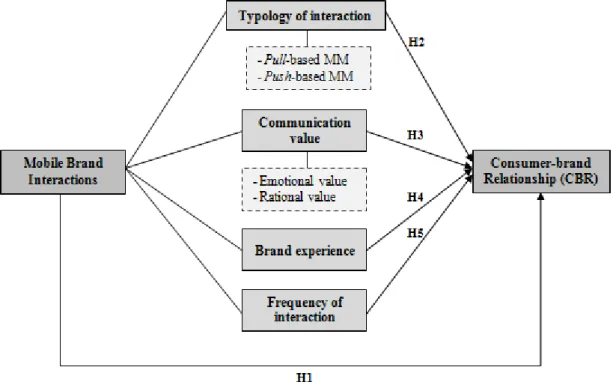
Figure 3 - Research framework ... 37
Figure 4 – Distribution of the sample by gender (%) ... 45
Figure 5 - Distribution of the sample by age (%) ... 45
Figure 6 - Distribution of the sample by Occupation (%)………...46
Figure 7 - Distribution by Qualifications(%) ... 46
Figure 8 – Distribution of the sample by type of mobile communication device (%) ... 46
Figure 9 - Penetration of Smartphone by age, gender, occupation, qualifications and location (%) ... 47
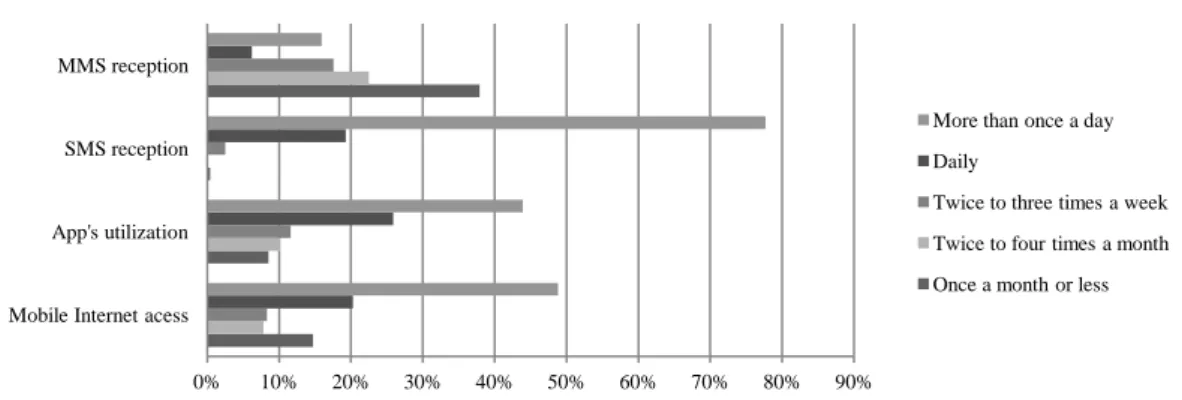
Figure 10 - Frequency of mobile activities (%) ... 48
Figure 11- Past brand interaction by mobile marketing tool (%) ... 50
Figure 12 - Penetration of Mobile Pull Marketing Tools by gender, age, location, qualifications, occupation and typology of mobile use by frequency (%) ... 51
Figure 13 - Frequency of apps use and Mobile Internet contact by typology (%) ... 52
Figure 14 - Penetration of app typology by gender, age and occupation (%) ... 52
Figure 15 - Frequencies of interaction by sector ... 53
Figure 16 - Distribution of the last interaction by sector (%) ... 53
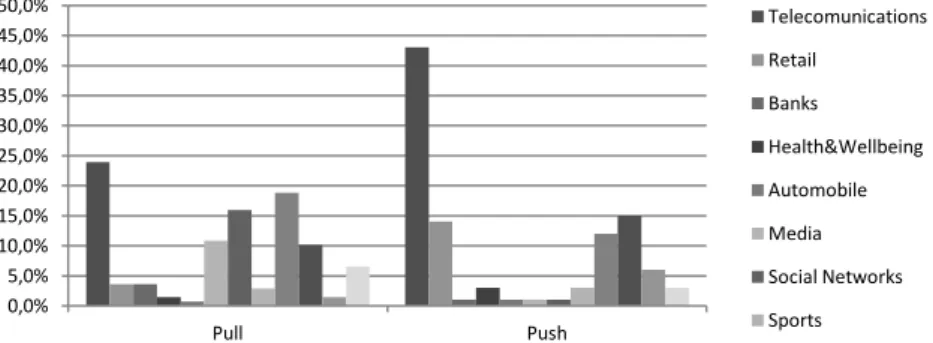
Figure 17 - Distribution of Pull based Marketing and Push based Marketing of last interaction by sector (%)... 53
Figure 18 - Frequency of emotional and rational value in the last brand interaction (%) ... 55
Figure 19 - Distribution of emotional vs rational communication by mobile marketing tool ... 55
Figure 20 – Mean of brand experience by type of mobile device ... 57
Figure 21 - Mean of brand experience by communication value ... 58
Figure 22 - Distribution of brand experience groups by typology of Mobile Marketing (%) ... 58
Figure 23 - Distribution of brand experience groups by pull mobile marketing tools ... 59
Figure 24 - Mean of each item of consumer-brand relationship scale due to mobile interaction ... 60
v
Figure 26 - Consumer-brand relationship mean by sector ... 64
Figure 27 - Typology of consumer-brand relationship by push vs pull marketing ... 66
Figure 28 - Consumer-brand relationship mean by mobile tool of interaction ... 66
Figure 29 - Distribution of typology of consumer-brand ... 66
Figure 30 - Distribution of consumer-brand typology by app typology (%) ... 67
Figure 31 – Consumer-brand relationship strength mean by communication value ... 68
Figure 32 - Consumer-brand relationship mean by cluster of brand experience... 69
Figure 33 - Mean interest in access to location based marketing services by type of service ... 70
Figure 34 - Distribution of interest in accessing to Location Based Services by type of service (%) ... 70
Figure 35 - Profile means for the future interests in Location Based Services by age ... 72
Figure 36 - Profile means for the future interests in Location Based Services by qualifications ... 72
Figure 37 - Type of mobile marketing by typology of future LBS intentions ... 74
Figure 38 - Distribution of future LBS interest by strenght of consumer-brand relationship ... 75
Figure 39 - Profile means for interest in location-based services by consumer-brand relationship strength ... 75
Figure 40 - Frequency of apps access by occupation, qualifications, gender and age (%) ... 97
Figure 41 - Frequency of internet access by occupation, qualification, gender and age (%) ... 97
Figure 42 - Frequency of SMS reception by type of mobile device, occupation, qualification, gender and age (%) ... 97
Figure 43 - Frequency of MMS reception by type of mobile device, occupation, qualification, gender and age (%) ... 98
vi
INDEX OF TABLES
Table 1 – Marketing Communication Mix ... 13
Table 2 – Differences from Traditional and Integrated Marketing Communications .... 14
Table 3 – Differences between Traditonal and Interactive Communication ... 16
Table 4 – Value propositions for mobile as relationship builder ... 27
Table 5 – Expenditures in mobile marketing across the world ... 30
Table 6 – t-Student test for brand experience mean by type of mobile device used ... 57
Table 7 - t-Student test for brand experience mean by communication value ... 57
Table 8 - t-Student test for brand experience mean by communication value ... 58
Table 9 - t-Student test for consumer-brand relationship mean ... 61
Table 10 – T-test for brand lovers’ cluster mean ... 62
Table 11 – ANOVA one-way for differences of consumer-brand relationship means across socio-demographic groups ... 62
Table 12 – t-Student test for mean differences of consumer-brand relationship across genders ... 63
Table 13 – t-Student test for mean differences of consumer-brand relationship across type of mobile device ... 63
Table 14 – ANOVA one-way test for mean differences of consumer-brand relationship across sectors ... 64
Table 15 - T-test for CBR mean of automobile and sports sectors ... 64
Table 16 – t-test for mean differences of consumer-brand relationship across pull/push based mobile marketing ... 65
Table 17 - t-Student test for mean differences of consumer-brand relationship by communication value ... 67
Table 18 – Pearson correlation coefficient between customer-brand relationship and brand experience ... 68
Table 19 - ANOVA one-way test for mean differences of consumer-brand relationship across frequency of interaction groups ... 69
Table 20 - T-Student test for mean interests in receive coupons and promotions of the brand ... 70
Table 21 – t-Student test for mean differences of interest in Location-Based Services by Gender ... 71
vii Table 22 - ANOVA one-way test for mean differences of interest in Location-Based Services by Age ... 71 Table 23 - ANOVA one-way test for mean differences of interest in Location-Based Services by Qualifications ... 72 Table 24 - ANOVA one-way test for mean differences of interest in Location-Based Services by Occupation ... 72 Table 25 - χ2 test for future intentions across consumer-brand relationship clusters ... 74
Table 26 – Kruskal-Wallis test of mean differences in interests in location-based
services across sectors ... 75 Table 27 – Results of the Research Hypothesis ... 75
viii
SUMÁRIO EXECUTIVO
O Marketing está a atravessar uma mudança de paradigma, em que o relacional está a ganhar forma entre empresas e os seus stakeholders, especialmente os consumidores, com várias razões que o justificam: os mercados estão a fragmentar-se, abandonando-se as massas; as formas de comunicação impessoais, especialmente a publicidade em meios tradicionais está a perder credibilidade devido à constante saturação publicitária que nos rodeia (Pelau and Zegrenau, 2010); num mundo eminentemente tecnológico novas formas de comunicação aparecem providenciando novas dinâmicas de interação (Pelau and Zegrenau, 2010) com características muito específicas: interação e comunicação two-way (Dionísio et al., 2009); isto dá ao consumidor o poder de escolher o que quer ver, o que quer ouvir, com quem que falar e aquilo em que quer acreditar. Estas novas tecnologias estão principalmente presentes na geração Y, uma geração que vai ditar através das suas opções de hoje, as tendências do futuro e que valoriza as marcas mais do que nenhuma geração anterior (L2, 2010).
São muitos os métodos procurados pelas marcas para se diferenciarem e assim ocuparem um lugar de destaque na vida dos consumidores, mas a diferenciação mais importante parece ser aquela que atinge os seus corações. Assim, a mudança de paradigma do marketing pode ao nível da marca ser traduzida nas relações que se estabelecem entre os consumidores e as marcas, construída através das suas diversas interações. A construção consumer-brand relationship já é antiga na literatura, no entanto, hoje parece estar mais actual que nunca. É uma construção maioritariamente emocional e um forte indício da lealdade dos consumidores (Nysveen, 2005).
Tudo o que a marca faz envia uma mensagem ao consumidor e a interação com este nas suas mais diversas formas é o que contribui para a construção dessa relação (Fournier, 2008). O objetivo desta investigação é compreender o potencial do mobile marketing para contribuir positivamente para o desenvolvimento de relações entre consumidores e marcas. Este é um novo meio de comunicação que utiliza a tecnologia dos dispositivos de comunicação móvel para comunicar com os consumidores e que possui características únicas enquanto meio de comunicação: personalização, comunicação em tempo real em qualquer lugar, comunicação two-way, diversidade de formatos de comunicação e comunicação em função da localização e contexto.
ix Para tal realizou-se uma investigação cujo método consistiu na aplicação de um questionário online a uma amostra não representativa dos jovens portugueses entre os 18 e 35 anos que tinham interagido com marcas nos últimos 2 meses. Obtiveram-se 238 casos válidos.
Não foi possível concluir acerca do potencial do mobile marketing para o desenvolvimento de relações uma vez que na generalidade da amostra os consumidores não avaliaram de forma positiva a sua relação com a marca derivado dessa interação. No entanto, foi possível comprovar que um grupo de indivíduos, que constitui 33% da amostra avaliou de forma muito positiva essa mesma relação devido à interação com a marca no dispositivo móvel – o que atesta que com as características certas para tal o mobile marketing pode efetivamente ser fonte de alimentação entre os consumidores e as marcas.
Algumas interessantes conclusões foram extraídas sobre como retirar o máximo partido do mobile marketing para o desenvolvimento de relações consumidor-marca mais positivas: ações de pull marketing (aplicações de marca, mobile internet e check-ins através de redes sociais) são avaliadas enquanto tendo um impacto mais positivo na relação que as ações de push marketing (SMS/MMS e cupões) – ou seja, os consumidores que foram sujeitos a ações de pull marketing mostraram ter desenvolvido relações mais fortes derivado dessa comunicação com a marca.
Por outro lado, os consumidores que foram sujeitos a ações de comunicação com um valor emocional/hedónico mostraram ter desenvolvido relações mais fortes com a marca derivado dessa comunicação do que aqueles que foram sujeitos a ações de comunicação com um valor utilitário.
Mostrou-se também que a força da relação consumidor-marca está positivamente relacionada com a experiência de marca, ou seja, o conjunto de respostas internas na forma de sensações, sentimentos e conhecimentos evocados pela interação com a marca. O que significa que o desenvolvimento de experiências de marca positivas nos dispositivos móveis conduz a relações mais forte com essa mesma marca.
Os consumidores mostraram interesses positivos em comunicações com as marcas através de Location-based Services (comunicação dependente da localização e context dos indivíduos), em que estes afirmam ter interesse em receber cupões de desconto da marca no seu telemóvel quando passam pela loja da marca. Interessante também
x constatar que os indivíduos que demonstraram maior interesses em interações futures via Location-based Services foram aqueles que através da interação com a marca no dispositvo móvel desenvolveram relações mais positivas.
Numa pequena abordagem ao estudo por sectores foi possível constatar que foram obtidas relações consumidor-marca positivas para os setores de produtos de elevado envolvimento, o que pode ser um indício do poder do mobile marketing nos setores deste tipo de produtos.
Assim, para as marcas serem bem sucedidas no aproveitamento do potencial do mobile
marketing para a fomentação das relações consumidor-marca é necessário que as
mesmas desenhem fortes experiências de marca; que apelem igualmente a emoções e sensações; que não sejam intrusivas e pelo contrário, criem proposições de valor que provoquem no consumidor interesse em procurá-las.
Para campanhas bem sucedidas este estudo revelou, através da consulta da perspetiva do consumidor, que é possível fazer este meio de comunicação avançar em Portugal – os consumidores têm interesse em usar quer aplicações de marca, quer em consultar websites das mesmas (é importante referir que quem usa estes dois tools de mobile marketing fá-lo frequentemente no dia-a-dia) e que a aceitação de novas funcionalidades, como o contacto com as marcas no contexto mais propício para o consumidor desperta o seu interesse.
1
INTRODUCTION
The Industrial Age was dominated by business that sought to mass produce products and to increase its overall market share, so the twentieth-century enterprise would use mass advertising to reach the greatest number of potential customers. Due to the commoditization of the products, branding emerged to offset this perception of being like all the competitors, helping to add value through familiarity, image and trust. For staying competitive brands need to find additional aspects that attract customers other than product superiority. In the interactive Era of the twenty-first century, enterprises are strategizing how to gain sustainable competitive advantage from the information about customers and win space on their shelves. Differentiation in emotional benefits becomes more and more crucial (Pawle, 2008)
If we invest a little time looking for future consumer’s trends it is easy to see that the place that brands need to conquer is not that one on the shelve, but on the heart – emotionology is leading the way - in our materialistic societies, people want to give meaning to their consumption. Only brands that add value to the product, tell a story, or situate their consumption in a ladder of immaterial values, can provide this meaning. We are leaving in an
emotion economy context. According to Pawle (2006: 39), consumers are highly emotional
and intuitive in their behaviors because they are“heavily influenced by emotions, not only by
reason”.
There are evidences that consumers can see personality traits in brands and build relationships with them (Blackton, 1992; Fournier, 1998; Veloutsou, 2007). Enterprises are trying to create these branded relationships, based on the dialogue between the enterprise and the consumer, suiting their individual needs (Peppers and Rogers, 2004). Consumer-brand relationships are built through the interactions between consumers and brands (Fournier, 1998).
In the past, the interaction took mainly the form of mass marketing, because this was believed to the best media to build brand image. However, today we are constantly bombarded with brand messages, consequently there is a disbelief in the effectiveness of this media so brands have to work a lot harder and smarter to get their share of attention. Also in this new marketing paradigm, an approach that emphasis on close, long-term and interactive relationships, sharing brand messages is important, but responsiveness and shared understanding is just as important (Duncan and Moriarty, 1998). So it involves two-way communication and a more deep notion of interactivity based on conversation and dialogue. Companies are shifting from mass marketing to targeted or one-to-one marketing and mass
2 media are increasingly replaced with more personal and focused media (Leppäniemi and Karjaluoto, 2008).
The digital age has spawned a host of new information and communication tools—from smartphones to the many faces of the Internet (e-mail, social networks, blogs, brand Web sites, and so much more). These explosive developments have had a dramatic impact on marketing communications. Advertisers are now adding a broad selection of more-specialized and highly targeted media to reach smaller customer segments with more-personalized, interactive messages (Kotler, 2012). Mobile marketing is the latest generation of Internet Marketing, one of the areas of communications that has been growing the mostly lately and it is expected to continue growing (Nysveen, 2005). Mobile marketing is “the use of mobile
medium as a mean of marketing communications” (Leppäniemi and Karjaluoto, 2008). The
penetration of mobile devices has been growing, specially Smartphones (Marktest, 2013), and they are an important part of our emotional life being a repository for storing links that engender emotional response and used in order to keep connection with our buddies (Vincent, 2006). This oppens mobile marketing an opportunity for emerge - global mobile marketing & advertising industry will grow 37% over 2016, reaching a value of US$22.6 (Andersson, 2012). This is a relevant and imediate media – it can reach consumers everytime and everywhere1; provide customized/personalized, timely and location-specific information (Smutkupt and Krairit, 2010). In Portugal, mobile marketing exibit a delay when comparing to some foreign countries - the dimensions of national campaigns are smaller as also less sophisticated, much due to the small dimensions of the market.2
Despite the novelty of this topic, attitudes about it are very well understood in the literature, there are a lot of studies regarding consumer attitudes and perceptions. However, as showed before, more important than attitudes, feelings and emotions seem to stick consumers to brands. Although, research on influential factors of consumer-brand relationship quality/strength are very limited, specially envolving the above referred marketing communication media, some authors have been made attempts to overcome this fact: Thorbjonsen et al. (2002) studies’ considered the Internet to be a well-suited medium for building consumer-brand relationships, and mobile marketing as an extension of the internet, may be a well medium also. Other author, Nysveen (2005) has focused on effectively study in
1
http://www.e-goi.pt/pt/recursos/noticias/mobile-pode-representar-152-dos-investimentos-em-publicidade-online/
3 practice the potential of mobile marketing on consumer-brand relationship only as effect of a channel addiction (SMS/MMS) to a main channel and concluded about its efficacy.
The fundamental objective of this investigation is to understand the potential of mobile marketing to impact positively the consumer-brand relationship, defined as an emotional construction, and also study the influence of other factors - as communication value, brand experience and type of tool used on this construction. It also pretends to be a contribution for the development of mobile marketing in Portugal through the study of consumer behavior in this specific media – mobile phone utilization habits, brands interaction habits and future interests in new services location based services.
Part I - Contextualization
LITERATURE REVIEW
1. From branding to the brand personality 1.1. Brands in the Marketing context
In consumer marketing, brands often provide the primary points of differentiation between competitive offerings, and as such they can be critical to the success of companies.
Kotler and Armstrong (2012) define three levels of products being each level synonymous of more consumer value: the core product (problem-solving benefits and services that consumers seek); the actual product (product and service features, design, quality level, brand name and packaging); and the augmented product (consists in offering additional consumer services and benefits).
As it stays clear, brand is a central issue in the product strategy namely in the actual product, as stated by Kotler et al. (1999: 570) “Consumers view a brand as an important part of a
product, and branding can add value to a product”.
Brand as part of a product strategy is one of the possible approaches to a brand integration in the marketing mix, but it can also be though as a more holistic approach. In the holistic approach the fundamental focus is not on the product but on the definition of the brand itself - through using the marketing mix, the brand is tailored to the needs and wants of a specified target group (Ambler and Styles, 1997). According to the same authors, the elements of the marketing mix are unified by the brand such that the individual elements of the mix are managed in a way which supports the brand message.
4 The holistic view seems more relevant to the current environment dominated by brands and line extensions, as it takes into consideration all the different product lines which come under a single brand umbrella. I will assume this approach during this research.
1.2. Branding
In the literature, authors agree that brands are becoming increasingly important. In an attention economy, Kapferer (2008) states in his book that there is so much choice and opacity and consumers cannot spend their time comparing before making a choice. This brings to mind the increasingly importance of brand building. Duncan and Moriarty (1998) considered branding as a signaling concept, which is still current nowadays according to AMA: “Brand is a differentiating sign, symbol, or any other feature that identifies one
seller’s good or service as distinct from those of other sellers” (American Marketing
Association, 2013). So given this definition it becomes clear that the essence of the brand is captured by a name with power to influence buyers, and it is considered by Kapferer (2008) as a set of added perceptions with an emotional component, which conduct to an attitude of non-indifference knitted into consumers’ hearts that goes from emotional resonance to liking. Brands allow consumers to facilitate choice and reduce perceived risk, as brands are powerful repositories of meaning purposively and differentially employed in the substation, creation and reproduction of concepts of self in the marketing age (Fournier, 1998).
According to Kotler et al. (1999) a brand can deliver up to four levels of meaning:
- Attributes – when we think about a brand it comes to mind several words that we associate to the branded products;
- Benefits – customers do not buy attributes they buy benefits, so they translate it into functional and emotional benefits;
- Values – a brand must identify values that coincide with the delivered benefit package and also say something to the consumers;
- Personality – a brand also projects a personality and will attract people whose actual or desired self-images match the brand’s image.
Looking into consumers perspective, branding is a continuous process of creating the totality of meaning, as they learn about a brand through the multiple experiences they have with it - each exposure is integrated with those that are already embedded on their minds (Gordon, 2006).
5 1.3. Brand experience
In the multiple contacts and interactions consumers have with a brand, they are exposed to brand-related stimulus, through its design (name, logo, symbol), packaging, marketing communications or environments in which the brand is marketed. In those moments consumer experience internal responses, which are referred as brand experience (Brakus et al., 2009). Brand experience is defined by Brakus et al. (2009: 52) as “subjective internal consumer
responses (sensations, feelings and cognitions) and behavioral responses evoked by brand-related stimuli that are part of a brand’s design and identity, packaging, communications, and environments”. It is divided in four main dimensions: sensory, affective, intellectual and
behavioral. The authors suggest that brand experiences vary in strength and intensity, ones being stronger and more positive than others. It is important to notice that brand experiences occur whenever there is a direct or indirect interaction with the brand, not only during or after consumption (Brakus et al, 2009).
Marketers realize that the way consumers experience brands is critical for developing marketing strategies for products and services, because consumers are looking for unique and memorable experiences (Zarantonello and Schimtt, 2010).
1.4. Brand equity
Brand equity is a concept that structure how consumers respond favorably to marketing activities of brands: perceptions, preferences and behavior arising from marketing mix decisions. It can be defined as “the differential effect of brand knowledge on consumer
response to the marketing of the brand” (Keller, 1993: 8). Brand equity is not the total value
of the brand, but added value quality that makes brands important to consumers; it is invested by the consumer which is a participant in the creation of equity, building brand’s idea (Blackston, 1992). It is about the consumers hold positive associations about the brand in memory (Keller, 1993).
Brand equity explains customers’ willingness to buy one brand more than its competitors because of the asset is represents in the minds and hearts of consumers: brand awareness, beliefs of exclusivity, superiority of some valued benefit and emotional bonding (Kapferer, 2008).
The relationships consumers form with brands in an interactive process are suggested to be an indicator of brand equity (Veloutsu, 2007; Blackston, 1992).
6 1.5. Brand personality
Consumers do not just perceive brands; they see it as having their own personality with which the consumer can relate. As stated earlier, brand personality is one of the four levels of meaning that consumers associate to a brand according to Kotler et al. (1999). Also Veloutsou (2007) divides brand expression (one of the main dimensions of brand Identity) into brand as a symbol, brand as a product and brand as a person.
Aaker (1997: 347) defines brand personality as being “a set of human characteristics
associated to a brand”. The author found 5 distinct personality dimensions: sincerity,
excitement, competence, sophistication and ruggedness. De Chernatory and Riley (2010) also agree with the theme of brand’s personality and argue that consumers project human values onto brands. Fournier (1998: 368) believes that the collection of perceptions in mind of consumer evolve through the activities of the managers and marketing actions, so “personality can be thought as a set of trait inferences constructed by the consumer based on
the repeated observation of behaviors enacted by the brand”. Brand personality plays a role
of “for me choice” of the brands, it means, “… I see myself in that brand or I see that brand
in myself” is an indicator for brand choice (Plummer, 2000: 80).
Various authors focus on the contribution of brand personality to analyze the existence of relationships between consumers and brands. As Blackston (1992) states we are comfortable with the idea of personifying brands and brand relationship is a logical extension of the idea of brand personality. Consumer-brand relationships goes one-step further the personality perspective and imply a proactive role of the brand towards the consumer, in other words, consumers not just have an attitude towards a brand but the brand also has an attitude towards the consumer (De Chernatory and Riley, 2010). For the brand to serve as a relationship partner it must surpass the personification qualification and behave as an active, contributing member of the dyad – marketing actions under the rubric of interactive and addressable communications qualify the brand as a reciprocating partner (Fournier, 2008).
2. Moving to a relationship paradigm
In the literature, the marketing mix management paradigm, based on the 4 P’s of Marketing (product, price, placement and promotion) has dominated marketing since it was introduced. However, we are assisting to a paradigm change since two decades ago. Grönroos (1994) was one of the first authors to study the concept of Relationship Marketing. The same author defines relationship marketing in the following way: “Marketing is to establish, maintain, and
7
enhance… relationships with customers and other partners, at a profit, so that the objectives of the parties involved are met. This is achieved by a mutual exchange and fulfillment of promises”. (p. 355)
Mass markets are fragmented and impersonal marketing communication, especially media advertising, has become less effective whereas relationship marketing is getting more important (Peppers, Rogers and Dorf, 1999). Relationship marketing is grounded in the idea of establishing a learning relationship with each customer, developing and maintaining successful relational exchanges (Peppers, Rogers and Dorf, 1999; Morgan and Hunt, 1994). In this new paradigm, the individual is in focus instead of masses because long term relationships are founded to be more profitable than one shot transactions. This new approach of building and management relationships is still current nowadays (Kumar and Singh, 2011). Within the relationship marketing paradigm, it is underlined that customers build relationships with brands not with companies (Peppers and Rogers, 2004).
2.1. Consumer-brand relationship
The term brand relationships grew in the 90’s along the drive to develop improved consumer’s satisfaction (Heath et al. 2006). It is clear that brands create value for their customers as we see many times consumers who postpone their purchase, or even switch stores when they cannot find their desired brand, as stated by Veloutsou (2007: 11), “this
attitude indicate that a bond with the brand exists”. A consumer-brand relationship can be
defined as a lasting bond between the brand and the consumer (Thomson et al., 2005).
Blackstone (1992: 80) established a parallelism with human relationships “it is an analogy of
the complex cognitive, affective and behavioral processes which constitute a relationship between two people.” Veloutsou (2007) in a studied that aimed to unfold the dimensions of
the consumer relationship with product brand proved this point of view, revealing that consumers form an interaction with brands expression feelings towards branded products very similar to those that one expects when describing interactions with other humans; consumers didn’t specifically accept that they have relationships with brands; however they understood that brands were very important to them. The author also pointed that the consumer-brand relationships formed vary according product categories - complex and high involvement products imply stronger bonds. When a relationship is established, the meaning of the brand becomes inseparable from the value of the product per se (Fournier, 1998).
8 Consumer-brand relationships involve reciprocal exchange between active and interdependent relationship partners; it can be described as exchange relationships where “people are
concerned with how much they receive for how much they give” (Esch and Langner, 2006:
100). If there is positive equity in the relationship for each of the parties they will continue in the relationship (Peterson, 1995). Consumer-brand relationship are also communal relationships “involve feelings (…); transcend self-interest” (Esch and Langner, 2006: 100). The costumer-brand relationships are different from a one-dimensional brand image (Blackstone, 1992), however they seem to be created mainly inside consumer’s heads. Consumers play active roles as meaning makers in their brand relationships, adapting the marketers’ brand meanings to fit their projects, concerns and tasks in life (Fournier, 2008). Besides that, the development of relationship is a two-way process and the brand has an important role to play in the creation and maintenance of the relationship, when the customer construct the meanings in his mind he analyses the brand’s attitudes and behaviors toward him, so it is necessary for brands to spend effort in creating and communicating the correct ones (Blackstone, 1992).
Nowadays, the idiographic notion of brand relationships has matured into a vibrant psycho-socio-cultural construal, because the brand relationships include the one-to-many of community brand relationships that characterize consumer societies (Heath et al., 2006).
2.2. The role of emotions in consumer-brand relationship building
Managers should recognize the growing strategic significance of emotions when brand building. Human behavior is heavily influenced by emotions and consumers are often highly emotional and intuitive in their behavior. In what respect to brands, they are coded in memory on a cognitive and emotional basis, but it is mainly the emotional somatic coding rather than reasoned that determines whether we take notice of a brand stimulus, how we process information about it and how we are open to its initiatives (Gordon, 2006). If the foundations of consumer behavior are emotional, so it follows that the strongest foundations of consumer-brand relationship are similarly emotional (Pawle and Cooper, 2008).
Blackston (1992) has identified a connection between feelings and brand relationships reveling that feelings tend to exert the great influence in this interaction. But he wasn’t the only one, Fournier (1998) in her study of consumer-brand relationships realized that consumers appear to develop feelings towards the brands – value them, sense a closeness to them and feel that they benefit from the interaction; Veloutsou (2007) considered
consumer-9 brand relationship as a multidimensional concept, including two dimensions: two-way communication and emotional exchange. This leaves us to the idea that cognitive characteristics and affective needs of consumers should be taking into account in brand management.
It is not clear which dimensions of the brand could be used to develop and maintain consumer-brand relationships over time because in each case it is necessary to identify what the brand really represents and then attempt to identify which component could work as a relational builder (Veloutsou, 2007). However, authors that studied this thematic found some similar and crucial elements in a successful, positive and long-term relationship with brands:
Satisfaction (Blackston, 1992; Esch and Langner, 2006) – it is the primary positive outcome of an exchange relationship and can be defined as the cognitive evaluation of whether or not the exchange relationship with the brand is rewarding (Esch and Langner, 2006); it involves supportiveness brand’s attitude – brand respond to customer needs (Blackston, 1992);
Trust (Blackston, 1992; Morgan and Hunt, 1994; Esch and Langner, 2006; Xie et al., 2010) – focus on cognitive aspects of consumer response (Xie et al., 2010). Trust has to be earned and it’s dependent of intimacy brand’s attitude – creating a personal link with the consumer and show him that it knows him (Blackston, 1992);
Attachment (Fournier, 1998; Esch and Langner, 2006) - it is a strong affective concept leading to a condition of emotional dependence involving separation anxiety and irreplacibility (Fournier, 1998); it can be defined as the reflection of brand relationship over time (Esch and Langner, 2006);
Commitment (Fournier, 1998; Morgan and Hunt, 1994) – defined as an intention to maintain a valued continuous relationship with a brand (Fournier, 1998).
Consumers are more likely to indicate higher level of satisfaction and commitment towards brands that are able to afford them happiness, comfort, security and other favorable affects. Brands with such capability are more likely to build good relationship with their consumers (Xie et al., 2010).
2.3. Importance of consumer-brand relationships
Marketing mix has become commoditized. Producers need to improve their approach to the final customers and they are forced to use their brands to achieve this goal since most of them
10 have little other contact consumers (Veloutsou, 2007). The most valuable assets to them are brand relationship with consumers, as the major determinant of brand value for consumers is the sum of brand relationships (Duncan and Moriarty, 1998).
In the literature we can learn about the importance of consumer-brand relationship in loyalty. Xie et al. (2010) tell us that consumers in positive emotions, which is the case when they develop relationships with brands, may indicate higher brand loyalty compared with negative emotions. Nysveen et al. (2005) underlines the importance of building strong consumer-brand relationships to avoid consumers switching to another brand and increase brand loyalty. Consumer-brand relationships are assets capable of impact the consumer decision making process. Esch and Langner (2006) developed a study to show how brand knowledge and brand relationships affect current and future purchase and their results indicate that to secure future purchases, a familiar brand with a positive image must build a positive brand relationship with the customer. The emotional bonds seem to manifest in committed repurchase against all odds, despite the incentives to switch.
This links the customers establish with brands allows customers to be more open-minded about its communications, become advocates of it and help to promote it through networks (Gordon, 2006).
2.4. Why consumers enter into consumer-brand relationships
From the customer’s perspective, the principal gain is entering on relationships with brands lies on diminished economical, functional, psychological and social risk when trusting the brand and deepening the relationship (Kapferer, 2008). Customers expect to reduce their choice and receive positive value of their participation: “Consumers enter into exchange
relationships on the basis of expected equity and the desire to increase the predictability of exchange outcomes” (Peterson, 1995: 280).
Fournier (2008) believes that relationships are facilitators, not ends in themselves, customers engage into relationships to meet functional needs and enjoy the social links that come from brand relationships, new social connections. Brand relationships “are meaning-laden
resources that help people live their lives” (Fournier, 2008: 596), providing functional and
emotional meanings to the persons who engage them. Still according to the author, the strongest brands are the ones who recognize and fulfill the needs of real people.
11 2.5. Consumer-brand relationship metric
Fournier (1998) developed an indicator of costumer-brand relationship quality, depth and strength, a six-faceted brand relationship quality construct (BRQ). According to this measure, the brand relationship quality evolves through the reciprocity principle – consumer/brand meaningful actions can enhance or dilute BRQ. It consists of six-dimensions, each capturing unique aspects of the richness of costumer-brand relationships:
Affective and socio-emotive attachments:
Love and Passion – refers to the intensity of the emotional ties between the consumer and the
brand. The affect supporting brand relationship endurance and depth is much greater than that implied in notions of brand preference. It can be found feelings of dependency in the relationship.
Self-connection – reflects the degree to which the brand delivers on important identity
concerns, tasks or themes thereby expressing a significant aspect of the consumer’s self.
Behavioral ties:
Interdependence – refers to the degree to which the actions of relationship partners are
intertwined, involving frequency of interactions, scope and diversity of activities and intensity of individual interaction events.
Commitment – captures the intention to behave in a manner supportive of the relationship
longevity.
Supportive cognitive believes:
Intimacy – refers to the degree of closeness, mutual understanding, and openness between
relationship partners.
Brand partner quality – represents consumer evaluation of the brand’s performance in its
partnership role. It include, among others, trust, reliability and feelings of positive orientation to consumer.
The BRQ qualify the strength of a consumer-brand relationship but according to the author it suffers from a bias that restricts its application and scope: if focus on highly committed and affective-laden relationship ideal. However, it is a scale largely used in the literature when it refers to the measure of quality of consumer-brand relationships and especially in the effects
12 of new technologies, as for example, the development of online brand relationships (Thorbjornsen et al., 2002)
2.6. Interaction in building consumer-brand relationships
It is common accepted in the literature that the building of the relationship between customers and brands is a phenomenon that comes from the interaction they develop over time; consumer-brand relationships evolve and change over a series of interactions. As argued by Fournier (1998) according to whom brand relationships represent the cumulative result of positive interactions with a brand. The relationships are developed through stages: initiation, growth, maintenance and decline; they evolve and change over a series of interactions and also in response to fluctuations in the contextual environment, so they require active management over time (Fournier, 2008). Also Morgan-Thomas and Veloutsou (2011: 3) argue that consumers form relationships with brands they interact with, “as the frequency and
duration of interaction increases, the relationships become stronger and more sustainable”.
One can be sure of the importance of constantly interact with customers in a relevant way. Throbjornsen et al. (2002: 40) in their study of the impact of Internet in the consumer-brand relationship development establish the bridge between interactivity and communication as part of interactivity enabling-technologies in marketing: “Interactivity is a characteristic of
communication, not a medium (…) Different applications, media and communication formats may enable interactivity to a larger or lesser extent”. It stays clear that to develop
relationship with consumers, brands have to communicate with them because no relationship can be created and further developed if the brand is unknown (Veloutsou, 2007). Everything a brand does affects relationship – from the personality-suggestive colors of the company website to the tonality of communications from the brand (Fournier, 2008 citing Aaker (2004) – when good brands do bad). Brand relationships have a broad relevance for all areas of marketing communications, because all of them can express brand attitudes and behaviors (Blackston, 2002).
In the multidimensional concept of consumer-brand relationship by Veloutsou (2007), he add an important point to this interaction provided by communication, the two-way communication, in which consumers are able not only to hear news about the brand but also to provide feedback, being actively involved in the communication process receiving and providing information.
13 3. Marketing Communications
In the literature, the definition of Marketing Communication in the literature is not unanimous.
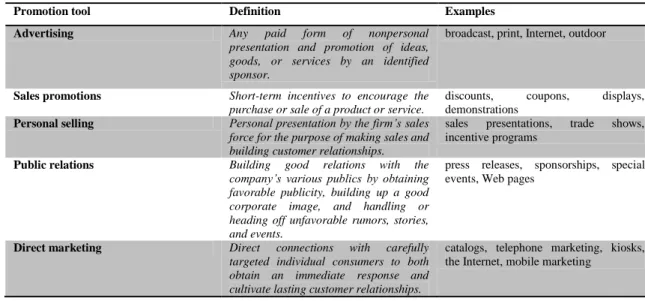
Kotler and Armstrong (2012) define marketing communications mix — also called promotion mix – “as a specific blend of advertising, public relations, personal selling, sales promotion,
and direct-marketing tools that the company uses to persuasively communicate customer value and build customer relationships”. The authors define five major promotion tools:
Table 1 – Marketing Communication Mix
Promotion tool Definition Examples
Advertising Any paid form of nonpersonal
presentation and promotion of ideas, goods, or services by an identified sponsor.
broadcast, print, Internet, outdoor
Sales promotions Short-term incentives to encourage the
purchase or sale of a product or service.
discounts, coupons, displays, demonstrations
Personal selling Personal presentation by the firm’s sales
force for the purpose of making sales and building customer relationships.
sales presentations, trade shows, incentive programs
Public relations Building good relations with the
company’s various publics by obtaining favorable publicity, building up a good corporate image, and handling or heading off unfavorable rumors, stories, and events.
press releases, sponsorships, special events, Web pages
Direct marketing Direct connections with carefully
targeted individual consumers to both obtain an immediate response and cultivate lasting customer relationships.
catalogs, telephone marketing, kiosks, the Internet, mobile marketing
According to Pickton and Broderick (2001) marketing communications represent the collection of all elements in a brand’s marketing mix that facilitate exchanges by establishing shared meanings with the brand’s stakeholders. The authors believe that the number of factors have led to a move away from the traditional promotions mix for marketing communications (personal selling, advertising, sales promotion and public relations) to the development of the concept of integrated marketing communications (IMC).
3.1. Integrated Marketing Communications
Brand messages need to be strategically consistent, which is achieved at marketing communication level through the concept of Integrated Marketing Communications (IMC). According to Peltier et al. (2003: 93) IMC can be defined as “a concept of marketing
communication planning that recognizes the added value of using a comprehensive plan to evaluate the strategic roles of a variety of communication disciplines”. This concept
recognizes the role of a variety of communication tools – all forms of communication and all message delivery channels - in the communication planning, in a consistent way, generating a
14 maximum communication impact. IMC is the way to integrate new media into the communication plans.
Pickton and Broderick (2001: 5) point a lot of reasons for the emergency of the IMC approach: “First, a reduced faith in the effectiveness of the mass media and, consequently, the
move towards highly targeted communication methods and, secondly, due to the greater demands being placed on marketing communication suppliers and the increased need to demonstrate return on investment. Thirdly, there is the need to coordinate and integrate the ever-widening array of communication tools and media available to the marketer”.
The authors also distinguished the traditional marketing communications from IMC: Table 2 – Differences from Traditional and Integrated Marketing Communications
Traditional Marketing Communications Integrated Marketing Communications
Separate functions: fragmentation Integrated into one strategy: synergy Starts with organization (goals, products) Customer oriented
Fragmented communication programs Consistent communication programs Short-term incentives Relationship/brand building objectives
Mass audiences Targeted to stakeholder segments
3.2. Tone of voice in Marketing Communication
According to Kotler and Armstrong (2012) there are three types of appeal in the communication message that the brand wants to transmit to the consumers: emotional, rational and moral.
Emotional appeals attempt to stir up either negative or positive emotions that can motivate the purchase. It is an execution to appeal to the receiver’s emotions by using drama, mood, music and other emotion-eliciting strategies (Yoo and MacInnis, 2005) that can range from love, joy or humor to fear and guilt.
Rational appeals relate to the audience’s self-interest. It is an execution designed to appeal to the rationality of the receiver by using objective information describing a brand’s attributes or benefits (Yoo and MacInnis, 2005), showing product’s quality, economy, value of performance.
3.3. Relationship communication
Finne and Grönroons (2009: 180) introduced the concept of relationship communication, which take off the consumer from a passive object of communication to an active subject:
15
“Relationship communication is any type of marketing communication that influences the receiver’s long-term commitment to the sender by facilitating meaning creation through integration with the receiver’s time and situational context. The time context refers to the receiver’s perception of the history and envisioned future of his/her relationship with the sender”.
According to the authors, relationship communication defines a consumer-centric perspective on IMC based on the factors that have impact on the consumer’s meaning (the outcome of perception) creation – is the customer who performs the integration of communications and in this integration process meaning creation takes place. So there is a need to focus on the customer instead of only on the message sent.
Hedonic vs. Utilitarian value
Value is a key concept in marketing strategy and previous studies suggest that value perception is about what customers believe they get from marketing activities, occurring during the various stages of the purchase process (Woodruff, 1997).
According to Park (2006) consumer make value considerations upon whether an offering intends to provide:
- Hedonic value - if the use is pleasure-based, enjoyable and experiential;
- Utilitarian value – if the use is utility-based focused on functional benefits and productivity.
Applying this topic to the communication thematic and switching the focus to consumer activity as performer of messages integration and meaning maker suggested earlier, one can conclude that the consumer is able to make judgments about his interpretation of the appeal of communication according to the value derived: hedonic value is expected to be generated by an emotional appeal, while utilitarian value is expected to be generated by a rational appeal.
3.4. Communication as an integrative element in brand relationships building Everything a brand does can send a brand message and multiple touch points shape the meaning of the brand (Gordon, 2006). Interactivity between the various messages sources, including marketing communications, and the consumers let the consumer-brand relationships develop (Duncan and Moriarty, 1998). So communication is a tool in dispose of brands to build brand relationships and may play a decisive role in the relationship marketing process. It
16 provides an understanding of the exchange partners’ intentions, thus forming the groundwork for the relationship development (Andersen, 2001).
Duncan and Moriarty (1998) defined a communication-based model of relationship marketing, in which communication is the primary integrative element in managing brand relationships. The communication based model adds the idea that information sharing can strength brand relationships.
3.5. New paradigms in communication
The last years have brought a number of changes in all communication areas. Traditionally communication was dominated by the brand, which pushed it messages to consumers through promotion. Traditional mass media have been popular for building brands since they reach a large number of audiences at a time, but it also provide a one-way, non-personal communication, not allowing the interaction between the sender and the receiver (Hongcharu and Somkiat, 2009). Advertising is no longer king because we are assisting to a general disbelief in its power to achieve its target (Pelau and Zegreanu, 2010). Brands are now looking for the technology to transmit the advertising message in a non-traditional way (Pelau and Zegreanu, 2010); they have taken center stage and are built and maintained through multiple channels of activity (Gordon, 2006).
According to Dionísio et al. (2009) the emergence of new technologies, especially internet, brings a deep change in the way companies generally act in the market and in communication.
Table 3 – Differences between Traditonal and Interactive Communication
Traditional Interactivity
Average consumer Individual consumer
Anonymous consumer Consumer profile
Standard product Personalized product
Mass production Customization
One-way communication Two-way communication
Conquer new clients Customer loyalty
Marketers face two realities: the traditional and the digital, so they have to manage the business in a blended version (Dionísio, 2009). Two-way communication and interactivity are key words in this time. Marketing communication has evolved from one-way to two-way due to the new communications technologies that allow companies to contact customers more closely and with channels that allow feedback. The customer left the passive approach behind and adopt a more proactive and interactive approach (Dionísio et al, 2009). Interactive media includes four elements: the two-way nature of the communication system, the level of response each part has on the communication process, the personalization of the
17 communication relationship and the use and involvement of database technology (Peltier et
al., 2003).
With the Internet emergence customers became more empowered, with tools that give them more influence in the companies and social communication environment (Dionísio et al, 2009). According to the same authors, the consumer can nowadays initiate itself the process of communication through comments, posts and uncontrollable conversations per part of the brands. This is leading brands to implement tools such as one-to-one marketing, customer engagement and brand advocacy.
Internet has been used for marketing communications as it provides a two-way interaction with target customers, persuade, change attitudes and elicit repurchase (Hongcharu and Somkiat, 2009). Mobile phones are gradually receiving all the features of computers in which regard to communication (Hongcharu and Somkiat, 2009).
4. Mobile Marketing
In the context of a development of technologies, especially that of mobile phones, and consumer behavior, a new way of marketing was developed: the mobile marketing. This ultimate marketing vehicle enables business entities to establish a persuasive electronic presence alongside their customers anytime, anywhere (Varnali and Aysegul, 2010). It considered a new form of Web Marketing by some authors (Krum, 2010).
4.1. Mobile Marketing definition
There is not a consensual definition of Mobile Marketing in the literature, although all of them point the involvement of Mobile Marketing in communication through mobile devices. Leppäniemi and Karjaluoto (2008: 51) define Mobile Marketing as “the use of mobile
medium as a mean of marketing communications”. Mobile Marketing Association completes
this definition as a “set of practices that enables organizations to communicate and engage
with their audience in an interactive and relevant manner through any mobile device or network” (MMA, 2012). Mobile Marketing allows communication to be conducted without
the restriction of being at a fixed location at a certain point of time (Smutkupt and Krairit, 2010).
There are two types of communication in mobile marketing depending on the request of the customer or not: the pushed-based marketing and the pull-based marketing. Push-based mobile marketing refers to “any content sent by or on behalf of advertisers and marketers to a
18
includes audio, short message service (SMS) messages, e-mail, multimedia messaging, cell broadcast, picture messages, surveys, or any other pushed advertising or content” (MMA,
2012). Pull-based mobile marketing is defined as “any content sent to the wireless subscriber
upon request, shortly thereafter, on a one time basis. For example, when a customer requests the local weather from a WAP-capable browser, the content of the response, including any related advertising, is Pull Messaging” (MMA, 2012).
Mobile Marketing is experiencing a considerable development do to the evolution of the technology in mobile phones; the new generation of mobile devices is Smartphone, which offers a far wider range of possibilities. The term Smartphone refers to “a phone that has an
operating system that allows applications to be added and removed, that can take and send data, and that can access Web content” (Krum, 2010). Mobile phones can be used in more
ways; they are no longer just the “conversation” machine with which we can make calls on the move, but it also offer games, access to various information and interactions such as cameras or music in MP3 format, mobile video and TV.
Initially used by cash rich and businessmen, mobiles are now accessible to most people – the mobile subscriptions are equivalent to 87% of the world population (ITC, 2011). Consumers start to recognize that convenience and comfort of mobile devices: feature-rich generation of attractive mobile devices has arrived (iPhone, BlackBerry, etc) and also high speed connectivity (3G and 4G) – 45% of the world’s population is now covered by 3G mobile network (ITU, 2011). Also, the cost per megabyte of this connectivity continues to fall (Portio Research, 2011).
Besides the statistics which give exact information regarding the spread of mobile phones, and specially Smartphone, it is enough to look around and observe the importance of mobile phones in our lives. Mobile phones are not shared; they are a uniquely targeted mean of communication. They are the most personal piece of technology because they are with the user all the time and go to the person wherever she moves; they have access to entire address book and calendar of the user (Krum, 2010). Mobile phones are becoming a highly personal utensil; they are a repository for storing links to things that engender emotional response, as well as performing a functional role in the management of day-to-day life (Vincent, 2006). The high global penetration of mobile communication devices is only one indicator of the high potential of mobile marketing (Bauer et al., 2005). Mobile Marketing will evolve just