Pedro Lourenc¸o
1, Jo˜ao Pedro Dias
1,2, Ademar Aguiar
1,2and Hugo Sereno Ferreira
1,21Department of Informatics Engineering, Faculty of Engineering, University of Porto, Portugal 2INESC TEC, Porto, Portugal
Keywords: Cloud Computing, Model-driven Development, Infrastructure Provisioning.
Abstract: Cloud computing has emerged as the de facto approach for providing services over the Internet. Although hav-ing increased popularity, challenges arise in the management of such environments, especially when the cloud service providers are constantly evolving their services and technology stack in order to maintain position in a demanding market. This usually leads to a combination of different services, each one managed individually, not providing a big picture of the architecture. In essence, the end state will be too many resources under man-agement in an overwhelming heterogeneous environment. An infrastructure that has considerable growth will not be able to avoid its increasing complexity. Thus, this papers introduces liveness as an attempt to increase the feedback-loop to the developer in the management of cloud architectures. This aims to ease the process of developing and integrating cloud-based systems, by giving the possibility to understand the system and manage it in an interactive and immersive experience, thus perceiving how the infrastructure reacts to change. This approach allows the real-time visualization of a cloud infrastructure composed of a set of Amazon Web Services resources, using visual city metaphors.
1
INTRODUCTION
Cloud Computing, in all its different forms, has emerged as a new paradigm for provisioning services over the Internet, in an on-demand self-service (Ab-basov, 2014). Organizations can completely abstract from hardware infrastructure management and fo-cus on the virtual architecture, eradicating concerns with resource maintenance and improving manage-ability (Armbrust et al., 2009).
One of the essential characteristics and advantages of the cloud is elasticity. The resources required to meet service expectations can be rapidly scaled out-wards and inout-wards to compensate for seesaw and un-predictable business demand; creating an illusion of infinite resource power. This flexibility allows the organization to focus on the core business instead of constantly maintaining provisioned infrastructure. Consequently, most of the times, there is no exact sense of location over the provided services, except, in some cases, the ability to specify multiple higher regions which can be used to increase reliability and avoid network outages (Mell and Grance, 2011).
When services are made available in a pay-as-you-go manner to the general public, resources are
mon-itored and metered, associating a cost depending on the type of service and usage. This deployment model is called a public cloud and associated with a Cloud Services Provider (Armbrust et al., 2009).
While these services bring increased interoper-ability and versatility, there is a substantial amount of complexity in building and managing consistent and reliable infrastructures, resulting in expert de-velopers being required to implement cloud architec-tures (Buyya et al., 2011).
As the market becomes more demanding and evolves at lightning speed, new ”as-a-service” models start to emerge (Erian, 2018; Mastelic et al., 2014). As we keep going, the result is eventually an ex-plosion of different services, each one managed in-dividually, which causes challenges to arise in the management of such environments. The largest chal-lenge is to understand these complex cloud architec-tures and the value they bring to the business. It’s not trivial to understand and manage such infrastruc-tures (Linthicum, 2016).
To clarify this point, 451 Research headlined the fact that the cloud services provider AWS portfo-lio provides more than 320,000 Stock Keeping Units (SKUs), with around 53,000 of these added
dur-Lourenço, P., Dias, J., Aguiar, A. and Ferreira, H.
CloudCity: A Live Environment for the Management of Cloud Infrastructures. DOI: 10.5220/0007699700270036
ing the first two weeks of November 2017. Owen Rogers, Research Director at 451 Research rein-forced (Rogers, 2017):
Cloud buyers have access to more capabilities than ever before, but the result is greater com-plexity. [...] The cloud was supposed to be a simple utility like electricity, but new innova-tions and new pricing models, such as AWS Reserved Instances, mean the IT landscape is more complex than ever.
According to insights from RightScale’s (RightScale, 2017)State of the Cloud Report, comparing the years 2016, 2017 and 2018, the number one (1) cloud challenges are the lack of resources/expertise and security in cloud man-agement. Despite observing a decline in nearly all challenges compared with the previous year, it is interesting to note governance/control is the only challenge which has nearly stagnated in the three-year comparison.
In this work, we intend to explore how cloud management can benefit from model-driven engineer-ing and live programmengineer-ing. Software visualization attempts to solve a similar problem as the one that live programming addresses - reducing programming complexity by making it easier to understand quickly what a program is doing or supposed to do (Tanimoto, 2013). By combining approaches from both areas we intend to provide a live visualization method that pro-vides continuous feedback about a virtual cloud in-frastructure.
This paper is structured as follows: the Section 2 delves into the city visual metaphor along with other core concepts of this work, Section 3 introduces dif-ferent approaches for the management of cloud in-frastructures, Section 4 presents an overview and ar-chitecture details of our approach, CloudCity, Sec-tion 5 presents the preliminary experiments carried on to validate the approach and, to conclude, Section 6 gives some final remarks and points to future work.
2
CONTEXT
2.1
Software Visualization
Software visualization refers to the visualization of information depicted and which composes software and its development process by methods for static, interactive and multi-dimensional visual representa-tions (Diehl, 2007). Besides program source code, the target artifacts can also include requirements, ar-chitectural design, and bug reports. In this chapter we
investigate high-level abstractions or proper support that could be transposed to the cloud environment, to enhance the management experience.
Kapec in (Kapec, 2010)Visualizing software ar-tifacts using hypergraphs developed a hypergraph-based software visualization system. Relations can be transposed to source-code as function calls or class inheritance with visible links between edges and store information about developers and tasks. Since hetero-geneous programming environments are a common practice (diverse language specifications) contribut-ing to software complexity, the hypergraph combined with visual data mining hides the actual implementa-tion but captures the call relaimplementa-tion.
Lanza and Ducasse (Lanza and Ducasse, 2003; Lanza, 2004) present a software visualization tech-nique enriched with metrics information. Polymet-ric views intend to help understand the structure and detect problems in the initial phases of a reverse en-gineering process. The actual visualization requires a layout, a set of metrics and a set of entities. A lay-out considers the selected entities, relationships and areas of interest into how they should be sorted and displayed (e.g., a tree layout is better suited for the display of an inheritance hierarchy than a circle lay-out). The metrics, extracted from the source code en-tities, heavily influence the resulting visualization, be-ing good means to control the state of a software sys-tem during development (Lanza and Ducasse, 2003). To enhance the view, certain parts or entities of the system are selected for visualization.
Wettel et al. (Wettel et al., 2011) conceptualize a metaphor-based approach for visualization adopting the urban domain as the central metaphor. Starting on the influence of civil architecture on software engi-neering, a city and a software system have many sim-ilarities. Both are conceived during a planning phase, in which requirements are a central piece; built incre-mentally and require a ceaseless maintenance.
In this city metaphor, city elements (e.g., buildings and districts) are mapped to software system compo-nents (classes and packages respectively). Moreover, to complement the visualization, physical properties of the urban artifacts (e.g., color and dimensions) also reflect attributes of the software components.
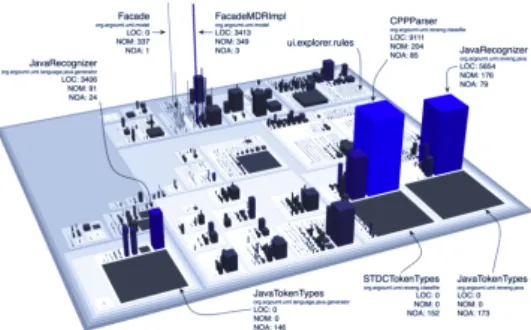
The concept was implemented in CodeCity by Wettel et al. (Wettel et al., 2011) (Fig. 1) followed by an empirical evaluation in a series of experimental runs spanned over six months of time. The main re-sults concluded that, for the program comprehension and design quality assessment, the city metaphor en-abled the creation of efficient software visualizations. The city metaphor has also been explored recently by other researchers in CityVR - an implementation of
Figure 1: A real representation of the code city of Ar-goUML (Wettel et al., 2011).
the city metaphor using virtual reality in an immersive 3D environment medium to boost developer engage-ment in software comprehension tasks (Merino et al., 2017); ExplorViz - a VR approach following the 3D city metaphor (Fittkau et al., 2015); VR City - a mod-ification of the city metaphor in virtual reality envi-ronment, with a different layout technique that pro-vides a higher level of detail and positioning oriented to the coupling between classes (Vincur et al., 2017); SwiftCity - metaphor applied to Swift projects (Nunes et al., 2017).
2.2
Live Programming
Programming is a strenuous task since most of the work happens in a programmer’s mind while thinking about how code executes, how to write it and update it (McDirmid, 2013; Sean McDirmid, 2017). To find the cause of errors, one should resort to debugging to get feedback about how the code behaves (McDirmid, 2013). This step causes a break in the mental simula-tion and the editing flow.
Live programming challenges this problem by unifying the gap between code editing and debug-ging (Sean McDirmid, 2017), re- executing the pro-gram and providing a continuous feedback while edit-ing (McDirmid, 2013). It is not a panacea for pro-gramming environments, but potentially very impor-tant for some. The ability to inspect and modify is taken for granted in most IDEs, adding liveness is an enhancement (Tanimoto, 2013).
Ideally, this concept is often made analogous to a water hose: moving a stream of water in an ever-evolving aim until the target is hit (Mcdirmid, 2016; Sean McDirmid, 2017). Small changes to the pro-gram should lead to small changes in the output. However, this idea is difficult to realize since the code is not directly related to program output, there is al-ways a mental effort to produce relevant changes.
Challenges in this concept point out to how feed-back can be considered harmful. Receiving
continu-ous results with change can be potentially distracting in some cases and cause the programmer to write in a certain order to ”keep it live”. For live programming to succeed, it must enhance programming without re-stricting what the programmer can do, either beginner or expert (Mcdirmid, 2016).
Other criticism (as cited in (McDirmid, 2013)) highlights the fact that the steps in between execu-tion are the most important part of programming. Therefore, by using live programming, a programmer would be hiding the critical flow of execution. This argument can remit to the concern of merely focus on updating the program output with successive code changes. However, the focus of live is not solving a ”right or wrong” programming model, where even without applying this concept the same problem re-mains. Nevertheless, from a debugging perspective, live programming can address this concern combining editing and debugging in time where updated debug results are readily visible while editing (McDirmid, 2013). With this approach, the focus returns back to the program flow and how changes affect certain parts of execution.
For the purpose of managing cloud infrastructures our aim is to receive continuous feedback on how ar-chitectural(instead of code) changes affect the whole system.
2.3
Cloud Management
Provisioning is defined as obtaining services from the cloud, such as spawning computers or virtual hosts and tailoring its software and configurations (Buyya et al., 2011). It should not be confused with deploy-ment, which does not necessarily imply provision-ing. Deployment is the process of getting a new ap-plication, or version, onto a prepared server (Sayers, 2017).
From the disconnection between the tradition-ally considered development and operations activ-ity, DevOps surges as a software engineering culture that aims to unify software development (oriented to change) and software operation (oriented to stabil-ity) (Amazon Web Services, 2017b; Edwards, 2010). The benefits of this model include:
• Rapid Delivery. Quickly respond to customer
needs and move a change into production (Ama-zon Web Services, 2017b; Edwards, 2010).
• Reliability. Ensure the quality of application
up-dates and infrastructure changes through testing in practices such as continuous integration and con-tinuous delivery (Amazon Web Services, 2017b; Edwards, 2010).
• Scale. Automation and consistency help changing
systems efficiently and with reduced risk (Ama-zon Web Services, 2017b).
• Collaboration. Developers and operation
engi-neers share responsibilities and combine work-flows (Amazon Web Services, 2017b).
For startups, the responsibilities are broadly guided towards supporting development, followed by build, continuous integration, and fast delivery (build-ing an effective pipeline of releases). Expanding companies focus more on configuration management, testing, and production (Kerzazi and Adams, 2016).
2.3.1 Configuration Management
In a broader context, configuration management (CM) is an important part of provisioning, which is de-signed to methodically handle changes to a system in order to maintain its integrity over time. Soft-ware configuration management is often referenced in a software engineering context, Pressman and Maxim (Pressman and Maxim, 2015) define it as:
A set of activities designed to manage change by identifying the work products that are likely to change, establishing relationships among them, defining mechanisms for managing dif-ferent versions of these work products, con-trolling the changes imposed, and auditing and reporting on the changes made.
Automation is the heart of server configuration management. It’s common to refer to configuration management tools as Automation Tools or IT Au-tomation Tools (Heidi, 2016).
2.3.2 Infrastructure Orchestration
On the other hand, orchestration tools define a dif-ferent purpose, they are designed to enforce a work-flow order to a set of automated tasks, such as the provisioning of those resources. Both categories are not mutually exclusive since some orchestration tools can extend to configuration and vice-versa (Brikman, 2016).
Automation and orchestration are becoming crit-ical concepts to the effective management of large-scale cloud architectures allowing developers to cope with unstable business need (Tosatto et al., 2015). In this section, we intend to explore the most valuable solutions to manage virtual machines, physical ma-chines, and containers.
3
RELATED WORK
Derived from the lack of resources/expertise and abil-ity to manage different cloud services, there has been a growing interest in methods to support infras-tructure provisioning, orchestration and configuration management.
CloudFormation is an aws-based orchestration tool to describe and provision infrastructure as code (Amazon Web Services, 2017a). It features the following aspects:
• Modeling. The ability to model, in a single file,
the entire infrastructure, standardize all compo-nents.
• Automation. Infrastructure can be destroyed and
re-built in ”one-click”, without custom scripts, and with roll-backs if errors are detected.
• Version Control. Source files can be authored
and reviewed before deploying into production. Source files can be formatted in two different lan-guages: JSON or YAML and previously converted into a graphical display which can help to analyze relations between templates (Amazon Web Services, 2017a).
Terraform is another orchestration tool for build-ing, changing and versioning infrastructure for ex-isting service providers as well as custom in-house solutions. Similarly to the previous competitor, re-sources are defined as code, reflecting a blueprint of the architecture which allows it to be versioned and shared (HashiCorp, 2017). The key features are:
• Execution Plans. Before infrastructure
deploy-ment, an execution plan synthesizes what ter-raform will apply.
• Resource Graph. The creation of non-dependent
resources can be parallelized, building infrastruc-ture as efficient as possible.
• Change Automation. Complex changes can be
applied to multiple services in incremental steps with minimal human interaction.
Terraform differs from the previous competitor for being cloud agnostic and enabling the combination of multiple cloud service providers with a unified syn-tax (HashiCorp, 2017). Configuration files follow a declarative style where resources to be provisioned are declared according to their desired end state.
Sandobalin et al., in his work presented a so-lution to help the management of Infrastructure-as-Code (IaC), through a domain specific language (San-dobalin et al., 2017). ARGON is a modeling tool for specifying the final state of the infrastructure and pro-visioning of cloud resources. The tool aims to fo-cus mainly on automation: automatic generation of
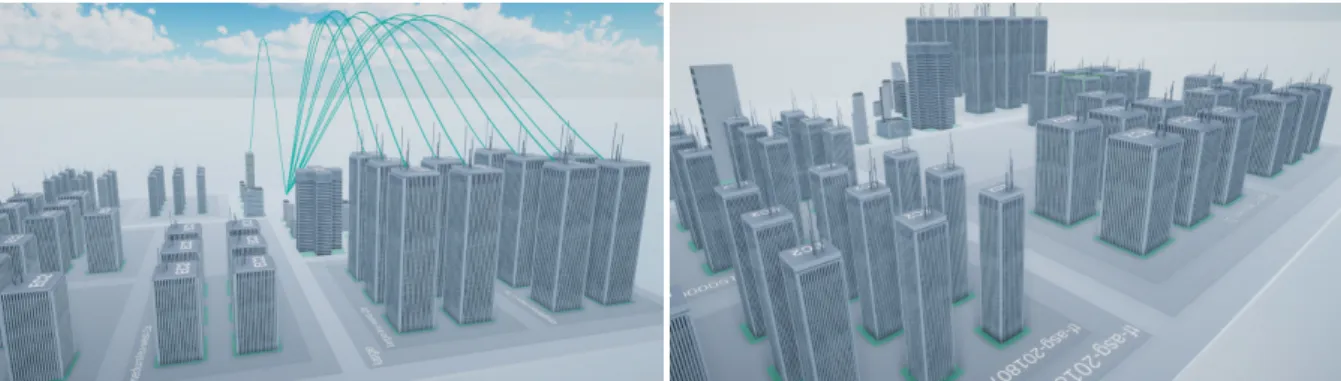
Figure 2: CloudCity’s main environment containing an small size example architecture, displaying a subset of the relations.
infrastructure provisioning scripts. One of the advan-tages of this approach is the abstraction from the com-plexity of working with different cloud providers, re-sulting in a platform-independent metamodel and pre-venting vendor lock-in.
Mastelic et al., in his work takes advantage of model-driven development for building and manag-ing arbitrary cloud services in a cloud-agnostic man-ner (Mastelic et al., 2014). Through the CoPS meta-model, cloud services are described using three se-quential models: (a) Service, that defines services re-quirements; (b) Product, that defines the arrangement of the service; and (c) Component, that defines the configuration of each component of the service.
4
CLOUDCITY
The 3D visualization method we propose for manag-ing cloud infrastructures is a city metaphor. By def-inition, the cloud is not a physical entity, and can-not, by nature, be purely synthesized into a straight-forward visually understandable mapping. Instead, it can be transposed into other dimensions, such as code or models, in order to ease its management. Repre-senting the cloud as a city intends to enable users to gradually become familiar with the represented archi-tecture, due to the relationship with many similarities between the two domains.
4.1
Overview
CloudCity is a live cloud management environment which embodies the city metaphor. We opted for ex-ploring this metaphor since it is has been picked and validated by the software engineering scientific com-munity as one with good empirical results in what regards software visualization (see subsection 2.1). The main concept is to allow the design and analy-sis of cloud compositions through an intuitive map-ping between city metaphors and cloud resources.
Each building contains a set of properties reflected from the cloud, which can be inspected or modified through simple interaction. Relations are depicted as curved lines between two elements which can be fil-tered and detailed on-demand. The main difference from other model-driven approaches is that this en-vironment doesn’t reflect a static infrastructure map-ping, but instead a live infrastructure which shows the real-time state of each component. A metaphor that we introduce as, the live city.
4.2
Architecture
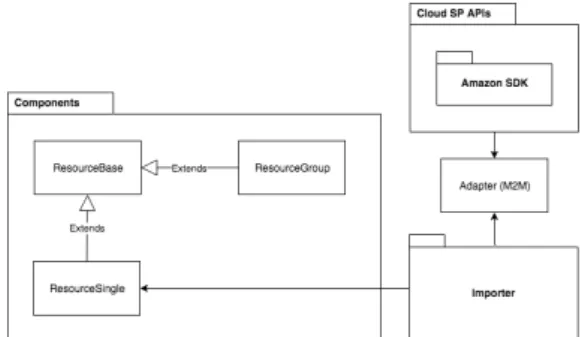
The definition of CloudCity follows the model-driven engineering principles. Fig. 3 describes, in a high-level, a representation of the system architecture. The tool is composed of three core packages:
• Cloud Service Providers API. Provides a
con-nection to a specific cloud service provider. For our proof of concept we picked Amazon Web Ser-vices among the existent options.
• Importer. Periodically pools the provider and
de-tects changes in the infrastructure state, forward-ing actions to update specific resources. In the future this could be improved by using a publish-subscribe solution.
• Resources. To define resources and groups, we
implemented the composite pattern. A group of resources can either contain a resource or an-other resource group. If it contains anan-other group, the same applies recursively downwards the tree structure.
Notwithstanding the fact that the proof of concept pre-sented in this work currently only recognizes a unique service provider; to mitigate the complexity of work-ing with different cloud service providers and to open the possibility of implementing their support in future work, we prepared our architecture to support differ-ent providers. For that reason, it was divided into two different decoupled layers:
Figure 3: CloudCity’s architecture described by a package diagram.
Figure 4: Infrastructure metamodel (inspired by the abstract syntax presented in (Sandobalin et al., 2017)).
1. Platform Independent Model. Illustrated in Fig. 4, this model is independent of any specific provider.
2. Platform Specific Model. This model is coupled with a specific provider and can be obtained with a model to model transformation.
The proof of concept was implemented using a multipurpose three-dimensional engine, Unity. This technology decision was derived from being an en-gine with extensive documentation and community support, thus accelerating the implementation. Open-ing room for new features to be studied and provide support for Virtual/Augmented Reality (an interest-ing perspective also studied in other approaches usinterest-ing the City Metaphor, as in (Merino et al., 2017; Vincur et al., 2017)).
4.3
Resource Mapping
One of the advantages of creating a visual map for the cloud is that there is a finite set of resources, with pre-dictable properties. Therefore, it allows us to create an alphabet with models for each of the instances we want to represent, rather than defining new metrics.
However, since cloud service providers must be constantly adapting to maintain their position in a de-manding market (Serrano et al., 2015), the result is an increase in their service portfolio. As a proof of concept, we prepared the environment to accept eight popular services:
Figure 5: CloudCity’s reference building dimensions sorted in ascending order.
1. Security Group: Security Groups act as a vir-tual firewall to control instances inbound and out-bound. Each group contains a set of rules which controls the port range where traffic is allowed. The metric chosen for the building height varies according to the port range the security group covers. Since the security group is a very com-mon instance in a cloud architecture (an instance can have from one up to five different groups), the building dimensions correspond to the small building type.
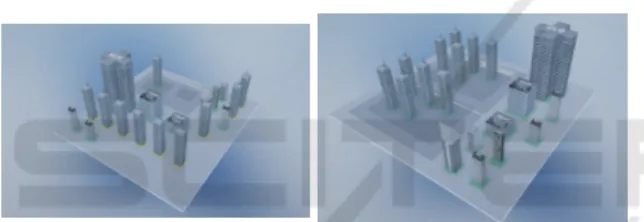
2. Virtual Machine: VMs provide scalable com-pute capacity in the cloud. Each instance contains a size, from a wide selection of instance types that define the hardware specifications. The metric for the building dimensions varies according to this attribute (visually represented on Fig. 6).
3. Load Balancer: Load balancers are responsi-ble for distributing traffic across multiple tar-gets, achieving multi-tenancy and resource pool-ing. One can have multiple listeners, to receive in-coming connections and distribute them, accord-ing to a rule (a specific host or path), to multi-ple groups of targets. The metric chosen for the building height varies depending on the number of total rules the load balancer takes into consid-eration when forwarding connections. Moreover, since load balancing is a central component be-tween the point of entry and the targets, we con-sider it as part of the big buildings category. 4. Listener: The listener, related to load balancing,
is a process that checks for incoming requests on a specific port and forwards them to a target group. The metric chosen for the building height varies in consonance with the number of rules it takes consideration when forwarding a connection to a specific group of targets. As for the building type, since this component is a subset of the load balancer, we chose to consider it as part of the medium buildings category.
5. Target Group: A target group routes incoming listener requests to one or more registered targets. The metric chosen for the building height varies depending on the number of instances registered
in it. As for the building type, since this com-ponent can also be considered a subset of the load balancer, it falls in the medium buildings category. 6. Launch Configuration: A launch configuration is a parental reference of machine specifications for a VM to be mirrored from. It is useful for when the auto scaling group is expanding and needs a source from where instances will be repli-cated. The building type chosen for this compo-nent depends on the instance type attribute (as in Table 1).
7. Scaling Policy: Policies define how the scaling group increases or decreases the size, and accord-ing to which metric. The metric chosen for the building height varies depending on the scaling adjustment. As for the building type, since this component can be considered a subset of the auto scaling group, it falls in the medium buildings cat-egory.
8. Auto Scaling Group: In contrast with the previ-ous resources, an auto-scaling group is not repre-sented by a building. Instead, since it is a group with multiple VMs and scales dynamically, we represent it as a plane with sufficient area to sup-port the different availability zones and specific VM (visually represented on Fig. 6).
Table 1: The building categories that correspond to specific instance types.
Instance Type Building Type
Nano small
Micro/Small medium large - 8xlarge big 8xlarge - 32xlarge large
Figure 6: Visual notation for a virtual machine by itself (left), and as part of an auto-scaling group (right).
4.4
Layout
To provide a proper environment for live managing cloud infrastructures, we need a mechanism to lay out and update components as the architecture is ex-panded and modified. In sum, the requirements are:
• Support for laying out all the imported
compo-nents of the infrastructure, with different dimen-sions, in an ordered manner;
• Do not waste much of the cities’ real-estate
(Wet-tel et al., 2011);
• Support for grouping components according to a
class.
Our first approach was to think of the components and relations as a graph. The force-directed graph layout is one of the most popular graph layout tech-niques, it consists in applying spring-like forces to the edges, attempting to achieve an aesthetically-pleasing layout. However, the drawbacks of this technique are: (a) intensive computation (naive approach), worst case running time is proportional to the square of the number of nodes, and (b) diverges from the standard city metaphor - losing resemblance to a known envi-ronment.
Another approach is the Tree-Map technique which divides the existing space into rectangular blocks according to an attribute of the respective ob-ject. However, this method does not take into account the dimensions and proportions of the buildings (Wet-tel et al., 2011).
After all, the technique we chose for layering the elements is CodeCity’s rectangle packing algorithm proposed by Wettel et al. (Wettel et al., 2011). It starts with an empty rectangular space, large enough to host a set of exposed components. Each step of the algo-rithm consists in layering the elements at the best free space from a list of potential candidates. In case the element does not cover the full space, we recursively split the surplus in two different cuts available to host new components, as depicted in Fig. 7.
4.5
Updates & Interaction
This section intends to address the most important question in the implementation of this concept: how to deal with infrastructural updates. The core idea to our suggested approach would be a publish-subscribe pattern that receives messages every time a change happens in the environment. However, since the spe-cific cloud provider we are working with doesn’t pro-vide the means to integrate this style, we are forced to periodically poll it and manually detect the differ-ences.
Figure 7: An example of the rectangle packing layout for a considerable size infrastructure, composed of: three auto scaling groups containing multiple size instances and two scaling policies; a stopped test instance; one load balancer and several security groups.
Figure 8: An illustration of an infrastructural update when an auto-scaling group increases it’s desired capacity. The number of instances changed from 1 to 10. For that reason, nine new servers were spawned (Figure on the left) and then attached inside the scaling group (Figure on the right).
Having considered a method to detect the change, the next step is to refresh the infrastructure. The most naive approach would be to destroy the whole infras-tructure and rebuilt it. But, for efficiency reasons, we decided not to destroy any element except if it has been terminated. Instead, every time the layout needs to re-position elements, only the affected ones will change position, as depicted in Fig. 8.
All things considered, to avoid abrupt changes in the layout, we prepared all components to change their position slowly (speed of 1 unit per second) to in-crease the response feedback (sliding in between po-sitions).
Relations are mapped into arcs beginning at one instance or group and ending in another. Both re-sources and their relations may contain a state de-pending on their nature which can also be inspected by clicking them, and filtered when a specific compo-nent is selected.
5
EXPERIMENTS AND RESULTS
In order to illustrate our approach, we conceived two different phases, one being the construction of a cloud infrastructure and another being the analysis of an ex-isting, which is not the implemented in the first phase.Figure 9: An illustration of the resulting CloudCity model for the first phase experiment.
In the construction phase, we designed a typical web-hosting reference architecture (excluding stor-age) composed of four resources: (a) an auto-scal-ing group with a minimum size of two instances; (b) a launch configuration for each new instance to be spawned inside the scaling group; (c) a security group; and (d) a target group to route incoming re-quests to the targets in the scaling group. The result-ing model is depicted in Fig. 9.
As for the second phase, analysis, it consisted in inspecting an existing infrastructure. In order to cre-ate some independence between the two phases, we prepared a different infrastructure using Terraform containing: (a) an auto-scaling group in two zones connected to the respective launch configuration; (b) two scaling policies; (c) a load balancer with the respective listener, target group and security group; and (d) a web server.
The rationale for this assignment is to simulate the occurrence of an unhealthy target, a common event in a cloud environment. In most cases, the cause is derived from a failed/overloaded instance or security group misconfiguration. For that purpose, we mis-configured a security group (firewall) on purpose in one of the registered targets and disallow any traffic coming from the target group. In consequence, the target group will not be able to send health check re-quests, and consider the instance unhealthy. The goal is to locate that specific instance and analyze its cause, targeting liveness level three: informative, significant
(a) The resulting model of the second phase of the ex-periment according to Terraform’s configuration plan.
(b) The resulting model immediately after the miscon-figuration of a security group, for the purpose of iden-tifying the resulting infrastructural changes, in spe-cific, a unhealthy instance.
Figure 10: Resulting visualizations of the experiments. The connections between components (buildings) are represent-ing connections and the floor gives information about the group/context where the different components are placed. If everything is operating normally both the connections and floor colors are in green, otherwise the connections and/or floor colors of each component turn red.
and responsive. Both the occurrences can be con-firmed in Fig. 10a and Fig. 10b.
6
CONCLUSIONS AND FUTURE
WORK
In this paper, we started by analyzing the challenges and evolution in the management of cloud environ-ments, specifically, it is important to notice: (a) the cloud service providers are constantly evolving their services in order to maintain position in a demanding market (b) this causes unavoidable increasing com-plexity when too many resources are under
manage-ment in an overwhelming disheveled environmanage-ment. From the perspective of cloud management, the main result is the contribution with an integrated development environment; to analyze, architect and configure cloud compositions with a higher level of abstraction. Enabling architects to focus their inter-ests in specific areas, and track the changes as the in-frastructure evolves and the complexity increases.
Our approach combines the strengths of existing approaches, techniques and tools by introducing live-ness to cloud management and providing a complete feedback loop which can help developers understand how the infrastructure reacts to change, working to-wards a Live Software Development (Aguiar et al., 2019) approach for cloud management.
We believe the approach represents a considerable improvement over current practices. When referring to managing cloud infrastructures, the focus is specif-ically cloud architecture configuration tasks.
Many issues were addressed by this work but it has also uncovered other interesting areas and sub-jects for further research based on this work, them being: (a) provide a modifiable layout technique - a user’s ability to manually modify the position of a specific component; (b) explore other levels of live-ness and (c) investigate different metaphors.
Furthermore, all the experiments carried on were made to evaluate the sanity and viability of the ap-proach. We consider that in the future several con-trolled experiments must be carried on to assert the usefulness of the work here presented.
ACKNOWLEDGEMENTS
This work is financed by the ERDF – European Re-gional Development Fund through the Operational Programme for Competitiveness and Internationali-sation - COMPETE 2020 Programme within project ”POCI-01-0145-FEDER-006961”, and by National Funds through the Portuguese funding agency, FCT - Fundac¸˜ao para a Ciˆencia e a Tecnologia as part of project ”UID/EEA/50014/2013”.
REFERENCES
Abbasov, B. (2014). Cloud computing: State of the art re-seach issues. 8th IEEE International Conference on Application of Information and Communication Tech-nologies, AICT 2014 - Conference Proceedings. Aguiar, A., Restivo, A., Figueiredo Correia, F., Ferreira,
H. S., and Dias, J. P. (2019). Live software devel-opment: Tightening the feedback loops. In Confer-ence Companion of the 3rd International ConferConfer-ence
on Art, Science, and Engineering of Programming, Programming 2019 Companion. To Appear.
Amazon Web Services (2017a). Cloudformation. Amazon Web Services (2017b). What is devops?
Armbrust, M., Fox, A., Griffith, R., Joseph, A., and RH (2009). Above the clouds: A Berkeley view of cloud computing. University of California, Berkeley, Tech. Rep. UCB, page 1.
Brikman, Y. (2016). Why we use terraform and not chef, puppet, ansible, saltstack, or cloudformation. Buyya, R., Broberg, J., and Goscinski, A. (2011). Cloud
Computing Principles and Paradigms. John Wiley & Sons, Inc., New Jersey.
Diehl, S. (2007). Software visualization: Visualizing the structure, behaviour, and evolution of software. Springer-Verlag.
Edwards, D. (2010). What is devops?
Erian, T. E. (2018). The xaas family: Understanding iaas, paas and saas.
Fittkau, F., Krause, A., and Hasselbring, W. (2015). Explor-ing software cities in virtual reality. 2015 IEEE 3rd Working Conference on Software Visualization, VIS-SOFT 2015 - Proceedings, pages 130–134.
HashiCorp (2017). Terraform vs. other software.
Heidi, E. (2016). An introduction to configuration manage-ment.
Kapec, P. (2010). Visualizing software artifacts using hy-pergraphs. Proceedings of the 26th Spring Conference on Computer Graphics - SCCG ’10, page 27. Kerzazi, N. and Adams, B. (2016). Who needs release and
devops engineers, and why? Proceedings of the Inter-national Workshop on Continuous Software Evolution and Delivery - CSED ’16, pages 77–83.
Lanza, M. (2004). CodeCrawler - Polymetric views in ac-tion. Proceedings - 19th International Conference on Automated Software Engineering, ASE 2004, pages 394–395.
Lanza, M. and Ducasse, S. (2003). Polymetric Views— A Lightweight Visual Approach to Reverse Engineer-ing. Transactions on Software Engineering (TSE), 29(9):782–795.
Linthicum, D. S. (2016). Understanding Complex Cloud Patterns. IEEE Cloud Computing, 3(1):8–11. Mastelic, T., Brandic, I., and Garcia, A. G. (2014). Towards
Uniform Management of Cloud Services by Apply-ing Model-Driven Development. 2014 IEEE 38th Annual Computer Software and Applications Confer-ence, pages 129–138.
McDirmid, S. (2013). Usable live programming. In Pro-ceedings of the 2013 ACM International Symposium on New Ideas, New Paradigms, and Reflections on Programming & Software, Onward! 2013, pages 53– 62, New York, NY, USA. ACM.
Mcdirmid, S. (2016). The Promise of Live Programming. LIVE Programming Workshop.
Mell, P. and Grance, T. (2011). The NIST Definition of Cloud Computing Recommendations of the National Institute of Standards and Technology. pages 2–3. Merino, L., Ghafari, M., Anslow, C., and Nierstrasz, O.
(2017). Cityvr: Gameful software visualization.
In 2017 IEEE International Conference on Software Maintenance and Evolution (ICSME), pages 633–637. Nunes, R., Reboucas, M., Soares-Neto, F., and Castor, F. (2017). Visualizing swift projects as cities. Proceed-ings - 2017 IEEE/ACM 39th International Conference on Software Engineering Companion, ICSE-C 2017, pages 368–370.
Pressman, R. S. and Maxim, B. R. (2015). Software En-gineering: A Practitioner’s Approach. McGraw-Hill Education.
RightScale (2017). State of the Cloud Report. Technical report, RightScale.
Rogers, O. (2017). Voice of the enterprise: Cloud transfor-mation. AWS re:invent.
Sandobalin, J., Insfran, E., and Abrahao, S. (2017). An In-frastructure Modelling Tool for Cloud Provisioning. Proceedings - 2017 IEEE 14th International Confer-ence on Services Computing, SCC 2017, pages 354– 361.
Sayers, D. (2017). Configuration management vs. applica-tion release automaapplica-tion.
Sean McDirmid (2017). Live Programming as Gradual Ab-straction. LIVE Programming Workshop.
Serrano, N., Gallardo, G., and Hernantes, J. (2015). Infras-tructure as a Service and Cloud Technologies. IEEE Software.
Tanimoto, S. L. (2013). A perspective on the evolution of live programming. In 2013 1st International Work-shop on Live Programming, LIVE 2013 - Proceedings, pages 31–34.
Tosatto, A., Ruiu, P., and Attanasio, A. (2015). Container-Based Orchestration in Cloud: State of the Art and Challenges. Proceedings - 2015 9th International Conference on Complex, Intelligent, and Software In-tensive Systems, CISIS 2015, pages 70–75.
Vincur, J., Navrat, P., and Polasek, I. (2017). VR City: Soft-ware Analysis in Virtual Reality Environment. 2017 IEEE International Conference on Software Quality, Reliability and Security Companion (QRS-C), pages 509–516.
Wettel, R., Lanza, M., and Robbes, R. (2011). Software sys-tems as cities. In Proceeding of the 33rd international conference on Software engineering - ICSE ’11.