C O N F E R E N C E
P R O C E E D I N G S
C O N F E R E N C E
P R O C E E D I N G S
C O N F E R E N C E
P R O C E E D I N G S
C O N F E R E N C E
C O N F E R E N C E
P R O C E E D I N G S
Published by
IATED Academy iated.org
INTED2019 Proceedings
13th International Technology, Education and Development Conference March 11th-13th, 2019 — Valencia, Spain
Edited by
L. Gómez Chova, A. López Martínez, I. Candel Torres IATED Academy
ISBN: 978-84-09-08619-1 ISSN: 2340-1079
Depósito Legal: V-247-2019
Book cover designed by J.L. Bernat
All rights reserved. Copyright© 2019, IATED
The papers published in these proceedings reflect the views only of the authors. The publisher cannot be held responsible for the validity or use of the information therein contained.
HIGHER EDUCATION IN PORTUGAL BETWEEN 1995-2015 AND
POSSIBLE FUTURES
B. Cabrito
1, L. Cerdeira
1, M.L. Machado
2, T. Patrocínio
1, P. Mucharreira
11University of Lisbon, Institute of Education - IEUL (PORTUGAL) 2University of Porto - CIPES (PORTUGAL)
Abstract
One of the most visible and striking changes in contemporary Portugal is certainly what has been happening in education, namely in higher education. In this communication, based on the official data, the authors analyze the course of higher education in Portugal, regarding the expansion and diversification of the supply and demand of higher education as well as the public and the private financing of this level of education. From the analysis of official data, the authors show that for decades there was an explosive demand for this level of education accompanied by a public offer and adjusted private offer, with a slowdown and decrease in demand from 2008 due mainly to the economic and financial crisis of the country between 2008 and 2015.
The authors show that this fall in the demand for higher education happens at the same time that the public investment in this level of education decreases and that the living conditions of the students worsen, denouncing a process of elitization of higher education in Portugal. To know the living conditions of the students, the authors had questioned about the social and economic origin of the student population as well as the costs that students are forced to carry out to study - costs associated to the enrollment and attendance of higher education and living costs - by applying a questionnaire to a representative sample of public and private Portuguese higher education students which has been applied already for 4 times: 1994/95, 2005/06, 2010/11, 2015/16.
The homologous data collected in the four editions of the questionnaire application are compared, aiming a better understanding of the dimension of the process of democratization of higher education in the country. From the analysis of the data coming from the 4 studies, it was concluded that higher education in Portugal, instead of democratizing and universalizing, seems to become increasingly a teaching for the elites. The authors finish the analysis by presenting some educational policy measures that appear to be indispensable for building a more just and equitable higher education in the country.
Keywords: Higher Education, Socioeconomic Origin of Higher Education Students, Democratization, Elites.
1 INTRODUCTION
In the last decades, Portugal has undergone numerous changes of a political nature towards the democratization of the country. After 48 years of dictatorship, since the Revolution of April 1974, Portugal has been democratizing itself. This process was translated, among other realities, into the mass consumption of public goods and services and the implementation of a welfare state. This was the case, for example, with education.
Since 1974, significant changes have taken place in the educational framework, namely the establishment of compulsory schooling (progressively 6, 9 and 12 years); the diversification of the offer of higher education, with the opening of this level of education to the private initiative and the creation of new establishments of higher education, public and private; the expansion of the social base of student’s recruitment and the increase in the rate of enrollment in higher education.
There was thus a demand for education in such an intense way that one can speak of an "explosion of education". In fact, the perception of the role of education in economic development as it is witnessed by studies of human capital [1-3] and as a process of social ascension [4-5], transformed the country. If at the end of the 1970s Portugal had an illiteracy rate around 50%, today it has a value that does not reach 5% and which basically covers the elderly population [6].
Proceedings of INTED2019 Conference
However, an analysis of the public policies for financing higher education and the social composition of higher education students leads us to question the hypothesis that higher education has become truly democratized.
2 ABOUT EDUCATIONAL ATTENDANCE LEVELS
One of the most significant realities regarding the demand for education in Portugal in the last decades is the explosive increase in demand, that the evolution of the real school enrolment rate witness. Observe the values in Table 1 [6].
Table 1. Real school enrolment rate by level of education (% of students enrolled in a given level of education compared to the population of normal age at that level)
LEVEL OF
EDUCATION 1961 1970 1980 1990 2000 2010 2015 2016
Preschool 0.9 2.4 14.2 41.7 71.6 83.9 88.5 88.4
Basic education 80.4 84.3 98.4 100.0 100.0 100.0 98.3 97.7 Secondary education 1.3 3.8 11.7 28.2 58.8 72.5 74.6 75.3 Higher education na. na. 10.7 20.2 24.0 31.3 31.4 33.1
The values in Table 1 clearly show the strong increase in real school enrollment rates in the country, although it should be noted:
• some irregularity in the evolution of these rates in recent years, which will not be strange the economic crisis that the country has known since 2008 and the austerity measures that accompanied it;
• the fact that the frequency of secondary education has not yet reached 100%;
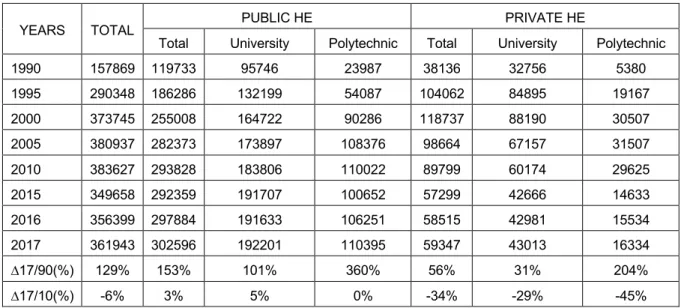
• the fact that the actual rate of enrollment in higher education is still far from the European 2020 target: that at least 40% of the population of the age of higher education is actually attending it. From the analysis of the values of the table, one can see that the country still has a significant way to go in order to fulfill the objectives of compulsory schooling and, in the framework of higher education, to fulfill the objectives of Europe 2020, despite the expansion that this sector has known in recent decades. However, the growth of higher education in Portugal in the last decades is undeniable. See Table 2 [6].
Table 2. Students enrolled in Higher Education: total and subsystem between 1990 and 2017
YEARS TOTAL PUBLIC HE PRIVATE HE
Total University Polytechnic Total University Polytechnic
1990 157869 119733 95746 23987 38136 32756 5380 1995 290348 186286 132199 54087 104062 84895 19167 2000 373745 255008 164722 90286 118737 88190 30507 2005 380937 282373 173897 108376 98664 67157 31507 2010 383627 293828 183806 110022 89799 60174 29625 2015 349658 292359 191707 100652 57299 42666 14633 2016 356399 297884 191633 106251 58515 42981 15534 2017 361943 302596 192201 110395 59347 43013 16334 ∆17/90(%) 129% 153% 101% 360% 56% 31% 204% ∆17/10(%) -6% 3% 5% 0% -34% -29% -45%
It should be noted that, following the financial crisis of 2008, the number of students declined by 6%, particularly in Private HE (-34%); Public HE stabilized to grow again slowly from year 2015, probably
as a consequence of the change from an ultraliberal government to a center-left government that put an end to some of the previously established austerity measures.
This process of democratization and the explosion of demand for higher education has had direct repercussions on the number of graduates, which has also increased at a high rate. See Table 3 [6].
Table 3. Evolution of the number of graduates in higher education
YEARS Nº YEARS Nº
1991 18671 2010 78609
1995 35939 2014 75906
2000 54255 2015 76892
2005 69987 2016 73086
The importance of higher education and the role that young people attach to education as an instrument of social advancement [4, 5, 7, 8] and an increase in skills and abilities that contribute to the growth of the economy and the country [3] is also the evolution of the number of PhDs held in the country as well as by Portuguese youths abroad in recent decades. See Table 4 [6].
Table 4. Evolution of the number of PhDs held
YEARS IN PORTUGAL ABROAD TOTAL
1970 23 37 60 1980 44 72 116 1990 250 87 337 2000 694 165 859 2005 1058 141 1199 2010 1500 232 1732 2014 2503 247 2750 2015 2351 618 2969
According to the values in Table 4 in less than 50 years, starting from a highly selective and elitist educational system, the number of doctorates increased more than 100 times. Already in the middle of the democratic period, in just over two decades, the number of doctorates increased almost 10 times.
3 FINANCING EDUCATION
One of the most significant facts regarding education in general and public higher education in particular is the sharp decline in public investment in education. Observe the values in Table 5 [9].
Table 5. Public expenditure on education and higher education, as a percentage of GDP
YEARS PORTUGAL All Education HE 1999 5,03 0,94 2005 5,06 0,92 2010 5,40 1,09 2011 5,13 1,01 2013 5,29 0,89 2014 5,13 0,91 9908
This progressive lack of State responsibility in education, particularly in higher education, is particularly disturbing because it does not follow what is happening in the partner countries of Portugal in the European Union or in the OECD. Observe the values in Table 6 [10].
Table 6. Evolution of public funding of higher education in the OECD, EU (28) and Portugal
YEARS 1995 2005 2008 2011 2013 2014
OECD average 77 70 70 70 71 70
UE28 average 86 80 80 80 80 78
Portugal 96 68 62 69 58 62
While it is true that the current trend in the world is the progressive reduction of the participation of the states in the financing of higher education, it is undeniable that in Portugal this decrease occurred abruptly and aggressively, obliging public institutions of higher education to seek external sources of financing , notably through patronage, service provision, contracts with companies and, fundamentally, through the collection of fees for students whose amounts reach between 15% and 20% of the budget of these institutions.
Of course, the public funding framework for higher education has to change, notably through new financing contracts from public higher education institutions that allow these institutions to fulfill their mission without external constraints and so that tuition fees are abolished or will substantially reduce its amount so that demand is intensified and the country is endowed with the highly skilled workforce it needs to develop.
4 SOCIO-ECONOMIC CONDITIONS OF STUDENTS OF HIGHER EDUCATION
4.1 Social composition of students in higher education
One of the factors that hamper the frequency of higher education around the world is certainly the financial factor. Portugal will be no exception.
In order to understand the socio-economic conditions of higher education students, the authors conducted a study on students of higher education, the CESTES - Economic and Social Conditions of Higher Education Students, which was carried out in the application of a questionnaire to a significant sample national HE students, both public and private, university and polytechnic and that already goes in the 4th edition. With this study it is possible to perceive the way in which the socioeconomic composition of the students of higher education has developed in the period 1995-2015.
See Table 7, which represents the students' perception about the income of their household [11]. Table 7. Socioeconomic status of families of students in higher education, according to students' perception
of household income in 1995, 2005, 2011 and 2016, as a percentage of the total of the students
HOUSEHOLD INCOME 1995 2005 2010 2015
High / medium high (>1500€/month) 14.4 17.3 38.2 36.7
Medium (870-1500€/month) 71.8 74.1 43.8 46.7
Low (< 870€/month) 13.8 8.6 18.0 16.6
The comparison of the level of income perceived by students of higher education in the four dates shows that higher education in Portugal, although, as has been shown previously, having grown in number has not truly democratized. In fact, the percentage of students perceived as belonging to the "lower class" has grown little in the 20 years under analysis while the opposite is true for students who consider "high / medium high" the level of income household, even if this growth has been made at the expense of the "middle classes" slimming.
Thus, as the increase in the demand for higher education in the country is undeniable, it can’t be said that there was an effective democratization of the frequency of this level of education. Obviously, in order to ensure this democratization, young people from all strata need to be called to HE. Social
support measures will be necessary to enable the most disadvantaged young people to have equal access to this level of education.
4.2 The evolution of affordability (financial accessibility) of students in
Portuguese higher education
Taking measures that effectively contribute to a higher demand for higher education requires not only the knowledge of the socio-economic background of students attending this level of education but also the ability of families to have a child to study in higher education. For this, an important indicator can be used - the affordability -, that is, the degree of financial accessibility of the students of the higher education that indicates the effort that the families realize so that one of its members attends the higher education.
Table 8 shows exactly how the effort that Portuguese families have made to have a child in higher education in the last decades has evolved. To do this, and following Johnstone [12] and Cabrito [8], the values of education costs (administrative costs and teaching materials) and living expenses (costs of food, clothing, housing, transportation, health and leisure) were used to understand the effort students and families do comparing net education costs with the values of GDP per capita in 2005, 2010 and 2015 [13].
Table 8. Education costs, students' living costs and total costs of students of higher education as% of GDP per capita (2005, 2010 and 2015)
2005 2010 2015 Value € % GDP Per Capita Value € % GDP Per Capita Value € % GDP Per Capita (1) GDP per capita (annual, at current
prices) 16 891,00 17 017,70 17 329,90
(2) Education Costs 1 841,20 10,9 1 934,83 11,4 1 718,10 9,9 (3) Cost of Living 2 880,00 17,1 4 689,62 27,6 4 727,40 27,3 (4)=(2)+(3)= Total Costs 4 721,20 28,0 6 624,45 38,9 6 445,50 37,2 (5) Support in Scholarships per Student 266,00 341,40 345.58
(6)=(4)-(5)= Net Cost 4 455,20 26,4 6 283,05 36,9 6 099,92 35,2
(7) Education Tax Deductions 600,00 670,00 800,00
(8)=(6)-(7)= Net Cost after Tax
Deductions 3 855,20 22,8 5 613,05 33,0 5 299,.92 30,6
(9) Loan per Student (*)
(10)=(4)-(5)-(9) Total Costs (out of
pocket) 4 455,20 26,4 6 283,05 36,9 6 099,92 35,2
(11)=(10)-(7) Total Costs after Tax
Deductions 3 855,20 22,8 5 613,05 33,0 5 299,92 30,6
The analysis of the figures in the table shows how difficult it is for a family to guarantee the presence of a child in higher education, which is more difficult in 2015 than in 2005. However, the evolution of this indicator seems to be moving in a positive direction, that at present this indicator is more favorable for students following the measures of social support and job creation that the government in charge has been implementing since 2015. However, it should be stressed that the effort required of a family is still too high so that it is possible to guarantee the massification of this level of education.
5 FINAL CONSIDERATIONS
The above shows clearly how higher education has evolved in Portugal, regarding the demand for this level of education and its financing. Thus, it seems to be possible to conclude that the massification of this level of education requires effective educational policy measures, namely greater participation of the State in the financing of higher education, increased social support for low strata students, abolition of attendance rates in public higher education and social and fiscal support to families.
New policies of state social accountability for higher education and support for students and their families will promote the demand for higher education and contribute to this level of education becoming mass higher education [14], the accomplishment of the objectives of Europe 2020 and the country is endowed with the highly qualified workforce needed for its development.
REFERENCES
[1] G. Becker, Human Capital - A Theoretical and Empirical Analysis, with Special Reference to Education. New York: Columbia University Press, 1964.
[2] T. Schultz, “Investment in Human Capital”, American Economic Review, no. 51, pp. 1-16, 1961. [3] M. C. Lopes, “Educação, desenvolvimento e conhecimento: novas roupagens da troca desigual e
globalização. O caso da África subsariana” in Grandes Lições, pp. 111-135, Lisboa: Tinta da China, 2013.
[4] P. Bourdieu and J. C. Passeron, Les Héritiers. Paris: Les Éditions Minuit, 1964. [5] P. Bourdieu and J. C. Passeron, La reproduction. Paris: Les Éditions Minuit, 1970. [6] PORDATA, Base de dados Portugal contemporâneo [Contemporary Portugal database],
Accessed 20 December, 2018. [Data collected and adapted from] Retrieved from http://www.pordata.pt.
[7] S. Grácio, Dinâmicas de escolarização e de oportunidades individuais. Lisboa: EDUCA, 1997. [8] B. Cabrito, Financiamento do Ensino Superior. Condição Social e Despesas de Educação dos
Estudantes Universitários em Portugal. Lisboa: EDUCA, 2002.
[9] UNESCO, Institute for Statistics, Accessed 7 January, 2019. [Data collected and adapted from] Retrieved from http://uis.unesco.org/.
[10] OECD, Education at a Glance. Paris: OECD Publishing, 2017.
[11] L. Cerdeira and B. Cabrito, Custos dos Estudantes do Ensino Superior Português. Lisboa: EDUCA, 2017.
[12] B. D. Johnstone, Sharing the Costs of Higher Education: Student Financial Assistance in the United Kingdom, the Federal Republic of Germany, France, Sweden and the United States. New York: College Entrance Examination Board, 1986.
[13] L. Cerdeira, B. Cabrito, T. Patrocínio, M. L. Machado-Taylor, R. Brites, A. Brito, N. B. Vicente, N. M. Nkula and A. Buza, “Higher Education Expansion in the portuguese speaking countries. The cases of Angola, Cape Vert and Portugal” in International Studies in Higher Education: Policy & Practice (A. Albuquerque, P. Jean-Jacques and N. Bagnall, eds.), London: Palgrave Publishers, 2019.
[14] M. Trow, Problems in the transition from elite to mass higher education. Berkeley, CA: Carnegie Commission on Higher Education, 1973.