Ciência Rural, v.41, n.8, ago, 2011.
ISSN 0103-8478
Carlos Eduardo CopattiI Luciano de Oliveira GarciaII Daiani KochhannIII Mauro Alves da CunhaIV Alexssandro Geferson BeckerIV Bernardo BaldisserottoIV,V*
Low water hardness and pH affect growth and survival of silver catfish juveniles
Baixa dureza da água e pH afetam o crescimento e a sobrevivência de juvenis de jundiá
IDepartamento de Ciências da Saúde, Universidade de Cruz Alta (UNICRUZ), Cruz Alta, RS, Brasil.
IIInstituto de Oceanografia, Estação Marinha de Aquacultura. Universidade Federal do Rio Grande (FURG), Rio Grande, RS, Brasil IIILaboratório de Ecofisiologia e Evolução Molecular, Instituto Nacional de Pesquisas da Amazônia (INPA), Manaus, AM, Brasil. IVPrograma de Pós-graduação em Zootecnia, Universidade Federal de Santa Maria (UFSM), Santa Maria, RS, Brasil.
VDepartamento de Fisiologia e Farmacologia, UFSM, 97105-900, Santa Maria, RS, Brasil. E-mail: [email protected].
*Autor para correspondência.
Received 08.05.09 Approved 05.12.11 Returned by the author 07.04.11
ABSTRACT
The objective of this study was to investigate the effects of exposure to low water hardness (0, 25 and 50mg CaCO3L
-1) into the 6.0-8.0 pH range to silver catfish juveniles
(Rhamdia quelen) survival and growth after 32 days. Juveniles kept at zero water hardness presented higher mortality at pH 7.0 and 8.0 than those submitted to other treatments. Weight of juveniles exposed to pH 6.0 and zero water hardness was significantly higher than those kept at the same water hardness and other pH. Survival and growth of juveniles exposed to 25 and 50mg CaCO3 L
-1 was not affected in the 6.0-8.0 pH range.
Therefore, the best water hardness for silver catfish juveniles growth is 25-50mg CaCO3 L
-1 and at low water hardness (next
zero) pH must be reduced.
Key words: acidic water, alkaline water, calcium, growth, mortality, Rhamdia quelen.
RESUMO
O objetivo deste estudo foi investigar os efeitos da exposição em baixas durezas da água (0; 25 e 50mg CaCO3L
-1)
na faixa de pH 6,0-8,0 no crescimento e na sobrevivência de juvenis de jundiás (Rhamdia quelen). Os juvenis foram expostos aos tratamentos durante 32 dias. Os indivíduos mantidos em dureza zero da água apresentaram maior mortalidade em pH 7,0 e 8,0 do que aqueles submetidos aos outros tratamentos. O peso dos juvenis expostos ao pH 6,0 com zero dureza da água foram significativamente maiores do que aqueles mantidos na mesma dureza e em outras faixas de pH. A sobrevivência e o crescimento dos indivíduos expostos em 25 e 50mg CaCO3L
-1
não foi afetado na faixa de pH 6,0-8,0. Portanto, a melhor
dureza da água para o crescimento e de juvenis de jundiá é 25-50mg CaCO3 L
-1 e em baixa dureza da água (próxima a
zero) o pH deve ser reduzido.
Palavras-chave: águas ácidas, águas alcalinas, cálcio, crescimento, mortalidade, Rhamdia quelen.
INTRODUCTION
Calcium is important for ionic regulation of freshwater fish because it influences the permeability of biological membranes, preventing the diffusive efflux and high ionic loss to water (WOOD & McDONALD, 1988). The relevance of the branchial tissue for Ca2+
uptake has been demonstrated in a large variety of freshwater fish species, and the gill epithelia is probably the most important site for Ca2+ uptake in fish (EVANS
et al., 2005).
In fish exposed to low pH, acid load through the gills is the source of acid-base disturbance, and there is an increase of H+ and NH
4
+ excretion by the
urine to compensate this problem (BOLNER & BALDISSEROTTO, 2007). The main problems in alkaline waters are the inhibition of ammonia excretion and increase of CO2 excretion (HEATH, 1995). High pH also inhibits branchial Na+/NH
4
+ and Cl-/HCO 3
- exchangers
Neutral and lightly alkaline pH have been recommended by a series of authors as being appropriate for the cultivation of commercial freshwater fish (BOYD, 1998) and growth of most fish populations is affected at pH below 6.0. Most teleosts species survive to acute pH changes down to 4.0-5.0 or up to 9.0-10.0, but exposure to more acidic or alkaline waters is leth al within a few h our s (PARRA & BALDISSEROTTO, 2007).
Brazilian fish farmers are interested in the culture of silver catfish, Rhamdia quelen Quoy & Gaimard, 1824 (Heptapteridae) because of its good growth rate, omnivorous feeding habit, high fertilization and hatching rates, and acceptance by the consumers (GOMES et al., 2000). This species is found in almost all states of Brazil and can survive to acute pH changes within the 4.0-9.0 range without significant mortality (ZAIONS & BALDISSEROTTO, 2000). Exposure to low pH (5.5-6.0) reduced length and weight of silver catfish larvae compared to those maintained at pH 8.0-8.5 (LOPES et al., 2001), and growth of juveniles of this species is lower in acidic (pH 5.5) or alkaline (pH 9.0) soft water compared to neutral water (pH 7.0) (COPATTI et al., 2005; in press a, b). In juveniles survival in acidic and alkaline pH is improved by the addition of Ca2+ to
the water (TOWNSEND & BALDISSEROTTO, 2001), a higher water hardness reduced the deleterious effects of acidity (pH 5.5) on growth in soft waters (COPATTI et al., 2011a, in press).
Therefore, this study verified the effects of the 6.0-8.0 pH range, at low water hardness in the survival and growth of silver catfish juveniles. This pH range was studied because is considered the best for fish culture (BOYD, 1998) and only more extreme pH values (pH 5.5 and 9.0) were tested for silver catfish growth.
MATERIALS AND METHODS
Experimental animals and management conditions Two hundred and forty three silver catfish juveniles were obtained from a fish culture near Santa Maria, southern Brazil. These juveniles were transferred to the Fish Physiology Laboratory at the Universidade Federal de Santa Maria and maintained in three continuously aerated (two air pumps of 12W each, minimum dissolved oxygen levels 60mg L-1) 250-L tanks.
Stocking density was 0.33 juveniles L-1.
Throughout 15 days of acclimation no mortality occurred and juveniles (0.603±0.07g and 4.25±0.17cm) were then transferred to 27 continuously aerated 40-L polypropylene boxes to begin the experiments. Each box was a semi-static system with
daily water replacement for siphoning loss, and no biofilter was used. Nine juveniles were placed in each box (0.225 juveniles L-1 or initial tank biomass of
5.427±0.07g) and kept for 32 days.
Nine treatments (three pH X three water hardness), were tested in triplicate. Water pH was fixed at 6.0 (5.95-6.02), 7.0 (6.95-7.02) and 8.0 (7.94-8.04) and water hardness at 0 (0.0-2.57), 25 (24.97-26.43) and 50 (48.76-52.48) mg CaCO
3 L
-1. Measured ranges of
alkalinity and total ammonia were 5-6mg CaCO
3 L -1 and
0.41-0.54mg L-1, 8-12.5mg CaCO 3 L
-1 and 0.33-0.36mg L-1,
31-33mg CaCO
3 L
-1 and 0.27-0.34mg/Lat pH 6.0, 7.0 and
8.0, respectively. Nitrite was below 0.05mg L-1, dissolved
oxygen levels 8.56-8.65mg L-1 and temperature
22.4-23.1ºC.
Tanks management and water quality
The diet offered was a fish commercial feed (Vicente Alimentos S.A., Presidente Prudente/SP, Brazil) with 3.5% Ca2+, 28.00% crude protein and 3,500kcal kg-1
digestible energy according to manufacturer. The juveniles were fed once a day, at 08:00 a.m., for 32 days, at a ratio of 5.0% body mass, adjusted weekly. Uneaten food, as well as other residues and feces were siphoned 30min after furnishing the food and consequently at least 20.0% of the water was replaced with water previously adjusted to the appropriate pH and water hardness using NaOH or H
2SO4 0.5M and CaCl2.2H2O,
respectively. Treatments with water hardness zero were obtained using distilled water. Whenever necessary, water change was increased to reduce ammonia and nitrite levels. Dead fish were daily removed and mortality recorded.
Water pH was monitored five to six times daily between 7:30 a.m. and 5:30 p.m. with a pH meter Quimis (model 400.A). Water hardness was calculated every two or three days with the EDTA titrimetric method and total ammonia levels were verified twice a week before siphoning by nesslerization according to GREENBERG et al. (1976) and non-ionized ammonia levels were calculated according to PIPER et al. (1982). Dissolved oxygen levels and temperature were measured daily with an YSI oxygen meter (model Y5512, YSI Inc., Yellow Springs, USA), and laboratory temperature was maintained with the use of an air conditioner. Levels of total alkalinity and nitrite were determined once a week according to BOYD (1998). Biometric analysis
0.6±0.07 and 4.25±0.15, respectively. At the end of the experiment (32 days) all remained juveniles were collected and measured. Specific growth rate (SGR), coefficient of variability (CV) for weight and length and condition factor (CF) were calculated according to COPATTI et al. (2005).
Statistical analysis
Data are expressed as mean + SEM. Homogeneity of variances among groups was tested with the Levene test. Mean length, weight, biomass, SGR, CV for weight and length, CF and survival of the treatment groups were compared by two-way ANOVA (pH X water hardness) followed by the Tukey test, using the Software Statistica version 5.1 (1997). The minimum significance level was set at P<0.05.
RESULTS AND DISCUSSION
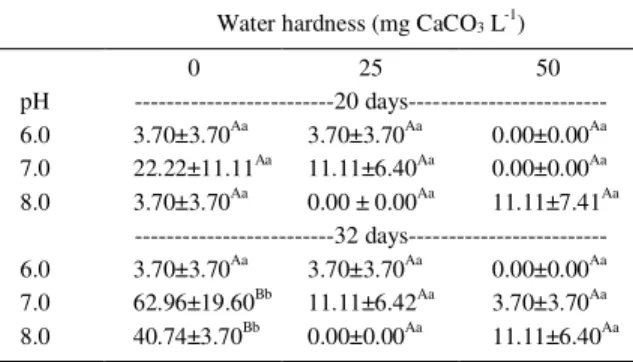
Dissolved oxygen, temperature, total ammonia, and nitrite did not show any significant difference among treatments. Twenty days after the beginning of the experiment there was no significant difference of mortality among treatments. However after 32 days, juveniles exposed to pH 7.0 and 8.0 at zero water hardness presented significantly higher mortality than those submitted to the other treatments (Table 1). After 32 days of experiment, coefficients of variability for weight (overall range 15.37-33.99%) and length (over all range 5.46-10.72%) wer e not significantly affected by either pH or water hardness
The present study verified that silver catfish juveniles maintained in very soft water (near zero water hardness) showed lower mortality at pH 6.0 (3.70%)
than those kept at pH 7.0 (62.96%) and 8.0 (40.74%) after 32 days of experiment, demonstrating that at near zero water hardness the use of slightly acidic water (pH 6.0) is advantageous to juveniles of this species. On the other hand, the increase of water hardness up to 25mg CaCO
3 L
-1 was enough to reduce mortality in
silver catfish at pH 7.0 and 8.0. This was expected because there mortality was low and not significantly affected by pH when this species was exposed for 30 days to pH 5.5, 7.5 or 9.0 and water hardness between 20-70mg CaCO
3 L
-1 (COPATTI et al., 2005; COPATTI et
al., 2011a, b, in press).
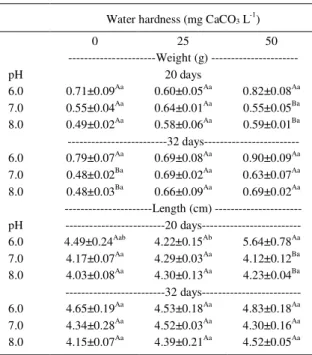
Twenty days after the beginning of the experiment, weight, length, biomass per tank and SGR were significantly higher in juveniles exposed to pH 6.0 than in those kept at pH 7.0 and 8.0 at 50mg CaCO
3
L-1. Length of juveniles exposed to pH 6.0 and 25mg
CaCO
3 L
-1 was significantly lower than of those
maintained at the same pH and 50mg CaCO
3 L -1. At 32
days of experiment there was no significant difference in length among treatments and water pH also did not affect significantly weight of silver catfish exposed to water hardness of 25 and 50mg CaCO
3 L
-1 (Tables 2 and
3). These results are in agreement with the fact that water hardness in the 30-180mg CaCO
3 L
-1 range did
not affect growth of silver catfish juveniles maintained at pH 7.0 for 30 days (COPATTI et al., 2011a, in press). Weight, biomass per tank and SGR of juveniles exposed to pH 6.0 and zero water hardness was significantly higher than those kept at the same water hardness and other pH (Tables 2 and 3). In addition, after 32 days of experiment, fish exposed to pH 7.0 and zero water hardness showed lower biomass per tank than those kept at 25 and 50mg CaCO
3 L -1.
Condition factor presented significantly lower values in fish exposed to pH 7.0 at zero water hardness than those maintained at pH 7.0 and 50mg CaCO
3 L -1 and
those at pH 6.0 and zero water hardness (Table 3). Growth of silver catfish juveniles kept at pH 6.0 was not affected by water hardness. This was in agreement with the fact that larvae survival in striped bass Morone saxatilis and Mozambique tilapia
Oreochromis mossambicus raised at optimum pH
(6.6-6.8) were not affected by water hardness of 3-250 and 3-96mg CaCO
3 L
-1, respectively (GRIZZLE et al., 1992,
HWANG et al., 1996). However, results in other species were different, because white bass female X sunshine bass male juveniles died in a few hours in water with 5-6mg CaCO
3 L
-1 at circumneutral pH and increase of
water hardness to 210mg CaCO
3 L
-1 increased survival
to 64% (GRIZZLE & MAULDIN, 1999). Juveniles of striped bass and striped bass hybrid (M. chrysops X
M. saxatilis) had 80-99% survival compared with 16%
Table 1 - Effect of water hardness and pH on silver catfish mortality (%).
Water hardness (mg CaCO3 L-1)
0 25 50
pH ---20
days---6.0 3.70±3.70Aa 3.70±3.70Aa 0.00±0.00Aa
7.0 22.22±11.11Aa 11.11±6.40Aa 0.00±0.00Aa
8.0 3.70±3.70Aa 0.00 ± 0.00Aa 11.11±7.41Aa
---32
days---6.0 3.70±3.70Aa 3.70±3.70Aa 0.00±0.00Aa
7.0 62.96±19.60Bb 11.11±6.42Aa 3.70±3.70Aa
8.0 40.74±3.70Bb 0.00±0.00Aa 11.11±6.40Aa
survival for a group of fish without additional Ca2+ in
the water before (20 to 45-100mg CaCO3L-1) or after (10
to 70-200mg CaCO3 L-1) harvest (pH 7.0) (GRIZZLE et
al., 1985).
In zero water hardness, silver catfish juveniles presented higher growth at pH 6.0 than at pH 7.0 and 8.0. A hypothesis to explain this result would be that at pH 7.0 and 8.0 NH3 levels were higher than at pH 6.0. However, maximum NH3 levels at pH 8.0 were 0.016mg L-1 in this study. According to WOOD (2004)
this value is within the range that might even improve growth in rainbow trout, Oncorhynchus mykiss. Therefore, is unlikely that NH3 levels might be responsible for the lower growth of silver catfish at pH 7.0 and 8.0 than at pH 6.0. It is possible that at pH 6.0 silver catfish would present lower loss of ions than at pH 7.0 and 8.0 when exposed to zero water hardness, but additional studies must be performed to confirm this hypothesis.
Prolonged exposure of tambaqui Colossoma
macropomum, a species that lives in the acidic
Amazon black waters to slightly alkaline soft water (pH 8.0) resulted in several changes in the blood physiology and reduced growth after 40 days of the exposition
(ARIDE et al., 2007). However, acidic water (pH 5.2-5.5) impaired growth in rainbow trout and silver catfish at water hardness 2.5 and 20mg CaCO3 L-1, respectively
(D’CRUZ & WOOD, 1998; COPATTI et al., 2005). Very soft hardness (zero) decreased growth of silver catfish exposed to pH 7.0 and 8.0 compared to higher hardness (25 and 50mg CaCO3 L-1). TOWNSEND
et al. (2003) concluded that at pH around 8.2 the best water hardness for survival, growth, and biomass gain for larvae of this species was 30-70mg CaCO3 L-1
(hardness lower than 30mg CaCO3 L-1 were not tested).
However, in rainbow trout, the average growth rate of fish maintained in water of higher Ca2+ concentrations
(40mg CaCO3 L-1) was significantly higher than that of
fish kept at 5mg CaCO3 L-1 and pH 5.3 or 6.5 (RODGERS, Table 2 - Effect of water hardness and pH on silver catfish weight
and length.
Water hardness (mg CaCO3 L-1)
0 25 50
Weight (g)
---pH 20 days
6.0 0.71±0.09Aa 0.60±0.05Aa 0.82±0.08Aa
7.0 0.55±0.04Aa 0.64±0.01Aa 0.55±0.05Ba
8.0 0.49±0.02Aa 0.58±0.06Aa 0.59±0.01Ba
---32
days---6.0 0.79±0.07Aa 0.69±0.08Aa 0.90±0.09Aa
7.0 0.48±0.02Ba 0.69±0.02Aa 0.63±0.07Aa
8.0 0.48±0.03Ba 0.66±0.09Aa 0.69±0.02Aa
Length (cm) ---pH ---20
days---6.0 4.49±0.24Aab 4.22±0.15Ab 5.64±0.78Aa
7.0 4.17±0.07Aa 4.29±0.03Aa 4.12±0.12Ba
8.0 4.03±0.08Aa 4.30±0.13Aa 4.23±0.04Ba
---32
days---6.0 4.65±0.19Aa 4.53±0.18Aa 4.83±0.18Aa
7.0 4.34±0.28Aa 4.52±0.03Aa 4.30±0.16Aa
8.0 4.15±0.07Aa 4.39±0.21Aa 4.52±0.05Aa
Values are reported as mean SEM, n=3.Means identified by different capital letters in the columns (in the same period of time) or small letters in the rows were significantly different (P<0.05) as determined by two-way ANOVA and Tukey comparison of mean values.
Table 3 - Effect of water hardness and pH on silver catfish standard growth rate, biomass per tank and condition factor.
Water hardness (mg CaCO3 L-1)
0 25 50
---Standard growth rate (% day-1) ---pH ---0-20
days---6.0 0.76±0.62Aa -0.09±0.44Aa 1.51±0.50Aa
7.0 -0.40±0.40Aa 0.32±0.07Aa -0.50±0.42Ba
8.0 -1.08±0.21Aa -0.22±0.52Aa -0.08±0.07ABa
20-32 days
6.0 0.82±0.25Aa 0.38±0.35Aa 1.21±0.31Aa
7.0 -0.72±0.13Ba 0.40±0.07Aa 0.12±0.34Aa
8.0 -0.74±0.17Ba 0.23±0.41Aa 0.40±0.11Aa
Biomass per tank (g) ---pH ---20
days---6.0 6.21±0.96Aa 5.12±0.56Aa 7.41±0.73Aa
7.0 3.93±0.80Aa 5.16±0.44Aa 4.95±0.42Ba
8.0 4.22±0.23Aa 5.25±0.57Aa 4.36±0.12ABa
---32
days---6.0 6.88±0.78 Aa 5.99±0.79 Aa 8.07±0.78 Aa
7.0 1.62±1.07 Bb 5.49±0.41 Aa 5.52±0.78 Aa
8.0 2.53±0.06 Ba 5.94±0.82 Aa 5.07±0.62 Aa
---Condition factor (g cm-3) ---pH ---20
days---6.0 0.78±0.03Aa 0.79±0.03Aa 0.58±0.02Aa
7.0 0.76±0.03Aa 0.82±0.04Aa 0.78±0.03Aa
8.0 0.74±0.02Aa 0.73±0.03Aa 0.78±0.03Aa
---32
days---6.0 0.78±0.03Aa 0.78±0.03Aa 0.78±0.03Aa
7.0 0.60±0.12Bb 0.60±0.12Bb 0.60±0.12Bb
8.0 0.66±0.01ABa 0.66±0.01ABa 0.66±0.01ABa
1984). In white bass, Morone chrysops X sunshine bass M. saxatilis, and Mozambique tilapia growth was not affected by different Ca2+ concentrations (2 to 96mg
CaCO
3 L
-1 and pH 6.9) (SEALS et al., 1994; HWANG et
al., 1996). Fry of channel catfish, Ictalurus punctatus, appeared lethargic and were spread out over the bottom in water with pH 7.0 and low Ca2+ concentration (below
5mg CaCO
3 L
-1) (TUCKER & STEEBY, 1993). The same
authors observed that 100 mg CaCO
3 L
-1 afforded no
significant benefit compared to 10mg CaCO
3 L -1, so
this was the minimum Ca2+ concentration recommended.
Our data allow concluding that water hardness of 25-50mg CaCO
3 L
-1 is indicated to raise
silver catfish juveniles at the 7.0-8.0 pH range, but at pH 6.0 the range can be extended to at least 0-50mg CaCO
3 L
-1. In very soft and acidic waters (pH 3.9-5.5),
as those found in some black rivers from Amazon (PARRA & BALDISSEROTTO, 2007), fish farmers that want to raise silver catfish could adjust water pH up to 6.0 without changing water hardness.
REFERENCES
ARIDE, P.H.R. et al. Tolerance response of tambaqui
Colossoma macropomum (Cuvier) to water pH. Aquaculture Research, v.38, p.588-594, 2007. Available from: <http:// o n l i n e l i b r a r y . w i l e y . c o m / d o i / 1 0 . 1 1 1 1 / j . 1 3 6 5 -2109.2007.01693.x/pdf>. Acessed: Apr 29, 2011. doi:
10.1111/j.1365-2109.2007.01693.x.
BOLNER, K.C.S.; BALDISSEROTTO, B. Water pH and urinary excretion in silver catfish Rhamdia quelen. Journal of Fish Biology, v.70, p.50-64, 2007. Available from: <http:// o n l i n e l i b r a r y . w i l e y . c o m / d o i / 1 0 . 1 1 1 1 / j . 1 0 9 5 -8649.2006.01253.x/pdf>. Acessed: Apr. 29, 2011. doi: 10.1111/j.1095-8649.2006.01253.x.
BOYD, C.E. Water quality management for pond fish culture: research and development. International Center for Aquaculture and Aquatic Environments, v.43, p.1-37, 1998.
COPATTI, C.E. et al. Effect of dietary calcium on growth and survival of silver catfish juveniles, Rham dia quelen
(Heptapteridae), exposed to different water pH. Aquaculture Nutrition, v.11, p.345-350, 2005. Available from: <http:// o n l i n e l i b r a r y . w i l e y . c o m / d o i / 1 0 . 1 1 1 1 / j . 1 3 6 5 -2095.2005.00355.x/pdf>. Acessed: Apr. 29, 2011. doi: 10.1111/j.1365-2095.2005.00355.x.
COPATTI, C.E. et al. Interaction of water hardness and pH on growth of silver catfish, Rhamdia quelen, juveniles. Journal of the World Aquaculture Society, in press 2011a. COPATTI, C.E. et al. Dietary salt and water pH effects on growth and Na+ fluxes of silver catfish juveniles. Acta
Scientiarum, Animal Sciences, in press 2011b.
D’CRUZ, L.M.; WOOD, C.M. The influence of dietary salt and energy on the response to low pH in juvenile rainbow trout.
Physiological Zoology, v.71, p.642-657, 1998. Available
from: <http://www.ncbi.nlm.nih.gov/pubmed/9798252>. Acessed: Apr. 29, 2011.
EVANS, D.H. et al. The multifunctional fish gill: dominant site of gas exchange, osmoregulation, acid-base regulation, and excretion of nitrogenous waste. Physiological Reviews, v.85, p.97-177, 2005. Available from: <http://physrev.physiology.org/ content/85/1/97.full.pdf+html>. Acessed: Apr. 29, 2011. doi: 10.1152/physrev.00050.2003.
GOMES, L.C. et al. Biologia do Rhamdia quelen (Teleostei, Pimelodidae). Ciência Rural, v.30, p.179-185, 2000. Available from: <http://www.scielo.br/scielo.php?script=sci_arttext&pid=S0103-84782000000100029 &lng=en&nrm=iso>. Acessed: Apr. 29, 2011. doi: 10.1590/S0103-84782000000100029.
GREENBERG, A.E. et al. Standard methods for the examination of water and wastewater. Illinois: Bru-El, 1976. 1093p.
GRIZZLE, J.M.; MAULDIN II, A.C. Increased postharvest survival of young white bass and sunshine bass by addition of calcium and sodium chloride to soft water. North American Journal of Aquaculture, v.61, p.146-149, 1999. Available from: <http:// www.informaworld.com/smpp/content~db=all~content=a932082316. Acessed: Apr. 29, 2011. doi: 10.1577/1548-8454.
GRIZZLE, J.M. et al. Effects of sodium chloride and calcium chloride on survival of larval striped bass. Journal of Aquatic Animal Health, v.4, p.281-285, 1992. Available from: <http:// www.informaworld.com/smpp/content~db=all~content=a932111379. Acessed: Apr. 29, 2011.
G RI ZZLE, J.M. et a l. Su rviva l of juvenile str iped bass (Morone saxatilis) and Morone hybrid bass (Morone crysops
X Morone saxatilis) increased by addition of calcium to soft water. Aquaculture, v.46, p.167-171, 1985. Available from: < h t t p : / / w w w . s c i e n c e d i r e c t . c o m / science? _ ob= Ar ticleUR L& _ u di= B 6 T 4 D -4 9 N Y 5 8 6 -6 B & _user=687358&_coverDate=05%2F15%2F1985&_rdoc=9&_fmt= high&_orig=browse&_origin=browse&_zone=rslt_list_item&_srch=doc-i n f o % 2 8 % 2 3 t o c % 2 3 4 9 7 2 % 2 3 1 9 8 5 % 2 3 9 9 9 5 3 9 9 9 7 %23462707%23FLP%23display%23Volume%29&_cdi=4972&_sort=d& _ d o c a n c h o r = & _ c t = 9 & _ a c c t = C 0 0 0 0 3 7 8 9 9 & _ v e r s i o n = 1 & _ u r l Ve r s i o n = 0 & _ u s e r i d = 6 8 7 3 5 8 & m d5= 8e1 59 ed0 25 06 0 59 b8 3 99 f4 0 2f3 fe2f2 3&sea rchtype=a . Acessed: Apr. 29, 2011.
HEATH, A.G. Water pollution and fish physiology. Florida: Lewis Publishers, 1995. 359p.
HWANG, P.P. et al. Effect of environmental calcium levels on calcium uptake in tilapia larvae Oreochromis mossambicus.
Fish Physiology and Biochemistry, v.15, p.363-370, 1996. Available from: <http://www.springerlink.com/content/ q274g563645476p2/>. Acessed: Apr. 29, 2011. doi: 10.1007/ BF01875578.
PARRA, J.E.G.; BALDISSEROTTO, B. Effect of water pH and hardness on survival and growth of freshwater teleosts. In: BALDISSEROTTO, B. et al. Fish osmoregulation. New Hampshire: Science Publishers, 2007. p.135-150.
PIPER, R.G. et al. Fish hatchery management. Washington: US Fish and Wildlife Service, 1982. 517p. Available from: < h t t p : / / w w w . n h b s . c o m / f i s h _ h a t c h e r y _management_tefno_150836.html>. Acessed: Apr. 29, 2011. RODGERS, D.W. Ambient pH and calcium concentration as modifiers of growth and calcium dynamics of brook trout,
Salvelinus fontinalis. Canadian Journal of Fisheries and Aquatic Sciences, v.41, p.1774-1780, 1984. Available from: <http://www.nrcresearchpress.com/doi/abs/10.1139/f84-219>. Acessed: Apr. 29, 2011. doi: 10.1139/f84-219.
SEALS, C. et al. Environmental calcium does not affect production or selected blood characteristics of sunshine bass reared under normal culture conditions. Progressive Fish-Culturist, v.56, p.269-272, 1994. Available from: <http://www.informaworld.com/smpp/ content~db=all~content=a932117086>. Acessed: Apr. 29, 2011. doi: 10.1577/1548-8640.
TOWNSEND, C.R.; BALDISSEROTTO, B. Survival of silver catfish juveniles exposed to acute changes of water pH and hardness. Aquaculture International, v.9, p.413-419, 2001. Available from: <http://www.springerlink.com/content/ u118h8t477213668/fulltext.pdf>. Acessed: Apr. 29, 2011. doi: 10.1023/A:1020592226860.
TOWNSEND, C.R. et al. Growth and survival of Rhamdia quelen
(Siluriformes, Pimelodidae) larvae exposes to different levels of water hardness. Aquaculture, v.215, p.103-108, 2003. Available from: < h t t p : / / w w w . s c i e n c e d i r e c t . c o m / s c i e n c e ? _ o b = A r t i c l e U R L & _ u d i = B 6 T 4 D - 4 5 T T P P
W-3 & _ u s e r = 6 8 7 W-3 5 8 & _ c o v e r D a t e = 0 1 % 2 F 1 0 % 2 F 2 0 0 W-3 & _rdoc=1&_fmt=high&_orig=gateway&_origin=gateway&_sort=d& _docanchor=&view=c&_searchStrId=1735083104&_rerunOrigin= google&_acct=C000037899&_version=1&_urlVersion=0&_userid =687358&md5=99a0e82602d39525ffe2cd2674531543&searchtype=a. Acessed: Apr. 29, 2011. doi: 10.1016/S0044-8486(02)00168-0. TUCKER, C.S.; STEEBY, J.A. A practical calcium hardness criterion for channel catfish hatchery water supplies. Journal of the World Aquaculture Society, v.24, p.396-401, 1993. Available from: <http://onlinelibrary.wiley.com/doi/10.1111/ j.1749-7345.1993.tb00171.x/abstract. Acessed: Apr. 29, 2011. doi: 10.1111/j.1749-7345.1993.tb00171.x.
WILKIE, M.P.; WOOD, C.M. The adaptations of fish to extremely alkaline environments. ComparativeBiochemistry andPhysiology Part B, v.113, p.665-673, 1996. Available from: <http://www.ingentaconnect.com/content/els/03050491/ 1996/00000113/00000004/art02092. Acessed: Apr. 29, 2011. doi: 10.1016/0305-0491(95)02092-6.
WOOD, C.M. Dogmas and controversies in the handling of nitrogenous wastes: is exogenous ammonia a growth stimulant in fish? Journal of Experimental Biology, v.207, p.2043-2054, 2004. Available from: <http://jeb.biologists.org/content/ 207/12/2043.full.pdf+html. Acessed: Apr. 29, 2011. doi: 10.1242/jeb.00990.
ZAIONS, M.I.; BALDISSEROTTO, B. Na+ and K+ Body levels