Dietary salt and water pH effects on growth and Na
+fluxes of silver
catfish juveniles
Carlos Eduardo Copatti1, Luciano de Oliveira Garcia2, Daiani Kochhann3, Mauro Alves Cunha3 and Bernardo Baldisserotto3*
1
Departamento de Ciências da Saúde, Universidade de Cruz Alta, Cruz Alta, Rio Grande do Sul, Brazil. 2Estação Marinha de Aquacultura, Instituto de Oceanografia, Universidade Federal do Rio Grande, Rio Grande, Rio Grande do Sul, Brazil.
3Departamento de Fisiologia e Farmacologia, Universidade Federal de Santa Maria, Av. Roraima, 1000, 97105-900, Camobi,
Santa Maria, Rio Grande do Sul, Brazil. *Author for correspondence. E-mail: [email protected]
ABSTRACT. This study verified the optimum dietary salt level for the growth and ion regulation of silver catfish juveniles at different water pH levels (5.5, 7.0 and 9.0). The control diet was supplemented with NaCl to yield experimental diets with 0.5, 1.0 and 2.0% NaCl. Juveniles were collected at 15 and 35 days after the beginning of experiment for analyses of Na+ net fluxes. Exposure of silver catfish juveniles to alkaline or acidic water did not affect their survival. Fish fed with diets without NaCl supplementation and exposed to pH 7.0 showed significantly higher weight, length, specific growth rate and biomass per tank than those exposed to pH 5.5. Ionoregulatory disturbances of silver catfish maintained at all pH are less pronounced when fed higher dietary salt supplementation (1.0-2.0% NaCl). The increase of dietary NaCl reduced body Na+ loss and protected against the impact of acidic water on growth.
Keywords: acidic water, alkaline water, dietary NaCl.
RESUMO. Efeito do sal na dieta e do pH da água no crescimento de juvenis de jundiá. Este estudo verificou o melhor nível de dieta de sal para o crescimento e regulação iônica de juvenis de jundiá em diferentes níveis de pH da água (5,5; 7,0 e 9,0). A dieta controle foi suplementada com 0,5; 1,0 e 2,0% de NaCl. Juvenis foram coletados aos 15 e 35 dias de experimento para análise dos fluxos líquidos de Na+. A exposição de juvenis de jundiá para águas ácidas ou alcalinas não afetou sua sobrevivência. Exemplares alimentados com dietas sem adição de NaCl e expostos em pH 7,0 mostraram peso, comprimento, taxa de crescimento específico e biomassa/tanque significativamente maiores que aqueles expostos em pH 5,5. Distúrbios ionorregulatórios em jundiás mantidos em todos os pH são menos pronunciados quando em exemplares alimentados com dietas com maior suplmentação de sal (1,0-2,0% NaCl). O aumento de NaCl na dieta reduziu a perda de Na+ corporal e protegeu contra o impacto da acidez da água no crescimento dos juvenis. Palavras-chave: águas ácidas, águas alcalinas, dieta de NaCl.
Introduction
Many fish are intolerant to low pH, while others, although more tolerant, will avoid low pH if possible (GRAHAM; HASTINGS, 1984). Growth of most fish species is affected at pH below 6.0 or above 9.0 (PARRA; BALDISSEROTTO, 2007). At low pH, acid load through the gills is the source of acid-base disturbance (WOOD, 2001)
and there is an increase in H+ and NH
4+ excretion
in urine to compensate this problem (BOLNER; BALDISSEROTTO, 2007).
Silver catfish, Rhamdia quelen, occurs from central
Argentina to southern Mexico (GOMES et al., 2000). Accepts artificial food and possesses high fertility, fast growth, and good acceptance in the fish market, and southern Brazil is the main producer of
this species (BALDISSEROTTO, 2009). The best
pH range for survival and growth of larvae of this species is 8.0-8.5 (LOPES et al., 2001) and pH 5.5 or 9.0 decreased juveniles growth compared to pH 7.5 (COPATTI et al., 2005).
In South Brazil, where the culture of silver catfish is increasing, surface waters can sometimes present pH lower than 5.0, and in underground waters used by fish farmers pH can reach 9.4 (ZAIONS; BALDISSEROTTO, 2000). Survival of this species in acidic and alkaline pH is improved by
the addition of Ca2+ to the water (TOWNSEND;
Oncorhynchus mykiss juveniles compared to a low-salt diet (D’CRUZ; WOOD, 1998), it might be interesting to adapt the fish diet when water
conditions are not optimal. However, dietary Ca2+
supplementation up to 2.4% did not improve growth of silver catfish juveniles exposed to acidic or alkaline pH (COPATTI et al., 2005). Dietary NaCl supplementation (up to 6.0%) decreased growth and was also ineffective as a therapy for ichthyophthiriasis in silver catfish juveniles (GARCIA et al., 2007), but no studies were performed regarding dietary salt supplementation and growth in acidic or alkaline waters. Therefore, the objective of this study was to determine the optimum dietary NaCl levels at different pH for
survival, growth and Na+ regulation of silver catfish
juveniles.
Material and methods
Experimental animal and management conditions
Silver catfish juveniles (n = 468) were obtained from a fish culture in Santa Maria, southern Brazil. These juveniles were transferred to the Fish Physiology Laboratory at the Universidade Federal de Santa Maria and were maintained in three continuously aerated (two air pumps of 12 W each)
250 L tanks. Stocking density was 2.56 g L-1. After
20 days of acclimation, juveniles (5.30 ± 0.19 g and 8.66 ± 0.11 cm) were then transferred to 36 continuously aerated 40 L polypropylene boxes and kept for 35 days. Thirteen juveniles were placed
in each box (3.98 g L-1).
Tank management and water quality
Juveniles were fed once a day, at 8:00 a.m. for 35 days (5.0% body mass). Uneaten food, as well as other residues and feces were siphoned 30 min. after furnishing the food, and consequently at least 20% of the water was replaced with water previously adjusted (stabilized two weeks before the start of the experimental period) to the appropriate pH using
NaOH or H2SO4 0.5 M. Whenever necessary, water
change was increased to reduce of ammonia and nitrite levels. Dead fish were also removed daily and mortality was registered.
Water pH was monitored daily, several times, from 7:30 a.m. to 5:30 p.m. with a Quimis pH meter (model 400A). Total ammonia levels were verified once a week by nesslerization according to Greenberg et al. (1976). Dissolved oxygen levels and temperature were measured daily using an YSI oxygen meter (model Y5512, Yellow Springs, USA), and temperature was maintained with the use of an
air conditioner in the laboratory. Water hardness was calculated once a week with the EDTA titrimetric method (GREENBERG et al., 1976). Alkalinity and nitrite levels were determined once a week according to Boyd (1998).
Experimental procedure
Twelve treatments (three pH x four treatment diets) were tested in triplicate. Water pH was fixed at 5.5 (5.47-5.49), 7.0 (6.95-6.99) and 9.0 (9.01-9.03), and the diets at 0.0; 0.5; 1.0 and 2.0% NaCl in the diet.
Alkalinity and total ammonia were 3.0-4.5 mg L-1
CaCO3 and 1.50-1.74 mg L-1, 19.0-23.0 mg L-1
CaCO3 and 1.18-1.39 mg L-1, 51.5-52.5 mg L-1
CaCO3 and 1.18-1.67 mg L-1 at pH 5.5, 7.0 and 9.0,
respectively. Nitrite was below 0.05 mg L-1, water
hardness levels 21.6-23.3 mg L-1 CaCO
3, dissolved
oxygen levels 5.38-6.80 mg L-1, and temperature
19-20o C. Waterborne Na+ level was 150.6mol L-1.
Experimental diets
The ingredients were ground in a blender when necessary, followed by hydration with approximately 50.0% v/w tap water. All diets were prepared based on a feed developed for silver catfish by Copatti et al. (2005), which has sugar cane yeast and soybean meal as its main constituents, and 32.0% crude
protein and 3,500 kcal kg-1 digestible energy. Salt
was added to the food paste. The resulting paste was mixed and extruded through a pasta maker, air-dried, and broken into small pellets with a grinder.
Actual measured Na+ concentrations in the four
diets were 0.07 0.002, 0.30 0.006, 0.60 0.012
and 1.22 0.030 g kg-1, respectively; K+
concentrations were 2.18 0.174, 1.95 0.07,
1.75 0.03 and 1.64 0.01 g kg-1, respectively; and
Cl- concentrations were 3.83 1.24, 4.40 1.28,
5.50 1.35 and 14.06 4.19 g kg-1, respectively.
Biometric analysis
Fifteen days after the start of the experiments, ten juveniles per replication were collected for measurement of weight and length, and afterwards returned to the tanks. At the end of the experiment (35 days), all remaining juveniles were collected and measured. Specific growth rate (SGR), coefficient of variability (CV) for weight and length, and condition factor (CF) were calculated according to Jobling (1994).
Net ion fluxes
individual chambers (100 mL) with aeration and water adjusted to the same pH values requested by
the experiment for the determination of Na+ ion
fluxes. After a 10 min. settling period, water samples (5 mL) were taken from the chambers at the beginning and end of the exposure time and then
stored in plastic tubes at -20C for posterior analysis
of Na+ levels. Fish were weighed at the end of the
flux experiment. Previous experiments of Rosso et al. (2006) demonstrated that net ion fluxes of juveniles maintained for 24 hours in chambers were not significantly different from the fluxes of those which measurements started around 10 min. after placing them in the chambers.
Water Na+ levels were measured with a B4262
flame spectrophotometer (Micronal, São Paulo
State, Brazil) and net Na+ fluxes were calculated
according to Baldisserotto and Val (2002):
Jnet = V([ion]1 – [ion]2).(Mt)-1
where:
[ion]1 and [ion]2 are the bath Na+
concentrations at the beginning and end of the flux period; V is the bath volume in L; M is the mass of the fish in kg; and t is the duration of the flux period in hours.
Statistical analysis
Homogeneity of variances among the different groups was tested using Levene’s test. Data of treatment groups presented homogeneous variances and were compared by two-way ANOVA (pH X dietary salt supplementations) followed by Tukey’s test. All statistical tests were performed with the aid of the software Statistica version 5.1 (1997). Data
were expressed as means SEM, and the minimum
significance level was set at p < 0.05.
Results and discussion
Oxygen dissolved in water, temperature, total ammonia, and nitrite did not show any significant difference among treatments. Survival of silver catfish juveniles was higher than 90.0% in all treatments, and there were no significant differences among treatments. This was expected because silver catfish can survive acute pH changes within the 4.0-9.0 range without significant rate of mortality for 96 h (ZAIONS; BALDISSEROTTO, 2000), and survival was also not affected in specimens kept at pH 5.5 or 9.0 for 30 days compared to those exposed to pH 7.5 (COPATTI et al., 2005).
Growth performance of silver catfish juveniles were similar or slightly lower than in laboratory
studies that used juveniles of similar size (ANDRADE et al., 2007; COPATTI et al., 2005; PIAIA; BALDISSEROTTO, 2000). However, growth performance of juveniles of this species maintained in earth tanks with abundant zooplankton and fed commercial food is much better (CARNEIRO; MIKOS, 2005).
Growth up to 15 days was also not significantly affected by either pH or dietary NaCl supplementation. Thirty-five days after the beginning
of the experiment, fish fed withdiets without NaCl
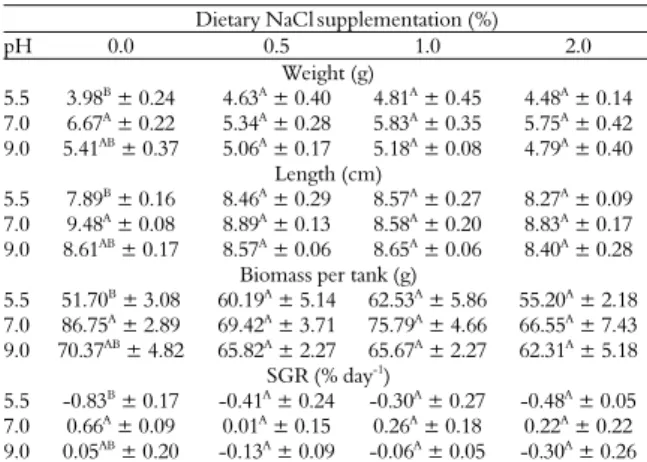
supplementation and exposed to pH 7.0 presented significantly higher weight, length, biomass per tank and SGR than those exposed to pH 5.5. Dietary NaCl supplementation did not improve growth of fish exposed to pH 7.0 and 9.0, but reduced the deleterious effect of pH 5.5 on growth (Table 1).
Condition factor (overall range 0.75-0.93 g cm-3);
coefficients of variability for weight (overall range 23.54-36.00%) and length (overall range 7.88-9.48%) were not significantly affected by either pH or diets.
Similarly, the negative influence of acidic pH on fish growth was previously reported in others
species, such as brook trout, Salvelinus fontinalis, and
rainbow trout, which presented lower growth at acidic water (pH 5.3) than neutral waters (pH 7.0) (MENENDEZ, 1976; RODGERS, 1984). Some studies proposed that acidic pH may impair growth in rainbow trout due to a decrease in food intake (D’CRUZ; WOOD, 1998), as was observed in silver catfish (COPATTI et al., 2005).
Table 1. Effect of dietary salt (NaCl) supplementation and pH on biometric parameters of silver catfish after 35 days.
Dietary NaClsupplementation (%)
pH 0.0 0.5 1.0 2.0
Weight (g)
5.5 3.98B ± 0.24 4.63A ± 0.40 4.81A ± 0.45 4.48A ± 0.14
7.0 6.67A
± 0.22 5.34A
± 0.28 5.83A
± 0.35 5.75A
± 0.42 9.0 5.41AB ± 0.37 5.06A ± 0.17 5.18A ± 0.08 4.79A ± 0.40
Length (cm) 5.5 7.89B
± 0.16 8.46A
± 0.29 8.57A
± 0.27 8.27A
± 0.09 7.0 9.48A ± 0.08 8.89A ± 0.13 8.58A ± 0.20 8.83A ± 0.17
9.0 8.61AB
± 0.17 8.57A
± 0.06 8.65A
± 0.06 8.40A
± 0.28 Biomass per tank (g)
5.5 51.70B ± 3.08 60.19A ± 5.14 62.53A ± 5.86 55.20A ± 2.18
7.0 86.75A
± 2.89 69.42A
± 3.71 75.79A
± 4.66 66.55A
± 7.43 9.0 70.37AB ± 4.82 65.82A ± 2.27 65.67A ± 2.27 62.31A ± 5.18
SGR (% day-1
)
5.5 -0.83B ± 0.17 -0.41A ± 0.24 -0.30A ± 0.27 -0.48A ± 0.05
7.0 0.66A ± 0.09 0.01A ± 0.15 0.26A ± 0.18 0.22A ± 0.22
9.0 0.05AB
± 0.20 -0.13A
± 0.09 -0.06A
± 0.05 -0.30A
± 0.26
Values are reported as mean S.E.M, n = 3.Means identified by different capital letters in the columns were significantly different (p < 0.05) as determined by analysis of variance and Tukey comparison of mean values. In the rows, there were no significant differences among different dietary NaCl supplementation for the same pH value.
Fifteen days after the beginning of the experiment specimens maintained at pH 9.0 and fed 0.0 and 2.0% dietary NaCl supplementation
showed net Na+ influxes significantly higher than
same diets at the other pH (Figure 1A). At 35 days of experiment, individuals exposed to all pH and fed 0.0 and 0.5% NaCl dietary supplementation
presented net Na+ loss, and those exposed to pH
9.0 showed significantly higher net Na+ loss than
those maintained at pH 5.5 and 7.0. However, silver catfish fed with 1.0 and 2.0% NaCl dietary
supplementation presented net Na+ uptake or very
low Na+ loss (pH 7.0) (Figure 1B). Therefore,
ionoregulatory disturbances at the end of the experiment were less pronounced in silver catfish fed 1.0-2.0% NaCl dietary supplementation, regardless of pH exposure.
Net N
a
+ fl
ux
(m
m
o
l kg
-1 h -1) 500 0 -500 1000
A
Bb Aa Bc Bc Bb Aa ABbc Bc Ab Bc Ac Aa5.5 7.0 9.0 pH (units)
Net N
a
+ fl
ux
(m
m
o
l kg
-1 h -1) 800 600 400 200 0 -200 -400 -600 -800 -1000 -1200 Ab Ab BcBa Ab Ac Ca Ca Bb Bb Aa Aa
B
5.5 7.0 9.0 pH (units)
Figure 1. Net Na+ fluxes in R. quelen after 15 (A) and 35 days (B) exposure to different pH and dietary NaCl supplementation. Data are expressed as mean SEM, n = 9. Positive values indicate net influxes and negative values net effluxes.
Means identified by different capital letters indicate significant difference between pH in the same dietary NaCl supplementation while means identified by different small letters indicate significant difference between different dietary NaCl supplementation at the same pH as determinate by two-way ANOVA and Tukey comparison of mean values (p < 0.05).
Rainbow trout exposed to acidic pH (5.2) for 28 days and fed on a low NaCl diet (0.10-0.18%), regardless of energy content, presented a decrease in
plasma and whole body Na+, but fish fed with 0.6%
NaCl did not show any ionic imbalance. Therefore, it is the salt content of the diet rather than the energy content that is critical in protecting against
the effect of acidic pH (5.2) (D’CRUZ; WOOD,
1998). In acidic water, high H+ concentrations
disrupt the tight junctions of gill epithelia, increasing ion loss by a paracellular route (WOOD, 2001), and leading to whole body ion loss, as observed in silver catfish (ZAIONS; BALDISSEROTTO, 2000). Silver catfish exposed to pH 5.0 and 6.0 for 24 h also showed reduced
plasma Na+ levels compared to those maintained at
water pH 7.5 (BOLNER; BALDISSEROTTO,
2007). This change in Na+ plasma levels would
require more energy to maintain the ionoregulatory balance, and explain the lower growth observed in the fish kept at pH 5.5.
Dietary salts may become very important in maintaining body ion levels during acid stress (D’CRUZ; WOOD, 1998). Starved rainbow trout (or fed with a very limited diet) showed ionoregulatory changes during exposure to acidic environment (pH 5.2), but when they were fed with adequate amount of salts (0.6% NaCl) the effect of low pH was reduced or did not occur (D’CRUZ et al., 1998). Therefore, dietary salt can replace branchial ion loss, because when fish are exposed to acidic pH branchial ion influx is lower and the efflux is higher than in neutral waters, and dietary salt supplementation may help maintain ionic balance (D’CRUZ; WOOD, 1998). To our knowledge, there are no studies regarding the effects of dietary salt in fish exposed to alkaline waters.
The intestine (or the pyloric ceca) can absorb ions provided by feeding (FERREIRA; BALDISSEROTTO, 2007). Therefore, diet can be an important ion source for the ionoregulatory needs of fish living in hyposaline environments. Dietary salt supplementation can also decrease energy spent on ionoregulation, and consequently more will be available for growth (D’CRUZ; WOOD, 1998). Therefore, in the present study it was hypothesized that NaCl-supplemented diets would protect against acidic or alkaline pH, compensating ion loss. Dietary NaCl supplementation is not effective to increase silver catfish growth in neutral and alkaline waters, but improves growth in juveniles exposed to acidic pH.
In addition, based in the results of net Na+ fluxes it
can be recommended a dietary NaCl
supplementation of 1.0-2.0% because the Na+
imbalance is less pronounced. Dietary NaCl supplementation higher than 2.0% is not recommended for silver catfish because 6.0% dietary NaCl supplementation decreases growth rate (GARCIA et al., 2007).
0 0.5
1.0 2.0
Dietary salt supplementation (%)
0 0.5
1.0 2.0
Dietary salt supplementation (%)
A
Conclusion
The exposure of silver catfish juveniles to alkaline (pH 9.0) or acidic (pH 5.5) water did not affect survival, but fish kept in acidic water and fed on a diet without NaCl supplementation presented reduced growth compared to those exposed to neutral pH (pH 7.0). Dietary NaCl supplementation in the 0.5-2.0% range protects against the impact of
acidic water, but based in the results of net Na+
fluxes it can be recommended a dietary NaCl
supplementation of 1.0-2.0% because the Na+
imbalance is less pronounced.
Acknowledgements
This study was supported by CNPq (Conselho Nacional de Desenvolvimento Científico e Tecnológico).
References
ANDRADE, L. S.; ANDRADE, R. L. B.; BECKER, A. G.; ROSSATO, L. V.; ROCHA, J. F.; BALDISSEROTTO, B. Interaction of water alkalinity and stocking density on survival and growth of silver catfish,
Rhamdia quelen, juveniles. Journal of the World
Aquaculture Society, v. 38, n. 3, p. 454-458, 2007. BALDISSEROTTO, B. Piscicultura continental no Rio Grande do Sul: situação atual, problemas e perspectivas para o futuro. Ciência Rural, v. 39, n. 1, p. 291-299, 2009.
BALDISSEROTTO, B.; VAL, A. L. Ion fluxes of Metynnis
hypsauchen, a teleost from the Rio Negro, Amazon,
exposed to an increase of temperature. Brazilian Journal of Biology, v. 62, n. 4, p. 749-752, 2002.
BOLNER, K. C. S.; BALDISSEROTTO, B. Water pH and urinary excretion in silver catfish Rhamdia quelen. Journal of Fish Biology, v. 70, n. 1, p. 50-64, 2007. BOYD, C. E. Water quality management for pond fish culture: research and development. International Center for Aquaculture and Aquatic Environment, v. 43, p. 1-37, 1998.
CARNEIRO, P. C. F.; MIKOS, J. D. Freqüência alimentar e crescimento de alevinos de jundiá, Rhamdia
quelen. Ciência Rural, v. 35, n. 1, p. 187-191, 2005.
COPATTI, C. E.; COLDEBELLA, I. J.; RADÜNZ NETO, J.; GARCIA, L. O.; ROCHA, M. C.; BALDISSEROTTO, B. Effect of dietary calcium on growth and survival of silver catfish juveniles, Rhamdia
quelen (Heptapteridae), exposed to different water pH.
Aquaculture Nutrition, v. 11, n. 5, p. 345-350, 2005. D’CRUZ, L. M.; WOOD, C. M. The influence of dietary salt and energy on the response to low pH in juvenile rainbow trout. Physiological Zoology, v. 71, n. 6, p. 642-657, 1998.
D’CRUZ, L. M.; DOCKRAY, J. J.; MORGAN, I. J.; WOOD, C. M. Physiological effects of sublethal acid exposure in juvenile rainbow trout o a limited ration
during a simulated global warming scenario. Physiological Zoology, v. 71, n. 4, p. 359-376, 1998. FERREIRA, F. W.; BALDISSEROTTO, B. Diet and osmorregulation. In: BALDISSEROTTO, B.; MANCERA, J. M.; KAPOOR, B. G. (Ed.). Fish osmoregulation. New Hampshire: Science Publishers, 2007. p. 67-83.
GARCIA, L. O.; BECKER, A. G.; COPATTI, C. E.; BALDISSEROTTO, B. Salt in the food and water a supportive therapy for Ichthyophthirius multifiliis infestation on silver catfish, Rhamdia quelen, juveniles. Journal of the World Aquaculture Society, v. 38, n. 1, p. 1-11, 2007. GOMES, L. C.; GOLOMBIESKI, J. I.; CHIPPARI GOMES, A. R.; BALDISSEROTTO, B. Biologia do
Rhamdia quelen (Teleostei, Pimelodidae). Ciência Rural,
v. 30, n. 1, p. 179-185, 2000.
GRAHAM, J. H.; HASTINGS, R. W. Distributional patterns of sunfishes on the New Jersey coastal plain. Environmental Biology of Fishes, v. 10, n. 3, p. 137-148, 1984.
GREENBERG, A. E.; TARAS, M. J.; RAND, M. C. Standard methods for the examination of water and wastewater. Illinois: Bru-El Graphic Inc, 1976.
JOBLING, M. Fish bioenergetics. London: Chapman and Hall, 1994.
LOPES, J. M.; SILVA, L. V. F.; BALDISSEROTTO, B. Survival and growth of silver catfish larvae exposed to different water pH. Aquaculture International, v. 9, n. 1, p. 73-80, 2001.
MENENDEZ, R. Chronic effects of reduced pH on brook trout, Salvelinus fontinalis. Journal of Fisheries Research Board Canada, v. 33, n. 1, p. 118-123, 1976. PARRA, J. E. G.; BALDISSEROTTO, B. Effect of water pH and hardness on survival and growth of freshwater teleosts. In: BALDISSEROTTO, B.; MANCERA, J. M.; KAPOOR, B. G. (Ed.). Fish osmoregulation. New Hampshire: Science Publishers, 2007. p. 135-150.
PIAIA, R.; BALDISSEROTTO, B. Densidade de estocagem e crescimento de alevinos de jundiá Rhamdia
quelen (Quoy & Gaimard, 1824). Ciência Rural, v. 30,
n. 3, p. 509-513, 2000.
RODGERS, D. W. Ambient pH and calcium concentration as modifiers of growth and calcium dynamics of brook trout, Salvelinus fontinalis. Canadian Journal of Fisheries and Aquatic Sciences, v. 41, n. 12, p. 1774-1780, 1984.
ROSSO, F. L.; BOLNER, K. C. S.; BALDISSEROTTO, B. Ion fluxes in silver catfish (Rhamdiaquelen) juveniles exposed to different dissolved oxygen levels. Neotropical Ichthyology, v. 4, n. 4, p. 435-440, 2006.
STATISTICA. Version 5.0. Tulsa: StatSoft, Inc., 1997. TOWNSEND, C. R.; BALDISSEROTTO, B. Survival of silver catfish juveniles exposed to acute changes of water pH and hardness. Aquaculture International, v. 9, n. 5, p. 413-419, 2001.
marine and freshwater teleosts. London: Taylor and Francis, 2001. p. 1-89.
ZAIONS, M. I.; BALDISSEROTTO, B. Na+ and K+ Body levels and survival of juveniles of Rhamdia quelen
(Siluriformes, Pimelodidae) exposed to acute changes of water pH. CiênciaRural, v. 30, n. 6, p. 1041-1045, 2000.
Received on September 17, 2010. Accepted on February 2, 2011.