A Work Project, presented as part of the requirements for the Award of a Masters’ Degree in Finance from the NOVA – School of Business and Economics
Private Equity in Germany:
The impact of debt and equity market conditions on the exit choice of private equity funds between 2000 and 2015
Michele Borrelli - 2356
A Project carried out on the Master in Finance Programme, under the supervision of:
Professor Fernando Anjos
Abstract
Private equity funds face an essential decision, when it comes to the divestment choice of a portfolio company. Using a sample of 237 private equity transactions in Germany between 2000 and 2015, I observe that private equity funds take advantage of windows of opportunity being more likely to exit through an initial public offering (IPO) during ‘hot’ equity markets. Furthermore, secondary buyouts might be more resilient to rising interest rates rather than trade sales or IPOs. Due to the presence of more private equity capital in the market, funds tend to overpay for their targets, thereby, significantly increasing the volume of secondary buyouts.
I. Introduction and purpose of the project
Nowadays, companies need to change the way they operate and enter new markets. In addition, they require access to finance, industry know-how, and managerial expertise. Adapting to a frequently changing macroeconomic environment has become more crucial than ever to enhancing productivity and competitiveness.
Private equity is a form of equity investment made into companies which are not publicly traded, or alternatively, the private equity fund engages in the buyout of public companies resulting in the delisting of public equity. After the investment is made, private equity managers work alongside the company’s management to deliver operational improvement due to their industry and market expertise.1
By addressing the challenges companies are facing and therefore playing an important role in the growth and recovery of the world’s economy, private equity has developed as an important field in academic research. However, Gompers (2001) and Lerner (2004) reveal that many questions about private equity remain unanswered. As a fact, private equity funds tend to avoid the public and to provide details about transactions as well as returns on their investments. This is a barrier to extensive quantitative research. Still, to date, research literature has elaborated on various aspects of private equity in detail, such as fundraising, investment determinants, value creation, pricing in buyouts etc., thereby, contributing to a more precise understanding of the private equity industry. Nevertheless, little academic attention has been given to the divestment stage of portfolio companies, the so-called exit phase. The investment of private equity funds is only held for a limited period, typically including a holding period around five years (Gompers et al., 2015). After this period, the private equity fund seeks the
exit of its investment – which implies either an initial public offering (“IPO”), a sale to another company (“trade sale”) or a sale to another private equity fund (“secondary buyout”).
My objective in this working paper is to contribute to a more precise understanding of how and to what extent debt and equity market conditions affect the divestment choice of private equity funds. For this purpose, I construct a new dataset comprised of detailed information on 237 exits. The sample solely contains private equity divestments in mid-sized and large German companies – over EUR 50m in transaction value – which were sold between 2000 and 2015. The private equity market in Germany is one of the most attractive in Europe, alongside that of the UK. The economy is strong, highly competitive and growing sustainably. Berlin, as the capital of Germany, is becoming increasingly an entrepreneurial hub globally and is therefore attracting additional investors, a fact that may also have been strengthened by recent events such as the imminent Brexit, which could lead to a decisive shift of private equity – especially venture capital – investors moving from London to Berlin. German companies enjoy an outstanding reputation for innovation, efficiency as well as for their highly-qualified employees.2, 3 In particular, small- and medium-sized enterprises – the so-called German Mittelstand – represent the anchor of the German economy, known and valued everywhere in the world. In comparison with other countries, Germany could overcome the financial and economic crisis very quickly, proving its positioning as a European growth engine, which was also reflected during the European sovereign debt crisis in the recent past.4 The fact that Germany has always provided and still provides investors with above-average growth opportunities is essential for the attractiveness and future of the private equity industry in Germany.
2 Brexit is an abbreviation for “British exit” which relates to the UK’s choice taken in a referendum on June 23, 2016 to leave the European Union (EU).
3 Venture capital is a type of private equity which focuses on small, early-stage and emerging companies. 4 The European sovereign debt crisis arose at a time in which several European countries – such as Ireland, Greece, Spain, Portugal and Cyprus – were confronted with the collapse of financial institutions, high government debt and swiftly rising bond yield spreads in government securities.
I structured the remainder of this working paper as follows. In section II, I highlight and discuss major findings in academic research relating to the investor’s choice of divestment. Section III contains empirical analysis. I comment on the sample construction as well as on multiple sources of data, and I present a summary of statistics and regression results. Section IV concludes.
II. Theoretical foundation and literature review
In the past, several studies have been conducted with different focus on the analysis of private equity exits. Particular academic attention received the analysis of characteristics relating to corresponding exit routes as well as the analysis on exit timing and choice.
Characteristics of exit routes
When it comes to a portfolio company’s exit choice, the private equity fund faces an essential phase throughout the private equity cycle.5 There are three main exit routes – trade sale, secondary buyout and IPO – a private equity fund considers, among three additional routes which are less frequent. Each route has different implications and therefore requires particular attention.
The most common private equity exit is the trade sale. In a trade sale, the portfolio company is sold to a third party, typically a strategic buyer. The strategic buyer operates in the same or related industry, and can be either vertically or horizontally integrated. Through the purchase of the target, it tries to expand into new markets and to gain access to products, technologies and technical know-how (Cumming and Macintosh, 2003a). Due to a strategic fit and potential synergies, it is a common perception that strategic buyers are willing to add a premium on the purchase price. However, this does not automatically imply that a strategic fit
5 The private equity cycle can be categorised into four different stages: I. Fundraising and creating the team (1 to 2 years), II. Sourcing the deal flow (2 to 5 years), III. Managing and improving the portfolio (3 to 7 years) and IV. Exiting the investment (no specific time length). The overall timeframe of the private equity cycle varies from fund to fund.
and synergies are always present. In fact, Gompers and Lerner (2004) observe that there is a misalignment between the activities of the target company and the strategy of the buyer. Further, they show that strategic fit and potential synergies are more likely to be created when the buyer shows a strong strategic focus within its acquisition department, particularly in terms of integration of specific technologies into its existing product portfolio. According to Cumming and Macintosh (2003b), gains resulting from synergies are usually split between the buyer and seller throughout the negotiation process and are therefore reflected in the purchase price. Nonetheless, the negotiations might be also influenced by the respective bargaining power, the information available to both parties, and the extent to which the seller is aware of the size of potential synergy gains.
In a secondary buyout, the company is sold to another financial sponsor. Financial sponsors seek good opportunities in which to invest, provide financial support using debt and equity, and exit in the short or medium term. Main characteristics for such investments are: strong cash flow generation, leading market positions, growth opportunities, efficiency enhancement opportunities, low capex requirements, strong asset base and a proven management team. Secondary buyouts are becoming more popular these days, evolving from a rarity in the 1990s amounting to 40 percent of private equity exits in recent years (Strömberg, 2008). Many researchers analysed the phenomenon of secondary buyouts and the majority agrees that these deals do create significant value in the target companies, mainly thanks to high leverage as well as improved governance structures and operational enhancements (Kaplan, 1989 and Smith, 1990). However, they have been creating some controversy as well. Some commentators refer to these deals as “pass the parcel” deals, in which the aim of the transaction is simply “to spend capital and collect fees” (Degeorge et al., 2016) so that the final value of the company remains uncertain as long as it is moved from one fund to another. Once the company is sold to someone other than a financial sponsor, the music stops playing and its
true value is unveiled (Jenkinson and Sousa, 2015). This arises from the fact that private equity funds face a finite period in which they need to invest their capital. Considering that general partners (GPs) earn management fees on the capital invested, an agency conflict between GPs and limited partners (LPs) arises. When private equity funds are near to an investment cycle’s end and have enough cash available, the GPs are incentivised to take bad deals and burn money. In that case, secondary buyouts represent a good opportunity because of significantly lower search costs and lower adverse selection problems, as compared with other buyouts (Axelson et. al., 2013).6, 7 Another concern about secondary buyouts is what added value, if any, such a transaction might have for the portfolio company compared with the first private equity fund. Assuming the buyer offers a complementary skill set to the seller’s, an increase in the value of the portfolio company might be achieved. Degeorge et al. (2016) investigate the creation of added value using a dataset of 2,137 companies from 121 private equity firms. They reveal that additional value is created when two private equity funds differ either in investment thesis, in geographic dispersion (e.g. global vs. regional fund), or in educational background and careers paths of its employees. Finally, there is a widespread conflict commonly known as LP overlapping. This situation occurs when the LPs in private equity funds are present not only on the buying side of the transaction, but also on the selling side. As a result, the LPs are left owning the same asset after the transaction, but paying high transaction costs. Degeorge et al. (2016) consider this view as incorrect when reassessing the various skill set of private equity funds. Assuming that GPs do not return any capital to the investors at any point in time – an assumption which is nearly always given in practice – LPs profit from the transaction when
6 Companies which are owned by private equities are publicly known and therefore, lead to lower search costs. 7 The adverse selection problem is defined as the risk of having asymmetric information between the buyer and the seller. If the seller is part of a private equity portfolio, this company is generally open to acquisition and therefore, the risk of adverse selection problems is mitigated.
being on both the buying and selling side, provided that they invested in funds with complementary skills.
In an IPO, a company’s shares are sold to public investors, which usually results in the listing of the company on a stock exchange. There are many advantages associated with a company going public. Initially, the IPO represents a massive opportunity for a company to be provided with a significant infusion of fresh capital. This might be useful for research and development, or even for paying off existing debt. Another advantage is the creation of public awareness. The company can profit from the publicity by marketing its products and extending its current customer base, thereby address new customer groups. However, at the time of an IPO, not all the private equity’s shares are immediately disposed to the public market. Rather the private equity will be subject to a lock-up agreement with the investment bank which is underwriting the offering.8 It is in the best interest of both parties – the private equity and the
underwriter – that the shares not be sold immediately after the offering. The immediate sale of shares could trigger a perception to the public that the investors have serious doubts about the prosperity of the company and that the share price might be overvalued (Povaly, 2007). Additionally, public investors would not benefit from the continued supervision of the management by the private equity if it leaves right after the IPO (Cumming and Macintosh, 2003b). Typically, the lock-up comprises a period of 6 to 12 months in which the private equity is not allowed to sell its shares to the public market (Gompers and Lerner, 1998). Following this period, securities are either sold to the public or distributed to other investors over months or even years after the offering. Leschke (2003) also states that a successful IPO exit requires thoughtful planning, an intense due diligence process as well as extensive preparation work,
8 Underwriting is defined as a process in which investment banks raise capital from investors on behalf of companies and governments that are issuing equity or debt securities.
and a lot of time by the management. Additionally, there are high transaction costs which must be considered when executing an offering. These can include costs such as:
the underwriter’s commission
accounting costs to prepare the company for public market reporting standards
legal, accounting and other costs relating to the production of registration statements and other documents which are required by securities regulators
listing fees that are charged by stock exchanges
All the costs associated with an IPO might take up to 20% of the offering’s proceeds resulting in a highly expensive exit strategy for a private equity fund (Povaly, 2007).
Lastly, there are additional three exit strategies – buy-backs, recapitalisations, and write-offs / write-downs – which are less frequent and therefore, do not receive much academic attention. In a buy-back, the stake of the private equity is sold back to the company or the entrepreneur that sold its shares in the first place. To finance a buy-back, the company or the entrepreneur need to borrow a substantial amount of capital, leading to high fixed interest payments as well as principals which can rarely be fully paid. As a result, companies and entrepreneurs often might not have the resources to perform a full buyout (Cumming and Macintosh, 2003a). A recapitalisation cannot be fully considered as a true form of exit, as it does not reduce the stake of the private equity within a company. In fact, it is a means of extracting cash from a company without even selling it. Usually, money is raised by borrowing from a bank or issuing bonds to repurchase the company’s own shares from its investors. In this way, current investors remain in control of the company while receiving cash payments and potential tax benefits. On the other hand, the amount of additional debt taken on might bring the company into financial distress and restrict the flexibility of the company in its operations. In a write-off, the private equity is not able to realise its initially expected returns and liquidates its investment. In some cases, the investor might keep holding its shares in the company if its investment is marginally
profitable (Cumming and Macintosh, 2003b). A write-down involves a form of value correction, in which initial upside potentials are not met but there is still some value left in the investment. In the private equity jargon, companies connected with a write-off or a write-down are tagged “as ‘living dead’ or ‘walking wounded’ investments” (Povaly, 2007).
In short, IPOs are often described as successful exits within academic research. However, these exits do not lead to quick, or definite gains as the private equity funds will be subject to a lock-up agreement of 6 to 12 months. Secondary buyouts are quick to execute and provide certain proceeds. Unlike trade sales where competitors are not the most improbable buyers, secondary buyouts are also involved in less regulatory issues. As a result, IPOs are relatively uncommon with most of private equity exits being either trade sales or secondary buyouts.
Exit timing and choice
Particular effort is made in the research of determining the optimal point to divest a portfolio company. Subsequently, I present various approaches, assumptions and major findings.
Most recent research on the exit timing and choice is conducted by Jenkinson and Sousa (2015) based on 1022 self-collected European private equity divestments. They examine exit determinants for leveraged buyouts by analysing three major impacts – market conditions, portfolio company characteristics and fund characteristics – on the exit choice. They find that the exit choice is primarily influenced by capital market conditions. Private equity funds make use of so-called windows of opportunity which are only present at some specific points in time. Another phenomenon can be observed during 2006 and 2007. Due to extraordinary conditions in the credit market, European buyouts were able to use higher levels of debt. In line with an increase of committed capital by LPs, private equities could afford to pay significant premia on top of transaction prices, and thereby, increase the proportion of secondary buyouts as
compared with trade sales. In terms of the impact of portfolio company characteristics and fund characteristics on the choice of divestment route, they conclude that secondary buyouts are more likely to take place when the portfolio company has a strong cash flow generation and requires lower capital expenditures. Also, private equity funds which have more experience tend selling to funds with less experience.
Wang (2012) studies the economic logic and pricing of secondary buyouts, particularly investigating the liquidity-based market timing as potential explanation for secondary buyouts. Like Jenkinson and Sousa (2015), she observes that secondary buyouts are more likely to be chosen during “cold” equity market periods,9 favourable debt market conditions, and when
selling private equity fund is facing liquidity constraints. For her analysis, she uses a hand-collected dataset comprising a total of 485 secondary buyouts in the UK between 1997 and 2008.
Axelson et al. (2013) are not directly involved in the analysis of exit timing and choice. Rather, they analyse the determinants of leverage and pricing using a dataset of secondary buyouts between 1980 and 2008. They find that leverage in secondary buyouts is primarily driven by economy-wide debt market conditions. Consequently, due to higher leverage used in transactions, an increase in transaction prices and a decrease in secondary buyout fund returns can be observed, assuming that buyers pay significant premia during favourable debt market conditions. Jenkinson and Sousa (2015) also suggest this.
Degeorge et al. (2016) primarily focus on value creation within private equity transactions. However, they raise some points which relate to the exit of secondary buyouts in a broad sense. They find that secondary buyouts which take place close to the end of a fund’s lifecycle underperform other secondary buyouts significantly. Within their working paper, they
9 A “cold equity” market is characterised by unfavourable equity market conditions, i.e. low or negative stock market returns.
also refer to a related study conducted by Arcot et al. (2013). They analyse the rationale and determinants of secondary buyouts using a dataset of 4,328 private equity divestments – including 1,274 secondary buyouts – within the US and 12 European countries between 1980 and 2015. They find that secondary buyouts are more likely to take place when either the buying or selling private equity fund is pressured to invest or exit. As a proxy for the transaction pressure they use the distance to the end of a fund lifecycle, its level of inactivity as well as its reputation. Moreover, they observe that buyers under pressure are also more likely to overpay for secondary buyouts, while sellers under pressure are more likely to agree to lower transaction prices for their portfolio companies.
Overall, several observations are raised with respect to the exit timing and choice of private equity funds. It is shown that especially macroeconomic effects, i.e. capital market conditions, play a significant role when it comes to a portfolio company’s exit. Subsequently, I investigate major findings relating to a macroeconomic impact within the empirical analysis of this working paper.
III. Empirical analysis
When conducting academic research around private equity one of the main limitations is the lack of data. As I mention earlier, private equity funds tend to avoid the public and to provide details about transactions as well as returns on their investments. This is a barrier to extensive quantitative research. Therefore, the focus is set on an analysis from a macroeconomic perspective, and, more specifically, on the impact of debt and equity market conditions on private equity fund’s exit choices between 2000 and 2015. Additionally, I consider whether liquidity constraints of the seller play a significant role within the divestment of portfolio companies.
First, I provide information relating to the sample construction, tested decision factors and hypotheses. Further, I show initial summary results based solely on descriptive statistics.
Finally, I test the likelihood of the three main divestment choices using a trinomial logit model and I summarise the respective regression results.
Sample construction, tested decision factors and hypotheses
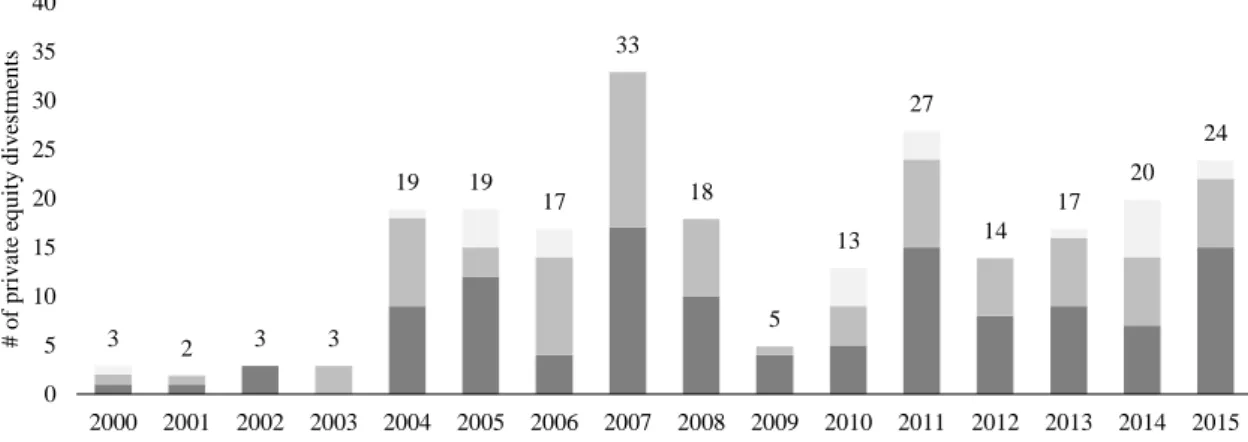
I construct the sample by using various sources and databases. As initial step, I primarily collect private equity divestments between 2000 and 2015 from Bloomberg, Thomson Reuters Eikon and individual research. Decisive for being part of the sample is the German headquarters of the portfolio company while the private equity funds themselves are globally active, and therefore not restricted to a specific regional area. More importantly, this hand-collected dataset allows me to analyse each private equity divestment individually and to evaluate different ownership structures within a portfolio company. For analysis purposes, I only consider deals with majority shareholding by the private equity funds, under the assumption that the exit choice is not primarily influenced by another shareholder. In total, I identify 237 private equity exits between 2000 and 2015. Among these, there are 120 trade sales, 92 secondary buyouts and 25 IPOs. Figure 1 illustrates the exit distribution by the respective choice and year.
Figure 1: Exit distribution by choice and year
3 2 3 3 19 19 17 33 18 5 13 27 14 17 20 24 0 5 10 15 20 25 30 35 40 2000 2001 2002 2003 2004 2005 2006 2007 2008 2009 2010 2011 2012 2013 2014 2015 # o f p ri v at e eq u it y d iv est me n ts
As a next step, I gather data relating to macroeconomic conditions – in particular, the equity and debt market.
Equity market conditions are characterised by using indicators such as the local stock market return and IPO volume which I retrieve from Bloomberg and relevant German stock exchange websites. The stock market return is expressed as the yearly average return – in percent – of the DAX index at the time the divestment of the portfolio company is made.10 De Bondt and Thaler (1985) find that stocks with high average returns over past periods do show lower returns over following periods. However, it is a common perception of many investors that recent stock returns are a good approximation of future stock returns (Barberis et al., 2016). Furthermore, my approach of using the local stock market return as an indicator for the state of the equity market is consistent with Jenkinson and Sousa (2015), except for the fact that they consider the average return between six and three months before the exit. Another variable is the IPO volume. Wang (2012) chooses the industry IPO volume to proxy the state of the equity market in the UK. She assumes that a high number of IPOs stands for a healthy equity market environment. In this working paper, the IPO volume includes the IPOs across all industries in Germany at the year of the exit by the private equity fund. Both variables reflect the health of the German equity market, and are primarily used to investigate the existence of windows of opportunity that private equity funds try to exploit by exiting through an IPO. This said, I formulate the following hypothesis:
Hypothesis A:
During a healthy stock market environment, an IPO’s divestment choice is more likely to be compared with secondary buyouts.
Debt market conditions are described by the European Central Bank (ECB) interest rate as well as the high-yield loan volume in Western Europe. The ECB provides detailed
information about official interest rates on its homepage, while high-yield loan volumes are retrieved from Thomson Reuter Eikon’s platform. The ECB interest rate represents the rate on the marginal lending facility which is selected when banks from the Eurosystem are provided with overnight credit. This is expressed as a yearly average percentage.11 By using the high-yield loan volume in Western Europe in the year of the divestment as an additional variable, I follow the approach of Wang (2012). She supposes that the size of the loan market has a positive impact on the probability of choosing secondary buyouts as a preferred exit choice. Both variables are used to display the cost of borrowing and the availability of debt in the market, respectively. It is widely spread that the boom of secondary buyouts between 2003 and 2007 was largely fuelled by favourable debt conditions, i.e. high availability of debt, cheap debt, convenient loan terms and weak covenants. With respect to the likelihood of secondary buyouts occurring, I test whether favourable debt market conditions indeed affect secondary buyouts as a preferred exit choice. Therefore, I make the following hypothesis:
Hypothesis B:
The cheaper the debt and the more debt is available, the more likely a secondary buyout will be performed compared with trade sales and IPOs.
As a final indicator, I select the committed capital index return,12 which I extract from
Preqin, a leading database for the alternative assets. The committed capital index reflects the amount of capital which is invested in private equity funds, indicating the health of the private equity industry. Like the local stock market return, it is calculated as the yearly average – in percent – at the time of the exit by the private equity fund.13 Between 2006 and 2007, there is a spike in secondary buyouts. Many authors and practitioners claim that increased amounts in
11 For analysis purposes, the yearly average ECB interest rate is multiplied by 100.
12 Committed capital is the capital amount raised by the private equity from its investors, and comprises un-called as well as called capital. Un-called capital is often invested into risk-free instruments (e.g. treasury bills) for growing purposes while called capital is defined as the capital which is distributed back to the investors.
committed capital contributed to this phenomenon, as private equity funds could afford to pay excessive premia on top of transaction prices, and therefore increasing the proportion of secondary buyouts compared with trade sales. This said, I examine the following hypothesis:
Hypothesis C:
A high committed capital index return makes secondary buyouts more likely compared with trade sales and IPOs.
Summary statistics
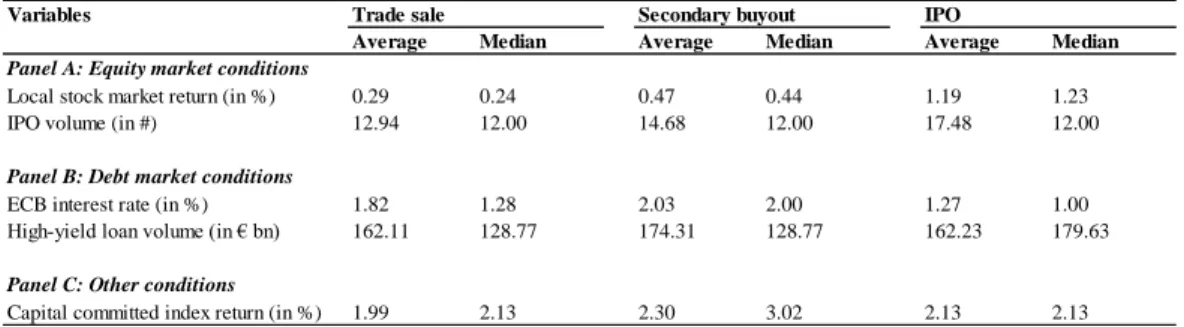
Table 1 provides summary information for each divestment subsample, including a total of 237 private equity transactions from 2000 to 2015. Further, I differentiate between three panels.
Table 1: Descriptive statistics – summary for each divestment subsample
Panel A describes the equity market conditions which include the local stock market and IPO volume as indicators. I observe that IPOs tend to be chosen as a preferred exit route when the local stock market is particularly strong. On average, the market return holds 1.19 percent when this divestment strategy is selected. With respect to the existence of windows of opportunity, it is clear that private equity funds do take advantage of a certain momentum within the equity market, as suggested by Jenkinson and Sousa (2015).
Panel B displays the debt market environment which is characterised by the ECB interest rate and the high-yield loan volume in Western Europe. The results show that the average and median ECB interest rate is slightly higher for secondary buyouts compared with trade sales and IPOs, suggesting that secondary buyouts might be less prone to rising interest
Average Median Average Median Average Median
Panel A: Equity market conditions
Local stock market return (in %) 0.29 0.24 0.47 0.44 1.19 1.23
IPO volume (in #) 12.94 12.00 14.68 12.00 17.48 12.00
Panel B: Debt market conditions
ECB interest rate (in %) 1.82 1.28 2.03 2.00 1.27 1.00
High-yield loan volume (in € bn) 162.11 128.77 174.31 128.77 162.23 179.63
Panel C: Other conditions
Capital committed index return (in %) 1.99 2.13 2.30 3.02 2.13 2.13
rates than the other divestment choices.
Panel C represents the committed capital index return which is a proxy for the health of the private equity industry. As expected, the average and the median committed capital index return are the highest for secondary buyouts, meaning that secondary buyouts are a preferred exit choice when there is a rise in capital within the private equity industry. Due to the presence of more capital, private equity funds are more likely to overpay for their target companies, thereby, increasing the volume of secondary buyouts significantly as it is observed between 2006 and 2007.
Trinomial logit model and regression results
In this section, I use a trinomial logit model to analyse the likelihood of one divestment strategy being chosen over another, given a specific set of macroeconomic factors.
The dependent variable 𝑦 is a categorical, unordered variable where one outcome can be selected among a number of 𝑗 alternatives denoted as 𝑗 = 0, 1, 2, … , 𝑛. Considering that these numbers are only used for coding purposes, their magnitude cannot be interpreted. In this case, the dependent variable represents the respective divestment strategy. There are three possible outcomes which are coded as follows: 0 for trade sales, 1 for secondary buyouts and 2 for IPOs. As independent variables, I select the five aforementioned indicators – local stock market return, IPO volume, ECB interest rate, high-yield loan volume and capital committed index return – to describe the divestment choice.
Table 2 provides the regression results for four trinomial logit models using secondary buyouts as base outcome. The standard errors of the coefficients are shown in parenthesis. Models 1 to 3 do only consider the individual panels A, B and C which are already described within the summary statistics. Model 4 includes all five independent variables.
Table 2: Trinomial logit model – regression results using secondary buyouts as base outcome
The regression results of the models 1 to 3 suggest that IPOs are more likely to be chosen as divestment strategy by private equity funds relative to the reference group of secondary buyouts when local stock market returns are high. Jenkinson and Sousa (2015) elaborate on windows of opportunity, which are only present at some specific points in time. During ‘hot’ equity market periods, private equity funds do take advantage of a certain momentum, leading to a significant increase in IPO activity. This is also in line with the results of descriptive statistics. When evaluating the results of equity market conditions with hypothesis A, I can confirm that an IPO’s divestment choice is more likely during a healthy stock market environment, as compared with secondary buyouts.
Furthermore, I observe that IPOs are less likely to occur as compared with secondary buyouts when ECB interest rates are high. As I suggest earlier, this might indicate that secondary buyouts are less prone to rising interest rates than IPOs. The same conclusion holds for trade sales as compared with secondary buyouts. However, the latter shows no statistical significance, so it comes more from economic importance. In this working paper, I do refrain from making any final conclusions at this point, as this observation requires further research. Therefore, I cannot verify hypothesis B that secondary buyouts are more likely to exit during favourable debt market conditions relative to trade sales and IPOs.
Trade sale IPO Trade sale IPO Trade sale IPO Trade sale IPO
Panel A: Equity market conditions
Local stock market return -0.063 0.402** -0.118 0.638**
(0.084) (0.191) (0.145) (0.267)
IPO volume -0.007 0.009 -0.001 0.023*
(0.009) (0.010) (0.010) (0.013)
Panel B: Debt market conditions
ECB interest rate -0.080 -0.443** -0.148 -0.491*
(0.109) (0.191) (0.133) (0.281)
High-yield loan volume -0.001 0.001 -0.001 0.003
(0.002) (0.003) (0.002) (0.004)
Panel C: Other conditions
Capital committed index return -0.072 -0.040 0.010 -0.379
(0.067) (0.109) (0.113) (0.271)
Observations LR Chi squared Pseudo R squared
Note:
* indicates a significance level of 10% ** indicates a significance level of 5% *** indicates a significance level of 1%
20.50** 237 0.046 237 1.16 0.003 237 7.05 0.016 237 9.16* 0.020
Another variable which might be from economic importance is the capital commitment index return. Model 3 indicates that not only trade sales but also IPOs are less likely to be selected as compared with secondary when the capital commitment index return is high. Due to more capital, private equity funds are more likely to overpay for their target companies and therefore, increasing the volume of secondary buyouts significantly. Therefore, investigating hypothesis C from an economic perspective I observe that a high capital commitment index return makes secondary buyouts more likely to take place relative to trade sales and IPOs. However, I would like to point out that there is no statistical significance relating to this finding. Model 4 confirms the precedent regression results from the models 1 to 3. An additional observation which must be stressed is the statistical significance of IPO volume. Consistent with the effect of the local stock market return, IPOs are more likely to be selected as exit strategies, relative to secondary buyouts when IPO volume is high, suggesting the existence of windows of opportunity.
Since the coefficients of the trinomial logit model merely provide an indication relating to the direction of the likelihood and do not draw any conclusions with respect to its magnitude, an analysis of relative risk ratios (RRRs) and marginal effects at its mean (MEM) is considered. For further analysis purposes, I do only use model 4.
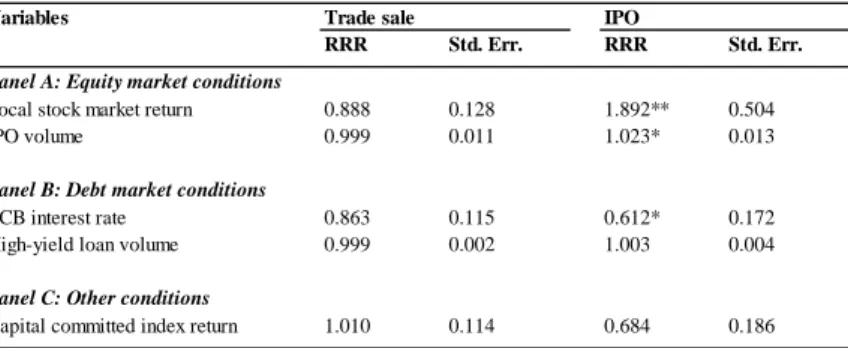
When exponentiating the coefficients of model 4 I obtain the respective RRRs. The RRR measures the risk for an event occurring over another, i.e. trade sales over secondary buyouts as well as IPOs over secondary buyouts. If the RRR is above 1 it can be concluded that the independent variable increases the probability of selecting the alternative outcome over the base outcome. If the RRR is below 1, then, the independent variable decreases the probability to choose the alternative outcome over the base outcome. Table 3 provides information on the RRRs of the trinomial logit model.
Table 3: Trinomial logit model – RRRs of model 4 using all independent variables
According to the RRRs, I observe that local stock market return, IPO volume and ECB interest rate provide statistically significant results at 10, 5 and 5 percent, respectively, when comparing IPOs relative to secondary buyouts.
These conclusions are based on the ceteris paribus assumption, i.e. keeping all other variables constant. If the local stock market return increases by one unit (corresponding to one percent), a private equity fund is 1.892 times more likely to exit through an IPO over a secondary buyout. A similar observation holds for IPO volume. If the IPO volume increases by one unit (corresponding to an additional IPO exit), a private equity fund is 1.023 times more likely to exit through an IPO over a secondary buyout. In terms of debt market conditions, I find that if the ECB interest rate rises by one unit (corresponding to one percent), a private equity fund’s exit through an IPO is 0.612 times more likely over a secondary buyout.
Another observation relates to the RRR of the ECB interest rate for trade sales compared with secondary buyouts. Even though this ratio does not provide any statistical significance, it might be from economic importance due to its high RRR. Keeping all other variables constant, if the ECB interest rate increases by one unit (corresponding to one percent), the private equity fund is 0.863 times more likely to exit through a trade sale over a secondary buyout.
RRR Std. Err. RRR Std. Err.
Panel A: Equity market conditions
Local stock market return 0.888 0.128 1.892** 0.504
IPO volume 0.999 0.011 1.023* 0.013
Panel B: Debt market conditions
ECB interest rate 0.863 0.115 0.612* 0.172
High-yield loan volume 0.999 0.002 1.003 0.004
Panel C: Other conditions
Capital committed index return 1.010 0.114 0.684 0.186
Note:
* indicates a significance level of 10% ** indicates a significance level of 5% *** indicates a significance level of 1%
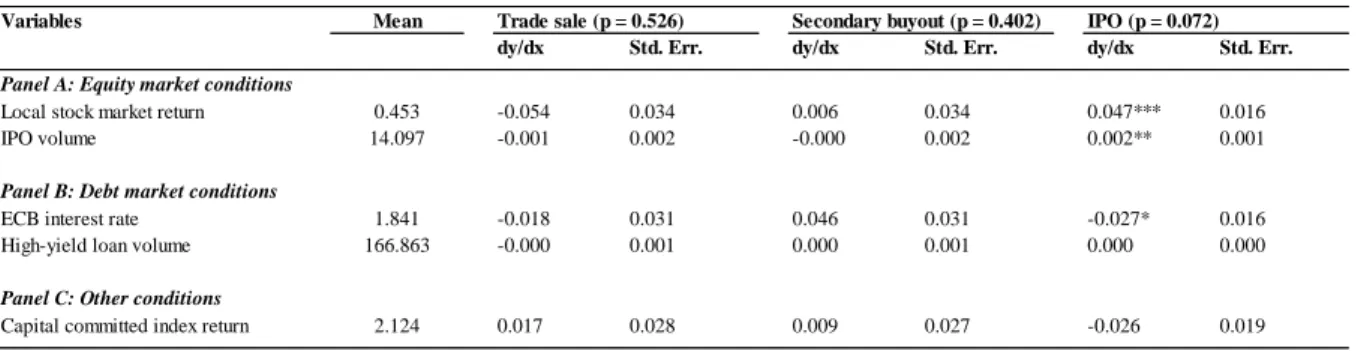
As alternative approach to understanding the magnitude of the trinomial logit model, the analysis of marginal effects can be used. The marginal effect describes the change in probability of choosing an outcome 𝑗 if the independent variable increases by one unit. In this case, I use MEM to measure how probabilities change as a response to a typical change in the respective variable of interest. The MEM is computed by setting the values of all explanatory variables to their respective means within the sample. Table 4 provides the marginal effects for the trinomial logit model.
Table 4: Trinomial logit model – MEM of model 4 using all independent variables
I find that when the local stock market return increases by one unit (corresponding to one percent), the probability of selecting trade sale as divestment choice decreases by 5.4 percent. However, there is no statistical significance. This observation is rather from economic importance due to its high MEM. A reverse effect is apparent in the case of IPOs. With a unit increase (corresponding to one percent) in local stock market return, the probability of choosing IPO as divestment strategy increases by 4.7 percent. Also, if the IPO volume increases by one unit (corresponding to an additional IPO exit), the average probability of selecting an IPO increases by 0.2 percent. In terms of debt market conditions, I find that when the ECB interest rate increases by one unit (corresponding to one percent), the probability of choosing IPO as divestment choice decreases by 2.7 percent. Another observation refers to capital commitment index return. Even though it does not provide any statistical significance, it might be
Mean
dy/dx Std. Err. dy/dx Std. Err. dy/dx Std. Err.
Panel A: Equity market conditions
Local stock market return 0.453 -0.054 0.034 0.006 0.034 0.047*** 0.016
IPO volume 14.097 -0.001 0.002 -0.000 0.002 0.002** 0.001
Panel B: Debt market conditions
ECB interest rate 1.841 -0.018 0.031 0.046 0.031 -0.027* 0.016
High-yield loan volume 166.863 -0.000 0.001 0.000 0.001 0.000 0.000
Panel C: Other conditions
Capital committed index return 2.124 0.017 0.028 0.009 0.027 -0.026 0.019
Note:
* indicates a significance level of 10% ** indicates a significance level of 5% *** indicates a significance level of 1%
economically important due to its high MEM. I notice that if the capital commitment index return increases by one unit (corresponding to one percent), the probability of selecting IPO as divestment choice decreases by 2.6 percent.
In summary, the results show that private equity funds tend to take advantage of windows of opportunity being more likely to select IPOs as preferred exit route. When it comes to the impact of debt market conditions on an exit route’s probability, it is apparent that IPOs and trade sales are less likely to take place, as compared with secondary buyouts when debt is expensive, which in turn indicates that secondary buyouts might be more resilient to rising interest rates. However, further research is required to confirm this assumption. From an economic perspective, I do also notice that IPOs are less likely to be selected, as compared with secondary buyouts when the capital commitment index return is high. Due to more capital in the market private equity funds tend to overpay for their target companies and therefore, increasing the volume of secondary buyouts significantly.
IV. Conclusion
Over the past five years, the number of private equity transactions – mainly the proportion of secondary buyouts – has been increasing significantly, and has therefore been playing a major role in the growth and recovery of the world’s economy. Particular attention has received the private equity industry in Germany, where transactions have been constantly growing with a compounded annual growth rate (CAGR) of 19.7 percent from 2012 to 2015. To date, many studies have been elaborating on various aspects of private equity in detail, such as fundraising, investment determinants and value creation, though little academic attention has been given to the divestment stage of portfolio companies. Using a sample of 237 private equity transactions in Germany between 2000 and 2015, the objective of this working paper is to contribute to a more precise understanding of how and to what extent debt and equity market conditions affect the private equity fund’s divestment choice.
The results show that the exit choice is strongly affected by the macroeconomic environment that private equities are facing, as suggested by Axelson et al. (2013) and Jenkinson and Sousa (2015). I observe that private equity funds do take advantage of windows of opportunity. During favourable equity market conditions, they tend to use the momentum, and are more likely to exit their investment in a portfolio company through an IPO, relative to a secondary buyout. As for the impact of debt market conditions, I notice that IPOs and trade sales are less likely to be used as divestment strategies relative to secondary buyouts when debt is expensive. This observation indicates that secondary buyouts might be more resilient to rising interest rates when compared with the alternative exit choices. However, more research needs to be done.
Lastly, an economic emphasis is placed on the impact of the capital commitment index return. IPOs are less likely to be chosen as a divestment strategy relative to secondary buyouts when the capital commitment index return is high. Due to the presence of more capital in the market, private equity funds tend to overpay for their target companies and therefore increase the volume of secondary buyouts significantly.
When comparing the results of this working paper with previous studies, I find many similarities while using a different sample of transactions. Instead of focusing on a cross section of countries, as Wang (2012), Axelson et al. (2013) and Jenkinson and Sousa (2015) do, I analyse the private equity industry in Germany. This allows me to make a significant academic contribution on the basis of a specific country. I observe that the divestment choices of private equity funds are strongly affected by their macroeconomic environments.
In research literature, IPOs are often described as successful exits. However, these exits do not lead to quick or definite gains, as the private equity funds will be subject to a lock-up agreement of 6 to 12 months. Secondary buyouts are quick to execute and provide certain proceeds. Unlike trade sales where competitors are not the most improbable buyers, secondary
buyouts are also involved in less regulatory issues. As a result, IPOs are relatively uncommon, and most of private equity exits are either trade sales or secondary buyouts.
Concluding this working paper with an outlook toward Germany’s private equity industry, the market appears to be bullish, with an upward trend from 2012 onwards. Favourable financial conditions and a major deterioration in political stability primarily due to the Brexit may benefit the private equity industry in Germany, leading to continuous growth in transactions and highlighting the importance of understanding the impact on private equity funds’ divestment choices.
References
Arcot, Sridhar, Zsuzsanna Fluck, José-Miguel Gaspar and Ulrich Hege. 2015. "Fund managers under pressure: Rationale and determinants of secondary buyouts." Journal of Financial Economics, Vol. 115, No. 1: 102-135.
Axelson, Ulf, Tim Jenkinson, Per Strömberg and Michael S. Weisbach. 2013. "Borrow Cheap, Buy High? The Determinants of Leverage and Pricing in Buyouts." The Journal of Finance, Vol. 68, No. 6: 2223-2267.
Badertscher, Brad, Sharon P. Katz and Sonja Olhoft Rego. 2010. "The Impact of Private Equity Ownership on Corporate Tax Avoidance." Harvard Business School Working Papers: No 10-004.
Barberis, Nicholas, Abhiroop Mukherjee and Baolian Wang. 2016. "Prospect Theory and Stock Returns: An Empirical Test." The Review of Financial Studies, Vol. 29, No. 11: 3068-3107.
Cumming, Douglas J. and Jeffrey G. Macintosh. 2003a. "A cross-country comparison of full and partial exits." Journal of Banking and Science, No. 27: 511-548.
Cumming, Douglas J. and Jeffrey G. Macintosh. 2003b. "Venture Capital Exits in Canada and the United States." University of Toronto Law Journal, Vol. 53: 101-200.
De Bondt, Werner F. M. and Richard Thaler. 1985. "Does the Stock Market Overreact?" Journal of Finance, Vol. 40, No. 3: 793-805.
Degeorge, Francois, Jens Martin and Ludovic Phalippou. 2016. "On secondary buyouts." Journal of Financial Economics, Vol. 120, No. 1: 124-145.
Gompers, Paul, Steven N. Kaplan and Vladimir Mukharlyamov. 2016. "What Do Private Equity Firms Say They Do?" Journal of Financial Economics, Vol. 121, No. 3: 449-476. Gompers, Paul, and Josh Lerner. 2004. The Venture Capital Cycle. Cambridge: MIT Press.
Gompers, Paul, and Josh Lerner. 2001. "The Venture Capital Revolution." Journal of Economic Perspectives, Vol. 15, No. 2: 145-168.
Gompers, Paul, and Josh Lerner. 1998. "Venture Capital Distributions: Short-Run and Long-Run Reactions." The Journal of Finance, Vol. 53, No. 6: 2161-2183.
Jenkinson, Tim and Miguel Sousa. 2015. "What determines the exit decision for leveraged buyouts?" Journal of Banking and Finance, Vol. 59: 399-408.
Leschke, Jürgen. 2003. "Exiterfahrungen im deutschen Beteiligungsmarkt." In Private Equity Investments: Praxis des Beteiligungsmanagements, Jugel, Stefan. Wiesbaden: Gabler. Kaplan, Steven N. 1989. "The Effects of Management Buyouts on Operating Performance and
Value." Journal of Financial Economics, Vol. 24, No. 2: 217-254.
Povaly, Stefan. 2007. Private Equity Exits: Divestment Process Management for Leveraged Buyouts. Heidelberg: Springer.
Schwarz, Marc and Edward. A. Weinstein. 1989. "So You Want to Do a Leveraged Buyout." The Journal of Business Strategy, Vol. 10, No 1: 10-14.
Smith, Abbie J. 1990. "Corporate Ownership Structure and Performance: The Case of Management Buyouts." Journal of Financial Economics, Vol. 27, No. 1: 143-164.
Strömberg, Per. 2008. "The new demography of private equity." The global impact of private equity report, Vol. 1: 3-26.
Wang, Yingdi. 2012. "Secondary Buyouts: Why Buy and at What Price?" Journal of Corporate Finance, Vol. 18, No. 5: 1306-1325.
Appendix A
Typical organisational structure for a private equity fund
Source: Own illustration based on Schwarz and Weinstein (1989), and Badertscher et al. (2010)
Exit distribution by choice and year
Note: The table comprises the exit distribution by choice and year with the corresponding independent variables which are used within the trinomial logit model. Please consider that all five independent variables are expressed on a yearly basis. Source: Own sample construction using Bloomberg, Thomson Reuters Eikon and individual research.
Private equity firm (general partners) Investors (limited partners) Private equity investment fund Portfolio company II Portfolio company I Portfolio company III Deal structure
Debt financing makes up around 80% of the entire transaction price the private equity investment fund pays for a portfolio company. In turn, debt lenders receive part of the target‘s future
cash flows as well as
securities over tangible assets. 5 to 10 % 90 to 95 % Minority equity ownership Majority equity ownership Management fees, plus
80 % of gain on the exit of the portfolio company carried interest –
20 % of gain on the exit of the portfolio company
Public pension funds, corporate pension funds, insurance companies, high-net-worth individuals, family offices foundations, etc.
Year Exits Trade sales
Secondary buyouts IPOs Local stock market IPO volume ECB interest rates High yield loan market size Committed capital index 2000 3 1 1 1 0.11 142.00 3.99 91.08 0.80 2001 2 1 1 0 -2.05 21.00 4.29 63.94 -0.58 2002 3 3 0 0 -4.47 7.00 3.22 77.50 0.54 2003 3 0 3 0 3.60 0.00 2.26 101.95 3.39 2004 19 9 9 1 0.44 4.00 2.00 102.56 4.02 2005 19 12 3 4 2.48 13.00 2.02 179.63 3.02 2006 17 4 10 3 1.54 32.00 2.76 247.75 3.87 2007 33 17 16 0 0.24 25.00 3.84 324.31 4.40 2008 18 10 8 0 -3.55 2.00 3.90 112.09 -3.64 2009 5 4 1 0 2.43 1.00 1.28 57.02 1.81 2010 13 5 4 4 2.02 6.00 1.00 86.01 2.13 2011 27 15 9 3 -0.45 12.00 1.25 100.55 1.08 2012 14 8 6 0 1.62 8.00 0.88 94.91 2.50 2013 17 9 7 1 1.56 5.00 0.55 128.77 3.62 2014 20 7 7 6 1.23 8.00 0.16 208.34 1.24 2015 24 15 7 2 -0.51 15.00 0.05 187.97 1.00