A Work Project, presented as part of the requirements for the Award of a Master’s degree in Management from the Nova School of Business and Economics.
THE ALIGNMENT OF HR PRACTICES AND WORK CULTURE WITH MOTIVATION AND PREFERENCES OF GENERATION Y –
A QUALITATIVE ANALYSIS IN THE STRATEGY CONSULTING INDUSTRY
LAURA SCHUPE, 34219
Work project carried out under the supervision of: Adjunct Professor Sónia Cristina Duarte Oliveira
1
Abstract
The strategy consulting industry represents the economic movement towards service-orientation. As young talent is the capital of these consultancies, it becomes increasingly important to examine Generation Y’s motivations and preferences. Thereby, the alignment of work culture and HR practices is a relevant lever. So far, no industry- and target group-specific action recommendations exist. Therefore, this study applies inductive thinking: it conducts interviews with the target group and experts and combines the results with existing theory. Strategy consultancies align with preferences and motivations in some points and constantly work on initiatives in order to meet the preferences over the next years.
Keywords: HR Practices, Motivation, Generation Y, Strategy Consulting
Funding
This work used infrastructure and resources funded by Fundação para a Ciência e a Tecnologia (UID/ECO/00124/2013, UID/ECO/00124/2019 and Social Sciences DataLab, Project 22209), POR Lisboa (LISBOA-01-0145-FEDER-007722 and Social Sciences DataLab, Project 22209) and POR Norte (Social Sciences DataLab, Project 22209).
2
1. Introduction
Developments such as the rise in globalisation, demographic change, increased diversity of the workforce, technological innovations and changes in the economy have resulted in many new demands on companies. These developments on the one hand exert pressure on HR and create the need for change, but on the other hand also bring opportunities for corporate success (Kontoghiorghes, 2016). Firstly, demographic change has increased the threat of a shortage of suitable workers (Stone, Tetrick, 2013). Hence, attracting and retaining the new generation entering the labour market, which currently is Generation Y (Gen Y), is essential for an organisation’s achievements. HR practices and work culture are critical levers in this context (Torsello, 2019).
Hereby, the employees’ motivations and preferences are increasingly important, enhanced by the shift from a manufacturing-based to a knowledge-based economy (Stone, Deadrick, 2015). This development can be attributed to the fact that employees have to be more innovative in knowledge-intensive companies, and their performance correlates highly with their motivation and the fulfilment of their preferences (Kultalahti, Viitala, 2015). Consequently, in order to attract and retain particularly talented workers, it is important to study their motivation and preferences and match the HR practices and work culture accordingly. Some theory on the motivation and workplace preferences of Gen Y already exists. However, a literature review on the topic reveals that current theories on Gen Y are held on a superficial level. Moreover, it shows that no industry- and subgroup-specific action recommendations for HR departments and managers are provided. Consequently, this work aims to fill this gap by investigating Gen Y’s motivation and preferences as well as HR practices and work culture in the context of a specific industry.
Thereby, the focus lies on the strategy consulting industry for several reasons. As stated in the Human Resource Management Review, the economy is moving forward towards knowledge-
3 and service-orientation at its core (Stone, Deadrick, 2015). Hence, the strategy consulting industry – consisting of service organisations, which advise institutions and firms on strategic decisions at high hierarchical levels – is important to this study, since it is representative for this knowledge-based economy. Besides, it currently is one of the most promising industries. According to prognoses, the already attractive market of 43 billion USD worldwide in 2017 will grow to over 90 million USD by 2025 – with a CAGR of 9.9 percent for the forecast period 2018-2025 (M2 Presswire, 2018). Therefore, it is not surprising that the industry is one of the most attractive career starting points of ambitious Gen Y students, coming from the best business schools and planning to become leaders of the future (Statista, 2018). In the context of the industry presented, this paper examines: “How HR practices and work culture align with the motivation and preferences of Generation Y”. Thus, inductive reasoning, combining theory and qualitative analysis, will be applied. An overview of the steps taken to answer the research question is provided in the next paragraph.
The paper starts by examining the most relevant literature about Gen Y’s motivation and preferences, HR practices and work culture. The literature review has three stages. Firstly, it focuses on renowned, most recent review papers and primary literature on the topic. Since the review papers observe relevant subjects for the paper, but do not examine the whole topic of the work project in context, a second stage is necessary. Here, the focus lies on topic specific academic papers. Therefore, an examination of the potentially relevant references in the selected review papers and other academic work follows. The third stage – the investigation of non-academic consultancy publications – is reasonable, because the availability of high-quality, suitable academic papers is limited due to the fact that the topic has only gained attention in recent years. In order to ensure a sufficient degree of quality and applicability to the work project, the focus lies on publications of the three leading strategy consultancies – McKinsey & Company (McKinsey), the Boston Consulting Group (BCG) and Bain &
4 Company (Bain) – as well as Deloitte, since the firm is one of the world’s leading management consultancies when it comes to Human Capital (Deloitte, 2019a; M2 Presswire, 2018; Statista, 2019). In the process of the literature review, the creation of tabular overviews helps to display similarities and contradictions. The multi method qualitative analysis applied in the further course of the work aims to clarify these contradictions and to answer the research question. Since the application in the strategy consulting industry has not yet been researched in depth, the inductive approach is particularly suitable here (Saunders, Lewis, Thornhill, 2012). A detailed explanation of the methodological choices follows in chapter three.
2. Literature Review 2.1 Context
At the beginning of this chapter, an overall view is intended to illustrate why it is reasonable to focus the research on the work culture and HR practices in the strategy consulting industry, and on motivations as well as preferences of Generation Y.
As already indicated in the introduction, the strategy consulting industry is considered highly relevant, with a further upward trend (Chelliah, Georges, 2015). This is due to the fact that it becomes increasingly important for organisations to be well advised in a rather challenging economic climate. To name just a few crucial factors, very rapidly changing or evolving business models, growing legal claims, raising sustainability aspirations and increasing competition are all contributing to the need for companies to act efficiently. As a result, they choose to use strategy consulting services as support more often. Consequently, with higher demand of the services, the demand for manpower in strategy consultancies also rises. This trend has been discernible for several years now and is unlikely to change soon (M2 Presswire, 2019).
Moreover, the fact that the three leading strategy consultancies are among the top five most popular companies for MBA students worldwide, makes this industry particularly worth
5 exploring in the context of Human Resources Management (TransparentCareer, 2019). Since many of these graduates become future leaders, these companies seem to attract a part of the generation entering the job market that somehow shapes the future of management (Statista, 2018).
As stated in the beginning of this paper, attraction and retention in this industry is highly correlated with the peoples’ motivations and their preferences fulfilment in the company. This is influenced by HR practices and work culture. Therefore, within the next subchapters, the literature review aims to display the motivations and preferences of Generation Y, corresponding HR practices and the work culture in strategy consultancies.
Before analysing the different variables of the research question, however, a closer examination of the term “Generation” seems valid. Multiple organisational challenges lead HR to deal with generational phenomena, which can only be mastered if the differences and similarities between employees of various ages are understood. Therefore, it seems plausible that research shows several practices to differentiate generations (Joshi, et al., 2010).
The Academy of Management refers to chronological succession which implies that generations follow one another in time and are each shaped by a social system and thus have a unique composition of skills, knowledge and experience. Moreover, it uncovers that a generation can be cohort-, age- or incumbency-based. This concept is important in order to understand what is considered Generation Y in the scope of this study. A cohort is a group of people who, for example, join an organisation – as a strategy consulting firm – at the same time, therefore participate in common events, and tend to show a similar reaction within the cohort but differently from other cohorts. Not only sharing experiences in the world of work, but also growing up in the same period, which is shaped by political trends and other currents, influences the motivations and preferences of people. This leads to the popular age-based concept of Baby Boomers, Generations X, Y and Z (Joshi, et al., 2010).
6 However, since only Generation Y is subject of this paper, the representation of the other generations’ motivations and preferences in the following subchapter is omitted.
2.2 Work Motivation and Preferences
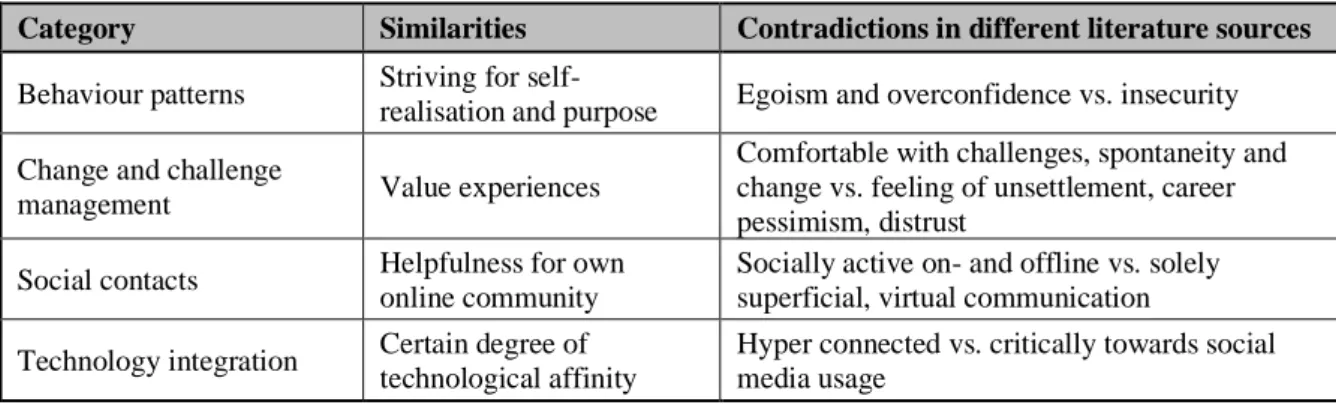
In theory, each generation is ascribed certain motivation factors and preferences (Bencsik, Horváth-Csikós, Juhász, 2016). Yet, since there is a danger of stereotyping, statements made in the literature about an entire generation must always be critically questioned. Nevertheless, assumptions of Gen Y, which appear more frequently in academic papers and consultancy reports, are summarised and delineated according to similar ideas and contradictions. Slight deviations can already be found in the literature when considering the birth years of Gen Y. In any case, the period is usually limited to 15 to 20 years and does not exceed the years 1978 and 2000 (Bencsik, Horváth-Csikós, Juhász, 2016; Kultalahti, Viitala, 2015; Torsello, 2019). In this section, two overview tables are provided. The first table shows some general preferences and behaviours of Gen Y in the work context, which are relevant to better understand its motivations regarding work culture and HR practices in the further course of the work. After a thorough literature review and the emergence of contradictions, it can be assumed that Generation Y is very diverse in itself. A detailed illustration and reasoning of the following representation can be found in the appendix (Appendix 1).
Category Similarities Contradictions in different literature sources
Behaviour patterns Striving for
self-realisation and purpose Egoism and overconfidence vs. insecurity Change and challenge
management Value experiences
Comfortable with challenges, spontaneity and change vs. feeling of unsettlement, career pessimism, distrust
Social contacts Helpfulness for own online community
Socially active on- and offline vs. solely superficial, virtual communication Technology integration Certain degree of
technological affinity
Hyper connected vs. critically towards social media usage
Table 1: Generation Y in the Workplace
Source: Conceptual analysis performed according to the details provided in the appendix, based on Bencsik, Horváth-Csikós, Juhász, 2016; Deloitte, 2019b; Kultalahti, Viitala, 2014; McKinsey & Company, 2016.
7 At this point, the contradictions in different literature sources are solely perceived. With the help of the following, detailed analysis of work motivation and preferences, tendencies will become recognisable. Later, in the course of the multi method analysis, hypotheses can be developed.
As outlined in the first chapter, Gen Y’s work motivation and preferences have only been studied for a few years. Thus, the range of academic literature is limited. Therefore, four academic papers that specialise in Gen Y’s work motivations and preferences were chosen. In order to integrate the business perspective, three reports from Deloitte and McKinsey were selected. The following table covers the most important aspects found in the literature. Results are categorised based on mentioned topics in the references, assigned to self-defined subjects and summarised with keywords. In terms of leadership, flexibility, learning and tasks there are rather similar notions described in the sources, which leads to the conclusion that these subjects do not need to be studied as much as others, which hold inconsistencies. Nevertheless, contradictions are recorded in each of the defined topics, which is why all five are going to be relevant in the context of the multi method analysis. Again, a detailed illustration is provided in the appendix (Appendix 1).
8
Table 2: Motivation Factors and Work Preferences of Gen Y
Source: Conceptual analysis performed according to the details provided in the appendix, based on Bencsik, Horváth-Csikós,Juhász, 2016; Deloitte, 2019b; Deloitte, 2019c; Kultalahti, Viitala, 2015; Kultalahti, Viitala,
2014; McKinsey & Company, 2016; Torsello, 2019.
In the results of the studies on work motivation presented above, correlations and dependencies between different subjects are missing. Therefore, in this context, a theoretical work motivation model is presented to illustrate which interrelationships of individual components have already been developed. The Hackman and Oldham model seems to be suitable for this purpose, as it shows the influence of the fulfilment of work motivation factors and preferences regarding work culture and other work components on employee motivation. Besides, it is the most extensively cited model in this field and still shapes today's theoretical work motivation literature. It defines five core job dimensions regarding variety, task definition, impact, autonomy and feedback, which can be considered motivation factors. These are also reflected
Topic Subject Keywords Contradictions in different literature sources
Leadership
Closeness, support, appreciation, constructive and direct feedback, participation, honesty,
communication skills, clear direction, feeling of importance, dynamic, trust, flexibility allowance, high demands
None
Team
Enthusiasm, development-orientation, common goals and effort, teamwork, knowledge-sharing, drive, encouragement, support, engagement,
trustworthiness, diversity, equality, open atmosphere, cooperation, respect, personal relationships
Importance of offline socialising components including knowledge-sharing vs. neglection of traditional social connections, especially due to affinity to social media; rivalry and knowledge-sharing only out of compulsion or self-interest
Free time and workload
Medium of exchange, sufficient amount, relocation for satisfaction, rewards for renouncement, family
Partial sacrifice of free time if appreciation and
compensation is offered, but still sufficient time for family and leisure activities vs. relocation for a satisfying career and family in the background
Flexibility Working hours, working methods, work
arrangements, location, mobility, decision power None Personal
growth
Responsibility, freedom, competences development, career advancement, success, opportunities, self-actualisation
Importance of opportunities to develop soft and hard skills vs. neglection of soft skills
Learning Trial and error, consistency, own way, work
integration, lifelong models None
Tasks
Interest, challenge, variation, renewal, projects, clarity, definition, usage of individual abilities, productiveness, performance-orientation, time frame
None
Impact Meaningfulness, impact, environmental and societal improvement, purpose
Stronger motivation through intrinsic factors, desire to find meaning and purpose as well as having a positive impact vs. egoistical, short-term view
Financial
factors Salary, instant bonuses, various perks
Stronger motivation through extrinsic factors vs. neglection of monetary factors, status symbols and formal positions Job stability Security Unsettled feeling, career pessimism, lack of faith and
distrust vs. neglection of stability and security demands Social relations and work environment Work-life balance and flexibility Training and development Job content Monetary compensation and job security
9 in Table 2.Their fulfilment influences three critical psychological states, which in turn affect personal and work-related outcomes, for instance internal work motivation. These critical psychological states – experienced meaningfulness, experienced responsibility and knowledge of the actual results – display preferences also mentioned in Table 2 (Hackman, Oldham, 1974). The last component included in the model below is employees’ growth need strength, which functions as a moderator (DeVaro, Li, Brookshire, 2007).
Figure 1: Hackman & Oldham's Job Characteristics Model Source: Own representation based on Hackman, Oldham, 1974.
Some supplementary studies deserve attention, because they add relevant information about strategy consulting and Gen Y. Firstly, results from a three-sample test elucidated in the Academy of Management Journal emphasise on the fact that people with stronger growth needs show a more positive attitude to broad-spectrum jobs than those with lower growth needs (Champoux, 1980).This implies that especially people with strong growth needs would prefer the job as a strategy consultant, as it is very broadly based (BCG, 2019a). Besides, a study published in the Journal of Occupational Psychology in 1978 corroborates that not only heterogeneous groups, but also homogeneous participants are affected by the interrelationships shown in the figure (Wall, Clegg, Jackson, 1978). Since the research subjects might form a
10 rather homogeneous group, Gen Y, this study reinforces the possible applicability of the model in the context of this thesis.
Summarising academically verified additions and components of the original model will be considered for the multi method analysis. However, the model has limitations as it neglects any potential influence a relationship between employees might have. Consequently, the study aims to develop a richer perspective. Before the qualitative analysis can be performed in order to be able to extend the model, the two variables work culture and HR practices must be explored.
2.3 HR Practices and Work Culture
In order to illustrate potential appropriate HR measures according to Gen Y’s preferences, academic papers and strategy consulting publications were examined. Next, findings were compared and three development areas self-created: flexibility, compensation and benefits, as well as leadership and personal development. Flexibility should be guaranteed regarding time and workspace. In concrete terms, this means, for example, abolishing fixed working hours, guaranteeing home office options, job rotation, shared desk and hot desk (Bencsik, Horváth-Csikós, Juhász, 2016). The performance management system must be adapted accordingly. For example, remuneration in the form of leisure time is to be integrated more strongly than purely monetary compensation (Deloitte, 2019c; Kultalahti, Viitala, 2015). In addition, benefits in the form of joint sports programmes can impact Gen Y workers’ motivation (Torsello, 2019). With reference to the last category, Gen Y employees should be provided a mentor with whom two-way communication can take place in an informal atmosphere on a regularly basis (McKinsey & Company, 2016; Torsello, 2019). Similarly, the HR department must work closely with managers to provide employees personal coaching, continuous feedback cycles, individual career path development discussions and the opportunity to have
11 an impact in the society (Deloitte, 2019b; McKinsey & Company, 2016). Again, a detailed overview, sorted by the respective publication, is provided in the appendix (Appendix 1). With regards to work culture in strategy consultancies, it can be stated that the work is mostly project-based, service-oriented and client-focused. Yet, renowned consultancies also do a lot of internal research in order to constantly stay at the forefront of the latest evolutions and develop their own innovative models for business, society and science (Chelliah, Georges, 2015). They work across functions, industries and countries in multidisciplinary teams (Bain & Company, 2019a; BCG, 2019a; McKinsey & Company, 2019a). The companies describe their culture as shaped by values such as integrity, respect for the individual, diversity, inclusion, collaboration, partnership, value creation, innovation, client-orientation and social impact (Bain & Company, 2019a; BCG, 2019b; McKinsey & Company, 2019b). However, since the presentation on the companies’ own websites should also portray a positive image, it must be critically questioned whether all the values equally shape the corporate culture. Therefore, insights from former as well as current employees and other industry experts serve to create a realistic impression. So far, the analysis lacks strategy consulting specific HR practices and realistic insights of the work culture, as well as work motivations and preferences of Gen Ys, who consider strategy consulting as a career option. To sum up, the qualitative analysis aims to find out whether work culture and HR practices in strategy consultancies align with motivations and preferences of Gen Y. Details about the research method and data analysis are subject of the next chapter.
3. Methodology
3.1 Research Method
When selecting a suitable research method, the market leading literary work "Research Methods for Business Students" by Saunders, Lewis and Thornhill (2012) and “The Discovery
12 of Grounded Theory: Strategies for Qualitative Research” by Glaser and Strauss (1967) were consulted. In the following, the respective decisions are summarised and reasoned.
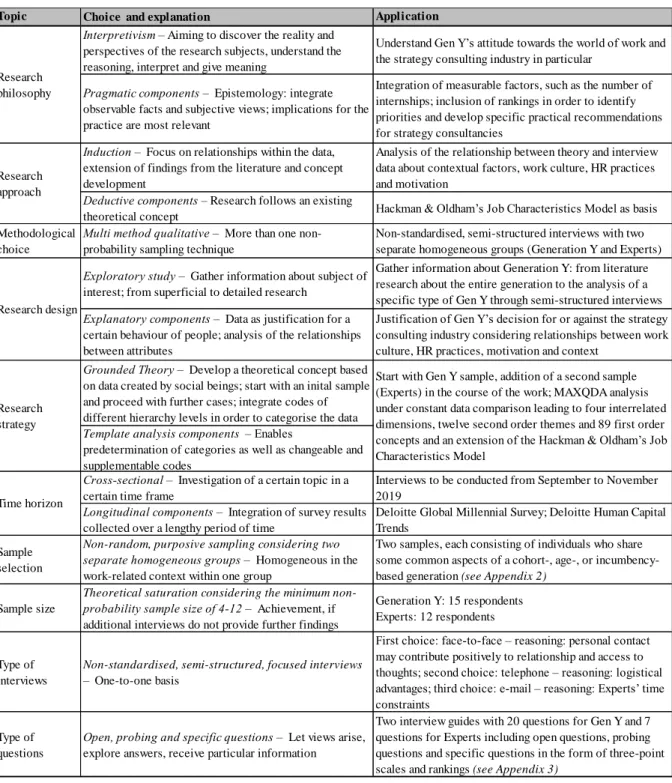
Table 3: Research Method Overview
3.2 Data Analysis
The data analysis aims at a concept formation, which illustrates interdependencies of the research question’s variables. The semi-structured interviews serve as a basis for the analysis. They can be found in the appendix (Appendix 7). As the interview guides, which are also
Topic Choice and explanation Application
Interpretivism – Aiming to discover the reality and
perspectives of the research subjects, understand the reasoning, interpret and give meaning
Understand Gen Y’s attitude towards the world of work and the strategy consulting industry in particular
Pragmatic components – Epistemology: integrate
observable facts and subjective views; implications for the practice are most relevant
Integration of measurable factors, such as the number of internships; inclusion of rankings in order to identify priorities and develop specific practical recommendations for strategy consultancies
Induction – Focus on relationships within the data,
extension of findings from the literature and concept development
Analysis of the relationship between theory and interview data about contextual factors, work culture, HR practices and motivation
Deductive components – Research follows an existing
theoretical concept Hackman & Oldham’s Job Characteristics Model as basis
Methodological choice
Multi method qualitative – More than one
non-probability sampling technique
Non-standardised, semi-structured interviews with two separate homogeneous groups (Generation Y and Experts)
Exploratory study – Gather information about subject of
interest; from superficial to detailed research
Gather information about Generation Y: from literature research about the entire generation to the analysis of a specific type of Gen Y through semi-structured interviews
Explanatory components – Data as justification for a
certain behaviour of people; analysis of the relationships between attributes
Justification of Gen Y’s decision for or against the strategy consulting industry considering relationships between work culture, HR practices, motivation and context
Grounded Theory – Develop a theoretical concept based
on data created by social beings; start with an inital sample and proceed with further cases; integrate codes of different hierarchy levels in order to categorise the data
Template analysis components – Enables
predetermination of categories as well as changeable and supplementable codes
Cross-sectional – Investigation of a certain topic in a
certain time frame
Interviews to be conducted from September to November 2019
Longitudinal components – Integration of survey results
collected over a lengthy period of time
Deloitte Global Millennial Survey; Deloitte Human Capital Trends
Sample selection
Non-random, purposive sampling considering two separate homogeneous groups – Homogeneous in the
work-related context within one group
Two samples, each consisting of individuals who share some common aspects of a cohort-, age-, or incumbency- based generation (see Appendix 2)
Sample size
Theoretical saturation considering the minimum non-probability sample size of 4-12 – Achievement, if
additional interviews do not provide further findings
Generation Y: 15 respondents Experts: 12 respondents
Type of interviews
Non-standardised, semi-structured, focused interviews – One-to-one basis
First choice: face-to-face – reasoning: personal contact may contribute positively to relationship and access to thoughts; second choice: telephone – reasoning: logistical advantages; third choice: e-mail – reasoning: Experts’ time constraints
Type of questions
Open, probing and specific questions – Let views arise,
explore answers, receive particular information
Two interview guides with 20 questions for Gen Y and 7 questions for Experts including open questions, probing questions and specific questions in the form of three-point scales and rankings (see Appendix 3)
Start with Gen Y sample, addition of a second sample (Experts) in the course of the work; MAXQDA analysis under constant data comparison leading to four interrelated dimensions, twelve second order themes and 89 first order concepts and an extension of the Hackman & Oldham’s Job Characteristics Model Research philosophy Research design Time horizon Research approach Research strategy
13 provided in the appendix (Appendix 4), entail qualitative as well as rather quantitative aspects, data gathered from the interviews is analysed in two different ways. In order to support the analysis of the qualitative statements, Grounded Theory is applied and the software MAXQDA is utilised. Therefore, coding and categorisation in a process of constant comparison is required. As Strauss’ and Corbin’s approach with three coding stages developed in 1998 still influences today’s inductive research, this work follows these coding stages. Firstly, raw data is reorganised into categories (open coding), then subcategories are created through relationship recognition (axial coding), and lastly, based on the established categories a theory is developed (selective coding) (Saunders, Lewis, Thornhill, 2012).
Further, another analysis technique is carried out to adequately evaluate the more quantitative components of the interviews. Two types of specific questions are classified as quantitative: firstly, rankings which require the prioritisation of motivational factors and aspects of work culture and secondly, three-point scales which are used to evaluate work culture, HR practices and general experiences in strategy consulting.
Each ranking and three-point scale assessment is evaluated individually. This requires several steps: first, each respondent’s evaluation is recorded per question in an excel-spreadsheet. Next, the answers per question are displayed separately for the Gen Y sample and the Experts sample. For each sample, the selection per answer option is then aggregated and displayed as a percentage. This way, a trend for each topic can be identified. The calculations can be found in the appendix (Appendix 5).
4. Results
In the following data tables, the highlights of the multi method analysis are summarised according to the type of interview questions: open questions (Table 4), specific questions including rankings (Table 5) and specific questions including three-point scales (Table 6). The
14 tables cover all topics that were addressed in the interviews. Amongst other things, the analysis aims to find out whether the perception of HR and industry experts matches the actual motivations and preferences of Generation Y. Moreover, the interpretation per topic, which is also provided in the following overviews, gives valuable insights for the conceptual formation. The detailed analysis is provided in the appendix (Appendix 5).
Table 4: Data Analysis – Open Questions
Table 5: Data Analysis – Specific Questions including Rankings
Topic Interpretation
Age, home country,
current position Gen Y respondents belong to the same generation.
Self-description of workplace behaviour
Particularly ambitious target group, not representative for the entire Gen Y.
Academic background & work experience
Highly educated, career-oriented target group with a good starting position for the professional life.
Number and type of internship offers in competition with BCG
As soon as this target group has the possibility to do an internship in one of the top 3 strategy consultancies, it takes the option.
Crucial factor to join BCG
BCG's prestigious position in the industry attracts driven people to do an internship. People at BCG are the company's main asset.
Data Analysis
Sample characterisation: German/Austrian Gen Y students and recent graduates born between 1993-1998 (for details see
appendix sample selection and characterisation).
Ambitious (6x), motivated (4x), passionate (3x), determined (3x), (results) driven (3x), focused (3x), curious (2x), responsible (2x), structured (2x), personally relaxed, balanced, independent, proactive, positive, enthusiastic, charismatic, communicative, sociable, people oriented, honest.
Sample characterisation: academic experiences at renowed universities and abroad, 3-7 previous internships in prestigious companies from different industries (for details see appendix sample selection and characterisation).
0-7 internship offers in competition with BCG: mostly from other strategy consultancies, which do not belong to the three leading ones, but also from previous internship companies in different industries and from start-ups.
Reputation (8x), (smart) people working at and with BCG (7x), learning, flexibility, exposure to a variety of industries, diversity, career progression, prestigious network building, personal references and experiences.
Topic Interpretation Motivation to start a career in strategy consulting Flexibility Meaning-fulness Compen-sation Job security and stability Learning and personal development % Priority 1 0% (8%) 7% (33%) 7% (8%) 0% (0%) 87% (50%) % Priority 2 20% (8%) 47% (17%) 13% (25%) 7% (8%) 13% (42%) % Priority 3 27% (17%) 20% (42%) 40% (33%) 13% (0%) 0% (8%) % Priority 4 33% (42%) 20% (0%) 27% (33%) 20% (25%) 0% (0%) % Priority 5 20% (25%) 7% (8%) 13% (0%) 60% (67%) 0% (0%) Work culture and
values Work-life balance Diversity and equality Corporate social responsibility Innovation Social connections and cooperation at work % Priority 1 20% (50%) 0% (8%) 0% (0%) 7% (17%) 73% (25%) % Priority 2 7% (17%) 27% (25%) 27% (17%) 27% (25%) 13% (17%) % Priority 3 47% (25%) 20% (33%) 7% (17%) 20% (8%) 7% (17%) % Priority 4 13% (0%) 53% (25%) 13% (33%) 13% (8%) 7% (33%) % Priority 5 13% (8%) 0% (8%) 53% (33%) 33% (42%) 0% (8%) Motivation factors in
the world of work
Feel wanted and important in the workplace Salary, especially (instant) bonuses and various perks Constructive feedback and an encouraging supervisor Given responsibility and opportunities for growth Variety in the working day: frequently changing, interesting tasks % Priority 1 27% (0%) 0% (8%) 0% (17%) 67% (50%) 7% (25%) % Priority 2 33% (8%) 0% (17%) 27% (25%) 13% (33%) 27% (17%) % Priority 3 7% (25%) 7% (33%) 53% (33%) 7% (8%) 27% (0%) % Priority 4 20% (25%) 27% (17%) 20% (25%) 7% (0%) 27% (33%) % Priority 5 13% (42%) 67% (25%) 0% (0%) 7% (8%) 13% (25%)
Learning and development: steep learning curve, exposure to various industries and smart people. Meaningfulness: Gen Y tends to be bored without meaning in its work. Divided opinion on the relevance of projects. Flexibility:
Advantages: academic leave, relocation. Disadvantages: long working and travelling
hours, fixed schedules. Security and stability: rather interested in career stability and security than job stability and security. Compensation: sufficient amount for time at work.
Learning and development: number one motivation factor to start a career in strategy consulting. Experts seem to be aware of that. Meaningfulness: to have an impact is important for Gen Y. Experts are more critical towards meaningfulness in strategy consulting. Therefore, this is a topic to work on. Flexibility: the industry does not seem to enable flexible working hours and this appears to be well known. Security and stability: Gen Y does not seem to worry a lot about job security in the beginning of its career, but career security is of relevance. Compensation: importance varies within the sample, nevertheless it remains in the midfield.
Social connections: Advantages: great teamwork, informal environment, interesting, supportive and smart people with similar values and drive, professionalism. Critism: changes in behaviour in stressful situations. Work-life balance: tendency to critise the lack of free time in the strategy consulting industry. Experts see this as a major problem in the fulfilment of preferences, while some Gen Ys are willing to put it in the background for career progression.
Social connections and cooperation: unambiguously have the highest priority for Gen Y. Experts seem to misjudge the importance. Work-life balance: prioritisation varies significantly even in the rather homogeneous Gen Y sample. Diversity and equality, CSR, innovation: no distinct prioritisation of one of the three topics, however due to their presence these topics should not be disregarded when measures are taken.
Data Analysis (Experts' estimation in % in brackets)
Given responsibility and opportunities for growth: top motivators for Gen Y. Feel wanted and important in the workplace: Experts misjudge the importance. Constructive feedback and an encouraging supervisor as well as variety in the working day: mostly ranked higher than extrinsic factors. Salary and perks: seem to have a lower significance than other components, but this could also be due to the fact that Gen Y interviewees seem to be a part of a group, which has little fear of existence due to its academic background and previous work experiences. In comparison, Experts expect salary to be more important.
Given responsibility and opportunities for growth: closely related to the topic learning and personal development and therefore important. Salary: not most important for Gen Y, nevertheless it expects a certain level of salary as compensation for the time at work, and in order to feel valued.
15
Table 6: Data Analysis – Specific Questions including Three-Point Scales
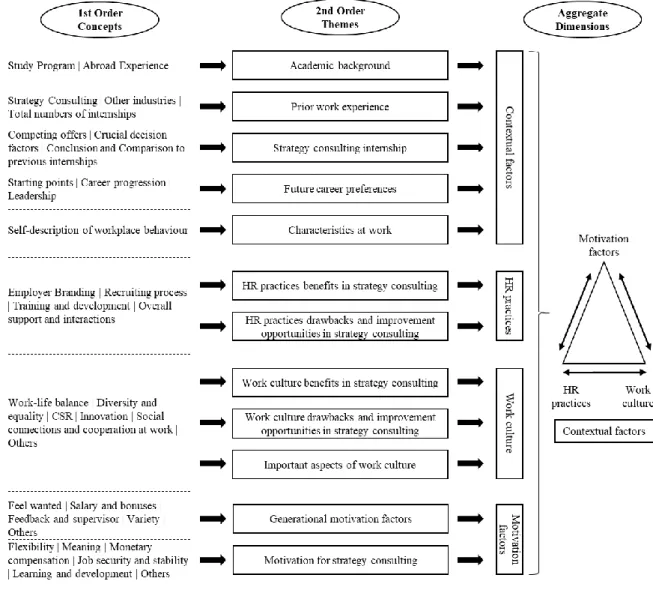
Utilising the results from the tables above and MAXQDA a conceptual formation is possible. As a basis, the 27 transcribed interviews, integrated in the software MAXQDA, were coded. As part of open coding, all statements were investigated, so that 89 first-order categories emerged, which seems to be a valid amount in this step (Gioia, Corley, Hamilton, 2013). For the sake of clarity, not all 89 first order concepts are displayed in the Gioia-Model below. All topics are covered, but the detailed version additionally distinguishes the listed first order concepts by sample, benefits and drawbacks (Appendix 6). In the next step, with aid of MAXQDA and the data analysis tables integrated above, all categories are examined for similarities and differences. This enables the bundling of topics into a well-manageable number of twelve second order themes, which in turn result in four dimensions. All data items can be assigned to one of the four dimensions. Besides, there seem to be enough qualitative statements on each topic. Therefore, it can be assumed that theoretical saturation is reached (Glaser, Strauss, 1967).
Topic Interpretation
Personal opinion of BCG's HR practices
2/3 refer to great overall support and interactions: helpfulness, reachability, attention, close contact, feeling valued and taken care of. Recruiting process: Gen Y values great organisation and the integration of an app. Training and development: positive (one exception). Employer Branding: Gen Y sees room for improvement. In contrast, HR experts regard it as a leading facet: intensified cooperation with career services and strong branding with diversity focused campaigns.
Distinct positive result for BCG. Overall support, training and development: consensus between Gen Y's and experts' perception; Employer Branding: the offline practices meet Gen Y's preferences, but experts have a misperception regarding online measures, which do not totally meet Gen Y's preferences. In general, experts seem to be more critical concerning the degree to which preferences are met. 87% (36%) exceed preferences
13% (45%) meet preferences
0% (18%) fall short preferences
Data Analysis (Experts' estimation in % in brackets)
Motivation factors and preference fulfilment with regards to work culture and HR practices are essential for evaluation of the internships.
Personal opinion of starting a career in strategy consulting
Gen Y considers companies which have an attractive work culture and offer a better work-life balance with the same learning curve: e.g. technology firms such as Google, Amazon or start-ups. Some Gen Ys decide that they want to specialise in an area of expertise: e.g. FMCG for Marketing or Investment Banking for Finance. Others consider starting traineeships at prestigious corporates.
Although every respondent has preferred an internship at BCG to other internships, only half are sure they want to take up a permanent position. Possible reasons include failure to meet preferences in the work culture and experienced/expected fulfilment of preferences in HR practices and the work culture of other firms. 80% above average experiences
13% within average experiences 7% below average experiences
53% yes
47% maybe Experiences at BCG compared to other internships
Above: people, feedback, learning, feeling wanted, interesting, challenging
tasks, overall support from HR, training, responsibility. Below: lack of work-life balance. General comment of some Gen Ys: There are other companies which also fulfill these preferences.
The time frames are just estimates and may vary depending on individual experiences and preference development over time. However, for many Gen Ys strategy consulting is attractive in the beginning of their careers, because they are not tied to an industry or department yet. Besides, they want to grow a prestigious network.
Desire for leadership responsibility in the future
For the respondents it is clear that they want to take on leadership in the course of their career. However, the extent varies within the target group. Some plan to lead a team and become project managers, while others are aiming for C-level positions. The definition of leadership varies.
The target group has importance for the future of management.
0% no
Gen Ys often refer to strategy consulting as an attractive starting point of their career due to the exposure to various industries as well as contact to smart colleagues and clients. Most of them state that they plan to specify on an industry after a couple of years.
47% (8%) up to 5 years 13% (33%) up to 3 years 27% (42%) up to 2 years 13% (17%) uncertain/no statement 100% yes 0% maybe 0% no Estimated length of stay in the industry and potential other starting points
16 Furthermore, these four dimensions – contextual factors, HR practices, work culture and motivation factors – seem to be interrelated. Results presented in the data tables indicate that contextual factors can influence all other dimensions, while HR practices, work culture and motivational factors appear to be interdependent. This is also shown in the model below. It will serve as a basis for discussion in the next chapter.
Figure 2: Gioia-Model
Source: Own representation based on Gioia, Corley, Hamilton, 2013.
5. Discussion
5.1 Theoretical Implications
The aim of this chapter is to connect findings from the analysis with those from the literature review in order to develop concepts further and address the research question. Hereby, all four
17 dimensions presented in the Gioia-Model are considered, as they are all important to the way motivations and preferences manifest in the workplace. The structure of the paper’s literature review will be used as a guide to present the theoretical implications. Hence, first, the initial research question will be adapted to the concrete context. Second, hypotheses will be developed to clarify the contradictions resulting from the literature review. Then, the Hackman & Oldham Model will be expanded. Finally, it will be concluded how HR practices and work culture in strategy consultancies align with the motivations and preferences of Gen Y.
A slight adjustment of the research question seems appropriate, since after the analysis of the four dimensions and a subsequent thorough examination of the literature review, a narrower focus emerged. The adapted research question: "How do HR practices and work culture in renowned strategy consultancies match the motivation and preferences of ambitious Gen Ys born between 1993 and 1998" shows two specifications: first, the focus on leading strategy consultancies due to the fact that the interviewees often separate McKinsey, Bain and BCG from other strategy consultancies in statements about work culture and HR practices. Second, the specialisation on a certain target group within the highly diverse Generation Y, which results from a comparison of the literature knowledge summarised in Table 1 and 2 with interview insights gained from Gen Y’s presented work behaviour patterns and both samples’ comments on motivation factors and work culture preferences.
Moreover, having examined the motivation factors and preferences regarding HR practices and work culture in the previous chapter, it is possible to formulate hypotheses with regard to the contradictions described in Table 1 and 2 of the literature review: based on the self-description of workplace behaviour and various changes regarding study locations and work experiences (Table 4), it can be concluded that the target group is self-confident, and comfortable with challenges and change. The prioritisation of social connections and cooperation at work (Table 5) as well as the described preferences concerning HR practices
18 (Table 6) lead to the hypothesis that Gen Y is socially active, both offline and online. The results also indicate that offline socializing components including knowledge sharing are important for Gen Y. The qualitative statements about work-life balance and about the motivation factor salary (Table 5) result in the hypothesis that free time can be partially sacrificed, if appreciation and compensation is offered. Gen Y’s comments on the importance of learning and personal development, social connections and cooperation at work as well as the appreciation of an encouraging supervisor (Table 5) show that soft skills are relevant and should be developed. Due to the lower prioritisation of monetary compensation, but emphasis on motivation factors such as responsibility, feeling wanted and frequently changing tasks (Table 5), it can be hypothesised that the target group’s intrinsic motivation is stronger than the extrinsic one. The results regarding motivation factors (Table 5) also indicate that meaning, purpose and impact are major aspects. Lastly, the ranking and comments on job stability and security lead to the hypothesis that these aspects are less relevant at the beginning of a career. Based on these hypotheses and the insights gained by the concept formulation, the Hackman & Oldham model is examined again. It can be stated that all existing components are still relevant, as these aspects are all integrated in the samples’ answers. However, the model lacks some important topics, which are added with a (+) in the figure below. Firstly, the core dimensions should be supplemented by flexibility, leadership and compensation, as these also contribute to experienced responsibility and knowledge of the actual results. At this point, experienced appreciation should be added as a psychological state and high contentment with supervisor and colleagues as personal and work outcomes. Moreover, HR practices and work culture with the defined, most relevant subjects should be integrated as core dimensions. They strongly contribute to the experienced identification with the organisation, which in turn should also be added as a psychological state due to its effect on personal and work outcomes. Lastly, not only growth need strength influences the whole process, but also other contextual
19 factors, such as the generation, academic background, work experiences and career preferences.
Figure 3: Work Motivation Model
Source: Own representation based on Hackman, Oldham, 1974.
Coming back to the research question, it can be stated that the HR practices in leading strategy consultancies largely align with the motivation and preferences of the target group. However, in order to remain at the forefront, both inside and outside the industry, continuous monitoring and further development is essential. Regarding work culture, renowned strategy consultancies seem to be on the right track to meet the preferences and motivation of Gen Y. In some relevant areas, such as the social environment and development opportunities, they currently exceed
20 the demands of the target group, while other issues, such as work-life balance, require essential measures for improvement. Which concrete steps and actions this could imply is among the deliverables of the next chapter.
5.2 Managerial Implications
The following managerial implications will be based on the findings, considering the interrelation of all four dimensions – contextual factors, HR practices, work culture and motivation factors. In order to structure them in a practical way for stakeholders, the action recommendations will be presented along a potential employee journey. Consequently, topic wise Employer Branding will be the starting point, followed by the recruiting process, training and development, overall support and all aspects of work culture.
In order to attract the target group, offline and online measures are required. The data analysis has shown that it is not a matter of course to win the target group, as it usually has competing offers. Prestigious strategy consultancies only target a specific part of Gen Y – ambitious, highly educated students and graduates. Consequently, HR departments should constantly monitor the global university market and seek contact with potential partners to find as many talented students and graduates from elite universities with international experience as possible. The target group highly values personal interactions with people working for the company. Therefore, it is advisable to be present on career fairs of the renowned institutions. To further strengthen communication and relationship building with targeted students, strategy consultancies should regularly invite to events, such as breakfasts and dinners in small groups. These measures give the target group the feeling of being valued, which – according to the rankings’ analysis – is an important motivation factor. According to the interview analysis, leading strategy consultancies seem to be on the right track regarding offline measures. However, online Employer Branding measures currently do not fully meet the preferences of targeted Gen Ys. According to the interviewees, the social media presence leaves the biggest
21 room for improvement. This means that strategy consultancies should spread more, different campaigns on various social media platforms. Thereby, they should stay authentic and at the same time communicate the message of a modern employer, who is a leader in work culture topics, which are important to Gen Y: social connections, work-life balance, diversity and equality, innovation and corporate social responsibility (CSR).
Once Gen Y is attracted with the Employer Branding measures and decides to apply at the firm, the recruiting process starts. As Gen Y likes to utilise digital tools, strategy consultancies should intensify the integration of digital solutions that are self-explanatory and personalised. For instance, the BCG App, which assists candidates until the assessment day, contributes positively to Gen Y’s preferences fulfilment. However, it is not enough, because this is so far the solely integrated digital tool within the recruiting process. Overall, the data analysis has identified many positive statements in the context of the recruiting process. Many of them are related to overall support of the HR department, implying that this is important for Gen Y and must be prioritised. This seems consistent, considering that social connections and cooperation at work is the crucial aspect of work culture for Gen Y.
Coming to the next step in the employee journey, onboarding, it can be stated that particularly in the strategy consulting industry training and development is of high importance. This becomes obvious, because learning and personal development is the top reason for Gen Y to start a career in this industry. This means that strategy consultancies have a particularly demanding target group in this respect, and must therefore, give priority to the further development of training programmes and individual support. As already outlined in the literature review, this includes providing a mentorship and a career advisor. Here, it is very important to consider that opportunities for growth, continuous and constructive feedback motivate Gen Y. Hence, career path development discussions and continuous feedback cycles are essential to motivate and retain Gen Y. In general, with regards to the target group’s
22 retention intrinsic motivational factors seem to be more important than extrinsic ones. Even though Gen Y employees want to be compensated for their efforts, the payment does not seem to be the deciding factor at the entry level. Accordingly, the money should better be invested in training, development and team building events as joint sport programmes, which again contribute positively to Gen Y’s number one work culture priority: social connections at work. Talking about work culture alignment, it must be stated that – although the ambitious target group is willing to sacrifice more for career advancement than other Gen Ys – work-life balance is the topic where the leading strategy consultancies have the most room for improvement. In particular, the weekend work, the long working hours and the many business trips must be counteracted. For example, more local staffing and modern working time models such as job sharing could be implemented. This would also benefit the topic diversity and equality – gender wise – as flexible working time models and increased presence in the hometown would facilitate the reconciliation of career and private life for young families. Moreover, local staffing would also contribute positively to the company’s CSR. According to the data analysis, it does not seem to be the most important topic. However, literature research and qualitative statements show that it has a certain relevance and presence for Gen Y, so strategy consultancies should try to act more socially responsible. This should imply, for example, replacing air travel with train travel if possible, or putting an increased emphasis on projects focusing on social impact and sustainability. This would also benefit the fact that Generation Y strives for meaningful work. If all these action recommendations are implemented, HR practices and work culture would temporarily be aligned with motivations and preferences of the target group. Finally, it would probably be possible to decrease the turnover rate. Nevertheless, constant monitoring and evaluation of the measures taken is recommended, as preferences and possibilities can change rapidly these days.
23
5.3 Limitations and Future Research
With respect to the evaluation of the research method, limitations arise, which offer potential for future research. Starting with the limitations of the research philosophy – interpretivism – it can be stated that according to axiology the researcher is part of what is being researched and therefore might be subjective. Since the study is carried out by a person who belongs to Generation Y and has also gained experience in strategy consulting, this might be the case. Therefore, it would be advisable to have the next study carried out by individuals belonging to another generation or, in the best case, by several researchers representing different generations.
Besides, the focus on a cross-sectional time horizon limits the examination of changes and development in preferences, motivation factors, HR practices and work culture. Consequently, it would make sense to repeat the study, for instance on a yearly basis in order to track the progress and react accordingly.
In addition, findings and hypotheses formulated after the qualitative data analysis should be examined by means of an in-depth literature review and inspected through a second data analysis technique, e.g. quantitative analysis in the form of questionnaires. In this context, it could make sense to add further prestigious work motivation models as a basis for theoretical implications, for instance Herzberg’s two factor model.
Coming to the limitations with regards to the sample it can be stated that the sample might not be representative for the entire Generation Y. First, age wise the sample only consists of people born between 1993-1998, who can be considered late Generation Y. Second, the sample does not represent the diverse backgrounds, which are said to exist in strategy consulting. Third, strategy consultancies seem to attract a particular ambitious subgroup of Gen Y. Fourth, as work experience at BCG is a criterion, one might say that the other strategy consultancies are neglected. Future researchers could conduct the study with a bigger sample, consisting of
24 individuals with more diverse backgrounds and strategy consulting experience in other companies than BCG.
Moreover, studies rely on the quality of data. With regards to the literature research, the availability of high-quality academic papers on the topic is limited. For interviews this means that they rely on the quality of responses. The fact that part of the sample – BCG project leaders, consultants and the recruiting director – has very limited time capacity is the reason why a few replies could only be collected by e-mail. This, for instance, does not allow probing questions and therefore results in a loss of quality. The last advice for future research in this context is to talk to complete HR departments of strategy consultancies, for instance in focus groups. Unfortunately, for this work this was restricted due to the company’s internal policies.
6. Conclusion
To conclude, it should be noted that motivations and preferences depend on contextual factors and therefore cannot be generalised for an entire generation. Currently and in the coming years, awareness of the existence of strong diversity within a generation is essential for organisational success. Strategy consultancies attract ambitious, motivated, determined and highly educated Gen Ys, who are willing to sacrifice part of their private life for career progression. Even within this target group, priorities regarding work culture, HR practices and motivation factors vary slightly for each individual. One of the biggest challenges will be the alignment according to these individual preferences and motivations. The fulfilment of preferences requires a constant interaction of HR practices and work culture under the consideration of motivation factors. For the target group, it can be stated that leading strategy consultancies’ work culture and HR practices align with preferences and motivations in some points. Over the next few years, these companies could meet the preferences of their target group by engaging in an ongoing dialogue, continuously monitoring, evaluating, questioning and further processing initiatives.
25
References
Bain & Company. 2019a. “About us.” Accessed November 27 2019.
https://www.bain.com/about/.
BCG. 2019a. “About BCG: Overview.” Accessed November 27 2019.
https://www.bcg.com/about/about-bcg/overview.aspx.
BCG. 2019b. “About BCG: BCG Values: Our Common Language.” Accessed November 27.
2019. https://www.bcg.com/about/about-bcg/people-values.aspx.
Bencsik, A., Horváth-Csikós G., Juhász, T. 2016. “Y and Z Generations at Workplaces.” Journal of Competitiveness, 6(3): 90-106.
Champoux, J. E. 1980. “A Three Sample Test of Some Extensions to the Job Characteristics
Model of Work Motivation.” Academy of Management Journal, 23(3): 466-478.
Chelliah, J., Georges, S. 2015. “Consulting firm identity: the online effort to differentiate and
compete.” Journal of Business Strategy, 36(6): 47-53.
Deloitte. 2019a. “Human Capital awards and recognition.” Accessed November 26 2019.
https://www2.deloitte.com/rs/en/pages/human-capital/articles/gx-human-capital-consulting-awards-recognition.html.
Deloitte. 2019b. “A generation disrupted: Highlights from the 2019 Deloitte Global Millennial
Survey.” Deloitte Insights.
Deloitte. 2019c. “Leading the social enterprise: Reinvent with a human focus: 2019 Deloitte
Global Human Capital Trends” Deloitte Insights.
DeVaro, J., Li, R., Brookshire, D. 2007. “Analysing the job characteristics model: new support
from a cross-section of establishments” International Journal of Human Resource Management, 18(6): 986-1003.
Gioia, D. A., Corley, K. G., Hamilton, A. L. 2013. “Seeking Qualitative Rigor in Inductive
26
Glaser, B. G., Strauss, A. L. 1967. “The Discovery of Grounded Theory: Strategies for Qualitative Research.” Piscataway: Transaction Publishers.
Hackman, J. R., Oldham, G. R. 1974. “The Job Diagnostic Survey: An Instrument for the Diagnosis of Jobs and the Evaluation of Job Redesign Projects.” New Haven: Department of
Administrative Sciences at Yale University.
Joshi, A., Dencker, J. C., Franz, G., Martocchio, J. J. 2010. “Unpacking Generational
Identities in Organizations.” Academy of Management Review, 35(3): 392-414.
Kontoghiorghes, C. 2016. “Linking high performance organizational culture and talent
management: satisfaction/motivation and organizational commitment as mediators.”
International Journal of Human Resource Management, 27(16): 1833-1853.
Kultalahti, S., Viitala, R. 2015. “Generation Y – challenging clients for HRM?” Journal of Managerial Psychology, 30(1): 101-114.
Kultalahti, S., Viitala, R. 2014. “Sufficient challenges and a weekend ahead – Generation Y
describing motivation at work.” Journal of Organizational Change Management, 27(4): 569-582.
McKinsey & Company. 2019a. “About us: Defined by our people.” Accessed November 27
2019. https://www.mckinsey.com/about-us/overview.
McKinsey & Company. 2019b. “About us: Our mission and values.” Accessed November 27
2019. https://www.mckinsey.com/about-us/overview/our-mission-and-values.
McKinsey & Company. 2016. “Millennials: Burden, Blessing, or both?” McKinsey Quarterly,
February 2016.
M2 Presswire. 2018. “$90+ Bn Strategy Consulting Market to 2025 – Global Analysis and
Forecasts by Services and Industry Vertical.” Accessed November 4 2019. https://news-business.vlex.co.uk/vid/90-bn-strategy-consulting-754231357.
27
M2 Presswire. 2019. “Strategy Consulting Market 2019 Global Applications, Size, Competitive
Landscape, Industry Share, Recent Trends and Growth Forecast to 2023.” Accessed November 5 2019. https://news-business.vlex.co.uk/vid/strategy-consulting-market-2019-784733565.
Saunders, M., Lewis, P., Thornhill, A. 2012. Research Methods for Business Students. Harlow:
Pearson Education Limited.
Statista. 2019. “Leading consulting firms in the United States in 2019, by prestige rating.”
Retrieved from Statista https://www.statista.com/statistics/190343/25-leading-us-consulting-firms-by-overall-prestige-2011/.
Statista. 2018. “To what extent do you agree/disagree with the following statement: I like to lead
others?” Retrieved from Statista https://fesrvsd.fe.unl.pt:2099/statistics/317422/united-kingdom-uk-survey-leading-others-students-future/.
Stone, D. L., Deadrick, D. L. 2015. “Challenges and opportunities affecting the future of human
resource management.” Human Resource Management Review, 25(2): 139-145.
Stone, D. L., Tetrick, L. E. 2013. “Understanding and facilitating age diversity in
organizations.” Journal of Managerial Psychology, 28(7-8): 725-728.
Torsello, D. 2019. “Generation Y workers: An empirical framework for cultural and
organizational aspects.” Employee Relations: The International Journal, 41(6): 1330-1347.
TransparentCareer. 2019. “The Most Popular Companies for MBAs.” Accessed December 16
2019. https://blog.transparentcareer.com/mbas/company-rankings/the-most-popular-companies-for-mbas/
Wall, T. D., Clegg, C. W., Jackson, P. R. 1978. “An evaluation of the Job Characteristics
Appendices
Appendix 1: Gen Y in the Workplace – Motivation Factors, Work Preferences and HR Practices Appendix 2: Sample Selection and Characterisation
Appendix 3: Interview Guides Design and Reasoning for Interview Guides Questions Appendix 4: Interview Guides
Appendix 5: Interview Results Tables Appendix 6: MAXQDA Code System Appendix 7: Transcripts
Appendix 1: Gen Y in the Workplace – Motivation Factors, Work Preferences and HR Practices Type of literature Title Publisher Year of
Publication Years of birth Gen Y in the workplace
Motivation factors and work preferences of Gen Y
Potential HR practices as response
Academic Paper Generation Y
workers
Employee
Relations 2019 1980-2000
Unpredictable behaviour; difficult to deal with; convenient in dealing with social media and technology; contradiction: neglection of or craving for social connections and networking; rather poor loyalty to the employer
Participative leadership style; direct feedback; task clarity; flexible job components, e.g. remote employment; variation of work tasks; work-life balance; intrinsic motivation (social connections within the organization, job satisfaction, meaningful work) more relevant than extrinsic features (e.g. salary) and job security; shared positive vision of tasks accomplishment; common goals; opportunities to utilise individual skills and try out; dynamic leaders' support, closeness and appreciation; cultural diversity; honesty; respect; leaders' communication strengths; personalised career growth perspectives; work-life balance
Improve employee experience and reduce boreout: training facilities: yoga, mediation and other sport programmes; food offerings; offer flexible working possibilities; teach particular leadership behaviour: communication in informal settings, coaching, encourage social compentences and technical skills development, enable job content flexibility, have social justice, show empathy
Academic Paper Y and Z Generations at Workplaces Journal of Competitiveness2016 1980-1995
Have highly skilled digital expertise; willingly deal with changes; live for the present and the moment; do not want to plan long-term; have a selfish short-term view; suspicious; hyperconfident; like speed in daily life; connection to friends is set up online; know how to deal well with cultural diversity; not willing to support the development of offline connections; underestimate soft skills; more focused on work than on family
Workplace and working hours flexibility; mobility; joy at work; career development and striving for leadership position; extrinsic motivators (e.g money) are more important than non-material incentives; success; work-life balance; teamwork and common goals; freedom of choice; self-fulfillment; direct feedback, participative leadership
Training and development: individual, IT based, immediate: Workplace flexibility: Hot desk, shared desk, open space; Environmental friendly measures Academic Paper Generation Y - Challenging clients for HRM? Journal of Managerial Psychology 2015 1978-1995
Particial sacrifice of free time for career development if appreciation and rewards exist
Freedom of choice; job content: variation and challenge in tasks; training and development: growth opportunities with a clear direction, continuous learning and competences development; try out culture; demanding, close, flexible leaders; continuous, constructive feedback; social connections and cooperation: euphoric, motivating, trustworthy, helpful, driven co-workers with common goals; equality; meaning in the job; work-life balance: sufficient free time; appropriate degree of workload; intrinsic motivation is more important than extrinsic and job security and stability; flexible work arrangements; self-actualisation; feeling of belonging and importance in the workplace; responsibility
Flexible working possibilities (location and time wise); adjust compensation structures; introduce time credits; job rotation; training and development: coaching, mentoring, development reviews including individually tailored career plans that incorporate task changes and preparation for growing demands; regular, just-in-time feedback from leaders Academic Paper Sufficient challenges and a weekend ahead - Generation Y describing motivation at work Journal of Organizational Change Management 2014 No information
Convenient in dealing with technology; socially outgoing; willingly deal with changes; motivated to improve their capabilities and accept changes in the job; particial sacrifice of free time for career development if appreciation and rewards exist; neglection of promotion, titles and status symbols
Extrinsic (financial) and intrinsic motivation; career advancement; open atmosphere; euphoric, motivating, trustworthy, helpful, driven co-workers with common goals; equality; developmental job content: variation and moderate challenges in tasks; moderate time effort; being treated respecfully and valued; lack of motivation through lack of sleep, lack of sport, lack of supervisor's competence, lack of feedback, lack of financial fairness