i
Improve of business value for Portuguese SME
that adopt Industry 4.0
Luís Filipe Henriques Anselmo
Dissertation presented as partial requirement for obtaining
the Master’s degree in Information Management
i
201
9 Title: Improve of business value for Portuguese SME that adopt Industry 4.0
Student: m2016495
i
NOVA Information Management School
Instituto Superior de Estatística e Gestão de Informação
Universidade Nova de Lisboa
IMPROVE OF BUSINESS VALUE FOR PORTUGUESE SME THAT ADOPT
INDUSTRY 4.0
by
Luís Filipe Henriques Anselmo
Dissertation presented as partial requirement for obtaining the Master’s degree in Information Management, with a specialization in Information Systems and Technologies Management.
Advisor / Co Advisor: Professor Doctor Vítor Santos
ii
ACKNOWLEDGEMENTS
The conclusion of this dissertation was only possible by the support of people around me, that I would like to thank.
To my wife and daughters, thank you for the unconditionally support, with all love, understanding and patience that gave me along this path.
Thank you to Professor Vítor Santos for his regular feedback, availability, continuous encouragement and valuable guidance, which have been essential in the development of this work successfully. I express my thanks to the companies that I interviewed for the availability, openness, involvement and all the knowledge shared, fundamental for the accomplishment of this work.
iii
ABSTRACT
Many industrial organizations already began the Digital Transformation path, with the premise and objective of applying the features and models that Industry 4.0 brought to the industry field, particularly factories, creating a new context of smart factories that will provide higher revenue. Aggregated to Industry 4.0 new types of architecture were born, that will create great challenges in terms of security, control, interoperability among others.
One of these areas is Edge computing that combines the very best of cloud and on-site computing. With the control authority, overall automation management and cloud based analytics, the edge systems answer the challenges identified as being crucial for any industrial 4.0 deployment.
In this work the research methodology will consist of a comprehensive review and strategic analysis of existing global literature on those topics, in parallel with interviews and data analysis that were performed to entities representing the Portuguese Small and Medium Enterprises in the Industrial market.
This work aims to contribute to stimulate the need of achievements, a more strategic and operational approach in the use of edge computing within organizations to clarify the existing strengths in this area. This way, Industry 4.0 strategy can be implemented with effective approaches and planned actions for a direct business value increase and also be able to create a reference model that could be applied in similar organizations.
As a result, this work bring knowledge for companies, in the same market segment of the study, that want to adopt initiatives of industry 4.0.
KEYWORDS
iv
INDEX
1.
Introduction ... 1
1.1.
Background Motivation ... 1
1.2.
Study Objectives ... 1
1.3.
Document Organization ... 2
2.
Literature Review ... 4
2.1.
Major Trends of Information Systems... 4
2.2.
Cloud and Fog Computing ... 5
2.2.1.
Cloud computing ... 5
2.2.2.
Fog computing ... 6
2.3.
Industry 4.0 and Cyber-Physical Systems ... 7
2.3.1.
Industry 4.0 ... 7
2.3.2.
Cyber-Physical Systems ... 8
2.4.
Fog Computing Capabilities for Industry 4.0 ... 10
2.5.
Business Value of Digital Transformation ... 11
2.6.
Evolution of Digital Transformation on Portuguese SME ... 11
2.7.
Industry 4.0 Adoption on Portuguese SME ... 12
3.
Research Methodology... 14
3.1.
Research Strategy ... 14
3.2.
Case Study ... 14
4.
Study Analysis ... 17
4.1.
Study Organization ... 17
4.2.
Case Study Selection ... 18
4.3.
Gathering Data ... 19
4.4.
Result Analysis ... 25
5.
Conclusion ... 27
5.1.
Limitations ... 27
5.2.
Recommendation for Future Work ... 28
Bibliography... 29
v
LIST OF FIGURES
Figure 1- NIST approach model ... 6
Figure 2 - Fog Computing and its Ecosystem, ... 7
Figure 3 - Indicative quantification of value drivers ... 8
Figure 4 - CPS structure ... 9
Figure 5 -SWOT Matrix for Industry 4.0 ... 13
Figure 6- Map Benefit Impact, ... 16
LIST OF TABLES
Table 1 – Selected Companies ... 18
vi
LIST OF ABBREVIATIONS AND ACRONYMS
CPS Cyber-Physical Systems
CRM Customer Relationship Management
ERP Enterprise Resource Planning
I4.0 Industry 4.0
ICS Industrial Control Systems
IoE Internet of Energy
IoP Internet of People
IoS Internet of Services
IoT Internet of Things
QoS Quality of Service
RCS Resilience Control System
SCADA Supervisory Control and Data Acquisition
1
1. INTRODUCTION
Nowadays, technology is evolving quicker than ever, creating very large challenges to organizations, governments and people. It’s known that at some point in time machines will prowl the earth performing activities that humans don’t want to, making them indispensable to us. Industry 4.0 is the starting point of this new era, creating new ways of working, efficiency and automation based on predictive information.
Started in Hannover in 2011, the term Industry 4.0 came as an approach to strengthening the competitiveness of the German manufacturing industry and can be defined as a collective term for technologies and concepts of a value chain organization which creates together Cyber-Physical Systems (CPS), Internet of Things (IoT), Internet of Services (IoS), Internet of People (IoP) and Internet of Energy (IoE) (Lom, Pribyl, & Svitek, 2016).
All these subjects have the need of data transportation and data analysis layers. One of the key areas to enable the creation of business value is the Edge Computing that can be used in almost every part of those initiatives. This technology plays an important role in the data layer, distinguishing which data will be sent up to the top level of controlling, while the rest of the data will be only used in local edges.
Edge Computing can be used in Industry 4.0 factories, where it can effectively separate manufacture data and only useful data will be provided to control, analysis and management level (Lom et al., 2016).
1.1. B
ACKGROUNDM
OTIVATIONIt is important to identify the business value that the usage of Edge Computing architecture can bring to the Portuguese small and medium enterprises that had adopted or will adopt Industry 4.0. One of the issues related with Industry 4.0 adoption is the high volume of data generated by the Cyber-Physics Systems and/or IoT devices that need to be transported, transformed and managed. Cloud Computing will have a major role at this level with all the new capabilities that it can provide, like Big Data analysis and Machine Learning, as demonstrated in previous researches, but will it be enough? For sure that edge computing will enable the optimization and management of interesting data in an efficient way that leverages business value. The ratio of benefit realization and investment needs to be evaluated, both in qualitative and quantitative terms, for Portuguese SME that adopted Industry 4.0.
1.2. S
TUDYO
BJECTIVESSome studies were already made in the overall approach to the industry 4.0’s applicability, concepts and scenarios (Hofmann & Rüsch, 2017) and also regarding edge computing, defining it in terms of
2 architecture and applicability dimensions (Varshney & Simmhan, 2017). This work aims to clarify what are the capabilities of Edge computing that will empower the business, in qualitative and quantitative terms for the Portuguese SME that adopt Industry 4.0, contributing for a better understanding of how organizations can leverage these two big domains of innovation, efficiency and value.
Thus, the main goal of this research is to quantify and qualify the value creation to business Portuguese SME organizations that already adopted Industry 4.0 in their culture, operating model and product lifecycle. Specific objectives will support this goal, such as: which capabilities of edge computing will support Industry automation challenges? How can the predictive maintenance benefit from edge computing? What’s the impact of Edge Computing across industry segments? What type of changes will be reflected in staff?
This work contributes to help Industrial organizations to have a practical and clear understanding of the value to business in qualitative and quantitative terms, when edge computing is integrated on operating models. It will extend the knowledge of applicability of edge computing on Portuguese SME factories based on the state of the art of this domain.
1.3. D
OCUMENTO
RGANIZATIONThis document is divided in three main parts as it is detailed in this section.
The first part, composed by chapters 1 and 2, is the result of a comprehensive literature review and analysis regarding the topic of all technological, social and human factors surrounding Industry 4.0. For this part the most relevant articles on the subject were analysed to provide a consistent basis for the research conducted during this dissertation, focusing primarily in the theoretical part of the business value that technology can bring to Portuguese SME.
Chapter 1 presents the introduction and contextualization of the topic, explaining the motivations that originated it, objectives and how the document is organized.
Chapter 2 presents the “state of the art” of Industry 4.0 and related topics setting to the best of our knowledge, considering that this subject is broad.
In the second part of the document, composed by chapters 3 and 4, the research methodology used to analyse the current situation of Industry 4.0 adoption and the technology behaviour in this context, through interview of small and medium enterprises are defined. Based on that information, the current situation and what might be the business value on Industry 4.0 implementation in Portugal is analysed.
Chapter 3 presents a study of the different methodologies used to design a case study and it’s characterization.
3 Chapter 4 presents the data gathering definition used, the results from the collected information and global research analysis.
The last part of the document, composed by Chapter 5, presents the conclusions, limitations and future work.
4
2. LITERATURE REVIEW
The literature review focuses on collecting information about the studies already performed to better understand and establish a baseline of knowledge. Starting from a broad view of major trends to the status of industry 4.0 in Portugal, it aims to get a detailed overview on the subject that inspired this study.
Several studies were born around the thematic of Industry 4.0 and Edge Computing. The critical review already ascertained its benefits and disadvantages, however there are few that related both in terms of capabilities that could help organizations in the decision process, at the time of business cases study related to Industry 4.0 adoption and build smarter factories (Nelson, 2017).
For example, some authors developed a platform that includes an edge infrastructure to improve the effectiveness of equipment failure models on an industrial process (Gazis et al., 2015). Other, proposed some architecture that consists of fog/edge nodes and edge resources inside a Smart Factory to achieve increased QoS. The mentioned studies take advantage of an edge-based architecture. Nonetheless, they do not consider the prediction of measured data to save energy that could provide value to business.
Some other opinions show the importance of this subject (Fraunhofer-Gesellschaft, 2017) by highlighting the strengths of the emerging business models that will be supported by edge computing (Rimal & Lumb, 2017).
2.1. M
AJORT
RENDS OFI
NFORMATIONS
YSTEMSThere are several trends of information systems that have important impact on this study. These trends can be social, technical and personal.
Globalization
The expansion of the internet is continuing to grow all over the world, making globalization a reality. Easier access to computers, the modernization of countries and an increase in the use of smartphones has given people the opportunity to use the internet more frequently and more conveniently. 3,578 million is the number of internet users registered worldwide (Statista, 2017).
Social
Increase in the use of social networks such as Facebook, Youtube, Twitter, QQ (China) and other social media sites. Social media has become ubiquitous and plays a critical role in today’s business environments. Many companies use social media tools to provide a variety of services and to interact with customers (He, Wu, Yan, Akula, & Shen, 2015)
5 Information systems users are modifying their experiences to meet their personal taste. The majority of devices already allows a personalization and with the collection of information we will begin seeing devices that match our personal preferences (Bourgeois, 2014).
Mobile
The most impactful trend in digital in the last 10 years has been the use of mobile technologies. Mobile device sales, growth of mobile subscribers, the internet access via mobile and the use of tablets are the most significant growth of mobile space (Bourgeois, 2014).
Autonomous
By combining software, sensors and location technologies, devices can operate to perform specific functions, such as medical nanotechnology robots, self-driving cars or unmanned aerial vehicles (Bourgeois, 2014).
Findable
The “Internet of Things” point us to the idea of physical objects being connected to the Internet. The advances in wireless technologies and sensors will allow physical objects to send and receive data about themselves and behaviours of usage (Bourgeois, 2014).
Collaborative
It will be simpler than ever to share data between wearables and smartphone for mutual benefit. Some of this sharing can be done passively, such as reporting our location to update traffic statistics. Other data can be reported actively, such as adding our rating of a restaurant to a review site (Bourgeois, 2014).
2.2. C
LOUD ANDF
OGC
OMPUTING2.2.1. Cloud computing
The Cloud Computing provides IT resources (storage, processing and networking) as a service from a centralized location, giving higher scalability and agility with cost reduction for the organizations (Mell & Grance, 2011).
Based on the NIST model there are four deployment models: public, private, hybrid and community; three service models: IaaS, PaaS and SaaS; and five major characteristics: network access ubiquity, elasticity, self-service, monitoring quality of service and resources pooling availability.
6 Figure 1- NIST approach model, (Simmon, 2018)
Nevertheless, for (Elahi, 2015) there are some challenges of cloud computing that need to be addressed:
• Too much centralized data;
• Applications that require very low and predictable latency; • Geographically distributed applications;
• Fast mobile applications; • Transport cost is too high;
• Large-scale distributed control systems such as smart grid, connected rail, smart traffic light systems.
2.2.2. Fog computing
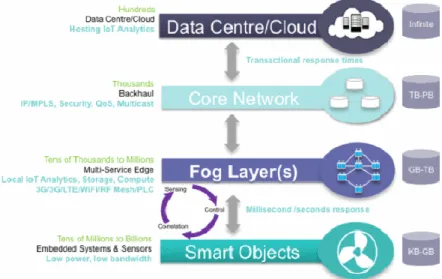
For (Rimal & Lumb, 2017) Fogs’ goal is to improve efficiency and reduce the amount of data that needs to be transported to the cloud for processing, analysis and storage. This is often done for efficiency reasons, but it may also be carried out for security and compliance reasons.
7 Based on (Varshney & Simmhan, 2017) the concept of Fog Computing was introduced by Cisco Systems in 2012, and in its initial definition it was considered as an ‘‘extension of the cloud computing paradigm, that provides computation, storage, and networking services between end devices and traditional cloud servers.
Therefore, fog computing does not cannibalize cloud computing, but complements it: the fog architecture facilitates the creation of a hierarchical infrastructure, where the analysis of local information is performed in the field, and the coordination and global analytics are performed in the cloud.
Figure 2 - Fog Computing and its Ecosystem, (Elahi, 2015)
2.3. I
NDUSTRY4.0
ANDC
YBER-P
HYSICALS
YSTEMS2.3.1. Industry 4.0
For (Kagermann, Wahlster, & Helbig, 2013) the fourth industrial revolution, is triggered by digital technologies that have a significant influence on manufacturing. A variety of concepts and solution-components were drawn and studied to fulfil the vision of Industry 4.0. It includes, Cyber-Physical Systems (CPS) as intelligent entities in production, Internet of Things (IoT) as communication platform for CPSs, Cloud solutions for decentralized services and Big Data solutions for high-performance processing of big data with large amounts in volume, variety, speed, variability, or veracity, etc. in manufacturing.
According to (Lom et al., 2016) Industry 4.0 is the digitization of the manufacturing sector, with embedded sensors in virtually all product components and manufacturing equipment, ubiquitous cyber-physical systems, and analysis of all relevant data.
8 Figure 3 - Indicative quantification of value drivers, (McKinsey Digital, 2015)
For (Kagermann et al., 2013) a key approach of Industry 4.0 is to equip future products and production systems with embedded systems as a basis for smart sensor and smart actuators that enable communication and intelligent operation control. Industry 4.0 uses the ability of cyber-physical systems to provide communication and intelligence for smart systems and can offer the following advantages based on (Lee, Bagheri, & Kao, 2015):
• More flexibility: Networks enable business processes to be structured more dynamically. Production procedures react more flexibly to changes in demand.
• Reduce lead times: Seamless data collection allows the rapid use of production-relevant data and information for near-term decision-making, and therefore reduces lead times for innovations in the market.
• Adapting to customer demands with small batch sizes: Industry 4.0 enables the incorporation of individual customer-specific criteria concerning planning, configuration, ordering, design, production, and operation. It also allows modifications in time.
• New offerings of downstream services: Industry 4.0 has the potential for high-performance services for the near-term evaluation of big data.
2.3.2. Cyber-Physical Systems
For (Wang & Wang, 2016) CPSs, is an “umbrella” term that includes systems of many types including robotics, machine automation, industrial control systems, process control systems, supervisory control and data acquisition (SCADA) systems, the Industrial Internet and the Internet of Things (IoT). Cyber means computation, communication, and control that are discrete, switched, and logical. The term physical refers to human-made systems ruled by the laws of physics and operated in continuous
9 time. For (Wang & Wang, 2016) a cyber-physical system is defined as transformative technologies for managing interconnected systems between their computational capabilities and physical assets. According to (Schoenthaler, Augenstein, & Karle, n.d.) CPS is a system for IT elements collaborating and being designed to control physical objects. Communication takes place via a data infrastructure such as the Internet. Traditional embedded systems can be regarded as a special case of a stand-alone CPS.
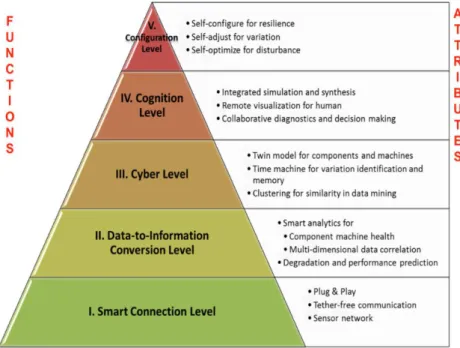
(Lee et al., 2015) proposed a 5-level CPS structure. It defines how people construct a CPS starting from the initial data acquisition to analytics and the final value creation.
Figure 4 - CPS structure, (Lee et al., 2015)
For (Lee et al., 2015) each level have a specific purpose with that can be explained as:
Smart Connection - Acquiring accurate and reliable data from machines and their components is the
first step;
Data-to-Information Conversion - Meaningful information has to be inferred from data;
Cyber - This level acts as a central information hub in this architecture. Having massive information
gathered, specific analytics have to be conducted to extract additional information for providing better insight;
10
Cognition - Implementing CPS upon this level generates a thorough knowledge of the monitored
system. A proper presentation of the acquired knowledge to expert users supports a correct decision;
Configuration - This level is the feedback from the cyber space to the physical space and acts as a
supervisory control to make machines self-configure and self-adaptive. This stage acts as a Resilience Control System (RCS) to apply corrective and preventive decisions.
2.4. F
OGC
OMPUTINGC
APABILITIES FORI
NDUSTRY4.0
There are some fog computing capabilities that we can consider as aligned with Industry 4.0. (Yang, Huang, Li, Liu, & Hu, 2017) study the benefits that could be retain from the fog computing capabilities, namely:
Low latency and real time interactions - enables low latency and meets the demand of real time
interactions, especially for latency-sensitive or time-sensitive applications;
Save bandwidth - data pre-processing, redundancy removing, data cleaning and filtering and
valuable information extraction are performed locally. Only part of useful data is transmitted to the cloud and most of the data doesn't need to be transmitted over the Internet. Big data era with huge amount of data;
Support for mobility - supports location-based mobility demands and enables administrators to
control where users and mobile devices are coming in and how they access the information;
Geographical distribution - the decentralized data analytic ensures the proximity of data analytics to
the customer. This characteristic can support faster analysis of big data, better location-based services, and more powerful capabilities of real-time decision making;
Heterogeneity - physical node, virtual node, high-speed links, but also wireless access technologies. Interoperability – integration interfaces to communicate to all systems;
Data security and privacy protection - can protect data by encryption and isolation; Analyse sensitive
data locally instead of sending it to the cloud for analysis. The IT team can monitor and control the devices that collect, analyse and store data; and
Low energy consumption - short range communication mode and some optimal energy Management
Policies of mobile nodes evidently reduce communication energy consumption. This will lead to reducing power consumption, saving energy and decreasing the cost.
11
2.5. B
USINESSV
ALUE OFD
IGITALT
RANSFORMATIONFor (Medhi & Simchi-Levi, 2016) the various outcomes and benefits of Digital transformation can be classified into three categories:
• New Business Models - New technologies can introduce new business models and sometimes also disrupt the value chain. Charged based on usage time, thus changing from a fixed cost to a variable cost service-based model. (Uber, Netflix, Airbnb are examples of disruptions in business models using technology);
• Operational Efficiency - New technologies are improving operational efficiency by building capabilities such as predictive maintenance, automation, dashboards, better supply chain visibility, asset monitoring and helping in faster decision making;
• Customized Offerings - the capability to offer customized services and experiences to customers, based on customer behaviour of using technology to gather that information in real time.
2.6. E
VOLUTION OFD
IGITALT
RANSFORMATION ONP
ORTUGUESESME
For (Probst, 2017) Portugal is a strong performer in entrepreneurial culture and in digital infrastructure. The country also shows a consolidated performance in integration of digital technology and e-leadership. Despite its rather favourable entrepreneurial climate, Portugal´s performance in ICT start-ups is quite weak.
The areas of investments and access to finance and supply and demand of digital skills present challenges for Portugal. Indeed, the area in which the country performs the lowest is the supply and demand of digital skills.
Overall, there is some room for improvement in three out of seven dimensions. The country´s main strengths lie in its entrepreneurial culture and digital infrastructure. However, further efforts are needed in investments and access to finance as well as in supply and demand of digital skills.
Strengths
For (Probst, 2017), Portugal’s strong performance in entrepreneurial culture relies on Portuguese´s great interest in being self-employed and in setting up their own company if they had the means to do so. However, entrepreneurs tend to have, in general, a rather negative image among the population.
Portugal’s solid digital infrastructure is based on companies ‘solid uptake of ICT software solutions and extensive use of fixed broadband connection. However, this overall good performance could be even further consolidated with a faster internet connection speed.
12 However, Portugal’s performance in supply and demand of digital skills could be significantly improved. A substantial number of companies find problems when hiring ICT specialists. Moreover, efforts should be stepped up in increasing high-tech patent applications.
According with (Probst, 2017) another key challenge for Portugal is the need to invest and access to finance. The country shows a rather weak performance in private R&D investment. Companies have difficulties in raising money through local equity markets.
2.7. I
NDUSTRY4.0
A
DOPTION ONP
ORTUGUESESME
i4.0 is the Portuguese strategy to develop industry in the digital area. Launched In January 2017, its aim is to put Portugal at the forefront of the 4th Industrial Revolution by focusing on 3 axes:
digitalization, innovation and training (Klitou, 2017). There are three main objectives targeted by the initiative:
• To provide the Portuguese industrial fabric with the knowledge, information and tools needed to transform, adapt and empower its national workforce.
• To create favourable conditions, national technological solutions in an international context for the development of i4.0 start-ups as well.
• To position Portugal as an international HUB by attracting resources and creating fiscal and legal conditions to attract foreign investors.
13 Figure 5 -SWOT Matrix for Industry 4.0, (Klitou, 2017)
For (Klitou, 2017) due to the infant stage of the initiative’s implementation, only a few barriers have been identified. The digital transformation that the companies need to undertake can lead, if not addressed correctly, to an increase of unemployment rates. Therefore, “Indústria 4.0” launched a core component of its strategy: the need to prepare the new and current generation for the skills that will be needed in future jobs.
Another barrier relates to the lack of mechanisms applied to ensure private financing. Although private stakeholders, particularly multinationals, have been actively involved, no instrument has been developed to ensure private funding commitments.
14
3. RESEARCH METHODOLOGY
3.1. R
ESEARCHS
TRATEGYThe methodology design adopted in this work will be based on a qualitative and quantitative research execution. This research will be supported by gathering information from of Portuguese SME Industry 4.0 adoption, choose an enterprise known for being leader in this adoption as well as being leader in their market.
After defining the population, the Portuguese small and medium enterprises that have adopted Industry 4.0, collected from statistics sources, an interview will be applied to evaluate the edge computing capabilities that those organizations perceived to be a creation of value for their business. Therefore, the research methodology more appropriate to study this subject is a case study, since an analysis will be illustrative of situations of the small and medium enterprises, which will be applied to entities that want adopt industry 4.0 in their culture and business models.
After gathering data, the results of the interview will be analysed against the definition and scale defined. These are the variables that will be analysed:
• Understand how and why various technologies were adopted and their many benefits. • Revenue impact (existing & new revenue);
• Cost (fixed & variable cost);
• Capability, Benefit and Impact - common capabilities and benefits that will achieve through technology adoption and their corresponding impact of revenue and cost;
• Map with benefit impact - understand how technologies can add value to the various business operations and functions in an organization.
The expectation is that with the interview and indirect research, all the questions will be possible to be answered, adding value to the field and helping organizations on decisions in terms of research, and contribute to the state-of-the-art to be possible to create a referential of capabilities according to the population context.
3.2. C
ASES
TUDYCase studies are used as a research methodology to investigate an occurrence in its neutral environment, by using various means of gathering data and information from one or more entities and then proceeding to the analysis of that information. This type of methodology is more appropriate for investigation, classification and hypothesis development. One of the characteristics
15 for this research methodology is that it may not be possible to identify sets of dependent and independent variables beforehand. This type of methodology can use quantitative, qualitative methods or a combination of both. The case study represents a research strategy connected to a history, hypothesis, experiment or simulation that can also lead to a different research strategy. The main drawback of this methodology is that, can be quite complicated to apply the conclusions gathered from its applicability into a general setting. However, (Kanellis & Papadopoulos, 2009) also mentioned that generality may not be problematic from another point of view. In that perspective, this type of methodology can be considered usable because it is seen as a method for organizing data rather than a technique for obtaining data. The focus in this case is to present a logical reasoning used to describe the results obtained and reach a conclusion through them.
Case studies are used to explain a situation or problem but can also be used for descriptive purposes if the generality is just used in order to understand the context. (Runeson & Höst, 2009) identify three types of case studies: the positivist, critical and interpretative. The positivist consists of searching for evidence of formal propositions, measure variables and testing hypothesis. The critical is based on making social critiques and interpretative tries to understand the occurrences from the participants point view of the context having a tendency for a descriptive and explanatory perspective.
In this work the most suitable type of case study is the interpretative, because it will be studying the current situation of a SME that adopted industry 4.0.
Following these guidelines the design plan will enrich with the following path presented by (Medhi & Simchi-Levi, 2016)
16 Figure 6- Map Benefit Impact, (Medhi & Simchi-Levi, 2016)
In terms of strategy:
• Researched and analysed SME case studies involving technologies of Industry 4.0 environments to understand the impact of the implementation of these technologies;
• Choose the growth and productivity factors as the ones that create shareholder value: o Growth Impact – How are organizations able to grow?
o Productivity Impact – How could organizations improve productivity?
According to (Runeson & Höst, 2009) there are 3 methods to gathering data: the direct method, such as interviews, the indirect method that can be conducted through surveys and the independent method that can be conducted through documentation analysis.
Normally, in case studies there is the need of collecting sensitive information, which must be handled within certain rules. It is required to have a high level of research ethic such as request for informed consent, or review board approval, data confidentiality, treatment of sensitive information and feedback.
17
4. STUDY ANALYSIS
4.1. S
TUDYO
RGANIZATIONThe literature review allowed to understand the ecosystem of industry 4.0, which technology enablers are available and what are the opportunities and challenges in terms of performance, business model and customer focus. From the literature review results the methodology adoption, based on case study that could be a reference useful for other companies that want to begin on this path of adopting the industry 4.0.
The case study was organized in three phases to be able to collect necessary information and answer the objective questions of this dissertation. For the first phase was analyzed COTEC information, regarding the verticals industries in Portugal with innovation references. From there were selected companies referenced as the ones that had already adopt industry 4.0 initiatives.
On the second phase was built the following interview guide that was applied to interviewees of the selected companies and on the third phase the collected information was analyzed and inferred. The interview guide was made to gather three types of information. First part related with interviewee and his/her experience in the market, second part related to the organizational context and the last part to drive deeper with industry 4.0 initiatives.
I. Interviewee information
1. What role do you have in the organization?
2. How many years of experience do you have in the company’s industry market? II. Company market position
1. Which industry does the company belong to and what is its business model? 2. What is the annual budget percentage allocated to innovation initiatives? III. Industry 4.0
1. Which industry 4.0 initiatives are running or are planned to be implemented at mid-term? 2. What is the operational efficiency percentage with the industry 4.0 initiatives already implemented?
3. How were these initiatives received by the organization? Was it with scepticism or seriously?
4. With the advantages in industry 4.0 adoption, which initiatives are running to retain, attract and support the employees in future?
18
4.2. C
ASES
TUDYS
ELECTIONTaking in consideration the initiatives that Portugal is following to dynamize industry 4.0 and based on COTEC papers published in 2016, one company from the 3 Portuguese more relevant vertical industries was chosen.
Industry Company
Automotive Simoldes Plasticos
Fashion & Retail Dielmar
Tourism Grupo Pestana
Table 1 – Selected Companies
The chosen companies were identified as having i4.0 initiatives running, and that could share their experiences that may add business value to other companies that are more sceptic on the benefits that the enablers of this industry can bring. The purpose is to, based on an interview guide, retain the positive points and the perception where the investments need to be made to maximize the value to companies, customers and people.
Direct interviews were conducted, to people with management responsibilities in each company and named as responsible for the implementation of invocation initiatives in their companies.
Simoldes Plásticos
For Simoldes Plásticos interview, the person contacted was Eng. Rui Tavares who is the Operations Manager for the WEST organization in the company. His department is responsible for all factory field operations. The company with headquarters in Oliveira de Azeméis has 7 factories over the world to fulfil demands of major worldwide automotive groups. The Simoldes Plásticos has been constantly evolving, with a large installed capacity and a wide range of quality products. The market for which Simoldes Plásticos works is essentially the automobile industry, so its production is based on interior (cladding) and exterior parts for cars, such as bumpers, dashboards, door, wheel arches, pillars, suitcases, fittings, etc, for brands like Renault, VW, Seat, PSA, Volvo, Ford, Audi, Porsche, Mercedes, Opel, among others.
It should be noted that Simoldes Plásticos is one of the few groups in the sector to directly supply the great manufacturers of the world. It has made a great contribution to its prestige because it has a high investment in state-of-the-art technology that offers the possibility to carry out and develop studies design, testing of parts and the monitoring of large projects for customers.
19
Grupo Pestana
The interview was conducted with Edgar Silva from Business Intelligence and André Vala from IT Business Technology that share their point of view related to the experiences that are being developed inside Grupo Pestana. Pestana is the major Portuguese group of hotels and accommodations and has made a very large contribution for the development of tourism in Portugal. They have over 90 hotels spread on major urban and touristic cities of Europe, North America and South America. The market segment where they are positioned is upscale, upper upscale and historical hotels and they have objectives of having 3500 new rooms until 2020.
There is a growth behaviour towards focus on customer, rather than financial focus that brings to a new paradigm of challenges in capture customer data to transform it in information that will support strategy, financial, customer campaigns and decisions.
Dielmar
Drª Ana Paula Rafael, CEO of Dielmar was the interviewed person. She has a degree in advocacy, but since an early age began working at her father’s factory. Ana Paula’s father was one of the four founders of Dielmar 53 years ago, that dedicated all his history to providing customers with an excellent product in menswear. Since the beginning, the factory was implemented in Castelo Branco district and currently has more than four hundred employees that are working every day on the factory, producing and managing Dielmar products. The brand belongs to the Affordable Luxury segment providing a creative design content and quality fabric. The label is now present in around 30 countries and exports 70% of its production.
4.3. G
ATHERINGD
ATAThe interviews were performed with each person in Portuguese and posteriorly translated as presented in this chapter. The objective was to understand the approaches developed by each company as a reference to their markets regarding efficiency, business-value and people.
The topics in this subchapter were separated in three and aligned with the interview guide. Each topic begun with the questions followed by the answers of each interviewer and a respective analysis. In subchapter 4.4 there is a global analysis.
The full interviews can be found in the annex.
I. Interviewee information
1. What role do you have in the organization? Simoldes Plásticos: Operation Manager
20
Grupo Pestana: BI Consultant and IT Consultant Dielmar: CEO
2. How many years of experience do you have in the company’s industry market? Simoldes Plásticos: > 20 years
Grupo Pestana: > 10 years Dielmar: > 20 years Group I analysis
All interviewers have experience in the market where the study company belongs. With this deep awareness they are better prepared to understand the needs, widely evaluate the impacts and are in position to develop and use technology enablers that fit the objectives when the initiatives of industry 4.0 are applied.
II. Company market position
1. Which industry does the company belong to and what is its business model?
Simoldes Plásticos: “Simoldes Plásticos is dedicated to the production of parts injected in
plastic for the automotive market. There are more than five-hundred parts per day that are built and transformed in our plants and the management of all this brings challenges to information systems. The plastic is injected in moulds, that are produced on our steel group company, to build the pieces that will be fit together to produce the final parts. There are also interactive components, like movement controls and others that will increase the value and quality of the parts. Another important topic is that some customers buy moulds to Simoldes Aço and the quality of the mould is tested in our plant before delivery to customer.”
Grupo Pestana: “Grupo Pestana is part of the Tourism industry in the hotel sector, where it is
dedicated to the construction, rehabilitation and rental of hotel units. The business model is based on rental of rooms in own hotels or partners hotels, in long-term leases, whether fixed or variable value and in management contracts. There are several of services around accommodations that, supporting by our service partners, our customers can consume creating a unique experience for them”
Dielmar: “Dielmar belongs to the Retail Fashion market, mixing an outsourcing of its internal
21 Dielmar brand the value-chain was improved to cover end to end activities, from manufacturing to sales and monitor the demand of its products: ready-to-wear and the made-to-measure.
2. What is the annual budget percentage allocated to innovation initiatives?
Simoldes Plásticos: “The information systems take the largest slice of the budget, but
percentage-wise the innovation initiatives have around 15-20% of the budget.”
Grupo Pestana: “In terms of innovation and regarding the specific initiatives that we are
talking about, around 10% of IT Business Technology Budget is approved in CapEx. This does not mean that if an innovation idea that represents a potential return value is presented to our CEO the investment will not be supported. The management is open to innovative initiatives, even by start-up companies.”
Dielmar: “There is a schedule for innovation investments based on prioritization of processes
that have higher return. Although less than 5% from the annual budget is used for innovation initiatives. We’re not elective for some government incentive plans on this area, because of our dimension, which means that the investment is made by the company itself.
Group II analysis
Depending on the market that the company belongs to and because some markets are more technology oriented than others, the percentage of the budget that is allocated to industry 4.0 initiatives is different. We can see that in a more industrialized and more automated market, the percentage of investment is higher than in traditional industries. Nevertheless, the value of investment is always under 20% of the annual budget. Some of the government incentive programs are not able to support the necessary investments or are not able to be used by some companies, which implies a latency on technology adherence in a competitive market.
III. Industry 4.0
1. Which industry 4.0 initiatives are running or are planned to be implemented at mid-term? Simoldes Plásticos: “In the factory floor we already have some robots and mechanical arms
that optimize the production lines, even in small containers where the product is assembled in a horizontal roof and the robot works beneath it, but the major challenge is to adequate and programming the robot quickly enough to respond to a change of assembly parts. We’re working with partners, like PSA, INESC, Critical, Sarkkis, Fraunhofer, Aalbourg University and
22 Lund University in the development of a Scalable Automation for Flexible Production Systems ScalABLE 4.0 that will bring us flexibility, integration with management and IT systems to support real-time decisions and capacity to simulate and plan the production line to maximize efficiency. Other initiative that we are developing is on autonomous robot, for the logistic line of packaging, transportation and delivery points also with partnerships with the university. The objective is that the transportation of parts inside the plant is robotic.”
Grupo Pestana: “There are several initiatives that we are working on in different areas. In
Business Intelligence, we are collecting data about customer experience in the cycle of contracting our services from the booking part, through the check-in and even experience in the room. This data is collected in various forms and from different sources, whether internal or external. The data is handled through multidimensional cubes to allow us to transform it into information and thus support decisions, segmentation and quality improvement.
In Business Technology, among other experiences, we already have an App Mobile project running that allows us to improve the customer's experience while in the room, having features like check-in and check-out, room door opener, room TV remote control, restaurant reservation or requests to the Front-office, requests for housekeeping and maintenance. We are also adding other partner’s services from the region that are housed in the same App. This App is also installed in the smartphones that are available in the rooms for the customer to use when leaving the hotel, to make calls, for example if they do not have roaming in their phones and that carry out a GPS tracking on the customer cluster to later correct tourist routes or develop services on those routes. There are other development related initiatives with the usage of IoT devices in the room, like controlling the air conditioning, lights and blinds, having movement sensors during the night to light on some presence leds, to not disturb sleeping people. In terms of hotel operational management there are Mobile Apps to control housekeeping efficiency”.
Dielmar: “One of the initiatives that we implemented was the computerization of the models
that need to be produced, they used to be in paper and now the lines operator has it in the tip of his fingers, making use of tablets and CAD/CAM applications.
Other initiative is related with the process efficiency in all departments, from commercial to maintenance, in terms of information systems that were previously not used and with the helping of ERP and CRM applications, the information is available when it is needed.
2. What is the operational efficiency percentage with the industry 4.0 initiatives already implemented?
23
Simoldes Plásticos: “Clearly the initiatives of industry 4.0 bring more efficiency to the
operation’s day-to-day. At the production lines, our current machinery has already a lot of sensors to mitigate problems like temperature, waste, and even to understand if the part has any defect or not, which gives us productivity gains. Nevertheless, with the new initiatives that we ‘re developing, efficiency was not yet measured.”
Grupo Pestana: “We always try to measure the return that an initiative gives us, but it’s not
always easy. In the case of GuestU Phone we measure the engagement and the usage that the App has. The AppMobile on this device, has an average use of 88 min of use per day, which is a higher value than facebook on smartphones. In addition, in the written surveys, customers comment as a positive point the use of GuestU Phone. These scores even from external scores raise the quality of our services and at the end of the day increase our financial return.”
Dielmar: “The improvements have created potential at the processes level, because it
became more accurate and faster. With the inclusion of the initiative of computerization of models there was a gain of 45 min per day, because the information is available just in time instead of wasting time in paper search.
3. How were these initiatives received by the organization? Was it with scepticism or seriously? Simoldes Plásticos: “These transformation initiatives need to be presented to the
organization by phases to have them committed and demonstrate the value return of each. This is way the partnerships with other entities are important to be able to share the risk. The digital transformation has impact in many things from the people that are going to use any instrument, to the IT that needs to integrate, even the logistics that need to adequate the operation model. So, the applicability of these transformation initiatives needs to be evaluated in several contexts.”
Grupo Pestana: “There are initiatives that bring operational people to the innovation
creating an idea bank that could improve their day-to-day activities. The Grupo Pestana is not an IT organization, so there are many people without technology awareness and for that reason there is a strong bet in training and development.”
Dielmar: “All these new ways of work need to be carefully implemented, even more in an
24 efficiency return is very high, and the organization needs to adapt and bring people to the solution.”
4. With the advantages in industry 4.0 adoption, which initiatives are running to retain, attract and support the employees in future?
Simoldes Plásticos: "It is a reality that the skills required to operate today on the factory floor
are different from those that were a decade ago, because the manufacturing process has had an evolution in terms of automation that drives jobs to shift to a more digital paradigm, thus creating new jobs. We can see workers who were once line operators and are now the ones who control and program machines and robots. For this the bet on training is essential, as well as people’s involvement in the process of adoption or transformation of technology. Sometimes there are news in which robots come to take jobs from people, however I think these people may have the opportunity to perform tasks that create more value for the company".
Grupo Pestana: “As already said, the training and awareness of using digital technology is the
key for our people to innovate and help management to support operational activities. The inclusion of new communication channels with customers’ needs to be a part of the improvement skills that people must have.”
Dielmar: “One off the key points is the change management processes that needs to be
made with the commitment of top management to involve the employees with respect and to be able to overcome barriers. The improvement process is a responsibility of all and needs to be explain in 3 steps: where we are today, where we will be in the future and which advantages are going to be obtained with this change. We start the process by training opinion leaders that can pass the word in a practical way to others. As a positive result this approach gave them more literacy in social applications and technology. Now they don’t want to come back to paper-work. The time that these initiatives will save in a day’s work will be used to increase product quality and doing other value tasks”.
Group III analysis
All organizations interviewed are running industry 4.0 initiatives with the objective of having better efficiency in operations, in adding value to customers and having more information in real time to support decisions. There is a high care with the employees and their adaptation to the new reality of automation and digital transformation helping them to grow the digital awareness and skills. The preparation of skills for the future is very important to support the adaptation of new technology in the companies. Another important point is the way that initiatives are presented to employees and
25 how they receive them. There is a need of have an organization change management to better involve people in the initiative’s adoption.
4.4. R
ESULTA
NALYSISThese case studies provided a realistic approach of what is being done on Portuguese companies across vertical markets. There are different approaches to the instantiation of the initiatives, but all of them have the same meaning: innovation.
What the companies aim to achieve when adopting Industry 4.0 initiatives is to innovate in the market in order to get ahead of the competition, improve quality of current products, provide newer services for the clients, improve processes efficiency and reduce costs. To do this, the study companies are increasing the technology footprint. With technology solutions being an inevitable change in how they’re going to work internally and externally.
In the studied companies, it is clear that the adoption of intelligent technologies, such as autonomous robots, advanced sensors for information gathering, process digitalization, real-time data analysis for edge decision and advanced data analytics to transform in information have improved performance of the company in the various areas of activity.
The use of capabilities near the time of manufacture or information gathering, as the case of the robot having the ability to decide whether the newly manufactured part has quality to follow to the next step or not, or even that by a customer’s location to be possible to present a set of services or to be able to request a maintenance intervention because under certain circumstances the probability of a production break is high, it supports the competitive advantages of these companies, as well as their operational value, endowing them with resilience and operational effectiveness capabilities, which are critical success factors and value creation, leading to a greater financial efficiency. These capabilities are only possible with the use of edge computing that allows them to have an expected result just in time.
At the level of value creation for the business, the results are not as evident and not always quantifiable, but there is a marked increase in production and improvement of quality of service, namely at the level of the customer satisfaction questionnaire, the quality of the product that goes out to the customer, as well as the volume of transacted business.
Regarding the people, there are several paradigms that make this subject extremely important, since in addition to being often the agent of change, at the end of the day, they have to adapt to the new technological reality. It should be noted that there is an active concern with the training of new skills, as well as a close monitoring of the management team on the implementation of the initiatives, leading to a plan of action with the employees.
26 The case studies confirm that the adopted initiatives of industry 4.0 has a high impact on several vectors of the studied company’s. Their business model, operational and financial efficiency are being transformed to adapt to the new key technology enablers.
Therefore, based on the COTEC information analyzed, these studied companies can be considered as a referential for their markets. Thereby we can infer that by applying similar initiatives to companies of the same vertical market, may also obtain similar results.
There are common success factors to all companies studied and for which they want to succeed, which is to maximize the return of investment for the smallest investment, as well as to have a program to transform employees skills in order to adapt to the digital transformation reality.
As conclusion of the analysis of results we can say that these results can support other companies in the investment decision making, as they have here in these case studies the success stories of the application of industry 4.0 initiatives in various vertical markets.
27
5. CONCLUSION
After defining the main objective for this dissertation, specifying what it was intended to achieve supported by more specific objectives, a literature survey was carried out in order to understand what had already been studied, what was being studied, what major pillars within the context of Industry 4.0 that should be considered, what technologies are involved, what adaptations need to be made to incorporate this new approach more efficiently, to have a greater focus on the customer and to contribute to a change in the business model of the companies.
For this, it was decided to apply a case study in a company of each vertical market considering Fashion and Retail, Automotive Industry, Tourism and the Agri-food industry. Focused on the programs currently underway in Portugal supported by Government policies and together with Portuguese organizations such as COTEC, four companies were chosen that are flagged as contributing to the development and application of Industry 4.0 initiatives in Portugal.
The type of case study applied was interpretive which led to a collection of information through face-to-face and telephone interviews with 3 of the selected companies. As a result of this analysis the great conclusion is that in most cases it is possible to qualify the efficiency generated by the application of the industry's 4.0 initiatives, but the time of the return of the investment can become heavy for the financial health of the companies. There is also much concern in the implementation plans of these initiatives, the need for an organization change management to adapt workers' skills to new technologies, as well as being the drivers of change themselves, proposing ideas and actions that can be solved in response to their problems and difficulties.
In conclusion, the application of new innovative technologies such as CPS and edge computing provide a better product, a more accurate customer knowledge and a positive impact on daily life, both professional and social of people of these companies.
The defined objectives of this dissertation were archived, by sharing knowledge and experiences of companies that already adopted industry 4.0 initiatives are doing and that can be considered as a reference for their vertical markets in Portugal.
5.1. L
IMITATIONSThe main limitation for this dissertation, was the fact that Industry 4.0 subject is very wide, and the interviews topics were limited to main reasons of adoption and operational efficiency extracted, that could not address specific details neither which initiatives were discarded or even what type of enablers better adjust to each industry.
Other limitation was what companies to choose, because we are assuming that this sample can represent other companies of same market industry and that can send out the case study. Besides some attempts, it was not possible to have one company of agri-food market to finish the circle of the Portuguese think tanks.
28
5.2. R
ECOMMENDATION FORF
UTUREW
ORKFor future recommendation, it would be very good to have an evolution and behaviours of one sector in particular. It would also be ideal to investigate which frameworks could better fit in that sector, to unlock the higher number of enablers and maximize the business performance.
Furthermore, there is a strong need to realize the Industry 4.0 financials initiatives, namely revenue potential and costs. It would be an interesting study, in the context of the described scenarios in this paper. This could probably be achieved through a rough quantification of cost advantages (e.g. reduction of inventory costs, complexity costs, wage costs) as well as the required investments (e.g. for infrastructure or employee training). This topic can be difficult achieve, however, companies might not be willing to invest into Industry unless they have a rough idea of the financials.
Future work that can be relevant also for the knowledge of industry 4.0 in Portugal is to select one of the companies of this paper and evaluate one initiative that can create value, setup efficiency KPIs, monitor the initiative implementation and collect and analyse the results.
Other relevant point is the study of unsuccessful cases of implementation of industry 4.0 initiatives, they should be analysed to understand what went wrong and try to propose new initiatives for the same type of context.
29
BIBLIOGRAPHY
Bourgeois, D. T. (2014). Chapter 13: Future Trends in Information Systems | Information Systems for Business and Beyond. Retrieved December 3, 2017, from
https://bus206.pressbooks.com/chapter/chapter-13-future-trends-in-information-systems/ Elahi, R. (2015). Fog Computing and its Ecosystem.
Fraunhofer-Gesellschaft. (2017). Industry 4.0 in real time -- ScienceDaily. Retrieved July 13, 2017, from https://www.sciencedaily.com/releases/2017/04/170412091232.htm
Gazis, V., Leonardi, A., Mathioudakis, K., Sasloglou, K., Kikiras, P., & Sudhaakar, R. (2015). Components of Fog Computing in an Industrial Internet of Things Context. Retrieved from http://s3.amazonaws.com/academia.edu.documents/45381574/gazis2015.pdf?AWSAccessKeyI d=AKIAIWOWYYGZ2Y53UL3A&Expires=1500074017&Signature=0maPmwv6OjL55jesbCnmIqN0 69Q%3D&response-content-disposition=inline%3B
filename%3DComponents_of_Fog_Computing_in_an_Indus
He, W., Wu, H., Yan, G., Akula, V., & Shen, J. (2015). A novel social media competitive analytics framework with sentiment benchmarks. Information and Management, 52(7), 801–812. https://doi.org/10.1016/j.im.2015.04.006
Hofmann, E., & Rüsch, M. (2017). Industry 4.0 and the current status as well as future prospects on logistics. Computers in Industry, 89, 23–34. https://doi.org/10.1016/j.compind.2017.04.002 Kagermann, P. D. H., Wahlster, P. D. W., & Helbig, D. J. (2013). Recommendations for implementing
the strategic initiative INDUSTRIE 4.0. Retrieved from
http://www.acatech.de/fileadmin/user_upload/Baumstruktur_nach_Website/Acatech/root/de /Material_fuer_Sonderseiten/Industrie_4.0/Final_report__Industrie_4.0_accessible.pdf Kanellis & Papadopoulos. (2009). Conducting research in information systems: an epistemological
journey. Books.Google.Com. Retrieved from
https://books.google.com/books?hl=en&lr=&id=LTJt47nc4Q8C&oi=fnd&pg=PA1&dq=Conductin g+research+in+information+systems:+an+epistemological+journey&ots=j5Np7wt8An&sig=n1qR QiU7-czv3r55f7PUyrnJjxA
Klitou, D. (2017). Country : Portugal Country : Portugal.
Lee, J., Bagheri, B., & Kao, H.-A. (2015). A Cyber-Physical Systems architecture for Industry 4.0-based manufacturing systems. Manufacturing Letters, 3, 18–23.
https://doi.org/10.1016/j.mfglet.2014.12.001
Lom, M., Pribyl, O., & Svitek, M. (2016). Industry 4.0 as a part of smart cities. In 2016 Smart Cities Symposium Prague (SCSP) (pp. 1–6). IEEE. https://doi.org/10.1109/SCSP.2016.7501015 McKinsey Digital. (2015). Industry 4.0 How to navigate digitization of the manufacturing sector, 60.
Retrieved from https://www.mckinsey.de/files/mck_industry_40_report.pdf
Medhi, G., & Simchi-Levi, D. (2016). Creating Value with Industry 4.0 Signature redacted. Retrieved from
30 Mell, P., & Grance, T. (2011). The NIST Definition of Cloud Computing. Special Publication 800-145.
https://doi.org/10.6028/NIST.SP.800-145
Nelson, R. (2017). Smart factories leverage cloud, edge computing - Evaluation Engineering. Retrieved July 14, 2017, from https://www.evaluationengineering.com/smart-factories-leverage-cloud-edge-computing
Probst, L. et all. (2017). Evidence of positive outcomes and current opportunities for EU businesses. Retrieved from https://ec.europa.eu/growth/tools-databases/dem/
Rimal, B. P., & Lumb, I. (2017). The Rise of Cloud Computing in the Era of Emerging Networked Society (pp. 3–25). Springer, Cham. https://doi.org/10.1007/978-3-319-54645-2_1 Runeson, P., & Höst, M. (2009). Tutorial: Case Studies in Software Engineering (pp. 441–442).
Springer, Berlin, Heidelberg. https://doi.org/10.1007/978-3-642-02152-7_36
Schoenthaler, F., Augenstein, D., & Karle, T. (n.d.). Design and Governance of Collaborative Business Processes in Industry 4.0. Retrieved from
https://pdfs.semanticscholar.org/6a64/429a5e5d05ab629195c585fe8dedf3db58b0.pdf
Simmon, E. (2018). Evaluation of Cloud Computing Services Based on NIST 800-145. National Institute of Standards and Technology Special Publication NIST, NIST Speci(February), 1–24.
https://doi.org/10.6028/NIST.SP.500-322
Statista. (2017). Number of internet users worldwide 2005-2017 | Statista. Retrieved February 4, 2018, from https://www.statista.com/statistics/273018/number-of-internet-users-worldwide/ Varshney, P., & Simmhan, Y. (2017). Demystifying Fog Computing: Characterizing Architectures,
Applications and Abstractions. Retrieved from http://arxiv.org/abs/1702.06331
Wang, L., & Wang, G. (2016). Big Data in Cyber-Physical Systems, Digital Manufacturing and Industry 4.0. I.J. Engineering and Manufacturing, 4, 1–8. https://doi.org/10.5815/ijem.2016.04.01 Yang, C., Huang, Q., Li, Z., Liu, K., & Hu, F. (2017). Big Data and cloud computing: innovation
opportunities and challenges. International Journal of Digital Earth, 10(1), 13–53. https://doi.org/10.1080/17538947.2016.1239771