A Work Project, presented as part of the requirements for the
Master of Science in Economics Degree from Nova School of Business and Economics.
Retirement age:
One size does not fit all
Maria Margarida Pimenta de Castro Rego, 23848
A project carried out in cooperation with the Portuguese Ministry for the Economy under the supervision of:
Retirement age: One size does not fit all
Abstract
The European population is ageing, challenging the financial and social sustainability of pension systems. By 2050, Portugal will face one of the most alarming scenarios, with an old-age dependency ratio - i.e. the number of individuals aged 65 or older as a share of active age population - above 65%, almost doubling the current 2016 figure. Using a rich micro-level database covering Portugal - the Survey of Health, Ageing and Retirement in Europe (SHARE) - we show that poor health and unemployment are, together with age and the length of the contributory career, key elements to understand early retirement, while late retirement is associated with higher income. These results highlight important individual heterogeneity on pension preferences and therefore may inform the current policy debate on retirement age in Portugal.
Keywords: Retirement age, Ageing, Pensions, SHARE
Acknowledgments
I would like to sincerely thank Ana Fontoura Goveia (Nova SBE and Banco de Portugal) for having accepted to be my work project’s advisor in the first place. Not only was she an extremely committed advisor, as she always encouraged me to bring my project to the next level. Though this is an individual project, I do believe that the quality of the work here presented would definitely not have been the same if I had not had her close advice throughout the entire process. I would also like to express my gratitude to Gabinete de Estratégia e Estudos of the Minsitry of Economy for having me as an intern during the past three months and ensuring I had the best working conditions to develop my study. Particularly, I would like to thank Tiago Domingues for the help in formatting the final document.
1
Introduction
1.1
Addressing the challenge of ageing
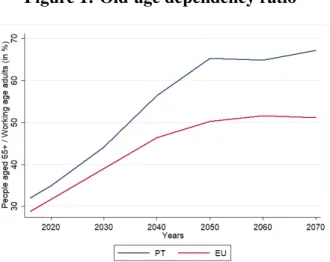
The population of European countries is ageing. Portugal is expected to experience one of the most severe ageing processes, resulting from a combination of increases of life expectancy and low fertility rates (the lowest among EU countries). In this context, the old-age dependency ratio - i.e. the number of people aged 65 years old or more for every 100 working age adults - is forecasted to increase from the currently 35% to more than 60% in 2050. As depicted in Figure 1, the gap vis-à-vis the EU average will increase markedly, reaching 10 percentage points (pp) in the last decades of the forecasted horizon.
Figure 1: Old-age dependency ratio
Source: Author’s own computation based on European Commission’s data
The ageing process has profound consequences for the economic and social fabric of a country. One important consequence relates to the old-age pension systems. In the context of Pay-as-you-go (PAYG) pensions, where current workers finance the pensions of the current old, there are financial sustainability issues, as the contributions may not suffice to pay the bene-fits.1 Measures to address the financial challenges risk endangering the adequacy of pensions to maintain a certain level of income in old-age. But even more fundamental than the financing challenge, there is, as Barr et al. (2001) puts it, the challenge of production: who will produce the goods and services that everyone consumes?
1As discussed in European Commission (2018), ageing has economic and fiscal implications beyond the impact
In past decades, countries have introduced important reforms to their pension systems, to contain the pressures of an ever-older population. In Portugal, two major reforms were in-troduced. Decree-law 35/2002 promulgated the significant reduction of the generosity of the benefits paid, which are now based on lifetime average earnings and not on the best 10 of the last 15 years of contributions2. The second major reform promulgated in 2013, with effects as of 2014, introduced the automatic indexation of the retirement age to life expectancy3. Due
to this reform, the legal retirement age (LRA) increased from 65 to 66 years and 4 months in 2018, though long contributory careers (more than 40 years) benefit from a 4-month reduction per year after the 40th.
These reforms were important steps to increase the financial sustainability of the system. As estimated in European Commission (2018), the increase in the old-age dependency ratio will be counterbalanced by both the decrease in the coverage ratio (i.e. the number of pensioners per person aged 65 or more) and the decrease in the benefit ratio (i.e. the average pension relative to the average wage). This means that people will retire later and receive lower benefits. It is therefore important to understand if adequacy of pensions is not endangered, both in terms of benefit level and in terms of age of take-up. In this project, we focus on the latter - the age at which people decide to retire.
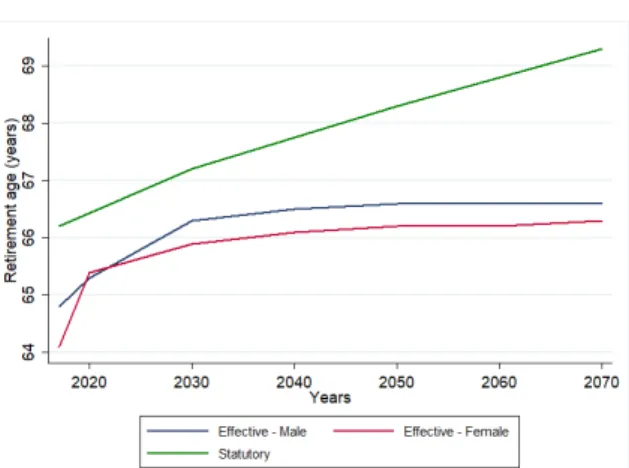
As discussed by the OECD (2017), the automatic increase does not compensate the effect of ageing (figure 2). The legal retirement age will increase by two years up to 2050, but it would have to increase by close to 10 years to keep the current old-age dependency ratio. Besides, the increase in the LRA is also predicted by the OECD (2017) not to be matched by an increase in the effective retirement age, which will stagnate below 67 years old while the statutory re-tirement age keeps on increasing (figure 3). If there are no significant productivity gains that compensate for the reduction in the relative number of the working-age population4, and given
the already large expected reduction in pension generosity5, the age of retirement will be a key
element to address the challenges of population ageing.
2Workers joining the system after 2002 are fully covered by these new rules. For those with more than 40 years
of contributions, the best 40 years are considered.
3Initially, the reform entailed a sustainability factor that decreased the value of the pension. Nowadays, the
factor applies only to early and disability retirement.
4In the past decades, the productivity growth in Portugal - like in other OECD countries - has been decelerating,
which hints that it may be difficult to rely on productivity increases.
5In line with the European Commission (2018), the gross replacement rate, i.e. the relation between the first
Figure 2: Working life extension that en-sures the current old-age dependency ra-tio by 2050
Source: VOX, CEPR Policy Portal (computa-tions of Hervé Boulhol, Christian Geppert) Note: The graph also compares changes in the LRA and life expectancy at 65
Figure 3: Projections on the statutory and effective retirement rates until 2070
Source: Author’s own computation based on European Commission’s data
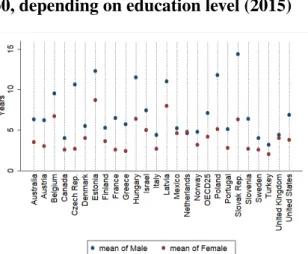
Active ageing - where older workers remain in the labour market, in similar or in other functions, in full-time or in part-time - is frequently discussed as a possible option. Indeed, life expectancy increases have generally occurred in good health. However, there are important differences across socio-economic groups. Life expectancy is highly dependent on one’s gender, education and income. According to the OECD (figure 4), a highly educated male is expected to live on average five more years than a low-educated man (three years more for females). In the same vein, there is a difference of more than 20 pp between high-income and low-income individuals reporting to be in good health (figure 5), indicating that the capacity to work also varies according to one’s income (the same results holds for education differentials).
Departing from this heterogeneity across individuals in their ability to remain in the labour force, this study explores a micro-level database covering adults with 50 years or more, allowing for a better understanding of the forces shaping individuals’ decision of when to retire. These results are informative for policy makers seeking public policy solutions to the ageing challenge. We find that age, physical health, the length of the contributory career and the current employ-ment status are the main factors impacting the expected retireemploy-ment age for individuals that plan to do so before or at the LRA. Disentangling the effects of the covariates on these individuals from those that expect to postpone retirement, we find that being highly depressed, having a higher income and being satisfied with the job further increase the age at which individuals
Figure 4: Differences in life expectancy at 30, depending on education level (2015)
Source: Author’s computation based on the OECD’s database
Note: We compare individuals with tertiary edu-cation with those with less than upper secondary education (by gender)
Figure 5: Self-reported health condition, depending on income level (2015)
Source: Author’s computation based on the OECD’s database
expect to retire.
The project is structured as follows: section 2 revises the literature on the determinants of the retirement age (expected and effective) per category and section 3 presents the SHARE data set as well as a statistical overview of the variables retrieved from the sample. Consecutively, we present the empirical model used to model the determinants of different preferences regarding the planned retirement age in section 4. Section 5 is dedicated to the results of the previous analysis and robustness checks, succeeded by a discussion and conclusions in section 6.
1.2
The retirement age in Portugal
In 1886, state factory workers at or above 60 years old became entitled to a pension. More than 40 years later, the system widened its personal and material applications, protecting employees of the trade, industrial and services sectors against sickness, disability, aging and death. From the 70s decade onward, the coverage of the system has been constantly changing (mostly ex-panding), reflecting the augmentation in workers’ social rights and the fluctuations in economic cycles. In 1987, the LRA rose to 65 for men and 62 for women, a result of female shorter career’s trend. Later in 1993, the LRA was standardized across genders to 65 with a transitory period of 6 years. Hence the adjustment solely came into force in 1999. As of 2014, the LRA
is indexed to the sustainability factor and is adjusted each year by 2/3 of the life expectancy gains. In 2018, it was 66 years and 4 months and is expected to grow close to one year per two decades, reaching the 69 years and 4 months in 2070 (European Commission, 2018). However, the actual retirement age of new pensioners has always been inferior to the statutory of the cor-responding year. In 2001 and 2017, the mean effective retirement age was about 64 years old, slightly fluctuating in the period in between Pordata (2018).
1.2.1 Early retirement
In 1991, workers with at least 55 years old and 30 years of contributions became entitled to early retirement benefits. As the scheme encompassed a large group of the active population, it was suspended between 2005-2007 and again in 2012-2014 due to financial distress. After 2007, a Sustainability Factor (SF) reducing the pension benefit was applied to old-age pensions, with a monthly penalty of 0.5% on early-retirement benefits. For each contributory year above the 40thyear of contributory career, the penalty reduces by 4 months (OECD, 2017).
Following the second suspension period, the scheme suffered many modifications (back and forth) but the predominant one changed the SF formula making it more severe yet only applicable for early-retirement pensioners and narrowed the criteria to access early retirement, requiring individuals to be at least 60 years old and having 40 years of discounts to the system. Contrarily, as of 2014 (set to 66), the LRA is indexed to life expectancy gains, enlarging the spectrum of individuals covered by the option of early retirement (in detriment of a retirement at the LRA). For long contributory careers6no penalties are applied (OECD, 2017).
Early-retirement is also accessible to long-term involuntary unemployed if they are: 1) at least 62 years old, became unemployed at the age of 57 or more and had at least 15 years of discounts or 2) at least 57 years old, became unemployed at the age of 52 or more, had at least 22 years of discounts and have exhausted the unemployment subsidy (a monthly penalty applies).
Together with Ireland and the UK, Portugal displays one of the lowest early-retirement pensions of the EU for individuals retiring 2 years before the LRA. If these same beneficiaries waited for the LRA to retire, their pension could increase at least 10 pp (European Commission, 2018). Still, with regards to pension and labour income combination, Portugal has relatively
6Since October 2018, long contributory careers concern individuals who are at least 62 years old and have more
loose rules compared to the European peers. Individuals collecting early-retirement benefits are only restricted from receiving work-related income if it is paid by their former employer.
1.2.2 Late retirement
The system features an option rewarding individuals to keep on working beyond the LRA until they are 70 years old. A monthly rate set according to the length of the individual’s contributory career is multiplied by the number of months worked beyond the LRA. The pension amount will increase by this factor, with a maximum ceiling of 92% of the best reference earnings used to calculate the pension. According to the OECD (2017), the rewarding scheme on late retirement makes Portugal one of the five OECD countries with the highest financial incentives for working after the LRA. Also, the non-existence of barriers to accumulating pensions with paid work after the LRA, makes Portugal one of the countries with the largest incentives to postpone retirement.
2
Literature review
Resorting to the empirical literature on the topic, this section presents the existing results on the key variables impacting expected and effective retirement ages. The first is in general consid-ered a good proxy of the second (e.g. Henkens and Tazelaar, 1997 on Dutch civil servants and Harkonmäki et al., 2009 for Finland), although they may not always coincide7.
Demographic characteristics
The direction and significance of the gender effect on the retirement age varies across studies. While some find no impact (for example, Disney et al., 2006), others, such as Hank and Korb-macher (2013), argue that gender effects are actually significant once interacted with income, age and parenthood (for instance, male fathers staying longer in the labour market).
Focusing on the probability of late retirement for older individuals, Larsen and Pedersen (2017) report heterogeneous effects of gender. For example, while Swedish low-educated
7Solem et al. (2016) and Carr et al. (2016) find mismatches between the two which may be the result of low
education levels, potentially associated with competencies less valued in later stages of the career; poor health conditions, forcing individuals to exit the labour market earlier; and financial constraints, obliging the workers to remain in the labour force.
women have a lower probability of retiring after the LRA, being Danish has the opposite effect. This is likely the result of cultural preferences rather than particular national incentive schemes. When restricting to a younger Norwegian cluster, Dahl et al. (2003) show that male early retirement takes place, on average, earlier than female. Still on early retirement, Alavinia and Burdorf (2008) find that it is negatively linked to individuals having a partner, which may be consequence of a matching employment behaviour along with its partner, if the latter works.
Education
According to Alavinia and Burdorf (2008), early retirement is positively linked to lower levels of education. Blöndal and Scarpetta (1997) find that lower-educated individuals are more prone to respond to financial incentives for early retirement. De Preter et al. (2013) and Larsen and Pedersen (2017) find a positive impact of high education levels on late retirement, though with some exceptions in the second, which might reflect higher financial needs faced by the less educated individuals, having the obligation to remain at work.
Health status
Poor general health status is frequently found to be one key factor decreasing actual (Dwyer and Hu, 2000 and Karpansalo et al., 2004) and planned (Mein et al., 2000 and Roberts et al., 2009) retirement ages. Bound et al. (1999) stress the relevance of timing and direction of health condition variations, suggesting that declines tend to push individuals out of the labour force but the sooner they occur, the lower impact they have. Cai and Kalb (2006) and Alavinia and Burdorf (2008), observe individuals under 65 and find that self-reported poor health conditions are positively impacting early retirement. For Danish, German and Swedish individuals over 65 years old, Larsen and Pedersen (2017) find good health conditions to be positively associated with labour force participation after the LRA.
Kerkhofs et al. (1999) find the health status’ effect on dutch retirement decisions significant yet of volatile magnitude depending on the measure used, overpredicting its impact with self-reported health status measures. On the contrary, Dwyer and Mitchell (1999) and Blau and Gilleskie (2001) argue the variation in the estimated coefficients is not significant in the US.
de-terminants per se. Wahrendorf et al. (2012) focus on 11 European countries and estimate a positive linkage between lower retirement age and poor mental health conditions and high lev-els of stress, which according to Karpansalo et al. (2005) is increasingly impacting the number of disability pension recipients. Jokela et al. (2010) empirically corroborate such relation with either poor physical and mental health conditions, which can be expected as these conditions are the criteria for the attribution of such pensions.
Income
On the impact of income on retirement, Mein et al. (2000) results point to a positive associa-tion between high-labour-income earners and early retirement, possibly resulting from a higher financial security and capacity to meet financial commitments with a reduced pension. The results of the empirical study conducted by Moreira et al. (2018) are in the same direction as these, though they argue on the possibility of non-linear effects, as individuals with household income on the 2ndquintile also display a higher propensity to plan an early retirement in some
specifications of their model. This may be the result of low early-retirement pensions (still, granting more financial security than those of the 1st quintile) combined with the appealing scheme discussed in section 1.2.1, that allows its accumulation with additional labour income.
Pensions
Moreira et al. (2018) conduct a study for Portugal using the SHARE and find the higher the replacement rate, the more prone are respondents to project and early retirement. Inversely, their study suggests that the higher the expectation the government will raise the LRA, the lower the probability of expecting to early retire. An expected rise on the LRA unmatched by a rise on the planned retirement age would most likely imply higher cuts on the early-retirement pensions, hence individuals forecast this loss and delay their withdrawal from the labour market.
Employment
For 11 European countries, De Preter et al. (2012) look at sectorial differences and their results suggest industrial workers to prefer to retire at lower ages, on average, which links to the sector’s increased propensity to poor health conditions (Blöndal and Scarpetta, 1997).
Job satisfaction is empirically measured by different indicators along the literature, like job demand and workplace social support (De Jonge et al., 2001) or recognition, job control and pay levels (Mansell et al., 2006). High levels are positively associated with the intended age of retirement, since individuals deriving higher satisfaction from work prefer staying longer in the job market (Mein et al., 2000, Blekesaune and Solem, 2005 and Siegrist et al., 2007). Poor job conditions positively impact retirement anticipation and the effect is intensified once interacted with poor health conditions, as stressed by Moreira et al. (2018).
Cai (2010) caution that health and job satisfaction may be highly correlated, as bad health may result from bad working conditions or lead to a lower working capacity, triggering early retirements. Mein et al. (2000) and Siegrist et al. (2007) find empirical evidence on the associa-tion of the two variables but independence of their effects on the dependent one. The last argue that the variables display an association via factors that impact them both, such as depressive symptoms, but that there is no direct influence of one in the other, hence no room for a correctly specified statistically significant joint effect on the expected retirement age.
The relevance of national studies
Retirement incentives hinge critically on the features on the pension system and the incentives it embeds. Therefore, cross-country studies need to be complemented with national level analyses that can better inform on the impact of individual characteristics in particular national settings. Mein et al. (2000) for the UK emphasize the significant impact of financial variables in early retirement decisions but advert that the country’s pension system is particularly less gen-erous than most industrialized countries, which implies that the results cannot be generalized to other countries as the incentives for early (and late) retirement are country-specific. Larsen and Pedersen (2017) focus on individuals with or over 65 years and study the late retirement determinants for Denmark, Germany and Sweden, identifying education, health and gender as the main drivers of employment in this stage of the individuals’ life. Yet, the magnitude and shape of the effect varies deeply across countries (e.g. U-shaped effects of education interacted with gender for Germany and Denmark, but not for Sweden).
3
Data
3.1
Dataset
The empirical analysis is performed using the Survey of Health, Ageing and Retirement in Europe (SHARE) that comprises micro-data on health, socio-economic status and social and family networks of more than 120 000 individuals aged 50 or older from 27 European countries and Israel. Where possible, individuals are kept in the sample from one wave to the other, allowing for a panel structure. We use the easySHARE database, a simplified version of the main SHARE dataset (see Gruber et al., 2014 and Börsch-Supan et al., 2018 for methodological details), to which we have added a number of additional variables8.
Given our goal of assessing the determinants of retirement age for the specific setting of Portugal, we focus on waves 4 and 6, the only two waves including data on Portugal. The first wave collected data from the respondents in 2011 and the second in 2015. While a cross-country analysis may provide useful insights, the focus on a single cross-country allows us to capture important national specificities that go beyond those captured by country fixed effects.
Our main model focuses on wave 6, using, in some specifications, lags of the explanatory variables or their change from one period to the other. We depart from a total of 1676 individuals interviewed in wave 6, of which 1505 are also part of wave 4. Of these, we target all those who are not yet retired, which represent around 34% of the sample.
3.2
Variables and descriptive statistics
In this section, we provide an overview of the variables used in this paper. For additional details on the variables, please refer to Table 6.
Our key dependent variable is the expected retirement age (ERA). In SHARE, respondents are asked which type of pensions they will be entitled to in the future among the following: pub-lic old age, pubpub-lic early retirement/pre-retirement, pubpub-lic sickness/invalidity/incapacity, private (occupational) old age or private early retirement. Subsequently, individuals report the age at
8The age at which individuals expect to collect one or more pensions, per pension; a measure of financial risk
aversion; the replacement rate; the number of years of contributions; the expectation on government raising the retirement age; and the sector of activity.
which they expect to start collecting each type of pension (if entitled to)9. As future disability
pension recipients are substantially different from the other individuals (e.g. health condition), they are excluded from the analysis. Our focus are those entitled to old-age pensions. Observa-tions on retired individuals expecting to collect more funds in the future were also excluded.
We end-up with a total of 379 observations available for 2015 (with 312 having information also for 2011). The respondents expect to retire on average close to reaching 65 years old (one year before the LRA in 2015). 43% plan to take an early retirement, on average, three years before the LRA, and 14% to retire later, on average, two years after the LRA.
For our set of regressors, and drawing from the literature, we focus on six main groups of variables, namely demographic characteristics, education and cognitive abilities, health condi-tion, income indicators, pension features and job-related aspects. For some variables, the effects are likely non-linear and therefore categorical variables (dummy or not) are created by natural clusters or by visual inspection of the variables’ distribution (residence location, education, cognitive capabilities, health (overall, chronic illnesses, limitations and depression indicators), household income and respective variations, expectations on the LRA and job satisfaction).
Table 1 presents the descriptive statistics for all variables, broken down by three main groups according to the reported expected age of retirement: before LRA, at LRA or after LRA. The section proceeds referring to statistically significant differences among those groups.
Demographic characteristics
The average age of the respondents in our sample is close to 59 years old and is increasing with the expected retirement age groups (i.e. before, at and after LRA), which may hint at a dynamic adjustment of the planned age of retirement, as individuals get older and therefore closer to their initial plans. More than half of the sample (61%) is female, with a significantly higher representativiness in the group that plans to retire at the LRA compared to the other two. In the sample, 87% of the individuals live with their partner and 29% dwell in a rural area or village.
9Apart from one observation, regardless of the number of pensions planned to be collected in the future (10
respondents are entitled to more than one pension), the respondents reported age is unique (for that observation, the lowest value provided was the one assumed true).
Education and skills
Close to 40% of the respondents have, at most, 4 years of schooling, 34% have between 5 and 8 years and 27% studied 9 years or more. The percentage of individuals who have studied between 4 and 9 years is significantly higher for early retirement seekers, reaching almost 40%, compensated by less highly-educated respondents.
On the joint result of the cognitive capabilities tests (an equally weighted average of the numeracy, memory and orientation tests’ scores, ranging from 0 to 15), we split respondents into three groups: those with a score above 12 (at percentile 90 that is the score registered, so it falls slightly bellow that percentile), those with a score of up to 7 (grade associated to percentile 10, hence including individuals marginally above that percentile) and all others (ref-erence group). Those planning on an early retirement have a significantly higher share of low scoring individuals and a corresponding lower share of high performing ones.
The results for early retirement seekers may result from labor demand effects, where those with lower capabilities face lower labor market opportunities and are more likely to be discour-aged by the employer.
Health status
Using a self-assessed measure on physical health with five levels, ranging from poor to excel-lent, we construct a variable that distinguishes the individuals who identify themselves as being in one of the two bottom levels, which we define as poor health individuals. 54% of the respon-dents report to be in poor health. From the 312 individuals who self-reported on their health status also in 2011, 22% claim to have suffered a deterioration of it between waves.
Objective measures of health are also considered. 1 out of 10 respondents face physical limitations, captured by a dummy that distinguishes individuals who have physical constraints when performing some basic physical activities. 64% of the sample suffers from at least one chronic disease but this weight is significantly lower for the cohort planning on a late retirement vis-à-vis the at LRA group, which is an expected result as individuals free of (chronic) diseases are in better conditions to postpone retirement.
Regarding mental health, 11% of the respondents show high levels of depression. We clas-sify as very depressed all those who report a level such as the one observed for percentile 90 (or
above it), corresponding to the last six levels of a twelve-layer scale, the EURO-D.
3.2.1 Income
Household income is split in three groups: the reference group (category 0) for those with incomes between the percentiles 25 and 75; the poor (category 1), those below or at percentile 25; and the rich (category 2), those above or at percentile 75. Those planning to retire before and after the LRA do not show significant income differences when compared to those in the at LRA group.
In terms of income variation, we separate individuals into those who saw their income in-crease by 10% or more from the others. Until percentile 74, income only drops or inin-creases by 1%, a fluctuation considered neglectable. After, changes start do display a higher magnitude and we draw a limit on the 10%, creating a dummy variable for which 13% of the sample re-ports such an increase between waves. With regards to financial risk aversion, 12% are very risk averse, "not willing to take any financial risks".
Pension-related variables
The average length of the contributory career is 32 years, with the group intending on early retiring having the highest average length, above 34. Around 6% of the respondents contribute to at least one private (occupational) pension scheme.
In terms of future prospects, the first wave on Portugal includes a question on expectations. 43% of the respondents think that the government will raise the LRA. Those reporting that they want to retire at the current LRA are more confident that the government will not change the rules, which may indicate that people who have such strong convictions either adjust their behaviour expectations by projecting an earlier retirement to avoid future reforms or a late retirement to match the expected modifications.
The replacement rate, i.e. the ratio between the first pension and the last wage, is only available in the first wave, with reference to 2011 data, and is only reported by 58 respondents. This may hint that many respondents are not informed about their future pension entitlement, hence we use this as a proxy for whether individuals are or not informed about their future pension-related income. Bearing in mind the fragility of this indicator, 15% of the respondents
are classified as informed on their future pension entitlements.
3.2.2 Job-related variables
Concerning the current employment status, 70% of the sample is employed, 18% unemployed and 12% are homemakers. For those out-looking for an early retirement, the weight of the un-employed is significantly higher while homemakers are over-represented in the group expecting to retire at the LRA. In 2011, more than three-fourths of the respondents work in the tertiary sector, 8% have a job on the primary sector and 14% on the secondary.
Respondents were asked to evaluate their job satisfaction on a four-level scale. Departing from the answers to this question we construct two indicators. The first distinguishes individuals who "strongly agree" to be satisfied with their job from the other three less satisfied levels. We find 11% of very satisfied respondents. The second identifies 4% of the sampled individuals experiencing a decline in the job satisfaction self-reported level between waves.
Though just less than one-fifth of the sample works in the public sector, when focusing on individuals predicting a late retirement, their weight rises to 32%, possibly due to the higher prevalence of highly qualified jobs in this sector, potentially more suitable for older workers.
4
Empirical strategy
4.1
The age of retirement
Our model is as follows
ERAi = β0+ N
X
n=1
βnXi+ εi (1)
where ERA denotes the expected retirement age of individual i and X stands for the ex-planatory variables as presented in Table 2. As we perform the White test and find evidence of heteroskedasticity in the sample, we resort to robust standard errors via the so-called sandwich estimator proposed by White (1980), which corrects for this misspecification.
As discussed in Section 2, the drivers of the retirement age may be different depending on whether the individual wants to take early retirement or if, on the contrary, wants to postpone
Table 1. Descriptive statistics
Total Before LRA At LRA After LRA
Variable Obs % / mean Obs % / mean Obs % / mean Obs % / mean
Age of expected retirement 379 65 163 63*** 162 66 54 68*** Demography Age 379 59 163 58** 162 59 54 60** Female 379 61% 163 56%** 162 68% 54 54%* Partner in the household 379 87% 163 87% 162 87% 54 85% Rural 360 29% 157 26% 152 34% 51 24% Education Education (years) [0;4] - ref 372 39% 162 38% 158 42% 52 35% ]4;9] 372 34% 162 40%** 158 29% 52 31% ]9;24] 372 27% 162 22% 158 29% 52 34%
Cognitive capabilities (score)
[0;7] 379 13% 163 17%* 162 11% 54 9%
]7;12] - ref 379 74% 163 73% 162 72% 54 76%
[13;15] 379 13% 163 10%* 162 17% 54 15%
Health
Poor health 379 54% 163 53% 162 56% 54 50%
Health got worse 312 22% 137 24% 132 18% 43 26%
Chronicly ill 379 64% 163 66% 162 69% 54 48%*** Physical limitations 379 11% 163 11% 162 11% 54 11% Very depressed 379 11% 163 12% 162 11% 54 6% Income Household income [p0;p25] 379 25% 163 23% 162 25% 54 30% ]p25;p75[ - ref 379 50% 163 55% 162 47% 54 44% [p75;p100] 379 25% 163 22% 162 28% 54 26% Significant income variation 307 13% 133 14% 131 15% 43 7% Pensions Years of contributions 367 32 158 34*** 157 30 52 32 Private 379 6% 163 8% 162 4% 54 2% Expects government
to raise LRA (lag) 219 43% 98 49%** 89 34% 32 50%*
Information on pensions (lag) 379 15% 163 13% 162 17% 54 15%
Job
Current job situation
Employed 289 70% 163 67% 162 70% 54 82%
Unemployed 289 18% 163 27%*** 162 11% 54 11%
Homemaker 289 12% 163 6%*** 162 19% 54 7%**
Sector of activity (lag)
Primary 289 8% 129 10% 118 8% 42 2% Secondary 289 14% 129 15% 118 13% 42 17% Tertiary 289 78% 129 75% 118 79% 42 81% Very satisfied 379 11% 163 10% 162 11% 54 13% Decline satisfaction 139 10% 57 12% 59 12% 23 0% Public sector 379 18% 163 14% 162 19% 54 32%**
Note:Statistically significant difference in the percentage (average) observed for the before (or after) LRA vis-à-vis the at LRA group with 1% (***), 5% (**) or 10% (*) confidence. All values represent the share of individuals in the sample (or sub-samples) that display a certain characteristic, except for age of expected retirement, age and years of contributions, for which we find average number of years.
retirement beyond the legal retirement age. For example, being one year older may be associated with an increase in the reported ERA for those who seek to retire before (or at) the LRA but have no such an impact on the group planning on a late retirement.
To test this, we re-estimate our model, interacting the covariates with a dummy that equals 1 for those seeking a late retirement and 0 otherwise, capturing group-specific effects of a single variable. Equation 2 allows to understand the intensive margin and is specified as follows
ERAi = β0 + X n βnXi + X k βkP OSTi+ X j βjXi∗ P OSTi+ εi (2)
where P OST is equal to 1 if the respondent reported an ERA beyond the LRA and 0 otherwise. It looks at individuals postponing retirement, and how late will they retire. Or equivalently, by how much will they postpone retirement? It still analyses all other individuals.
Following the same approach, we re-estimate the model using a dummy equivalent to 1 if the person seeks to early retire. As the construction is close to the symmetric of the first, we will not be scrutinizing the obtained results, though it is possible to find them in Figure 8.
5
Results
5.1
Understanding the retirement age
The first three columns of Table 2 display the results of different specifications of equation 1, being the dependent variable the age at which one predicts to retire. Coefficients are measured in years. Models (1) and (2) are based on 341 observations and differ only in the way health is measured (self-assessed in the first; observed in the second). Model (3) additionally controls for lagged or first differenced explanatory variables based on the previous wave. This allows for time dynamic effects at the cost of less observations (199 observations).
In the three specifications we find evidence that older individuals tend to plan on late retire: being five years older adds one year to the planned retirement age. This may relate to a dynamic adjustment of retirement prospects as individuals grow older10.
Similarly to Disney et al. (2006), we find gender effects not having an impact on the
de-10The average ERA reported by individuals interviewed in both waves is 63.8 in 2011 and 65.1 in 2015, in line
Table 2. Different specifications of the models
Dependent variable: Age of expected retirement
Model (1) Model (2) Model (3) Model (4) Early Post Demography
Age 0.22*** 0.24*** 0.26*** 0.20*** 0.05
Female 0.33 0.25 0.11 0.51 -0.26
Partner in the household 0.20 0.22 -0.79* 0.33 0.21
Rural 0.29 0.27 0.64 0.45 0.27
Education and skills Education ]4;9] -0.24 -0.17 -0.12 -0.40 -0.23 ]9;24] -0.38 -0.11 -0.57 -0.66 0.11 Cognitive capabilities [0;7] 0.01 0.31 -0.07 -0.02 -0.52* [13;15] 0.27 0.32 -0.10 0.68 -0.80* Health status Poor health -0.88*** -1.13** -1.11*** 0.06 Health became worse 0.16
Chronicly ill -0.75*** Physical limitations -0.21 Very depressed -1.04* -1.28** -1.87** -0.97 1.11** Income Household income Poor 0.29 0.19 -0.08 0.17 0.04 Rich 0.39 0.27 0.35 0.41 1.20*** Significant income variation 0.8
Pension-related
Years of contributions -0.06*** -0.05*** -0.05** -0.05*** -0-02 Private -0.30 -0.39 -1.03 -0.10 0.48* Expects government
raises retirement age -0.26 Information scenario on pensions 0.02 Job-related
Current job situation
Unemployed -1.77*** -1.72*** -2.34*** -1.83*** -0.06 Homemaker -0.95** -0.9** -0.3 -0.7 -0.24 Sector Secondary 0.18 Tertiary -0.43 Very satisfied 0.35 0.29 0.22 0.38 0.92* Public sector 0.22 0.34 0.32 -0.18 0.33 Constant 53.87*** 52.94*** 53.32*** 54.76*** 64.67*** Observations 341 341 199 341 R-squared 25% 24% 30% 39%
Note:The effects of the covariates on the ERA are statistically significant with 1% (***), 5% (**) or 10% (*) confidence.
pendent variable, even after interacted with other variables, which may be consequence of a relatively gender balanced labour market in Portugal. We tested for an interaction with age (and living with a partner), following Hank and Korbmacher (2013), but the result is unchanged (9). Cohabiting with a partner is only significant in Model (3), associated with 0.8 years lower ERAs, on average, ceteris paribus. This might be reflecting the impact of living with a non-retired person, rather than just living with a partner (raising issues of endogeneity), as individ-uals tend to match their partner’s employment status Henkens and Van Solinge (2002), but we cannot control for this variable as very few observations are available. Alternatively, this may be wrongly accounting for a household’s wealth effect (though including income as a regressor should partially control for the financial incentives of the retirement age estimation).
Living in rural areas does not seem to impact the expected retirement age. The more obvious connection between the location area and the expected retirement age would be due to higher prevalence of lower income families in these (10), which we control for with household income. Turning to education and skills, and contrasting with Alavinia and Burdorf, 2008 and Solem et al., 2016, whose results point to a positive relation between early retirement and low education levels, we find no relation between education and retirement age nor with cognitive abilities. It may be that potential differences are captured by the employment status and income levels, as the first study does not account for these variables and the second only does so for income (on our literature research, we did not come across any study controlling for the current employment status).
Focusing on health variables, we find individuals with physical health problems expecting to retire 0.9 to 1.4 years earlier than those in good health conditions, an effect that goes in line with the vast literature on the subject (e.g. Roberts et al., 2009). Intuitively, we understand that being in poor physical health makes working less desirable from both demand and supply sides, as a low-health individual has less capability to work. To address a concern raised by several authors regarding the potential bias in different health measures’ impact - in particular self-assessment v. observed health status - model 2 provides an alternative to the self-reported physical health measure used in model 1. As Achdut et al. (2015), using more objective measures, e.g. being chronically ill and experiencing limitations in daily activities, does not lead to significant dif-ferent results. Also, we compare individuals who see their health condition deteriorate between
the two waves (model 3) but find no impact on one’s forecasted retirement age.
Concerning mental health, highly depressed respondents are expected to retire at least 1 year before individuals in better mental health conditions, a result in line with Wahrendorf et al. (2012). In our assessment, we show its relevance and while the sign of the coefficient is an expected (and consistent) result, there could be uncertainty in the magnitude of the effect (which depending on the specification, can vary in almost 1 year).
Income variables - both the level and the change from previous periods - are found not to be significant. This could result from an interaction of substitution and income effects, which are possibly cancelling out (e.g. a poorer household would need to continue working to keep a certain income stream but the cost of leisure is low - the foregone wages v. retirement benefit differential - which may induce retirement). On a study including Portugal, Moreira et al. (2018) find non-linear significant effects as opposed to our study, which could already be indicative of forces pushing in opposite directions in one’s ERA.
For robustness check purposes, education (years), cognitive abilities (test score) and house-hold income are controlled for in the base model in a categorical form to allow for non-linear effects. We also test them in a continuous setting (or the entire score interval, in the cognitive test’s case), but no statistically significant effects are found (11).
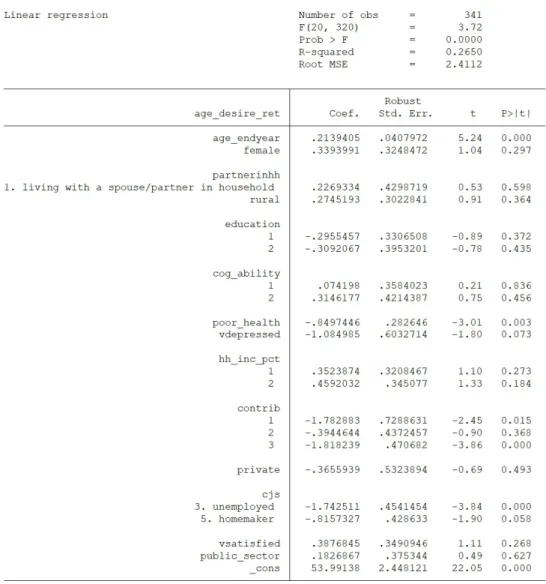
Concerning pension related variables, only the length of the contributory career impacts retirement plans, with longer careers reducing the planned retirement age, an expected result as this is a key element of pension entitlements. A respondent with a standard deviation above the average contributory career (respectively 41.2 and 30.6 years) will plan to retire close to half a year before those with an average contributory career’s length. Because the minimum pension value changes according to the number of years of discounts (at 15, 20 and 30, more precisely), we substitute the length of the contributory career in the base model to check if the variable has non-linear effects. The results indicate that contributors with 15 to 20 years of discounts or more than 30 expect to retire 1.8 years earlier than the others (12). Also, the length of the contributory career is expected to grow with age11, hence we include an interaction term between age and
years of contribution in the model. The effect of one additional year of age on the expected retirement age is no longer significant but the joint test on years of contribution still indicates
11The average length of contributory careers of individuals interviewed in both waves is 29.7 in 2011 and 32.6
this impacts the dependent variable (13). This result corroborates that age’s significant effect in the base model is due to its interaction with the contributory career’s length.
Private pension entitlements do not impact retirement plans. We also test whether expec-tations on the government raising the retirement age impact retirement plans, a result found in Moreira et al. (2018). The authors use a cross-country sample, arguing for a small yet significant negative effect because people want to retire before to avoid the application of new reforms. We find a negative yet not significant effect, which may be due to the reduced size of our sample. The replacement rate is certainly a key factor for retirement plans but as it is only answered by one-fourth of the respondents, we can only use this to build information measure with regard to the future pension-related income, but we find no association with the dependent variable.
On job-related regressors, we find the current employment situation to be one of the ma-jor determinants of the ERA, with unemployed individuals retiring at least 1.8 years before the employed and homemakers 0.9 years (in model 3, the unemployed retire 2.3 years before on average but being a homemaker has no statistically significant effect). Unemployed indi-viduals anticipating retirement is in line with the expected as the pension system allows for long-duration unemployed to start collecting full-benefits earlier (see section 1.2.1). For home-makers, no such incentive exists so we suspect they expect to retire almost 1 year before the LRA due to increased financial needs as they grow older, making pension collection more ur-gent12, but this should be better explored in further research. Opposite to De Preter et al. (2012)
findings on a negative association between working in the industrial sector and retirement age predictions, we find no sectorial differences.
Concerning job satisfaction, we find a positive yet not significant effect, but it may be that our measure is a crude one. Siegrist et al. (2007) follow a different approach, whereby satisfac-tion on the job is measured by a balance between efforts and rewards. We would like to test such an alternative measure of job satisfaction but the necessary variables for the ratio’s computation have significantly less observations than the measure we use. As well, we include a variable accounting for declines in job satisfaction. It would seem these are negatively linked to the ERA but, once included, we loose more than 200 observations and the coefficients on different employment status due to collinearity, and ultimately the variable is not linked to the expected
12Currently being a homemaker does not invalidate these individuals’ years of past contributions, which is why
retirement age (14). Likewise, belonging to the public sector does not impact the dependent variable. This is reasonable as we are controlling for the variables via which this condition could more obviously impact the dependent one, e.g. income or job satisfaction.
5.2
Heterogeneous effects
As in Section 4, there may be important differences between the factors relevant for early and late retirement, which can be captured by model 4 that follows equation 2. For ease of exposi-tion, we rearrange the coefficients and display directly the early and late retirement coefficients. We find that age, physical health, length of contributory career and being unemployed are only relevant for those seeking to retire before the LRA. For individuals expecting on a late retirement, the ERA is negatively affected by both poor and good cognitive capabilities. The first can be a reflex of low expectations on low-skilled job demand in older ages, and the second may be mirroring a preference for self-employment or leisure activities of older highly skilled workers. Inversely, it is positively impacted by high depression levels, private pension entitle-ments, higher job satisfaction (an effect widely observed in the literature, e.g. Davies et al., 2017) and relatively rich household incomes. The latter, may actually be linked to less physi-cally demanding jobs and a higher opportunity cost of retiring (that could be better analysed in possession of the respondents’ future replacement rates).
6
Conclusions and way forward
Portugal is ageing at a higher rate than its European peers. The old-age dependency ratio - i.e. the number of individuals aged 65+ compared to working age population - will increase from the current 32% to 67% by 2070. As put forward by the European Commission (2018) in its flagship publication The Ageing Report 2018, the ageing of the Portuguese population puts the fiscal sustainability of the pension system at stake, unless the envisaged reduction of pension benefits and increase in the legal retirement age are strictly kept. The latter is the focus of our study. Given the important socio-economic differences in life expectancy and health in older ages, we explore the determinants of retirement age preferences in Portugal13. Understanding
these differences is critical for policy makers to ensure the right incentives for late retirement while allowing those that cannot continue to work to leave the labor market at an earlier date. Our study could not be more timely, as the retirement age has been at the heart of the public policy debate14. The government has put forward the notion of a personal statutory retirement
age - in the current proposal, based on length of the contributory career and age - acknowledging the fact that no individual path is the same.
We find physical health and job market status, particularly, being unemployed or a home-maker, to be key determinants of the retirement age, reducing the planned retirement age. An unemployed person in poor health is likely to plan to retire 2 to 4 years before a healthy worker. As could be expected, these effects are only relevant for early retirement seekers, having no impact for those planning on retiring later. This means that policies aiming at increasing the effective retirement age, thereby reducing early retirement, need to be broadly based, namely by ensuring a more inclusive health system that mitigates health differences across individuals and by promoting labour market participation, for instance via effective active labour market poli-cies as discussed by Boone and Van Ours (2004). Still, the pension system needs to be flexible enough so that individuals in poor health are allowed to retire with adequate pension benefits. The incentives embedded directly in the pension system are also relevant for early retirement, as younger individuals with longer contributory careers opt to retire earlier.
The effect of mental health deserves further attention, as we show that depressed individuals tend to move away from the LRA, either by retiring earlier or by postponing retirement. This may be linked to different underlying reasons for the mental health condition, in some cases potentiated by the work environment (and thus calling for reform anticipation) and in other cases attenuated by it (and therefore warranting late retirement). Given the specificities of mental health conditions, a more detailed assessment should be done to understand the underlying causes and the possible policy answers.
Interestingly, income is not related to early retirement (apart from its impact on physical health) but it does impact late retirement. Richer individuals want to retire on average more than 1 year later than less wealthy counterparts. This may be linked to the generous late retirement incentives in Portugal, which can increase pension benefits by 92%, and therefore increase
14During the month of December 2018 alone, there were, according to Google data, more than 100 related news
the opportunity cost of not-postponing retirement for the richer household group. However, in a context of decreasing marginal utility of income, for those households, the value of each additional euro is lower. In that case, richer individuals may prefer to retire later because they have better, less physically demanding and more rewarding jobs (factors not well captured by our other covariates), meaning they would opt for late retirement irrespectively of pecuniary incentives, challenging the effectiveness of the current late retirement majoration scheme.
While these results bring some light on the factors (positively or negatively) associated with the retirement age in Portugal, they do not allow to infer causal relations. As more data for Portugal is collected in the SHARE, the above analysis can be further developed, possibly relying on alternative, more robust identification strategies. It would also allow for a better understanding of dynamic effects - e.g changes in income or in health status - that, despite likely important, turn out not significant in our analysis based on a limited number of observations. Additional waves are also crucial to follow individuals across time. This would allow, for instance, a deeper understanding of individual preference changes, a better comprehension of policy changes’ effects or to assess the link between planned and effective retirement age.
Finally, to fully understand retirement incentives, it is also important to duly capture cul-tural attitudes towards work on old-age. The low old-age participation rates observed in Por-tugal (vis-à-vis those in other OECD countries - OECD, 2017) may also be linked to negative perceptions on active ageing, both by younger employees and by employers . According to Eurobarometer data15, 82% of the respondents believe that older workers are not perceived pos-itively by employers and more than 50% think that people should be forced to retire once they reach the legal retirement age. Hence, it is of great importance that further research focuses on labor demand factors, as employers play an active role in pushing (or pulling) individuals out of (into) the labor market, and on the role of social perceptions, in particular the relation between youth employment and labor market participation of older workers. Only an encompassing view of the determinants of the retirement age can lead to resilient public policy solutions.
7
References
Achdut, L., A. Tur-Sinai, and R. Troitsky (2015). Transitions between states of labor-force participation among older israelis. European journal of ageing 12(1), 39–49.
Alavinia, S. M. and A. Burdorf (2008). Unemployment and retirement and ill-health: a cross-sectional analysis across european countries. International archives of occupational and en-vironmental health 82(1), 39–45.
Barr, N. A. et al. (2001). The welfare state as piggy bank: information, risk, uncertainty, and the role of the state. Oxford University Press.
Blau, D. M. and D. B. Gilleskie (2001). The effect of health on employment transitions of older men. In Worker Wellbeing in a Changing Labor Market, pp. 35–65. Emerald Group Publishing Limited.
Blekesaune, M. and P. E. Solem (2005). Working conditions and early retirement: A prospective study of retirement behavior. Research on Aging 27(1), 3–30.
Blöndal, S. and S. Scarpetta (1997). Early retirement in oecd countries: the role of social security systems. OECD Economic studies, 7–54.
Boone, J. and J. C. Van Ours (2004). Effective active labor market policies.
Bound, J., M. Schoenbaum, T. R. Stinebrickner, and T. Waidmann (1999). The dynamic effects of health on the labor force transitions of older workers. Labour Economics 6(2), 179–202. Cai, L. (2010). The relationship between health and labour force participation: Evidence from
a panel data simultaneous equation model. Labour Economics 17(1), 77–90.
Cai, L. and G. Kalb (2006). Health status and labour force participation: evidence from aus-tralia. Health economics 15(3), 241–261.
Carr, E., G. Hagger-Johnson, J. Head, N. Shelton, M. Stafford, S. Stansfeld, and P. Zaninotto (2016). Working conditions as predictors of retirement intentions and exit from paid employ-ment: a 10-year follow-up of the english longitudinal study of ageing. European journal of ageing 13(1), 39–48.
Dahl, S.-Å., Ø. A. Nilsen, and K. Vaage (2003). Gender differences in early retirement be-haviour. European sociological review 19(2), 179–198.
Dal Bianco, C., E. Trevisan, and G. Weber (2015). â ˘AIJi want to break freeâ ˘A˙I. the role of work-ing conditions on retirement expectations and decisions. European journal of agework-ing 12(1), 17–28.
Davies, E. M., B. I. Van der Heijden, and M. Flynn (2017). Job satisfaction, retirement atti-tude and intended retirement age: a conditional process analysis across workersâ ˘A ´Z level of household income. Frontiers in psychology 8, 891.
De Jonge, J., C. Dormann, P. P. Janssen, M. F. Dollard, J. A. Landeweerd, and F. J. Nijhuis (2001). Testing reciprocal relationships between job characteristics and psychological well-being: A cross-lagged structural equation model. Journal of occupational and organizational psychology 74(1), 29–46.
De Preter, H., D. Mortelmans, and D. Van Looy (2012). Retirement timing in e urope: does sector make a difference? Industrial Relations Journal 43(6), 511–526.
De Preter, H., D. Van Looy, and D. Mortelmans (2013). Individual and institutional push and pull factors as predictors of retirement timing in europe: A multilevel analysis. Journal of Aging Studies 27(4), 299–307.
Disney, R., C. Emmerson, and M. Wakefield (2006). Ill health and retirement in britain: A panel data-based analysis. Journal of health economics 25(4), 621–649.
Dwyer, D. S. and J. Hu (2000). Retirement expectations and realizations: The role of health shocks and economic factors. Forecasting retirement needs and retirement wealth, 274–287.
Dwyer, D. S. and O. S. Mitchell (1999). Health problems as determinants of retirement: Are self-rated measures endogenous? Journal of health economics 18(2), 173–193.
European Commission (2012). Special Eurobarometer 378. Available at: http://ec.europa.eu/commfrontoffice/publicopinion/archives/ebs/ebs378en.pdf.
European Commission (2018). The 2018 Ageing Report: Economic and Budgetary Projections for the EU Member States (2016-2070).
Hank, K. and J. M. Korbmacher (2013). Parenthood and retirement: Gender, cohort, and welfare regime differences. European Societies 15(3), 446–461.
Harkonmäki, K., P. Martikainen, E. Lahelma, J. Pitkäniemi, T. Halmeenmäki, K. Silventoinen, and O. Rahkonen (2009). Intentions to retire, life dissatisfaction and the subsequent risk of disability retirement. Scandinavian journal of public health 37(3), 252–259.
Henkens, K. and F. Tazelaar (1997). Explaining retirement decisions of civil servants in the nether-lands: intentions, behavior; and the discrepancy between the two. Research on Aging 19(2), 139–173.
Henkens, K. and H. Van Solinge (2002). Spousal influences on the decision to retire. International Journal of Sociology 32(2), 55–74.
Jokela, M., J. E. Ferrie, D. Gimeno, T. Chandola, M. J. Shipley, J. Head, J. Vahtera, H. Westerlund, M. G. Marmot, and M. Kivimäki (2010). From midlife to early old age: health trajectories associated with retirement. Epidemiology (Cambridge, Mass.) 21(3), 284.
Karpansalo, M., J. Kauhanen, T. Lakka, P. Manninen, G. Kaplan, and J. Salonen (2005). Depres-sion and early retirement: prospective population based study in middle aged men. Journal of Epidemiology & Community Health 59(1), 70–74.
Karpansalo, M., P. Manninen, J. Kauhanen, T. A. Lakka, and J. T. Salonen (2004). Perceived health as a predictor of early retirement. Scandinavian journal of work, environment & health, 287–292.
Kerkhofs, M., M. Lindeboom, and J. Theeuwes (1999). Retirement, financial incentives and health. Labour Economics 6(2), 203–227.
Larsen, M. and P. J. Pedersen (2017). Labour force activity after 65: what explain recent trends in denmark, germany and sweden? arbeitsmarktbeteiligung von über 65-jährigen: Ursachen für die jüngsten entwicklungstrends in dänemark, deutschland und schweden. Journal for labour market research 50(1), 15–27.
Mansell, A., P. Brough, and K. Cole (2006). Stable predictors of job satisfaction, psychological strain, and employee retention: An evaluation of organizational change within the new zealand customs service. International Journal of Stress Management 13(1), 84.
Mein, G., P. Martikainen, S. A. Stansfeld, E. J. Brunner, R. Fuhrer, and M. G. Marmot (2000). Predictors of early retirement in british civil servants. Age and ageing 29(6), 529–536.
Moreira, A., A. B. Azevedo, and L. P. Manso (2018). Reducing early retirement in europe: Do working conditions matter? Journal of Population Ageing 11(3), 265–284.
OECD (2017). Pensions at a Glance 2017.
Pordata (2018). Effective retirement age in Portugal. Retrieved from Social Protection Indicators, https://www.pordata.pt.
Roberts, J., N. Rice, and A. M. Jones (2009). Early retirement and inequality in britain and germany: How important is health?
Siegrist, J., M. Wahrendorf, O. Von dem Knesebeck, H. Jürges, and A. Börsch-Supan (2007). Quality of work, well-being, and intended early retirement of older employeesâ ˘AˇTbaseline re-sults from the share study. The European Journal of Public Health 17(1), 62–68.
(2016). To leave or not to leave: retirement intentions and retirement behaviour. Ageing & Society 36(2), 259–281.
Wahrendorf, M., N. Dragano, and J. Siegrist (2012). Social position, work stress, and retirement intentions: a study with older employees from 11 european countries. European Sociological Review 29(4), 792–802.
White, H. (1980). A heteroskedasticity-consistent covariance matrix estimator and a direct test for heteroskedasticity. Econometrica: Journal of the Econometric Society, 817–838.
8
Appendix
Figure 10: Further descriptive statistics on rural
Figure 13: Model 1 with contributions*age