Fernanda Cosme 1*, Nuno Jorge 1,2, Alice Vilela 1 Fernando M. Nunes 2
1 CQ-VR, Chemistry Research Centre Vila Real, University of Trás-os-Montes and Alto Douro, School of Life
Sciences and Environment, Biology and Environment Department, Edifício de Enologia, 5000-801 Vila Real, Portugal * Email: [email protected]
2 CQ-VR, Chemistry Research Centre Vila Real, University of Trás-os-Montes and Alto Douro, School of Life Sciences
and Environment, Chemistry Department, 5000-801 Vila Real, Portugal
Abstract. Animal protein fining agents are traditionally used in the wine industry. However, in recent years
some allergic problems of these protein fining agents have promoted to search for allergen free alternatives. A possible alternative to animal proteins are plant proteins, in particular, pea protein. Therefore, the aim of this study was to compare the effect of gelatine of animal origin (porcine gelatine and fish skin gelatine) with non-allergenic fining agents (association of PVPP, plant protein and silica; pea protein; association of PVPP, calcium bentonite and inert yeast; inert yeast and activated sodium bentonite) on a Reserve Ruby Port Wine chromatic characteristics, phenolic compounds and sensory attributes, at laboratory scale. Colour intensity, hue, coloured anthocyanins and polymeric pigments showed a significant decrease in all fined wines when compared to the unfined wine. The highest decrease in colour intensity, total anthocyanins and polymeric pigments occurred in wines treated with porcine gelatine. The lowest decrease in colour intensity was observed in wines treated with inert yeast, association of PVPP, calcium bentonite and inert yeast and activated sodium bentonite. The most balanced wine and that with the best results on colour intensity was the one treated with association of PVPP, calcium bentonite and inert yeast.
1 Introduction
Phenolic compounds are important for wine quality, since they are responsible for wine sensory characteristics, such as colour, astringency and bitterness [1]. However, in some red wines it is necessary to use protein fining agents to remove excessive astringency, bitterness or unstable colloidal colour compounds. The most used fining agents in red wine are animal protein fining agents such as gelatine. A possible alternative to animal proteins are plant proteins, in particular, pea protein. The European legislation has authorized the use of vegetable proteins since 2005 as fining agents and has also authorized the use of pea protein, according to recent legislation (Reg. CE606/2009 Annex IA) [2, 3]. Pea protein is a protein which is not genetically modified and it is also used in the production of vegan wine and under current legislation, it would not have to be labelled as an allergen [4]. In recent years also the use of inactive dry yeast preparations such as inactive yeast, yeast autolysates, yeast extracts and yeast hulls or walls have been widely used within the oenological industry to improve either technological processes or the sensory characteristics of wines [5]. According to Sarni-Manchado et al. [6] gelatine in red wine removed
polyphenols; however the phenolic content and composition were not significant affected. The effects of allergen free fining agents on Reserve Ruby Port wines chemical and sensory properties are scarce or inexistent. Therefore, the main purpose of this work was to evaluate the technological potential of some allergen free fining agents as an alternative to gelatine of animal origin (porcine gelatine and fish skin gelatine). Alternative fining agents were tested such as pea protein, inert yeast, association of PVPP, plant protein and silica, association of PVPP, calcium bentonite and inert yeast, by measuring important parameters for the port wine industry such as wine chromatic characteristics, phenolic compounds and sensory characteristics.
2 Material and Methods
2.1 Wine Samples
In this study a Ruby Reserve Port Wine produced in the Douro Region with traditional grape varieties such as Touriga Francesa, Tinta Roriz, Touriga Nacional, Tinta Barroca and Tinto Cão was used. It presented the following characteristics: Specific gravity at 20ºC (g/cm3)
1.024; alcohol content (% vol.) 19.9; total solids (g/L) 135.3; non-reducing extract (g/L) 26.9; reducing substances (g/L) 108.4; titratable acidity (g/L tartaric acid) 4.9; volatile acidity (g/L acetic acid) 0.3; pH 3.5; total sulphur dioxide (mg/L) 58; iron (mg/L) 0.4; copper (mg/L) 0.13; calcium (mg/L) 80 and baumé degree (º Bé) 3.7.
2.2 Fining agents
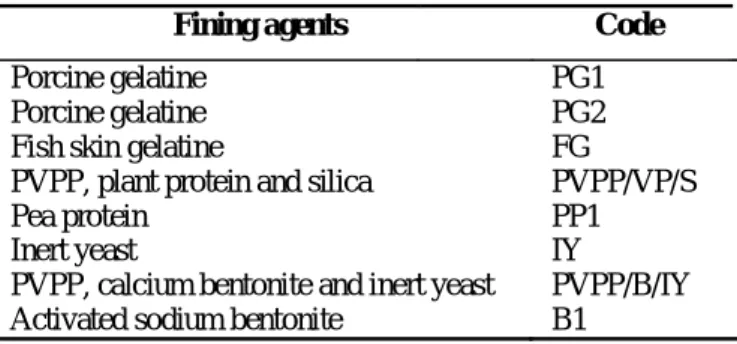
In this study, eight different fining agents were used (Table 1): two porcine gelatines, one fish skin gelatine, one association of PVPP, plant protein and silica, one plant proteins (pea protein), one association of PVPP, calcium bentonite and inert yeast, one inert yeast and one activated sodium bentonite.
Table 1 Fining agents used in this study.
Fining agents Code
Porcine gelatine PG1
Porcine gelatine PG2
Fish skin gelatine FG
PVPP, plant protein and silica PVPP/VP/S
Pea protein PP1
Inert yeast IY
PVPP, calcium bentonite and inert yeast PVPP/B/IY
Activated sodium bentonite B1
2.3 Experimental design
The experiment involved the addition of eight commercial fining agents to the wine, according to the manufactures recommendation: porcine gelatine (PG1 20 g/hL; PG2 60 g/hL), fish skin gelatine (FG 50 g/hL), association of PVPP, plant protein and silica (PVPP/VP/S 30 g/hL), pea protein (PP1 15 g/hL), association of PVPP, calcium bentonite and inert yeast (PVPP/B/IY 20 g/hL), inert yeast (IY 30 g/hL) and activated sodium bentonite (B1 15 g/hL). The objective of this assay is to compare the effect of gelatine protein fining agents traditionally used with the other fining agents. The experiment was conducted on 2000 mL flasks at laboratory scale. The fining agents were thoroughly mixed, added to each treatment and allowed to remain in contact with the wines for 6 days at 20 ºC. Then they were decanted and the physicochemical and sensory analyses were performed. All experiments and analysis were carried out in duplicate.
2.4 Quantification of non-flavonoids, flavonoids and total phenols
The phenolic content of the wines was quantified using the absorbance at 280 nm before and after precipitation of the flavonoid phenols, through reaction with formaldehyde, according to Kramling and Singleton [7]. The results were expressed as gallic acid equivalents
by means of calibration curves with standard gallic acid. The total phenolic content was also determined by a spectrophotometric method, using a UV-vis spectrophotometer according to Ribéreau-Gayon et al. [8].
2.5 Colour intensity and hue
Colour intensity was quantified by measuring absorbance at 420 nm, 520 nm and 620 nm and hue by measuring the absorbance at 420 and 520 nm using a 1 mm path length cell as described in the O.I.V. methods [9].
2.6 Total and coloured anthocyanins, polymeric and total pigments
Total and coloured anthocyanins, polymeric and total pigments were analysed according to Somers and Evans [10].
2.7 Total anthocyanins
Total anthocyanins were determined using the sulphur dioxide bleaching method described by Ribéreau-Gayon and Stonestreet [11].
2.8 Chromatic characteristics
The absorption spectra of wine samples were recorded with a spectrophotometer scanned from a range of 380 770 nm using 1 cm path length quartz cells. Data were collected to determine a measure of L* (lightness), a* (redness), and b* (yellowness) coordinates using the CIELab method according to Organization International de la Vigne et du Vin [9]. The Chroma [C* = [(a*)2 +
(b*)2]1/2] and hue-angle [ho = tan -1(b*/a*)] values were
also determined. To distinguish the colour more accurately, the difference was calculated using the
2 2 2]1/2
and reported in CIELab units. This allows reliable quantification of the overall colour difference of a sample when compared to a reference sample (unfined sample). Visual perception of colour differences by the human eye will be assumed as
[12].
2.9 Sensory characteristics
The sensory analysis was performed by a panel of 7 judges specialized in this type of evaluation. The samples were stored at appropriate light and temperature conditions (20ºC). The wines were presented to the tasters, in normalized tasting glasses [13], and were rated on a scale of 1 to 10 [14]. All evaluations were conducted from 10:00 to 12:00 a.m. in an individual booth and according to standardized procedures [15]. Thirty-eight attributes were selected for this part of the assay. Fifteen visual: clarity (crystalline; bright; clear; powdered; cloudy), hue (red loaded; red; red blondish; blondish;
seared clear), intensity (excellent; good; average; mediocre; insufficient). Ten aroma attributes: quality (excellent; floral; fruity; fleshy fruit flavours); nice; without blemish; without aromas; herbaceous aromas; hydrogen sulphide and other unpleasant aromas), intensity (excellent; good; average; mediocre; insufficient). Thirteen taste attributes: balance (low acidity; high alcohol content; harmonious; delicate; rich; sweet; silky; velvety; acceptable; correct acidity; acid; dormant; dry; excessive or insufficient acidity; unpleasant; astringent; hard; aggressive), intensity (excellent; good; average; mediocre; insufficient), persistence (long; average; short).
2.10 Statistical treatment
The data are presented as means ± standard deviation. Both physicochemical and sensory data were statistically tested by analysis of variance (ANOVA). Tukey at 5% significance level, test was applied to physicochemical data to determine significant differences between the wines. The results of sensory evaluation were subjected to analysis of variance (ANOVA), the Duncan test at 5% significance level to compare the averages. A covariance Principal Component Analysis (cov-PCA) was also performed. All statistical analyses were performed using the software Statistica 2010 (StatSoft Inc. 2010).
3
Results and discussion
3.1. Effect of fining agents on wine colour intensity, hue, total and coloured anthocyanins, polymeric and total pigments
Colour intensity and hue showed a significant decrease in all fined wines when compared to the unfined wine. A significant decrease was also observed for coloured anthocyanins in all fined wines when compared to the unfined wine, as shown in Table 2.
Table 2.Total and coloured anthocyanins, polymeric and total
pigments for both unfined Reserve Ruby Port wine and for Reserve Ruby Port wine after different fining treatments.
Fining agents Total anthocyanins (mg/L) Coloured anthocyanins* Polymeric pigments* Total pigments* T 231±0a 0.52±0.00a 2.49±0.00a 8.73±0.01a PG1 113±3c 0.09±0.00e 0.33±0.00e 4.95±0.01g PG2 124±6bc 0.10±0.00d 0.38±0.00d 6.07±0.02e FG 128±0b 0.09±0.00e 0.38±0.00d 5.83±0.00f PVPP/VP/S 129±0b 0.12±0.00b 0.41±0.00b 6.06±0.02e PP1 125±6bc 0.09±0.00e 0.40±0.00c 6.06±0.02e PVPP/B/IY 123±5bc 0.09±0.00e 0.41±0.00d 6.15±0.01d IY 125±1bc 0.11±0.00c 0.38±0.00b 7.29±0.01b B1 127±1b 0.09±0.00e 0.39±0.00c 6.78±0.00c
Means within a column followed by the same letter are not significant different (Tukey, 5%); * - absorbance units.
These results are in accordance to the work of Braga et al. [16] and Cosme et al. [17] who observed that the addition of gelatine decreased coloured anthocyanins and consequently colour intensity. The most significant decrease on total anthocyanins occurred in wine treated with porcine gelatine (PG1), also Braga et al. [16] verified in wines treated with porcine gelatine a decrease on total anthocyanin content. In all the fined wines when compared to the unfined wine a significant decrease on polymeric pigments was observed (Table 2), being lower in wines treated with porcine gelatine (PG1). Cosme et al. [17] and Braga et al. [16] also observed a significant decrease on polymeric pigments in wines treated with gelatines. A significant decrease was also observed in wine total pigments after addition of all the fining agents when compared to the unfined wine. The most significant decrease was in wines fined with porcine (PG1) and fish skin (FG) gelatine. These results are in agreement with Sarni-Manchado et al. [6] and Braga et al. [16].
3.2. Effect of fining agents on wine total phenols, non-flavonoid phenols and flavonoid phenols
Total phenols showed a significant decrease in all fined wines when compared the unfined wine, except for wine fined with porcine gelatine (PG1), (Table 3). Non-flavonoid phenols decreased significant in all fined wines when compared the unfined wine, with the exception of the wines fined with pea protein (PP1). The wines fined with association of PVPP, plant protein and silica (PVPP/VP/S), porcine gelatine (PG2) and inert yeast (IY) had the most significant decrease. This is in accordance to the work of Cosme et al. [18] that observed a significant decrease on non-flavonoid phenols in wines treated with pea protein in association with PVPP. Table 3. Total phenols, flavonoids and non-flavonoids for both
unfined Reserve Ruby Port wine and for Reserve Ruby Port wine after different fining treatments
Fining agents Total phenols (mg/L gallic acid) Non-flavonoid phenols (mg/L gallic acid) Flavonoid phenols (mg/L gallic acid) T 1571±1d 67±0d 1505±1c PG1 1566±2d 64±0cd 1502±1c PG2 1216±3ab 55±1b 1161±4a FG 1228±13b 63±1c 1165±12a PVPP/VP/S 1201±7a 51±0a 1150±7a PP1 1224±3ab 67±1d 1157±2a PVPP/B/IY 1231±6b 62±1c 1167±5a IY 1267±2c 56±1b 1209±0b B1 1264±10c 63±0c 1202±10b
3.3. Effect of fining agents on wine chromatic characteristics
Wines fined with porcine gelatine (PG1) showed the highest lightness (L*), which is in accordance to Braga et al. [16] and Cosme et al. [17]. On Table 4, a significant decrease on redness (a*) is observed in all fined wines. The increase in lightness (L*) of the fined wines seemed to be correlated with less redness (a*) [19], due to the removal of pigments as previously observed by Gil-Munoz et al. [20]. The value for yellowness (b*) decreased significant in all fined wines. The colour
when it is greater than 1 CIELab units. All the fined 1 CIELab units [12].
Table 4. Chromatic characteristics for both unfined Reserve
Ruby Port wine and for Reserve Ruby Port wine after different fining treatments
Fining
agents Chromatic characteristics
L* a* b* T 58.60±0.37a 27.56±2.80c 18.18±0.01cd - PG1 66.89±0.02d 24.55±0.03abc 17.29±0.02b 3.35±2.51a PG2 63.52±0.05c 25.34±0.44abc 17.65±0.52bc 4.14±2.27a FG 59.48±0.68a 25.22±0.08abc 17.87±0.04bc 2.42±2.63a PVPP/VP/S 62.32±0.01b 26.74±0.08bc 18.34±0.24cd 4.08±0.58a PP1 62.47±0.04b. 26.74±0.00bc 18.97±0.01d 4.96±0.51a PVPP/B/IY 65.92±0.02d 24.04±0.01abc 17.56±0.01bc 3.79±2.64a IY 63.27±0.06bc 22.27±0.28a 15.70±0.26a 7.12±2.56a B1 63.69±0.08c 23.26±0.01ab 17.19±0.01b 4.63±2.63a
Means within a column followed by the same letter are not significant different (Tukey, 5%).
3.4. Effect of fining agents on wine sensory characteristics
The wines sensory profile is shown in Figure 1 where the sum of the mean values assigned by the panellists for each attribute is marked on the corresponding axis.
Figure 1.Sensory profile of wine treated with different fining
agents and wine without treatment.
Unfined wine (T); porcine gelatine (PG2, PG1); fish skin gelatine (FG); PVPP, plant protein and silica (PVPP/VP/S); pea protein (PP1); PVPP, calcium bentonite and inert yeast (PVPP/B/IY), inert yeast (IY) and activated sodium bentonite (B1).
Figure 1 shows that the wine treated with association of PVPP, plant protein and silica (PVPP/VP/S) had lower values for all the attributes evaluated, except for limpidity. These results for limpidity are in accordance to the value of lightness (L*) presented in Table 4. The most balanced wine and that with the best results on colour intensity was the one treated with association of PVPP, calcium bentonite and inert yeast (PVPP/B/IY).
In the PCA (Principal Component Analysis) the first component accounted for 65.61% of the total variance and the second for 15.06%, representing the first two factorial axes 80.67% of the total variance (Figure 2 A and B).
Projection of the variables on the factor-plane ( 1 x 2)
Limpidity Hue Colour intensity Aromatic intensity Quality Flavour intensity Balance Persistensy -4,5 -4,0 -3,5 -3,0 -2,5 -2,0 -1,5 -1,0 -0,5 0,0 0,5 1,0 1,5 Factor 1 : 65,61% -5 -4 -3 -2 -1 0 1 2 3 Limpidity Hue Colour intensity Aromatic intensity Quality Flavour intensity Balance Persistensy
A
Projection of the cases on the factor-plane ( 1 x 2) Cases with sum of cosine square >= 0,00
T PVPP/VP/S PG2 IY PVPP/B/IY B1 PG1 FG PP1 -20 -15 -10 -5 0 5 10 15 20 Factor 1: 65,61% -10 -8 -6 -4 -2 0 2 4 6 8 T PVPP/VP/S PG2 IY PVPP/B/IY B1 PG1 FG PP1
B
Figure 2.Principal Component Analysis (cov-PCA) obtained by
analysis of sensory data of eight wine samples.
Unfined wine (T); porcine gelatine (PG2, PG1); fish skin gelatine (FG); PVPP, plant protein and silica (PVPP/VP/S); pea protein (PP1); PVPP, calcium bentonite and inert yeast (PVPP/B/IY); inert yeast (IY) and activated sodium bentonite (B1).
Evaluating the projection of Figure 2 A and B is possible to visualize the spatial distribution of the samples evaluated sensoryally. Among the sensory were the attributes that most contributed to PC1 (Figure 2 A). Evaluating the fining agents, we observed the
formation of three distinct groups. One group is formed by PP1, PG1, IY and PVPP/B/IY wine samples; the other group is formed by B1, PG2, PVPP/VP/S and FG wine samples and, at last, the T wine sample forms a group of her own.
4 Conclusions
Wines fined with porcine gelatine showed a significant decrease on colour intensity, coloured and total anthocyanins, polymeric and total pigments, when compared to the unfined wines. Lightness (L*) increased significant in wines fined with PVPP, plant protein and silica and with fish gelatine. Redness (a*) decreased significantly in wines fined with inert yeast, pea protein and porcine gelatine and yellowness (b*) decreased significantly in wines fined with pea protein, association of PVPP, plant protein and silica and with porcine gelatine. All fined wines had colour
higher than one CIELab units, which means that colour variations could be distinguished by the human eye. The sensory analysis showed that limpidity was higher scored in wines fined with pea protein, association of PVPP, plant protein and silica and porcine gelatine. Sensory characteristics of persistency, aromatic quality and intensity, flavour intensity and balance were also higher scored in wines fined with association of PVPP, plant protein and silica. Based on the results obtained, it is possible to provide information that could be used to select an appropriate alternative to gelatine of animal origin.
Acknowledgements
This work was partially funded by the Chemical Research Center (CQ-UTAD). Additional thanks to SOGRAPE for the availability of wines and to the Projet I&D INNOVINE&WINE Vineyard and Wine Innovation Platform, NORTE-01-0145-FEDER-000038, co-financed by the Fundo Europeu de Desenvolvimento Regional (FEDER) through the NORTE 2020 (Programa Operacional Regional do Norte 2014/2020).
References
1. J.L. Ribichaud, A.C. Noble, J. Agric. Food Chem.
53, 343 (1990).
2. P. Weber, H. Steinhart, A. Paschke, J. Agric. Food Chem. 55, 3127 (2007).
3. P. Weber, H. Steinhart, A. Paschke, J. Agric. Food Chem. 57, 8399 (2009).
4. S.L. Walker, M.C.D. Camarena, G. Freeman, J. I. Brewing, 113, 347 (2007).
5. M.A. Pozo-Bayón, I. Andújar-Ortiz, M. V. Moreno-Arribas, Food Res. Int., 42, 754 (2009).
6. P. Sarni-Manchado, A. Deleris, S. Avallone, V. Cheynier, M. Moutounet, Am. J. Enol. Vitic, 50, 81 (1999).
7. Am J Enol Vitic, 20,
86 (1969).
8. P. Ribéreau-Gayon, E. Peynaud, P. Sudraud, Science et Techniques du Vin.Tome 4. Dunod, Paris (1982).
9. OIV - Organisation International de la Vigne et du Vin Récueil de Méthodes Internationales d
des Vins et des Moûts. Edition O cielle, Paris, (2006).
10. T.C. Somers, Phytochem. 10, 2175 (1971).
11. P. Ribéreau-Gayon, E. Stonestreet, Bull Soc Chim Fr, 9, 2649 (1965).
12. J.F. Gonnet, Food Chem. 63, 409 (1998).
13. ISO 3591: 1977 retrieved from:
http://www.iso.org/iso/catalogue_detail.htm?csnum
ber=9002.
14. ISO 4121: 2003 retrieved from:
http://www.iso.org/iso/home/store/catalogue_tc/cata logue_detail.htm?csnumber=3387
15. ISO 8589: 2007 retrieved from:
http://www.iso.org/iso/home/store/catalogue_tc/cata logue_detail.htm?csnumber=3635
16. A. Braga, F. Cosme, J.M. Ricardo-da-Silva, O. Laureano, J Int Sci Vigne Vin, 4, 203 (2007). 17. F. Cosme, J.M. Ricardo-da-Silva, O. Laureano, Ital.
J. Food Sci., 19, 39 (2007).
18. F. Cosme, I. Capão, L. Filipe-Ribeiro, R.N. Bennett, A. Mendes-Faia, LWT -Food Sci. Technol. 46, 382 (2012).
19. A.I. Negueruela, J.F. Echavarri, M.M. Perez, Am. J. Enol. Vitic. 3, 353 (1995).
20. R. Gil-Munoz, E. Gomez-Plaza, A. Martinez, J.M. Lopez-Roca, Food Res. Int., 30, 699 (1997).