ECAS 2013
5th
European Conference on African Studies African Dynamics in a Multipolar World
©2014 Centro de Estudos Internacionais do Instituto Universitário de Lisboa (ISCTE-IUL) ISBN: 978-989-732-364-5
COMMUNITY PERSPECTIVES ON THE IMPACTS OF OIL AND GAS
ACTIVITIES IN GHANA: A CLOSER LOOK AND ANALYSIS OF
FISHERY LIVELIHOODS WITHIN SIX COASTAL DISTRICTS
Fred Kodzo Ayifli
KITE/ WUR – Netherlands [email protected]
Kwabena Boafo Adom-Opare
USAID West Africa [email protected]
Tutu Kerekang
Hatfield Africa, Consultants [email protected]
Abstract
Discovery of oil in commercial quantities in Ghana has resulted in significant commercial opportunities for the West African nation. After a few years of exploration and production, some concerns have emerged. These are concerns about the environmental and livelihoods related changes induced by the presence of oil and gas activities. Do the existing institutional arrangements provide the needed protection for livelihoods in these coastal areas, particularly fisheries? The narratives for this paper are from engagements with fishers and other stakeholders in six coastal districts of Ghana. The paper is an attempt to offer a general framework for understanding the context and interactions of the fisheries sector with the oil and gas sector using a political ecology perspective alongside insights from a sustainable livelihoods framework.
Key Words: Oil and gas activities, fisheries livelihoods, community perspectives,
1. Introduction
In 2007, Ghana discovered oil in commercial quantities. This discovery is expected to result in significant economic opportunities for the country. The opportunities however need to be balanced with oil-related (socio-economic and political) concerns emerging in the local discourse. In a number of other contexts, oil induced changes and concerns related to oil exploration are well documented. Wantchekon (2002) for instance points to the breakdown of democratic regimes due to a combination of incumbency advantage, political instability and repression, all as products of oil and gas activities. Collier and Hoeffer (2005), Ross (2006) discuss links to armed conflict whiles Vicente (2007) and Dunning (2008) highlight links with corruption and increase in rent seeking activities. In Ghana, some of the emerging concerns are related to perceived environmental impacts of oil exploration on communities. Generally, local communities in areas close to production sites of oil drilling activities tend to suffer pollution of water sources, land or loss of sources of livelihood (Manu, 2011). In this paper, we describe oil and gas activities to include all exploration and related processes of field development to well- drilling and production within the coastal areas of the Western Region. Our main argument in this paper is that oil and gas developments as identified by the narratives gathered, can degrade the environment and thus affect livelihoods; but also with larger implications for human health and therefore needs appropriate institutional responses.
1.1 Oil Discoveries And Increasing Concerns
Since 2007, more oil field discoveries have been made in the Deep Tano/West Cape Three Points Area. These have led to increases in oil exploration activities into newer oil fields. In September 2010, Tullow Oil announced the discovery of oil in a second reservoir called the
Tweneboa-Enyenra-Ntomme - by the acronym TEN which is expected to also produce oil by the next few years. According to Tullow (2013) the Plan of Development (PoD) has been approved by the Government which paves way for Tullow and its partners to proceed with the development of these discoveries and to potentially deliver first oil in 2016. Development of the TEN Project will also require the drilling and completion of up to about 24 development wells which will be connected through subsea infrastructure to a Floating, Production, Storage and Offloading vessel (FPSO), moored in approximately 1,500 metres of water.There is then the Owo field; referred to as the largest light oil discovery in Africa since the discovery of the Jubilee oil field in 2007. The Owo field is estimated to hold between 70 and 550 million barrels of light sweet and high quality crude respectively. In 2010, Lukoil of Russia also discovered oil deposits in the Dzata field of the West Cape Three Points block (Asafu-Adjaye, 2011). Despite these developments, the major exploration activities are still in the Jubilee Field which is in the Atlantic Ocean with some estimated 1.8 billion barrels (Sapa-AFP 2010). The Jubilee field is spread out in the Deepwater Tano and West Cape Three Points blocs with wells at a water depth between 1,100 and 1,300 meters, and at a total depth between 3,400 and 4,200 meters. The field covers 110 km², which is about the size of 155 football pitches (Offshore-Technology.com, 2011). From the time these oil discoveries were made, there has been high development optimism with expectations that oil explorations will bring about a lot of positive impacts. Edjekumhene et al (2010) suggest that the discovery of oil, will lead to the expansion of the oil and gas industry to bring about new and/or improved employment, business and training opportunities, as well as infrastructure development and social program development. These positive views about oil induced developments are only one side of the debate about oil-induced changes. There are also issues on the other side, emerging discourses and narratives that are
framed to highlight the likely negative impacts of the oil and gas activities, particularly on human livelihoods. Prior to oil exploration activities within the Western region of Ghana, the fisheries sector has been and is still a critical part of the livelihoods of the people in the region and serves as the (socio-) economic mainstay for community members.
In this paper, we focus on some of the perceived and real impacts of oil and gas activities and operations that affect fisheries livelihoods. The decision for our focus on fisheries livelihoods was informed by observations from our community consultation process for the pilot project titled: Using ICT as a two-way tool for transparency and accountability in the oil and gas sector in Ghana. The findings and narratives for the analytical material in this paper are thus generated mainly from the perceptions of fishermen and community members about the impacts of the oil and gas activities in their communities. The rest of the paper is organized as follows: the fisheries context in an era of oil and gas exploration is presented in section 2. We present a brief overview of the theoretical framework within which the issues are discussed in Section 3. Section 4 presents some key results and discussions with section 5 providing both the summary of the way forward and conclusions.
2. Context Of Fishing Livelihoods And The Emerging Oil And Gas Sector
Ghana has 550 kilometre coastline and a total continental shelf area of about 24,300 square kilometres that supports her marine fishing industry (Gyesi, 20121
). The industry provides a major source of inexpensive protein. There are many coastal communities and families that depend on fisheries resources for their livelihoods. Fish farming is thus a major source of employment for coastal communities and contributes to the national income. Diverse
!!!!!!!!!!!!!!!!!!!!!!!!!!!!!!!!!!!!!!!!!!!!!!!!!!!!!!!!!!!!! 1
http://crystal-lake-fish.com/index.php?view=article&catid=1%3Alatest-news&id=118%3Alegal-framework-of-fish-fishing-stakeholders are thus directly involved in fishing and fishing management at different scales, including large numbers of organisations and individuals. These arrangements however tend to be extremely complex to manage. As Finegold et al (2010) stated, the Western Region fishery management is no exception. As a livelihood activity within the region, fishing is usually organized on a small-scale from sedentary to migrant fishers or communities, from part-time to full-time fishing, from subsistence to commercial fishing, from advanced and non-differentiated to highly non-differentiated and specialized forms of fishing2
(Demuynck, 1994). In this paper, our emphasis is on the small-scaleness of fishing activities in the selected coastal communities. This distinction is deliberate and aimed at showing the difference between the small-scale fishing also described as ‘traditional’ or artisanal fishing and large-scale commercial fishing activities. In terms of technology, small-scale fishers own smaller boats and gears, and they catch smaller quantities of fish than large-scale commercial fishing boats. Along the West African coast, large dug-out wooden canoes are most commonly used by the small-scale fishers. In terms of the socio-cultural and institutional characteristics, fishers and their communities share features such as higher population growth which are linked to heavy demands of labour for fishing and fishing related activities3
(Marquette, 2002). Already, artisanal fishery in Ghana has been described as characterized by the use of destructive fishing gears, including nets that have patches with small mesh sizes that target juvenile stock, contributing to over-fishing (Atta-Mills et al. 2004; Walker, 2002; Koranteng, 1992); other challenges include the uncertainties that face small-scale fishers such as risks at sea, unequal power relations to middlemen and owners of fishing vessels and underrepresentation in national politics
!!!!!!!!!!!!!!!!!!!!!!!!!!!!!!!!!!!!!!!!!!!!!!!!!!!!!!!!!!!!!
2 Demuynck, K.; DETMAC Associates. The Participatory Rapid Appraisal on Perceptions and Practices of Fisher-folk on Fishery Resource Management in an Artisanal Fishing Community in Cameroon; FAO: Cotonou, Benin, 1994; p. 32.
(Hoorweg et al. 2009). We note however that with the increasing mechanisation of the fisheries sector, it has now become possible for small-scale fishers to go into deeper areas for fishing just like some ‘large-scale fishers’. Some of these deeper fishing areas are the locations where ‘contestations’ emerge particularly with the introduction of oil and gas actors (off-shore). Several other management challenges and finding the right scales and levels at which different management activities needed to be undertaken alongside legal and political challenges have long impeded the fisheries sector. Questions pertaining to how best to involve diverse stakeholders with conflicting interests and objectives also continue to be a major issue worthy of note particularly in an era of oil and gas explorations.
2.1 The Oil Explorations Fields And Local Identities Linked To Fisheries
In the six coastal communities where we conducted the stakeholder engagements, most livelihoods were generally linked to ‘fish’ as a commodity. This implies that communities are dependent on fishing as a livelihood activity. Livelihood identities are formed around fish as a product with fish being the basis of their communal social structure; as a result, any analysis of the fisheries sector has to emphasis the interactions between the socio-cultural and economic activities that the people engage with. Such an analysis has to acknowledge that activities that negatively affect or reduce access to fisheries resources and it has to be understood in a broader context, more than just within the context of fishing as a ‘stand-alone-activity’. A typical local fish economy of these coastal areas, will reveal that a number of people share these identities and are drawn into the sector not only for economic reasons but also because of socio-cultural reasons. There are diverse direct beneficiaries of fishing activities but also those who indirectly engage in related activities such as fish processing and marketing, amongst others. In this paper,
we use ‘fishers’ and ‘fishermen’ interchangeably. Our entry point is that fisheries as a sector, incorporates a diverse range of livelihood activities organized by the different actors mostly called fishermen in Ghana. One fishing job it is argued could therefore create many other smaller livelihood options - a situation described as the multipliers in fisheries, according to the Sustainable Fisheries Livelihood Programme (SFLP). These multipliers suggest that, one fishing job created about seven additional livelihoods within the coastal districts and in other areas of the country. Some of these induced multipliers include the supply of goods and services that are inputs to the production process — such as boat-building or fuel and others that are linked to marketing, processing and transport services amongst others. The loss or threat to one fishing job could therefore have a similar multiplier effect on other livelihoods. This is why any threat to fishing as an economic activity within the country deserves critical attention. Atta-Mills et al. (2004) suggested that up to 20% of the workforce in the country is directly or indirectly supported by fishing activities. Finegold et al. (2010) illustrated that a visit to a typical Ghanaian landing site when boats are unloading reveals an astonishing array of economic activities, with numerous examples of multiple activities that support production, marketing and other economic developments in the vicinity.
2.2 Oil Explorations And Development Of Fields
With the introduction of oil and gas activities in the Western Region, the picture of the fisheries sector is fast changing along the coastal districts. New social actors in the form of oil and gas companies are increasingly exploring oil in areas that were previously accessible to fishers. With the arrival, of companies such as Tullow Oil and Kosmos Energy, the dynamics of the fishery sector, the ‘fishing areas’ have changed. Generally, these oil and gas companies
acquire exploration rights in terms of licensed blocks of several kilometres. Each block contains several fields, whiles each field may support a number of different production sites. Undoubtedly, the geopolitics of oil production is different from that of exploration. Exploration is dominated by companies from countries that have the technological know-how and by financial institutions with access to high risk capital; in contrast to corporations from countries seeking to increase and diversify their supply of oil who dominate production (des Clers 2007; p 18). In Ghana, reports are that although developments for new oil fields are steadily progressing, there has still not been any comprehensive fisheries impact assessment to determine the extent to which the oil and gas sector may impact fisheries livelihoods. It is only assessments of this nature that can determine the expected impact of oil and gas activities and environmental factors on fish production. Ghana’s law stipulates that if (petroleum) activities take place on the ocean, a fisheries impact assessment should take place (Section 93 of the Fisheries Act 2002, Act 625 i);
and this assessment has not been incorporated into the Jubilee Field Environmental Impact Assessment (EIA) (Kroon, 2012) – a very important activity which was neglected. Based on this situation, we argue that fishers along coastal districts have been ushered into an era of struggle to maintain a legacy of earning livelihoods from fisheries vis-à-vis dealing with oil and gas companies. For most oil and gas companies, exploration is the high-risk end of the oil business and because of the dynamic nature of conditions that influence that process, alongside the uncertainties of outcomes, it has been suggested that this partly explains the little attention paid to community relation issues (des Clers 2007; p 8). From our assessments, impacts on livelihoods, when looked at from a community relations perspective demonstrates a precarious state of fisheries livelihoods and raises an endless set of questions regarding these developments. Are these struggles for fisheries livelihoods a trade-off for oil exploration and production
activities? What institutional and governance arrangements are available to protect fishers from these real or perceived adverse impacts of oil exploration on fisheries resources and livelihoods? Examining the multiple perspectives of stakeholders involved in not only the fisheries management but also those directly involved in the oil and gas sector is one of the ways that some of these questions can be addressed. An engagement that we believe could lead to the avoidance of the displacements of fishing and its related livelihood activities.
3. Fisheries Livelihoods And The Political Ecology Of Oil And Gas : A Brief Theoretical Analysis
3.1 Sustainable Fisheries Livelihoods And Recent Struggles
The sustainable livelihoods approach (SLA) has been applied successfully to areas such as fisheries (Allison & Ellis, 2001; Scoones 2009). There are diverse advantages in using SLA to identify challenges that confront livelihoods – whether in the fisheries sector or other agricultural sectors like food and cash crop farming. Some challenges identified by SLA are well documented except for the limitations of SLA to expand on the debates of power and politics as referenced by Scoones (2009). We use SLA in this context to examine the realities of fishers and to illustrate the dynamics involved in their changing livelihood systems, especially in terms of their vulnerabilities within an era of oil and gas exploration. SLA is applied as an analytical tool to explore links between fisheries livelihoods and the larger context of oil and gas explorations. It examines how the two sectors interact. It incorporates ecological system concepts of sensitivity and resilience, referring to the degree to which a livelihood system reacts to shocks or other types of stress (referring to its sensitivity) and how well it can be expected to ‘bounce’ back and recover from such shocks (its resilience). In this regard, our analysis looks at oil and gas
activities as forms of ‘shocks and stressors’ introduced into the fisheries sector. This is not to suggest that only oil and gas activities are the sole threatening factor for fisheries livelihoods but they are analytically examined as new forms of – stressors – into an already vulnerable sector. Existing information, past research and local knowledge make it clear that the fishery system is under considerable stress (CRC 2010)
3.2 The Vulnerability Context, New Rules And The Struggles For Livelihoods
We look at vulnerability in this context from two perspectives: first in terms of the external threats to livelihood security with the overall emergence of oil and gas exploration in areas formerly used as fishing grounds; and also in terms of the internal coping capabilities of fishers. The latter, as influenced by assets - available to fishers and also available to oil and gas sector actors. For fishers, capital assets owned and controlled are mainly in terms of skills, knowledge and the ability to engage in fishing as an economic activity. This is their human capital base. They possess networks that rely on relationships to thrive. This is part of their social capitals. In terms of physical capital, most fishers especially in the Western Region rely on the use of basic materials, tools and equipment which can be considered as elementary. This therefore determines their financial capital base which is mostly dependent on access savings and credits amongst other strategies to sustain their livelihoods financially. For oil and gas actors, human capital is driven by dependence on high level technical skills; alongside the need for an extremely sophisticated technology which is mostly very capital intensive. Assets may also include the capability or power to negotiate for new rules or to influence the patterns of government policies and the extent to which these policies and rules can be adopted and enforced in the interest of fishers or oil and gas companies or vice-versa. The introduction of new actors in
the form of oil companies into a long-thriving fishing sector, we argue, brought ‘new-rules of the game – mainly in terms of the use of the sea. The non-compliance to undertake a fisheries impact assessment prior to the commencement of exploration activities is seen within this context as exposing the local fishing economy to diverse forms of vulnerabilities. We use political ecology as a perspective to analyze the linkages between these two domains – the fisheries sector and the oil and gas sector. We frame the challenges confronting the small scale fishing sector as ‘new struggles’ bearing in mind the need for an analysis that pays attention to the discourse of power and politics. Within our analysis we see both the small-scale coastal fishers and oil companies as operating within a highly politicized environment. In such a politicized environment, power can be exercised in an unbalanced manner to transform not only the social relations but also livelihood systems. To understand livelihood-based struggles, one ought to appreciate the fact that struggles for sustaining livelihoods are also mainly manifestations of political processes; and that they are also directly linked to issues of control and entitlements (Bryant 1997; Peluso and Watts, 2001) but also access to power (Wolf 1990) emerging from all the diverse actors (borrowing from Foucault’s notion of power as the ability “…to structure the possible field of action of others”; Foucault 1984:428). Political ecology is thus applied to the complexities of the small-scale fishing industry and the oil and gas actors in the Western Region and their interactions with the natural environment (the sea). The analysis highlights their interactions with the policies that are in place (or supposed to be in place) to regulate or promote their respective activities. All of these relationships between the diverse actors are nested together into different forms of power systems and with discourses that operate within specific or intertwined socioeconomic contexts. Discourses as used here are defined as knowledge regimes that produce shared meanings. The understanding of such regimes reflects issues on a local,
national, international or global level. All actors/stakeholders are thus participants in the production, reproduction and transformation of these discourses through various forms of interactions (Hannigen, 1995). These interactions and dynamics need to be understood considering that oil exploration is a relatively new business in the social and political life of Ghana compared to countries such as Nigeria within the sub-region. There is therefore the need to unpack all the social relations and to identify the key actors involved in the social organizations of the two sectors.
3.3 Actors And Institutions: Protecting Fisheries Livelihoods, Promoting Oil And Gas Activities
Within Ghana’s fisheries sector, we observe that actors at the centre of fisheries livelihoods are mainly the local coastal communities and individual households; but for a detail understanding of the interactions between fisheries livelihoods and oil and gas activities, actors at other scales such as the international, national and local scales ought to also be considered. These actors are necessary when issues of livelihoods and how the oil and gas sector is promoted. In Ghana, actors from civil society are also quite vocal on issues pertaining to the protection of fisheries livelihoods. All these different actors are nevertheless driven by different interests as they operate at different scales. So, whiles the oil companies are actively exploring and producing oil within the Western region, actors such as the traditional authorities – chiefs, including chief fishermen4
and chief fishmongers are also lamenting about the problems confronting their livelihoods as a result of the oil and gas activities. Traditional authorities and
!!!!!!!!!!!!!!!!!!!!!!!!!!!!!!!!!!!!!!!!!!!!!!!!!!!!!!!!!!!!!
4!The chief fisherman is often accompanied by a council of elders; the roles determined by either fishing experience and expertise or lineage,
the chief fishermen are but some of the actors that command a lot of respect within these coastal communities, which makes them critical actors. Institutional actors include the Government of Ghana (represented by institutions such as Ministry of Lands and Natural Resources, Ministry of Environment, Science and Technology, Ministry of Energy and Environmental Protection Agency; Ghana National Petroleum Cooperation; others are the donors and international institutions involved in fisheries and oil and gas sector related issues. All these actors possess varied agencies, knowledge and inherent organizational strength to influence one another’s social relations (Long 2001). Our understanding of agency (the capacity of actors to exert influence) requires an analysis of how diverse actors actively shape processes into becoming ‘new ways of doing things’ – or as policy outcomes or actions. Looking at institutions, we recognize that they [institutions] ought to be recognized by everyone who is affected by them, even though they (institutions such as firms, families, private organizations, governmental agencies and legislative bodies) all come with their different meanings and interpretations. According to Jentoft (2004), entities such as symbolic systems and social fields could also be deemed to be institutions since they are changed, re-shaped and fine-tuned through multiple interactions. It is this perspective of institutions that we apply in this paper especially in the face of ‘changing institutional structures’ within communities since the start of oil and gas explorations in Ghana. We have observed the emergence of new structures for management of oil and gas resource alongside the changing roles of existing bodies and mandates but also ways of doing things. Though institutions can be traditionally seen as responses to management challenges – whether in dealing with problems posed by oil exploration or in terms of managing the negative impacts of these activities on livelihoods, the question still remains about the extent to which institutional arrangements can provide the needed protection for fishery livelihoods and
at the same time ensure that benefits from the oil and gas sector are also maintained. Scott (2001) argues that institutions need to include the norms and values that define goals, impose constraints on social behaviour and empower social action. It is, therefore, very useful to have a broad perspective of institutions in order to contribute to evolving creative solutions and designs for ‘institutions’, that can effectively manage operations that are essential for their efficiency (Jentoft, 2004).
4. Materials And Methods
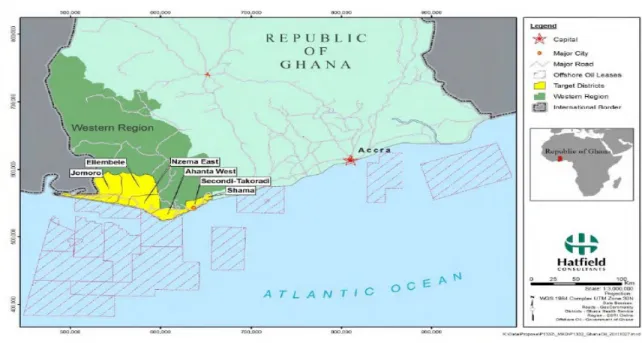
The data for this work is drawn from interactions at the consultative phase of an 18-months pilot project implemented by Hatfield Consultants in collaboration with the Kumasi Institute of Technology, Energy and Environment. The narratives were gathered from individual community members – mainly fishermen (whose day-to-day subsistence depends directly on fishery resources). Others included groups representing institutions involved in different and/or overlapping aspects of the fisheries and the oil and gas sector within (6) coastal districts in the Western Region. We targeted these coastal districts because they are expected to experience the largest impacts from the off-shore oil and gas developments. Figure 1 shows the map of the coastal districts covered, namely Shama; Sekondi-Takoradi; Ahanta West; Nzema East; Ellembelle; and Jomoro; as produced by this project.
Figure 1: Study area, showing the six coastal districts.
Perspectives were explored through the use of both formal and informal interviews. The former approach relied on a template of standard questions that were analysed after data collection. For all the data gathered, deductive analytical methods were employed to review the information collected. Overall, field-based investigations using in-depth interviews, observations and other forms of informal focus group discussions with fishers and relevant stakeholders helped to generate sufficient data. The stakeholder involvement survey in the six coastal districts received contributions from 169 participants representing various demographic characteristics (gender, age, and income but also literacy levels). Questionnaires extracted information about the impacts of the oil and gas activities on the local communities; the specific issues presented in this paper were isolated for specific emphasis. From the surveyed population (65%) of the respondents took part in the focus group discussions of the consultation while (35%) answered individual questionnaires. All perspectives gathered were reviewed in the light of existing literature using the theoretical perspectives of political ecology and sustainable livelihoods. More than half
and 40 years, and of these (50%) had tertiary/university level education. On the other hand the focus group participants were highly heterogeneous in literacy level (educational background) as well as in age.
5. Results And Discussions
5.1 Awareness Of Oil And Gas Activities Impact On Fisheries Sector
Based on the analysis of narratives from the focused group discussions and questionnaires, most community members interviewed were aware of the likely and actual effects of oil exploration on their local economy. Community in this context is not seen as a homogenous entity; but rather in the light of the dominant frames gathered from the engagements. Much of the information gathered related to environmental impacts; and impact on the ecosystem but also on the human and socio-cultural systems. Generally, we identify with the difficulty in obtaining measurement indicators of actual impacts for these parameters including the physical environment so respondents were asked to list their priority issues in their local communities and in relation to oil and gas activities. Most respondents identified environmental impacts as the main issue of top priority, followed by socio-economic impacts (43% and 32% respectively). Other issues included education and expectation management, and oil revenue management but also transparency amongst others. The analysis of responses between the two population samples (the focus group discussants and the individual questionnaire respondents) based on the demographics, shows that the majority of individual questionnaire contributions were from a youthful and relatively higher level educational background participants. We thus posit that the differences on the priority issues could be attributed to age and literacy levels of the respondents. This is because of the possibility of a higher awareness of the biophysical environmental impacts
of the oil and gas activities from the youth or a population that has access to more information. In specific reference to fisheries livelihoods, we highlight three key issues as synthesized from the narratives gathered. These are presented as part of the analysis in the next section.
5.2 Lack Of Access To Fisheries And Related Resources
The first main issue highlighted from the engagements relates to concerns that fishermen were slowly losing their livelihood. Indicators used included reports on the decline in daily fish catch because of oil and gas activities. Whether perceived or real, no objective quantitative data was analysed during our consultation to confirm this assertions. Reasons cited by respondents as confirmation of this community reality included what was described as the effect of lights from oil rigs. According to the respondents, fishes are attracted to the Floating Production Storage and Offloading (FPSO); due to the FPSO being stationary and acting as a fish aggregating device (FAD). Fishermen are however barred from fishing near these areas where the rigs are located due to safety and security concerns. These safety zones are supposedly aimed at ensuring the safety of both fishermen and of the oil and gas installations, thus helping to avoid or reduce the probability of accidents caused by the interaction of fishing boats and gears and oil rigs. These exclusion zones are however considered by some fishermen as hindrances to fisheries operations. This requires an analysis of fish catch trends since the commencement of oil exploration in order to concretely allude any perceived or real falls in fish catch to oil and gas activities. Finegold et al (2010) suggest that even though data on catch from Ghana’s coastal fisheries are available as far back as 1950 , the more recent advent of the current system, comparisons of reported catches before and after 1972 should be regarded with caution. This implies that there is the need to target and conduct such a study comprehensively in order to address some of
these concerns. Evidently, confrontations and harassments reported by fishers with naval officers who are seen to be protecting the oil rigs has been described as an ‘attack on’ fisheries livelihoods. Generally, oil and gas developments are also mostly accompanied by noise and disturbances that are associated with bulk vessels and drilling activities. All these activities are considered to have negative impacts on the ecosystems and on marine organisms. Fish and some mammals such as whales are particularly affected by sound elevation because of their dependence on sound for reproduction, feeding and avoiding hazards such as predators and navigation (Tyack & Miller, 2002; Popper, 2003). There have also been reported deaths as possible impacts of noise from oil and gas operation (Fernandez et al., 2005); even though none of these have been scientifically established in the instances where whales have been found dead within the Ghanaian coasts.
From a political ecology perspective, we argue that the emerging challenges posed to the fisheries resources and livelihoods by the oil and gas activities cannot be explained only in terms of the discourse of ‘loss of livelihoods’ alone. The changes, both positive and negative should be seen within a broader context of transformations brought about by the introduction of the oil and gas activities – but also leading to changes in the ways that the micro level dynamics connect with the macro level. The transformations being induced by the oil and gas activities come with diverse macro-economic advantages for the country at large, but at the same time, it is heralding a new micro-economic disadvantage for the host communities. The use of a sustainable livelihood framework to analyze this case is to encourage an explicit consideration of links between the local issues of concern such as depletion of fishing resources; alongside meso-level processes such as finding ways that local authorities can play a role in mitigating the impact on the fisheries livelihood and other general level concerns about how to still benefit from the
economic and social changes that oil exploration may induce within a country or for a local economy.
5.3 Adapting Fisheries Livelihood Strategies To ‘New Ways’?
We noted that strategies for survival when livelihoods are threatened included adopting livelihood options that can help one to cope with or adapt for survival. Here it meant that old ways of ‘doing’ things by fishermen needed modification. From some of the factors outlined, it was evident that ‘new sets of rules’ now governed fishing activities. Some fishermen for example reported about their inability to plan their activities effectively because of the lack of specific knowledge about activities of the oil and gas companies. There are areas demarcated as oil fields where fishers are technically not allowed access; but the reality as reported by accounts from fishermen is that, not all fishermen know where these exclusion zones are. This has led to increased risks of collision accidents from structures at sea and complaints about the loss of fishing gears as a result of interactions with oil and gas vessels. We see that these dynamics are producing new forms of ‘power fields’ leading to the emergence of unequal but also contesting fields and control as well as entitlements over the ocean resources where fishing activity is currently on-going alongside oil and gas exploration. Understanding livelihood struggles of fishermen within these contexts will require the careful examination of all the different claims of entitlements, control and power. In our discussions at the community, comments such as ‘Who owns the seas?’ point to some of these underlying contestations. Unlike land, having access and possessing exclusive rights to resources such as the sea are always difficult. According to Vatn (2005), any undefined or unclear property rights may yield both large conflicts and losses;
bearing in mind that a property right as a social construction may be conferred on an individual or on groups of individuals by norms or laws (Knight 2010).
5.4 Examining Power Dynamics And Impacts On Livelihoods
We described the actors within the fisheries sector, especially those whose livelihoods depended on the coast as having ‘power’ and entitlements over the resources that provide them with the means to eke out their living. Using the conceptualization of Wolf (1990) we can argue that power is what is exercised. The extent to which the struggles to maintain grips on this ‘power’ is challenged by the new encounters with ‘outside’ socio-political structures that threaten to alter the ‘established’ ways of doing things – in this case the ways of earning livelihoods – will demonstrate the power dynamics at play within the context of both the fisheries sector and for the oil and gas actors. Obviously, the power dynamics that can allow for an actor to have access to a resource and to be able to sustain such an access is a function of multiple social, economic, and political factors – a notion that is also fundamental to the concept of political ecology. We use Wolf’s ideas of power both in terms of organisational power and structural power to provide an appropriate interpretation of these dynamics as they influence the course of actions within the two sectors. Wolf (1990) sees organisational power as that form of power which allows some social actors to exercise control over the activities of other actors in the setting where their interaction takes place. [We] can succeed to understand this type of power by exploring the tools that some of the actors can use to manipulate the activities of others in the settings that they construct their existence. For structural power, Wolf argues that it is that kind of power which helps to shape the social field of action so as to render some kinds of behaviour possible, while making others less possible or impossible. What oil and gas exploration has
brought about, for example, is to make it possible for the generation of additional revenues that hitherto was not available to the nation. This has provided the sector players with ‘power’ and it is possible to follow the flows of capital and revenues to understand the extent of the influence that these petro-dollars have. This is not a purely economic relation, but a political one as well; and it takes clout to set up such a system, clout to also maintain but most importantly to also defend. It is the manifestation of such clout that becomes a target for competition and highly contested by other actors. The question then emerges whether fishers also have such power and if not, then what is their situation in relation to the issues of power as bestowed through access to capital as a resource? It is through the representation and examination of the various differential power sources that different interests are amplified and enforced as well as struggled over. Drawing from the political ecology perspective, the unequal power relations between the different actors (between the fishers and oil and gas companies) provides a way to also explain the uneven distribution of access to water resources for different purposes. The power again emanates from the differential ability of the actors (oil and gas companies/fishers) to control access to valued environmental resources, with the main objective to have control over the economic benefits (economic capital) ensuing from that resource exploitation (Bryant, 1997: 11; see also Dauvergne, 1994; Bryant, 1996). As it stands, actors in the oil and gas sector are seen to be in possession of some form of ‘power’. Ghana needs the oil revenues and finds the exploration activities as fundamental to securing its future energy needs and for additional revenue. Fishers on the other hand do have their strongest and visible form of power in terms of the claim to entitlements manifested through the call for access to coastal resources as a matter of ‘rights’ and to guarantee food security. The fishers can also rely on their identities to recreate their social realities and as a way to challenge other forms of unequal power relations. Prior to
the discovery of the oil and gas, the sea was governed by an open access regime where local fishermen had the ‘right’ to the use of the sea uninhibited only to be inhibited by the government in the era of oil discovery leading to a curtailment of some of these access rights of the local fishermen. Some other issues highlighted from the findings included the high costs of production incurred in the fishing activity in recent times. Fishermen explained that now they had to travel longer distances to get comparatively larger quantities of fish; which also meant the buying of larger quantities of fuel.
In terms of pollutions and effects on livelihoods, no formal reports were gathered about any oil spillage apart from community reports on previous spillage of low toxicity oil-based mud by Kosmos Energy in the Jubilee Field in December 2009 and March 2010; and as reported by EPA in 2010. Other related concerns mentioned had to do with the disposal of ballast water and the fear of contaminations to marine life as part of real impacts of oil and gas activities.
6. Conclusion And Recommendations
In conclusion, we have sought to present through this paper a number of key features of both the oil and gas sector and fisheries sector as gathered from our consultations; and based on some minimal review of relevant literature. In summary, our findings have demonstrated that community narratives point towards a decline in traditional fishing grounds and catching opportunities for fishermen; due to what some described as the increased competition from displaced fishing grounds. There were then concerns that fishermen now needed to take longer sailing routes and times to arrive at fishing grounds. From all these issues outlined, it is apparent that the two sectors – need to thrive and co-exist together. From the analysis, it is evident that the sectors are intertwined in a complex relationship. Our conclusions are that, attention needs not
only be paid to the oil and gas sector based on the revenues that can be generated from the petroleum exploration as a boost the economy. This is the seemingly widely shared perception. It does not also have to focus solely on the concerns about lose of livelihoods but rather stakeholders particularly state actors and the private sector (mainly oil companies) need to take an active interest in contributing towards sustaining both sectors in ways that can allow the two sectors to positively interact with one another. There are existing international treaties, national policies and legally mandated national institutions that can support such efforts but these institutions will need to be strengthened in their capacities to function effectively. For some of the international treaties and conventions, they will need to be adapted to the national context and effectively enforced. Notable among these treaties ratified and of particular importance to the environment and fisheries livelihoods include : (e.g Kloff & Wicks, 2004) International Convention for the Prevention of Pollution of the Sea by Oil, 1962; the International Convention on the Establishment of an International Fund for Compensation of Oil Pollution Damage, 1971; the International Convention for the Cooperation in the Protection and Development of the Marine and Coastal Environment of the West and Central African Region, 1981 (Abidjan Convention); the International Convention on Civil Liability for Oil Pollution Damage, (1969); the Convention on Wetlands of International Importance, especially as Waterfowl Habitats,1971; United Nations Convention on the Laws of the Sea, 1982; the International Convention for the Prevention of Pollution from Ships (MARPOL Convention 73/78); the International Convention on Oil Pollution Preparedness, Response and Cooperation,1990 amongst others. For Ghana to be able to effectively address some of the accompanying negative environmental and fisheries livelihood impacts, it will be imperative for the nation to immediately take necessary steps to ensure an effective and efficient exploitation
and production of oil and gas, with the goal of minimizing or avoiding these attendant environmental consequences (both on fisheries livelihoods and generally on ocean and aquatic life). Without a conscious effort, it is unlikely that these efforts will emerge by themselves. Governance arrangements that promote interaction of the two sectors and the interactions amongst multiple actors will be required – to drive the determination of Ghana’s energy future from oil and gas but with actors from the fishery sector considered as critical players. This requires a better integration of the two sectors and a need for more multi-stakeholder engagements. Actors from the two sectors can be incorporated into comprehensive awareness plans that will target the need to avoid the presence of fishing boats in areas where the oil and gas’ platform’s are located (the navigation exclusion zones) – but at the same time to demonstrate that the concerns of fishers are not being neglected. In general, we see the need for processes to be initiated to protect and boost livelihoods that could be affected by the oil and gas activities in the western region. Communities and government institutions as well as the oil companies may need to step up to this challenge but supported by empirical research. Further research is thus needed to examine these multiple perspectives of all the actors that are operating within the two domains about the varied forms of impacts particularly in relation to the socio-economic and biophysical environmental impacts. The new power relations need to also be fully explored and understood and with examples drawn from other cross-country experiences to help ensure that responses to promote co-existence of the two sectors are sustainable, technologically practical but also culturally sound. There is also the need to commission a fisheries impact assessment which would bring in all actors in the different overlapping areas of the oil and gas sector to a common forum.
Acknowledgement
The authors would like to thank Amzat Jimoh (PhD) and Olufunso Somorin for the insightful comments on the manuscript. The paper was produced based on the contributions made to the 5th
European Conference on African studies Panel in Lisbon, Portugal. Panel titled – Crude moves: social fields of global oil. The findings are however based on results from the participatory stakeholder engagement of the project titled: Using Technology as a Tool for Two Way Transparency and Accountability around Oil and Gas Sector, Ghana, funded by the World Bank and implemented by Hatfield Consultants in collaboration with the Kumasi Institute of Technology, Energy and Environment (KITE). The views expressed and how the analysis is presented in this paper, however, remain those of the authors and not of the donor or the affiliated institutions of the authors.
References
Amoasah, G., (2010) The potential impacts of oil and gas exploration and production on the Coastal zone of Ghana: an ecosystem services approach. Thesis (MSc) Environmental Sciences; Wageningen University, The Netherlands
Atta-Mills J., Alder J., Sumaila U.R (2004) The decline of a regional fishing nation: The case of Ghana and West Africa; Natural Resources Forum 28, pp 13-21.
Agbeko, E. (2013) Aquaculture can offset fish deficit [Online] Available:
http://www.ghanabusinessnews.com/2013/09/03/aquaculture-can-offset-fish-deficit-scientist/ Asafu-Adjaye (2011) Tracking Transparency and Accountability in Ghana’s Oil and Gas
Industry, IEA P-Trac Index 2011 Report
Asafu-Adjaye, J., (2010) ‘Oil Production and Ghana’s Economy: What Can We Expect?’ Ghana Policy Journal, 4, 35-49,
Bryant, R. L. (1997). Beyond the impasse: the power of political ecology in Third World environmental research. Area 29(1): 5-19.
Collier, Paul and Anke Hoeffler (2005). Resource rents, governance and conflict. Journal of Conflict Resolution 49 (4): 625–633.
Coastal Resources Center (2010) Hen Mpoano: our coast, our future, Western Region of Ghana. Narragansett: Coastal Resources Center, University of Rhode Island.
Darkwah, A. (2010). The Impact of Oil and Gas Discovery and Exploration on Communities
http://www.g-Dunning, T. (2008): Crude Democracy: Natural Resource Wealth and Political Regimes. Cambridge: Cambridge University Press
des Clers, S. (2007). Mitigating the Impact of Oil Exploration and Production on Coastal and Wetland Livelihoods in Central and West Africa, Sustainable Fisheries Livelihood Programme, DFID/FAO/SFLP
Bryant R (1997) Beyond the impasse: the power of political ecology in Third World environment research. Area 29 (1), 5–19.
Edjekumhene et al (2010) Ghana’s Emerging Petroleum Industry : What Stakeholders Need to Know. Accra, Combert Impressions; http://kiteonline.net/images/downloads/emerog.pdf (Kumasi Institute of Technology, Energy and Environment)
EPA (2010) National oil spill contingency plan: Ghana’s “National contingency plan to combat pollution by oil and other noxious and hazardous substances”. Environmental Protection Agency (Ghana) Report (103 pp.)
Fernández A., et al (2005) ‘Gas and fat embolic syndrome’ involving a mass stranding of beaked whales (Family Ziphiidae) exposed to anthropogenic sonar signals. Vet. Pathol. 42: 446-57
Foucault, Michel (1984). The Subject and Power. In Art after Modernism: Rethinking Representation. Brian Wallis, ed. Pp. 41 7-432. Boston/New York: David R. Godine/New Museum of contemporary Art.
Finegold, C.(2010). Western Region Fisheries Sector Review, WorldFish Center. USAID Integrated Coastal and Fisheries Governance Initiative for the Western Region, Ghana. Dauvergne P (1994) The politics of deforestation in Indonesia. Pacific Affairs 66 (4), 497–518. Demuynck, K.; DETMAC Associates. The Participatory Rapid Appraisal on Perceptions
and Practices of Fisher-folk on Fishery Resource Management in an Artisanal Fishing Community in Cameroon; FAO: Cotonou, Benin, 1994; p. 32
Dunning, T. (2008) Crude Democracy: Natural Resource Wealth and Political Regimes. Cambridge: Cambridge University Press, 2008;
The Political Economy Analysis of the Oil & Gas Sector in Ghana: the Implications for STAR-Ghana.
Government of Ghana (2009) The national oil spill response dispersant use policy. Accra: Parliament of Ghana.
Government of Ghana (2010) Spillage contingency plan. Accra: Parliament of Ghana.
Gyesi, H., (2012) Legal framework of fish, fishing, fisherfolk, the law and the fishing Institutions s.l.:s.n.
Hannigen, J.A (1995) Environmental Sociology. London: Routledge
Jentoft, S., (2000) Co-managing the coastal zone: is the task too complex? Ocean & Coastal Management, 43, pp.527-35.
Long, N. (2001) Development sociology: actor perspectives. London, Routledge
Odotei, I. (1999) Gender and traditional authority in the artisanal marine fishing industry in Ghana. Journal Institute of African Studies. Research Review. Vol 15. No 1. 1999: 15-38. Overå, R., (2001) Institutions, mobility and resilience in the Fante migratory fisheries of West
Africa. CMI Working Papers 2001:2. Bergen, Norway: Chr. Michelson Institute.
Overå, R.(2003) Gender ideology and manoeuvring space for female fisheries entrepreneurs. Research Review NS. 19.2. 2003.
Peluso, N. L. and M. Watts (Eds.) (2001) Violent Environments. New York, Cornel University Press.
Manu, D.A.K., (2011) The emerging oil industry in Ghana: socio-economic and environmental impact on the people of Cape Three Points. Master’s thesis in International Environmental and Development Studies, Norwegian University of Life Sciences, Norway.
Michael L. Ross, (2004) ‘What do we know about natural resources and Civil War? Journal of Peace Research 41, 3, p.342
Marquette, C.M; Koranteng, K.A.; Overå, R.; Aryeetey, E.B.-D (2002) Small-scale fisheries, population dynamics and resource use in Africa: The case of Moree, Ghana. Ambio 2002, 31, 324–336.
Offshore-Technology.com (2011): Jubilee Field, Ghana. Available online at http://www.offshore-technology.com/projects/jubilee-field
Ross, M.L., (2006) ‘A Closer Look at Oil, Diamonds, and Civil War’, Annual Review of Political Science, 9: 265–300, 2006.
Sapa-AFP (2010) Ghana becomes an oil nation. General news of Wednesday, 15 December 2010.
Scoones, I (1998) Sustainable Rural Livelihoods: A Framework for Analysis. IDS, Working Paper 72, IDS, Brighton, UK, June,
Scoones (2009) Livelihoods perspectives and rural development; Journal of Peasant Studies Vol. 36, No. 1, January 2009
Tyack P. L. and Miller E. H. (2002). Vocal anatomy, acoustic communication and echolocation. In Marine Mammal Biology. (A. R. Hoelzel, ed.), pp. 142–184. Blackwell Science Ltd., Oxford, UK.
Kloff S. and Wicks C. (2004). Environmental management of offshore oil development and maritime oil transport; A background document for stakeholders of the West African Marine Eco Region. IUCN working paper.
Kumasi Institute of Technology (2010) Ghana’s Emerging Petroleum Industry. Accra, Combert Impressions
Vatn, A (2005) Institutions and the Environment. Cheltenham, UK: Edward Elgar Publishing Limited.
Vicente, Pedro. 2007. Does oil corrupt? Theory and evidence from a natural experiment in West Africa. Discussion Paper. Department of Economics, University of Oxford.
Wolf, W.R (1990) Distinguished Lecture: Facing Power-Old Insights, New Questions At the 88th annual meeting of the American Anthropological Association, November 19, 1989, in Washington, D. C.
Wolf, E. R. (1999) Envisioning Power: Ideologies of Dominance and Crisis. Berkeley: University of California Press.
Watts, M., 2004. Resource curse? Governmentality, oil and power in the Niger Delta, Nigeria. Geopolitics, 9 (1), 50–80.
Wang, Y (2013) Ghana earns 541.83 mln USD in oil revenues in first half year. [Online] Available: http://news.xinhuanet.com/english/africa/2013-08/23/c_132655013.htm
Wantchekon, Leonard. 2002. Why do resource dependent countries have authoritarian governments? Journal of African Finance and Economic Development 5 (2): 57–77.
Notes
1!!FISHERIES ACT - 2002 (ACT 625) Section - 93
Fisheries impact Assessments!
(1) A person or government department or other agency planning to conduct any activity other than fishing, which is likely to have a substantial impact on the fishery resources or other aquatic resources of Ghana, shall inform the Commission of the plans prior to the commencement of the planned activity with a view to the conservation and protection of the resources.
(2) The Commission may make or require reports and recommendation by those conducting the planned activity regarding the likely impact of the activity on the fishery resources or other aquatic resources of Ghana and possible means of preventing or minimising adverse impacts, which shall be taken into account by the person, government department or other agency in the planning of the activity and in the development of means of preventing or minimising any adverse impacts.