http://periodicos.uem.br/ojs/acta ISSN on-line: 1807-8672
Doi: 10.4025/actascianimsci.v41i1.39005
ANIMAL PRODUCTION
Body weight components of Nellore steers finished in tropical
pastures
Vitor Visintin Silva de Almeida1*, Aline Cardoso Oliveira1, Hellenn Cardoso Oliveira2, Robério Rodrigues Silva3 and Dorgival Morais de Lima Júnior1
1Universidade Federal de Alagoas, Campus Arapiraca, Avenida Manoel Severino Barbosa, Bom Sucesso, 57309-005, Arapiraca, Alagoas, Brasil.
2Departamento de Zootecnia, Universidade Federal de Viçosa, Viçosa, Minas Gerais, Brasil. 3Universidade Estadual do Sudoeste Baiano, Campus Itapetinga, Itapetinga, Bahia, Brasil. *Author for correspondence: [email protected]
ABSTRACT. The aim of this study was to evaluate the effect of increasing levels of supplementation on body weight components of Nellore cattle grazing in Urochloa brizantha. Twenty-four steers with initial body weight (BW) of 371 ± 14 kg and average age of 26 months were used. Four animals were slaughtered at the beginning of the experiment as a reference and the others were distributed in 4 treatments [0.0% (mineral salt), 0.3%, 0.6% and 0.9% supplement BW]. The slaughter of the experimental group was performed when the animals reached 450 kg and the body weight components were weighed. Data were submitted to analysis of variance and regression. The increase in supplementation level reduced (p < 0.05) pasture dry matter intake, but did not influence (p > 0.05) on empty body weight (EBW) (380.3 kg) and cold carcass weight (CCW) (247.5 kg). The weights of skin, liver, rumen and fat were not influenced (p > 0.05) by supplementation level. The animals gained, on average, 75.3 kg EBW and 50.7 kg CCW, but the treatments did not influence (p > 0.05) the gains of body weight components. The increasing of energetic-protein supplement level for Nellore steers in Urochloa brizantha pasture does not affect carcass and non-carcass components.
Keywords: Urochloa brizantha; empty body weight; non-carcass components; slaughter by-products.
Received on August 8, 2017. Accepted on November 14, 2017.
Introduction
Brazilian cattle herd surpasses 200 million head, most Zebu, raised mainly in grazing regime. In these production systems, the variation in pasture along the year generates seasonality in the weight gain of herds (Ferraz & Felício, 2010). Therefore, supplementation is as an alternative for bovine cattle in Brazil.
The use of supplement in tropical pasture is a constant challenge mainly concerning to its effects on animal performance. In an extensive review, Silva et al. (2009) showed performance trends of cattle supplemented in pastures of Urochloa spp., and pointed out that levels above 0.3% of body weight (BW) may be deleterious to animal performance.
Animal performance represents gain of carcass components (muscle, fat and bones) and non-carcass components (NCC) (organs, viscera and slaughter by-products). The NCCs represent more than 50% of the cattle empty body weight (Backes, Paulino, Alves, & Valadares Filho, 2010) and are demanded by pet food, pharmaceutical, clothing and chemistry industries (Toldrá, Mora, & Reig, 2016). According to Vaz et al. (2015), non-carcass components add from R$ 0.71 to R$ 0.80 per kilogram of carcass to the frigorific industry. In 2014, the NCCs contributed with 8.4% of the total exported beef, totaling almost 200,000 tons of giblets which were sent to destinations such as Hong Kong and Angola.
Thus, the aim of this study was to evaluate the effect of increasing levels of supplementation on body weight components of Nellore cattle under grazing conditions in Urochloa brizantha.
Material and methods
Twenty-four owl and Nellore steers with average initial body weight of 371 ± 14 kg and average age of 26 months were used. At the beginning of the experiment, four steers were slaughtered, being a reference in the subsequent studies. The other 20 animals were weighed and distributed in a completely randomized design (CRD) with four treatments and five replicates: 0.0% = only mineral salt; 0.3% = 0.3% energy and protein supplementation as a function of body weight; 0.6% = 0.6% energy and protein supplementation as a function of body weight and 0.9% = 0.9% energy and protein supplementation as a function of body weight. Supplementation was provided during the dry season (from August to November). From mid-November (beginning of the rainy season) to February, the animals were kept under the same diet, receiving only mineral salt ad libitum until reaching 450 kg, which was the previously established slaughter weight.
The continuous stocking method with the same animal load was adopted. Eight paddocks were used, deferred at the beginning of May. To reduce the influence of biomass variation between paddocks, the steers remained in each paddock for seven days and then transferred to another one randomly, in a pre-established sense. Supplementation was provided daily in uncovered plastic troughs. The supplement was offered once a day at the same time (10:00 a.m.). The composition of the supplements and the mineral salt is presented in Table 1.
Chromium oxide was used as external indicator to estimate fecal production and was supplied at 9 am every day in a single 10-gram dose packed in paper during seven days of adaptation and regulation of the excretory flow and five days for faeces collection in five animals from each treatment. The faeces were collected at the time of indicator administration directly from the rectal ampulla and stored in a cold chamber at -10° C, once a day, during five days. Faeces samples were analyzed by atomic absorption spectrophotometry for chromium dosing, according to Williams, David, and Iismaa (1962). Fecal excretion was estimated using chromic oxide (Burns, Pond, & Fisher, 1994), calculated based on the ratio of the amount of indicator supplied and its concentration in faeces:
Estimates of individual voluntary consumption were obtained using the indigestible acid detergent fiber (ADFi) as internal indicator, with the following equations:
In which: FE = fecal excretion (kg day-1); CIF = concentration of indicator in faeces (kg kg-1); IS = internal indicator in the supplement (kg day-1); CIFO = concentration of indicator in forage (kg kg-1) e SDMI = supplement dry matter intake (kg day-1).
Table 1. Supplements and diets dry matter (DM), crude protein (CP), ethereal extract (EE), total carbohydrates (TCHO), non-fibrous carbohydrates (NFC), neutral detergent fiber (NDF), acid detergent fiber (ADF), total digestible nutrients (TDN) and ashes of Urochloa
brizantha (during dry and rainy season).
Ingredients Urochloa brizantha Treatments
Dry season Rainy season 0,3% 0,6% 0,9%
DM, % 67.93 54.00 93.54 94.12 95.23
CP1 6.09 7.20 22.49 15.61 13.30
EE1 2.20 2.20 3.61 3.73 3.92
TCH1 85.61 84.30 68.02 77.30 80.04
NFC1 1.31 3.50 55.78 64.37 66.68
NDF1 84.30 80.80 12.24 12.93 13.36
ADF1 46.00 42.70 4.14 4.38 5.12
TDN1 61.02 63.72 76.06 80.62 82.97
Ashes1 6.10 6.30 5.88 3.36 2.74
Total diet
CP1 6.09 7.20 8.28 8.99 9.16
EE1 2.20 2.20 2.39 2.67 2.93
TCH1 85.61 84.30 83.26 83.08 83.23
NFC1 1.31 3.50 8.58 20.55 29.15
NDF1 84.30 80.80 74.68 62.53 54.08
ADF1 46.00 42.70 40.41 33.30 28.59
TDN1 61.02 63.72 63.02 66.99 70.36
Ashes1 6.10 6.30 6.07 5.26 4.67
Forage and supplement chemical composition was determined according to the methodologies described by Silva and Queiroz (2002). Total carbohydrates (TCH) were obtained through the equation: 100 - (%CP + %EE + %Ashes) (Sniffen, O'Connor, Van Soest, Fox, & Russell, 1992). Non-fibrous carbohydrates (NFC) were obtained by the difference between TCH and NDF.
Every 15 days, animals were weighed until reach 450 kg BW. Then, the animals were desensitized by concussion through penetrative percussion, bled, skinned, eviscerated, decapitated, free from limbs extremities. The components of body cavity (organs, viscera and fat) were individualized and weighed. The gastrointestinal tract was emptied and weighed for EBW determination. The gain of body weight components was obtained by the difference between the weights of the treated animals’ components and
the reference animals’. Results were interpreted statistically through analysis of variance and regression.
Results and discussion
Total dry matter intake was not influenced by supplementation (p > 0.05) during dry or rainy season. However, pasture dry matter intake presented a negative linear behavior ( , r2 = 0.90) during supplementation period (Figure 1).
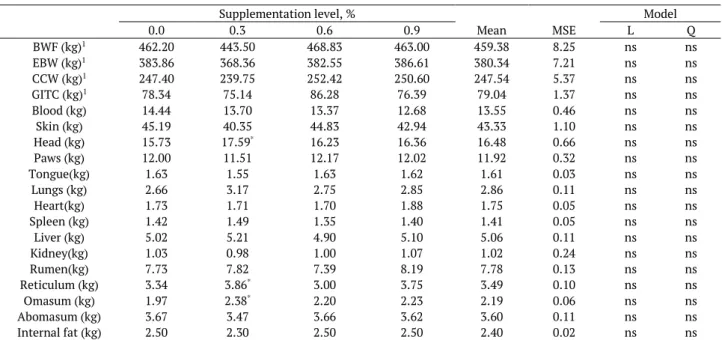
Body weight at fasting (BWF), empty body weight (EBW) and cold carcass weight (CCW) presented means of 459.4 kg, 380.6 kg and 247.5 kg respectively, and were not influenced by supplementation levels (Table 2). Zebu BWF has positive allometry, increasing proportionally more than the EBW (Jorge, Fontes, & Cervieri, 2003). Then, it can be inferred that the absence of effect (p > 0.5) of the supplementation level on the EBW explains the non-detection of weight differences in the carcasses of the animals.
Supplementation with concentrate in cattle grazing tropical pastures increases energy supply and improves weight gain (Tonello et al., 2011). If supplementation exceeds 0.2-0.3% of the animal's BW, there is a tendency for a greater reduction in forage consumption, and also deleterious effects on ruminal fermentation that may impair weight gain when supplementation reaches 0.8% BW (Silva et al., 2009). Thus, no effect (p > 0.05) of the supplementation level was observed, probably due to the substitute effect of the concentrate under pasture (reduction of pasture intake in Figure 1) and possible deleterious effects of the levels 0.6 and 0.9% under ruminal fermentation of supplemented cattle.
The gastrointestinal tract content was not influenced by supplementation levels (p > 0.05) and represented 17% of body weight at fasting of animals. It was expected that GITC would decrease with the increase of concentrate in the diet (Véras et al., 2001). However, there are complex interactions to consider in forage intake and the degree of satiety of the animals as revised by Carvalho et al. (2007). In addition, psychogenic factors may have modulated animal responses, resulting in the absence of supplementation effect on the GITC weight.
Blood, skin, head and paws corresponded to 3.5; 17.4; 4.3 and 3.1% EBW, respectively, and their weights were not influenced (p > 0.05) by supplementation levels. Leg + head + skin strongly influences carcass yield (Backes et al., 2006). In the present study, this group represented 24.8% of the EBW of the animals, a very high value when compared to that observed Backes et al. (2010) which was 17.6% for castrated males (Indubrasil).
Figure 1. Total dry matter intake during dry season (TDMId), dry matter intake of the pasture (DMIp) and total dry matter intake during rainy season
The head weight of animals fed 0.3% supplementation differed (p < 0.05), by Dunett's test, from cattle fed only mineral mix (0% supplement). Cattle present centripetal growth, in which the extremities grow at a higher rate than the center of the body (Berg & Walters, 1983). Therefore, it is probable that the head has grown at a faster rate, mediated by the associative pasture-concentrate effect, increasing its participation in the body weight of animals fed with 0.3% supplement. Despite this increase, head weight does not contribute to the elevation of EBW of animals supplemented with 0.3% BW.
The weight of lungs, heart, spleen, liver and kidneys which are priority organs of animal metabolism (Véras et al., 2001) did not differ (p > 0.05) between supplementation levels. In relation to empty body weight, liver was more representative, representing 1.33%, followed by heart (0.46%), spleen (0.37%) and kidneys (0.27%). These values were close to those referenced by Jorge, Fontes, Paulino, and Gomes Júnior (1999) for liver (1.38%), heart (0.37%) and spleen (0.27%) in zebu. Liver and spleen grow at a rate higher than EBW, while heart and lungs grow more slowly than EBW in zebu animals (Jorge & Fontes, 2001). Thus, the absence of supplementation level effect on EBW was reflected in the absence of effect on organ weights.
The sum of empty rumen, reticulum, omasum and abomasum weight was 4% of bovine EBW. Backes et al. (2006) and Backes et al. (2010) observed that pre-stomachs and abomasum represented about 3% EBW in zebu animals.
Table 2. Body weight and body weight components of castrated Nellore cattle grazing on Urochloa brizantha submitted to increasing levels of concentrate supplementation.
Supplementation level, % Model
0.0 0.3 0.6 0.9 Mean MSE L Q
BWF (kg)1 462.20 443.50 468.83 463.00 459.38 8.25 ns ns
EBW (kg)1 383.86 368.36 382.55 386.61 380.34 7.21 ns ns
CCW (kg)1 247.40 239.75 252.42 250.60 247.54 5.37 ns ns
GITC (kg)1 78.34 75.14 86.28 76.39 79.04 1.37 ns ns
Blood (kg) 14.44 13.70 13.37 12.68 13.55 0.46 ns ns
Skin (kg) 45.19 40.35 44.83 42.94 43.33 1.10 ns ns
Head (kg) 15.73 17.59* 16.23 16.36 16.48 0.66 ns ns
Paws (kg) 12.00 11.51 12.17 12.02 11.92 0.32 ns ns
Tongue(kg) 1.63 1.55 1.63 1.62 1.61 0.03 ns ns
Lungs (kg) 2.66 3.17 2.75 2.85 2.86 0.11 ns ns
Heart(kg) 1.73 1.71 1.70 1.88 1.75 0.05 ns ns
Spleen (kg) 1.42 1.49 1.35 1.40 1.41 0.05 ns ns
Liver (kg) 5.02 5.21 4.90 5.10 5.06 0.11 ns ns
Kidney(kg) 1.03 0.98 1.00 1.07 1.02 0.24 ns ns
Rumen(kg) 7.73 7.82 7.39 8.19 7.78 0.13 ns ns
Reticulum (kg) 3.34 3.86* 3.00 3.75 3.49 0.10 ns ns
Omasum (kg) 1.97 2.38* 2.20 2.23 2.19 0.06 ns ns
Abomasum (kg) 3.67 3.47 3.66 3.62 3.60 0.11 ns ns
Internal fat (kg) 2.50 2.30 2.50 2.50 2.40 0.02 ns ns
1Body weight at fasting (BWF); Empty body weight (EBW); Cold carcass weight (CCW); Gastrointestinal tract content (GITC). Means followed by * differ among each other by Dunett’s test at 5%.
Table 3. Empty body weight gain and gain of body weight components of Nellore cattle grazing on Urochloa brizantha submitted to increasing levels of supplementation.
Supplementation level. % Model
0.0 0.3 0.6 0.9 Média EPM L Q
EBWG (kg) 78.79 63.39 77.48 81.54 75.27 4.81 ns ns
CCWG (kg) 50.60 42.95 55.62 53.80 50.71 3.21 ns ns
BloodG(kg) 4.49 3.75 4.42 2.73 9.79 0.41 ns ns
SkinG(kg) 11.66 6.82 11.30 9.41 11.40 0.87 ns ns
LungsG(kg) 0.45 0.44 0.43 0.60 0.48 0.03 ns ns
HeartG(kg) 0.55 0.62 0.48 0.53 0.54 0.02 ns ns
SpleenG(kg) 0.93 1.13 0.80 1.01 0.96 0.09 ns ns
KidneyG(kg) 0.50 0.44 0.49 0.49 0.47 0.01 ns ns
AbomasumG(kg) 1.24 1.03 1.22 1.19 1.17 0.05 ns ns
Internal fatG(kg) 2.10 1.57 1.79 2.40 1.96 0.22 ns ns
1Empty body weight gain (EBWG); Cold carcass weight gain (CCWG); Gastrointestinal tract content (GITC). Means followed by * differ among each other by
Reticulum and omasum weight, at 0.3% supplement level, differed from the treatment in which the animals received only mineral mix (0% supplement). The supplement probably increased DMI, especially during the dry season and this effect generated heavier reticulum and omasum in the treatment with 0.3% supplementation. Véras et al. (2001) found a quadratic effect of the concentrate level on rumen-reticulum (kg) and omasum (%) weight.
Increasing levels of supplementation did not influence gains of carcass or non-carcass components (Table 3). Carcass and non-carcass gain rates are similar and increase with increasing body weight. As no effect of supplementation on the EBW was verified, the gains of the components of EBW were not influenced either.
The supplementation with concentrate increases the weight of non-carcass components, mainly the internal fat (Véras et al., 2001). It was expected that steers with a higher level of supplementation presented greater fat gain as they were castrated. This fact did not occur, probably because the age of the animals still does not correspond to maturity.
Conclusion
The increasing in energetic-protein supplementation level for Nellore steers on Urochloa brizantha
pasture does not affect carcass and non-carcass components.
References
Backes, A. A., Paulino, M. F., Alves, D. D., Rennó, L. N., Valadares Filho, S. C., & Lana, R. d. P. (2006). Tamanho relativo dos órgãos internos e do trato gastrintestinal de bovinos Zebu e mestiços leiteiros em sistema de recria. Ciência Rural, 36(2), 594-598. doi: 10.1590/S0103-84782006000200036.
Backes, A. A., Paulino, M. F., Alves, D. D., & Valadares Filho, S. C. (2010). Tamanho relativo dos órgãos internos e do trato gastrintestinal de bovinos indubrasil e mestiços leiteiros em fase de engorda. Ciência Rural, 40(7), 1160-1165. doi: 10.1590/S0103-84782010005000071.
Berg, R. T., & Walters, L. E. (1983). The meat animal: Changes and challenges. Journal of Animal Science, 57(Supplement 2), 133-146. doi: 10.2527/animalsci1983.57Supplement_2133x.
Burns, J. C., Pond, K. R., & Fisher, D. S. (1994). Measurement of forage intake. In G. C. Fahey Junior (Ed.),
Forage quality, evaluation and utilization. Madison, WI: America Society of Agronomy.
Carvalho, P. C. F., Kozloski, G. V., Ribeiro Filho, H. M. N., Reffatti, M. V., Genro, T. C. M., & Euclides, V. P. B. (2007). Avanços metodológicos na determinação do consumo de ruminantes em pastejo. Revista
Brasileira de Zootecnia, 36(1), 151-170. doi: 10.1590/S1516-35982007001000016.
Ferraz, J. B. S., & Felício, P. E. (2010). Production systems – An example from Brazil. Meat Science, 84(2), 238-243. doi: 10.1016/j.meatsci.2009.06.006.
Jorge, A. M., & Fontes, C. A. A. (2001). Desenvolvimento relativo das partes do corpo de zebuínos de quatro raças. Ciência Rural, 31(5), 857-861. doi: 10.1590/S0103-84782001000500019.
Jorge, A. M., Fontes, C. A. A., & Cervieri, R. C. (2003). Crescimento relativo e composição do ganho de tecidos da carcaça de zebuínos de quatro raças. Revista Brasileira de Zootecnia, 32(4), 986-991. doi: 10.1590/S1516-35982003000400026.
Jorge, A. M., Fontes, C. A. A., Paulino, M. F., & Gomes Júnior, P. (1999). Tamanho relativo dos órgãos internos de zebuínos sob alimentação restrita e ad libitum. Revista Brasileira de Zootecnia, 28(2), 374-380. doi: 10.1590/S1516-35981999000200022.
Silva, F. F., Sá, J. F., Schio, A. R., Ítavo, L. C. V., Silva, R. R., & Mateus, R. G. (2009). Suplementação a pasto: disponibilidade e qualidade x níveis de suplementação x desempenho. Revista Brasileira de Zootecnia, 38(1), 371-389. doi: 10.1590/S1516-35982009001300037.
Silva, D. J., & Queiroz, A. C. (2002). Análise de alimentos - métodos químicos e biológicos (2a ed.). Viçosa, MG: Universidade Federal de Viçosa.
Toldrá, F., Mora, L., & Reig, M. (2016). New insights into meat by-product utilization. Meat Science, 120, 54-59. doi: 0.1016/j.meatsci.2016.04.021.
Tonello, C. L., Branco, A. F., Tsutsumi, C. Y., Ribeiro, L. B., Coneglian, S. M., & Castañeda, R. D. (2011). Suplementação e desempenho de bovinos de corte em pastagens: tipo de forragem. Acta Scientiarum. Animal Sciences, 33(2), 199-205. doi: 10.4025/actascianimsci.v33i28130.
Vaz, F. N., Restle, J., Pádua, J. T., Fonseca, C. A., Pascoal, L. L., & Severo, M. M. (2015). Componentes não carcaça de bovinos nelore abatidos com diferentes pesos. Ciência Animal Brasileira, 16(3), 313-323. Doi: 10.1590/1089-6891v16i318694.
Véras, A. S. C., Valadares Filho, S. C., Silva, J. F. C., Paulino, M. F., Cecon, P. R., Valadares, R. F. D., ... Fontes, C. M. S. (2001). Efeito do nível de concentrado sobre o peso dos órgãos internos e do conteúdo gastrintestinal de bovinos Nelore não-castrados. Revista Brasileira de Zootecnia, 30(3), 1120-1126. doi: 10.1590/S1516-35982001000400029.