1
NAA and STS effects on bract survival time, carbohydrate content,
1
respiration rate and carbohydrate balance of potted Bougainvillea
2
spectabilis Willd.
34
Custódia M. L. Gago, José A. Monteiro* 5
6
F.C.T., University of Algarve, 8005-139 Faro, Portugal 7
8
*Corresponding author. Tel.: +351-289-800-966; fax: +351-289-818-419; e-mail
9 address: [email protected] 10 11 12 Abstract 13 14
The aims of this work were to deepen the knowledge on the physiology of bract
15
abscission in Bougainvillea spectabilis ‘Killie Campbell’ plants, in what relates to
16
respiration and carbon balance. Using the effects induced by Silver Thiosulphate (STS)
17
and/or Naphtalene Acetic Acid (NAA, at high concentration: 500 mg.l-1) on bract
18
abscission under interior conditions, the relationship between bract survival time
19
(longevity) and, respiration rate or carbohydrate levels, was investigated.
20
Treatments that included NAA were the ones that reduced significantly bract
21
abscission. Unexpectedly, the higher the levels of bract soluble and total carbohydrates,
22
measured at day 10 postproduction (PP), the higher the abscission of bracts. These
23
results show, for the first time, that abscission can positively correlate with non
24
structural carbohydrates levels in the organ that abscise.
25
*Manuscript
2
Bract respiration rate was significantly affected by treatment and postproduction
26
day (PP). Treatments that had higher bract respiration rates (WATER and STS) also had
27
higher levels of non structural carbohydrates in the bracts. Bract respiration rate
28
decreased from day 10 to day 17 PP by approximately 50% (on average of all
29
treatments) and was negatively correlated with bract survival time.
30
In the carbon balance per gram of bract dry weight, the treatments WATER and
31
STS, showed the largest decrease in the content of total carbohydrates and had the
32
highest consumption of carbohydrates through respiration. So, these were the bracts that
33
needed to import a higher amount of carbohydrates per gram of bract dry weight. In the
34
carbon balance for the whole mass of bracts and adjacent stems in an average plant, the
35
treatments WATER and STS continued to allow for the largest decreases in total
36
carbohydrate during postproduction. However, and contradicting the results per gram of
37
bract dry weight, the highest total consumption of carbohydrates by respiration was
38
obtained for the NAA and STS+NAA treatments. It makes sense that bracts that last
39
longer have lower individual carbon consumption while, at the plant level, the increased
40
number of remaining bracts causes a higher overall expenditure.
41
Respiration rate has been used as an indicator of flower longevity, this correlation
42
is here extended for the flower+bract system. Plants that had higher bract respiration
43
rates, most probably, had a higher flow of carbohydrates through the bracts (and
44
flowers), which, in the end, was sensed as a higher carbohydrate level.
45 46
Keywords: Ornamentals; Postproduction; Postharvest; Auxin; Longevity; Keeping
47 quality. 48 49 1. Introduction 50 51
3
Flower/bract drop in potted plants is a major problem leading to losses of quality
52
and, as consequence, loss of market value. The ability to control/predict flower/bract
53
abscission and enhance longevity of floricultural product is of great importance.
54
The abscission process is controlled by both external environmental conditions
55
and internal (genetically controlled development time and, energy availability)
56
mechanisms (Ascough et al., 2005). The respiration rate is considered a good indicator
57
of longevity, correlating negatively with organ longevity (Reid, 1985). In potted
58
chrysanthemum, cultivars with higher flower respiration rate during postproduction had
59
shorter flower longevities under interior conditions (Monteiro, 1991). Similar results
60
were obtained in potted miniature roses in the summer experiments but, the opposite
61
happened in autumn/winter: flowers with higher respiration rates had greater
62
longevities. It seems that environmental conditions imposed stringent restrictions on the
63
respiration of the flowers and, on the energy available for its development, the limiting
64
factor to their longevity (Monteiro, 1993). A low maintenance respiration may be
65
responsible for higher levels of efficiency at low irradiance, as was observed in
66
Brassaia actinophylla Endl., Nephrolepis exaltata (L.) Schott ‘Bostoniensis’ and
67
Epipremnum aureum (Linden & Andre) (Pass and Hartley, 1979). Respiration rate may
68
also sense the speed of genetically controlled development both in plants (Pearl, 1928)
69
and in animals (Adelman et al., 1988).
70
In the postproduction of flowering potted plants the main stress is low irradiance,
71
either acting through hormone mediated responses or, directly, through negative net
72
photosynthesis. Also, it is known that considerable amounts of carbohydrates are
73
necessary for the development/maintenance of the reproductive organs (Ho and Nichols,
74
1977; van Meeteren et al., 1995; Waithaka et al., 2001). The levels existing in these
75
organs as well as the amounts that can be obtained from other plant parts (or exogenous
4
supply) seem to affect flower/bract longevity.
77
Several positive correlations have been established between carbohydrates levels
78
and flower longevity, as in chrysanthemum (Monteiro, 1991), Christmas begonia (Fjeld,
79
1992) and asiatic hybrid lily tepals (detached flowers) (van der Meulen-Muisers et al.,
80
2001). Lilium L. (‘Bright Beauty’, ‘Fashion’ and ‘Orlito’) flower longevity relies on the
81
carbohydrates translocated from other plant parts (van der Meulen-Muisers et al., 2001).
82
An exogenous supply of carbohydrates delays abscission, or flower wilting, prolonging
83
the longevity of some cut flowers like Strelitzia reginae Ait. (Halevy et al., 1978),
84
carnation (Halevy and Mayak, 1979), Delphinium hybrid ‘Bellamosum’ (Ichimura et
85
al., 2000) and Alstroemeria ´Rebecca’ (Chanasut et al., 2003). The same effect was
86
described for potted miniature rose (Rosa hybrida ‘Meijikatar’) flowers (Monteiro et al.,
87
2002). However, there are species in which the exogenous supply of carbohydrates does
88
not extend the life of flowers like hybrid Limonium (Ichimura, 1998), Celosia argentea
89
L. ‘Forest Fire’ and Helianthus maximilianii Schräd (Redman et al., 2002).
90
Ethylene and auxins have been involved in the abscission process. Two abscission
91
processes of floral organs have been shown: one ethylene dependent and the other
92
ethylene independent (Patterson and Bleecker, 2004). Ethylene seems to enhance
93
respiration rate in flowers, and commonly hastens the process of senescence and/or
94
abscission (Woltering, 1987; Borochov and Woodson, 1989). STS acts as an ethylene
95
inhibitor (sensing and action) (Veen, 1979; Reid, 1985) thus, counteracting ethylene
96
action.
97
The role of auxins seems less clear: they affect ethylene sensitivity and production
98
(Beyer and Morgan, 1971; McManus et al., 1998; Brown, 1997) and carbohydrate
99
partitioning (Zhao and Oosterhuis, 1998; Nahar and Ikeda, 2002). In tomato, auxin may
100
be responsible for a higher carbohydrate supply to early developing flower tissue (Pröls,
5
2004). Auxin direct effect on respiration is rarely mentioned. Sacalis and Nichols
102
(1980) showed that the effect of the auxin 2,4-D on the respiration rate of carnation
103
flower, depended on the concentration applied. Compared to water controls, CO2
104
production was accelerated by uptakeof 4, 20 and 100 mg of 2,4-D.l-1. However, 500
105
mg 2,4-D.l-1 suppressed CO2 and ethylene evolution and retarded senescence. In small
106
fruits, some studies involving auxin application (15, 25 or 50 mg NAA.l-1), have shown
107
a reduction in dark respiration in the tissues of developing apples (Stopar et al., 2001)
108
and medlar (Amorós et al., 2004). In the whole plant level, depending on the dose and
109
time of application, auxins can either induce abscission or counteract it in citrus fruits
110
(Greenberg et al., 2006; Gupta and Kaur, 2007; Yuan and Carbaugh, 2007).
111
In young excised bougainvillea (‘Purple Flower’ and ´Taipei Red’) bracts, Chang
112
and Chen (2001) reported ethylene production. Also, Xin and Lin (2005) showed a
113
climacteric ethylene production pattern in B. glabra and B. spectabilis during flower
114
opening and senescence. However, for B. spectabilis ‘Killie Campbell’, in the absence
115
of exogenous ethylene, STS alone is not very effective on counteracting bract abscission
116
(Gago et al., 2001; Meir et al., 2007) while NAA (500 ppm), at end of production,
117
substantially reduces bract abscission under interior conditions. In the presence of
118
exogenous ethylene, both STS and NAA are needed to control effectively bract
119
abscission (Gago et al., 2001). The auxin 2, 4, 5-TP, was shown to have the same effect
120
as NAA (Meir et al., 2007).
121
Thus, it seems probable that in bougainvillea under interior conditions, the
122
abscission process can be related to respiration rate and/or carbohydrate levels.
123
Regardless of the primary control of bract abscission (ethylene dependent or
124
independent), the knowledge of how it proceeds may help us devise strategies for its
125
control. The objective of this work is to deepen the knowledge on the physiology of
6
bougainvillea bract abscission, in what relates to respiration and carbon balance. Using
127
the variability induced by STS and/or NAA treatments, the respiration and carbohydrate
128
levels were assessed in several plant parts, to try to establish correlations with bract
129
abscission and to compute some simplified carbohydrate balances.
130 131
2. Materials and methods 132
133
2.1. General procedures 134
135
Two postproduction experiments with Bougainvillea spectabilis ‘Killie Campbell’
136
plants were done (beginning at: June 20, 2002 - experiment one, and August 25, 2003 -
137
experiment two), with completely randomized designs and five replications per
138
treatment.
139
Plants were grown in plastic greenhouses, using the normal procedures, at the
140
“Horto” of University of Algarve, Faro, until the beginning of the experiments. The
141
only environmental control provided was greenhouse ventilation when temperature
142
exceeded 24 ºC. Temperature was monitored hourly with a temperature logger
143
(Testostor 175, Testo GmbH & Co., Lenzkirch, Germany). On both experiments, at the
144
beginning of the plant production period, i.e. the winter months (December/January) the
145
minimum temperature went down to 6ºC and the maximum temperature rose to 21ºC.
146
At the end of the production period (June/August) temperature ranged from a minimum
147
of 20ºC to a maximum of 35ºC.
148
At end of production, plants had approximately 60 cm height, at least ten bracts
149
completely developed and, at least one of them with an open flower (at anthesis). The
150
term bract, unless mentioned otherwise, refers to the bracts + flowers, i.e. an
151
inflorescence with 3 flowers and 3 bracts.
7
Treatments with STS were initiated during production, starting when bracts
153
became visible, and were applied every 15 days up to end of production. They consisted
154
of a 160 mg.l-1 spray of STS (2 g.l-1 of Argylene®; Argylene Biochem ApS,
155
Frederiksberg, Denmark). Treatments with NAA consisted of a single spray, at the end
156
of production (day 0 postproduction), using 500 mg.l-1 of NAA (30.30 g.l-1 of
157
Agritone® (0.45%NAA+1.2%NAA-amide; Etisa, Barcelona, Espanha)). Both types of
158
spray were done to wet uniformly the leaves and bracts, up to start of dripping.
159
Treatments performed were: a) STS, b) NAA, c) STS+NAA and d) WATER.
160
Once dry from the sprays, plants were sleeved, boxed in open card boxes - 10
161
plants per 30×52×50cm (height X length X width) box, and kept for three days under
162
simulated transport conditions (17±1ºC, no light).
163
At day 3 postproduction (PP) plants were unboxed, removed from the sleeves and
164
placed under interior conditions [21±1ºC and 12 mmol.m-2.s-1of cool white fluorescent
165
light (Philips,TLD, 58/830) 12 hr a day].
166
At end of production (day 0 PP), end of simulated shipping (day 3 PP) and, twice
167
a week, through the remaining of postproduction, the number of bracts remaining in the
168
plants was assessed (all bracts stages)
169 170 171 2.2. Respiration measurement 172 173
At day 10 and day 17 PP, the measurement of dark respiration was made
174
separately for two plant parts: a) bracts: all the bracts and the small stems that support
175
them on each plant (TBS), b) leaves: all the leaves existing in the 20 cm of stem below
176
the bract zone and the respective small stems (TLS).
8
CO2-exchange measurements were made in a closed system, using an IRGA
178
(model CI-301 (CI-301PS) CID Inc., Vancouver, WA 98682 USA) equipped with a 4
179
liters chamber. Attached bracts or leaves were conveniently enclosed in the chamber
180
and the chamber was flushed with outside air to bring the CO2 levels to approximately
181
360 ppm. The system was then changed to a closed circuit and the measurements done
182
in absolute mode. Ten consecutive measurements at 25 s intervals were taken for the
183
rate of CO2 increment, and the average of these measurements recorded.
184
Bracts, stems adjacent to the bracts, leaves and stems adjacent to the leaves, were
185
harvested separately, dried and their dry weight (DW) assessed. Bract + adjacent stem
186
respiration rate (BS) and leaf + adjacent stem respiration rate (LS) were expressed per
187
gram of bract and leaf dry weight, respectively.
188 189
2.3. Carbohydrate assessment 190
191
At days 10 and 17 PP, after 4 hours of exposure to light, samples for bracts, leaves
192
and stems were taken separately. Samples consisted of: a) bracts: all the bracts existing
193
in the plant, b) leaves: all the leaves existing in the 20 cm of stem below the bract zone,
194
c) stems: the 20 cm of stem below the bract zone, where the leaves were previously
195
harvested.
196
Some plants sprayed with WATER and STS lost all the bracts before day 10 and
197
day 17 PP, respectively, reducing the number of replications.
198
All fresh plant material was weighed and immediately frozen in liquid nitrogen,
199
being then dried in a ventilated oven at 80ºC. When completely dry, they were ground
200
in a mill (MF 10 basic, IKA ®, Werke) and then re-dried in the same oven for a short
201
period. After proper homogenization, a 0.1g sub-sample for each plant part was used for
9
carbohydrate extraction. Total non structural carbohydrates were assessed (soluble
203
sugars and starch separately) using the phenol-sulphuric method (Dubois et al., 1956)
204
following the procedure described by Stamps (1984).
205 206 2.4. Calculations 207 2.4.1. Bract respiration 208 209
Due to the way respiration was measured, it was not possible to separate, directly,
210
bract respiration, from respiration of the adjacent stem. To allow for this separation, a
211
linear model was used:
212
TBS=a+Bdw×br+Sdw×sr+t×DPP
213
TBS – total respiration in bracts + adjacent stems (mg CO2.h-1)
214
a - constant 215
Bdw – bract dry weight (g)
216
br – bract respiration (mg CO2.g-1 bract dry weight.h-1)
217
Sdw – stem dry weight (g)
218
sr – stem respiration (mg CO2.g-1 stem dry weight.h-1)
219
t – change in respiration rate per day (mg CO2.day-1.h-1)
220
DPP – day postproduction for the measurement
221 222
2.4.2. Carbon balance 223
224
A simplified carbon balance was computed using respiration and carbohydrate
225
data. For that purpose it was assumed: (1) that the plants, or their organs, did not
226
photosynthesize (either in the complete dark or with the low light intensities of 12
10
μmol.m-2.s-1) during PP (no published information exists on bougainvillea
228
photosynthesis at low irradiances) and, (2) that respiration rate was constant through the
229
whole 24 hr period (i.e. during the dark or the low light intensity period). Mean daily
230
respiration was considered as the average of day 10 and day 17 PP.
231
For the different treatments, three different types of carbon balance were calculated,
232
between day 10 and day 17 PP, as shown in Table 1.
233 234
2.5. Statistical analysis
235
Bract abscission data was analyzed using survival analysis (Kleinbaum and Klein,
236
1995).The survival time started at the beginning of the postproduction period and ended
237
when bract abscission was observed. An observation was censored when the bract was
238
still on the plant by the end of the experiment. Survival times were analyzed using the
239
Kaplan-Meier technique (Kleinbaum and Klein, 1995), producing the empirical survival
240
curves for the four postproduction treatments. The difference in survival times between
241
the treatments were tested with the log-rank test. A disadvantage of this method is that
242
the effects of the explanatory factors (covariates) cannot be quantified (Wubs et al.,
243
2007).
244
For carbohydrate levels and respiration rate a 3-way factorial was used
245
(experiment × day PP × treatment). When needed, means were compared using
246
Duncan’s New Multiple Range Test at P=0.05. Linear regressions were also run when
247
appropriate. Softwares used for the statistical treatments were SAS (SAS Institute
248
Inc.,Cary, NC,USA) and SPSS (SPSS Inc., Chicago, USA).
249 250 251
3. Results 252
11 253
3.1. Bracts survival time 254
255
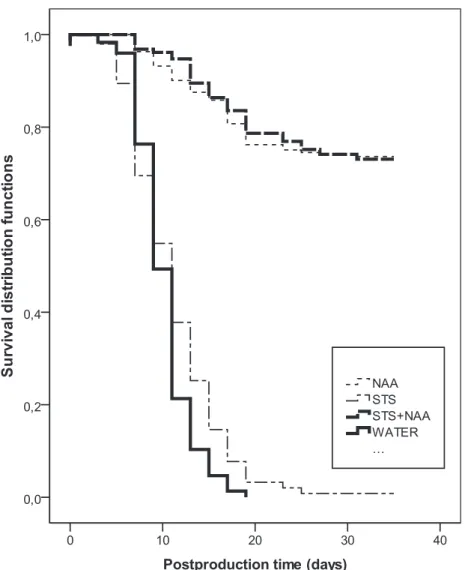
Plants sprayed with NAA and STS+NAA did not differ in their bracts’ survival
256
time (29.57 and 29.85 days, respectively; at P=0.997), but had a significantly higher
257
survival time than bracts treated with WATER or STS (at P<0.0001). Bracts sprayed
258
with STS survived longer (11.18 days) than bracts sprayed with WATER (10.11 days;
259
at P<0.0001). Bracts treated with WATER and STS abscised more intensively in the
260
first 11 days of postproduction period. In that period, plants treated with STS and
261
WATER had similar fractions of surviving bracts. At day 15 PP, plants treated with
262
WATER or STS had less than 5% or 15% of surviving bracts, respectively. On the same
263
PP day, plants sprayed with NAA or STS+NAA had more than 80% of surviving bracts
264 (Fig. 1). 265 266 267 3.2. Carbohydrates 268 269 Bracts 270
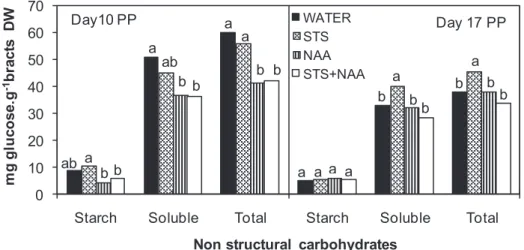
Bract carbohydrate levels (starch, soluble and total carbohydrates) were significantly
271
affected by PP treatments (at P=0.022, P=0.0001 and P=0.0001, respectively) and the
272
PP day (at P=0.0431, P=0.0001 and P=0.0001, respectively). The levels of soluble and
273
total carbohydrates were also affected by experiment (at P=0.0210 and P=0.0172,
274
respectively), with the higher values in the 2003 experiment. Since bract starch and total
275
carbohydrates presented an interaction between treatment and PP day, data are
276
presented by treatment and PP day for all types of carbohydrates assessed (Fig. 2). On
12
day 10 PP, bracts sprayed with STS and WATER had the highest levels of total
278
carbohydrates, while the differences among treatments in soluble carbohydrates and
279
starch were less marked. At day 17 PP, STS treated bracts still had the highest soluble
280
and total carbohydrates levels, but WATER treated bracts had levels similar to the
281
bracts sprayed with NAA or STS+NAA. At this time bract starch content was similar in
282
all treatments. Between days 10 and 17 PP, bracts sprayed with WATER and
283
STS+NAA reduced the content of soluble (at P=0.0123 and P=0.0041, respectively)
284
and total carbohydrates (at P=0.0083 and P=0.0025, respectively) and, only bracts
285
treated with STS reduced the level of starch (at P=0.0151).
286
The higher the levels of soluble and total carbohydrates (Fig. 3), measured at day
287
10 PP, the shorter the bract survival time. However, the higher the percentage of starch
288
in the bracts, measured at day 17 PP, the longer the bracts survive (Fig. 3).
289 290
Leaves
291
Leaf soluble and total carbohydrate levels were significantly affected by an
292
interaction between treatments and experiments: in 2002, no differences were found
293
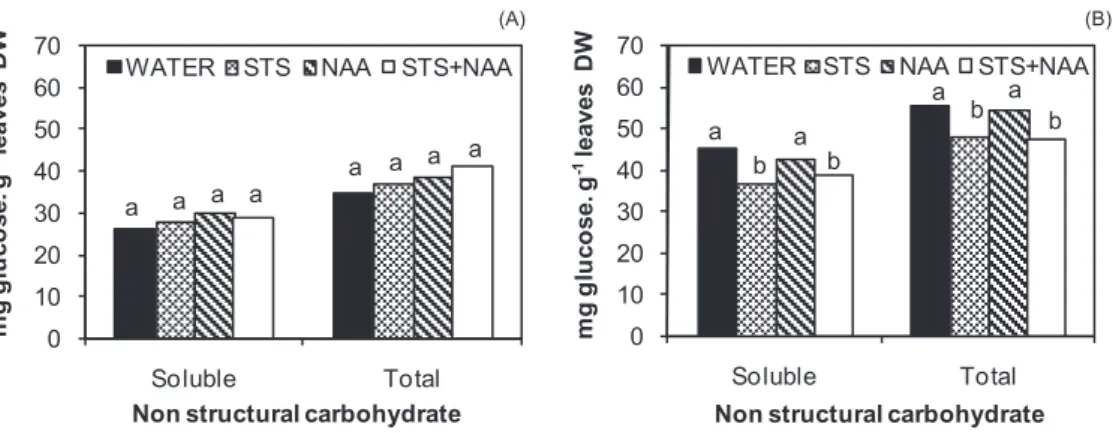
among the levels of carbohydrates (soluble and total) of the different treatments (Fig. 4
294
A), while in 2003, plants sprayed with WATER and NAA presented higher levels of
295
leaf soluble and total carbohydrates (Fig. 4 B).
296
Experiment affected the levels of soluble sugars (at P=0.001), total non structural
297
carbohydrates (at P=0.001) and percentage of starch (at P=0.0198).
298
Day of carbohydrate assessment (i.e. day PP) affected the levels of starch, soluble
299
carbohydrates and starch percentage on leaves, independently from treatment and
300
experiment. The starch content at day 10 PP (17 mg glucose.g-1DW) was higher than at
301
day 17 PP (9 mg glucose.g-1DW). The reverse happened with the soluble carbohydrates
13
having 33 mg glucose.g-1DW, at day 10 PP, and 36 mg glucose.g-1DW, at day 17 PP.
303
Total carbohydrates did not differ between days 10 and 17 PP, but the percentage of
304
starch in leaves decreased from 25% to 20% (at P=0,0119). No effect of treatment or
305
experiment could be found in the levels of leaf starch. Also, the percentage of starch in
306
leaves was not affected by postproduction treatment but was affected by the experiment.
307
Overall, the percentage of starch (average of the 4 postproduction treatments) was
308
higher in the plants of the 2002 experiment (24.4%) than in plants of the 2003
309
experiment (20.64%). No correlations were found between the levels of leaf non
310
structural carbohydrates and bract abscission.
311 312 3.3. Respiration 313 3.3.1. Bracts 314 315
Bract respiration rate (BS) was significantly affected by treatment and day PP (at
316
P=0.0074 and P=0.0011, respectively). Plants sprayed with WATER presented the
317
highest bract respiration rate, followed by intermediate values on plants treated with
318
STS and STS+NAA and, the lowest respiration rates occurred on bracts sprayed with
319
NAA (Fig. 5 A).
320
Respiration rate decreased from day 10 to day 17 PP (Fig. 5 B) by approximately
321
50% (on average of all treatments).
322 323
Separation of bract from stem respiration
324
At all postproduction treatments TBS was reasonably explained by bract and stem
325
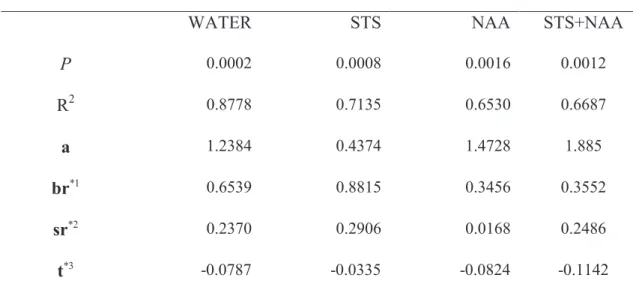
dry weights and by postproduction day (Table 2). Estimated bract respiration rate (br)
326
presented slightly lower values in plants sprayed with NAA. Also, stem respiration rate
14
(sr) presented lower values in plants treated with NAA but, these values were very close
328
to the values computed for WATER, STS and STS+NAA treatments. In all
329
postproduction treatments sr was lower than br: less than 50% in WATER, NAA and
330
STS. Only in STS+NAA, sr was about 70% of br (Table 2).
331
When compared to the WATER control, STS alone lowered the model constant
332
(a) and, the treatments with NAA (with or without STS) presented the highest values.
333
Similar results were obtained for t, the decrease of respiration rate by day PP.
334 335 336
Relationship between bract respiration and bract survival time (longevity)
337
Bract respiration, as measured together with the adjacent stems (BS) on days 10
338
and 17 PP, or estimated (br), negatively correlated with bract longevity. However, it
339
was BS at day 17 PP, who showed the best correlation (Fig. 6).
340 341
Relationship between bract respiration and carbohydrate levels
342
Using the carbohydrate data and pooling the data for the two experiments, and for
343
days 10 and 17 PP, the treatments that had a higher estimated bract respiration rate (br)
344
were those with more non structural carbohydrates in the bracts: starch, soluble and
345
total (Fig. 7).
346 347
Bract carbon balance
348
Considering the carbon balance per gram of bract dry weight (br), the treatments
349
WATER and STS, showed the largest decrease in the content of total carbohydrates and
350
had the highest consumption of carbohydrates through respiration (Table 3). So, these
351
were the bracts that imported an higher amount of carbohydrates per gram of dry
15
weight. Plants treated with NAA or STS+NAA presented similar values of br, but the
353
decrease in total carbohydrates was higher in the STS+NAA treatment.
354 355
In the carbon balance for the whole mass of bracts and adjacent stems in an
356
average plant (Table 4), the treatments WATER and STS continued to allow for the
357
largest decreases in total carbohydrate. However, and contradicting the results per gram
358
of bract DW, the highest total consumption of carbohydrates by respiration appeared in
359
the NAA and STS+NAA treatments. Most probably, the more bracts remained in a
360
plant, the greater the expenditure of carbohydrates. Indeed, between days 10 and 17 PP,
361
in the plants treated with WATER and STS, bract dry weight was only 40% of the
362
whole mass of bracts and adjacent stems, whereas in the NAA and STS+NAA
363
treatments, bracts represented about 60%.
364 365
3.3.2. Leaf 366
367
The respiration rate in leaves + adjacent stem (LS), in the dark, was not affected
368
by postproduction treatment, but was significantly influenced by experiment (at
369
P=0.0025) and by postproduction day (at P=0.0107), and there was an interaction
370
between these two effects (at P=0.0503).
371
All treatments decreased their LS from day 10 to day 17 PP (data not shown). No
372
correlations could be established between the abscission of leaves (data not shown) and
373
their respiration rate. Variability was considerable. Also, leaf respiration was measured
374
in the upper part of the plant (the 20 cm of stem below the area of bracts), while the
375
leaves that fell the most, were in the lower part.
16
In the 2003 experiment, at day 17 PP, a higher LS, was related to a lower level of
377
leaf total carbohydrates, on that day [LS = 2.197 – 0.0309 × total carbohydrates (mg
378
glucose.g-1 leaf DW); R2=0.893 e P=0.0552]. However, it was not possible to establish
379
this correlation for 2002.
380
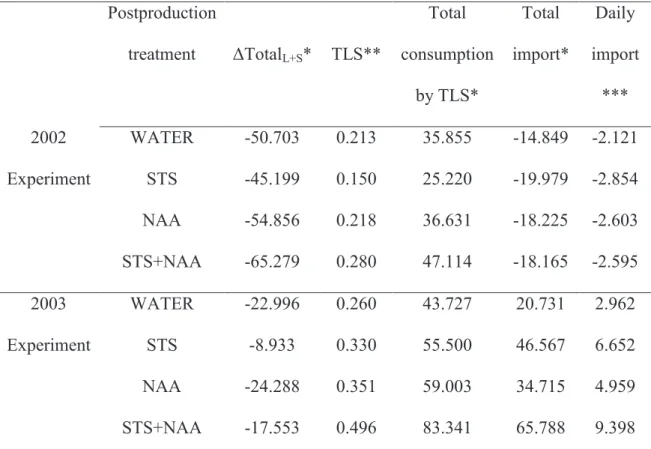
The carbon balance of the whole mass of leaves assessed and their adjacent stems
381
was performed (Table 5) for the two experiments. More than differences among
382
treatments there were differences between experiments (data not shown). In 2002, the
383
decrease in the content of total carbohydrates, from day 10 to day 17 PP was high and
384
superior to the respiration needs, leading to some export. In 2003, comparing with 2002,
385
there was a higher consumption by respiration, and a smaller decrease in the
386
carbohydrate content of the leaves, leading to a computed import of carbohydrates.
387
These results suggest that the different treatments did not influence substantially
388
the carbon balance in the leaves, and may suggest that the plants in the two experiments
389
had different leaf age. Unfortunately, photosynthetic rates were not measured and it is
390
unknown if it had any role in the balance. Percent of dry weight of leaves in the total
391
weight of leaves and adjacent stems differed with experiment: 52% in 2002 and 30% in
392 2003. 393 394 395 4. Discussion 396 397
In this work, the pattern of bract abscission obtained by STS and/or NAA
398
treatments was similar to the results presented by Gago et al. (2001). Clearly the
399
treatments that prolong bract survival time or, what is the same, reduce bract abscission
400
(Fig.1) are the ones that include NAA.
17
In bougainvillea bracts, the content of soluble sugars was always much higher
402
than the starch content (Fig. 2), suggesting that these are places of transit or
403
consumption of carbohydrates. Previously, Zhao and Oosterhuis (2000) showed the
404
importance of cotton bracts in the adjustment of the transport of photoassimilates to the
405
flower parts. To determine whether bougainvillea bracts have or not a function on
406
carbohydrates supply to the flower, bract and flower carbohydrates should have been
407
quantified separately, which unfortunately was not done.
408
As it was expected, STS and/or NAA treatments induced variability in the
409
carbohydrate levels of several plant parts. It was possible to establish correlations
410
between bract abscission rate and carbohydrate levels in some plant parts (bracts and
411
stems (data not shown)), however, in an unexpected way. Bracts which showed higher
412
contents of soluble and total sugars, initially, were those that had the lowest longevity
413
(Fig. 3). These results differ from those presented so far in the literature, where
414
examples exist of positive correlations between the levels of flower non structural
415
carbohydrates and its longevity as well as of negative correlations between the
416
carbohydrate content of an organ and its abscission. Begonia inflorescences with higher
417
contents of sucrose and starch had greater longevities (Fjeld, 1992). The stress caused
418
by low light intensities (80% reduction in light level) influenced the photoassimilates
419
availability to flower/fruit development in pepper: cultivars with higher flower and/or
420
fruit abscission had lower content of non structural carbohydrates (Wien et al, 1989).
421
Bracts have intermediate characteristics between leaves and petals and little
422
research has been done on these plant organs. In this study, when referring to bracts,
423
flowers are also included, and it is unknown in bougainvillea, despite their abscission as
424
a whole, to what extent these two organs behave in a similar way. As far as
425
carbohydrate levels and abscission are concerned, these two organs may have different
18
physiologies, and the different dry weights or different carbohydrate levels, may mask
427
the individual effects. Nevertheless, whatever the prevalence is, these results show, for
428
the first time that longevity can negatively correlate with non structural carbohydrates
429
levels in the organ. However, bracts with higher percentages of starch, at day 17 PP, had
430
lower abscission rates (Fig. 3). An increased starch percentage may mean that there is
431
‘excess’ of carbohydrates (as of higher transit, higher import, and/or lower
432
consumption) in a sink organ as we assume bracts to be. An higher priority for storage,
433
is also possible in a source or storage organ.
434
The carbohydrates content may not be a reliable estimate of their availability: it
435
does not reflect the rate of utilization, the proportion that is not available or the rate of
436
import from other plant parts. An higher content of soluble sugars (or total
437
carbohydrates) may have different explanations such as: an higher rate of
438
import/production for a reduced or constant consumption; a constant rate of
439
import/production together with a lower consumption,... Nevertheless, a more active
440
metabolism, with an higher rate of consumption and an higher rate of
441
import/production, i.e. an higher flow of carbohydrates through the organ, may also be
442
sensed as an actual, higher content of carbohydrates.
443
Both bract and leaf respiration rate decreased, between days 10 and 17 PP. This
444
decline in respiration rate may be due to a lack of carbohydrates available or, a
445
reduction in metabolic activity. Decreases in respiration rate (decreased metabolic
446
activity) induced by low irradiance have been shown in leaves (Noguchi et al., 2001),
447
where this decrease is essential to maintain a positive (or less negative) balance of
448
carbohydrates. Inflorescence/flower respiration under interior conditions is also known
449
to decrease during postproduction, as it was reported for chrysanthemum (Monteiro,
450
1991). No previous information, specific for bracts under interior conditions, exists.
19
However, according to what is known for flowers and leaves, the decrease in bract
452
respiration rate was expected.
453
Bract respiration rate (br as estimated or BS as assessed) negatively correlated
454
with bract survival time. In general biology, it is common that species or organs with
455
higher respiratory rates have shorter longevities (Cevallos and Reid, 2000) and
456
respiration rate has been suggested as an indicator of flower longevity (Kuc and
457
Workman, 1964; Reid, 1985; Monteiro, 1991). Here, this correlation is extended for the
458
flower+bract system.
459
This study is consistent with previous works in which respiration rate is
460
negatively correlated with the longevity of the floral organs (Monteiro, 1991; Monteiro,
461
1993; Grossi et al., 2003). In the previous studies, the causes of variation that
462
influenced the respiratory rates were often the genetic differences (different cultivars),
463
treatments that directly affect the speed of chemical reactions (such as temperature), or
464
substances such as STS that prevent ethylene action. Here, for the first time, it is shown
465
that the effect of NAA, in the maintenance of bracts of plants kept at low irradiance, is
466
accompanied by a decrease in the respiratory rate per gram of brac. This type of
467
response was previously found in apple (Stopar et al., 2001) and medlar growing fruits
468
(Amorós et al., 2004).
469
The meaning of the positive correlation between bract respiration rate and
470
carbohydrate level in the bracts is not so clear. We expected carbohydrate levels to be
471
lower in the treatments where their consumption was higher and the opposite happened.
472
It is possible that, if carbohydrate availability was a limiting factor, higher amounts of
473
available carbohydrates in the bracts allowed for higher respiration rates. However, it
474
does not make much sense that increased carbohydrate availability (although inducing
475
increased respiration rate) goes together with shorter bract longevity. In potted
20
miniature roses (Monteiro et al., 2001), when a lack of carbohydrate availability existed,
477
flower longevity decreased and if the limitation was overcome, the flower respiration
478
rate increased simultaneously with flower longevity. We are more prone to the
479
hypothesis that, in the plants that had higher bract respiration rates, there was an higher
480
flow of carbohydrates through the bracts (and flowers), which, in the end, was sensed as
481
an higher carbohydrate level.
482
Rather interesting are the completely different results found in the two carbon
483
balances performed: a) per gram of bract dry weight and b) for the whole mass of bracts
484
plus adjacent stems in the average plant. Comparing the treatments with delayed bract
485
abscission (the ones including NAA) with the others: in the balances per gram of bract
486
dry weight, the former had the lowest carbon consumptions, while in the balances for
487
the whole mass of bracts and adjacent stems in the average plant, these same treatments
488
had the highest carbon consumptions. These differences were mainly due to the higher
489
number of bracts present in the plants during the postproduction period. It makes sense
490
that bracts that last longer have lower individual carbon consumption while, at the plant
491
level, the increased number of bracts remaining in the plant, causes a higher overall
492
expenditure. It is clear that treatments allowing for longer bract persistence are the ones
493
that, in a whole plant basis, spend more carbon for overall floral organ maintenance.
494
This is in accordance with the lower levels of starch found in the stems (data not shown)
495
of plants from the treatments with NAA, strengthening the hypothesis that
496
bracts+flowers are mainly places of consumption.
497
Plants sprayed with NAA had modified carbon partitioning rates to the bracts. The
498
importance of the carbohydrate levels for the control of bract abscission in
499
bougainvillea is still unknown. Nevertheless, recent works have been stressing the
500
importance of some carbohydrate molecules (mainly glucose), interacting with plant
21
hormones (ABA, auxin, ethylene, ...) in the regulation of plant growth and development
502
(Sheen, 2010).
503
No differences in respiratory rates of leaves, induced by postproduction
504
treatments were detected but, plants of the two experiments seemed to be in different
505
stages of their development. In 2002, the leaves may have provided energy for
506
development and maintenance of bracts, which did not seem to happen in 2003 (Table
507
5). Probably, these differences may be associated with differences in leaf age and/or
508
different conditions of plant production: Stahl and McCree (1988) reported that in
509
Sorghum bicolor, the two components of respiration in the dark, maintenance
510
respiration and growth respiration decrease with age of the leaf.
511 512
Acknowledgements 513
This research was supported by a grant Praxis XXI/BD/15640/98 and the project
514
PBIC/C/2286/95, both from Fundação para a Ciência e Tecnologia. We also thank
515
CDCTPV/University of Algarve (including Projecto de unidade I&D: CDCTPV
2003-516
2005, POCTI/POCI, 2010) for the support and facilities.
517 518 519 References 520 521
Adelman R., Saul R. L., Ames B. N., 1988. Oxidative damage to DNA: Relation to
522
species metabolic rate and life span. Proc. Natl. Acad. Sci. 85, 2706-2708.
523
Amorós A., Zapata P., Pretel M. T., Botella M. A., Almansa M. S., Serrano M., 2004.
524
Role of naphthalene acetic acid and phenothiol treatments on increasing fruit size
525
and advancing fruit maturity in loquat. Sci. Hortic. 101, 387-398.
22
Ascough G. D., Nogemane N., Mtshall N. P., van Staden J., 2005. Flower abscission:
527
environmental control, internal regulation and physiological responses of plants.
528
South African J. Bot. 71 (3 & 4), 287-301.
529
Beyer Jr. E. M., Morgan P. W., 1971. Abscission: The role of ethylene modification of
530
auxin transport. Plant Physiol. 48, 208-212.
531
Borochov A., Woodson W., 1989. Physiology and biochemistry of flower petal
532
senescence. Hortic. Rev. 11, 15-43.
533
Brown K. M., 1997. Ethylene and abscission. Physiol. Plant. 100, 567-576.
534
Cevallos J. C., Reid M. S., 2000. Effects of temperature on the respiration and vase life
535
of Narcissus flowers. Acta Hortic 517, 335-341.
536
Chang Y.-S., Chen H.-C., 2001. Variability between silver thiosulfate and
1-537
naphthaleneacetic acid applications in prolonging bract longevity of potted
538
bougainvillea. Sci. Hortic. 87, 217-224.
539
Chanasut U., Rogers H. J., Leverentz M. K., Griffiths G., Thomas B., Wagstaff C.,
540
Stead A. D., 2003. Increasing flower longevity in Alstroemeria. Postharvest Biol.
541
Technol. 29, 324-332.
542
Dubois M., Gilles K. A., Hamilton J. K., Rebers P. A., Smith F., 1956. Colorimetric
543
method for determination of sugars and related substances. Analytical chemistry 3
544
(28), 350-356.
545
Fjeld T., 1992. Effects of temperature and irradiance level on carbohydrates content and
546
keeping quality of Christmas begonia (Begonia × cheimantha Everett). Sci. Hortic.
547
50, 219-228.
548
Gago, C. M. L., Monteiro, J. A., Rodrigues, M. H., 2001. Bougainvillea postproduction:
549
NAA and STS control of bract abscission is subject to exogenous ethylene. Acta
550
Hortic. 543, 47-53.
23
Greenberg J., Kaplan I., Fainzack M., Egozi Y., Giladi B., 2006. Effects of auxins
552
sprays on yield, fruit size, fruit splitting and the incidence of creasing of 'Nova'
553
mandarin. Acta Hortic. 727, 249-254.
554
Grossi J. A.S., Pemberton H. B., Baker J. T., 2003. Leaf photosynthesis, flower
555
respiration and flower longevity of pot roses influenced by cultivar and growing
556
environment. Acta Hortic. 624, 329-334.
557
Gupta M., Kaur H., 2007. Effect of growth regulators on pre-harvest fruit drop in plum
558
(Prunus salicina L.) cv. Satluj Purple. Indian J. Hortic. 64(3), 278-281.
559
Halevy A. H., Kofranek A. M., Besemer S. T., 1978. Post-harvest handling methods for
560
Bird-of-paradise flowers (Strelitzia reginae Ait.). J. Am. Soc. Hortic. Sci. 103,
165-561
169.
562
Halevy A. H., Mayak S., 1979. Senescence and post-harvest physiology of cut flowers -
563
part 1. Hortic. Rev. 1, 204-236.
564
Ho L. C., Nichols R., 1977. Translocation of 14C-sucrose in relation to changes in
565
carbohydrate content in rose corollas cut at different stages of development. Ann.
566
Bot. 41, 227-242.
567
Ichimura K., 1998. Improvement of postharvest life in several cut flowers by addition of
568
sucrose. Jpn. Agric. Res. Q. 32, 275-280.
569
Ichimura K., Katsumort K., Goto R., 2000. Soluble carbohydrates in Delphinium and
570
their influence on sepal abscission in cut flowers. Physiol. Plant. 108, 307-313.
571
Kleinbaum D. G., Klein M., 1995. Suvival Analysis: A self-learning text. Springer.
572
Second edition.
573
Kuc R., Workman M., 1964. The relation of maturity to the respiration and keeping
574
quality of cut carnations and chrysanthemums. Proceedings of American Society of
575
Horticultural Science 84, 575-581.
24
McManus M. T., Thompson D. S., Merriman C., Lyne L., Osborne D. J., 1998. Trans
577
differentiation of mature cortical cells to functional abscission cells in bean. Plant
578
Physiol. 116, 891-899.
579
Meir S., Salim S., Chernov Z., Philosoph-Hadas S., 2007. Quality improvement of cut
580
flowers and potted plants with postharvest treatments based on various cytokinins
581
and auxins. Acta Hortic. 755, 143-156.
582
Monteiro J. A., 1991. Potted chrysanthemum postproduction longevity: carbon
583
exchange rates, dry matter and nonstrutural carbohydrates. M. S. Thesis, University
584
of Florida. Gainesville.
585
Monteiro J. A., 1993. Postproduction longevity of potted miniature rose: flower
586
respiration, exogenous sugar and environmental factors during production. PhD
587
Thesis, University of Florida. Gainesville.
588
Monteiro J. A., Nell T. A., Barret J. E., 2001. Postproduction of potted miniature rose:
589
flower respiration and single flower longevity. J. Am. Soc. Hortic. Sci. 126(1),
590
134-139.
591
Monteiro J. A., Nell T. A., Barret J. E., 2002. Effects of exogenous sucrose on
592
carbohydrate levels, flower respiration and longevity of potted miniature rose
593
(Rosa Hybrida) flowers during postproduction. Postharvest Biol. Technol. 26,
221-594
229.
595
Nahar B. S., Ikeda T., 2002. Effect of different concentrations of Figaron on production
596
and abscission of reproductive organs, growth, and yield in soybean (Glycine max
597
L.). Field Crops Research 78, 41-50.
598
Noguchi K., Nakajima N., Terashima I., 2001. Acclimation of leaf respiratory
599
proprieties in Alocasia odora following reciprocal transfers of plants between high-
600
and low-light environments. Plant, Cell and Environment 24, 831-839.
25
Pass R. G., Hartley D. E., 1979. Net photosynthesis of three foliage plants under low
602
irradiation levels. J. Am. Soc. Hortic. Sci. 104, 745-748.
603
Patterson, S.E., Bleecker, A.B., 2004. Ethylene-dependent and independent processes
604
associated with floral organ abscission in Arabidopsis. Plant Physiol. 134, 194-203.
605
Pearl R., 1928. Experiments on longevity. Quarterly Rev. Biol. 3, 391-407.
606
Pröls, R., 2004. Regulation and function of extracellular invertases of tomato. PhD
607
Dissertation, Julius-Maximilians-Universität, Würzburg.
608
Redman, P. B., Dole J. M., Maneess N. O., Anderson J. A., 2002. Postharvest handling
609
of nine specialty cut flower species. Sci. Hortic. 92, 293-303.
610
Reid M. S., 1985. Ethylene and abscission. HortScience 20 (1), 45-50.
611
Sacalis, J., R. Nichols, 1980. Effects of 2,4-D uptake on petal senescence in cut
612
carnation flowers. HortScience 15(4), 499–500.
613
Sheen, J., 2010. Discover and connect cellular signaling. Plant Physiol. 154, 562-566.
614
Stahl R. S., McCree K. J., 1988. Ontogenetic changes in the respiration coefficients of
615
grain sorghum. Crop Science 28, 111-113.
616
Stamps R. H., 1984. Production temperature effects on anatomy, morphology,
617
physiology and post harvest longevity of leatherleaf fern (Rumorha adiantiformis
618
Forst. Ching). Ph. D. Dissertation, University of Florida, Gainesville.
619
Stopar M., Resnik M., Pongrac V. Z., 2001. Non structural carbohydrate status and CO2
620
exchange rate of apple fruitlets at the time of abscission influenced by shade, NAA
621
or BA. Sci. Hortic. 87, 65-76.
622
van der Meulen-Muisers J. J. M., van Oeveren J. C. , van der Plas L. H. W., van Tuyl.,
623
2001. Postharvest flower development in Asiatic hybrid lilies as related to tepal
624
carbohydrate status. Postharvest Biol. Technol. 21, 201-211.
625
van Meeteren U., van Gelder H., van Peppel A. C., 1995. Aspects of carbohydrate
626
balance during floret opening in freesia. Acta Hortic. 405: 117-122.
26
Veen H., 1979. Effects of silver on ethylene synthesis and action in cut carnations.
628
Planta 145, 467-470.
629
Xin L., Lin Z., 2005. Ethylene production and Polyamines in Bougainvillea glabra.
630
Acta Hortic. Sinica 32(4), 722-724.
631
Waithaka K., Dodge L. L., Reid M. S., 2001. Carbohydrate traffic during opening of
632
gladiolus florets. Acta Hortic. 543, 217–221.
633
Wien H. C., Turner A. D., Zhang Y., 1989. Hormonal basis for low light
intensity-634
induced flower bud abscission of pepper. J. Am. Soc. Hortic. Sci. 114 (6), 981-985.
635
Woltering E. J., 1987. Effects of ethylene on ornamental pot plants: a classification. Sci.
636
Hortic. 31, 283-294.
637
Wubs A. M., Heuvelink E., Marcelis L. F. M., Hemerik L., 2007. Survival analysis of
638
flower and fruit abortion in sweet pepper. Acta Hortic. 761, 617-624.
639
Yuan R. C., Carbaugh D. H., 2007. Effects of NAA, AVG, and 1-MCP on ethylene
640
biosynthesis, preharvest fruit drop, fruit maturity, and quality of 'Golden Supreme'
641
and 'Golden Delicious' apples. HortScience 42(1), 101-105.
642
Zhao D., Oosterhuis D. M., 1998. Physiologic and yield responses of shaded cotton to
643
the plant growth regulator PGR-IV. J. Plant Growth Regul. 17, 47-52.
644
Zhao D., Oosterhuis D. M., 2000. Dynamics of non structural carbohydrates in
645
developing leaves bracts and floral buds of cotton. Env. Exp. Bot. 43, 185-195.
646 647 648
Table 1 – Carbon balance calculations, for the different treatments, between day 10 and day 17 PP: (a) per gram of bract dry weight (using the estimate of bract respiration, br), (b) for the whole mass of bracts and adjacent stems existing in the average plant (using measured values, TBS), (c) for the whole mass of leaves and stems in the 20 cm below the bract zone, for the average plant (using measured values, TLS).
Assessment Calculation
Variation in carbohydrate levels from day 10 PP to day 17 PP
Δ Total carbohydrates (mg glucose) *= Total
carbohydrates at day 17* - Total carbohydrates at day 10*
Carbohydrate consumption through respiration for the 7 day period
Total consumption of carbohydrates (mg glucose)*=(R**×24 h×7 days)/1.47 Imported carbohydrates,
calculated from the
consumption of carbohydrates and the variation of
carbohydrates levels between day 10 and 17 PP
Total carbohydrate import *(mg glucose) = Total consumption of carbohydrates + Δ Total
carbohydrates
Daily carbohydrate import Daily import carbohydrates*(mg glucose.day-1) = Total carbohydrate import/7 days
*on bracts (a), expressed on mg glucose per gram of bract dry weight;
on bracts + adjacent stems (b), expressed on mg glucose for the average plant;
on total leaves + adjacent stem in the 20 cm below bracts (c), expressed on mg glucose for the average plant.
**(a) R= br; (b) R= TBS; (c) R= TLS
Table 2 – Linear model TBR= a+Bdw×br+Sdw×sr+t×DPP, for each postproduction treatment: significance level (P), determination coefficient (R2) and estimated parameters (a, br, sr and t). Each value was obtained using data from the two experiments.
Postproduction treatments
WATER STS NAA STS+NAA
P 0.0002 0.0008 0.0016 0.0012 R2 0.8778 0.7135 0.6530 0.6687 a 1.2384 0.4374 1.4728 1.885 br*1 0.6539 0.8815 0.3456 0.3552 sr*2 0.2370 0.2906 0.0168 0.2486 t*3 -0.0787 -0.0335 -0.0824 -0.1142 *1 mg CO2.h -1 .g-1 bract DW,*2 mg CO2.h -1 .g-1 stem DW, *3 mg CO2.day -1 .h-1 Table
Table 3 – Different treatments carbon balance, between days 10 and 17 PP, per gram of bract dry weight. The balance was computed using data from the 2002 and 2003 experiments.Bract respiration rate (br) was estimated from assessed values of bract+adjacent stem respiration rates.
Carbon balance -per g of bract dry weight- Postproduction treatment ΔtotalB* br** Total consumption by br* Total import* Daily import*** WATER -22.120 0.446 74.885 52.765 7.538 STS -10.131 0.601 100.949 90.819 12.974 NAA -3.294 0.236 39.578 36.284 5.183 STS+NAA -8.291 0.242 40.677 32.386 4.627
ΔTotalB=Variation in bract carbohydrate levels *(mg glucose.g-1 bract dry weight);
**(mg glucose.g-1 bract dry weight. h-1); *** (mg glucose.g-1 bract dry weight.day-1). Table
Table 4 – Different treatments carbon balance, between day 10 and 17 PP, for the whole mass of bracts and adjacent stems of an average plant. The balance was computed using data from the 2002 and 2003 experiments.
Carbon balance, whole mass of bracts and adjacent stems, in an average plant - Postproduction treatments ΔTotalB+S* TBS** Total consumption by TBS* Total import* Daily import*** WATER -40.350 0.455 76.512 36.162 5.166 STS -22.636 0.390 65.591 42.955 6.136 NAA -5.609 0.541 90.912 85.303 12.186 STS+NAA -10.639 0.636 106.838 96.198 13.743
ΔTotalB+S = Variation in the bract+adjacent stem carbohydrate levels; TBS= total (bract+ adjacent stems) respiration rate.
*(mg glucose. average plant-1); **(mg glucose. average plant-1. h-1); *** (mg glucose. average plant-1.day-1). Table
Table 5 – Different treatments carbon balance by experiment, between days 10 and 17 PP, for the whole mass of leaves+adjacent stems in the 20 cm below the bract zone.
Carbon balance, whole mass of leaves and adjacent stems, in an average plant Postproduction treatment ΔTotalL+S* TLS** Total consumption by TLS* Total import* Daily import *** 2002 WATER -50.703 0.213 35.855 -14.849 -2.121 Experiment STS -45.199 0.150 25.220 -19.979 -2.854 NAA -54.856 0.218 36.631 -18.225 -2.603 STS+NAA -65.279 0.280 47.114 -18.165 -2.595 2003 WATER -22.996 0.260 43.727 20.731 2.962 Experiment STS -8.933 0.330 55.500 46.567 6.652 NAA -24.288 0.351 59.003 34.715 4.959 STS+NAA -17.553 0.496 83.341 65.788 9.398
ΔTotalL+S =Variation in the leaf+adjacent stems carbohydrate levels. TLS= leaf+adjacent stems respiration rate for the 20 cm below bract zone. *(mg glucose.average plant-1);
**(mg glucose.average plant-1. h-1); ***(mg glucose.average plant-1.day-1). Table
Fig. 1 – Kaplan-Meier estimates survival functions describing probability that a bract survive to time (t), in plants sprayed with WATER, STS, NAA and STS+NAA. Figure
0 10 20 30 40 50 60 70
Starch Soluble Total Starch Soluble Total
m g g lu c o s e .g -1b ra c ts D W
Non structural carbohydrates WATER STS NAA STS+NAA Day10 PP Day 17 PP b a a a a ab b a b b ab a a b b b b a b b b a b a
Fig. 2- Bracts starch, soluble and total non-structural carbohydrates for the different treatments (WATER, STS, NAA and STS+NAA) and the two postproduction days (days 10 and 17 PP). Bars are the means for the two experiments and, bars with different letters, within each day PP and carbohydrate type, are significantly different for Duncan’s New Multiple Range Test, at P=0.05.
R² = 0.980 P=0.009 R² = 0.904 P=0.049 R² = 0.958 P=0.021 10% 11% 12% 13% 14% 15% 16% 17% 18% 30 35 40 45 50 55 60 65 5 15 25 35
B
ra
ct
s
ta
rc
h
B
ra
ct
ca
rb
o
h
yd
ra
te
s
(m
g
gl
u
co
se
.g
-1b
ra
ct
DW
)
Bract survival time (day)
Total Soluble Starch %
Linear (Total) Linear (Soluble) Linear (Starch %)
Fig. 3 - Linear regressions between bract survival time and bract non structural carbohydrate levels (total and soluble, measured at day 10 PP), and between bract survival time and bract starch percentage (measured at day 17 PP).
0 10 20 30 40 50 60 70 Soluble Total m g g lu c o s e . g -1 le a v e s D W
Non structural carbohydrate WATER STS NAA STS+NAA
(A) a a a a a a a a 0 10 20 30 40 50 60 70 Soluble Total m g g lu c o s e . g -1le a v e s D W
Non structural carbohydrate WATER STS NAA STS+NAA
(B) a b a b b a b a
Fig. 4 – Leaf non structural carbohydrates: soluble and total for the different treatments (WATER, STS, NAA and STS+NAA). Experiment of 2002 (A) and 2003 (B): Bars are means of two postproduction days (days 10 and 17 PP) and bars with different letters, within each carbohydrate type, are significantly different for Duncan’s New Multiple Range Test, at P=0.05.
0 0,2 0,4 0,6 0,8 1 1,2 1,4 1,6 1,8
WATER STS NAA STS+NAA
R e s p ir a ti o n r a te o f b ra c ts + s te m (m g C O2 .h -1.g -1b ra c t D W ) Postproduction treatment a ab c bc (A) 0 0,2 0,4 0,6 0,8 1 1,2 1,4 1,6 1,8 10 17 R e s p ir a ti o n r a te o f b ra c ts + s te m (m g C O2 .h -1.g -1b ra c t D W ) Day postproduction a b (B)
Fig. 5- Respiration rate of bract+stem (BS): (A) for the different postproduction treatments (WATER, STS, NAA and STS+NAA). Bars are means of two
postproduction days (days 10 and 17 PP) and two experiments (2002 and 2003); (B) for postproduction days 10 and 17. Bars are means of four postproduction treatments (WATER, STS, NAA and STS+NAA) and two experiments (2002 and 2003). Bars with the same letter, are not significantly different for Duncan’s New Multiple Range Test, at
P=0.05.
R² = 0.910 P = 0.023 R² = 0.986 P=0.038 R² = 0.842 P = 0.082 0 0,2 0,4 0,6 0,8 1 1,2 1,4 1,6 1,8 0 10 20 30 40 Br a ct r e sp ir a ti o n r a te (mg C O2 .h -1.g -1.b ra ct D W )
Bract survival time (day)
BS, day 10 PP BS, day 17 PP
br Linear (BS, day 10 PP)
Linear (BS, day 17 PP) Linear (br)
Fig. 6 - Linear regressions between bract survival time and bract respiration rate (measured together with the adjacent stems (BS) on days 10 and 17 PP, or estimated (br)).