Revista Ambiente & Água - An Interdisciplinary Journal of Applied Science: v. 8, n.2, 2013. Tel.: (12) 3631-8004
–
Fate of the herbicide
14C-atrazine during sewage treatment on a
lab-scale bioreactor
doi: 10.4136/ambi-agua.1039
Jaime L. M. Oliveira1*; Edir M. Ferreira2; Denise da P. Silva1; Márcia Dezotti2; Tomaz Langenbach2
1
Fundação Oswaldo Cruz (Fiocruz) – Rio de Janeiro, RJ, Brasil Escola Nacional de Saúde Pública Sergio Arouca (ENSP)
2
Universidade Federal do Rio de Janeiro(UFRJ) – Rio de Janeiro, RJ, Brasil Instituto de Microbiologia Paulo Góes
*Autor correspondente: e-mail:[email protected], [email protected], [email protected],
[email protected], [email protected]
ABSTRACT
Atrazine (2-chloro-4-(ethylamino)-6-(isopropylamino)-s-triazine) is a persistent herbicide used on some crops and it has been found both in ground and surface water and drainage systems. This work studied the behaviour of atrazine during a sewage treatment process by activated sludge. The process was conducted on a laboratory scale using an under fed-batch system with a hydraulic retention time of 24 hours. After this period, the raw sewage (with atrazine) was changed and another batch was begun (the sludge age was 7 days old). Radiolabel molecules (14C-atrazine) were used for to trace their fate and to measure to the
14
C-CO2 and the residues of atrazine were analysed by HPLC/UV. Initially about 50% of
radioactivity was sorbed by the settled sludge but it was desorbed with successive additions of raw sewage without atrazine. The final balance of radioactivity showed that 98% of the atrazine was released into the treated effluent, probably without any biodegradation. Therefore, other organic micropollutants with similar characteristics to atrazine may behave a similar way.
Keywords: atrazine, activated sludge, persistent organic pollutants.
O destino do herbicida
14C-atrazina durante o tratamento de esgoto
por um bioreator em escala laboratorial
RESUMO
A atrazina é um herbicida persistente usado em diversos tipos de culturas podendo ser detectado tanto em águas subterrâneas quanto em águas superficiais e em sistemas de drenagem. Este trabalho estudou o comportamento da atrazina durante o tratamento de esgoto por lodos ativados. O processo foi realizado em escala laboratorial em regime de batelada adotando um tempo de retenção hidráulica de 24 horas. Após este período, o esgoto bruto (com atrazina) foi trocado e outra batelada foi iniciada (a idade do lodo foi de 7 dias). Foram usadas moléculas radiomarcadas (14C-atrazina) para traçar seu destino e medir o 14C-CO2
28
biodegradação. Portanto, micropoluentes orgânicos que possuam características semelhantes à atrazina podem ter este mesmo comportamento.
Palavras-chave: atrazine, lodos ativados, poluentes orgânicos persistentes.
1. INTRODUCTION
The herbicide atrazine (2-chloro-4-(ethylamino)-6-(isopropylamino)-s-triazine) is a pesticide of the s-triazines group and is applied worldwide to corn, sorghum, rangeland,
sugarcane and other crops. It is persistent and is reported as one of the main ground water pollutants. Some authors have described its action as an endocrine disruptor (Anderson et al., 2002; Gosh and Philip, 2004; Kadian et al., 2008). This compound has been found in sewage systems via drainage and consequently can be found in treatment plants (Meakins et al., 1994).
Atrazine is a molecule with intermediate polarity compared to other organic micro-pollutants such as DDT and lindane. Although it has a low octanol/water partition coefficient (log Kow = 2.5) and average solubility in water (33 mL L-1) some authors observed the higher
affinity of atrazine to organic matter in soil systems (Correia et al., 2010). Therefore atrazine can probably be sorbed by organic matter in other systems such as sewage treatment processes.
The most common sewage treatment used is the aerobic process by activated sludge in which raw sewage is mixed with biological sludge. The time of contact between sludge and sewage is called the hydraulic retention time (HRT). This sludge could be reused to treat raw sewage again for a set time and this is called cellular residence time or sludge age. Normally treatment systems use a HRT of between 6 and 24 hours and a sludge age of 4 to 30 days (von Sperling, 2002).
Various authors have studied the behaviour of organic micro-pollutants in this process and reported that the main mechanism that removes these compounds is sorption by the sludge (Morris and Lester, 1994; Byrns, 2001; Kipopoulou et al., 2004; Katsoyiannis and Samara, 2004 and 2005; Katsoyiannis et al., 2006). However, little research has been done on molecules with intermediate polarity and average solubility in water. Meakins et al. (1994) reported that 40% of atrazine was removed from the sewage in a lab-scale activated sludge process using a HRT of 18 h without sludge reuse. They suggested that the remainder amount was probably biodegraded.
In this work the fate of atrazine was studied under the same process with a HRT of 24 h and a sludge age of 7 days. The use of radiolabel atrazine (14C-atrazine) made it possible to measure the mineralization (14C-CO2) and to trace the distribution of atrazine residues in the
settled sludge as well as in the treated effluent. The biological sludge used was not acclimatised for the purpose of this study. HPLC analysis was used to identify atrazine residues in the treated effluent.
2. MATERIAL AND METHODS
2.1. Experimental Approach
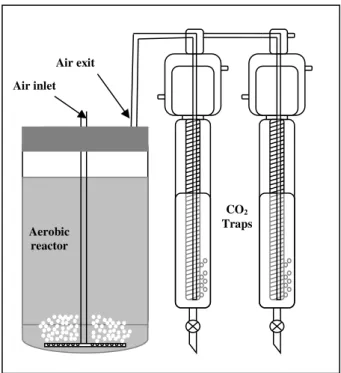
The biological treatment was performed in a reactor connected to specific glassware containing 30 mL of diethylene glycol monobuthyl ether and ethanolamine (1:1 ratio) to capture 14C-CO2 as the trap solution (Figure 1). Radioactive ring labelled atrazine (14
29
The reactor was fed with 2.5 L of raw sewage, 1.0 L of biological sludge and 3.5 mg of atrazine mixed with 105 Bc (2.7 µCi) of 14C-atrazine (final concentration of 1 mg L-1). The reactor was kept aerated in order to provide oxygen (at an air flow rate of 15 L min-1) and the mixture was maintained by magnetic stirring. The process was carried out over a 24 h period at room temperature (25 ºC). After this period, the process was stopped for 30 minutes and the treated effluent (upper layer) and the trap solution were removed. The settled sludge was reused in another sequencing batch using new raw sewage without atrazine. After each batch the trap solution was renewed.
The settled sludge in the reactor was reused five times with raw sewage. Samples of settled sludge and sewage (raw and treated) were collected after each batch and submitted to physical-chemical analyses, measurements of radioactivity and determination of the concentration of atrazine. A control reactor (without atrazine) was used to evaluate the efficiency of the process on a lab-scale. These processes were performed in duplicate. The experimental model was the same as that used by Oliveira et al. (2008). An atrazine concentration of 1.0 mg L-1 was used because it is the highest concentration of organic micro-pollutants that can be found in sewage treatment systems as according to Byrns (2001).
The efficiency of the processes was measured by organic matter (COD - Chemical Oxygen Demand) removal, concentration of biomass (MLSS - Mixed Liquor Suspension Solids) in the reactor and sludge settle-ability (SVI - Sludge Volume Index) after each batch. COD and MLSS were carried out using standard methods (APHA et al., 2012) and SVI was determined according to von Sperling (2002).
Figure 1. Diagram of aerobic reactor connected to traps to capture CO2 in the lab-scale treatment process.
2.2. Radioactivity Measurements
To determine the 14C-CO2, an aliquot of 5 mL of a trap solution was mixed with 5 mL of
scintillation solution (4 g of 2,5-diphenyloxazole, 0.25 g of 2,2`-p-phenylene-bis-(5- phenyloxazole), 33 mL of Triton X100 and 667 mL of toluene). To measure the radioactivity
Air inlet Air exit
CO2 Traps Aerobic
30
in the biological sludge and the treated effluent, 1 mL of these samples were burned in a Havey Biological Oxidizer OX-500 (R.J. Havey Instrument Corp.) and recovered in an oxidizer solution (mixture of 480 mL scintillation solution with 320 mL methanol and 200 mL ethanolamine). The radioactivity was measured in a Liquid Scintillation Counter model Tri-carb 2100TR (Packard).
2.3. HPLC/UV Analysis
The concentration of atrazine in the treated effluent was determined by liquid chromatography coupled to an ultraviolet detector (HPLC/UV) according to the methodology described in the literature (Correia and Langenbach, 2006; Correia et al., 2007; Correia et al., 2010). A certified standard of atrazine (Dr. Ehrenstörfer Reference Materials) was used. The treated effluent (250 mL) was mixed with 30 mL of dichloromethane in a separation funnel for liquid-liquid extraction. The lower fraction was removed and the extraction process was repeated twice again using dichloromethane. The extract was dried in a rotator evaporator at 37ºC and was re-suspended in 15 mL of methanol. It was then transferred to a C-18 cartridge (SPE Varian) previously activated with 15 mL of methanol and 15 mL of distillate water. This cartridge was washed with 10 mL of distillate water and residues of atrazine were recovered with 15 mL of a mixture of dichloromethane and methanol (7:3 v/v). The clean extract obtained was dried in a rotator evaporator (37ºC) and re-suspended in 2.5 mL of acetonitrile. Finally, the extract was analyzed in a HPLC 717 Waters System coupled to a 786 UV detector (256 nm) using a C-18 reversed-phase column (Lichrocart 250-4 Lichrospher 100 RP-18, 5 μm, Merck). The mobile phase was acetonitrile:methanol (65:35) with a flow of 0.3 mL min-1. The volume sample injected was 20 μL. This analysis was performed in triplicate.
3. RESULTS AND DISCUSSIONS
The reactors (with and without atrazine) had an efficiency in COD (Chemical Oxygen Demand) removal of between 91 and 95% and the values of SVI (Sludge Volume Index) were below 200 mL g-1. The concentration of the biomass (MLSS – Mixed Liquor Suspension Solid) in these reactors remained between 1.7 and 2.5 g L-1. The results showed that these processes have a performance similar to the activated sludge systems on a real scale (von Sperling, 2002). Thus, atrazine (concentration of 1.0 mg L-1) did not affect its efficiency.
After seven days of the process, the total amount of 14C-CO2 was 0.05% of the total
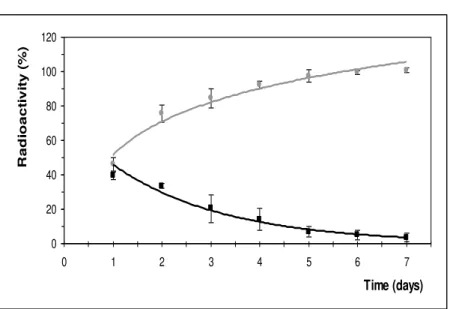
radioactivity applied, demonstrating that atrazine was not mineralized. Figure 2 shows that about 50% of the radioactivity in the first batch was released in the treated sewage and after the seventh day of the process the radioactivity measured in the settled sludge was reduced to 2% of the quantity initially applied. These results show that radioactivity sorbed by the settled sludge was gradually washed out with the treated effluent.
31
Figure 2. Distribution of radioactivity over 7 days of the process where (●) the sum of radioactivity released in the treated effluent (in percentage) relative to the amount initially applied and (■) remaining in the settled sludge.
Table 1. Amount of atrazine found in the treated effluent after each batch of the process.
Time of the process
Concentration of atrazine in treated effluent
Quantity of atrazine recovered from the initially amount applied
1 day 0.81 mg L-1 58 %
2 days 0.28 mg L-1 78 %
3 days less than 0.2 mg L-1 N.Q.
4 days less than 0.2 mg L-1 N.Q.
5 days N.D. N.Q.
6 days N.D. N.Q.
7 days N.D. N.Q.
Note:N.D. – not detected; N.Q. – not quantified
These results are different from those reported in the literature for other organic micro-pollutants. Oliveira et al. (2012) observed that 60% of 14C-didofol, an organochlorine acaricide was sorbed by the settled sludge using the same process and they observed a partial biodegradation. Kipopoulou et al. (2004) measured a removal of 67% of lindane by sludge with a sewage aerobic treatment and suggested biodegradation of up to 60%. Katsoyiannis et al. (2006) studied organochlorines and polychlorobiphenyls using a bench scale sewage treatment process by activated sludge and measured an uptake of between 85 and 100% in the sludge. These authors showed that these compounds were preferentially removed by the settled sludge and biodegradation was observed in the some cases; however in this work atrazine was released into the treated effluent without biodegradation.
In our study, about 50% of radioactivity was sorbed in the settled sludge after 24 h of the process (Figure 2); however, adopting the sludge age of 7 days, this radioactivity was desorbed from the sludge by addition of new raw sewage showing that this sorption was not permanent. The radioactivity data showed that mineralization of atrazine did not occur and HPLC/UV analysis identified that atrazine was probably discharged in effluent. Thus atrazine
0 20 40 60 80 100 120
0 1 2 3 4 5 6 7
Time (days)
R
a
d
io
a
c
ti
v
it
y
(
%
32
was not biodegraded by sewage aerobic treatment process, as was suggested by Meakins et al. (1994).
Probably lipophilic molecules (nonpolar) such as dicofol, lindane, polychlorobiphenyls and other organochlorine compounds are more likely sorbed by the sludge and therefore may be removed from the sewage by this process. However, molecules with intermediate polarity such as atrazine showed low sludge sorption; thus they are more likely to be discharged with the treated effluent. Although atrazine has a preferential partitioning of organic matter that is concentrated on biological sludge its solubility prevailed in this system. Possibly the time of contact this compound had with the biological sludge did not further its biodegradation although the HRT used the maximum cited by the literature (von Sperling, 2002).These results can be rationalized considering that substances with a low log Kow (octanol/water
partition coefficient) such as atrazine could have a greater affinity for the treated effluent (aqueous phase) and therefore would not be retained in the sludge (Kipopoulou et al., 2004; Katsoyiannis and Samara, 2004; Byrns, 2001). The challenge to avoid pollution by release of atrazine in the effluent is to find an efficient sewage treatment process to biodegrade this molecule.
4. CONCLUSIONS
This study evaluated the behaviour of 14C-atrazine in an activated sludge process on a lab-scale. It was possible to conclude that:
Atrazine (1.0 mg L-1) did not affect the process efficiency in terms of organic matter removal, concentration of biomass and sludge settleability.
Atrazine was not mineralized or biodegraded by the aerobic sewage treatment activated sludge.
Atrazine was gradually released into the treated effluent and consequently this substance remained as an environmental pollutant.
5. REFERENCES
AMERICAN PUBLIC HEALTH ASSOCIATION – APHA; AMERICAN WATER WORKS ASSOCIATION - AWWA; WATER ENVIRONMENT FEDERATION - WEF.
Standard methods for the examination of water and wastewater. 22th ed. Washington DC, 2012.
ANDERSON, K. L.; WHEELER, K. A.; ROBINSON,, J. B.; TUOVINEN, O. H. Atrazine mineralization potential in two wetlands. Water Research, v. 36, n. 19, p. 4785-4794. 2002. http://dx.doi.org/10.1016/S0043-1354(02)00209-9
BYRNS, G. The fate of xenobiotic organic compounds in wastewater treatment plants. Water Research, v. 35, n. 10, p. 2523-2533, 2001. http://dx.doi.org/10.1016/S0043-1354(00)00529-7
CORREIA, F. V.; LANGENBACH, T. Dinâmica da distribuição e degradação de atrazina em argissolo vermelho-amarelo sob condições de clima tropical úmido. Revista Brasileira de Ciência do Solo, v. 30, n. 1, p. 183-192, 2006. http://dx.doi.org/10.1590/S0100-06832006000100018
33
CORREIA, F. V.; LANGENBACH T.; CAMPOS, T. M. Avaliação do transporte de atrazina em solos sob diferentes condições de manejo agrícola. Revista Brasileira de Ciência do Solo, v. 34, n. 2, p. 525-534, 2010. http://dx.doi.org/10.1590/S0100-06832010000200026
GHOSH, P. K.; PHILIP, L. Atrazine degradation in anaerobic environment by a mixed microbial consortium. Water Research, v 38, n. 9, p. 2277-2284, 2004. http://dx.doi.org/10.1016/ j.watres.2003.10.059
KADIAN, N.; GULTA, A.; SATYA, S.; MEHTA, R. K.; MALIK, A. Biodegradation of herbicide (atrazine) in contaminated soil using various bioprocessed materials.
Bioresource Technology, v. 99, n. 11, p. 4642-4647, 2008. http://dx.doi.org/10.1016/ j.biortech.2007.06.064
KATSOYIANNIS, A.; SAMARA, C. Persistent organic pollutants (POPs) in the sewage treatment plant of Thessaloniki, northern Greece: occurrence and removal. Water Research, v. 38, n. 11, p. 2685-2698, 2004. http://dx.doi.org/10.1016/j .watres.2004.03.027
KATSOYIANNIS, A.; SAMARA, C. Persistent organic pollutants (POPs) in the conventional activated sludge treatment process: fate and mass balance. Environmental Research, v. 97, p. 245-257, 2005. http://dx.doi.org/10.1016/j.envres.2004.09.001
KATSOYIANNIS, A.; ZOUBOULIS, A.; SAMARA, C. Persistent organic pollutants (POPs) in conventional activated sludge treatment process: model predictions against experimental values. Chemosphere, v. 65, n. 9, p. 1634-1641, 2006. http://dx.doi.org/10.1016/j.chemosphere.2006.02.030
KIPOPOULOU, A. M.; ZOUBOULIS, A.; SAMARA, C.; KOUIMTZIS, T. H. The fate of lindane in the conventional sludge treatment process. Chemosphere, v. 55, n. 1, p. 81-91, 2004. http:// dx.doi.org/10.1016/j.chemosphere.2003.11.020
MEAKINS, N. C.; BUBB, J. M.; LESTER, J. N. The behaviour of the s-triazine herbicides,
atrazine and simazine, during primary and secondary treatment biological waste water treatment. Chemosphere, v. 28, n. 9, p. 1611-1622, 1994. http://dx.doi.org/ 10.1016/0045-6535(94)90420-0
MORRIS S.; LESTER, J. N. Behaviour and fate of polychlorinated biphenyls in a pilot wastewater treatment plant. Water Research, v. 28, n. 7, p. 1553-1561, 1994. http://dx.doi.org/ 10.1016/0043-1354(94)90222-4
OLIVEIRA, J. L. M.; LANGENBACH T.; DEZOTTI, M. Fate of organochlorine 14C-dicofol in a lab-scale wastewater treatment. Brazilian Journal of Microbiology, v. 39, p. 311-313, 2008. http://dx.doi.org/10.1590/S1517-83822008000200021
OLIVEIRA, J. L. M.; SILVA, D. P.; FERREIRA, E. M.; LANGENBACH, T.; DEZOTTI, M. Biodegradation of 14C-dicofol in wastewater aerobic treatment and sludge anaerobic biodigestion. Environmental Technology, v. 33, n. 6, p. 695-701, 2012. http://dx.doi:10.1080/09593330.2011.588961