i
UNIVERSIDADE DA BEIRA INTERIOR
Ciências Sociais e Humanas
Knowledge Intensive Business Services (KIBS) in
Portugal: Location and Innovative Capacity
Cristina Isabel Miranda Abreu Soares Fernandes
Tese para obtenção do Grau de Doutor em
Gestão
(3º ciclo de estudos)
Orientador: Prof. Doutor João José Matos Ferreira
Co-orientador: Prof. Doutora Carla Susana da Encarnação Marques
i
Dedicatória
À minha filha Inês Ao meu irmão Miguel
ii
Thanks and Acknowledgements
There have been a range of persons who, whether directly or indirectly, contributed towards making sure this work proved possible.
I would like to thank my parents, for the values they handed down and all of the courage they instilled within me. I owe them everything that I am today.
To my academic supervisors, Professor João Ferreira and Professor Carla Susana da Encarnação Marques for their guidance, availability and the sense of encouragement they have always conveyed. Beyond their supervisory role, I am able to consider them my friends. Many thanks.
I would like to thank Cristina Estêvão, a friend who has made the journey with me since our Master’s Degrees and both have followed the same path, finding mutual support and lending each other the courage to continue along the way. For myself, she is a ―sister‖. And thank you, sister.
As least in my case, it does seem that difficult times really do show you who your true friends are. Emília, my colleague since my early days in university and undoubtedly the friend who has provided the greatest and most unconditional support and so important to the endurance needed in completing this work. And to whom I wish to offer my sincerest thanks.
To the 500 business leaders who also contributed towards this project as without their input, everything else would have become so very much more difficult. I must also thank the University of Beira Interior, for giving me the opportunity to conduct this research.
iii
Abstract
Within the service industry, the swift growth of the KIBS (Knowledge Intensive Business Service(s)) sector has played a crucial role in innovation processes. Above all, this role is confirmed by the fact that such entities do not turn in a simple performance in innovation activities as would be the case in simply meeting the needs of prevailing levels of demand or, more specifically, their clients. Instead, they establish bridges of knowledge and points of innovation between companies and science. The literature goes so far as to identify the origins of the third industrial revolution with the importance attributable to KIBS. While the debate on the growth of KIBS unfolds around these new specialist fields and the growth in the tertiary sector in general, there is ever growing recognition that both new manufacturing processes and new services and innovations in more general terms increasingly derive from KIBS.
Our interest in KIBS derives from a position broadly defended by a wide range of authors (Muller, 2001; Howells and Tether, 2004; Toivonen, 2004; Koch and Stahlecker, 2006): the irrefutable role played by KIBS in the development of their surrounding regions. In the Thesis below, we have sought to study these companies across four fundamental research facets: (i) location; (ii) cooperation with universities; (iii) factors of innovation and (iv) innovative and competitive capacities.
To approach factors of location, we deployed exploratory factorial analysis and Logit regression modelling and found that in this aspect, there was statistical significance for rural and urban KIBS. The results revealed that rural KIBS are essentially influenced by personal motivations and their owners tend to be younger and with fewer years of experience. In the case of urban KIBS, the main factor is the prevailing business conditions in the location with entrepreneurs tending to be older and with more years of experience.
Our analysis of cooperation between KIBS and universities involved the application of exploratory factorial analysis and a logit regression model. Our findings show that the probability of KIBS establishing partnerships with universities rises in accordance with the levels of proximity and trust, the types of cost associated with such partnerships and the age of the entrepreneur. Furthermore, we encounter no difference in terms of either location or typology. The results also enable us to conclude that there is a statistically significant effect between the employment of staff with higher education, the age and academic background of the company owner, and the logistical probability of the company locating in rural areas. This means that, while there is little or no direct cooperation between universities and KIBS companies, there is a transfer of knowledge courtesy of the university graduates employed in these professions. The level of graduate employment is high at both rural and urban KIBS.
To study the factors of innovation, we made recourse to confirmatory factorial analysis with the objective of verifying whether the strategy, the organisation, the learning, the networks and the process, influence the innovation activities ongoing at KIBS. We found that the network factor is of high importance to both KIBS types (professional and technological). However, professional KIBS also returned the strategy factor as the driver of innovation while technological KIBS
iv attributed greatest priority to learning as a factor for innovation. Furthermore, no statistically significant differences were identified between rural and urban located KIBS.
Finally, we applied structural equations for analysis of the innovative and competitive capacities of KIBS and evaluating up to just what point innovation depends on the nature of the service (technological or professional) and location (rural and urban). Firstly, the results of certain analytical processes found that the innovative capacities of the different types of rurally located KIBS displayed no statistical significance while at KIBS in urban locations, professional KIBS companies innovated less than their technological peers and the latter thereby proved able to simultaneously turn in better financial performance and hence may be deemed more competitive.
Key – Words: Knowledge Intensive Business services; location factors; innovation; innovative capacity.
v
Resumo Alargado
Dentro da indústria dos serviços, o rápido crescimento do sector dos KIBS (Knowledge Intensive Business Service) tem evidenciado um papel crucial nos processos de inovação. Este papel é afirmado, acima de tudo, pelo facto destes não terem uma performance simples na actividade inovadora, como seria a de atenderem, simplesmente, aos desejos da procura e, mais especificamente, ao desejo dos seus clientes, mas por criarem pontes de conhecimento ou pontes de inovação entre as empresas e a ciência. Defende-se também que a origem de uma terceira revolução industrial está na importância que tem que se dar aos KIBS. Embora o debate sobre o crescimento dos KIBS se desenrole em torno das suas novas especializações e do crescimento do sector terciário em geral, é cada vez mais notório que, tanto os novos processos de fabrico como os novos serviços e inovações em geral têm cada vez mais a sua origem a partir dos KIBS.
Tendo em conta a importância vital do sector dos KIBS, para a competitividade de qualquer economia, pretendemos na nossa investigação analisar os factores de localização do sector dos KIBS em Portugal e compreender a sua contribuição na capacidade inovadora e competitiva. Para isso, e com base na natureza dos KIBS (profissionais e tecnológicos) e o tipo de região (rural e urbano) visamos averiguar em que medida o tipo de natureza dos KIBS explica de forma distinta (ou não) a sua capacidade inovadora e competitiva.
Face ao presente enquadramento da problemática em estudo, são levantadas as seguintes quatro questões de investigação:
1. Quais os factores que explicam a localização dos KIBS nas diferentes regiões rurais e urbanas?
2. Qual o nível de cooperação entre os KIBS e as universidades?
3. Quais os factores que influenciam as actividades de inovação dos KIBS?
4. Existem diferenças ao nível da capacidade inovadora competitiva e o tipo de KIBS? Se sim quais? E qual a sua relação com o desempenho financeiro?
Tendo por base estas questões de investigação, são propostos na presente tese os seguintes objectivos:
1. Identificar os factores que influenciam a escolha de localização dos KIBS rurais e urbanos;
2. Analisar os modos de transferência de conhecimento entre os KIBS e as universidades
3. Identificar os fatores de inovação dos KIBS.
4. Averiguar até que ponto o nível de inovação dos KIBS depende do tipo de serviços (tecnológico vs. profissional), da sua localização (rural vs. urbano) e de que modo esta inovação influencia o seu desempenho financeiro
Na análise dos factores de localização utilizamos a análise factorial exploratória e a regressão modelo Logit, verificamos que a este nível apenas houve significado estatístico para os KIBS
vi rurais e urbanos. Os resultados evidenciaram que os KIBS rurais são influenciados essencialmente por motivações pessoais, e os seus empresários são mais novos e têm menos anos de experiencia. No caso dos KIBS urbanos o principal factor que influencia a sua localização são as condições económicas da localidade, e os seus empresários são mais velhos e têm mais anos de experiencia.
Na análise da cooperação entre KIBS e universidades foram usadas uma análise factorial exploratória e uma regressão modelo logit. Constatou-se que a probabilidade das empresas estabelecerem parcerias com instituições de ensino superior é positivamente influenciada por relações de proximidade e confiança, pelos tipos de custos associados à criação da cooperação e pela idade dos proprietários. Porém, não se verificaram diferenças ao nível de localização e tipologia. Os resultados permitiram ainda concluir que existe um efeito, estatisticamente significativo, da empregabilidade de trabalhadores com ensino superior, da idade e formação académica dos proprietários, sobre o logit da probabilidade da empresa se localizar em áreas rurais. Isto significa que, apesar de não existir uma colaboração directa entre as instituições de ensino superior e as empresas KIBS, existe uma transferência de conhecimento gerado pelas universidades nos profissionais empregados. A média de empregabilidade de profissionais com ensino superior é elevado tanto nos KIBS rurais como urbanos.
No estudo dos factores de inovação recorremos à analise factorial confirmatória no sentido de verificarmos se os cinco factores: estratégia, organização, aprendizagem, redes e processo, influenciam as actividades de inovação dos KIBS. Concluímos que o factor redes é importante para ambos tipos de KIBS (profissional e tecnológico). Contudo, os KIBS profissionais evidenciam o factor estratégia como o principal factor à inovação enquanto que para os KIBS profissionais é a aprendizagem o factor mais importante. Não se verificaram diferenças estatísticas significativas ao nível da localização.
Por fim, recorremos ao modelo de equações estruturais para analisar a capacidade inovadora e competitiva dos KIBS e avaliar até que ponto o seu nível de inovação depende da natureza de serviço (tecnológico ou profissional) e localização (rural e urbano). Em primeiro lugar, verificou-se que os KIBS rurais não tinham qualquer significado estatístico no nosso estudo. Relativamente aos KIBS urbanos, os resultados evidenciam que os KIBS profissionais inovam menos que os tecnológicos e estes têm um melhor desempenho financeiro, logo são considerados mais competitivos.
Key Words: Knowledge Intensive Business services; factores de localização; inovação; capacidade inovadora.
vii
Indice
Part I...1
1. Introduction...2
1.1. The Framework...2
1.2 Sample and Unit of Analysis...8
1.3 Thesis Model Design...11
Part II ...14
Chapter 1 - KIBS location...15
Entrepreneurship and the Location of Knowledge Intensive Business Service Companies: An Empirical Assessment ...16
Chapter 2 - Cooperation between KIBS and Universities...44
Knowledge Spillovers and Knowledge Intensive Business Services: An Empirical Study...45
Chapter 3 - Factors of innovation and innovative capacities...71
KIBS innovation management capability in rural and urban Portuguese regions: empirical evidence ...72
Influence of the KIBS Type and Location on their Innovative and Competitive Capacities...98
Part III ...122
Conclusion...123
References ...128
1
2
1. Introduction
1.1. The Framework
Research interest in the service sector has been rising ever since 1980, when regional development studies in Europe and North American began to focus on deindustrialisation related issues (Kline and Rosenberg, 1986; Von Hippel, 1988; Johne and Storey, 1998; Miles, 2000; De Jong et al., 2003). Thus far, services had been perceived as merely subsidiary to transformative and manufacturing activities. In the last two decades, attention has mounted especially on service activities given that they have not only generated progressively rising levels of growth in developed economies but have also been identified as major drivers of innovation (Wood, 2005).
Despite the growing awareness that innovation is not simply confined to technical processes and products, some recent innovation research has centred only on the observation of technical innovation and especially in the transformative industrial sector (Becker and Dietz, 2004; Huergo and Jaumandreu, 2004; Lynskey, 2004; Nieto and Santamaria, 2005). Indeed, greater importance has only more recently been given to the service sector (Gallouj and Weinstein, 1997; Tether, 2003). According to Tether et al. (2001), service company innovation has traditionally been perceived as something that takes place very slowly. Services were perceived as unable to innovate with such entities limited to adopting the innovations emerging out of transformative industrial companies. Pavitt (1984) also proposed that the smaller the service companies are, the less they would tend to run their own research and development (R&D) functions and ending up as mere recipients, absorbing the technology and innovation issuing out of other sectors.
Nevertheless, within the service industry, rapid growth in the Knowledge Intensive Business Service (KIBS) sector has demonstrated the crucial role played by innovation processes (Muller, 2001; Howells and Tether, 2004; Toivonen, 2004; Koch and Stahlecker, 2006). Above all, this role proves of such relevance given that the sector enables bridges of knowledge and innovation between companies and scientific output (Miles et al., 1995; Czarnitzki and Spielkamp, 2003). Furthermore, there are also authors who defend that the origins of a third industrial revolution may be traced to the importance due to KIBS companies (Tether and Hipp, 2002). Although the debate over the growth of KIBS revolves around their new specialist fields of competence and the growth in the tertiary sector in general, there is a rising level of acknowledgement that not only do new manufacturing processes but also new services and innovations in more general terms trace their origins to the KIBS sector (KaraÃmerlioglu and Carisson, 1999; Tomlinson and Milles, 1999, Frell, 2006).
Miles et al. (1995) identify three key KIBS characteristics: (i) the high level of importance attributed to professional knowledge by these companies; (ii) the company’s strategic objectives include being the first to draw upon information and knowledge and deploy such knowledge to produce services and serve as intermediaries between these services, their
3 clients and their production processes; and, (iii) the sheer importance of the KIBS service type rendered to companies in terms of competition and competitiveness.
At this point, we need to differentiate between the two KIBS types referred to in the literature (Frell, 2006; Miles et al., 1995; Doloreux and Muller, 2007, Shearmur, and Doloreux, 2008): (1) Technological KIBS companies engaged in activities related to information technology, research and development, engineering and architecture and consultancy, testing and analytical techniques; and (2) Professional KIBS undertaking legal activities, accountancy, company bookkeeping, auditing and fiscal consultancy activities, and market studies as well as the entire scope of the publicity sector.
According to the research undertaken by Frell (2006), technological KIBS employ persons with higher levels of qualification that in turn impact on their levels of innovation while in the case of professional KIBS, the companies represent the suppliers with the clients themselves fostering the innovation.
Amara et al. (2008) refer that KIBS companies survive on knowledge based services. In this industry, transactions are made up of knowledge with the outputs very often intangible in nature. Innovations mostly result from new combinations of knowledge rather than new combinations of physical artefacts. Coffey (2000), in turn, highlights the rising interest in service producers (High-Order Producer Services - HOPS) and provides full recognition of their important role in western economies as from the end of the 1970s and in the early years of the 1980s. Service producers have experienced swift growth in their specific market sector (Daniels, 1985; Coffey and Shearmur, 1997). Furthermore, the role of regional competitiveness has also been identified and attracted the attention of both regional geographers and social scientists (Beyers and Alvin, 1985; Coffey and Polèse, 1987; and Illeris, 1996).
However, there remain significant difficulties in securing consensus around distinctive definitions for KIBS and HOPS, as both are terms applied in the definition of the service sector. The HOPS represent all those services that require a complex manipulation of symbols and the transformation of information, and very often proving highly complex and atypical (Reich, 1992; Daniels, 1985; Bryson et al., 2004). The meaning behind ―knowledge intensive‖ may be summarised as service companies engaged in operations of a complex intellectual nature in which the human factor is fundamental (Alvesson, 1995).
The importance of studying these services was clearly made by Pires et al. (2008) in empirically demonstrating the positive effects of KIBS on the competitiveness of other companies and the added value thereby produced. Among all the other services to companies, KIBS have notched up swifter growth rates than all other sectors. This achievement is due to a range of issues, in particular, the outsourcing of such services by other sectors, the development of information and communication technologies, changes to the regulatory, legal and market frameworks as well as globalisation and internationalisation (Bengtsson and Dabhilkar 2009).
4 Taking into consideration that these companies are knowledge intensive, there is clearly a need to highlight how such knowledge is currently perceived as a fulcral resource for companies and taking on an ever higher profile in recognising and leveraging entrepreneurial opportunities (Andersson, et al., 2009). The growing body of literature on the importance of entrepreneurialism at the regional level, as well as location characteristics tend to concur that knowledge is at the core of the founding of new companies and hence opting to emphasise the knowledge spread mechanisms (spillovers) in effect at universities and other R&D institutions. Correspondingly, the knowledge generated emerges out of means of cooperation between companies and state funded research institutions (Audretsch and Lehmann, 2005). According to Acs et al. (2006), entrepreneurial activities may be expected to steadily grow in both size and effectiveness given that investment in new knowledge proves relatively high but within the framework of which, companies, especially KIBS, make recourse to genuine sources of knowledge (universities and R&D institutions).
Despite the plethora of voices raised in defence of the importance and the role that KIBS play in the economy and in regional dynamics (Marshall et al., 1987; Hansen, 1993; Miles et al., 1995; Muller and Zenker, 2001; Czarnitzki and Spielkamp, 2003; Miles, 2003), there have, however, been very few studies on the innovation activities in effect at KIBS (Koch, and Strotmann, 2008). From the perspective of Howells (2000), the fact that there are few studies on innovation in the service sector primarily stems from the highly heterogeneous nature of the sector and putting many researchers off. Nevertheless, there has been a steady increase in the numbers of these service sector companies. In particular, small KIBS have been recognised as playing a dynamic and central role in the ―new‖ knowledge based economies. This recognition has fostered new and growing levels of research on this service sector (Wong and He, 2005).
As suppliers of knowledge intensive services, their provision in any specific location is frequently deemed an important leverage of the competitiveness of regional industries and economies. According to Dall’erba et al. (2007), there is a clear correlation between the level of employment in KIBS firms and the level of productivity of non-KIBS companies in the European Union regions hosting such companies.
Hence, associated with the role actually played by KIBS, theories have inevitably emerged on locations, serving as the foundation for the identification of the factors that may be behind the decisions of entrepreneurs in choosing one site over another for their business (Autant-Bernard et al., 2006; Van Praag and Versloot, 2007; Ferreira et al., 2010; Lafuente et al., 2010). The rural/urban dichotomy dealing with the location of entrepreneurial activities in rural areas is also a point of particular importance. This correspondingly drives the question: how do you define rural and urban regions?
Should we reach out for a universal concept defining the respective boundaries of rural communities, we shall act in vain. In some countries, the central authorities even attribute different definitions to the concept in accordance with the projects that are undertaken by each ministry (OECD, 2007). Nevertheless, population density remains the criterion most used
5 by economic actors as well as academic studies, in order to determine the boundary between rural and urban areas (North et al., 2001; Smallbone et al., 2002). The OECD has specifically deployed population density for the measurement of rural regions and establishing them as all areas home to less than 150 inhabitants per square kilometre (km2) (OECD, 1996). In regional terms, the OECD (2009) established a typology that takes into account the different geographies of regions. The international organisation classified regions as: (i) predominantly rural (all regions with more than 50% of their populations living in rural locations); (ii) intermediary (with less than 50% of the population in rural regions); (iii) predominantly urban (less than 15% of residents in rural areas). Furthermore, the European Commission (1997) also uses population density as a means of gauging the extent of rural communities in qualifying them as all areas where the population density drops below 100 inhabitants per km2. Kayser (1990) puts forward a more micro means of classifying rural communities through categorising them by municipality and holding that all municipalities with less than 5,000 inhabitants are rural with this criteria adopted within the scope of this research.
The European Union and many other OECD member states have introduced policies designed to foster entrepreneurialism as a key tool for rural development1. In Europe, diversification in the rural base of production was stipulated as an objective of rural development policies (European Commission, 1997). Similarly, there is growing demand and interest in founding and nurturing new business opportunities and perceived as a key factor in the development and revitalisation of some specific European areas (Rosell and Viladomiu, 2001). The OECD (2006) includes entrepreneurialism, endogenous economic growth and innovation as core issues to the New Rural Paradigm.
However, the rural areas remain well behind their urban counterparts in terms of hosting technological companies (Roper and Love, 2006). Correspondingly, classical and contemporary researchers have pointed to urban agglomerations as preferable for locating new businesses. From the outset, Smith (1776) argued that urban centres provided for a better division of labour. For Marshall (1890), urban centres provide a better supply of labour and greater access to non-traded products and goods. Access is also facilitated with monetary resources also in easier supply (Hoover, 1948) as well as the better evaluation of complementary services (Mydral, 1957). Jacobs (1969) holds that access to the infrastructures appropriate to entrepreneurial needs is undoubtedly easier in urban centres, and, above all, these urban centres, in comparison with their rural peers, bring together a far greater volume of business demand (Krugman, 1981, 1991).
In addition, transport, communication and information technology infrastructures clearly do hold great importance in physically and psychologically reducing the gap between the different environments, that is urban and rural areas (Grimes, 2000). Indeed, there are some formal, institutional and infrastructural disadvantages between the urban and rural realities in Europe and the many other OECD member states, although having been somewhat offset in
1 Measures proposed by the European Commission in 1997 for encouraging the founding of new businesses in rural
6 the meanwhile, that ensure many rural areas are not able to experience the existence of certain technological levels already in effect in urban areas (Bade and Nerlinguer, 2000). Given the paucity of studies on this type of service sector (KIBS) and given they play an increasingly active role in regional innovation and competitiveness, there is correspondingly an imperative to research the contribution actually made by such companies to the Portuguese economy. Thus, we set out the core conceptual model of this Doctoral thesis below (Figure 1).
Figure 1: Doctoral Thesis Model
Taking into account the vital importance of the KIBS sector to the competitiveness of any economy, our research furthermore seeks to analyse the dynamics driving the location of the KIBS sector in Portugal and better understand its overall role within the framework of innovation and competitiveness. To this end, and based upon the KIBS type (professional vs. technological) and their location (rural vs. urban), we seek to ascertain to what extent the type and location of KIBS is able to generate insights into their innovative and competitive capacities.
In accordance with the framework set out above, the following four research questions are proposed:
1. What factors explain the location choices of KIBS companies? 2. What level of cooperation exists between KIBS and universities? 3. Which factors influence KIBS innovation activities?
Knowledge Intensive Business Services
Location
Cooperation with universities
Factors of Innovation
Innovative and Competitive Capacities
7 4. Are there any differences in the levels of innovative capacities and the KIBS type?
Where yes, what are they and what is their relationship with financial performance? Based upon these four research questions, this thesis correspondingly incorporates the following objectives:
1. To identify the factors influencing the choice of rural and urban KIBS location options, 2. To analyse the means of knowledge transfer between KIBS and universities,
3. To identify KIBS factors of innovation,
4. To ascertain the extent that the respective level of KIBS innovation depends on its service type (technological vs. professional), on its location (rural vs. urban) and the impact this innovation has on company financial performance.
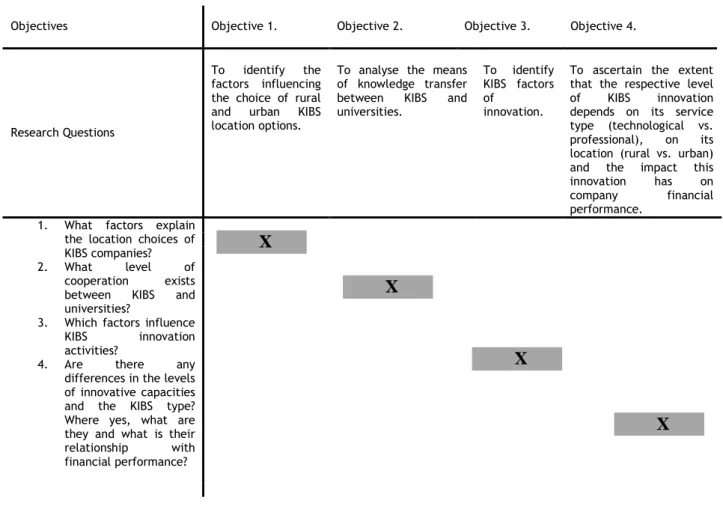
The relationship between the research questions and objectives may be set out as follows (Table 1):
8
Table 1 – Matrix of Research Question/Objectives
Objectives Objective 1. Objective 2. Objective 3. Objective 4.
Research Questions
To identify the factors influencing the choice of rural and urban KIBS location options.
To analyse the means of knowledge transfer between KIBS and universities.
To identify KIBS factors of
innovation.
To ascertain the extent that the respective level of KIBS innovation depends on its service type (technological vs. professional), on its location (rural vs. urban) and the impact this innovation has on company financial performance.
1. What factors explain the location choices of KIBS companies? 2. What level of
cooperation exists between KIBS and universities?
3. Which factors influence KIBS innovation activities?
4. Are there any differences in the levels of innovative capacities and the KIBS type? Where yes, what are they and what is their relationship with financial performance?
1.2. Sample and Unit of Analysis
The sample was founded on a data base granted access to by Grupo Coface. This data base contains details on the trends (in terms of bankruptcies and operationally active companies) in KIBS between 2004 and 2009. The data base contained a total of 39,254 KIBS in 2004 and sliding to 34,644 KIBS in 2009 (4,578 closed down while 32 relocated internationally). The sample was extracted based upon company turnover and correspondingly only including companies returning turnover greater than € 0.01. These companies were selected according to their CAE (REV.3) and NACE (REV.2) business codes, similar to other researchers (Frell, 2006, Miles et al., 1995; Doloreux and Muller, 2007, Shearmur and Doloreux, 2008) in order to ensure the sample included both KIBS groups: technological KIBS (t_KIBS) incorporating companies engaged in activities related to information technology, research and development, engineering and architecture as well as activities within the scope of consultancy, testing and analytical techniques (NACE codes: 62.01; 62.02; 62.03; 62.09; 63.11; 63.91; 63.99; 71.11; 71.12; 71.20; 72.1; 72.2) and professional KIBS (p_KIBS), that incorporate the legal sectors, accountancy, company bookkeeping, auditing and fiscal consultancy activities, and market studies as well as the entire scope of the publicity sector (NACE codes: 69.10; 69.20; 73.20; 70.22; 73.11; 73.12; 78.10; 78.30; 74.20; 74.90). Table 2
X
X
X
9 details the economic activities identified as falling under the auspices of KIBS. Taking into consideration that one of the research objectives represents verifying the location of KIBS in rural and urban councils, we found from the outset that there were only 93 KIBS located in rural council with the remainder all established in urban councils (thus, in settlements with populations in excess of 5,000 inhabitants).
A total of 500 questionnaires were completed either by telephone or face-to-face with company owners. This process took place between 01/10/2010 and 15/12/2010.
Table 2: Classification of activities
NACE Codes Rev. 2 (2008) CAE Codes REV 3 (2007)
62: Computer programming, consultancy and related activities
62: IT programming, consultancy and related activities 62.02: Computer programming activities 62010: IT programming activities
62.01: Computer programming, consultancy and related activities
62020: IT consultancy activities 63: Information service activities
63.11: Data processing, hosting and related activities
63: IT service activities
63110: Data processing activities, hosting and related activities
63.91: News agency activities 63.99: News agency activities
63910: News agency activities 63990: Other news agency activities
62.03: Computer facilities management activities 62030: IT facilities management and operational activities
62.09: Other information technology and computer service activities
62090: Other activities related to information and communication technologies
72 Scientific research and development 72: Scientific research and development 72.1 Research and experimental development on
natural sciences and engineering
72.11 Research and experimental development on biotechnology
72110: Biotechnology research and development 72190: Other physical and natural science research and development
72.2 Research and experimental development on social sciences and humanities
72200: Social and human science research and development
69: Legal and accounting activities 69: Legal and accountancy activities 69.10 Legal activities 69101: Legal activities
69102: Notary related activities 69.20 : Accounting, book-keeping and auditing
activities; tax consultancy 69200: Accountancy and audit activities; fiscal consultancy 73.20 Market research and public opinion polling - 73200: Market studies and opinion polls
70.22: Business and other management consultancy activities
70220: Other business and management consultancy activities
70210: Public relation and communication activities 71.1 Architectural and engineering activities and
related technical consultancy 71.11 Architectural activities
71.12 Engineering activities and technical consultancy
71110: Architectural activities
71120: Engineering and similar technical activities
71.20 Technical testing and analysis 71200: Testing and analytical activities 73.1 Advertising
73.11 Advertising agencies 73.12 Media representation
73110: Publicity agencies 73120: Media placement activities 78.10 Activities of employment placement
agencies
78100: Human resource recruitment and placement activities
78.30 Other human resources provision 78300: Other human resources 74.20 Photographic activities - 74200: Photographic activities 74.90 Other professional scientific and technical
activities
74900: Other consulting, scientific, technical and similar activities
10 The research population distribution and sample is set out in the table below:
Table 3: Distribution of Population and Sample
Thus, the final sample of 500 KIBS companies was: professional KIBS (65.6%, 328 companies) and technological KIBS (34.4%, 172 companies). Of the total, 18.6% of companies are located in rural locations (93 companies) while 81.4% have established their businesses in urban settings (407 companies).
Of the 328 professional KIBS companies, 63 are located in rural surroundings with the other 265 in urban locations. As regards technological KIBS, the numbers stand at 30 and 142 respectively (Table 4). Population Sample 2010 CAE Total 2004 Data for 2009 Total
KIBS Type Rural Urban Total Rural Urban t_KIBS p_KIBS
62010 1832 1513 t_KIBS 1513 19 19 t_KIBS 62020 875 780 t_KIBS 780 5 5 t_KIBS 62030 17 17 t_KIBS 17 7 7 t_KIBS 62090 820 715 t_KIBS 1 714 9 1 8 t_KIBS 63110 236 199 t_KIBS 1 198 4 1 3 t_KIBS 63910 51 43 t_KIBS 1 42 1 1 0 t_KIBS 69101 70 64 p_KIBS 64 1 1 p_KIBS 69200 9187 8413 p_KIBS 35 8378 150 35 115 p_KIBS 70210 41 38 p_KIBS 38 10 10 p_KIBS 70220 8575 7499 p_KIBS 12 7487 58 12 46 p_KIBS 71110 3105 2768 t_KIBS 15 2753 66 15 51 t_KIBS 71120 4166 3704 t_KIBS 9 3695 37 9 28 t_KIBS 71200 502 439 t_KIBS 1 438 9 1 8 t_KIBS 72190 151 141 t_KIBS 2 139 5 2 3 t_KIBS 72200 76 64 t_KIBS 64 10 10 t_KIBS 73110 2395 2105 p_KIBS 2 2103 23 2 21 p_KIBS 73120 418 364 p_KIBS 1 363 4 1 3 p_KIBS 73200 280 237 p_KIBS 1 236 5 1 4 p_KIBS 74200 725 639 p_KIBS 3 636 21 3 18 p_KIBS 74900 5482 4705 p_KIBS 9 4696 44 9 10 p_KIBS 78100 240 187 p_KIBS 187 2 2 p_KIBS 78300 10 10 p_KIBS 10 10 10 p_KIBS Total 39.254 34.644 93 34551 500 93 407 172 328
11
Table 4: Distribution of KIBS: typology and location
KIBS Typology
KIBS Location Total
Rural Urbana p_KIBS N 63 265 328 % 12.6% 53.0% 65.6% t_KIBS N 30 142 172 % 6.0% 28.4% 34.4% Total N 93 407 500 % 18,6% 81.4% 100.0%
The hypotheses put forward were tested and the dependent and independent variables compared through the application of a diverse range of tests within the scope of Univariate analysis and multivariate analysis. The Univariate analysis (cross-referencing data, t tests and χ2 tests) and multivariate (for example, confirmatory factorial analysis and logistical regression modelling and structural equations) techniques utilised are described in the respective chapters making up Thesis Part II (Figure 2), in the section on data analysis, and when providing an overview of the respective results of each of the statistical processes carried out.
The differing study dimensions approached in each chapter in Thesis Part II and the respective statistical and associated econometric techniques are set out in Table 5.
Table 5 – Questions, study dimensions and the statistical techniques deployed in each chapter
CHAPTER DIMENSIONS AND COMPONENTS STATISTICAL TECHNIQUE(S) Chapter I Analysis of issues relating to location and cooperation
with higher education Exploratory factorial analysis and logit regression modelling Chapter
II
Analysis of cooperation between KIBS and universities and the employment of professionals with higher education qualifications
Exploratory factorial analysis and logit regression modelling Chapter
III
Factors of innovation Confirmatory factorial analysis Measuring innovative capacities and financial
performance
Structural equation modelling
1.3. Thesis Model Design
This Thesis is structured into three core sections. This first is made up of the Introduction, which provides a brief overview of the literature transversal to the set of articles making up the body of the dissertation. This introduction also details our objectives and research
12 questions. We also present a description of both the population and the sample subject to analysis.
The second section is made up of three chapters containing four empirical studies. The third and final part provides the final Thesis considerations and puts forward the core conclusions and contributions generated by the research. A summary of the Thesis structure is provided below (Figure 2):
Figure 2: Thesis Structure
The four empirical articles in this thesis have all been submitted to international journals (table 5), in accordance with the content of each article and the core interests of the respective journal, with all currently undergoing peer review.
Thesis
Section I
Introduction
Description of Unit of Analysis Thesis model design
Section II
Chapter 1: KIBS location
Chapter 2: Cooperation between
KIBS and Universities
Chapter 3: Factors of innovation and innovative
capacities Empirical Article Empirical Article Section III Final Considerations Empirical Article Empirical Article
13
Table 5: Thesis empirical articles:
Chapter Article Journal
Chapter 1 Entrepreneurship and the Location of Knowledge Intensive Business Service Companies: An Empirical Assessment
Research Policy
Chapter 2 Knowledge Spillovers and Knowledge Intensive
Business Services: An Empirical Study
Journal of Small Business Management
Chapter 3 KIBS innovation management capability in Rural
Portuguese regions: empirical evidence
Industry & Innovation
Influence of the KIBS Type and Location on their Innovative and Competitive Capacities
14
PART II
15
Chapter 1
KIBS location
16 Entrepreneurship and the Location of Knowledge Intensive Business Service
Companies: An Empirical Assessment
Abstract
In broad terms, the profile of entrepreneurship has been rising and attracting ever more interest within the scope of both development policy making and the research community. Inherently bound up with the importance of entrepreneurship to regional development are approaches able to explain both its incidence, especially in the case of knowledge intensive business services (KIBS), and the respective factors driving an entrepreneur‘s (as the individual responsible for entrepreneurial activities) decisions in choosing the company location.
Correspondingly, this study seeks to analyse KIBS entrepreneurship through identifying the factors behind companies locating in rural areas in accordance with the entrepreneur‘s profile. We used an exploratory factor analysis in order to identify the location factors and then used the logit model in order to analyze the influence of location factors in rural and urban KIBS. The results allowed to determine significant differences between rural and urban KIBS in relation to location factors. Economic conditions and the local infrastructures appear to be factors weighing most heavily in deciding the location of urban KIBS.
Furthermore, we aim to identify which regional drivers/inhibitors explain the choice of KIBS location.
Keywords: entrepreneurship; knowledge intensive business services; location factors
1. Introduction
In 1934, Schumpeter conceived of business owners as individuals appointed to the role of managing the implementation of new combinations of resources and that the entrepreneurial role consisted of identifying and engaging with new opportunities in the economic field. However, it was actually only after the 1980s that interest began to crystallise around the role of entrepreneurship in economic development due in no small part due to the revolution in endogenous growth studies (Low and MacMillan, 1988). This academic trend resulted in a new wave of research this time placing the individual
17 capacity to cope with risk at the centre of economic analysis (Groot et al., 2004). Furthermore, this ability to deal with risk had very early on been studied as one of the characteristics of entrepreneurialism (Knight, 1921; Lucas, 1978; Kihlstrom and Laffont, 1979; Kahneman and Tversky, 1979; Jovanovic, 1982; Parker, 1996; 1997).
Hence, entrepreneurial activities, in conjunction with all of the factors behind their existence, as well as their influence on regional economic development have been subject to study by a wide range of authors (Birley 1985, Kirchoff and Phillips 1988; Storey, 1994; Arauzo and Manjon, 2004). As far as the relationship between entrepreneurialism and economic growth is concerned, many authors have deemed it a fundamental factor to economic growth and perceiving the role of entrepreneurs as highly important in the creation of employment and fostering innovation (Wennekers and Thurik, 1999; Thurik and Wennekers, 2004; van Stel, 2006; Welter and Lasch, 2008).
Entrepreneurship has recently been defined as the design and launch of new economic activities (Davidsson et al., 2006). While entrepreneurs may be analysed individually, they operate at the organisational (Shane and Venkataraman, 2000), economic, social and institutional levels(Veciana and Urbano, 2008)
Underlying the issue of the importance of entrepreneurship to regional development, attention is inevitably drawn to issues related to location, thus, factors behind the decisions taken by business founders (bringing about the entrepreneurial activities) in choosing a specific location for their company (Von Thünen, 1826; Marshall, 1890; Weber, 1909; Christaller, 1933; Hayter 1997; Trullén, 2001; Parker, 2004; Autant-Bernard et al. 2006; Van Praag and Versloot, 2007; Ferreira et al., 2010; Lafuente et al. 2010). Regarding the dichotomy between rural and urban locations, various researchers have defended the position that such companies prefer locations in major urban environments (Smith, 1776; Marshall, 1890; Hoover, 1948; Myrdal, 1957; Jacobs, 1969; Krugman, 1981, 1991). Furthermore, at the level of international bodies, there is an increasing level of commitment to the revitalisation of rural areas deploying entrepreneurship so as to render them more competitive (OECD, 2006). In Portugal, interest in the study of entrepreneurship and more specifically in rural areas stems from the major asymmetries that these display in relation to their urban peers (Figueiredo et al., 2002; Silva, 2006).
Entrepreneurial activities in the knowledge intensive business service (KIBS) sector have attracted growing levels of research interest, due to the added value that they
18 endow on the economy (Timmons, 1998; Acs, 2002; Autio and Acs, 2007; Mina, 2008; Henrekson and Johansson, 2010). The KIBS sector is deemed strategic to not only generating innovation but also to the transfer of knowledge (Tether and Tajar, 2008; Acs et al., 2009).
Despite the existence of diverse studies on the advantages and disadvantages (North and Smallbone, 1996; Keeble, 1998; Dawe and Bryden, 1999; Bryden et al. 2004; Agarwal et al 2009) and factors behind the location of companies (Elgen et al 2004; Meyer 2003; Audrestch et al 2005; Autant-Bernard et al. 2006), there are still very few studies, and to the point of non-existence, focused upon the KIBS sector. This study thereby seeks to contribute towards overcoming this shortcoming in the literature.
Correspondingly, this study aims to analyse the entrepreneurial dimension to KIBS through the identification of those factors determining the choice of location between rural and urban environments by such companies in accordance with entrepreneur profiles. We, furthermore, aim to identify the regional factors driving and inhibiting this choice of location.
The article is structured as follows: firstly, we carry out a review of the literature on entrepreneurialism, on KIBS and approaches to company location. Secondly, we set out our methodology, with a description of the sample and methods adopted before presenting and discussing the results obtained. Finally, we put forward our final considerations.
2. Literature Review
2.1.Entrepreneurship and entrepreneurs
Schumpeter (1934, 1939, 1942) identifies the entrepreneur as the main driver behind economic development. Such individuals are able to bring about the innovations that enable the generation of profits while assuming the risks inherent to their ―creations‖. According to Schumpeter, development implies the introduction of new combinations into the circular flows of economic life and thus entrepreneurs prove able to introduce innovations to such an extent that they cause cyclical ruptures in the economy. Such combinations, introduced by these new actors (the owners of businesses), throw up new forms of production, new products, new technologies, new forms of organisation, new markets and new resources for their products and outputs, thus shaping economic development and the very future of capitalism.
19 Another approach to the role of entrepreneurs is proposed by Kirzner (1973). This author argues that entrepreneurs are actors driving market equilibrium and their activities are essential to competitiveness, with the latter factor inherent to entrepreneurial processes (Fuller-Love 2009; Schindehutte and Morris 2009; Fuentes et al., 2010; Chiles et al. 2010). In turn, research by McClelland (1961) contemplates the personality of the entrepreneur and details the individual characteristics and types propitious to the production of innovative businesses. McClelland finds that entrepreneurship is linked to a desire for self-fulfilment that ends up transposed to the business, where risks, diverse in nature, may be taken on and financial success attained out of competence and not by mere chance. Between the 1960s and 1970s, the notion of the entrepreneur as somewhat different to the remainder of the population (Kilby, 1971) took hold. During this period, the entrepreneur‘s personality was emphasised in terms of their capacity to deal with exposure to risk and personal ambition (Kihlstrom and Laffont, 1979). Interest in the personal characteristics of entrepreneurs continued into the 1980s (Gartner, 1988).
The conceptual portrayal of entrepreneurs in this period was they derived from a homogenous group with a different psychological profile to the rest of society (Hebert and Link, 1989). The need to establish a relationship between entrepreneurial decisions and their personal characteristics, and including parental professions, gender, race or ethnicity, academic qualifications, years of experience in the sector of activity and age, have only more recently drawn the attention of the research community (Mitchell et al., 2002; Lafuente et al., 2010).
However, interest in entrepreneurship has gained increasing relevance within the contemporary environment whether for governments (NCOE, 2001), companies and decision makers (Galbraith, 1985; Hansen, 1987; Felsenstein, 1996; Sternberg and Arndt, 2001) or for researchers themselves (Hisrich et al., 2007; Audretsch, 2007; Mabhbubani, 2008). We may also add that state bodies have paid attention to the role of entrepreneurship within the scope of regional growth and particularly in rural areas since the 1990s (European Commission, 1997; 2006). Correspondingly, there has been rising demand for an interest in launching and nurturing new businesses representing a key factor in the development and revitalisation processes targeting certain specific European regions (Rosell and Viladomiu, 2001). Thus, entrepreneurship as a qualified economic development mechanism is able to guarantee the supply of goods and services to a community while simultaneous generating employment and therefore wealth and
20 correspondingly ensuring governments move to design policies rendering support to such phenomena (Audretsch and Fritsch, 2002).
According to the Global Entrepreneurship Monitor (GEM, 2007) report, the instance of entrepreneurialism is above all else a complex phenomenon. The variety of concepts surrounding it is substantial and wide reaching. Additionally, prior to a company even beginning operations, the entrepreneurial process has actually already been launched.
We should, at this point in time, stress that there are two types of entrepreneur: the individual who has simply embarked on the adventure of running a business and attempts to do this within a competitive market despite not having any major growth aspirations, and/or the individual who has a specific business for a determined period of time and engaged in innovating that business for that same period of time. Both represent differing facets of entrepreneurship with the GEM (2007) report also presenting characteristics deemed inherent to entrepreneurship and including motivations, innovations and the desire of entrepreneurs to attain high levels of growth. As regards the contribution made by entrepreneurship to overall economic development, the same report (GEM 2007) states that countries with lower levels of per capita income display national economies characterised by small scale companies. Furthermore, in countries experiencing rising per capita earnings, industrialisation and economies of scale are both to the fore and thus play an important role in the economic development of such countries.
The OECD (2005) puts forward that between 20% and 40% of employment in more industrialised countries is directly related with a high rate of entrepreneurship. This serves above all as a catalyser of economic growth and national competitiveness (GEM, 2010) and represents a crucial input to economic development (Gatner, 1988; Sarasvathy, 2001; Baron, 2004; Sternberg, 2004; Krueger, 2007). Thus, analysing entrepreneurship in KIBS proves of particular relevance as these make up a category of service activities that is commonly very highly innovative as well as facilitating innovation in other economic sectors, including the transformative industries (Miles et al., 1995).
2.2.Entrepreneurship in KIBS
KIBS have reported substantial growth rates since the second half of the 1990s (Mamede et al., 2007). The European Monitoring Centre on Change (2005) defines
21 KIBS as a subset of services rendered by companies within the overall panorama of the service sector. These services are only involved in changing the state of the goods produced, information or even knowledge and not actually in the production of these assets. As companies rendering services to companies, KIBS focus on supplying knowledge, intensively applied to business processes taking place in organisations. Such client organisations very often extend to including the public sector. Therefore, KIBS are not simply rendering services to companies but instead providing them with a service that inherently incorporates the intensive transfer of knowledge and technology. The growth in KIBS is an integral part of the major transformations taking place within a framework of an increasingly dynamic knowledge based market (Antonelli, 1999) and simultaneously playing an important role in shrinking some transaction costs due to the rise in applied information technology (Langlois, 2003).
According to Hertog (1998), KIBS foster and nurture innovation enabling the spread of innovative concepts and ideas and become a tangible source of capital and correspondingly now play a fundamental role in bringing about economic competitiveness. The importance of studying these services is demonstrated by the research of Pires et al. (2008) that highlights the positive effects of KIBS on the competitive positioning of other companies and the added value produced. Within the overall range of services rendered to companies, KIBS have consistently turned in higher growth rates than other segments ever since the 1980s, which is, in turn, due to a range of factors, especially the outsourcing of these services by other sectors, the boom in information and communication technologies, changes to the regulatory, legal and market frameworks and all against the background of globalisation and internationalisation (Wood, 2005; Corrocher, et al, 2009; Bengtsson, and Dabhilkar, 2009).
The OECD (1999) report furthermore stresses the role played by KIBS within their host communities: generating innovation and a receptiveness to technology among business actors while nurturing connective networks between these actors. Mamede et al. (2007), in research looking at Portuguese KIBS, conclude that their dynamics are distinct to other industries as their emergence is more closely related with the availability and relevant competences of their business owners than with any system of incentives, for example, designed to encourage the launch of technology companies.
The competitiveness of these companies seems very closely related with this sector (European Commission, 1998) and there have been various studies finding in support of
22 that relationship (Muller, 2001; Wood, 2006; Muller and Doloreux, 2009; Consoli and Hortelano, 2010). The company services sector is an important part of the economy and due also to the fact it has recorded the highest growth rates in terms of both added value and employment throughout recent years. Its importance to the competitiveness of the companies served, as well as to overall economic growth, deserves greater policy attention.
There is major potential for boosting the KIBS role within both the European and world economies through the implementation of policies and actions designed to improve the structural conditions. Such would include ensuring a regulatory framework favourable to small and medium sized companies and grants and supports for raising productivity, creating employment, competitiveness, inter-business cooperation, boosting awareness about the prevailing knowledge profile as well as modernising state administrative structures (OECD, 2007).
Sheamur and Doloreaux (2008) argue that KIBS contribute towards innovation and regional competitiveness in keeping with a twofold perspective. The first stems from how KIBS interact with other local actors with a view to producing innovation and consequently regional development. This first perspective advocates how KIBS should be able to participate in regional development whenever those regions are able to host the leveraging of synergies.
From a second perspective, KIBS contribute towards regional development at a distance, without actually being located in the regions through recourse to information and communication technologies. From this latter view, we may move onto discussing the different approaches to issues surrounding the location of KIBS.
2.3.Approaches to the location of KIBS
The location decisions of KIBS and their contribution towards the local and/or regional economies have been subject to analysis by a range of researchers (Ohuallacháin and Reid 1991; Coffey and Shearmur 1997; Gong, 2001).Their location within urban environments, their sensitivity to general economic agglomerations (Eberts and Randall, 1998; Poehling, 1999; Wernerheim and Sharpe, 2003) and their trend to gather into spatial clusters (Coe, 1998; Keeble and Nachum 2002) have all been documented and researched according to a range of methodological tools. Many of these studies have been motivated by an interest in grasping the dynamics of local and
23 regional economies and understanding the reasons for some geographies to grow more and faster than others (Moyart, 2005).
The location of economic activities has long since attracted particular interest from the research community (Arauzo and Viladecans, 2006). Von Thünen (1826) first contemplated this issue in his study on the concept of property estate rents within which he proposed the distance factor as the most important aspect to defining rent levels. Marshall (1890) focused upon the agglomeration of economies and the concept of an industrial district. Weber (1909) began by approaching the location of industry and particularly stressed the importance of minimising costs. According to Weber (1909), there were three factors determining the location of an industrial firm: the cost of transport, the cost of labour and the advantages associated with agglomeration (economies of scale).
Hoover (1948) studied what he referred to as the spatial division of the market, combining scale and agglomeration with the costs of transport. Lösch (1954) looked at the scale of the market which he perceived as homogeneous along with demand and that transport costs are proportional to the distance to be covered and Christaller (1933) conceived the theory of central places thus providing a fundamental contribution towards the analysis of urban system structures.
According to Capello (2007), there are two theoretical groupings (broadly within the scope of ―regional economics‖), firstly that approaching the question of economic logic in seeking to explain the location of companies and then another second group studying why some areas end up as more developed than others: (i) location theories: the economic mechanisms causing the distribution of activities in space, (ii) growth and regional development theories: centring on spatial facets of economic growth and the territorial distribution of earnings.
As regards location theories, Capello (2007) identifies another two core theoretical clusters: (i) theories on the minimisation of costs given that it is important for companies to ascertain the price of raw materials and, in accordance with the respective location, just how much it will cost to get them into the company so as to be in a position to meet market demand, and (ii) profit maximisation theories given that, when faced by a specific distribution of demand, the company objective becomes how to structure itself to meet such demand.
As regards growth and regional development theories, Capello (2007) sets out three main groups of theory: (i) classical and neoclassical theory within which the objective is
24 to identify the factors generating employment and earnings within a localised system over a short period of time, (ii) theories on capital, labour and non-utilised resources within which the core objective is the identification of mechanisms enabling a region to avoid poverty and guarantee a minimum set level of wellbeing and hence guaranteeing a certain level of per capita earnings to residents, and (iii) modern growth theories with the purpose of researching the locally present conditions enabling the economic system to produce high levels of competitiveness and innovation.
Furthermore, Hayter (1997) proposes three distinct approaches to analysing the locations of economic activities: (i) neoclassical, (ii) institutional and (iii) behavioural. Each of these approaches has been adopted by various researchers. The neoclassical approach (Grimes, 2000; Ouwersloot and Rietveld, 2000; Holl; 2004) is broadly dedicated to the theory of location with its analysis correspondingly centred on strategies for maximising profits and minimising costs: for example, costs of transport and labour and economic externalities.
The institutional perspective (Galbraith; 1985; Felsenstein, 1996 Arauzo and Viladecans, 2006) affirms the importance of taking into consideration not only the company‘s search for appropriate sites but also the institutional framework surrounding such sites and made up of clients, suppliers, commercial associations, regional systems, government entities and other companies.
The behavioural approach in turn contemplates the levels of uncertainty and lack of objective information. According to Arauzo and Manjón (2004), the behavioural factors to location are not uniform, and hence diverge from one geographic area to another. Within such circumstances, entrepreneurs (the decision makers) base their options on non-economic factors and hence on issues related with the personality characteristics of the entrepreneurs themselves. This type of localised decision making is more frequent in small and medium sized companies that fundamentally decide on their location out of place of origin, the experience of the entrepreneur in the sector and the financial position of the respective individual. Table 1 systematically details the main location factors according to each of the three approaches alongside the different studies produced.
25
Table 1: Factors in company location
Approach Factors Studies
Behavioural Factors (B)
B1: The founder, managers and employees wish to live there
B2: Residence founder proximity B3: Good housing conditions B4: Climate
B5: Community attitude towards the business community
B6: Recreational and leisure activities B7: The founder having been born there B8: Good means of access
B9. Financial position of the entrepreneur
Elgen et al (2004); Meyer (2003); Audrestch et al (2005); Autant-Bernard et al. (2006); Trullén (2001); Hayter (1997); Ferreira et al. (2010); Lafuente et al. (2010); Parker (2004); Van Praag andVersloot (2007)
Neoclassical Factors
(N)
N10. Distance between companies and urban centres N11. Distance to the market and the agglomerations present
N12. Road infrastructures N13. Geographic specialisation N14. Human capital qualifications N15. Costs with industrial property N16. Costs with salaries
N17. Population density
N18. Prevailing level of local economic activity N19. Other physical infrastructures (railroads, airports, telecommunications, etc.).
N20. Proximity to raw materials N21. Proximity to services
Grimes (2000); Ouwersloot and Rietveld (2000); Holl (2004); Costa et al (2004); Hayter (1997); Ferreira et al (2010); Lafuente et al (2010) Institutional Factors (I)
I22. Company incubator
I23. Access to knowledge generated by universities and research centres
I24. Located close to centres of government I25. Access to science parks
I26. R&D, job and other incentives I27. Proximity to educational institutions I28. Technological fairs
I29. Leading entrepreneurs from the region
Galbraith (1985); Arauzo and Viladecans (2006); Felsenstein (1996); Hayter (1997); Ferreira et al. (2010); Lafuente et al. (2010)
From the perspective of Malecki et al. (2004), KIBS are essentially located in urban centres as these are the optimal environments for the incidence of entrepreneurial innovations as well as the development of networks leading to innovation. Nevertheless, Sheamur and Doloreaux (2008), in their study of Canada involving the selection of KIBS from 152 urban agglomerations and KIBS from 230 rural areas, find that service companies in the latter areas had arrived in from urban environments and had opted to locate in rural areas. What reasons might have led this type of company to choose an urban or a rural environment? What driving/inhibiting factors might be bound up with rural and/or urban areas? In fact, various research projects have striven to identify the advantages and disadvantages of companies locating in rural areas (table 2) but no study has been made on the advantages and disadvantages of KIBS locating in rural areas.
26
Table 2: Advantages and disadvantages of locating companies in rural areas
Advantages Approaches
1.Quality of life
2. Property/buildings/storage costs
3. Costs of supplies/raw materials/services 4. Costs of labour (local employees)
5. Availability of qualified and specialist labour 6. Availability of non-qualified and non-specialist labour
7. Availability of property/buildings/warehouses 8. Availability of supplies/raw materials/services 9. Natural position/surrounding environment
Hodge and Monk (1987); Keeble et al., (1992); Townsend, (1993); Smallbone et al., (1993); Keeble and Tyler (1995); North and Smallbone, (1996); Keeble, (1998); Dawe and Bryden, (1999); Bryden et al. (2004); Agarwal et al (2009)
Disadvantages 1. Isolation
2. Shortage of appropriate road infrastructures 3. Inappropriate supplies /raw materials/services 4. Lack of qualified and specialist labour
5. Lack of non-qualified and non-specialist labour 6. Difficulty in accessing telecommunications infrastructures
7. High labour costs (salaries)
8. Lack of property/buildings/warehouses 9. Lack of demand
3. Methodology
3.1.Sample and Methods
The sample was drawn from a database made up of a total of 34,644 KIBS. The database was extracted in accordance with the business volume of turnover and only considering those companies recording business volumes in excess of €0.01. These companies were in selected according to their CAE (REV.3) and NACE (REV 2) codes. The final sample was made up of around 500 companies. The total number of rural KIBS existing (93 companies) was fully incorporated into the sample with the remaining 407 KIBS forming the urban sample, according to the Kayser criteria (1990), hence companies located in urban councils with populations in excess of 5,000 inhabitants. Taking into account the differentiation between rural and urban areas, we labelled KIBS as rural (r_KIBS) and urban (u_KIBS) in accordance with their respective locations.
The statistical methodological processing began with a descriptive analysis of entrepreneur profile and the advantages and disadvantages of locating KIBS in rural surroundings. In order to be able to compare the averages of the two analyses between the two samples (rural and urban), we deployed the Mann-Whitney U test. With the