Aida Campos The e sti mation and i mprove men t of the sel ecti vit y in cru stac ean and fi sh tr awls Univ . Algarve 2003
The estimation and improvement of the selectivity
in crustacean and fish trawls
Aida Campos
Universidade do
Algarve
Faculdade de Ciências do Mar e do
Ambiente
Ph.D. Dissertation, 2003
Cover image: Painting by S.
T omshinsky in the series “Dreaming, - “The figure out of the dry land, unknown.”
The estimation and improvement of the selectivity in crustacean and
fish trawls
Aida Campos
Instituto Nacional de Investigação Agrícola e das Pescas (INIAP/IPIMAR)
(Leva uma Figura)
Dissertation submitted to the Universidade do Algarve, for obtaining the Ph.D. degree in Fisheries Science and Technology, speciality Fisheries.
Dissertação apresentada à Universidade do Algarve, para obtenção do grau de Doutor em Ciências e Tecnologias das Pescas, especialidade Pescas.
Ao André e à Margarida
Acknowledgements
This work, as most similar studies, involved the collaboration of a high number of persons.
I gratefully acknowledge the Direction of IPIMAR, the supporting institution where it was carried out and particularly my colleagues of the Fisheries Technology Department: Paulo Fonseca; Victor Henriques; Carlos Ferreira and Joaquim Parente, for their support. Special thanks are due to Paulo Fonseca for his deep involvement in planning and conducting the work, as well as for his effective support through many valuable discussions during the thesis.
I wish to express my sincere thanks to Professor Karim Erzini, from the Algarve University, my supervisor. His contribution was extremely important at an earlier stage of this work, during the discussion of the thesis framework, and through many valuable discussions in subsequent stages of data treatment and paper writing, by always providing me great help and positive criticism. Also for his important contribution in improving my poor English.
I gratefully acknowledge David Wileman and the remaining ex-DIFTA (DK) staff for their deep involvement during the design and scale model testing of the trawl equipped with the separator panel and square mesh window. Also to Klaus Lehmann and Mogens Andersen for their invaluable assistance and expertise during the trawl first sea trials in Portugal.
I owe many thanks to Dr. Rob Fryer (FRS-Marine Laboratory Aberdeen, UK) and René Holst (ConStat, DK) for their useful advice on statistical aspects of modelling selectivity data. Their comprehensive explanations in answers to many e-mails helped me a lot in an earlier stage of this work. Also to Professors Tadashi Tokai (Tokyo University, JP) and Russel Millar (Auckland University, NZ), for their contributions in clarifying some particular points in statistics.
I extend my sincere thanks to all these who have in some way contributed to this thesis. To the participants in the sea trials, including the skippers and crew of R/V “Noruega”, R/V “Mestre Costeiro” and F/V “Cidade de Tavira”. A special thank to Dagoberto Ferraz, for his valuable assistance during the sea trials. To João Pereira, Alberto Murta, Teresa Moita and Antonina Santos for many helpful suggestions and encouragement throughout. And to Beatriz Mendes and Manuel Rodrigues for valuable assistance in figures and technical drawings.
The financial support granted by DG XIV of the European Commission and the Portuguese Ministry of Agriculture, Rural Development and Fisheries is gratefully acknowledged.
Abstract
Scientific evidence points to the overfishing of some of the most important commercial stocks exploited in Por-tuguese waters (ICES sub-area IXa) by the bottom trawling fleets targeting fish and crustaceans. While temporary fishing interdiction has been implemented in specific areas off the south-west coast, in an attempt to reduce the fishing effort upon juvenile fish, there has been considerable resistance to the introduction of gear modifications, including the increase in cod end mesh sizes. The small cod end mesh sizes currently in use, particularly in crus-tacean trawling, largely contribute to catch discarding or misreporting, causing increasing conflicts between trawl fishermen and fishermen from other métiers competing for common resources.
Recent studies have shown that discard rates can attain very high levels, up to 70% on board of both crustacean and fish trawlers off the Portuguese south coast, with a high number of low-valued species, especially small pelagics, being discarded in large amounts.
A number of gear modifications were tested in crustacean and fish trawls, aiming at reducing the amount of un-dersized fish from the target species and allowing for the escapement of a significant fraction of non-commercial by-catch. Their usefulness is discussed in a review, six papers and an overview of the thesis.
The improvement of size-selectivity, by increasing cod end mesh size and changing mesh configuration was addressed for the deep groundfish assemblage off the south coast exploited by crustacean trawlers (Papers I and II), and for the shallow and deep groundfish assemblages off the south west coast, where a number of fish trawl-ers usually operate (Paptrawl-ers III and IV). Cod end selectivity paramettrawl-ers for three different mesh sizes and two mesh configurations, diamond and square mesh, were estimated for a large number of target and by-catch species. In a number of cases, the data structure allowed for the analysis of between-haul variation, and selectivity models were proposed which relate the estimated parameters to the variables under test and also to external variables such as cod end catch and trawling depth, giving a first insight into the mechanisms involved in cod end size selectiv-ity.
By-catch reducing devices (BRD’s) placed in the rear part of the trawls or in the cod end, comprising different combinations of oblique separator panels in association with square mesh windows, and square mesh windows alone, were tested in crustacean fishing grounds off the south coast (Papers V and VI), with the purpose of ex-cluding the non-commercial by-catch. The effectiveness of the different BRD’s was separately evaluated for the most captured species. Between-species differences in behaviour towards the sorting devices are discussed. Size-dependence in escapement through the square mesh windows was recorded for a number of species, and the win-dow selectivity could then be separately estimated.
The cod end selectivity experiments carried out for crustacean trawling suggested that an increase in cod end mesh size from the current 55 mm to 70 mm diamond mesh, without changing cod end design or material, would be advisable in order to reduce the amount of undersized catch. Such an increase would simultaneously allow for the exclusion of a large fraction of non-commercial by-catch. The results obtained for fish trawling provide, on the other hand, evidence of the difficulty in managing a number of target species of different shapes and sizes based only on mesh size or mesh configuration regulations.
The use of BRD’s greatly contributed to the exclusion of non-commercial by-catch. While evidence of active escape behaviour through the square mesh windows was found for some by-catch species, for others the exclusion from the trawl relied on previous guidance to upper trawl areas by the separator panels used. Overall, the results suggest a significant potential for the use of by-catch reducing devices in this fishery.
Resumo
Existem evidências científicas apontando para uma sobrepesca dos mananciais mais importantes explorados, em águas nacionais (sub-área IXa do ICES), pelas frotas de arrasto de peixe e crustáceos. A interdição temporária à pesca foi implementada em áreas específicas na costa sudoeste, numa tentativa de reduzir o esforço de pesca sobre os juvenis. Por outro lado, a introdução de alterações às redes de arrasto, incluindo o aumento da malhagem no saco, tem sido alvo de uma resistência generalizada. As malhagens reduzidas correntemente utilizadas, particularmente no arrasto para crustáceos, têm contribuído largamente quer para a prática de rejeições, quer para a fuga à lota, contribuindo para a existência de conflitos crescentes entre os pescadores do arrasto e outros grupos que competem pelos mesmos recursos.
Recentemente, tem sido largamente comprovado que a percentagem de rejeições pode atingir níveis muito elevados, até cerca de 70%, a bordo de arrastões de crustáceos e de peixe na costa algarvia, onde é rejeitado um grande número de espécies sem valor comercial, correspondendo, na sua maior parte, a pequenos pelágicos.
Neste trabalho, foi testado um conjunto de modificações em redes de arrasto utilizadas na captura de crustáceos e de peixes, com os objectivos de reduzir as capturas de juvenis das espécies-alvo e permitir o escape de uma fracção significativa das capturas acessórias sem interesse comercial. A utilidade destas alterações na minimização das capturas acessórias e das rejeições, é discutida ao longo dos seis papers e dos dois capítulos introdutórios que compõem esta tese.
As consequências do aumento da malhagem e da alteração da configuração da malha do saco na selectividade intra-específica foram estudadas para a associação de espécies característica do talude continental na zona sul da costa Portuguesa, explorada pelos arrastões de crustáceos (Papers I e II), bem como para as associações características da plataforma e do talude na zona sudoeste (Papers III e IV), onde opera durante a maior parte do ano um conjunto de arrastões dedicados ao arrasto de peixe. Foram estimados parâmetros de selectividade para sacos de três malhagens diferentes e duas configurações da malha, em losango e em quadrado, para diversas espécies-alvo e espécies acessórias nas pescarias em estudo. A estrutura dos dados permitiu, para um número considerável de casos, a análise da variação entre lances, sendo propostos modelos de selectividade que relacionam os parâmetros de selectividade estimados com as variáveis testadas e com outras variáveis como a quantidade de captura no saco e a profundidade de arrasto, constituindo uma primeira abordagem, para estas pescarias, dos mecanismos envolvidos na selectividade de sacos.
Foi testado, em fundos de pesca de crustáceos na costa sul, um conjunto de dispositivos de selecção (“BRD’s”), instalados na zona posterior da rede ou no saco, compreendendo várias combinações de painéis separadores associados a janelas em malha quadrada, ou janelas funcionando isoladamente (Papers V e VI), com o objectivo de excluir espécies acessórias sem valor comercial. A sua eficiência foi avaliada para as espécies mais capturadas, sendo discutidas diferenças entre espécies no comportamento face a estes dispositivos. Foram registadas, em alguns casos, variações no escape através das janelas relacionadas com o comprimento dos indivíduos, que permitiram a estimação de parâmetros de selectividade.
Os resultados obtidos no estudo da selectividade em sacos sugerem que, para o arrasto de crustáceos, seria desejável um aumento da malhagem de 55 mm, actualmente utilizada, para 70 mm. Este aumento de malhagem, mantendo constantes o diâmetro e o tipo de material utilizado na confecção do saco, permitiria reduzir as capturas de crustáceos abaixo do tamanho mínimo de desembarque, permitindo simultâneamente a exclusão de uma fracção considerável das capturas acessórias não comerciais.
Em contrapartida, no arrasto dirigido aos peixes, os resultados obtidos põem em evidência a dificuldade em gerir, com base no aumento da malhagem ou na alteração da configuração da malha, uma pescaria onde é capturado um grande número de espécies-alvo com diferentes características morfológicas.
A utilização de dispositivos de selecção contribuiu grandemente para a exclusão das capturas acessórias sem valor comercial. Enquanto que algumas espécies evidenciaram um comportamento activo de escape através das janelas em malha quadrada, para outras, a exclusão através da janela dependeu da utilização de painéis separadores que conduziram as capturas para a secção superior da rede, promovendo o escape. Globalmente, os resultados obtidos sugerem a existência de um potencial na utilização de dispositivos selectivos nesta pescaria.
Aim of the study and list of papers
The main objectives of this study were:
1) To test the effects of increases in cod end mesh size and changes in mesh configuration on the selectivity for a number of fish and crustacean species commonly captured off the Portuguese coast, and to estimate cod end selectivity parameters for the cod ends used taking into account between-haul variation in selectiv-ity;
2) To analyse between-haul variation and to look for possible effects of other variables on selectivity, giving a deeper insight into the mechanisms involved in cod end escapement;
3) To examine the utility of several by-catch reduction devices based on differences in behaviour between crustaceans and fish species, such as separator panels and square mesh windows, in the exclusion of the undesirable by-catch in crustacean trawls without affecting the catch of target species.
These questions have been addressed within a review, six papers, and an overview of the thesis. The papers are referred to in the text by their Roman numerals. Papers I, II and IV were reprinted with permission from Elsevier Science.
Paper I.
Campos, A., Fonseca, P., Erzini, K., 2002. Size selectivity of diamond and square mesh cod ends for rose shrimp (Parapenaeus longirostris) and Norway lobster (Nephrops norvegicus) off the Portuguese south coast. Fish. Res., 58, 281-301.
Paper II.
Campos, A., Fonseca, P., Erzini, K., 2003. Size selectivity of diamond and square mesh cod ends for four by-catch species captured in the crustacean fishery off the Portuguese south coast. Fish. Res., 60, 79-97.
Paper III.
Campos, A., Fonseca, P.. Selectivity of diamond and square mesh cod ends for horse mackerel (Trachurus trachurus), European hake (Merluccius merluccius) and axillary seabream (Pagellus acarne) in the shallow groundfish assemblage off the Portuguese South-west coast. Sci. Mar. (in press).
Paper IV.
Campos, A., Fonseca, P., Henriques, V.. Size selectivity for four fish species of the deep groundfish assemblage off the Portu-guese southwest coast: evidence of mesh size, mesh configuration and cod end catch effects. Fish. Res. (in press).
Paper V.
Campos, A., Fonseca, P. (submitted). Evaluation of separator panels and square mesh windows as by-catch reduction devices in the Algarve (South Portugal) crustacean trawl fishery.
Paper VI.
Campos, A., Fonseca, P. (manuscript). Reduction of unwanted by-catch in the Portuguese crustacean trawl fishery through the use of square mesh windows placed in the cod end and trawl belly.
In the Review, some of the main factors affecting escapement at cod ends are discussed and their impact on cod end selectivity is closely examined. A number of trawl modifications in order to improve species or size selectiv-ity is presented, and their utilselectiv-ity as by-catch reduction devices is discussed. Survival of fish escaping through cod ends or modified trawls is briefly addressed.
The Overview is a general framework for the thesis. At the same time, several aspects of the methodology are addressed that were not discussed at the different papers. Overall results and discussion are presented.
In Papers I to IV, the cod end size selectivity of a number of mesh sizes (including the currently used mesh sizes) and two mesh configurations, diamond and square mesh, was estimated for the most captured crustacean and fish species in the deep and shallow fish assemblages of the Portuguese continental coast. In Papers I, II and IV the underlying causes of between-haul variability in selectivity are investigated, and selectivity models are
proposed which relate the selectivity parameters estimated with the variables under test, as well as with other variables potentially responsible for between-haul variation, giving a first insight into the mechanisms involved in cod end selectivity. The utility of several by-catch reduction devices (BRD’s), including separator panels associ-ated to square mesh windows, and square mesh windows alone, for the exclusion of the non-commercial by-catch in crustacean trawling off the south coast is examined in Papers V and VI.
Review of trawl selectivity
Aida Campos
IPIMAR, Portuguese Institute for Fisheries and Sea Research, Avenida de Brasília, 1449-006, Lisbon, Portugal
Table of Contents
1. Introduction ... 1
2. Factors affecting cod end selectivity ... 2
2.1. Mesh size and mesh shape ... 2
2.2. Twine characteristics and cod end construction... 2
2.3 Seasonal variation ... 6
2.4 Vessel and sea state related factors ... 6
2.5 Cod end catch... 7
2.6 Haul duration and towing speed... 7
2.7 Towing depth ... 9
3. Improving the selectivity in trawl areas external to cod ends... 9
3.1 Mesh panels ... 9
3.2 Square mesh windows... 12
3.3 Sorting grid systems... 13
4. Commercial introduction of cod end modifications and species-sorting devices ... 13
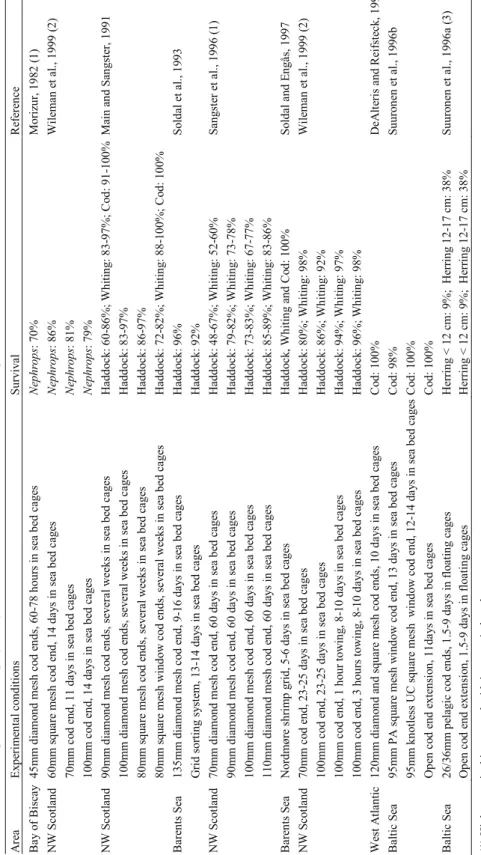
5. Survival of fish escaping from cod ends or modified trawls ... 17
References ... 19
1. Introduction
Trawl selectivity has been traditionally improved by the establishment of minimum cod end mesh sizes, based on the assumption that adult fish of a particular species or group of species should be retained, while juveniles should be released, and cod end mesh size regulations are still the basis for the control of the exploitation pattern in most trawl fisheries manage-ment programmes (Armstrong et al., 1990; Caddy, 1999). However, experience has shown that the
in-crease in cod end mesh size, when considered sepa-rately from other measures, can be of limited use due to a number of different reasons (Van Marlen, 1991; Stewart, 1993). It has been long recognized that mesh size is just one of many parameters affecting fish es-capement through cod ends. Moreover, it was found that trawl selectivity can also be manipulated by changing gear design in order to separate or exclude species during the catch process, based on their dif-ferent sizes, body shapes and behavioural responses
to the different trawl components, which can be par-ticularly useful in multispecies fisheries.
2. Factors affecting cod end selectivity 2.1. Mesh size and mesh shape
Cod end mesh size effects on selectivity have long been reported and became a focus of research since the late 1950s. There is a vast literature on this sub-ject, reviewed by a number of authors (see Holden (1971) and Wileman (1988, 1991) for general re-views; and Briggs (1986) for a review on Norway lobster selectivity). Escapement through cod end meshes has generally been reported to increase with mesh size for a large number of species differing in their morphological traits.
However, evidence exists since earlier studies that a high number of other variables besides mesh size can affect the retention process in cod ends, and from the mid-to-late 1970s increasing effort has been put into the study of other characteristics influencing cod end selectivity. Mesh configuration proved to be one of the most important variables, since escapement through cod end meshes is determined to a large ex-tent by the way the fish shape adapts to mesh shape. Square meshes, which can be obtained from normal diamond mesh netting by mounting it in such a way that the main axis of the netting deviates 45º from its original position, do not close under tension, giving most fish a better chance to escape.
The selectivity of standard diamond mesh cod ends has been compared with that of square mesh ones of similar mesh size in a large number of studies (Table 1). The observed differences in selectivity between the two mesh configurations can fluctuate considerably depending on both the species under study and the range of mesh sizes tested, being more evident for larger mesh sizes than for small mesh cod ends below 50 mm. However, higher selective properties have generally been reported in square mesh cod ends both for crustaceans such as the Norway lobster (Nephrops norvegicus), the rose shrimp (Parapenaeus longirostris) and the red shrimp (Aristeus antennatus), and for round or elliptical cross-sectional shaped fish such as haddock (Melanogrammus aeglefinus), whiting (Merlangius
merlangus), cod (Gadus morhua), saithe (Pollachius virens), herring (Clupea harengus), the European hake (Merluccius merluccius), horse mackerel (Trachurus trachurus), blue whiting (Micromesistius poutassou) and red mullet (Mullus barbatus), among others. In contrast, for those species of more flat cross-sectional shape, including the American plaice (Hippoglossoides platessoides), the sole (Solea solea), the four-spot megrim (Lepidorhombus boscii) and, to a lesser extent, the pout (Trisopterus luscus) and the seabreams (axillary seabream Pagellus acarne and annular seabream Diplodus annularis), for which the body shape is better adapted to a diamond mesh configuration, the use of square mesh cod ends has been observed to have the opposite effect of reducing L50.
As observed in Table 1, variations in L50 are not followed by similar variations in SR, the selection range. Crustaceans are an exception, the increase in L50 when using square mesh being found to be gener-ally associated to corresponding increase in SR, indi-cating lower retention at the same size and selection across a wider range of length classes in square mesh cod ends. For both round and flatfish, higher L50 es-timates in square mesh cod ends may be associated either to an increase in SR, or decrease in this pa-rameter.
A small number of experiments have been carried out where the effects on selectivity of other cod end mesh configurations such as hexagonal mesh were tested. Such effects were less conclusive, as illus-trated for herring in the Baltic trawl fishery, for which higher selectivity is reported by Shevtsov (1988) when using hexagonal meshes, while Suuronen et al. (1991) reported significantly higher retention of small fish when using this mesh configuration when com-pared to diamond mesh of similar mesh size.
2.2. Twine characteristics and cod end construction Similarly to cod end mesh size effects, differences in selectivity related to cod end materials have been addressed since the 1950’s, and the higher selective properties of polyamide cod ends intensively reported when these cod ends were compared with similar ones made in natural materials or in polyethylene (see Holden, 1971, for a review). However, few studies were carried out where the differences found in
Table 1.
Comparison of the selectivity parameters L50 and SR in diamond and square mesh cod ends for different species. Cod end mesh sizes are in
mm. L50 and SR are in total length (cm) for fish species and carapace length (mm) for crustaceans. C - Covered cod end; HC - Hooped
cov-ered cod end; TR - Trouser trawl.
Selectivity parameters Diamond mesh Square mesh Area Experimental conditions
Species L50 SR L50 SR Reference
Scotland C 65mm Nephrops 17.1 17.1 39.3 19.0 Robertson et al., 1986
North Sea C 70mm D vs.60mm S
Nephrops 26.4 11.5 40.1 13.4 Larsvik and Ulmestrand, 1992
Aegean Sea C 20mm Nephrops 22.8 9.5 24.1 5.9 Stergiou et al., 1997
South Portugal HC 55mm Nephrops 27.1 6.1 34.7 16.0 Paper I
HC 55mm Rose shrimp 21.8 5.7 27.1 9.3
South Portugal HC 55mm Red shrimp 13.8 22.6 32.3 9.1 Paper II
Scotland C 90mm Haddock 23.3 5.7 28.6 5.0 Robertson, 1983
Canada TR 130mm Haddock 45.8 5.5 47.1 5.7 Cooper and Hickey, 1987
Canada TR 130mm Haddock 46.5 6.8 51.8 4.2 Cooper and Hickey, 1989
Scotland C 80mm Haddock 21.2 7.4 26.4 6.5 Robertson and Stewart, 1988
C 85mm 20.4 10.6 30.2 5.9
Norway TR 135mm Haddock 47.0 3.5 49.0 3.6 Isaksen and Valdemarsen, 1988
Canada TR 130mm Haddock 41.7 8.5 49.6 4.9 Halliday et al., 1999
Scotland C 90mm Whiting 24.5 6.7 32.8 5.3 Robertson, 1983
Scotland C 80mm Whiting 27.1 7.6 30.8 8.8 Robertson and Stewart, 1988
C 85mm 26.7 10.0 36.5 9.8
Norway TR 135mm Cod 49.2 3.6 54.0 4.0 Isaksen and Valdemarsen, 1988
Canada TR 130mm Cod 58.7 4.5 59.7 4.6 Cooper and Hickey, 1987
Canada TR 140mm Cod 56.2 8.1 61.4 7.6 Cooper and Hickey, 1989
TR 155mm Cod 61.3 6.2 65.0 6.0
Canada TR 130mm Cod 49.5 11.2 56.0 6.7 Halliday et al., 1999
Canada TR 130mm Cod 49.5 11.2 56.0 6.7 Halliday, 2002
TR 140mm Saithe 46.4 7.3 58.5 5.5 Cooper and Hickey, 1989
Baltic Sea C 36mm Herring 15.2 - 16.3 - Dahm, 1991
C 42mm Herring 16.9 - 17.7 -
Finland TR 36mm Herring 15.6 3.5 16.2 1.6 Suuronen and Millar, 1992
SW Portugal C 65mm Hake 16.6 6.0 30.9 8.8 Fonseca et al., 1993
Aegean Sea C 20mm Hake 13.8 7.1 15.1 5.7 Petrakis and Stergiou, 1997
South Portugal HC 55mm Horse mackerel 18.0 3.8 21.7 5.0 Paper II SW Portugal C 60mm Horse mackerel 14.4 3.3 21.9 8.3 Paper III
Aegean Sea C 20mm Blue whiting 21.2 4.1 17.0 4.4 Petrakis and Stergiou, 1997 South Portugal HC 55mm Blue whiting 23.0 3.7 30.2 4.5 Paper II
Aegean Sea C 36mm Red mullet 11 1.8 11.8 1.6 Tokaç et al., 1998
C 40mm Red mullet 12.2 2.2 13.2 1.9
C 44mm Red mullet 13.5 2.7 14.7 2.9
selectivity can be attributed to cod end material only, since in most of them cod end design and mesh size, twine diameter and twine construction, which can affect cod end selectivity due to their influence on mesh opening, were found to vary simultaneously. A recent study by Tokaç et al. (2002), where the selec-tivity of similar cod ends only differing in the mate-rial (polyamide vs. polyethylene) was compared for several Mediterranean species, reports higher L50 for polyamide cod ends.
The effects of netting and twine characteristics on selectivity have been more recently reviewed by Ferro and O’Neill (1994). Mechanical effects affect-ing mesh shape and mesh openaffect-ing are reported to be dependent on twine material, as well as on twine di-ameter and construction. These variables are also likely to change the water flow inside the cod end, which in turn can affect escape responses of fish or passive wash-out through cod end meshes. While the increase in twine diameter and the use of braided, instead of twisted twines, had already been reported to reduce the selectivity (Isaksen et al., 1990), ad-verse effects of increasing twine diameter were also found in more recent studies by Lowry (1995), Lowry and Robertson (1996), Kynoch et al., (1999) and
Öz-bilgin et al. (2002) in polyethylene cod ends, where they are reported to reduce mesh opening due to an increase in flexural stiffness.
Mechanical effects affecting mesh shape and mesh opening are pointed out by Ferro and O’Neill (1994) to be highly related to several aspects of cod end con-struction, such as the length of the cod end extension, the number of meshes in cod end circumference and the use of lastridge ropes. This was demonstrated in a number of studies for diamond mesh cod ends (Table 2). Because diamond meshes, in the rear net sections, tend to close under tension as the catch bulk in-creases, reducing the cod end extension was found to contribute to an increase in cod end mesh opening, increasing the escape probability of fish. A similar effect can be attained by using narrow cod ends with a lower number of meshes in circumference, or using shortened lastridge ropes. While the effects of these variables on selectivity have been mainly investigated for round-bodied fish, species that are more flat in cross-sectional shape do not seem to profit, as ex-pected, from increase in cod end mesh opening re-lated to such cod end alterations, as suggested by the selectivity data for annular seabream (Lök et al., 1997) in Table 2.
Table 1 (continued from previous page).
Comparison of the selectivity parameters L50 and SR in diamond and square mesh cod ends for different species. Cod end mesh sizes are in
mm. L50 and SR are in total length (cm) for fish species and carapace length (mm) for crustaceans. C - Covered cod end; HC - Hooped
cov-ered cod end; TR - Trouser trawl.
Selectivity parameters Diamond mesh Square mesh Area Experimental conditions
Species L50 SR L50 SR Reference
Canada TR 130mm American plaice 31.1 7.3 30.5 4.2 Walsh et al., 1992 TR 140mm American plaice 38.4 9.6 30.5 4.0
TR 155mm American plaice 38.2 8.4 32.3 3.2
Belgium C 75mm Sole 20.6 5.6 20.3 4.8 Fonteyne and M'Rabett, 1992
22.9 5.3 22.4 6.5
Aegean Sea C 20mm Four-spot megrim 10.3 3.3 8.5 3.5 Petrakis and Stergiou, 1997 SW Portugal HC 65mm Four-spot megrim 16.7 3.5 16.0 2.8 Paper IV
Aegean Sea C 20mm Pout 13.7 5.5 11.9 6.0 Petrakis and Stergiou, 1997
Aegean Sea C 36mm Annular sea bream 7.6 1.4 7.5 2.1 Tokaç et al., 1998
C 40mm Annular sea bream 8.6 1.2 8.8 1.5
C 44mm Annular sea bream 9.9 1.1 8.8 1.1
C 48mm Annular sea bream 12.7 1.3 12.0 2.2 C 36mm Axillary sea bream 10.6 2.2 10.4 2.3 C 40mm Axillary sea bream 11.8 1.6 12.4 1.8
Table 2.
Relationship between L50 (in cm) and cod end extension length, cod end diameter and length of lastrige ropes. Cod end mesh sizes are in mm.
C - Covered cod end; HC - Hooped covered cod end; TR - trouser trawl; TW - twin trawl.
Area Experimental conditions Species Extension length (m) Reference
Long Short Standard
North Sea C 80mm Haddock 19.4 26.0 Robertson and Ferro, 1988
Whiting 25.9 30.3
18.5 13.9 12.1
Baltic Sea C 42mm Herring 17.2 17.7 19.5 Dahm, 1991
13.7 9.1 no ext.
North Sea C 80mm Haddock 20.1 21.4 23.9 Reeves et al., 1992 (1)
2.2m diameter Whiting 23.6 25.3 28.7
Cod 21.4 22.2 23.6
Cod end diameter (m)
Standard Narrow
North Sea C 80mm Haddock 20.2 23.2 Robertson and Ferro, 1988
C 90mm Whiting 26.7 31.2
4.0 3.2 2.2
North Sea C 80mm Haddock 16.5 19.8 23.9 Reeves et al., 1992 (1)
with no
exten-sion Whiting 21.5 24.7 28.7
4.2 3.2 2.2
North Sea C 90mm Haddock 20.4 25.1 29.8 Galbraith et al., 1994 (2)
Whiting 22.8 29.4 36.0
Cod 23 28.8 34.7
3.5 Narrow
Aegean Sea C 44mm Red mullet 13.7 14.3 Lök et al., 1997
Annular sea
bream 9.9 10.1
Large Standard
Adriatic Sea HC 46mm Hake 9.7 11.5 Fiorentini and Leonori, 2002
HC 56mm 12 17.3
HC 46mm Red mullet 6 10.8
HC 56mm 9.7 13.4
(1) All combinations of extension length and cod end diameter have been tested in 80, 90 and 100mm cod ends. (2) All combinations of cod end diameters have been tested in 90, 100 and 110mm cod ends.
2.3 Seasonal variation
The importance of seasonal variation in selectivity was demonstrated in a few studies that relate selectiv-ity to differences in body shape associated to seasonal changes in fish condition or to the effects of seasonal temperature changes on fish activity, thus condition-ing escape behaviour. Selectivity for cod and haddock was found to increase with increasing girth associated with better fish condition or with increasing water temperature (Tschernij et al., 1996; Özbilgin, 1998; Özbilgin and Wardle, 2002), suggesting that the abil-ity of fish to pass through cod end meshes does not entirely depend on the geometric relationship be-tween fish body and mesh shape, being also affected by fish swimming activity.
2.4 Vessel and sea state related factors
Effects on cod end selectivity of vessel-related fac-tors such as vessel size, vessel-gear interaction (rela-tionship between vessel propulsion and gear drag) and hauling technique were estimated by Tchernij
and Holst (1999) for the Baltic Sea cod fishery in seven trawlers using identical cod ends. Hauling type in particular was found to affect L50 and SR, with increased selectivity in vessels where haul-back is interrupted, which indicates post-towing escape dur-ing this process. Differences in cod end selectivity were also reported for sole (De Clerck et al., 1981); Nephrops (Polet and Redant, 1994); and brown shrimp Crangon crangon (Polet, 2000), which were related to differences in sea state. These authors refer that sea roughness and the resulting increase in gear motion can promote wash-out effects in the cod end during haul-back, thereby increasing post-towing escape.
In a more recent study, O’Neill et al. (2003) sys-tematically investigated the relationship between sea state induced vessel motion and cod end selection for haddock and whiting. Cod ends were observed to pulse with the frequency of the vessel motion in rough weather, producing changes in mesh slackness that are likely to be responsible for the increase in cod end selectivity during hauls.
Table 2 (continued from previous page).
Relationship between L50 (in cm) and cod end extension length, cod end diameter and length of lastrige ropes. Cod end mesh sizes are in mm.
C - Covered cod end; HC - Hooped covered cod end; TR - trouser trawl; TW - twin trawl.
Area Experimental conditions Species Lastridge ropes Reference
Standard -15%
Barents Sea TR 135mm Cod 52.0 58.0 Isaksen and Valdemarsen, 1990
Standard -6% -15%
Baltic Sea C 42mm Herring 16.9 19.1 18.6 Dahm, 1991
Standard -15%
North Sea TW 135mm Haddock -55% Jacobsen, 1991 (3)
Cod -8%
Saithe -10%
Red fish -19%
Standard -12%
Canada TR 115mm Deepwater redfish 31.5 33.2 Hickey et al., 1995
TR 105mm 26.8 32.1
TR 90mm 27.2 26.9
Aegean Sea C 44mm Standard -15% Lök et al., 1997
Red mullet 13.7 15.1
Annular sea
bream 9.9 9.8
2.5 Cod end catch
While the effects on cod end selectivity of most of the above variables were systematically investigated with the purpose of improving the understanding of the selection process in cod ends, other variables, such as haul duration or cod end catch size, were in-cidentally observed to be related with selectivity in a considerable number of studies. Cod end catch size has been found to affect cod end geometry and reduce the degree of mesh opening in the central part of the cod end, thus conditioning the escape through cod end meshes (Robertson and Stewart, 1988). There is evidence of negative correlation between cod end catch size and selectivity parameters L50 or SF, mostly in standard diamond cod ends or cod ends equipped with square mesh windows, in a number of studies e.g. for haddock, cod, whiting, herring, wall-eye pollack (Theragra chalcogramma) and the Ar-gentine hake (Merluccius hubbsi) (Table 3). On the other hand, evidence of positive correlation between cod end catch size and selectivity was found for the Norway lobster, haddock, whiting, cod, blue whiting, silver hake (Merluccius bilinearis) and for the Euro-pean hake. A possible explanation for this apparent contradiction can be proposed when the range of cod end catch is taken into account for the different stud-ies (Table 3), suggesting that negative effects of this variable on selectivity tend to be associated with higher catches, while positive effects were generally recorded in studies where lower catch values are re-ported. O’Neill and Kynoch (1996) suggest a non-linear relationship between cod end catch and selec-tivity parameters on the basis of cod end mechanical behaviour: as the catch builds up the meshes in front of the cod end open wider and selectivity increases, up to a point where maximum mesh opening is achieved. For higher catches, these authors suggest that the adverse effects on selectivity attributed to mesh closeness in the central part of the cod end, thus reducing the escape area, can possibly be confounded with masking effects resulting from the use of covers. However, this hypothesis is not in accordance with Isaksen et al. (1990) and Suuronen et al. (1991), who reported decreasing L50 with increasing catch, in se-lectivity experiments where trouser trawls were used, while Erickson et al. (1996) report the same effect in alternate hauls experiments. More recently, Madsen
and Holst (2002), using covered cod ends equipped with a kite cover, for which no masking effects were observed (see Madsen et al. 2001), have also reported negative effects of cod end catch on L50 for cod in catches of up to 700 Kg, while Madsen et al. (2002) using the same cover, found similar effects for cod in catches under 400 Kg, after which L50 was observed to stabilise.
Initial increase in selectivity followed by further decrease is probably the most likely mechanism to explain the variability observed for roundfish. How-ever, this mechanism does not apply to flatfish cod end selectivity data (Van Beek et al., 1983), where negative correlation between cod end catch size and SF are reported, at lower catch levels, for sole and plaice (Pleuronectes platessa). For such species these effects are likely to be related to cod end mesh clog-ging by accumulating catches. Polet (2000), in a cod end selectivity study for brown shrimp, where by-catch includes flatfish species, also reported negative correlation between total catch size (or mesh clog-ging) and L50.
2.6 Haul duration and towing speed
Haul duration, together with towing speed, were found to affect the catching efficiency in trawls by possibly contributing to act as a species and/or a size selecting mechanism (Wardle, 1986, 1987, 1989; He, 1993). While fish swimming in the path of a trawl during the first stages of the catch process tend to keep a constant position relative to the net panels as a result of compensatory movements in response to shifts in their visual field, at a latter stage they can either become exhausted, falling back towards the cod end, or outswim the trawl, depending on whether the trawling speed and/or haul duration exceed fish swimming abilities. This is a complex process affect-ing catch composition and catch size distribution, and the extent to which it affects selectivity is difficult to predict. Consistent effects of towing speed have not been reported in selectivity studies, even when they have been directly addressed as was the case in ex-periments by Dahm et al. (2002), for cod and had-dock. This is not surprising if the narrow towing speed ranges practiced for a given fishery are taken into account, along with the inherent difficulty of investigating a parameter such as speed. On the other
T ab le 3 . R el at io ns hi ps b et w ee n se le ct iv it y an d co d en d ca tc h si ze . C od e nd m es h si ze s ar e in m m . C C ov er ed c od e nd ; H C H oo pe d co ve re d co d en d; T R T ro us er tr aw l; A A lt er na te ha ul s. S r ef er s to s qu ar e m es h. A re a E xp er im en ta l c on di ti on s Sp ec ie s C od e nd c at ch si ze ( K g) R el at io ns hi p be tw ee n se le ct iv it y an d co d en d ca tc h si ze R ef er en ce C el ti c Se a C 4 5-75 m m N ep h ro p s 30 1 10 po si tiv e (o n SF ) C ha ru au , 1 97 8 (1 ) C el ti c Se a C 5 0-75 m m N ep h ro p s 0 - 14 8 po si tiv e (o n SF ) C ha ru au , 1 97 9 (1 ) So ut h Po rt ug al H C 5 5-70 m m D , 5 5m m S N ep h ro p s 0 - 25 0 po si tiv e (o n SR ) Pa pe r I N or th S ea C 2 2m m B ro w n sh ri m p no t s pe ci fi ed ne ga ti ve ( on L50 ) Po le t ( 20 00 ) ( 2) C an ad a C 6 0-70 m m Si lv er h ak e 0 - 20 00 po si tiv e (o n SF ) C la y, 1 97 9 A rg en ti na C 1 10 -1 25 m m A rg en ti ne h ak e 50 0 - 30 00 ne ga ti ve ( on S F) D ah m , 1 98 0 A rg en ti na C 1 20 m m w ith a nd w ith ou t 9 0m m w in do w A rg en ti ne h ak e 72 0 - 26 00 0 ne ga ti ve ( on L 50 ) E hr ha rd t, 19 96 ( 3) SW P or tu ga l C 6 5 an d 70 m m H ak e 10 0 - 30 0 po si tiv e (o n L50 ) Pa pe r IV B ar en ts S ea T R 1 40 m m C od a nd H ad do ck 10 0 - 15 00 ne ga ti ve ( on L50 ) Is ak se n et a l., 1 99 0 B al tic S ea C 1 20 a nd 1 40 m m C od 50 0 - 14 00 ne ga ti ve ( on L50 ) T sc he rn ij et a l., 1 99 6 B al tic S ea H C 1 05 m m w ith 1 15 m m s qu ar e m es h w in do w C od 30 0 - 80 0 ne ga ti ve ( on L50 ), p os it iv e (o n SR ) M ad se n et a l., 1 99 8 B al tic S ea C 1 20 m m C od 82 00 2 75 00 ne ga ti ve ( on L50 ), p os it iv e (o n SR ) T sc he rn ij an d H ol st , 1 99 9 B al tic S ea C ( ki te c ov er ) 10 5m m w it h 11 0m m w in do w C od 0 - 70 0 ne ga ti ve ( on L50 ) M ad se n an d H ol st , 2 00 2 B al tic S ea C ( ki te c ov er ) 10 5-14 0m m C od 10 0 – 11 00 ne ga ti ve ( on L50 ) un de r 40 0K g, st ab ili zi ng a t h ig he r ca tc he s M ad se n et a l., 2 00 2 N or w ay C 1 00 m m C od a nd H ad do ck 90 7 70 po si tiv e (o n L50 ) D ah m e t a l., 2 00 2 Sc ot ti sh S ea H C 1 00 m m H ad do ck a nd W hi tin g 10 0 - 40 0 po si tiv e (o n L50 ) O 'N ei ll an d K yn oc h, 1 99 6 N or th -S ea H C 7 0m m w it h 90 m m s qu ar e m es h w in do w W hi tin g 20 0 - 10 00 ne ga ti ve ( on L50 a nd S R ) M ad se n et a l., 1 99 9 B al tic S ea C 4 2m m S H er ri ng 0 - 18 00 ne ga ti ve ( on L50 ) D ah m , 1 99 1 G ul f of F in la nd T R 3 2m m H er ri ng 20 0 - 16 00 ne ga ti ve ( on L50 ) Su ur on en e t a l., 1 99 1 B er in g Se a A 8 8 an d 11 3m m , 9 5 an d 10 8m m S W al le ye p ol lo ck 0 - 80 0 00 ne ga ti ve ( on L50 ) E ri ck so n et a l., 1 99 6 So ut h Po rt ug al H C 5 5, 6 0 an d 70 m m B lu e w hi tin g 50 3 50 po si tiv e (o n L50 ) Pa pe r II SW P or tu ga l C 6 5 an d 70 m m B lu e w hi tin g 50 3 00 po si tiv e (o n L50 ) Pa pe r IV T he N et he rl an ds C 4 2 m m So le a nd P la ic e 0 - 30 0 ne ga ti ve ( on S F) V an B ee k et a l., 1 98 3 (1) T he in fl ue nc e of th e am ou nt o f by -c at ch w as r ep or te d on S F (2 ) T he in fl ue nc e of to ta l c at ch s iz e w as r ep or te d on L50 (3 ) T he in fl ue nc e of to ta l c at ch s iz e on L50 h as b ee n di re ct ly a dd re ss ed
hand, in what regards to the possible effects of haul duration on selectivity, this variable is usually posi-tively correlated to cod end catch, and their separate effects are therefore difficult to analyse.
2.7 Towing depth
The effects of depth on fish escapement from cod ends or other trawl areas have usually been related to the intensity of visual stimuli produced by net panels and rigging at different light levels (Glass and Wardle, 1989; Walsh and Hickey, 1993). However, depth can affect species and size composition of the populations fished, and this can influence selectivity to a considerable extent. In Papers I and II L50 and SR were found to increase with increasing depth for blue whiting and rose shrimp respectively, captured in crustacean fishing grounds from 150 to 700 m off the south coast, where larger individuals were cap-tured at greater depths. While for the rose shrimp the observed increase in SR can to a certain extent reflect the wider length intervals recorded at greater depths from 200 to 400 m, the results for blue whiting sug-gest that the ability of fish to pass through cod end meshes can be affected by variables other than fish dimensions. More active behaviour of bigger fish associated to higher swimming capacity can possibly contribute to explain the unexpected effects of depth on the selectivity for this species.
3. Improving the selectivity in trawl areas external to cod ends
While changing cod end characteristics may lead to more size-selective trawls, allowing for the escape-ment of undersized fish, the problem of species-selectivity remains unsolved in many fisheries, par-ticularly those where a large number of species are captured as by-catch. In the last two decades, there has been a widespread concern about the level of by-catch and discards associated with multi-species fish-eries, and consequently an intensification of the search for alternatives to mesh size regulations. In a global assessment of by-catch and discards, Alverson et al. (1994), estimated the total annual discards in world’s marine fisheries to be around 27 million ton-nes of fish and other organisms, mostly dead or
dy-ing, for a target catch of 77 million tonnes. Discards to landed target catch weight ratios were found to be particularly high for trawl fisheries, especially in shrimp trawling, for which discards were estimated to be 9.5 million tons.
The problem of discards has been addressed in a number of countries through the introduction of physical modifications to conventional trawls. The recognition that trawl selectivity can be manipulated in trawl areas external to the cod end by changing gear design in order to separate and/or exclude spe-cies during the catch process, was the key factor when searching for alternatives to mesh size regula-tions. Crustacean trawling in particular offers a wide basis for gear modifications, since differences in be-haviour between crustacean and fish by-catch species can be explored, together with differences in size, in order to reduce by-catch and discards while maintain-ing the catches of commercial crustaceans.
3.1 Mesh panels
Many different types of modifications to crusta-cean trawls were tested worldwide over the last dec-ades (for a general review, see Broadhurst, 2000) that include mechanisms based on differences in behav-iour between shrimp and fish species, or mechanical sorting by size. In many cases they proved to be suc-cessful as by-catch separators or excluders, and some were commercially enforced or have been used on a voluntary basis. In North-Atlantic prawn-trawl fisher-ies, the utility of a number of different sorting vices, including separator panels and excluding de-vices, has been examined since the 1960’s, with the testing of the first selective trawl equipped with an oblique sorting panel extending from the net mouth until the cod end entrance (Kurc et al., 1965). A number of experiments were carried out in Nephrops fisheries using modifications of this panel (Kurc and Betus, 1969) or horizontal panels designed to create two levels inside the trawl connected to two cod ends of different mesh sizes (Symonds and Simpson, 1971; Hillis, 1983, 1985; Ashcroft, 1984; Charuau, 1985; Hillis and Carrol, 1988; Main and Sangster, 1982a, 1982b, 1985a, 1985b). Good results have been re-ported for a number of designs (Table 4) in the sepa-ration between Nephrops which, similarly to most benthic invertebrates, has low swimming capacity
T ab le 4 . E ff ec ts o f us in g se pa ra to r pa ne ls o n ta rg et c at ch a nd b y-ca tc h re po rt ed b y di ff er en t a ut ho rs . H h or iz on ta l p an el s. H d iv id in g th e w ho le tr aw l f ro m f oo tr op e to c od e nd . H 2 - di vi d-in g th e re ar h al f of th e tr aw l; H 3 - di vi di ng th e co d en d. O 1 - ob liq ue p an el s in th e re ar p ar t o f th e tr aw l; O 2 - ob li qu e pa ne ls b ef or e th e co d en d; O 3 - H H o bl iq ue p an el s. P an el m es h si ze s ar e in m m . Are a Se pa ra to r pa ne ls % s ep ar at ed to u pp er c od e nd R ef er en ce T ar ge t c at ch B y-ca tc h Fr en ch c oa st O 1 40 m m N ep h ro p s: 2 -1 7% H ak e: 7 3% K ur c an d B et us , 1 96 9 Ir is h Se a H 3 50 m m N ep h ro p s: 2 1% W hi tin g: 6 6% M L S Sy m on ds a nd S im ps on , 1 97 1 Ir is h Se a O 1 15 0m m N ep h ro p s: 1 2% W hi tin g: 8 6% H ill is , 1 98 3 Ir is h Se a H 1 60 m m , 0 .5 0m a bo ve f oo tr op e N ep h ro p s: 0 % W hi tin g: 9 6% A sh cr of t, 19 84 Ir is h Se a H 2, 0 .7 5m a bo ve f oo tr op e N ep h ro p s: 7 % M L S N ep h ro p s: 1 0% < M L S H ill is , 1 98 5 ( 1) W hi tin g: 9 6% M L S 86 % < M L S Ir is h Se a H 2, 0 .7 5m a bo ve f oo tr op e N ep h ro p s: 1 3% W hi tin g: 7 5% H ill is a nd C ar ro l, 19 88 ( 1) B ay o f B is ca y H 1 50 m m , 0 .7 5m a bo ve f oo tr op e N ep h ro p s: 7 % H ak e: 9 0% C ha ru au , 1 98 5 C el ti c Se a N ep h ro p s: 9 % H ak e: 5 8% Sc ot la nd H 1 85 m m , 1 .0 6m a bo ve f oo tr op e N ep h ro p s: 1 1% W hi tin g: 6 5% M ai n an d Sa ng st er , 1 98 2a H ad do ck : 3 6% C od : 5 % H 1 85 m m , 0 .6 0m a bo ve f oo tr op e N ep h ro p s: 1 4% W hi tin g: 8 0% H ad do ck : 8 1% C od : 1 7% H 1 85 m m , 0 .4 5m a bo ve f oo tr op e N ep h ro p s: 1 7% W hi tin g: 7 5% H ad do ck : 8 6% C od : 4 6% N or th S ea H 1 50 m m , 0 .7 5m a bo ve f oo tr op e N ep h ro p s: 1 % H ad do ck : 9 6% M ai n an d Sa ng st er , 1 98 5a W hi tin g: 9 4% So ut h Po rt ug al O 2 12 0m m N ep h ro p s: 1 % M L S R os e sh ri m p: 1 3% < M L S Pa pe r V R os e sh ri m p: 1 2% M L S B oa rf is h: 6 7 to 7 7% B lu e w hi tin g: 8 1% H or se m ac ke re l: 51 to 6 9% M L S (1) P an el m es h si ze s ar e no t s pe ci fi ed . Con tin ue s on th e ne xt p ag e
T ab le 4 ( co nt in ue d fr om p re vi ou s pa ge ). E ff ec ts o f us in g se pa ra to r pa ne ls o n ta rg et c at ch a nd b y-ca tc h re po rt ed b y di ff er en t a ut ho rs . H h or iz on ta l p an el s. H d iv id in g th e w ho le tr aw l f ro m f oo tr op e to c od e nd . H 2 - di vi d-in g th e re ar h al f of th e tr aw l; H 3 - di vi di ng th e co d en d. O 1 - ob liq ue p an el s in th e re ar p ar t o f th e tr aw l; O 2 - ob li qu e pa ne ls b ef or e th e co d en d; O 3 - H H o bl iq ue p an el s. P an el m es si ze s ar e in m m . Are a Se pa ra to r pa ne ls % s ep ar at ed to u pp er c od e nd R ef er en ce T ar ge t c at ch B y-ca tc h B ar en ts S ea O 3 60 m m Pi nk s hr im p: 1 2% H ad do ck : 8 7% K ar ls en , 1 97 6 (2 ) B lu e w hi tin g: 8 6% C od : 8 7% N or w ay p ou t: 37 % E ur op ea n Fl ou nd er : 6 3% B ar en ts S ea O 3 6 0/ 55 m m Pi nk s hr im p: 5 % H ad do ck : 9 5% K ar ls en a nd M at ha i, 19 78 ( 2) C od : 9 0% E ur op ea n Fl ou nd er : 7 5% N or th S ea H 1 35 m m , 1 .5 0m a bo ve f oo tr op e Pi nk s hr im p: 2 8% N or w ay p ou t: 57 % M ai n an d Sa ng st er , 1 98 5b B ar en ts S ea O 3 6 0/ 55 m m Pi nk s hr im p: 1 3% H ad do ck : 4 7% L ar se n, 1 98 6 (2 ) B lu e w hi tin g: 4 9% C od : 7 1% E ur op ea n Fl ou nd er : 7 2% N or th S ea O 2 10 0m m Pi nk s hr im p: 0 % no t q ua nt if ie d Sø re ns en a nd Y ng ve ss on , 1 98 7 B ar en ts S ea H 1 12 0m m , 0 .7 5m a bo ve f oo tr op e H ad do ck : 5 2% V al de m ar se n et a l., 1 98 5 Sa ith e: 8 7% C od : 3 3% B ar en ts S ea H 2 30 0m m , s qu ar e m es h H ad do ck : 8 9% E ng ås e t a l., 1 98 8 Sa ith e: 7 2% C od : 2 9% (2) In t ra w ls e qu ip pe d w ith H -H o bl iq ue p an el s th er e is n o up pe r co d en d an d th e co nt ro l o f th e ca tc h fr ac tio ns r et ai ne d by th e pa ne ls is c ar ri ed o ut b y m ea ns o f to p co ve rs .
and cannot resist water flow inside the trawl (Main and Sangster, 1985c; Newland and Chapman, 1989), tumbling down the net and being directed to the lower cod end, and fish species such as haddock, whiting and saithe, which tend to swim upwards (Main and Sangster, 1981, 1982a, 1982b,1985b), be-ing captured in the upper cod end.
The resistance to their commercial introduction related either to the increase in gear weight and cost or to operational problems was a major factor contributing to the abandonment this type of design in favour of smaller panels, placed in the rear part of the trawl. By this time oblique sorting panels made in square meshes, placed before the cod end and covering the entire trawl vertical section, associated to escape openings, had already been tested in Norway, aiming at the exclusion of cod, haddock, Norway pout Trisopterus esmarki and European flounder Platichthys flesus from trawls targeting the pink shrimp Pandalus borealis. Karlsen (1976) and Karlsen and Mathai (1978) reported a number of experiments using these types of panels, which were commercially adopted in 1985 in response to regulations that limited fish by-catch in pink shrimp fisheries (Larsen, 1986; Karlsen, 1988).
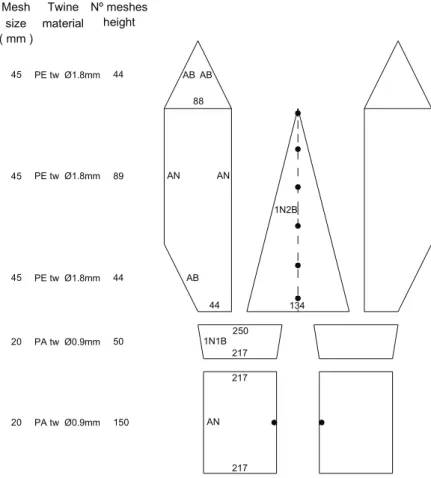
A different concept of oblique separator panel, to be installed at the rear part of the trawl, was developed for a two cod end trawl by Sørensen and Yngvesson (1987) for the Danish fishery for pink shrimp in the northwestern North Sea, where the by-catch includes a large fraction of round fish including Norway pout, cod and haddock, and also of benthic species such as the Norway lobster, monkfish (Lophius piscatorius) and several flatfish species. This panel design includes an upward sloping forepart, installed with the purpose of guiding the higher swimming fish to the upper trawl section, followed by an horizontal small mesh rear part separating the trawl in two different compartments ending in a lower and an upper cod end. The large mesh forepart was made in big meshes to allow shrimps to pass through and be retained in the lower cod end. A passage between the lower trawl belly and the leading edge of the panel was provided to allow the Norway lobster, monkfish and flatfish to be directed to the lower cod end.
This design was tested in the Portuguese crustacean fishery off the south coast (Paper V), showing good
results in the separation between crustaceans, Norway lobster and rose shrimp, which were captured at the lower cod end, and small pelagic by-catch species such as the boarfish (Capros aper) and the blue whiting, guided to the upper trawl section. However, for horse mackerel and hake a clear separation could not be achieved.
3.2 Square mesh windows
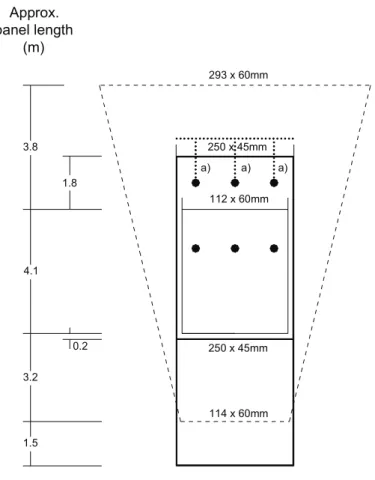
The utility of square mesh windows as by-catch re-ducing devices based on differences in behaviour between crustaceans and fish, has on the other hand been examined more recently, during the last decade. They have been recognized as preferential fish escape zones when placed in the cod ends or other strategi-cally chosen trawl areas, creating visual stimuli that enhance fish escapement (Briggs and Robertson, 1993; Glass et al., 1993) and modifying the water flow inside the trawl (Broadhurst et al., 1999). Square mesh windows have been tested in Nephrops fisheries where the by-catch is comprised mainly of haddock and whiting, as well as in haddock and whit-ing fisheries, and shrimp fisheries (Table 5). Most studies refer to comparative fishing experiments where square mesh window cod ends have been tested against conventional diamond mesh cod ends using twin trawl rigs, while Hillis et al. (1991) used single trawls in parallel hauls experiments, and in Paper VI a single trawl equipped with a top cover was towed.
In more recent experiments (Graham and Kynoch, 2001), the selectivity of conventional diamond mesh cod ends and the same cod ends equipped with win-dows placed in the top of the cod end and in the ex-tension was estimated for haddock in the North Sea, by testing them against a control cod end in a twin trawl rig, and a higher L50 was reported for the cod end with the window placed at top. On the other hand, Madsen et al. (2002) compared the selectivity of a number of conventional cod ends and window cod ends using the cod end covered method in twin trawls for the Baltic cod fishery. Significantly higher L50 and lower SR values were reported for window cod ends with the same mesh size as that of standard cod ends.
While the reported escape percentage through square mesh windows is almost always near zero for
Nephrops and relatively small for shrimps, a consid-erable reduction of the marketable fish by-catch, along with undersized individuals, has been generally observed associated with the use of these sorting de-vices (Table 5).
3.3 Sorting grid systems
Sorting grid systems, which were originally devel-oped for species separation and further applied to size separation, were first tested in Norway by the end of the 1980’s with the aim of excluding cod, haddock, Norway pout and European flounder from trawls tar-geting the pink shrimp (Isaksen et al., 1992). In the original design, known as the Nordmøre grid, the grid frame was made in bars covering the entire trawl sec-tion, allowing the passage of shrimp towards the cod end, while by-catch species are released through a triangular shaped escape hole placed above the grid at the top of the extension piece. A guiding funnel was placed before the grid with the purpose of forcing all the fish and shrimp to enter in contact with the grid, irrespective of the height of their entrance in the trawl.
Nordmøre grids along with variations of the origi-nal design were intensively tested during the last dec-ade in pink shrimp fisheries in Norway (Valde-marsen, 1996), the North Sea (Valde(Valde-marsen, 1996; Madsen and Hansen, 2001), off the Canadian East coast (Brothers and Boulos, 1996; Brothers, 1998), as well as in Greenland, Iceland, Spitzbergen and the Barents Sea (Anon, 1996; Anon, 1998). Their evalua-tion as by-catch excluders was extended to Nephrops (Valdemarsen et al., 1996), silver hake and cod (Brothers, 1998), monkfish (Meillat et al., 1994), brown shrimp (Wienbeck, 1997; Polet, 2002) and crustacean fisheries (Fonseca et al., 2001, unpub-lished data); to Australian shrimp fisheries (Broad-hurst et al., 1996); and to the Argentine hake fishery (Ercoli et al., 1997, 1998). Changes to the original design included modifications in the shape or position of the grid frames and in the grid angle of attack; in-troduction of bottom or top escape passages through which target species larger in size that cannot pass through the grid can be directed to the trawl cod end; and differences in the distance between grid bars, which was adapted to the dimensions of the target species.
In Table 6 some of the results are presented from different studies where Nordmøre-type grid sorting systems have been tested. For a number of them, se-lectivity parameters could be estimated for the main species. However, unlike for square mesh windows, in most experiments with grids no direct comparisons were made between the selectivity in standard trawls and trawls equipped with grids. Therefore, selectivity parameters are not presented; instead the reported effects on target catch or reduction of by-catch (esti-mated through the use of top covers attached to the grid escape holes) are shown, when available. Com-parative fishing experiments of trawls equipped with grid sorting systems against conventional trawls were carried out by Broadhurst et al. (1996) and Madsen and Hansen (2001), using a twin trawl rig, and by Ercoli et al. (1997) in alternate hauls.
4. Commercial introduction of cod end modifications and species-sorting devices The improvement of the selectivity in cod ends by using thinner twines and low numbers of meshes in circumference has been widely recognized, and these measures are at present being progressively incorpo-rated in fisheries regulations (see Reg. (CE) 850/98). Some problems are raised, on the other hand, associ-ated to the use of square mesh cod ends. Knot slip-page, which can occur with continued use associated to high catches, has been generally reported as a ma-jor drawback to their commercial use. Practical prob-lems concerning the use of square mesh cod ends could be successfully overcome with the use of knot-less netting (Van Marlen, 1991), but no information was found on the introduction of square mesh cod ends made in knotless netting in fisheries regulations as a way to improve selectivity. However, square mesh cod ends made in conventional netting have been voluntarily used by some fishermen in Nephrops trawls in the Skagerrak (Ulmestrand, pers. comm.).
From the vast amount of gear modifications tested in order to reduce by-catch, only a small number has been successfully introduced in the commercial activ-ity. Resistance to their implementation by the final users has been associated to complex designs and high costs, failures in operating efficiently over a range of commercial conditions and undesirable
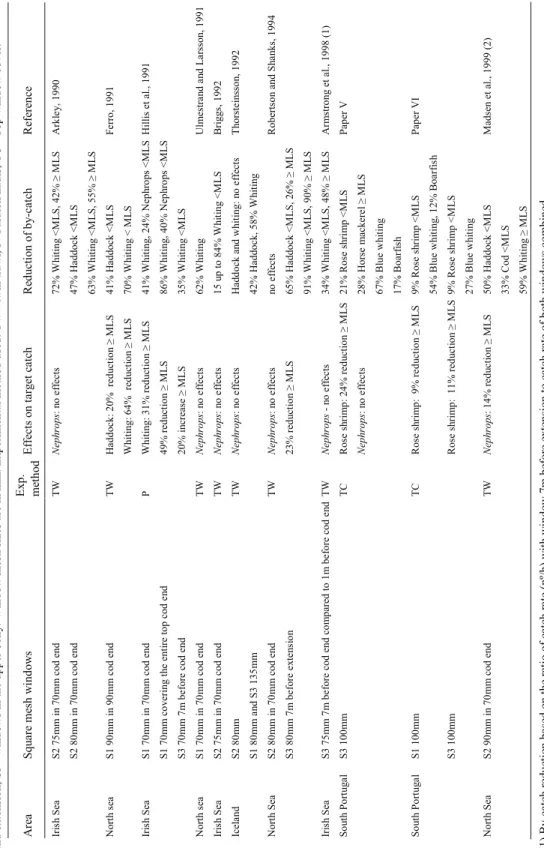
T ab le 5 . E ff ec ts o f us in g sq ua re m es h w in do w s on ta rg et c at ch a nd b y-ca tc h re po rt ed b y di ff er en t a ut ho rs . S 1 - w in do w s pl ac ed in th e to p of th e co d en d; S 2 - w in do w s in th e to p of th e co d en d ex te ns io n; S 3 - w in do w s in th e up pe r be lly . W in do w m es h si ze s ar e in m m . E xp er im en ta l m et ho d us ed : T W tw in tr aw l; P ar al el l h au ls ; T C T op w in do w c ov er . A re a Sq ua re m es h w in do w s E xp . m et ho d E ff ec ts o n ta rg et c at ch R ed uc tio n of b y-ca tc h R ef er en ce Ir is h S ea S 2 75 m m in 7 0m m c od e nd T W N ephr ops : n o ef fe ct s 72 % W hi ti ng < M L S, 4 2% M L S A rk le y, 1 99 0 S 2 80 m m in 7 0m m c od e nd 47 % H ad do ck < M L S 63 % W hi ti ng < M L S, 5 5% M L S N or th s ea S 1 90 m m in 9 0m m c od e nd T W H ad do ck : 2 0% r ed uc ti on M L S 41 % H ad do ck < M L S Fe rr o, 1 99 1 W hi ti ng : 6 4% r ed uc tio n M L S 70% W hi ti ng < M L S Ir is h Se a S1 7 0m m in 7 0m m c od e nd P W hi ti ng : 3 1% r ed uc ti on M L S 41 % W hi ti ng , 2 4% N ep hr op s < M L S H ill is e t a l., 1 99 1 S 1 70 m m c ov er in g th e en tir e to p co d en d 49 % r ed uc ti on M L S 86 % W hi ti ng , 4 0% N ep hr op s < M L S S 3 70 m m 7 m b ef or e co d en d 20 % in cr ea se M L S 35 % W hi ti ng < M L S N or th s ea S 1 70 m m in 7 0m m c od e nd T W N ephr ops : n o ef fe ct s 62 % W hi ti ng U lm es tr an d an d L ar ss on , 1 99 1 Ir is h S ea S 2 75 m m in 7 0m m c od end T W N ephr ops : n o ef fe ct s 15 u p to 8 4% W hi ti ng < M L S B ri gg s, 1 99 2 Ic el an d S 2 80 m m T W N ephr ops : n o ef fe ct s H ad do ck a nd w hi ti ng : n o ef fe ct s T ho rs te in ss on , 1 99 2 S1 8 0m m a nd S 3 13 5m m 42 % H ad do ck , 5 8% W hi ti ng N or th S ea S 2 80 m m in 7 0m m c od e nd T W N ephr ops : n o ef fe ct s no ef fe ct s R ob er ts on a nd S ha nk s, 1 99 4 S3 8 0m m 7 m b ef or e ex te ns io n 23 % r ed uc ti on M L S 65 % H ad do ck < M L S, 2 6% M L S 91 % W hi ti ng < M L S, 9 0% M L S Ir is h S ea S 3 75 m m 7 m b ef or e co d en d co m pa re d to 1 m b ef or e co d en d T W N ephr ops n o ef fe ct s 34 % W hi ti ng < M L S, 4 8% M L S A rm st ro ng e t a l., 1 99 8 (1) So ut h Po rt ug al S3 1 00 m m T C R os e sh ri m p: 2 4% r ed uc ti on M L S 21 % R os e sh ri m p < M L S P ap er V N ephr ops : n o ef fe ct s 28 % H or se m ac ke re l M L S 67 % B lu e w hi ti ng 17 % B oa rf is h So ut h Po rt ug al S1 1 00 m m T C R os e sh ri m p: 9 % r ed uc tio n M L S 9% R os e sh ri m p < M L S P ap er V I 54 % B lu e w hi ti ng , 1 2% B oa rf is h S3 100 m m R os e sh ri m p: 11 % r ed uc tio n M L S 9% R os e sh ri m p < M L S 27 % B lu e w hi ti ng N or th S ea S 2 90 m m in 7 0m m c od e nd T W N ephr ops : 14 % r ed uc tio n M L S 50 % H ad do ck < M L S M ad se n et a l., 1 99 9 (2) 33 % C od < M L S 59% W hi ti ng M L S (1) B y-ca tc h re du ct io n ba se d on th e ra ti o of c at ch r at e (n º/ h) w it h w in do w 7 m b ef or e ex te ns io n to c at ch r at e of b ot h w in do w s co m bi ne d (2 ) Se le ct iv it y ex pe ri m en t
T ab le 6 . E ff ec ts o f th e us e of g ri d so rt in g sy st em s on ta rg et c at ch a nd b y-ca tc h re po rt ed b y di ff er en t a ut ho rs . N T N or dm or e-ty pe g ri d; N T U m od if ie d gr id w ith u pp er e sc ap e ho le ; N T L -m od if ie d gr id w it h lo w er e sc ap e ho le . D is ta nc e be tw ee n gr id b ar s ar e in m m . T C to p co ve r; T W tw in tr aw ls ; A a lte rn at e ha ul s. A re a So rt in g gr id E xp . E ff ec ts o n ta rg et c at ch R ed uc tio n of R ef er en ce sy st em s m et ho d by -c at ch N or w ay N T , 1 7-21 m m T C Pi nk s hr im p: 2 -5 % r ed uc ti on M L S no t r ep or te d Is ak se n et a l., 1 99 2 (2 ) Sv al ba rd N T , 1 9 m m T C Pi nk s hr im p: 2 to 8 % r ed uc ti on 17 to 4 8% C od L ar se n, 1 99 6 (2 ) 34 to 8 4% R ed fi sh 80 to 1 00 % G re en la nd h al ib ut 65 to 8 3% D ab 5 to 4 3% P ol ar c od A us tr al ia N T , 1 9 m m T W K in g pr aw n: n o ef fe ct s 77 % o f by -c at ch B ro ad hu rs t e t a l., 1 99 6 C an ad a N T , 1 9 m m T C Pi nk s hr im p: 2 % r ed uc ti on 97 % o f by -c at ch B ro th er s, 1 98 8 C an ad a N T , 4 0 m m T C Si lv er h ak e: 5 % r ed uc ti on 95 % H ad do ck B ro th er s, 1 98 8 99 % C od 96 % P ol lo ck 38 % H er ri ng C an ad a N T , 1 27 m m T C Pl ai ce : 8 % r ed uc ti on 88 % C od B ro th er s, 1 98 8 Y el lo w ta il fl ou nd er : 8 % r ed uc ti on A rg en ti na N T U , 3 3 m m A no t r ep or te d H ak e: 9 0% < 35 cm E rc ol i e t a l., 1 99 7 (2 ) A rg en ti na N T U , 3 0 m m T C A rg en ti ne H ak e: 2 % r ed uc ti on 35 cm 34 % < 35 cm E rc ol i e t a l., 1 99 8 (2 ) 3 3 m m 5 % r ed uc tio n 35 cm 59 % < 35 cm 4 0 m m 3 3% r ed uc tio n 35 cm 73 % < 35 cm C el ti c Se a N T , 1 10 /6 5 m m ( 1) T C M on kf is h: 9 % r ed uc tio n M L S 78 % < M L S M ei lla t e t a l., 1 99 4 B ay o f B is ca y M eg ri m : 4 1% r ed uc ti on M L S 83 % < M L S R ay s: n o ef fe ct s 5% < M L S H ak e: 2 8% r ed uc ti on M L S 64 % < M L S So ut h Po rt ug al N T L , 2 5m m T C R os e sh ri m p: 4 % r ed uc tio n M L S 4% r ed uc ti on < M L S Fo ns ec a et a l., 2 00 1, u np ub lis he d N ep h ro p s: 5 % r ed uc ti on M L S 44 % H ak e M L S, 2 5% < M L S 50 % C on ge r ee l M L S 75 % B lu e w hi tin g 48 % B oa rf is h (1) D is ta nc e be tw ee n ho ri zo nt al a nd v er ti ca l g ri d ba rs r es pe ct iv el y (2 ) Se le ct iv it y ex pe ri m en t C on tin ue s on th e ne xt p ag e
T ab le 6 ( co nt in ue d fr om p re vi ou s pa ge ). E ff ec ts o f th e us e of g ri d so rt in g sy st em s on ta rg et c at ch a nd b y-ca tc h re po rt ed b y di ff er en t a ut ho rs . N T N or dm or e-ty pe g ri d; N T U m od if ie d gr id w ith u pp er e sc ap e ho le ; N T L -m od if ie d gr id w it h lo w er e sc ap e ho le . D is ta nc e be tw ee n gr id b ar s ar e in m m . T C to p co ve r; T W tw in tr aw ls ; A a lte rn at e ha ul s. A re a So rt in g gr id E xp . E ff ec ts o n ta rg et c at ch R ed uc tio n of R ef er en ce sy st em s m et ho d by -c at ch N or th S ea N T U + N T L , 1 9m m T W Pi nk s hr im p: n o ef fe ct s no t r ep or te d M ad se n an d H an se n, 2 00 1 N ep h ro p s: 1 8% r ed uc tio n M L S 54 % < M L S H ad do ck : 5 8% r ed uc ti on M L S 88 % < M L S W hi tin g: 8 8% r ed uc ti on M L S 18 % < M L S C od : n o ef fe ct s 69 % < M L S 39 % N or w ay p ou t N or th S ea N T , 1 2-14 m m T C B ro w n sh ri m p: 1 3% r ed uc ti on M L S 17 % r ed uc ti on < M L S Po le t, 20 02 ( 2) 70 % o f fi sh b y-ca tc h 65 % o f be nt hi c sp ec ie s (2) Se le ct iv it y ex pe ri m en t