Vol.58, n.3: pp. 431-442, May-June 2015 http://dx.doi.org/10.1590/S1516-8913201500024
ISSN 1516-8913 Printed in Brazil
BRAZILIAN ARCHIVES OF BIOLOGY AND TECHNOLOGY
A N I N T E R N A T I O N A L J O U R N A L
New
Aminoporphyrins
Bearing
Urea
Derivative
Substituents: Synthesis, Characterization, Antibacterial and
Antifungal Activity
Gholamreza Karimipour
1*Saeed Kowkabi
1and Asghar Naghiha
21Department of Chemistry; Yasouj University; Yasouj – Iran. 2Department of Animal Science; Yasouj University;
Yasouj - Iran
ABSTRACT
This work studied the synthesis of 5,10,15-tris(4-aminophenyl)-20-(N,N-dialkyl/diaryl-N-phenylurea) porphyrins (P1-P4 with alkyl or aryl groups of Ph, iPr, Et and Me, respectively) and also the preparation of their manganese (III) and cobalt (II) complexes (MnP and CoP). The P1-P4 ligands were characterized by different spectroscopic techniques (1H NMR, FTIR, UV-Vis) and elemental analysis, and metalated with Mn and Co acetate salts. The antibacterial and antifungal activities of these compounds in vitro were investigated by agar-disc diffusion method against Escherichia coli (-), Pseudomonas aeruginosa (-), Staphylococcus aureus (+), Bacillus subtilis (+) and
Aspergillus oryzae and Candida albicans. Results showed that antibacterial and antifungal activity of the test samples increased with increase of their concentrations and the highest activity was obtained when the concentration of porphyrin compounds was 100 µg/mL. The activity for the porphyrin ligands depended on the nature of the urea derivative substituents and increased in the order P1 > P2 > P3 >P4, which was consistent with the order of their liposolubility. MnP and CoP complexes exhibited much higher antibacterial and antifungal activity than P1-P4 ligands. Further, the growth inhibitory effects of these compounds was generally in the order CoP complexes > MnP complexes > P1-P4 ligands. Among these porphyrin compounds, CoP1 displayed the highest antibacterial and antifungal activity, especially with a concentration of 100 µg/mL, against all the four tested bacteria and two fungi, and therefore it could be potential to be used as drug.
Key words: Porphyrin, Aminoporphyrins, Antibacterial/Antifungal Activity, Synthesis, Carbamoyl Chloride
*Author for correspondence: [email protected]
INTRODUCTION
Antibiotic resistance is one of the most severe public health problems globally that is of serious concern. It affects children and adults who have common infections, once easily treatable with antibiotics. It is important to find alternate treatments for microbial infections. Porphyrins and
their metallo-derivatives are significant
biomimetic compounds that are used in the studies in the areas of chemistry, biology and biotechnology (Banfi et al. 2006; Orlandi et al. 2012, 2013; Dosselli et al. 2013; Katsunori et al.
2013). In the recent years, porphyrins have been studied as flexible model compounds. It is possible to obtain useful biologically active materials by changing the peripheral functional groups in porphyrin skeleton and central metal atom in porphyrin core (Li et al. 1997; Beirão et al. 2014; Prasanth et al. 2014; Meng et al. 2015; Zoltan et al. 2015). Their properties can be tuned for specific application by metalation and/or by
introducing substituents selectively at their β or
meso-position (Goodrich et al. 2013; Nowak-Król
architecture that suites a wide variety of applications, or further synthetic elaboration. To synthesize porphyrins bearing a molecular recognition site, porphyrin synthons that have
functional groups at the p-positions of the meso
-phenyl groups are usually employed, since these functional groups might be further modified by chemical treatments to enhance selectivity in the porphyrin-mediated reactions.
Following interest in development of porphyrins as selective electrodes (Karimipour et al. 2012) and as biomimetic oxidation catalysts (Mohajer et al. 2004; Karimipour et al. 2007, 2013), this work aimed to study the synthesis and characterization of new conjugates of aminoporphyrins in which one urea derivatives joins porphyrin by using carbamoyl chlorides. Also, the corresponding cobalt (II) and manganese (III) porphyrin derivatives were prepared. Finally, the biological activity of the newly synthesized porphyrin ligands and their complexes was tested against
antibiotic-resistant fungi (Aspergillus oryzae and
Candida albicans) and some Gram (+) and Gram
(-) bacteria (Escherichia coli, Pseudomonas
aeruginosa, Staphylococcus aureus and Bacillus
subtilis).
MATERIAL AND METHODS
All chemicals and solvents used for this work were obtained from Merck and Fluka Companies. All solvents and pyrrole were used after distillation. The melting points of the synthesized compounds were determined in open-glass capillaries on A-KRUSS-KSP1D melting point apparatus. IR absorption spectra were recorded on JASCO-680 using KBr pellets. UV-Vis spectroscopy was
performed using JASCO-570 spectrometer, and 1H
NMR spectra were recorded on a BRUKER
spectrometer operating at 400MHz. The 1H NMR
chemical shifts are reported as parts per million
(ppm) downfield from TMS (Me4Si) used as an
internal standard. The elemental analysis was
performed using an ELEMENTAR series elemental analyzer equipped with a vario EL software (vario EL cube) supplement based on absorption technique with TCD detector.
Synthesis of N,N-diphenyl and
diisopropylcarbamoyl chloride
In a 50 mL two-necked flask, containing triphosgene (3.6 g, 12 mmol) in benzene/xylene
(20 mL, 1:1, v/v), diphenylamine/
diisopropylamine (39 mmol) was added slowly. The reaction was carried out in the presence of dry solid sodium hydroxide as mild catalyst (600 mg, 15 mmol) for 30 min under refluxing condition. The reaction mixture was cooled at room temperature and filtered. The filtrate was
evaporated in vacuo to dryness and the residue
was washedwith hot hexane to remove unreacted
triphosgene; the mixture was filtered and the resulting residue was crystallized from hexane to give corresponding carbamoyl chloride (Scheme 2;
a and b) (Zare et al. 2012).
Diphenylcarbamoyl chloride (grey-green
crystalline powder, yield: 73%), mp: 84 οC, IR
(KBr, ν, cm-1): 760 (C-Cl), 1350 (C-N), 1650
(C=O), 3050 (C-H aromatic) and
diisopropylcarbamoyl chloride (white to yellow
solid, yield: 68%), mp: 58 οC, IR (KBr, ν, cm-1):
760 (C-Cl), 1400 (C-N), 1680 (C=O), 3050 (C-H sp3).
Synthesis of N,N-dimethyl and
diethylcarbamoyl chloride
In a 50 mL two-necked flask, containing triphosgene (4.5 g, 15 mmol) in benzene/xylene (15 mL, 1:1, v/v), 40% aqueous dimethylamine solution/diethylamine (49 mmol) was added dropwise. The reaction was stirred and refluxed in the presence of dry solid sodium hydroxide as mild catalyst (750 mg, 19 mmol) for 30 min to give corresponding carbamoyl chloride (Scheme 2,
c and d) (Zare et al. 2012).
Dimethylcarbamoyl chloride (yellow liquid with a
pungent odor, yield: 56%), bp: 167 οC, IR (KBr, ν,
cm-1): 680 (C-Cl), 1400 (C-N), 1500 (C=O), 3000
(C-H sp3). Diethylcarbamoyl chloride (clear to
slightly grayish liquid, yield: 61%), bp: 122 οC, IR
(KBr, ν, cm-1): 675 (C-Cl), 1400 (C-N), 1500
(C=O), 3050 (C-H sp3).
Synthesis of
5,10,15,20-tetrakis(4-nitrophenylporphyrin); H2T(4-NO2PP)
H2T(4-NO2PP) was prepared according to a
precipitate was collected by filtration, washed by deionized water and dried. The crude material was taken into pyridine (80 mL), and the reaction mixture was then refluxed for 2 h. The mixture
was kept in refrigerator at 0οC for 24 h, and then
filtered and dried under ambient condition. H2
T(4-NO2PP) (~20%) was characterized by
spectroscopic techniques. UV-Vis (λmax nm in
CH2Cl2at 298 ºK), [log ε(103 M-1cm-1]: (Soret) 425
[208], (Q-IV) 517 [15], (Q-III) 552 [8], (Q-II) 591
[6], (Q-I) 657 [4]. IR (KBr, ν, cm-1), 3318 (pyrrole
NH), 1591 (aromatic C=C), 1513 (aromatic NO2),
1336 (aromatic NO2), 1102 (aromatic C-H
in-plane bend). 1H NMR (CDCl
3): −2.95 (s, 2H,
pyrrole NH), 8.82 (s, 8H, β-pyrrole), 8.66 (d, 8H, J = 8.6 Hz, 2,6-(4-nitrophenyl)), 8.40 (d, 8H, J = 8.4 Hz, 3,5-(4-nitrophenyl)).
Synthesis of
5,10,15,20-tetrakis(4-aminophenylporphyrin); H2T(4-NH2PP)
H2T(4-NH2PP) was prepared by the reduction of
H2T(4-NO2PP) with SnCl2.2H2O and concentrated
hydrochloric acid (Chen and Hsieh 1997). In a 100
mL three-necked flask, H2T(4-NO2PP) (1.7 g, 2.1
mmol) was dissolved in concentrated hydrochloric acid (20 mL, 37%) and the resulting green mixture was vigorously stirred at room temperature for 1 h. Simultaneously, in a two-necked 100 mL flask, a solution containing stannous chloride dihydrate (1.1 g, 4.88 mmol) and concentrated hydrochloric acid (30 mL, 37%) was prepared with stirring by performing argon atmosphere for 1 h. Then, this solution was quickly added to the mixture
containing H2T(4-NO2PP), by pipette and the
reaction was refluxed at 75-80 οC for 2 h. After
completion of the reaction, ammonium hydroxide (25%) was added dropwise until the neutral pH. Then, it was kept under chemical hood for 24 h, filtered and dried. The dark green product was dissolved in 100 mL NaOH solution (5%) and stirred for 30 min. Again the solution was filtered and washed several times with distilled water and dried. The powder residue placed in a cellulose extraction thimble and final purification was performed by use of Soxhlet extraction apparatus in the presence of chloroform (250 mL) for 72 h. After the purification was completed, the solvent was evaporated and the purple residue was
pulverized to a fine powder (scheme 3). H2
T(4-NH2PP) (~80%) was characterized by
spectroscopic techniques. UV-Vis (λmax nm in
CH2Cl2at 298 ºK), [log ε(103 M-1cm-1]: (Soret) 428
[257], (Q-IV) 522 [12], (Q-III) 562 [12], (Q-II)
596 [6], (Q-I) 654 [5]. IR (KBr, ν, cm-1), 3322
(pyrrole and amine NH), 1598 (aromatic C=C),
3348 (asy NH2), 3360 (sy NH2), 1180 (aromatic
C-H in-plane bend), 741 (aromatic C-C-H out-of-plane
bend). 1H NMR (CDCl
3): δ -2.73 (s, 2H, pyrrole
NH), 4.06 (s, 8H, amine NH2), 8.90 (s, 8H, β
-pyrrole), 7.99 (d, 8H, J = 8.1 Hz, 2,6-(4-aminophenyl)), 7.07 (d, 8H, J = 8.1 Hz, 3,5-(4-aminophenyl)).
Synthesis of 5,10,15-tris(4-aminophenyl)-20-(N,N-dialkyl/diaryl-N-phenylurea) porphyrins
H2T(4-NH2PP) (679 mg, 1 mmol) was added to
dry THF (150 mL) and the reaction flask was
transferred into an ice-water bath. After dissolving the porphyrin, triethylamine (300 mg, 2.99 mmol) was added as HCl scavenger to the reaction mixture. Then, dialkyl/diarylcarbamoyl chloride (1 mmol) solution in dry THF (25 mL) was added dropwise over 30 min and the reaction mixture was vigorously stirred in ice-water bath for 3 h.
Finally, the precipitate was filtered and washed
thoroughly with ethanol and hot water to extract
Et3HN+Cl- salt and obtain compounds P1-P4
(Scheme 4).
5,10,15-tris(4-aminophenyl)-20-(N,N-diphenyl-N-phenylurea) porphyrin; P1
(Yield: 79%, mp > 300 °C). 1H NMR (CDCl
3):
−2.67(s, 2H, NH), 4.10 (s, 6H, NH2), 7.31 (s, 1H,
NH; amide), 8.95 (s, 8Hβ, pyrrole), 8.27 (m, 6Hm,
4-aminophenyl), 8.30 (m, 6Ho, 4-aminophenyl),
8.03 (m, 2Hm, 4-N,N-phenyl-N-phenylurea), 8.12
(m, 2Ho, 4-N,N-phenyl-N-phenylurea). UV-Vis
(λmax nm in CH2Cl2): 419 (Soret), 521, 572, and
677. IR (KBr, ν, cm-1): 1650 (C=O), 3350 (NH 2
amine), 3300 (NH amide), 1540 (C=C Ph). EA
calcd for C57H43N9O: C, 78.69; H, 4.98; N, 14.49;
O, 1.84. Found: C, 78.16; H, 5.11; N, 14.35; O, 1.78.
5,10,15-tris(4-aminophenyl)-20-(N,N-diisopropyl-N-phenylurea) porphyrin; P2
(Yield: 72%, mp > 300 °C). 1H NMR (CDCl
3):
-2.73 (s, 2H, NH), 3.35 (m, 6H, NH2), 7.83 (s, 1H,
NH; amide), 8.87 (s, 8Hβ, pyrrole), 6.90 (d, 8Hm),
7.83 (d, 8Ho), 3.24-3.52 (m, 12H, CH3 bonded to
CH iPr), 2.3-2.6 (m, 2H, CH iPr). UV-Vis (λmax nm
in CH2Cl2 at 298 ºK): 423 (Soret), 518, 574, and
678. IR (KBr, ν, cm-1): 1640 (C=O), 3360 (NH 2
C51H47N9O: C, 76.38; H, 5.91; N, 15.72, O, 1.99.
Found: C, 76.85; H, 5.49; N, 15.98; O, 2.11.
5,10,15-tris(4-aminophenyl)-20-(N,N-diethyl-N-phenylurea)porphyrin; P3
(Yield: 77%, mp > 300 °C). 1H NMR (CDCl
3):
-2.67 (s, 2H, NH), 4.08 (s, 6H, NH2), 8.03 (d, 1H,
NH; amide), 8.93 (s, 8Hβ, pyrrole), 7.10 (d, 8Hm),
7.32 (m, 8Ho), 3.78 (t, 4H, CH2(ethyl)), 1.57 (m,
6H, CH3(ethyl)). UV-Vis (λmax nm in CH2Cl2 at
298 ºK): 421 (Soret), 519, 575, and 672. IR (KBr,
ν, cm-1): 1670 (C=O), 3340 (NH
2 amine), 3300
(NH amide), 2950 (aromatic C-H), 1200 (C-N).
EA calcd for C49H43N9O: C, 76.04; H, 5.60; N,
16.29, O, 2.07. Found: C, 75.74; H, 5.39; N, 16.34; O, 2.12.
5,10,15-tris(4-aminophenyl)-20-(N,N-dimethyl-N-phenylurea) porphyrin; P4
(Yield: 74%, mp > 300 °C). 1H NMR (CDCl
3):
-2.66 (s, 2H, NH), 4.05 (s, 6H, NH2), 8.03 (d, 1H,
NH; amide), 8.93 (s, 8Hβ, pyrrole), 7.10 (d, 8Hm),
7.29 (m, 8Ho), 1.89 (m, 6H, methyl). UV-Vis (λmax
nm in CH2Cl2 at 298 ºK): 418 (Soret), 516, 579,
and 676. IR (KBr, ν, cm-1): 1670 (C=O), 3365
(NH2 amine), 3300 (NH amide), 1200(C-N). EA
calcd for C47H39N9O: C, 75.68; H, 5.27; N, 16.90,
O, 2.15. Found: C, 76.25; H, 5.41; N, 17.13; O, 1.98.
Synthesis of MnP1-MnP4
MnP1-MnP4 was prepared using the Adler method
by mixing of P1-P4 (0.7 mmol) and manganese (II)
acetate tetrahydrate (490 mg, 2.0 mmol) in N,N
-dimethylformamide (DMF) (100 mL) (Adler et al. 1970). The reaction mixtures were briefly stirred in reflux condition for 2 h and then cooled at room temperature. The solution was filtered and the precipitate was dissolved in small amount of
CH2Cl2 and purified by silica gel chromatography
with CHCl3/EtOAc as eluant to obtain MnP1-MnP4
as green powder (yield = 47-58%) (Scheme 5) and
confirmed by electronic spectra. UV-Vis (λmax nm
in CH2Cl2 at 298 ºK); MnP1: 466 (Soret), 514, 561,
MnP2: 470 (Soret), 525, 559, MnP3: 475 (Soret),
520, 559, MnP4: 468 (Soret), 513, 560. These
spectroscopic data were similar to data previously reported manganese porphyrin systems (Michael et al. 1984).
Synthesis of CoP1-CoP4
Cobalt porphyrins derivatives were synthesized
according to Lauher and Ibers (1974). The P1-P4
(0.65 mmol) was placed in a 250 mL two-necked round bottom flask and 80 mL of freshly distilled chloroform was added; the mixture was stirred and heated for 10 min to dissolve the porphyrin completely. A solution consisting of cobalt (II) acetate tetrahydrate (2.0 g, 8.0 mmol) in 50 mL methanol was added and the mixture was heated to reflux for 2 h. The solution was cooled at room temperature and the reaction mixture added to a separatory funnel containing of 100 mL of distilled water. The chloroform was placed at the bottom, while the methanol and excess inorganic salt was dissolved in the water. After repeating this operation, most of the inorganic salts and methanol were removed and the chloroform solution of the cobalt porphyrin was washed several times with fresh water. Finally, the
chloroform solution was dried over Na2SO4, the
drying agent was filtered off, and then the filtrate
was evaporated to dryness. The CoP1-CoP4 was
separated as dark-red crystals (yield: 59-83%)
(Scheme 5). UV-Vis (λmax nm in CH2Cl2 at 298
ºK); CoP1: 412 (Soret), 541, 573, CoP2: 416
(Soret), 545, 583, CoP3: 415 (Soret), 539, 580,
CoP4: 414 (Soret), 543, 581 (Chizhova et al.
2013).
RESULTS AND DISCUSSION
Antibacterial and antifungal activity test
The in vitro antibacterial and antifungal activity
test of newly synthesized porphyrin compounds
were carried out against E. coli (ATCC 25922), S.
aureus (ATCC 6538), P. aeruginosa (ATCC
9027), B. subtilis (ATCC 6633), A. oryzae (ATCC
20423) and C. albicans (isolated from a patient).
The antibacterial activities were evaluated by the agar-disc diffusion method as per National Committee for Clinical Laboratory Standards
guidelines (NCCLS 1997). The filter paper
sterilized discs saturated with measured quantity of the sample (25, 50 and 100 µg/mL) were placed on plate containing solid bacterial medium (Muller Hinton agar/broth) and fungal medium (sabouraud dextrose agar). The assay plates were incubated at 25°C for 72 h, at 25°C for 5 days and at 37°C for 24 h for yeast, fungus and bacteria, respectively. After incubations, the diameters of the clear zone of inhibition surrounding the sample were measured in millimeters by digital caliper (Figs.
Several reagents such as phosgene (carbonyl dichloride) (Ryan et al. 1996; Marrs et al. 1996; Goren et al. 1991), diphosgene (trichloromethyl chloroformate) (Hood and Murdock 1919; Kurita et al. 1976; Skorna and Ugi 1977) and triphosgene (bis(trichloromethyl) carbonate) (Ramsperger and Waddington 1933; Babad and Zeiler 1973; Nolan et al. 2012) have been used previously for phosgenation. The synthetic applications and characteristics of triphosgene have been reviewed recently. Compared to phosgene and diphosgene, it exhibits superior properties. Generally, aliphatic and aromatic carbamoyl chlorides are prepared from amines and phosgene group compounds by a simple one-step condensation method (Scheme 1) (Tilley and Sayigh 1963; Johnson 1967).
Scheme 1 - Phosgenation reagents and carbamoyl
chloride structures.
In this work triphosgene was used for the synthesis of carbamoyl chloride derivatives instead of phosgene and diphosgene to avoid handling hazardous and high risk materials. Carbamoyl chloride is used in the various reactions such as nucleophilic substitution reactions, Grignard reagents (Marcos et al 2010), amine reactions (Montel et al. 2008), production of urea derivatives (Fish et al. 2008; Gumaste and Deshmukh 2004; Kamisaki et al. 2009), cycloaddition reactions to generate heterocycles (Grzyb and Batey 2008) and also polymerization reactions to produce polymers such as polyurethanes (Hamdach et al. 2006).
In this study, carbamoyl chlorides a-d were
prepared by reacting the secondary amines (R2NH;
R= Ph, i-Pr, Et and Me) with reagent triphosgene,
a stable phosgene substitute (Scheme 2) (Zare et al. 2012).
The reactions were clean and only the carbamoyl chlorides were detected by spectroscopic analysis of the crude products. The produced carbamoyl chlorides had a chloride leaving group that allowed for addition-elimination reactions with amines. This directed us to design a series of non-symmetrical aminoporphyrins containing urea derivatives using these carbamoyl chlorides.
Scheme 2 - Synthesis of carbamoyl chloride
derivatives.
Synthesis of aminoporphyrins bearing urea
derivative substituents and their metal
complexes
As reported previously (Adler et al. 1967), 5,10,15,20-tetrakis(4-nitrophenylporphyrin);
H2T(4-NO2PP) was prepared using freshly
distilled 4-nitrobenzaldehyde and pyrrole and identified by UV-Vis spectroscopy. Starting with
the prepared H2T(4-NO2PP) and reduction of the
-NO2 groups with SnCl2/HCl, it can be obtained
5,10,15,20-tetrakis(4-aminophenylporphyrin);
H2T(4-NH2PP), as a potent starting porphyrin
wherein each p-phenyl positions occupied by
amino-groups (Scheme 3)(Chen et al. 1997).
The reaction of H2T(4-NH2PP) with carbamoyl
chlorides a-d in a 1:1 molar ratio gave
aminoporphyrins P1-P4 (72-79%) in which only
one amino group converted into urea derivatives. A typical profile of these reactions is reported in Scheme 4.
Scheme 4 - Synthesis of 5,10,15-tris(4-aminophenyl)-20-(N,N-dialkyl/diaryl-N-phenylurea) porphyrins.
Formation of the P1-P4 was confirmed by the IR,
1H NMR and UV-Vis spectroscopy. The IR
spectra of the compounds showed a strong
absorption at about 1650 cm-1 due to the carbonyl
stretch. In 1H NMR, the pyrrole and phenyl ring
protons appeared in 7.29-8.93 ppm and the methyl groups emerged at 1.573.52 ppm. The two inner -NH signals appeared at -2.66- (-2.73) ppm as a weak singlet. The signals at about 4 and 8 ppm
indicated the free -NH2 and the -NH of amide
substituent, respectively (see Materials and Methods section).
In comparison with H2T(4-NH2PP), the unchanged
Soret absorption band of P1-P4 showed that N,N
-dialkyl/diarylcarbamoyl chloride reacted
selectively only with a peripheral amino group and the key aromatic 18e structure of the porphyrin
skeleton stayed intact. The conversion of H2
T(4-NH2PP) to P1-P4 was monitored by the IR spectral
change. In P1-P4 compounds, the -NH amide group
stretching vibrations displayed a characteristic
band at about 3300 cm-1 rang, while this band did
not appear in H2T(4-NH2PP). The Mn and Co
porphyrin complexes (MnP and CoP) were
synthesized by the reaction of P1-P4 and the
corresponding metal acetate salts (Scheme 5). The formation of porphyrin complexes and bonding modes were inferred from the positions of
characteristic bands in UV-Vis spectra (vide
supra).
Antibacterial and Antifungal bioassay (in vitro)
Tetrapyrrolic compounds such as porphyrins and their complexes are considered an important class of organic compounds, which have wide applications in many biological aspects (Boulton et al. 2001; Chiller et al. 2001; Maisch et al. 2004; Meisel and Kocher 2005; Satyasheel and Mahendra 2013; Bajju et al. 2014). The biological activity of the porphyrins and their complexes in inhibition of bacterial growth could be attributed to one of the following mechanisms. The first mechanism could be by the inhibition of the bacterial cell wall synthesis by bounding to the precursor of the cell wall, and second mechanism revealed that some antibodies had similar stereo structure to substrate (D-alanyl D-alanine). Hence, it would act competitive inhibitions for the enzymes (transpeptidase and /or carboxpeptidase), which were the main enzymes catalyzed the end step in the biosynthesis of peptidoglycans of the bacterial cell wall. Other mechanisms could contribute to the results found in the study that included the inhibition of biosynthesis of bacterial proteins by linking to the ribosome by doing so. The ribosome would not be in contact with tRNA (transfer ribonucleic acid), hence, the bacteria would not survive. Other mechanisms postulated
that some antibodies inhibited the de novo
synthesis of bacterial DNA by splitting the DNA in DNA-enzyme complexes by inhibiting DNA ligase (Murray et al. 1991; Baron et al. 1994). In this study, the antibacterial activity of all new porphyrins and their complexes against the studied
bacteria was indicated by the growth free “zone of inhibition” near the respective disc. The sensitive
bacteria grew everywhere, except in the areas around the disc containing porphyrin compounds
and antibiotic in the medium. The in vitro activity
tests were carried out using the growth inhibitory zone (well method) (Indu et al. 2006; Tabatabaeian et al. 2013). The potency of components was determined against the two
Gram-negative bacteria (E. coli, and P.
aeruginosa), two Gram-positive bacteria (S.
aureus and B. subtilis) and two fungi (A. oryzae,
and C. albicans).
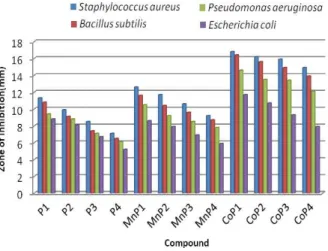
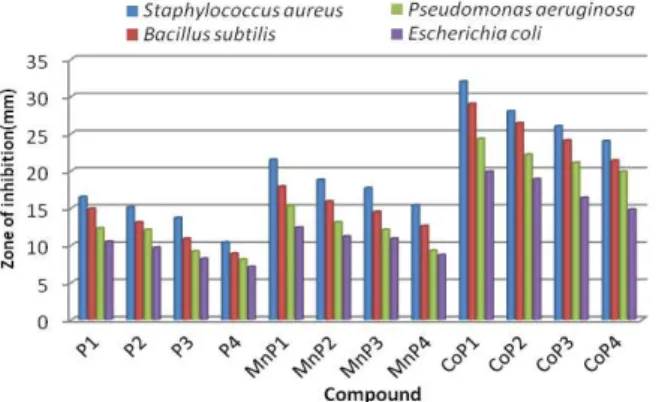
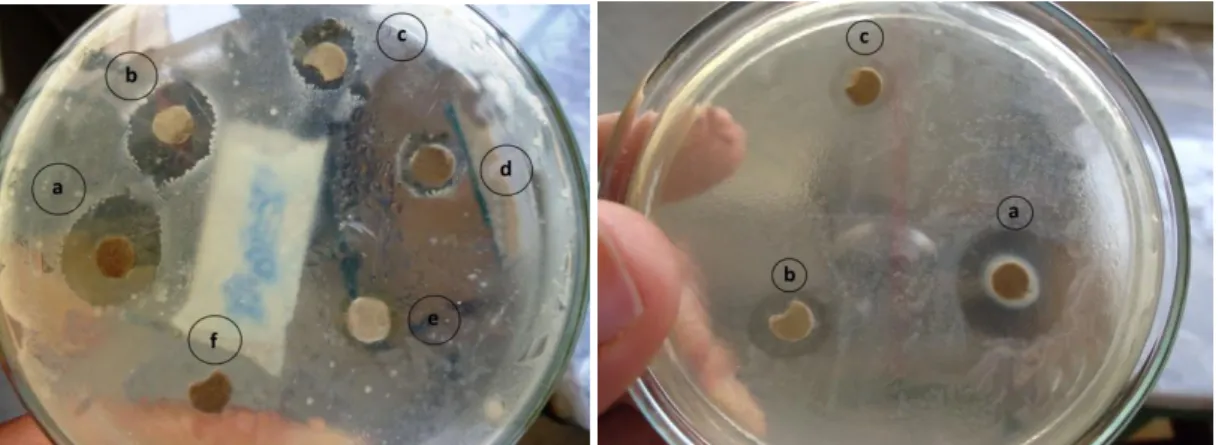
The results reported in Figures 1-3 for bacteria and Figures 4-6 for fungi, and also two samples of the growth inhibition halos are represented in Figure 7. The synthesized compounds showed varying degree of inhibitory effects: low (up to 10 mm),
moderate (up to 16 mm) and significant (above 16
mm). The parent H2T(4-NH2PP) could not be
thoroughly investigated due to its very low solubility in DMSO. However, the urea
substituents on the porphyrins P1-P4 ligands and
the respective metalloporphyrins increased their
solubility in DMSO. P1 possessed a moderate
activity against the bacterial strains at 25 µg/mL (Fig. 1) and 50 µg/mL (Fig. 2), but indicated
moderate to high activity at 100 µg/mL (Fig. 3). P2
exhibited low activity against all the strains at 25 µg/mL, but it was improved with increasing the concentration, which indicated moderate activity
against S. aureus and B. subtilis at 50 and 100
µg/mL. Also, P3 and P4 exhibited weak to
moderate activity against these bacterial strains. Hence, both antibacterial and antifungal activities
for the ligands increased in the order P1 > P2 > P3
>P4. The observed difference in activity could
attribute to the difference in lipophilicity of the
porphyrin ligands (vide infra) containing different
urea derivative substituents.
Figure 1 - Antibacterial activity of porphyrins and their
complexes (25 µg/mL) by disc-diffusion method.
Figure 2 - Antibacterial activity of porphyrins and their
Figure 3 - Antibacterial activity of porphyrins and their complexes (100 µg/mL) by disc-diffusion method.
As the second step, MnP1-MnP4 complexes were
tested for their inhibitory effects on the growth of
bacterial strains. MnP1 showed moderate activity
against S. aureus, B. subtilis and P. aeruginosa,
but was weak against E. coli at 25 µg/mL
concentration, whereas significant activity was
observed against S. aureus and moderate activity
against all other bacterial strains at 50 µg/mL for this compound. At higher concentration (100
µg/mL), MnP1 exhibited significant activity against
the four bacterial strains, except E. coli. Similarly,
MnP2 showed moderate activity against S. aureus
and B. subtilis at 25 µg/mL, whereas with
increasing the concentration of MnP2 solution to
100 µg/mL, the inhibition diameter was increased.
It showed significant activity against S. aureus, B.
subtilis and moderate against P. aeruginosa and E.
coli. The reduction in halo diameters was observed
for MnP3 and MnP4 (Figs. 1-3). Hence,
antibacterial and antifungal activity for these
manganese porphyrins was in the order MnP1 >
MnP2 > MnP3 > MnP4..
Finally, a similarly inhibitory effect on the
microorganisms as CoP1 > CoP2 > CoP3 > CoP4
was also detected for Co(II) complexes. The
inhibitory effect of CoP1 and CoP2 complexes was
investigated, which showed the most antibacterial
activity against these bacterial strains. The CoP1
exhibitedthe highest effect and showed significant
activity against S. aureus and B. subtilis and also
moderate against P. aeruginosa and E. coli even at
low concentration (25 µg/mL). This
metalloporphyrin had maximum antibacterial
against all four bacterial strains between P1-P4
porphyrins and their synthesized complexes in this
study, which showed significant activity against S.
aureus (32 mm), B. subtilis (29 mm), P.
aeruginosa (24.3 mm) and E. coli (19.9 mm) at
100 µg/mL, which were admissible. Similarly, CoP2 exhibited moderate to significant activity,
especially at 50 and 100 µg/mL. CoP3 showed
significant activity against S. aureus at all the three
concentrations and moderate against the others and
also showed significant activity against the four
bacterial strains at 100 µg/mL. CoP4 showed
moderate to significant activity against all bacterial
strains, except for E. coli. The antifungal activities
of the porphyrins and their complexes were quantitatively assessed by the presence, or absence
of inhibition zones and zone diameters against C.
albicans and A. oryzae according to Zahid et al.
(2010) (Figs. 4-6). These compounds showed remarkable inhibition zones at 100 µg/mL. The
porphyrins P1-P2 showed weak antifungal activity
but their complexes, especially cobalt derivatives exhibited moderate to significant activity against
C. albicans and A. oryzae. Recent studies have
indicated that different metals cause discrete and distinct types of injuries to microbial cells as a result of oxidative stress, protein dysfunction or membrane damage (Lemire et al. 2013). The same pattern was obtained and observed in this study.
Different antimicrobial activity of P1-P4 and their
complexes suggested different mechanism and/or biocidal property. Further studies are required to explore the exact mechanism of antibacterial and antifungal potency. Overall, the solvent used to prepare the compound solutions (DMSO) did not show inhibition against the tested organisms (negative control), the antibacterial and antifungal
activity of free porphyrins P1-P4 increased upon
coordination to metal ions. They inhibited the growth of bacteria and fungi more than the parent uncomplexed ligands under identical experimental conditions (Figs. 1-6).
Figure 4 - Antifungal activity of porphyrins and their
Figure 5 - Antifungal activity of porphyrins and their
complexes (50 µg/mL) by disc-diffusion method.
Figure 6 - Antifungal activity of porphyrins and their
complexes (100 µg/mL) by disc-diffusion method.
Figure 7 - Zone of inhibition for antimicrobial activity of CoP1 (right pic: (a) S. aureus, (b) B. subtilis and
(c) P. aeruginosa)and antifungal activity of CoP1 ((left pic: (a) A. oryzae, (b) C. albicans);
CoP2 (left pic: (c) A. oryzae, (d) C. albicans) and CoP3 (left pic: (e) A. oryzae (f) C. albicans).
Such increase in the activity of the complexes compared to that of ligands could be explained on
the basis of Overtone’s concept (Overton 1901) and Tweedy’s Chelation theory (Tweedy 1964). According to Overtone’s concept of cell
permeability, the lipid membrane that surrounds the cell favors the passage of only the lipid-soluble materials, which makes liposolubility as an important factor that controls the antibacterial and antifungal activity. Upon chelation, the polarity of cation is reduced to a greater extent due to the overlap of the ligand orbital and partial sharing of the positive charge of the metal ion. The chelation increases the delocalization of p-electrons over the whole chelate ring and enhances the lipophilicity of the complexes. It is plausible that MnP
complexes contain Mn3+ and P2- and an OAc- as
counter ion that makes it less lipophilic and less
able to act as antibacterial and antifungal agents.
However, in CoP complexes, Co2+ is almost
completely neutralized by the porphyrin ligands
(P2-). Therefore, the polarity is minimized and the
liposolubility of CoP complexes is significantly increased.
This increase in lipophilicity enhances the penetration of the complexes into lipid membranes, and blocks the metal binding sites of the enzymes of the microorganism. Metal complexes also disturb the respiration process of the cell and, block the synthesis of the proteins and can restrict further growth of the organism. In this study, MnP and CoP complexes were more
reactive than the corresponding uncomplexed P1
-P4 ligands. Among different porphyrin complexes,
CoP1 showed the highest antibacterial and
that antibacterial and antifungal activity of these
5,10,15-tris(4-aminophenyl)-20-(N,N-dialkyl/
diaryl-N-phenylurea) porphyrins (P1-P4) and their
Mn and Co complexes (MnP and CoP) were comparable and in some cases, even superior to
previously synthesized porphyrins and
metalloporphyrins in terms of the growth inhibitory effects (Li et al. 1997; Beirão et al. 2014; Prasanth et al. 2014; Meng et al. 2015; Zoltan et al. 2015).
CONCLUSIONS
The present work studied the synthesis and characterization of some new
5,10,15-tris(4-aminophenyl)-20-(N,N-dialkyl/diaryl-N phenylurea)
porphyrin ligands (P1-P4) and their Mn(III) and
Co(II) complexes (MnP, CoP) and evaluation of
their antibacterial activity against E coli, P.
aeruginosa, S. aureus, B. subtilis and antifungal
activity against A. oryzae and C. albicans in vitro
by agar-disc diffusion method. The peripheral urea
derivative substituents in the para position of
phenyl ring affected the antibacterial and antifungal activity of these porphyrin ligands. The
order of activity for the ligands was P1 > P2 > P3
>P4, which was consistent with the order of their
liposolubility. However, MnP and CoP complexes showed higher antibacterial and antifungal
activities than P1-P4 ligands and markedly
inhibited the growth of most bacteria and fungi tested. The result also showed that the order of
activity for the Mn(III) complexes was MnP1 >
MnP2 > MnP3 > MnP4 and for the Co(II)
complexes, it was CoP1 > CoP2 > CoP3 > CoP4.
Generally, the Co(II) complexes virtually exhibited enhanced antibacterial and antifungal
activities compared to MnP complexes.This could
be related to lower polarity of the Co(II) complexes (higher lipophilicity), which enhanced the penetration of the complexes into lipid membranes of the microorganism. Among the
Co(II) complexes, CoP1 showed significant
inhibitory effects against both Gram-positive (S.
aureus, B. subtilis) and Gram-negative (E. coli, P.
aeruginosa) bacterial and fungus species (A.
oryzae, C. albicans) and, therefore, could have a
potential to be used as drug. Having established antibacterial and antifungal activity of these
aminoporphyrins having urea derivative
substituents and their metal complexes, the next goal could be to synthesis aminoporphyrins with
two or more biological active functions and evaluate their antibacterial, antifungal activity and DNA binding affinities.
ACKNOWLEDGEMENTS
The authors thank Dr Ebrahimi Mohammadi
(University of New South Wales, Australia) who kindly edited the English texts. Also, the partial support of this work by the Yasouj University Research Council is gratefully acknowledged.
REFERENCES
Adler AD, Longo FR, Finarelli JD, Goldmacher J, Assour J, Korsakoff L. A simplified synthesis for meso-tetraphenylporphine. J Org Chem. 1967; 32(2):
476-476
Adler AD, Longo FR, Kampas F, Kim J. On the preparation of metalloporphyrins. J Inorg Nucl Chem.
1970; 32(7): 2443-2445
Babad H, Zeiler AG. The chemistry of phosgene. Chem Rev. 1973; 73(1): 75-91.
Bajju GD, Kundan S, Bhagat M, Gupta D, Kapahi A, Devi G. Synthesis and spectroscopic and biological activities of Zn(II) porphyrin with oxygen donors.
Bioinorg Chem App1. 2014; 2014: Article ID 428121,
1-13.
Banfi S, Caruso E, Buccafurni L, Battini V, Zazzaron S, Barbieri P, et al. Antibacterial activity of tetraaryl-porphyrin photosensitizers: An in vitro study on
Gram negative and Gram positive bacteria. J Photochem Photobiol B. 2006; 85(1): 28-38.
Baron EJ, Chang RS, Howed HD. Medical Microbiology. New York: Wiely Liss. Publication; 1994.
Beirão S, Fernandes S, Coelho J, Faustino MAF, Tomé JPC, Neves MGPMS. Photodynamic inactivation of bacterial and yeast biofilms with a cationic porphyrin.
Photochem Photobiol. 2014; 90(6): 1387-1396.
Boulton B, Rozanowska M, Rozanowski B. Retinal photodamage. J Photochem Photobiol B. 2001;
64(2-3): 144-161
Chen CT, Hsieh SJ. Synthesis and characterization of push-pull porphyrins. J Chin Chem Soc. 1997; 44(1):
23-31
Chiller K, Selkin BA, Murakawa GJ. Skin microflora and bacterial infections of the skin. J Investig Dermatol Symp Proc. 2001; 6(3): 170-174
Chizhova NV, Kumeev RS, Mamardashvili NZ. Synthesis and spectral properties of cobalt(II) and cobalt(III) tetraarylporphyrinates. Russ J Inorg Chem.
Dosselli R, Tampieri C, Ruiz-González R, De Munari S, Ragàs X, Sánchez-García D, et al. Synthesis, characterization, and photoinduced antibacterial activity of porphyrin-type photosensitizers conjugated to the antimicrobial peptide apidaecin 1b. J Med Chem. 2013; 56(3): 1052-1063.
Fish PV, Barta NS, Gary DL, Ryckmans T, Stobie A, Wakenhut F, et al. Derivatives of (3S)-N-(biphenyl-2-ylmethyl)pyrrolidin-3-amine as selective noradrenaline reuptake inhibitors: Reducing P-gp mediated efflux by modulation of H-bond acceptor capacity. Bioorg Med Chem Lett. 2008; 18(15):
4355-4359
Goodrich LE, Roy S, Alp EE, Zhao J, Hu MY, Lehnert N. Electronic structure and biologically relevant reactivity of low-spin {FeNO}8 porphyrin model complexes: new insight from a bis-picket Fence porphyrin. Inorg Chem. 2013; 52(13): 7766-7780.
Goren Z, Heeg MJ, Mobashery S. Facile chloride substitution of activated alcohols by triphosgene: application to cephalosporin chemistry. J Org Chem.
1991; 56(25): 7186-7188
Grzyb JA, Batey RA Achieving functional group diversity in parallel synthesis: solution-phase synthesis of a library of ureas, carbamates, thiocarbamates, and amides using carbamoylimidazolium salts. Tetrahedron Lett 2008;
49(36): 5279-5282
Gumaste VK, Deshmukh ARAS. One-pot preparation of dialkylcarbamoyl azides from tertiary amines using triphosgene and sodium azide. Tetrahedron Lett.
2004; 45(35): 6571-6573.
Hamdach A, El Hadrami EM, Gil S, Zaragozá RJ, Zaballos-García E, Sepúlveda-Arques J. Reactivity difference between diphosgene and phosgene in reaction with (2,3-anti)-3-amino-1,2-diols.
Tetrahedron. 2006; 62(26): 6392-6397
Hood HP, Murdock HR. Superpalite. J Phys Chem.
1919; 23(7): 498-512
Indu MN, Hatha AAM, Abirosh C, Harsha U, Vivekanandan G. Antimicrobial activity of some of the south-Indian spices against serotypes of Escherichia coli, Salmonella, Listeria monocytogenes and Aeromonas hydrophila. Braz J Microbiol. 2006;
37: 153-158
Johnson CK. A new synthesis of 2-chloroalkyl isocyanates. J Org Chem. 1967; 32(5): 1508-1510
Kamisaki H, Yasui Y, Takemoto Y. Pd-catalyzed intramolecular amidation of 2-(buta-1,3-dienyl)phenylcarbamoyl chloride: a concise synthesis of spiro[indoline-3,3′-pyrrolidine]. Tetrahedron Lett.
2009; 50(21): 2589-2592
Karimipour G, Ghaedi M, Behfar M, Andikaey Z, Kowkabi S, Orojloo AH. Synthesis and application of new porphyrin derivatives for preparation of copper
selective electrodes: influence of carbon nanotube on
their responses. IEEE Sens J. 2012; 12(8):
2638-2647
Karimipour G, Karami B, Montazerozohori M, Zakavi S. Oxidative decarboxylation of carboxylic acids with tetrabutylammonium periodate catalyzed by manganese (III) meso-tetraarylporphyrins: effect of metals, meso-substituents, and anionic axial ligands.
Chin J Catal. 2007; 28(11): 940-946
Karimipour G, Rezaei M, Ashouri D. Zeolite encapsulated Fe-porphyrin for catalytic oxidation with iodobenzene diacetate (PhI(OAc)2). J Mex Chem
Soc. 2013; 57(4): 276-282.
Katsunori Y, Yamanishi K, Yairi T, Suzuki K, Kondo M. Biomimic O2 activation hydroxylates a
meso-carbon of the porphyrin ring regioselectively under mild conditions. Chem Commun. 2013; 49(81):
9296-9298
Kurita K, Matsumura T, Iwakura Y. Trichloromethyl chloroformate. Reaction with amines, amino acids, and amino alcohols. J Org Chem. 1976; 41(11):
2070-2071
Lauher JW, Ibers JA. Stereochemistry of cobalt porphyrins. II. Characterization and structure of meso-tetraphenylporphinatobis (imidazole) cobalt (III) acetate monohydrate monochloroformate, [Co(Im)2(TPP)][OAc].H2O.CHCl3. J Am Chem Soc.
1974; 96(14): 4447-4452.
Li H, Fedorova OS, Grachev AN, Trumble WR, Bohach GA, Czuchajowski L. A series of meso-tris N-methyl-pyridiniumyl)-(4-alkylamidophenyl) porphyrins: synthesis, interaction with DNA and antibacterial activity. Biochim Biophys Acta. 1997;
1354(3): 252-260.
Maisch T, Szeimies RM, Jori G, Abels C. Antibacterial photodynamic therapy in dermatology. Photochem Photobiol Sci. 2004; 3(10): 907-917
Marcos IS, Beneitez A, Moro RF, Basabe P, Diez D, Urones JG. Lateral lithiation in terpenes: synthesis of (+)-ferruginol and (+)-sugiol. Tetrahedron. 2010;
66(39): 7773-7780.
Marrs TC, Maynard RL, Sidell FR. Chemical Warfare Agents. Toxicology and Treatment. Chichester: J Wiley and Son; 1996, 185p.
Meisel P, Kocher T. Photodynamic therapy for periodontal diseases: State of the art. J Photochem Photobiol B. 2005; 79(2): 159-170
Meng S, Xu Z, Hong G, Zhao L, Zhao Z, Guo J, et al. Synthesis, characterization and in vitro photodynamic antimicrobial activity of basic amino acid-porphyrin conjugates. Eur J Med Chem. 2015; 92: 35-48.
Michael FP, Emil FP, Thomas CB. Study of (tetraphenylporphinato) manganese(III)-catalyzed epoxidation and demethylation using p-cyano-N,N-dimethylaniline N-oxide as oxygen donor in a homogeneous system. Kinetics, radiochemical ligation studies, and reaction mechanism for a model of cytochrome P-450. J Am Chem Soc. 1984;
Mohajer D, Karimipour G, Bagherzadeh M. Reactivity studies of biomimetic catalytic epoxidation of alkenes with tetrabutylammonium periodate in the presence of various manganese porphyrins and nitrogen
donors: significant axial ligand π-bonding effects.
New J Chem. 2004; 28; 740-747.
Montel F, Lamberth C, Jung PMJ. First synthesis of 7-amido-[1,2,4]triazolo[1,5-a]pyrimidines using halogen–metal exchange. Tetrahedron. 2008; 64(27):
6372-6376
Murray PR, Baron EJ, Faller MAP, Tenover FC, Yken RH. Manual of clinical microbiology. Washington: 7th ed, Asapress; 1991.
National Committee for Clinical Laboratory Standards, NCCLS Approved Standard M27-A.
Wayne Pa. Pennsylvania; 1997.
Nolan AM, Amberger BK, Esselman BJ, Thimmakondu VS, Stanton JF, Woods RC, et al. Carbonyl diazide, OC(N3)2: synthesis, purification, and IR spectrum.
Inorg Chem. 2012; 51(18): 9846-9851
Nowak-Król A, Gryko DT. Oxidative aromatic coupling of meso-arylamino-porphyrins. Org Lett.
2013; 15(22): 5618-5621
Orlandi VT, Caruso E, Banfi S, Barbieri P. Effect of organic matter on the in vitro photoeradication of pseudomonas aeruginosa by means of a cationic tetraaryl-porphyrin. Photochem Photobiol. 2012;
88(3): 557-564.
Orlandi VT, Caruso E, Tettamanti G, Banfi S, Barbieri P. Photoinduced antibacterial activity of two dicationic 5,15-diarylporphyrins. J Photochem Photobiol B. 2013; 127: 123-132.
Overton CE. Studien über die Narkose zugleich ein Beitrag zur allgemeinen Pharmakologie. Gustav Fischer. Jena: Switzerland; 1901.
Prasanth CS, Karunakaran SC, Paul AK, Kussovski V, Mantareva V, Ramaiah D, et al. Antimicrobial photodynamic efficiency of novel cationic porphyrins towards periodontal gram-positive and gram-negative pathogenic bacteria. Photochem Photobiol. 2014;
90(3): 628-640.
Ramsperger HC, Waddington G. The kinetics of the thermal decomposition of trichloromethyl chloroformate. J Am Chem Soc. 1933; 55(1):
214-220
Ryan TA, Ryan C, Seddon EA, Seddon KR. Phosgene and Related Carbonyl Halides. Amsterdam: Elsevier; 1996, 223p.
Satyasheel S, Mahendra, N. Synthesis of meso-substituted dihydro-1,3-oxazinoporphyrins. Beilstein J Org Chem. 2013; 9: 496-502
Skorna G, Ugi I. Isocyanide synthesis with diphosgene.
Angew Chem Int Ed Engl. 1977; 16(4): 259-260
Tabatabaeian K, Mahmoodi NO, Najafi Yasouri, Amirrahmat R. Synthesis and investigation of biological activities of a new α-methylene-γ -butyrolactone using cobaloxime catalyzed radical cyclization. J Chem Pharm Res. 2013; 5(4): 8-12
Tilley JN, Sayigh AAR. Pyrolysis of N-t-Butyl-N-alkylcarbamoyl chlorides. A new synthesis of isocyanates. J Org Chem. 1963; 28(8): 2076-2079
Tweedy BG. Plant extracts with metal ions as potential antimicrobial agents. Phytopathology. 1964; 55:
910-917.
Zahid HC, Sajjad HS, Moulay HY, Taibi BH. Metal based biologically active compounds: Design, synthesis, and antibacterial/antifungal/cytotoxic properties of triazole-derived Schiff bases and their oxovanadium(IV) complexes. Eur J Med Chem.
2010; 45(7): 2739-2747.
Lemire JA, Harrison JJ, Turner RJ.Antimicrobial activity of metals: mechanisms, molecular targets and applications. Nature Rev Microbiol. 2013; 11:
371-384.
Zare H, Ghanbari MM, Jamali M, Aboodi A. A novel and efficient strategy for the synthesis of various carbamates using carbamoyl chlorides under solvent-free and grinding conditions using microwave irradiation. Chin Chem Lett. 2012; 23(8): 883-886
Zoltan T, Vargas F, López V, Chávez V, Rivas C, Ramírez ÁH. Influence of charge and metal coordination of meso-substituted porphyrins on bacterial photoinactivation. Spectrochim Acta Part A Mol Biomol Spectrosc. 2015; 135: 747-756.