Vol.55, n. 3: pp. 329-334, May-June 2012
ISSN 1516-8913 Printed in Brazil BRAZILIAN ARCHIVES OF
BIOLOGY AND TECHNOLOGY
A N I N T E R N A T I O N A L J O U R N A L
Efficient Regeneration of
Eucalyptus urophylla × Eucalyptus
grandis
from Stem Segment
Lejun Ouyang
1,2, Zhenchi Huang
1, Longyan Zhao
1,2, Yuee Sha
1,2, Fuhua Zeng
1*and
Xiangyang Lu
21College of Life Science and Technology; Zhanjiang Normal University; Zhanjiang 524048; P R - China. 2College of Biological Science and Technology; Hunan Agricultural University; Changsha 410128; P R - China
ABSTRACT
The aim of the present study was to establish an efficient regeneration system for the hybrid E. urophylla
×E. grandis by means of organogenesis. Stem segments from seedlings were used as explants and cultured in a modified Murashige and Skoog medium (MS), supplemented with 13.2 µM N-phenyl-N’-[6-(2-chlorobenzothiazol)-yl] urea (PBU) and 0.285 µM indole-3-acetic acid (IAA). PBU was a useful growth regulator. After cultivating for 5 d, 96% explants formed callus. After 30 d, the calli obtained were transferred to MS medium containing different combinations of 6-benzyladenine (BA) and naphthalene acetic acid (NAA). Compared with other growth regulator combinations, PBU stimulated more vigorous calli and restrained browning. In addition, a large percentage (91.3%) of the calli induced by PBU showed adventitious buds formation. Shoot elongation was then stimulated on half-strength MS mineral salts medium supplemented with 6.6 µM PBU and 0.285 µM IAA for 20 d. For rooting, the elongated shoots were cultivated on root induction medium containing 2.46 µM indole-3-butyric acid (IBA). Plantlets were then successfully transplanted to a greenhouse. This procedure represented an efficient way of
E. urophylla ×E. grandis plant regeneration.
Key words:in vitro regeneration, bud induction, proliferation, substituted urea
*
INTRODUCTION
Eucalypt is the most widely planted hardwood crop in tropical and subtropical regions worldwide (Doughty 2000; Potts and Dungey 2004), and is the most important forest tree in China, covering more than three million hectares of commercial plantations (FAO 2001). The hybrid E. urophylla
×E. grandis is highly prized in China for its
superior wood properties, rooting ability and disease resistance. Plantation forestry of
E. urophylla ×E. grandis supplies high-quality
raw material for pulp, paper, wood, and energy while it can reduce the pressure on native forests
and associated biodiversity. The expansion of these ‘fiber farms’ may become limited by land needs for the growth of food and other biofuel crops, in some cases, by public pressure. From a strategic standpoint, increasing the forest productivity and the quality of wood products by transgenic technologies has become increasingly important to the forest industry (Grattapaglia and Kirst 2008). E. urophylla ×E. grandis can be transformed by Agrobacterium tumefasciens, but the major difficulty in growing them lies in regeneration (Gonzales et al. 2002). Significant progress has been made in the regeneration of
some Eucalyptus species via organogenesis (Dibax
et al. 2005; Sartoretto et al. 2002). However, very few studies have reported successful regeneration
of E. urophylla ×E. grandis. Synthetic phenylurea
derivatives are potent plant growth regulators and exhibit cytokinin-like activity in various culture systems (Carra et al. 2006; Chung et al. 2007; Khan et al. 2006; Ricci et al. 2005; Turker et al. 2009). Among them, N-phenyl-N’-[6-(2-chlorobenzothiazol)-yl] urea (PBU; Fig. 1) was
first synthesized and purified in our laboratory (Li and Luo 2001).
The aim of this work was to establish an efficient regeneration system for the hybrid E. urophylla
×E. grandis by organogenesis from the stem
segment, and to use PBU for efficient callus and bud induction as a preliminary step towards the regeneration of explants derived from the axenic seedlings.
Figure 1 - Structure of N - phenyl-N’-[6-(2-chlorobenzothiazol)-yl] urea (PBU).
MATERIALS AND METHODS
Plant material
Stem segments originated from the axenic seedlings of E. urophylla ×E. grandis were used as explants, which were kindly provided by the China Eucalyptus Research Center.
Callus induction
Stem segments (4 - 8 mm) were excised from the axenic seedlings and inoculated on MS medium supplemented with 100 mg·L-1 Vitamin C, 30 g·L-1 sucrose, 7 g·L-1 agar and different plant growth regulator combinations (Table 1) for callus induction. MS medium was sterilized at 120 ºC for 20 min and the pH was adjusted between 5.8 to 6.0. Vitamin C was sterilized by filtration using a membrane with 0.22 µm pore diameter before combining with other components of the medium. The explants were incubated at 25 ± 2 ºC in darkness for two weeks and then for another two weeks under a 16 h of photoperiod with luminous intensity of approximately 50 µmol·m-2·s-1 emitted from cool fluorescent tubes (standard culture conditions).
Adventitious bud induction
To induce the formation of adventitious buds, calli derived from the explants were cultivated on MS medium containing different combinations of BA and NAA (Table 2). The calli were maintained at
standard culture conditions of photoperiod and temperature. After 40 d, adventitious bud formation was evaluated and reported.
Shoot elongation, rooting and acclimatization
In order to stimulate shoot elongation and proliferation, calli with short adventitious buds were first transferred to half-strength MS medium supplemented with different plant growth regulator combinations (Table 3) for 20 d. After this period, the elongated shoots (approximately 35 mm long) were cultivated in modified half-strength MS medium containing different concentration of IBA for rooting. Subsequently, rooted plantlets in the conical flasks covered with ventilate pellicle were transferred to a greenhouse (25 ± 2 ºC and 80% relative humidity) for 7 d, following which plantlets were transferred to a mixture of soil and fine sand (2:1 v/v) in the greenhouse and allowed to develop into fully grown plants.
Statistical analysis
RESULTS AND DISCUSSION
Callus formation
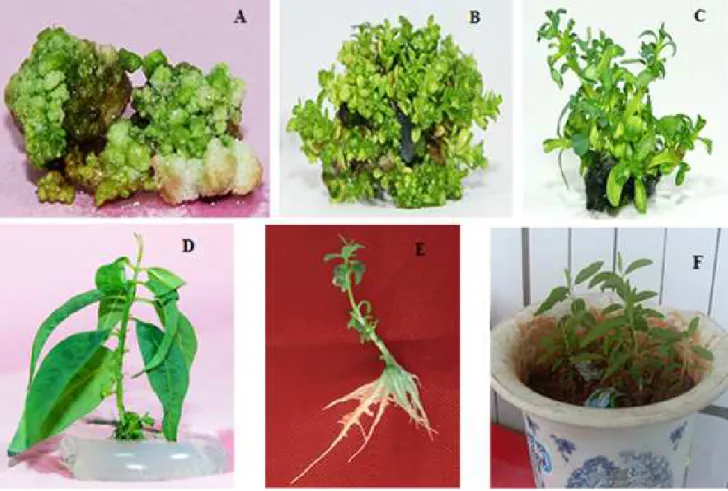
Various properties of the explants were found to be important for callus induction. The length of explants could not be more than 8 mm. If the original explants contained meristems of axillary buds, the shoots grew out directly from those buds. Calli bore different colours associated with the presence of anthocyanins, and buds sprouted from greenish-yellow calli (Fig. 2A). These calli maintained their ability to grow until approximately 30 d on MS medium. After this period, the calluses gradually became brown and no adventitious buds were observed. In a previous study PBU induced higher percentage of callus formation was observed than other plant growth regulators (Huang et al. 2010). About 96% of the cut surface had grown calli on the 6th day when
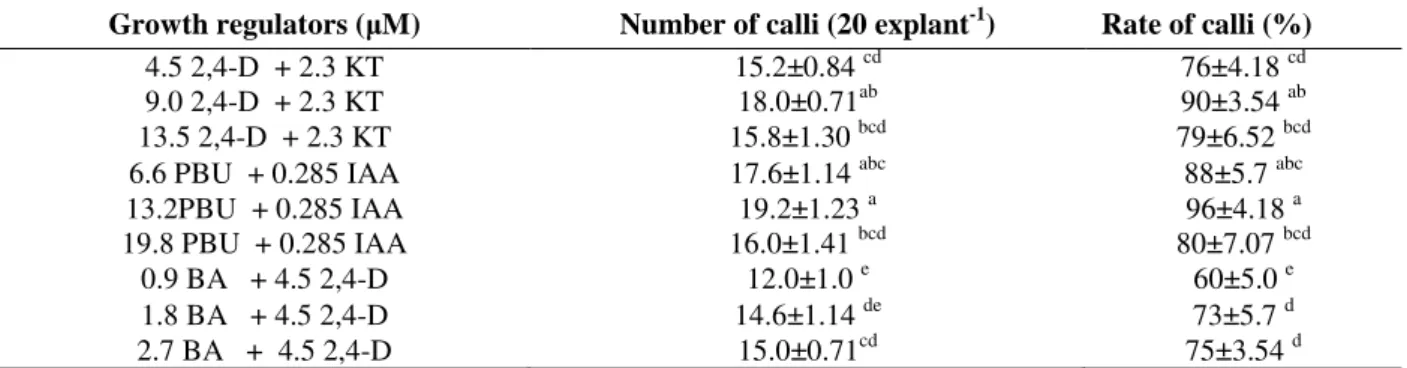
the explants were cultured on MS medium containing 13.2 µM PBU and 0.285 µM IAA (Table 1). Compared with TDZ or the combination of BA and 2, 4-D, PBU stimulated more vigorous calli and prevented them from browning. In addition, the calli induced by PBU showed higher frequency of adventitious buds induction after transferring to adventitious bud inducing medium. In this study, PBU was used to induce the calli formation only for 30 d, following which other cytokinins (TDZ or BA) were used to stimulate the shoot proliferation. This is the first study which used PBU to induce Eucalyptus callus. This class of synthetic cytokinins probably acts by activating the cytokinin response pathway (Yamada et al. 2001). It might also be possible that PBU inhibited ethylene production, whereas, these calli were inhibited browning.
Table 1 - Callus induction and growth from stem segments of E. urophylla ×E. grandis and incubated on MS medium.
Growth regulators (µM) Number of calli (20 explant-1) Rate of calli (%)
4.5 2,4-D + 2.3 KT 15.2±0.84 cd 76±4.18 cd
9.0 2,4-D + 2.3 KT 18.0±0.71ab 90±3.54 ab
13.5 2,4-D + 2.3 KT 15.8±1.30 bcd 79±6.52 bcd
6.6 PBU + 0.285 IAA 17.6±1.14 abc 88±5.7 abc
13.2PBU + 0.285 IAA 19.2±1.23 a 96±4.18 a
19.8 PBU + 0.285 IAA 16.0±1.41 bcd 80±7.07 bcd
0.9 BA + 4.5 2,4-D 12.0±1.0 e 60±5.0 e
1.8 BA + 4.5 2,4-D 14.6±1.14 de 73±5.7 d
2.7 BA + 4.5 2,4-D 15.0±0.71cd 75±3.54 d
Values are means ± SD. Means followed by the same letter in a column do not differ significantly (α>0.05) .
Adventitious bud induction
The adventitious buds were observed 40 d after the calli were cultivated on MS medium supplemented with the combinations of NAA with BA or kinetin (KT) (Table 2). Regarding the percentage of explants regenerating buds and number of buds per explant, the interaction among NAA with BA or KT concentrations was significant.
Among the combinations of plant growth regulators tested, the combination of 0.25 µM NAA and 4.4 µM BA yielded the best results, with 91.3% of adventitious bud formation. These results differed from those described by Ho et al. (1998) and Diallo and Duhoux (1984), both of whom got bud regeneration on cotyledonary leaf explants cultured in the presence of 16.2 µM NAA and 4.44 µM BA or 5.4 µM NAA and 2.22 µM BA. These authors used auxin at a concentration
higher than the concentration of BA. In the present study, however, the best results were obtained when the concentration of BA was higher than the concentration of NAA. The present results and reported in other studies together indicated that the efficiency of Eucalyptus micro-propagation was highly dependent on the adventitious bud induction. The percentage of adventitious bud formation was 91.3%, which was higher than that reported in other studies (Cid et al. 1999; Hervep et al. 2001; Alves et al. 2004).
Shoot cluster production was continuous from the calli derived from all the tested explants during the first 40 d on MS medium supplemented with 4.4
medium for more than 60 d, they gradually became reddish and later turned brown, causing the medium to darken in color. This might have been due to the production of phenolic compounds. It has been speculated that a long
exposure to light might increase the presence of specific receptors to phenolic inductors (Mayer 1987). The presence of cytokinin in the medium also seems to stimulate callus browning.
Table 2 - The effect of different combinations of BA and NAA on adventitious bud induction from calli of E. urophylla ×E. grandis
Growth regulators (µM) Rate of bud differentiation (%) Bud number (callus-1)
0.1 NAA + 0.93 KT 20.3±1.09 d 2.2±0.53 e
0.25 NAA + 0.93 KT 35.5±1.52 c 3.5±0.23 d
0.5 NAA + 0.93 KT 23.4±1.69 d 2.5±0.19 de
0.1 NAA + 4.4 6-BA 79.1±1.20 b 6.8±0.4 c
0.25 NAA + 4.4 6-BA 91.3±1.37 a 10.5±0.82 a
0.5 NAA + 4.4 6-BA 81.8±2.77 b 8.3±0.33 b
Values are means ± SD. Means followed by the same letter in a column do not differ significantly (α>0.05).
Shoot elongation, rooting and acclimatization
Adventitious buds cultivated on half-strength MS medium supplemented with the combinations of IAA with PBU or BA (Table 3). 30 d after the transfer, the percentage of adventitious buds showing shoot induction was significant differences in all the six different plant growth regulator combinations tested, and the length of buds ranged from 0.5 to 4 cm. Among the combinations of plant growth regulators tested, the combination of 6.6 µM PBU and 0.285 µM IAA yielded the best results, with 98% of shoot elongation (approximately 35 mm long, Fig. 2C). Shoots submitted to rooting treatment with IBA had a better response, varying between 78 to
100%, compared to the control at 50% (cultured in the half-strength MS medium without any hormones). Regarding the percentage of rooting and the time of rooting, all IBA treated shoots exhibited a superior rooting capacity compared with the control (Table 3). After 12 d, under standard culture conditions, 6 - 10 adventitious roots were visible at the bottom of the shoots. Another 10 d later, the length of roots was 30 - 40 mm (Fig. 2E). These results indicated that IBA pre-treatment was important to increase the rooting efficiency in this hybrid. All of the rooted plantlets transferred to soil survived in greenhouse conditions and developed into normal plants without any obvious variant phenotypes (Fig. 2F).
Table 3 - The effect of different plant growth regulators on shoot elongation and rooting from adventitious buds of
E. urophylla ×E. grandis
Growth regulators (µM)
Rate of shoot elongation (%)
Growth regulators (µM)
Rate of rooting
(%) Time of rooting
6.6 PBU + 0.285 IAA 98±3.2 a 0 IBA 50±4.2 e 12 d after rooting treatment
13.2PBU + 0.285 IAA 89±4.1b 1.23 IBA 78±3.3 d 12 d after rooting treatment
19.8 PBU + 0.285 IAA 79±5.1 c 2.46 IBA 100±1.2 a 7 d after rooting treatment
2.2 6-BA+ 0.285 IAA 62±5.0 e 3.69 IBA 92±2.6 b 9 d after rooting treatment
4.4 6-BA+ 0.285 IAA 73±5.7 d 4.92 IBA 90±2.9 b 9 d after rooting treatment
6.72-BA+ 0.285 IAA 75±3.54cd 6.15 IBA 85±3.5 c 9 d after rooting treatment
Figure 2 - Regeneration of Eucalyptus urophylla ×Eucalyptus grandis from stem segment. A - Callus inoculated on MS medium with 6.6 µM PBU and 0.285 µM IAA. B - Differentiation of adventitious buds after transfer on MS medium with 4.4 µM BA and 0.25 µM NAA. C - Elongation and proliferation of adventitious buds inoculated on half-strength MS medium supplemented with 6.6 µM PBU and 0.285 µM NAA. D, E - Rooting of elongated shoot cultivated in modified half-strength MS medium supplemented with 2.46 µM IBA. F - Plants in a plastic pot in a greenhouse.
This could be a simple, reliable and efficient procedure to regenerate E. urophylla ×E. grandis
plants from stem segment, comprising four culture stages: a callus induction stage on a PBU-containing medium, an adventitious bud formation stage on medium containing NAA and BA, an elongation stage in the presence of PBU and IAA, and a final rooting stage consisting of IBA pre-treatment. It lasted about three months to get the regenerated plant from the stem segment of
E. urophylla ×E. grandis. PBU, as a kind of
di-substituted urea, was more efficient to induce
Eucalyptus callus than BA and 2,4-D. In addition,
the callus induced by PBU showed higher
frequency of adventitious buds induction after transferring to adventitious bud inducing medium. Finally, this work marked an important step in further improving the genetic transformation for
Eucalyptus genus.
ACKNOWLEDGMENTS
Foundation (10152404801000005; 104524048010 04328), Science and Technology Tackle Key Problem (2010B020301011) of Guangdong province and Science and Technology Tackle Key Problem (2010B020301011) of Zhanjiang city
REFERENCES
Alves ECSC, Xavier A, Otoni WC. Organogênese de explante foliar de clones de Eucalyptus grandis x
Eucalyptus urophylla. Pesq Agrop Brasil. 2004;
39(5): 421-430.
Carra A, Pasquale FD, Ricci A, Carimi F. Diphenylurea derivatives induce somatic embryogenesis in Citrus.
Plant Cell Tissue Organ Cult.2006; 87(1): 41-48. Chung HH, Chen JT, Chang WC.Plant regeneration
through direct somatic embryogenesis from leaf explants of Dendrobium. Biol Plant. 2007; 51(2): 346-350.
Cid LPB, Machado CMGA, Carvalheira SBRC, Brasileiro ACM. Plant regeneration from seedling explants of Eucalyptus grandis × E.urophylla. Plant Cell Tiss Org Cult. 1999; 56(1): 17–23.
Dibax R, Quisen RC, Bona C, Quoirin M. Plant Regeneration from Cotyledonary Explants of
Eucalyptus camaldulensis Dehn and Histological Study of Organogenesis in Vitro. Braz. Arch Biol Technol. 2010; 53(2): 311-318.
Dibax R, Eisfeld CDL, Cuquel FL, Koehler H, Quoirin M. Plant regeneration from cotylendonary explants of
Eucalyptus camaldulensis. Sci Agric. 2005; 62(4): 406-412.
Dlallo N, Duhoux E. Organogenèse et multiplication in vitro chez Eucalyptus camaldulensis. J of Plant Physiol. 1984; 115(3):177–182.
Doughty RW .The Eucalyptus: a natural and commercial history of the gum tree. Baltimore:
Doughty RW;2000. .
FAO. Global forest resources assessment 2000 –Main Report – FAO Forestry Paper. 2001; 140-479. Gonzales ER, Andrade A, Bertolo AL, Lacerda GC,
Carneiro RT, Defavarl V, Veneziano LM, Labate CA .Production of transgenic Eucalyptus grandis ×E. urophyllausing the sonication-assisted Agrobacterium
transformation (SAAT) system. Functional Plant Biology. 2002; 29(1): 97-102.
Grattapaglia D, Kirst M. Eucalyptus applied genomics: fromgene sequences to breeding tools. New Phytologist. 2008; 179(4): 911–929.
Hervep, Jauneau A, Paquesm, Marien JN, Boudet AM, Teulieres C. A procedure for shoot organogenesis in vitro fromleaves and nodes of an elite Eucalyptus gunnii clone: comparative histology. Plant Sci.2001; 161(4): 645-653.
Ho CK, Chang SH, Tsay JY, Tsal CJ, Chiang VL, Chen ZZ. Agrobacterium tumefaciens–mediated transformation of Eucalyptus camaldulensis and production of transgenic plants. Plant Cell Rep. 1998; 17(9): 675–680.
Huang ZC, Zeng FH, Lu XY. Efficient regeneration of
Eucalyptus urophylla from seedling-derived hypocotyls. Biol Plantarum. 2010;54(1): 131-134. Khan H, Siddique I, Anis M. Thidiazuron induced
somatic embryogenesis and plant regeneration in
Capsicum annuum. Biol Plant. 2006;50(4): 789-792. Li ZF, Luo FY. Synthesis and characterization of N-substituted phenyl-N’-[6-(2-chlorobenzothiazol)-yl] urea. Chem Res Appl. 2001; 13(1): 80-82.
Mayer AM. Polyphenol oxidases in plants – recent progress. Phytochemistry. 1987;26(1): 11–20. Potts BM, Dungey HS. Interspecific hybridization of
eucalypts: key issues for breeders and geneticists.
New For. 2004;27(2): 115–138.
Prakash MG, Gurumurthi K. Genetic transformation and regeneration of transgenic plants from precultured cotyledon and hypocotyl explants of
Eucalyptus tereticornis Sm. using Agrobacterium tumefaciens. In Vitro Cell Dev Biol Plant. 2009; 45(4): 429–434.
Ricci A, Carra A, Rolli E, Bertoletti C, Morini G, Incerti M, et al. Effect of Cl-substitution on rooting or cytokinin-like activity of diphenylurea derivatives. J Plant Growth Regul. 2005; 23(4): 261-268.
Sartoretto LM, Cid LPB, Brasileiro ACM. Biolistic transformation of Eucalyptus grandis×E. urophylla
callus. Funct Plant Biol. 2002; 29(8): 917 – 924. Turker AU, Yucesan B, Gurel E.An efficient in vitro
regeneration system for Lythrum salicaria. Biol Plant. 2009;53(4): 750-754.
Yamada H, Suzuki T, Terada K, Takei K, Ishikawa K, Miwa K, et al. The Arabidopsis AHK4 histidine kinase is a cytokinin-binding receptor that transduces cytokinin signals across the membrane. Plant and Cell Physiol. 2001;42(9): 1017-1023
![Figure 1 - Structure of N - phenyl-N’-[6-(2-chlorobenzothiazol)-yl] urea (PBU).](https://thumb-eu.123doks.com/thumbv2/123dok_br/15958556.683436/2.892.340.597.350.432/figure-structure-n-phenyl-n-chlorobenzothiazol-urea-pbu.webp)