Acta Scientiarum
http://www.uem.br/acta ISSN printed: 1806-2636 ISSN on-line: 1807-8672
Doi: 10.4025/actascianimsci.v38i3.31114
Forage yield in pastures with bermuda grass mixed with different
legumes
Amanda Nunes Assis dos Anjos, Clair Jorge Olivo*, Caroline Paim Sauter, Aline Rodrigues Silva, Fabiene Tomazetti dos Santos and Daiane Cristine Seibt
Universidade Federal de Santa Maria, Avenida Roraima, 1000, 97105-900, Santa Maria, Rio Grande do Sul, Brazil. *Author for correspondence. E-mail: [email protected]
ABSTRACT. Three grazing systems with Coastcross-1 bermuda grass (CC) + 100 kg N ha-1 year-1 + common vetch; CC + 100 kg N ha-1 year-1 + arrowleaf clover; and CC + 200 kg N ha-1 year-1 were evaluated. Thirteen grazing cycles were performed during the experimental period (313 days), with two, five, four and two cycles respectively in winter, spring, summer and fall. Lactating Holstein cows were used in the evaluation. Daily accumulation rate, forage production, rate of forage disappearance, agronomic intake, grazing efficiency, herbage allowance and stocking rate were evaluated. Mean rates of forage yield and stocking rate were 20.8; 17.6 and 19.7 t DM ha-1 and 7.0; 6.8 to 6.8 animal units ha-1 day-1 for the respective forage systems. The mixture Coastcross-1 plus common vetch, fertilized with 100 kg N ha-1 year-1 and Coastcross-1 fertilized with 200 kg N ha-1 year-1 provided greater productivity and better distribution of forage throughout the seasons.
Keywords:Cynodon, lactating cows, stocking rate, Trifolium vesiculosum, Vicia sativa.
Produção de forragem em pastagens de capim bermuda consorciado com diferentes
leguminosas
RESUMO. Este trabalho foi realizado para avaliar três sistemas forrageiros constituídos por capim bermuda, cv. Coastcross-1 (CC) + 100 kg N ha -1 ano-1 + ervilhaca comum; CC + 100 kg N ha -1 ano-1 + trevo vesiculoso e CC + 200 kg N ha -1 ano-1. Foram realizados 13 ciclos de pastejo durante o período experimental (313 dias), dois, cinco, quatro e dois ciclos, no inverno, primavera, verão e outono, respectivamente. Para avaliação experimental foram utilizadas vacas em lactação da raça Holandesa. Foram avaliados a taxa de acúmulo diário, a produção de forragem, a taxa de desaparecimento, o consumo agronômico, a eficiência de pastejo, a oferta de forragem e a taxa de lotação. Os valores médios da produção de forragem e taxa de lotação foram 20,8; 17,6 e 19,7 t MS ha-1 e 7,0; 6,8 e 6,8 unidade animal ha-1 dia-1 para os respectivos sistemas de forrageiras. O consórcio constituído por Coastcross-1 + ervilhaca, adubado com 100 kg N ha -1 ano-1 e a pastagem de Coastcross-1 adubada com 200 kg N ha -1 ano-1 proporcionaram maior produtividade e melhor distribuição da forragem ao longo das estações.
Palavras-chave: Cynodon, vacas em lactação, taxa de lotação, Trifolium vesiculosum, Vicia sativa.
Introduction
Pastures on most dairy farms in South Brazil are the main roughage source for milking cows. Forage comprises grasses of the genus Cynodon (Moreira, Prado, Cecato, & Evelázio, 2003a; Moreira et al., 2003b; Moreira, Prado, Cecato, Wada, & Mizubuti, 2004). (Moreira et al. 2003a; 2003b; 2004), such as the varieties Tifton 85, Tifton 68 and Coastcross-1, due to fast establishment, high productivity and low susceptibility to trampling (Carnevalli et al., 2001; Paris et al., 2016).
On the other hand, growth and establishment of forage grasses are mainly limited to nitrogen deficiency in the soil, which is actually the main
nutrient in production. High amounts of nitrogen-based fertilizers are employed to compensate the forage deficit (Paris, Cecato, Branco, Barbero, & Galbeiro, 2009; Paris et al., 2009), with increase in milk production costs. It must be underscored that usually foragers are the sole crop with great distribution varieties and nutrition rates of forage throughout the productive cycle (Bem et al., 2015).
these foragers, productivity and flexibility especially for pasture and hay (Branco et al., 2012). However, the mixture with cultivars of the genus Cynodon is not easy due to high competitiveness of the grass (Pereira et al., 2011). Owing to seasonality in southern Brazil, strategies may be employed with the mixture of hibernal cycle legumes and thus extend the pasture´s usage period. Supply and nutrition rate of forage are placed in equilibrium, besides improving the soil´s fertility (Barcellos, Ramos, Vilela, & Junior, 2008; Azevedo Júnior et al., 2013). Vetch (Vicia sativa L.) and arrowleaf clover (Trifolium vesiculosum Savi) may be underscored within the legumes of the hibernal cycle, due to their high nitrogen fixation, forage mass yield and nutritional quality for animals´ diet (Ovalle, Del Pozo, Fernández, & Arredondo, 2009; Pinnow et al., 2013).
Current research evaluated forage yield of mixed Coastcross-1 with vetch and Coastcross-1 with arrowleaf clover for pasture with dairy cattle.
Material and method
Current assay was approved by the Committee for Ethics and Bio-safety of the Universidade Federal de Santa Maria, Santa Maria, Rio Grande do Sul State, Brazil, by decree 113/2011 of protocol 23081016073/2011.
Research was conducted between May 2013 and April 2014 in the Laboratory of Dairy Livestock of the Department of Animal Science of the Universidade Federal de Santa Maria, Santa Maria, Rio Grande do Sul State, Brazil, located at the Central Depression of the state of Rio Grande do Sul. The soil of the experimental area is classified as sandy dystrophic red argisol (Empresa Brasileira de Pesquisa Agropecuária [Embrapa], 2006), with the following mean rates when analyzed in 2013: pH-H2O = 5.6; SMP Index = 6.1; clay = 21.5%;
p = 26.75, and K = 140 mg dm-3; OM = 3.25%;
Al = 0; Ca = 6.15, and Mg = 2.95 cmolc dm-3; base
saturation = 70.3% and saturation by Al = 0%. According to Koppen´s classification, the region´s climate is humid subtropical (Cfa).
The 313-day experimental period ranged between 23rd May 2013 and 18th April 2014, and the
grazing period lasted 247 days. Mean monthly rainfall for the period was 130.7 mm and monthly mean temperature reached 20ºC, with normal climatological means for the period 134.7 mm month-1 and 18.8ºC respectively. Rainfall
and temperature data were retrieved from the Meteorological Experimental Station of the Universidade Federal de Santa Maria, 8th
Meteorological District of the Brazilian Institute of
Meteorology (INMET), distant 500 m from the experimentation site.
The 4691 m2 experimental area was subdivided
into nine plots and treatments comprised the following forage systems: Bermuda grass (Cynodon
dactylon L. Pers.), cv. Coastcross-1 +
200 kg N ha-1 year-1; Coastcross-1 +
100 kg N ha-1 year-1 + vetch (Vicia sativa L.), cv.
Comum; and Coastcross-1 + 100 kg N ha-1 year-1 +
arrowleaf clover (Trifolium vesiculosum Savi), cv. Yuchi. Coastcross-1 had already been planted manually in the experimental area, with seedlings from tussock subdivision from the experimental area of the Laboratory. Ryegrass (Lolium multiflorum
Lam.) is a reseedling in the area. Vetch overseeding on Coastcross-1 was undertaken on three plots in mid-May by mechanized tillage, with a inoculated density of 60 kg of seeds ha-1, at 17 cm spacing
between the rows. Scarified and inoculated arrowleaf clover was distributed during the same period on the other three plots, at a density of 10 kg ha-1. Natural ryegrass reseeding occurred on
the other plots and on the plots with legume overseeding.
Fertilization was undertaken based on soil analysis, following recommendations of the Fertilization and Liming Manual for the states of Rio Grande do Sul and Santa Catarina (Comissão de Química e Fertilidade do Solo – RS/SC [CQFS-RS/SC], 2004), for grass-legume mixture, with mean rates of P2O5 and K2O for the winter and
summer periods, or rather, 90 kg ha-1 year-1. Six
applications of nitrogen-base fertilization were performed, comprising urea, according to each treatment. The first was done prior to the start of grazing on the experimental areas and after the 1st,
4th, 6th, 8th and 10th grazing. Mowing of the
experimental area was undertaken on the 27th
November, after the 6th grazing.
Rotational grazing system was employed featuring one-day grazing, with canopy height of the different forage systems as the entrance criterion to pasture. Usage for mixed areas started on the 15th
August 2013 when the legumes were about 30 cm high. In the case of sole cultivation, ryegrass canopy height was close to 25 cm (Aguinaga et al., 2006). As from the 5th grazing in November, Coastcross-1
canopy height close to 25 cm with residue estimated between 10 and 15 cm was the criterion for all areas (Fontaneli, Santos, & Fontaneli, 2009).
Forage supply was 6 kg of dry matter (DM) for every 100 kg body weight (BW) throughout the year. Holstein dairy cows, mean weight 567 and mean yield 19.3 kg milk day-1, were used for the
After milking, the cows received a feed supplementation at 0.9% of BW, taking into account milking period and mean milk production, with mineral salt and water ad libitum. When the cows were absent from the experimental area, they were kept in pastures with season grass, with similar management to experimentation.
In the pre- and post-grazing period, forage mass was estimated by double sampling technique, following T’Mannetje (2000) with 20 visual estimates and five cuts close to the ground per plot. Sample-derived forage was weighed and homogenized. One sub-sampled was removed to estimate the botanic and structural composition of Coastcross-1. Material was dried in a forced air oven at 55°C till constant weight to calculate partially dried matter. Percentage of participation of each, based on the sum of all dry matter weights, was calculated from data on the weight of dry matter of each component of the pasture.
Total forage yield was calculated by adding forage accumulation in each grazing cycle. Rate of daily accumulation of pasture and its components was calculated by subtracting initial forage mass from the residual forage mass of previous grazing and divided by the number of interval days between grazing. Forage disappearance rate was estimated by subtracting residual from initial forage mass, dividing the result by animal load. Stocking rate was calculated by dividing instantaneous animal load rate by the number of days of the grazing cycle and by the mean weight of the cows. Grazing efficiency was estimated by subtracting residual forage mass from the initial forage mass and dividing the product by the initial forage mass, multiplied by 100. True forage supply was calculated by the percentage between initial forage mass and instantaneous animal load. Agronomic intake was estimated by subtracting the initial forage mass by the residual forage mass divided by instantaneous animal load.
Grazing mean data of each season were employed for statistical analysis. The experimental design was totally randomized, with three treatments (forage systems), three replications (plots) with repeated measures over time (seasons). Data underwent analysis of variance at 5% probability. When the effect of the forage system or of the season within the system was significant, means were submitted to Tukey´s test (procedure MIXED - Statistical Analysis System [SAS], 2004). The statistical model below was used, according Equation 1:
Yijk = m + Ti + Rj(Ti) + Ek + (TE)ik + εijk (1)
where:
Yijk represents independent variables;
m is the mean of all data;
Ti is the effect of treatments (forage systems);
Rj(Ti) is the effect of replication (plots) in the
treatments (error a);
Ek is the effect of the seasons;
(TE)ik is the interaction between treatments and
seasons;
εijk is the residual effect (error b).
Results and discussion
Thirteen grazing cycles comprising mixture of arrowleaf clover and legume-less system and twelve grazing cycles in the forage system with vetch were performed during the evaluation period, between seeding of legumes till the last grazing (313 days). The mean period for grazing cycles was 27 days, with one day stocking. Longer grazing cycles occurred in the winter and autumn, whilst the shortest occurred in spring and summer, averaging 36 and 20 days respectively.
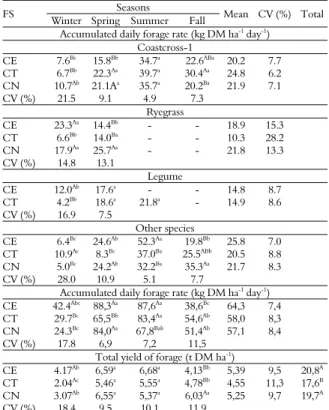
Difference in forage accumulation rate occurred (p < 0.05) between the systems in the summer with low rate for Coastcross-1 mixed with vetch (Table 1), due to legumes that interfere in the development of the accompanying grass (Aguirre et al., 2014). The same effect was inverted in the spring, with higher accumulation rate of Coastcross-1 due to vetch´s residual effect on the mixed grasses. It should be underscored that such effect is maintained throughout the use of the pasture, up to autumn. In the case of arrowleaf clover, there was also a residual effect on the accompanying grass, albeit slight, in the summer and autumn, with forage accumulation rate of Coastcross-1 similar to that of pasture with double nitrogen-based fertilization.
Vetch affected inversely the production of the ryegrass forage accumulation rate. A similar behavior occurred when mixed with arrowleaf clover, associated with the season (spring) when the legume had the highest participation in the composition of pasture during winter. Legume accumulation rates were associated with the development period in winter and spring for vetch, and in the spring and summer for arrowleaf clover.
Legumes also interfered on the other spontaneous growth species, especially bermuda
(Cynodon dactylon), guanxuma (Sida santaremnensis),
papuã (Urochloa plantaginea) and paspalum (Paspalum
conjugatum) grass, with a lower accumulation rate
vetch which delayed the development of Coastcross-1 during the winter and thus provided high accumulated forage rates of the species. Lower production yield of the spontaneous growth species in the same period occurred when there was high participation of the arrowleaf clover.
Table 1. Daily accumulation rate of pasture components and total forage production of different forage systems (FS), comprising Coastcross-1 + 100 kg N ha-1 year-1 + vetch (CE);
Coastcross-1 + 100 kg N ha-1 year-1 + arrowleaf clover (CT) and
Coastcross-1 + 200 kg N ha-1
year-1
(CN). Santa Maria, Rio Grande do Sul State, Brazil, 2013-2014.
FS Seasons Mean CV (%) Total
Winter Spring Summer Fall Accumulated daily forage rate (kg DM ha-1
day-1
) Coastcross-1
CE 7.6Bc 15.8Bb 34.7a 22.6ABa 20.2 7.7
CT 6.7Bb 22.3Aa 39.7a 30.4Aa 24.8 6.2
CN 10.7Ab
21.1Aa
35.7a
20.2Ba
21.9 7.1
CV (%) 21.5 9.1 4.9 7.3
Ryegrass
CE 23.3Aa 14.4Bb - - 18.9 15.3
CT 6.6Bb 14.0Ba - - 10.3 28.2
CN 17.9Aa 25.7Aa - - 21.8 13.3
CV (%) 14.8 13.1
Legume
CE 12.0Ab 17.6a - - 14.8 8.7
CT 4.2Bb 18.6a 21.8a - 14.9 8.6
CV (%) 16.9 7.5
Other species
CE 6.4Bc 24.6Ab 52.3Aa 19.8Bb 25.8 7.0
CT 10.9Ac 8.3Bc 37.0Ba 25.5ABb 20.5 8.8
CN 5.0Bc 24.2Ab 32.2Ba 35.3Aa 21.7 8.3
CV (%) 28.0 10.9 5.1 7.7
Accumulated daily forage rate (kg DM ha-1 day-1)
CE 42.4Abc
88,3Aa
87,6Aa
38,6Bc
64,3 7,4 CT 29.7Bc 65,5Bb 83,4Aa 54,6Ab 58,0 8,3
CN 24.3Bc 84,0Aa 67,8Bab 51,4Ab 57,1 8,4
CV (%) 17.8 6,9 7,2 11,5
Total yield of forage (t DM ha-1)
CE 4.17Ab 6,59a 6,68a 4,13Bb 5,39 9,5 20,8A
CT 2.04Ac 5,46a 5,55a 4,78Bb 4,55 11,3 17,6B
CN 3.07Ab 6,55a 5,37a 6,03Aa 5,25 9,7 19,7A
CV (%) 18.4 9,5 10,1 11,9
Means followed by different letters on the line and by capital letters in the column are different (p < 0.05) by Tukey´s test. CV = Coefficient of variation.
Vetch caused a higher rate (p < 0.05) for daily accumulation forage rate in winter, spring and summer, whereas mixture with arrowleaf clover contributed in the summer and autumn due to its late production. In the legume-less system, highest fertilization level caused a higher rate during spring and autumn due to the faster use of the chemical fertilizer. Rates were corroborated by Carnevalli et al. (2001), with forage accumulation rates for Coastcross-1 between 60 and 72 kg DM ha-1 day-1,
during spring, and between 85 and 100 kg DM ha-1
day-1, during summer. Rates were also similar to
those reported by Ribeiro et al. (2008), or rather, 82 kg DM ha-1 day-1, with Coastcross-1 fertilized
with 200 kg of N ha-1, during spring-summer period
in the state of Paraná, Brazil.
Accumulation rate was related to forage yield in winter; there was one grazing cycle less during
spring in the mixture with vetch, due to the significant presence of the legume and ryegrass which contributed towards the delay of Coastcross-1 with a similar production to that of the other systems. Higher yield in the legume-less system is due to a higher nitrogen-based fertilization level. Lowest production in the other systems is possible, associated with the lowest residual deficit of the legumes. Taking into consideration forage yield, difference (p < 0.05) between forage systems was reported, with a higher rate for mixture with vetch and legume-less pasture in which double nitrogenated fertilization was used. Rates were similar to those registered by Aguirre et al. (2014) in pastures with Coastcross-1 mixed with legumes of the winter cycle fertilized with 100 kg N ha-1 year-1.
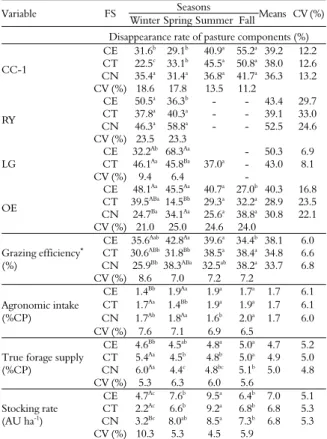
There was no difference between forage systems for Coastcross-1 with regard to the disappearance rate of pasture components (Table 2). When the seasons are compared, the lowest rates for the disappearance of Coastcross-1 were reported in the winter and in the spring, in mixtures, due to the animals´ preference for the accompany species (ryegrass and legumes). There was no difference for ryegrass among the systems; rates for legumes were similar in the winter and different among the mixtures during spring, with higher rates (p < 0.05) for the disappearance rate of vetch forage. The above may be due to the high canopy of the plant when compared to that of the arrowleaf clover which makes difficult the selection of pasture by animals due to its prostration condition and mixture with other species.
When average rates were taken into account, the highest disappearance rates were reported in legumes and ryegrass due to the foragers´ higher nutrition rates when compared with the other mixed species. Further, it should be underscored that average rate of the fraction composed of other species was 33%. This is similar to Coastcross-1, since most species also belong to the summer cycle and thus, employed similarly by the animals.
Delagarde, Prache, D'Hour, and Petit (2001) the above occurred when grazing efficiency was higher than 50%.
Table 2. Disappearance rate of pasture components, grazing efficiency, agronomic intake, true supply of forage and stocking rate of different foraging systems (FS), formed by Coastcross-1 + 100 kg N ha-1 year-1 + vetch (CE); Coastcross-1 +
100 kg N ha-1
year-1
+ arrowleaf clover (CT) and Coastcross-1 + 200 kg N ha-1 year-1(CN)
.
Santa Maria, Rio Grande do Sul State,Brazil, 2013-2014.
Variable FS Seasons Means CV (%)
Winter Spring Summer Fall
Disappearance rate of pasture components (%)
CC-1
CE 31.6b 29.1b 40.9a 55.2a 39.2 12.2
CT 22.5c 33.1b 45.5a 50.8a 38.0 12.6
CN 35.4a
31.4a
36.8a
41.7a
36.3 13.2 CV (%) 18.6 17.8 13.5 11.2
RY
CE 50.5a 36.3b - - 43.4 29.7
CT 37.8a 40.3a - - 39.1 33.0
CN 46.3a 58.8a - - 52.5 24.6
CV (%) 23.5 23.3
LG
CE 32.2Ab 68.3Aa - 50.3 6.9
CT 46.1Aa 45.8Ba 37.0a - 43.0 8.1
CV (%) 9.4 6.4 -
OE
CE 48.1Aa 45.5Aa 40.7a 27.0b 40.3 16.8
CT 39.5ABa
14.5Bb
29.3a
32.2a
28.9 23.5 CN 24.7Ba 34.1Aa 25.6a 38.8a 30.8 22.1
CV (%) 21.0 25.0 24.6 24.0
Grazing efficiency*
(%)
CE 35.6Aab 42.8Aa 39.6a 34.4b 38.1 6.0
CT 30.6ABb 31.8Bb 38.5a 38.4a 34.8 6.6
CN 25.9Bb 38.3ABa 32.5ab 38.2a 33.7 6.8
CV (%) 8.6 7.0 7.2 7.2
Agronomic intake (%CP)
CE 1.4Bb 1.9Aa 1.9a 1.7a 1.7 6.1
CT 1.7Aa
1.4Bb
1.9a
1.9a
1.7 6.1 CN 1.7Ab 1.8Aa 1.6b 2.0a 1.7 6.0
CV (%) 7.6 7.1 6.9 6.5
True forage supply (%CP)
CE 4.6Bb
4.5ab
4.8a
5.0a
4.7 5.2 CT 5.4Aa 4.5b 4.8b 5.0a 4.9 5.0
CN 6.0Aa 4.4c 4.8bc 5.1b 5.0 4.8
CV (%) 5.3 6.3 6.0 5.6
Stocking rate (AU ha-1)
CE 4.7Ac 7.6b 9.5a 6.4b 7.0 5.1
CT 2.2Ac
6.6b
9.2a
6.8b
6.8 5.3 CN 3.2Bc 8.0ab 8.5a 7.3b 6.8 5.3
CV (%) 10.3 5.3 4.5 5.9
Means followed by different small letters in the line and capital letters in the columns are different (p < 0.05) by Tukey´s test. CV = Coefficient of variation. Coastcross-1: CC-1, ryegrass: RY, Legumes: LG, Other species: OE. *% of initial forage mass.
BW: body weight.
Differences were reported in true forage supply (p < 0.05) among pastures during the winter only, with lower rates for mixture with vetch due to higher participation of the legume in the pasture, with higher forage quality. There were no differences between pastures in the other seasons due to similarity in the plants´ botanic composition, mostly made up of forage species of the summer cycle.
Results on stocking rates are related to forage production (Table 1). When seasons are evaluated, the mixture with vetch had the best equilibrium in stocking rates due to the residual effect of the legume in the pasture. Mean rates during spring and summer were 7.4 and 9.1 AU ha-1, respectively, or
rather, higher than rates by Scaravelli, Pereira,
Olivo, and Agnolin (2007), with 5.05 AU ha-1, by
assessing Coastcross-1 pasture from January to May, with nitrogen-based fertilization of 80 kg N ha-1,
and those reported by Paris, Cecato, Branco, Barbero, and Galbeiro (2009), or rather, 4.37 and 4.70 AU ha-1, in pastures with Coastcross-1 mixed
with forage groundnut + 100 kg N ha-1 year-1 and
Coastcross-1 in sole cultivation + 200 kg N ha-1 year-1, respectively.
Conclusion
The introduction of vetch or clover in Coastcross-1 pastures causes delay in the development of the grass. Mixtures of Coastcross-1 and vetch, fertilized with 100 kg N ha-1 year-1 and
Coastcross-1 pasture fertilized with 200 kg N ha-1 year-1 are equivalent and provide a
higher yield and better distribution of forage throughout the seasons.
References
Aguinaga, A. A. Q., Carvalho, P. C. F., Anghinoni, I., Santos, D. T., Freitas, F. K., & Terra Lopes, M. (2006). Produção de novilhos superprecoces em pastagem de aveia e azevém submetida a diferentes alturas de manejo. Revista Brasileira de Zootecnia, 35(4), 1765-1773.
Aguirre, P. F., Olivo, C. J., Simonetti, G. D., Nunes, J. S., Silva, J. O., Santos, M. S., ... Anjos, A. N. A. (2014). Produtividade de pastagens de Coastcross-1 em consórcio com diferentes leguminosas de ciclo hibernal. Ciência Rural, 44(12), 2265-2272.
Azevedo Júnior, R. L., Olivo, C. J., Bem, C. M., Aguirre, P. F., Quatrin, M. P., & Ávila, S. C. (2013). Nutritional value and chemical composition of pastures of peanut forage or red clover. Acta
Scientiarum. Animal Sciences, 35(1), 57-62.
Barcellos, A. O., Ramos, A. K. B., Vilela, L., & Junior, G. B. M. (2008). Sustentabilidade da produção animal baseada em pastagens consorciadas e no emprego de leguminosas exclusivas, na forma de banco de proteína, nos trópicos brasileiros. Revista Brasileira de
Zootecnia, 37(supl. especial), 51-67.
Bem, C. M., Olivo, C. J., Agnolin, C. A., Aguirre, P. F., Bratz, V. F., Quatrin, M. P., ... Alessio, V. (2015). Dinâmica e valor nutritivo da forragem de sistemas forrageiros submetidos à produção orgânica e convencional. Revista Brasileira de Saúde e Produção
Animal, 16(3), 513-522.
Branco, A. F., Viana, K. B., Castañeda, R. D., Prohmann, P. E., Coneglian, S. M., & Mouro, G. F. (2012). Chemical composition and crude protein fractions of Coastcross grass under grazing on winter, spring and summer in Southern Brazil. Acta Scientiarum. Animal
Carnevalli, R. A., Silva, S. C., Carvalho, C. A. B., Sbrissia, A. F., Fagundes, J. L., Pinto, L. F. M., & Pedreira, C. G. S. (2001). Desempenho de ovinos e respostas de pastagens de coastcross submetidas a regimes de desfolha sob lotação contínua. Pesquisa Agropecuária
Brasileira, 36(6), 919-927.
Comissão de Química e Fertilidade do Solo – RS/SC. (2004). Manual de adubação e calagem para os estados do
Rio Grande do Sul e Santa Catarina. Porto Alegre, RS:
SBCSNRS.
Delagarde, R., Prache, S., D'Hour, P., & Petit, M. (2001). Ingestion de l’herbe par les ruminants au pâturage.
Fourrages, 166(1), 189-212.
Empresa Brasileira de Pesquisa Agropecuária. (2006).
Serviço nacional de levantamento e conservação de solos.
Sistema brasileiro de classificação de solos (2a ed.). Rio de
Janeiro, RJ: Embrapa Solos.
Fontaneli, R. S., Santos, H. P., & Fontaneli, R. S. (2009).
Forrageiras para a integração lavoura-pecuária floresta na
região Sul-Brasileira. Passo Fundo, RS: Embrapa Trigo.
Moreira, F. B., Prado, I. N., Cecato, U., & Evelázio, N. (2003a). Suplementação com sal mineral proteinado para bovinos de corte mantidos em pastagem de estrela roxa no final do verão. Acta Scientiarum Animal Sciences, 25(1), 185-191.
Moreira, F. B., Prado, I. N., Cecato, U., Wada, F. Y., & Mizubuti, I. Y. (2004). Forage evaluation, chemical composition, and in vitro digestibility of continuously grazed star grass. Animal Feed Science and Technology, 113(1), 239-249.
Moreira, F. B., Prado, I. N., Cecato, U., Wada, F. Y., Nascimento, W. G., & Souza, N. E. (2003b). Suplementação com sal mineral proteinado para bovinos de corte, em crescimento e terminação, mantidos em pastagem de grama estrela roxa (Cynodon
plectostachyrus Pilger) no inverno. Revista Brasileira de
Zootecnia, 32(2), 449-455.
Ovalle, O. C., Del Pozo, A., Fernández, F., & Arredondo, S. (2009). Arrowleaf clover (Trifolium vesiculosum Savi): a new species of annual legumes for high rainfall areas of the Mediterranean climate zone of Chile. Chilean
Journal of Agricultural Research, 70(1), 170-177.
Paris, W., Cecato, U., Branco, A. F., Barbero, L. M., & Galbeiro, S. (2009). Produção de novilhas de corte em pastagem de Coastcross-1 consorciada com “Arachis
pintoi” com e sem adubação nitrogenada. Revista
Brasileira de Zootecnia, 38(1), 122-129.
Paris, W., Cecato, U., Martins, E. N., Limão, V. A., Galbeiro, S., & Oliveira, E. (2009). Estrutura e valor nutritivo da pastagem de Coastcross-1 consorciada com" Arachis pintoi", com e sem adubação nitrogenada.
Revista Brasileira de Saúde e Produção Animal, 10(3),
513-524.
Paris, W., Tonion, R., Martinello, C., Sartor, L. R., Paula, F. L. M., & Oliveira, J. D. (2016). Productivity and nutritional value of African Star managed with different leaf blade mass. Acta Scientiarum. Animal
Sciences, 38(1), 31-36.
Pereira, O. G., Oliveira, M. A., Pinto, J. C., Santos, M. E. R., Ribeiro, K. G., & Cecon, P. R. (2011). Análise de crescimento do capim Coastcross-1 sob adubação nitrogenada em duas idades de rebrotação. Revista
Brasileira de Zootecnia, 40(10), 2121-2128.
Pinnow, C., Benin, G., Viola, R., Silva, C. L., Gutkoski, L. C., & Cassol, L. C. (2013). Qualidade industrial do trigo em resposta à adubação verde e doses de nitrogênio. Bragantia, 72(1), 20-28.
Ribeiro, O. L., Cecato, U., Roma, C. F. C., Faveri, J. C., Gomes, J. A. N., & Barbero, L. M. (2008).Produção de forragem e desempenho animal em pastagens de coastcross consorciada ou não com Arachis pintoi, com e sem nitrogênio. Acta Scientiarum. Animal Sciences, 30(4), 371-377.
Scaravelli, L. F., Pereira, L. E. T., Olivo, C. J., & Agnolin, C. A. (2007). Produção e qualidade de pastagens de Coastcross-1 e milheto utilizadas com vacas leiteiras.
Ciência Rural, 37(3), 841-846.
Statistical Analysis System. (2004). SAS/STAT user guide,
version 9.1.2. Cary, NC: SAS Institute Inc.
T’Mannetje, L. (2000). Measuring biomass of grassland vegetation. In L. T’Mannetje, & R. M. Jones (Eds.),
Field and laboratory methods for grass land and animal
production research (p. 51-178). Cambridge, UK: Cabi.
Received on February 25, 2016. Accepted on March 16, 2016.
License information: This is an open-access article distributed under the terms of the Creative Commons Attribution License, which permits unrestricted use, distribution, and reproduction in any medium, provided the original work is properly cited.