Engineering
ISSN: 1809-4430 (on-line)
_________________________
1 –
COMPARISON OF DIFFUSION MODELS FOR DESCRIPTION OF OSMOTIC DEHYDRATION OF RADISH SLICES DIPPED IN BRINE
Doi:http://dx.doi.org/10.1590/1809-4430-Eng.Agric.v35n5p894-904/2015
WILTON P. DA SILVA1, CLEIDE M. D. P. DA S. E SILVA2, JOSIVANDA P. GOMES3
ABSTRACT: This paper aims at describing the osmotic dehydration of radish cut into cylindrical pieces, using one- and two-dimensional analytical solutions of diffusion equation with boundary conditions of the first and third kind. These solutions were coupled with an optimizer to determine the process parameters, using experimental data. Three models were proposed to describe the osmotic dehydration of radish slices in brine at low temperature. The two-dimensional model with boundary condition of the third kind well described the kinetics of mass transfers, and it enabled prediction of moisture and solid distributions at any given time.
KEYWORDS: inverse method; analytical models; cylindrical geometry
COMPARAÇÃO DE MODELOS DE DIFUSÃO NA DESCRIÇÃO DA DESIDRATAÇÃO OSMÓTICA DE FATIAS DE RABANETE EM SALMOURA
RESUMO: Este artigo descreve a desidratação osmótica de rabanete cortado em pedaços cilíndricos, usando soluções analíticas uni e bidimensionais da equação de difusão com condições de contorno do primeiro e terceiro tipos. Para determinar os parâmetros de processo, tais soluções foram acopladas a um otimizador que usa dados experimentais e o método inverso. Três modelos foram analisados na descrição de um experimento de desidratação osmótica de fatias de rabanete mergulhadas em salmoura, em baixa temperatura. Um modelo bidimensional com condição de contorno do terceiro tipo descreveu bem os processos de migração de massa e possibilitou prever as distribuições de umidade e de sólidos em um instante qualquer.
PALAVRAS-CHAVE: Método inverso, modelos analíticos, geometria cilíndrica.
INTRODUCTION
Radish (Raphanus sativus L.) is a popular edible root being processed into a range of fresh,
dried, salted and pickled products. Even though this vegetable is consumed worldwide, Asia has been the main market. According to COOGAN and WILLS (2002), in Japan, for example, the population consumes radish daily. As for humans, its nutritional value includes carbohydrates, sugars, fibers, fat and protein, aside from vitamins B1-B6, B9 and C and calcium, iron and magnesium, among others. This way, several studies on radish are found in the literature because of such nutritional importance (COOGAN and WILLS, 2002; HERMAN-LARA et al., 2013; GOYENECHE et al., 2013), and some of these researches will be highlighted hereinafter.
this sense, HERMAN-LARA et al. (2013) investigated equilibrium and dynamic mass transfer properties of water and solute during osmotic dehydration of radish slices dipped in sodium chloride solutions at varied concentrations and temperatures. Then, these authors used one-dimensional
analytical model for mass transfer based on Fick’s second law to describe water loss and solute gain curves. According to these authors, their results may be applied to determine a set of conditions (process time, brine concentration and process temperature) yielding an osmodehydrated radish product within given specifications. The diffusion model used by HERMAN-LARA et al. (2013) to describe the mass transfers within the cylindrical pieces of radish involves, mainly, two simplifications: (1) the slices were considered as infinite slabs; (2) the boundary condition of diffusion equation is of first order. As an advantage, this model can determine mass diffusivities by means of simple regressions. However, SILVA et al. (2013), studying drying of banana slices, noted that external resistance to water flow and the real product geometry should not be neglected prior to analysis of their influence on process description. Therefore, studies aiming to eliminate simplifications 1 and 2 may provide better results for description of radish osmotic dehydration.
This paper has as main goal to describe mass transfers in radish slices during osmotic dehydration, using three different diffusion models, including process optimization and simulation. The models used were one- and two-dimensional analytical solutions of diffusion equation with boundary conditions of first and third order. Process parameters for each model can be thus obtained by using the experimental dataset and further determining the corresponding statistical indicators. Therefore, mass transfer kinetics can be simulated and analyzed for the best model.
MATERIAL AND METHODS
During osmotic dehydration of radish (Raphanus sativus L.) cut into cylindrical pieces, mass
transfers within slices can be considered as diffusion phenomenon. Thus, an analytical solution of diffusion equation can be used to describe these transfers. On the other hand, a finite cylinder of radius R and height L can be interpreted as intersection point of infinite slab of thickness L and
infinite cylinder of radius R, as is shown in Fig. 1.
FIGURE 1. Finite cylinder of height L (y-axis) and radius R (r-axis) obtained by intersecting an
infinite slab (thickness L) with an infinite cylinder (radius R).
As observed by LUIKOV (1968), if a symmetric diffusion in relation to the y-axis is assumed, a position can be given by the coordinates (r, y) defined through the system of axes r and y with
origin at the center of the finite cylinder (Fig. 1).
Three diffusion models are described below. These models represent the mass transfers occurred in cylindrical slices of radish throughout the osmotic dehydration.
Model 1: Finite cylinder with convective boundary condition
As stated by DA SILVA et al. (2012) and SILVA et al. (2013), the analytical solution of diffusion equation in cylindrical coordinates under the above-mentioned assumptions can be obtained by separation of variables and results in:
) 2 / cos( ) ( ) ( ) , ,( 0 ,1 ,2
1 2 , 1 , 1 0 L y R r J A A X X X t y r
X n m
m
m n n
eq
eq
Dt L R m n 2 2 2 , 2 2 1 , ) 2 / (
exp , (1) where,
X represents water loss or solid gain; D is the effective mass diffusivity;
t is the time, r and y are the coordinates of position; Xeq is the equilibrium value of X, and
X0 is the initial value of X.
The coefficients An,1 and Am,2 are given by the following equations:
) )( ( 2 2 1 , 2 1 1 , 0 1 1 , n n n Bi J Bi A
(2)
and ) ( ) ( 2 ) 1 ( 2 2 , 2 2 2 2 , 2 / 1 2 2 , 2 2 2 1 2 , m m m m m Bi Bi Bi Bi A
. (3)
In eqs. (1) and (2), J0 is the Bessel function of first kind of order zero. In eqs. (1) and (3),
n,1 and m,2 are, respectively, the roots of the characteristic equations for infinite cylinder and
infinite slab. In eqs. (2) and (3), Bi1 and Bi2 are the mass transfer Biot numbers relative to both
infinite cylinder and slab, respectively. The expressions for these Biot numbers are given as follows:
D hR
Bi1 (4)
and
D L h
Bi2 ( /2) (5)
where,
h is the convective mass transfer coefficient.
From the comparison between eqs. (4) and (5), the following relationship between Bi1 and Bi2
is obtained by the equation:
R L Bi
The expressions to determine n,1 and m,2 are given by: 1 1 , 1 , 1 1 , 0 ) ( ) ( Bi J J n n n
(7)
and 2 2 , 2 , cot Bi m m
(8)
In [eq. (7)], J1 is the Bessel function of first kind of first order. Conversely, in experiments
of radish osmotic dehydration, only averages of water loss and solid gain will be measured at a given instant t. Thus, an expression to determine the average value of X at time t, denoted by X(t), should be obtained from eq. (1). This expression is obtained through the following equation:
dV t y r X V t
X( ) 1
( , , ) , (9)where,
V is the finite cylinder volume.
Substituting eq. (1) into eq. (9), it is obtained:
Dt ) (L/ μ R μ B B ) X (X X (t)X n, m,
m m, n, n eq eq 2 2 2 2 2 1 1 2 1 1 0 2
exp . (10)
The coefficients Bn,1 and Bm,2 are given by:
) ( 4 2 1 , 2 1 2 1 , 2 1 1 , n n n Bi Bi B
(11)
and ) ( 2 2 2 , 2 2 2 2 2 , 2 2 2 , m m m Bi Bi Bi B
. (12)
To extract values from Eq. (1) and (10), the roots n,1 and m,2 must be known for a given Bi1
and Bi2, respectively. Thus, the first 16 roots of [eq. (7)] were calculated for 452 specified values of
mass transfer Biot numbers, from Bi1 = 0 (which corresponds to an infinite resistance of water flux
at the surface) to Bi1 = 200 (which practically corresponds to an equilibrium boundary condition).
Similarly, the first 16 roots of [eq. (8)] were calculated for 472 specified values of mass transfer Biot numbers, from Bi2 = 0 to Bi2 = 200.
To determine D and h by optimization, using an experimental dataset, the objective function
to be minimized is given by (SILVA et al., 2010):
p ana N i i i i σ )] (D, Bi X X [ χ 1 2 2 exp 1 1
in which,
exp i
X is the ith experimental point; )
(D,Bi
Xanai 1 is the analytical average value of X at the same point, given as a function of D
and Bi1;
i
σ is the standard deviation of Xexpi ;
D is the effective mass diffusivity, and Np is the number of experimental points.
For a specified value of Bi1 (and consequently Bi2), the chi-square depends only on a single
variable, namely the effective mass diffusivity, D. Thus, optimum values of D can be determined
for each one of the 452 Bi1 defined for the cylinder. The best D is determined by a minimum χ2
among the 452 minima calculated. Each one of the 452 optimization process was accomplished as recommended by SILVA et al. (2009) and SILVA et al. (2010).
In the optimizations, for a stipulated Bi1, Bi2 is calculated by [eq. (6)], and m,2 corresponding
to each Bi2 was determined by linear interpolation, using previously calculated values. In contrast,
once D and h are determined through optimization, [eq. (1)] can be used to determine solid
distribution (and water loss) as a function of position (r,y), at time t.
Model 2: Infinite slab with convective boundary condition
To investigate if geometric factor is important to modeling the mass transfers in osmotic dehydration of radish slices, model 2 was defined as an infinite slab with boundary condition of the third kind. Thus, if finite cylinder dimensions satisfy a relationship of R >> L, then [eq. (10)] can be
re-written for an infinite slab, in the following way:
Dt ) (L/
μ
B ) X (X X (t)
X m,
m m, eq
eq 2
2 2
1 2 0
2
exp , (14)
where,
m,2 and Bm,2 are calculated by eqs. (8) and (12), respectively. Equation (14) together with
eqs. (8) and (12) represent the analytical solution of diffusion equation with boundary condition of the third kind for an infinite slab with thickness L.
Model 3: Infinite slab with equilibrium boundary condition
To investigate if the boundary condition is important to modeling the mass transfers in osmotic dehydration of radish slices, model 3 was established as an infinite slab with boundary condition of the first kind. The boundary condition of the first kind means an infinite mass transfer Biot number:Bi2 . Thus, [eq. (8)] becomes:
0
cotm,2 (15)
and, consequently, 2 / ) 1 2 (
2
, m
m
(16)
2 2 , 2 ,
2
m m
B
. (17)
Equation (14) together with eq. (16) and (17) are the analytical solution of diffusion equation with boundary condition of the first kind for an infinite slab with thickness L.
Material
We used the most commonly known variety of radish (Raphanus Sativus L.), red-skinned
variety, with a moisture content of 0.95 g water/ g wet product, for osmotic dehydration modeling. The vegetables were cut into cylindrical slices with the following average dimensions: thickness L
= 5 mm and radius R = 20 mm. The process was performed using sodium chloride solutions and
distilled water, which were prepared at a concentration of 15 g NaCl/ 100 g water. Brine stirring was performed by agitation at 120 rpm with a digital plate stirrer. We used a ratio of 1: 15 between radish slice and brine. This proportion was adopted to ensure osmotic solution concentration steadiness throughout the experiment. Geometry and boundary condition influences on water and sodium chloride transfers were analyzed at 25 °C, that is, close to room temperature. As it is known, moderate temperatures can enhance color and flavor retention (KHIN et al., 2006), as well as providing least thermal degradation of nutrients (JAIN et al., 2011). The experiments were conducted as in HERMAN-LARA et al. (2013), in which water loss and sodium chloride gain were determined by gravimetric method (precision of 0.001 g). At each sampling, the slices were rinsed under distilled water and gently wiped with paper towel to remove outer moisture. Thereafter, samples were dried in an oven at 105 °C for 8 hours, enough time to achieve equilibrium.
The variables of interest to be analyzed in radish slices at a given instant t are water loss
(M(t)), and sodium chloride gain (S(t)). Such variables were obtained by the following equations:
0
) ( ) 0 ( )
(
m t m m
t
M W W (18)
and
0
) ( ) (
m t m t
S S . (19)
In eq. (18) and (19), mW(t) is the water at any time t, mS(t) is the sodium chloride mass
migrated to the slices at any time t, mW(0) is the initial water mass in the sample and mo is the initial
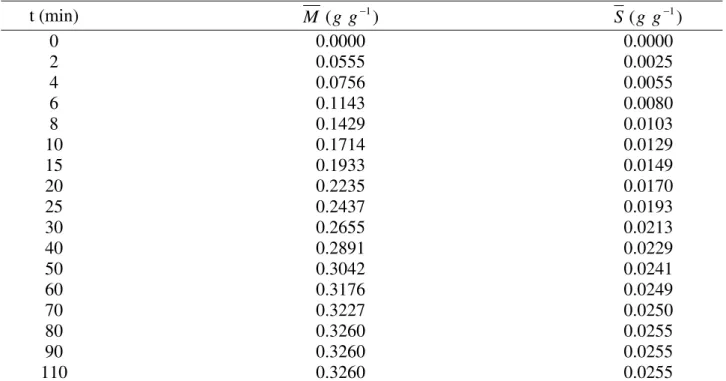
mass of the wet sample. First, each sample was weighted, and dry matter was determined from one of them. This procedure enables calculating the initial dry matter of each sample. After that, at each instant t, sample mass and dry mass were measured; and this way water loss M(t)and sodium chloride gain S(t)could be calculated for samples still dipped in brine at instant t. Table 1 shows
Table 1. Experimental datasets of water loss and sodium chloride gain throughout time.
t (min) ( 1)
g g
M S (g g1)
0 0.0000 0.0000
2 0.0555 0.0025
4 0.0756 0.0055
6 0.1143 0.0080
8 0.1429 0.0103
10 0.1714 0.0129
15 0.1933 0.0149
20 0.2235 0.0170
25 0.2437 0.0193
30 0.2655 0.0213
40 0.2891 0.0229
50 0.3042 0.0241
60 0.3176 0.0249
70 0.3227 0.0250
80 0.3260 0.0255
90 0.3260 0.0255
110 0.3260 0.0255
When describing water loss over time using the analytical solutions presented here, it is required to change the symbol X in eq. (1), (10), (13) and (14) to M. Yet for sodium chloride
penetration, the appropriate symbol is S, instead of X. Moreover, it can be observed that for dataset
in Table 1 at instant t = 0, M0 S0 0, Meq 0.3260 as well asSeq 0.0255. RESULTS AND DISCUSSION
Table 2 shows the optimization results for sodium chloride gain and water loss, for each proposed model.
TABLE 2. Optimization results for sodium chloride gain and water loss.
Model D (m2 min-1) h (m min-1) Bi2 χ2 R2
NaCl Gain
1 5.177 x 10⁻⁷ 1.569 x 10⁻⁴ 0.758 3.043 x 10⁻⁶ 0.9976
2 3.818 x 10⁻⁷ 2.214 x 10⁻⁴ 1.450 3.310 x 10⁻⁶ 0.9973
3 1.147 x 10⁻⁷ - - 2.170 x 10⁻⁵ 0.9904
Water Loss
1 1.832 x 10⁻⁷ 2.931 x 10⁻⁴ 4.000 5.123 x 10⁻⁴ 0.9973
2 1.783 x 10⁻⁷ 4.815 x 10⁻⁴ 6.750 5.570 x 10⁻⁴ 0.9970
3 1.179 x 10⁻⁷ - - 1.475 x 10⁻³ 0.9950
(a) (b) (c) FIGURE 2. Sodium chloride gain kinetics described through: (a) Model 1; (b) Model 2; (c) Model 3.
Fig. 3 shows the simulations of water loss kinetics over time using the three proposed models.
(a) (b) (c)
FIGURE 3. Water loss kinetics described through: (a) Model 1; (b) Model 2; (c) Model 3.
Fig. 4 states the distributions of water loss and sodium chloride gain within the cylinder, highlighting the area within the ry-axis where such distributions will be shown using model 1.
FIGURE 4. Finite cylinder (with no scale) highlighting the area within the ry-axis where water loss
and sodium chloride gain distributions will be shown using model 1.
Fig. 5 indicates the distributions of sodium chloride gain at two different instants (t = 5.5 and
11.0 min), using model 1.
(a) (b)
FIGURE 5. Sodium chloride gain distribution (with non-scaled rectangle) at instants: (a) t = 5.5 min; (b) t = 11.0 min.
(a) (b)
FIGURE 6. Water loss distribution (with non-scaled rectangle) at instants: (a) t = 5.5 min;
(b) t = 11.0 min.
Unlike models 1 and 2, in which two process parameters must be determined (D and Bi2),
model 3 requires a single process parameter (D). In this case, this parameter could be also
determined by a simple non-linear regression, using commercial software instead of a specific optimization algorithm. To minimize cut-off errors, we used number of 256 (16 x 16 terms) series terms to represent model 1, which is two-dimensional, while for the one-dimensional models 2 and 3, it was 16.
In the literature, diffusion models with boundary condition of the first kind are mostly used to explain convective drying (SILVA et al., 2009; DA SILVA et al., 2012; SILVA et al., 2012; DOYMAZ, 2013) and also osmotic dehydration of agricultural products (QUEIROZ et al., 2010; SOUZA SILVA et al., 2011; MERCALI et al., 2011; HERMAN-LARA et al., 2013). Overall, the boundary condition is derived from the agitation condition of the environment within which a particular product is immersed. However, as observed by SILVA et al. (2013), external resistance to mass transfer may not be discarded prior to analysis of its influence on mass transfer processes. In addition, several researches have reported that a simplified product geometry reduces diffusion problem in one-dimensional cases (SINGH et al., 2008). Regarding mass transfers in radish, for instance, model 2 and 3 ignore a radial mass transport, considering only an axial flux.
Concerning sodium chloride, Fig. 2 illustrates that model 3 is very poor when compared with models 1 and 2. Similar result can be seen in Fig. 3 for water transfer. To quantify this observation for sodium chloride data, Tab. 2 shows the chi-square of model 3, which is about 7 times greater than model 1. However, this relationship for water loss is about 3. Thus, even if brine had been stirred, model 3 should be disregarded in a precise description of osmotic dehydration of radish slices, as assessed in this paper. Anyway, according to Table 2, the use of model 3 is less critical to describe water loss (R2 = 0.9950) than sodium chloride gain (R2 = 0.9904). On the other hand, when
comparing statistical indicators of both models, we can conclude that model 1 is superior to model 2, as is expected. Therefore, the closer the geometry is to real values, the better the results are. Nevertheless, all the results securely indicate the correct choice of a boundary condition as the most significant factor in process description, which must be of the third kind.
The excellence of model 1 in comparison to model 2 points out that maintenance of peel during radish cutting would not prevent mass transfer. Even so, if model 2 is chosen to describe mass transfers, researchers must take into account the overestimation of Biot number, as is shown in Table 2. As observed, Bi2 changed from 0.758 to 1.450 for sodium chloride case, and from 4.000 to
6.750 for water loss.
As a final comment, it can be observed that osmotic dehydration kinetics, moisture and solid distributions at any time and predictive mathematical models are useful tools to get information on mass transfer processes, as well as increase the potential use of radish in agro industry.
CONCLUSIONS
According to the statistical indicators, model 3 (one-dimensional with boundary condition of the first kind) is inadequate and should be avoided to describe mass transfers, in case of accurate results.
Model 2, which is one-dimensional with boundary condition of the third kind, is reasonable and can majorly be used only after analyzing the kinetics of mass transfers.
Model 1, which two-dimensional with boundary condition of the third kind, presents good statistical indicators for the description of mass transfer kinetics. In addition, it enables predicting the mass distributions of water and solids. Thus, in case of accurate descriptions of osmotic dehydration of radish slices, this model should be preferred.
From the results obtained, we can conclude that external resistance to mass fluxes cannot be discarded prior to analysis of its influence on osmotic dehydration process. In contrast, we observed a lower significance of the geometric factor compared to the correct choice of boundary condition.
ACKNOWLEDGMENT
The first author wants to thank CNPq (Conselho Nacional de Desenvolvimento Científico e Tecnológico) for all support and for his research grant (Process Number 301697/2012-4). We also want to express our gratitude to the reviewers for comments and suggestions.
REFERENCES
COOGAN, R.C.; WILLS, R.B.H. Effect of drying and salting on the flavour compound of Asian white radish. Food Chemistry, Reading, v.77, n.3, p.305–307, jun. 2002.
DOYMAZ, I. Effect of blanching temperature and dipping time on drying time of broccoli. Food Science and Technology International, Valencia, v.20, n.2, p.149-157, mar. 2013.
GOYENECHE, R.; DI SCALA, K.; ROURA, S. Biochemical characterization and thermal inactivation of polyphenol oxidase from radish (Raphanus sativus var. sativus). LWT - Food
Science and Technology, Athens-Clarke County, v.54, n.1, p.57-62, nov. 2013.
HERMAN-LARA, E.; MARTÍNEZ-SÁNCHEZ, C.E.; PACHECO-ANGULO, H.; CARMONA-GARCÍA, R.; RUIZ-ESPINOSA, H.; RUIZ-LÓPEZ I.I. Mass transfer modeling of equilibrium and dynamic periods during osmotic dehydration of radish in NaCl solutions. Food and Bioproducts Processing, Christchurch, v.91, n.3, p.216–224, jul. 2013.
JAIN, S.K.; VERMA, R.C.; MURDIA, L.K.; JAIN, H.K.; SHARMA, G.P. Optimization of process parameters for osmotic dehydration of papaya cubes. Journal of Food Science and Technology, Mysore, v.48, n.2, p211–217, apr. 2011.
KHIN, M.M.; ZHOU, W.; PERERA, C.O. A study of the mass transfer in osmotic dehydration of coated potato cubes. Journal of Food Engineering, Davis, v.77, n.1, p.84–95, nov. 2006.
LUIKOV, A.V. Analytical heat diffusion theory. London: Academic Press, 1968. 685 p.
MERCALI, G.D.; MARCZAK, L.D.F.; TESSARO, I.C.; NOREÑA, C. P.Z. Evaluation of water, sucrose and NaCl effective diffusivities during osmotic dehydration of banana (Musa sapientum,
QUEIROZ, V.A.V.; BERBERT, P.A.; MOLINA; M.A.B.; GRAVINA, G.A.; QUEIROZ, L.R. Mecanismos de transferência de massa na desidratação osmótica de goiaba em soluções de sacarose, sucralose e açúcar invertido. Engenharia Agrícola, Jaboticabal, v.30, n.4, p.715-725, jul./aug. 2010.
SILVA C.M.D.P.S.; SILVA W.P. da; FARIAS V.S.O.; GOMES J.P. Effective diffusivity and convective mass transfer coefficient during the drying of bananas. Engenharia Agrícola, Jaboticabal, v.32, n.2, p.342-353, mar./apr. 2012.
SILVA, W.P. da; SILVA, C.M.D.P.S.; GOMES, J.P. Comparison of boundary conditions to describe drying of turmeric (Curcuma longa) rhizomes using diffusion models. Journal of Food
Science and Technology, Mysore, v.51, n.1, p.3181-3189, nov. 2012.
SILVA, W.P. da; AMARAL, D.S.; DUARTE, M.E.M.; MATA, M.E.R.M.C.; SILVA, C.M.D.P.S.; PINHEIRO, R.M.M.; PESSOA, T. Description of the osmotic dehydration and convective drying of coconut (Cocos nucifera L.) pieces: A three-dimensional approach. Journal of Food Engineering,
Davis, v.115, n.1, p.121–131, mar. 2013.
SILVA, W.P. da; PRECKER, J.W.; SILVA, C.M.D.P.S.; GOMES, J.P. Determination of effective diffusivity and convective mass transfer coefficient for cylindrical solids via analytical solution and inverse method: application to the drying of rough rice. Journal of Food Engineering, Davis, v.98, n.3, p.302-308, jun. 2010.
SILVA, W.P.; PRECKER, J.W.; SILVA, C.M.D.P.S.; SILVA, D.D.P.S. Determination of the effective diffusivity via minimization of the objective function by scanning: Application to drying of cowpea. Journal of Food Engineering, Davis, v.95, n.2, p.298-304, nov. 2009.
SILVA, W.P.; SILVA, C.M.D.P.S.; GOMES, J.P. Drying description of cylindrical pieces of bananas in different temperatures using diffusion models. Journal of Food Engineering, Davis, v.117, n.3, p.417–424, aug. 2013.
SILVA, W.P. da; SILVA, C.M.D.P.S.; AIRES, J.E.F.; SILVA JÚNIOR, A.F. Osmotic dehydration and convective drying of coconut slices: Experimental determination and description using one-dimensional diffusion model. Journal of the Saudi Society of Agricultural Sciences, Riyadh, v.13, n.2, p.162-168, jun. 2014.
SINGH, B.; PANESAR, P.S.; NANDA, V. Osmotic dehydration kinetics of carrot cubes in sodium chloride solution. International Journal of Food Science and Technology, Christchurch, v.43, n.8, p.1361–1370, aug. 2008.
SOUZA SILVA, K.; CAETANO, L.C.; GARCIA, C.C.; ROMERO, J.T.; SANTOS, A.B.;