A Work Project, presented as part of the requirements for the Award of a
Masters Degree in Management from the NOVA
–
School of Business and
Economics.
How can commercial media
literacy change the influence
of product placement on
children
Maria Cláudia Caldeira Reis #929
A Project carried out on the Field Lab in Marketing , under the supervision of:
Professor Luísa Agante
Abstract
Purpose - The goal of this research is to analyze how the introduction of commercial media literacy programs can reduce the influence of product placement on children by giving them tools to easily identify it and understand its persuasive intent.
Methodology - An experimental design with 147 children was performed, in order to compare if children that had a class about product placement were less influenced by it and could better identify its presence and understand its purpose.
Findings - Results suggest that commercial media literacy is indeed effective mitigating some effects of product placement on children, since it contributed to decrease children’s preference for the placed brand. Moreover, it increased their understanding of the advertisements’ persuasive intent and product placement awareness on TV shows.
Research Limitations– Further research should include children from other countries and ages. The medium and long-term effects should be analyzed as well. Besides, a longer intervention could be performed.
Value – Previous research had already found that product placement is very effective in influencing children’s consumer behaviors due to their vulnerability. Nonetheless, this is
the first study that seeks to solve this problem and overcomes the existing literature gap concerning the effectiveness of commercial media literacy on mitigating the effect of this subtle type of advertisement.
Index
Abstract ... 2
1. Introduction ... 4
2. Literature Review and Hypotheses ... 5
2.1 Product Placement ... 5
2.2 Product Placement targeting Children ... 7
2.3 The European Case ... 9
2.4 The Effect of Commercial Media Literacy ... 11
3. Methodology ... 13
3.1 Sample ... 13
3.2 Research Design ... 14
3.3 Stimuli ... 15
3.4 Measures ... 16
4. Results ... 18
4.1 Sample Composition ... 18
4.2. Hypothesis testing ... 19
5. Discussion and Conclusions ... 22
6. Limitations and Future Research ... 26
7. References ... 27
8. Appendices ... 30
1.
Introduction
Nowadays, the advertisement market in traditional media is saturated and television advertising efficacy is declining (Mackay et al., 2009). Hence, marketers are searching for innovative and more effective ways of influencing consumers’ attitudes. As such, product
placement has exponentially increased in the last years (Homer, 2009). Product placement is the insertion of branded product or services in non-commercial settings. This subtle type of advertisement influences children on their consumer behaviors in an unconscious way. However, while there are several studies about the effect of product placement on adults, little attention has been given to its influence on children (Auty and Lewis, 2004).
Marketers and advertisers are directing their strategies and attempts more to influence children, since they are future consumers and their purchase power and influence on their parents is increasing (McNeal, 1992). However, children have difficulties in understanding advertisement content and are easily influenced by it. According to leading researchers this is because they lack some cognitive skills and life experiences (Brucks et al., 1988; Armstrong and Brucks, 1988). In the specific case of product placement it is even worse, since it is a very subtle way of advertising and it can be more harmful than conventional advertising (Williams et al., 2011).
Within European countries, children are starting to watch TV earlier and spend more time on it (Sigman, 2010), watching on average 3.6 hours a day (Kern European Affairs, 2009). Therefore, they are constantly exposed to this type of advertisement.
example as a lesson in the elementary schools’ curriculum. As a result, it allows them to
better understand advertisement and protect themselves against its persuasive intent (Eagle, 2007).
The goal of this research is to overcome the existing gap of literature regarding commercial media literacy and the specific case of product placement (Buckingham, 2005; Eagle, 2007), showing that commercial media literacy programs can change the awareness and influence of product placement on children. Parents and teachers have a very important role concerning this issue. Companies can make social responsible marketing for children and their parents by supporting commercial media literacy initiatives. Furthermore, according to Hobbs (1998) by doing that, companies can reduce the criticism of the potential negative effects of the media themselves.
2.
Literature Review and Hypotheses
2.1. Product Placement
Product placement is a marketing practice in advertising, where branded products or services are inserted in editorial content in return of compensation (Homer, 2009; d’Astous and Chartier, 2000; Balasubramanian, 1994). Its purpose is to increase brand awareness, brand recognition and improve attitude towards the brand, in order to increase consumers’ likelihood of purchase (Williams et al., 2011).
product placements last 6.2 seconds and the verbal ones around 5.5 seconds (Williams et al., 2011). The interaction between the characters and the brand is the most effective type of product placement, especially if vision is combined with audio, since recall and recognition increase (La Ferle and Edwards, 2006). It was also proven that incongruent placements might negatively affect brand attitudes (Russell, 2002).
Investments in product placement have increased along the years and it is expected to keep its pace, in this “fast growing multi-billion dollar industry” (McDonnell and Drennan, 2010). For instance, according to the “IHS Screen Digest Advertising Intelligent Service” report (2011) the product placement revenue in the UK was €3 million in 2010 and is expected to be around €45 million in 2015.
The current popularity around product placement has several reasons. First, the advertisement market in traditional media is saturated and its efficacy is declining (Mackay et al., 2009). Therefore, marketers have the need to keep innovating and are looking for more effective ways of doing advertisement. Additionally, there is a technical issue regarding the increased usage of video recorders, which allows people to forward and skip commercials (O’Neill and Barrett, 2004). Furthermore, two-thirds of people mute or zap during commercials (Kiley, 2006). Also studies proved that the use of product placement is indeed very effective, since it increases brand awareness, familiarity and probability of purchases (Lord and Gupta, 2010; Williams et al., 2011).
fact, people do not interpret or process the product placement message in the same way as commercial messages, since the sponsorship is not explicitly identified (Balasubramanian, 1994). Furthermore, the placed brands are highly processed by the viewers, since they are motivated to process the images that appear during the TV programs (Gupta and Lord, 1998).
2.2 Product Placement targeting Children
Product placement targeting children is increasing (Hudson et al., 2007), yet the research community did not keep up. The existing literature regarding this issue suggests that product placement is not only very effective with adults, but also with children. Auty and Lewis (2004) proved that children, who watched a movie scene, where a bottle of Pepsi was placed on a table, were more likely to choose Pepsi over Coca-Cola compared to the control group, who saw the same scene without the placement. The results show that product placement significantly influences children’s brand preference.
the concrete operational stage, they might understand the persuasive intent of advertisement and bias, but do not use this knowledge to evaluate advertising messages (John, 1999; Wilcox et al., 2004), since “they tend to absorb information without filtering it” (Andronikidis and Lambrianidou, 2010: 300).
Taking into account that fast food and sugary snacks are the most advertised types of food during children’s programs (Borzekowski and Robinson, 2001; Harrison and Marske, 2005;
Connor, 2006; Kotz and Story, 1994; Powell et al., 2007) and that it influences their consumption (Goldberg et al., 1978), product placement can be very harmful for children by inducing them to unhealthy food habits. There are many studies that suggest that children’s TV exposure is positively correlated with the risk of obesity (Anderson et al., 1998; Halford et al., 2003; Dietz and Gortmaker, 1985). It has also been proven that placement of cigarettes in movies considerably increases the likelihood of future smoking among adolescents who have never smoked before (Distefan, 2004). Furthermore, TV advertising might lead to an increase of materialism among children, by encouraging them to acquire expensive or unneeded products, which commonly leads to an increase in family conflicts (Armstrong and Brucks, 1988).
2.3 The European Case
In order to protect children, the European commission specified on its audiovisual and media policies in 2009 that product placement within children’s TV shows is forbidden1. Additionally, several voluntary initiatives made by food and beverage companies regarding advertisement to children, like the EU Pledge and UNESDA (Union of European Soft Drinks Association) have as one of their commitments that “No advertising of products to children under 12 years, except for products which fulfill specific nutrition criteria based on accepted scientific evidence and/or applicable national and international dietary guidelines.” shall be performed.
Despite the existence of this European policy children are still often exposed to product placement. First, because there are several countries that do not comply with the European policies. One of those countries is Portugal, where the creation of legislation that prohibits product placement in children’s TV shows is still being debated (Journal DN, 01/05/2012).
Besides, the existing regulation made by a civil institution of self commercial discipline called ICAP is often not respected by its members. In an observation research about two soap operas that are targeted towards children, “Morangos com Açúcar” and “Floribela”, it was shown that 24 episodes contained 1596 product placement appearances, which corresponded to a total of one hour and twenty-four minutes of exposure (Pereira and Veríssimo, 2009).
Second, because children do not only watch TV shows that are targeted towards them, they also frequently watch familiar TV shows, especially during prime-time. As a matter of fact, the use of product placement in familiar TV shows can be seen as a way to overcome the
1
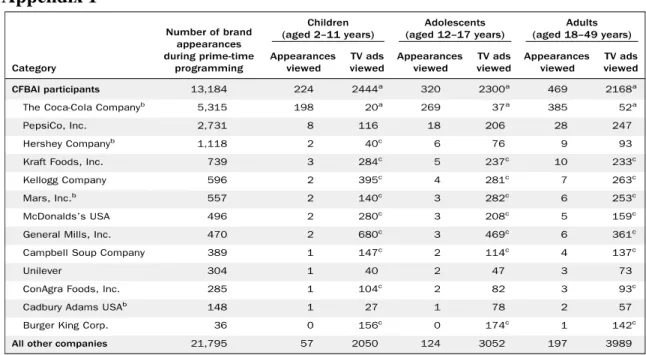
existing legislative restrictions regarding product placement in children’s TV shows. For example, in a report performed by Nielsen, approximately 35,000 brand placements of foods, beverages and restaurants on prime-time TV shows in 2008 in the US were counted and a large part of them were performed by CFBAI (Children's Food and Beverage Advertising Initiative) participating companies with pledges that they would not advertise to children under 12 years (Appendix 1)2.
One of the countries that complies with the policy given by the European Commission is Germany, which has implemented the policy in its own legislation. In the Rundfunkstaatsvertrag (Interstate Broadcasting Agreement) is specified that product placement is not allowed in TV shows for children. However, it is frequently present in familiar TV shows, like soap operas and reality shows. Popular familiar German talent shows like “Das Supertalent” and “Deutschland sucht den Superstar” (Statisca, 2012), also contain several types of product placement.
There are other countries, like Sweden, where legislation is even more restrictive than given by the policies. Every type of television advertisements targeting children under 12 years is completely forbidden (Bjurstrom, 1994). However, product placement is also frequently used in TV shows that do not target children (Abrahamsson and Lindblom, 2012). It is estimated that in 2011 product placement had a turnover of around 500 million SEK (≈€60 millions) (journal Svenska Dagbladet- svd.se). This means that even children in
countries with restrictive laws are exposed to product placement. As a result, we believe
2 Speers, S. E.; Harris, J. L.; Schwartz, M. B. 2011, “Child and Adolescent Exposure to Food and Beverage
that it is necessary to prepare children to the advertisement environment that surrounds them.
2.4 The Effect of Commercial Media Literacy
Media literacy is frequently defined as the ability to access, analyze, understand and communicate messages in different ways (Aufderheide, 1993). The European Commission considers it “an extremely important factor for active citizenship in today's information society”3. Media literacy can be subdivided into several categories. Here we want to focus on commercial media literacy, which is a way of educating children about the persuasive and selling intent of advertisements. Commercial media literacy’s intent is to develop children’s critical thinking and allow them to better understand, identify and evaluate
advertisement (Eagle, 2007). In this way, children create a cognitive defense and tend to like advertisement less and are less influenced by it, decreasing their desires for the advertised products (Robertson and Rossiter, 1974; Armstrong and Brucks, 1988; Eagle, 2007). Furthermore, when children understand the persuasive intent behind the advertising they are less likely to take it as truthful and accurate and the influence of the advertisement among them decreases. (Wilcox et al., 2004). As mentioned in a Directive of the European Parliament and Council4 (11/12/07) people with media education are not only able to do informed choices as media consumers, but also to defend themselves against dangerous material.
Commercial media literacy intervention aimed to inform children about the persuasive intent of advertisement. Therefore, for the initiatives to be effective it is necessary that
3
Media Programme: http://ec.europa.eu/culture/media/media-literacy/index_en.htm
4
children realize that marketers have different points of view than consumers, that persuasive messages do not always present the truth and finally, that advertisements should be interpreted in a different way than other types of messages and should be frequently put into question. Furthermore, it is necessary to keep the importance of “promoting real questioning and analysis” (Hobbs, 1998: 19) in mind. It is also important that the learning procedure involves “a dialectical relationship between doing and analyzing”
(Buckingham, 2003: 133), to ensure that children are able to apply the acquired findings on future situations. Moreover, the analysis of real examples is an excellent way to get the message across to children as they can relate to the specific advert (Buckingham et al., 2007).
In some European countries a media literacy program for schools called Media Smart has been implemented, in order to give children tools to understand and interpret advertisement and to be able to do informed choices. According to a program evaluation performed in the UK, the program is in general effective, since it increases children’s curiosity about advertisement issues that they have not considered before and induces them to ask analytical questions and challenge them to think in new ways about advertising (Buckingham et al., 2007).
Taking the literature review findings into account the following hypotheses are
proposed:
H1: Product placement’s effect on brand preference is lower on children who were exposed to a commercial media literacy intervention than children who were not exposed.
H3: Children who were exposed to a commercial media literacy intervention will have a lower attitude towards the brand than children who were not exposed.
H4: Children who were exposed to commercial media literacy intervention will more easily understand the persuasive intent of product placement than children who were not exposed.
H5: Children that attended a commercial media literacy intervention will be able to identify more placed brands in a movie scene than others that were not exposed to the intervention.
H6: Children who were exposed to a commercial media literacy intervention will have a lower attitude towards product placement than children who were not exposed.
3.
Methodology
3.1 Sample
The sample was composed of 147 Portuguese children, 66 from a public school and 81 from a private school, in order to have a sample of children with different backgrounds and social classes. Both schools have not adopted the Media Smart program yet. The majority of the children were between 10 and 11 years old (5th and 6thgrade), which are considered cued processors (Roedder, 1999). This age group was chosen because according to Piaget’s theory of cognitive development (Ginsburg and Opper, 1988) as children become older, they can more easily employ logical thought to problems (D’Alessio, 2009). Moreover, children within this age are able to answer a questionnaire in writing (Pecheux and Derbaix, 1999).
Portuguese Education Authority. The sample’s age distribution is given in Table 1 and fully described in Booklet 2:
Age Total
9 10 11 12 13 14
Control 1 34 36 3 1 0 75
Experimental 3 27 36 5 0 1 72
Total 4 61 72 8 1 1 147
Table 1: Sample's age distribution
3.2 Research Design
In order to test the hypotheses the experiment was designed as follows. The 147 children were divided in two main groups: an experimental group and a control group. Therefore, in each school two classes from different grades were assigned to each group. In this perspective, both the experimental and control group included children from different social classes, ages and with different cognitive skills.
The goal was to test their awareness of product placement, the influence of product placement on them and their ability to understand the persuasive intent of product placement and how commercial media literacy intervention could change it. Therefore, the experimental group was exposed to a commercial media literacy intervention conducted in the classroom about product placement. For this intervention we used the materials of Media Smart – a media literacy program that targets this age range5. Children’s attention was directed to the use of product placement and an explanation of the purpose and possible influences of product placement was presented. To facilitate their learning, real examples of product placement were shown and little exercises suggested by the Media Smart program were used. The control group was not exposed to any commercial media
5
literacy intervention, in order to infer the actual knowledge that children have regarding product placement and the influence that product placement has on them without any intervention. Afterwards, both groups watched two movies and answered a questionnaire. The questionnaire was previously analyzed by a psychologist and a pre-test was performed with 3 children, in order to evaluate if its language is appropriate and understandable by children.
In order to disguise the goal of the measuring instruments and obtain more accurate answers, before presenting the first movie, a talent show, the students were told that they would have to identify the singer that they liked the most. However, afterwards they were asked other questions as well. Before the second movie was shown they were also told before that they would be asked to identify the movie that they liked the most and other questions.
3.3 Stimuli
In order to perform a quantitative analysis related with product placement awareness (hypothesis five), excerpts of movies and TV shows that contained product placement were shown to both groups. The first clip was a Portuguese TV show that targets children, “Floribella”, where an actress speaks about the importance of using sunscreen and the
specific characteristics of that sunscreen, Ambre Solaire from Garnier. The second clip was the movie “Mac and Me”, where a birthday party takes place in McDonald’s and Ronald McDonald and McDonald’s employees appear dancing and interacting with the actors. The
3rd clip is a Portuguese soap Opera, “Morangos com Açúcar” that targets children and teenagers, in the clip the actors eat a Kalise ice-cream and the brand name appears several times. The 4th clip was the American series, “Modern Family”, which does not target children and where one of the main actors wants an iPad tablet computer for his birthday and describes its advantages and characteristics. In the last clip of the same talent show, “The X-Factor” was shown, where a cup of Pepsi was presented in a prominent way. This
set of clips lasted around 5 minutes in total.
3.4 Measures
over the other brands than children from the control group. Brands with similar values of sales6 were chosen.
Purchase intention (H2): In the case of children, purchase intention does not only express their likelihood to purchase a product, but also the probability of them to ask someone else to buy it for them (Ward et al., 1977). Therefore, based on the study performed by Phelps and Hoy (1996) children were asked how likely they were to purchase the product or to ask their parents to do and to rate it on a 5-point Likert-scale (very likely, likely, maybe, unlikely, very unlikely).
Attitude towards the brand (H3): The attitude towards the brand expresses what a person feels about a brand. Therefore, children were asked to rate Pepsi in 7 characteristics on a 4-point Likert scale. We chose the characteristics by adapting the scale proposed by Pecheux and Derbaix (1999). Some scale attributes were substituted by others that were considered more adequate to this specific drink. As a result, attributes like “It is tasteful”, “It is
refreshing”, “It is young” and “It is healthy” were added.
Understanding the persuasive intent of product placement (H4): The understanding of the persuasive intent of product placement is defined as the comprehension of this specific type of advertisement’s intent, i.e. influence people to purchase the placed brands. This variable was measured by adapting the methods used by Oates et al. (2003). First, children were asked about the purpose of product placement in the specific example of the presented movie, “Why are judges drinking Pepsi during the TV show?”. Then, they were asked
6
about the source of the product placement, “Who choose the drink that the judges are
drinking during the TV show?”.
Product placement awareness (H5): This variable allows to understand if children realize that several brands are presented during TV shows and movies. In order to analyze children’s product placement awareness they watched the second compilation, which
presented 5 clips of movies and TV shows that included product placements and were asked to recall all the brands that they saw in the video.
Attitude towards product placement (H6): Attitude towards product placement reflects the way that a person evaluates this type of advertisement. This variable was measured by adapting the scale used by Rossiter (1977) to analyze children’s attitude towards television commercials.
4.
Results
4.1 Sample Composition
A total of 198 authorizations were delivered to a private school and a public school in the metropolitan area of Lisbon. The response rate was 74,2%. The sample was composed of 50,3% females and 49,7% males, of 49% 5th graders and 51% 6th graders, and of 44,9% of public school students and 55,1% of private school students. The composition of the sample is presented below in Table 2.
Type of School
5th Graders Total 5th 6th Graders Total 6th Total Gender Public
School
Females 16 31 Females 23 35 39
Males 15 Males 12 27
Private School
Females 18 41 Females 17 40 35
Males 23 Males 23 46
Total 72 75 147
4.2. Hypothesis testing
Table 3 summarizes the results for each hypothesis. In order to test the hypothesis t-tests were performed.7
N=147 Commercial media literacy impact on: brand preference, purchase
intention, attitude towards the brand, understanding of persuasive intent, product placement awareness and attitude towards product placement
Hypothesis test Hypothesis description
Expected sign of the
impact
Sig. (2-tailed) Evidence to support the hypothesis?
H1 Brand preference - p=0,033 Yes
H2 Purchase
intention -
p=0,754 No
H3 Attitude towards
the brand -
p=0,641 No
H4 Understand the
persuasive intent +
p=0,000 Yes
H5 Product
placement awareness
+
p=0,000 Yes
H6 Attitude towards
product placement
-
p=0,108 No
Table 3: Hypothesis results
Hypothesis 1: The goal of the first hypothesis was to analyze if the product placement effect on brand preference would be lower on children who were exposed to a commercial media literacy intervention. The drink that children chose the most against Pepsi on the experimental group, was Nestea (72,2% chose Nestea over Pepsi), followed by Fanta (58,3%) and finally, Sprite (31,9%). While on the control group, children had similar preferences, the most chosen drink against Pepsi was also Nestea (66,7%), followed by Fanta (41,3%) and by Sprite (24%). Nonetheless, children from the experimental group chose less times Pepsi over the other brands (44,76%) in comparison to the control group (55,4%).8 The t-test (p=0,033) showed that the commercial media literacy intervention, i.e.
7
For each hypothesis it was carried out qui-squared tests to analyze if there was an association with any of the following subject variables: grade (5th and 6th), type of school, gender and level of parent’s education and the variable being measured in each hypothesis. For all the tests a significance level of 5% was considered.
8
the product placement’s class, had a negative impact on the placed brand preference. As a
result, H1 is not rejected. Descriptive statistics showed that girls chose less times Pepsi over the other brands in comparison with boys. While 78,4% of the girls preferred Nestea over Pepsi, only 60,3% of the boys preferred Nestea. Concerning Fanta, the majority of the girls (59,5%) preferred it over Pepsi, while only 39,7% of the boys chose Fanta. Moreover, between Sprite and Pepsi, boys and girls had similar preferences, since 27% of the girls preferred Sprite and 28,8% of the boys also chose it as the preferred soda. The qui-square test showed that the variable brand preference and gender are dependent ( 2=8,268; p=0,041).
Hypothesis 2: The aim of this hypothesis was to prove that commercial media literacy intervention has a negative impact on the purchasing intention of placed brands. Against our expectations, children from the experimental group had a slightly higher purchase intention average than the control group (3,15 out of 5 vs. 3,09). However, the t-test between both variables showed that the difference was not significant (p=0,754), meaning that the intervention did not have a relevant impact on the purchasing intention. As a result,
H2 is rejected. Descriptive statistics also showed that children whose parents had university studies had a higher purchasing intention (3,16 out of 5) in comparison to the other ones (3,02), being this difference significant ( 2=9,972; p=0,041).
higher (2,57 out of 4 vs. 2,53), after performing the t-test, it was possible to conclude that the differences were not significant (p=0,641). Thus, H3 is rejected.
Hypothesis 4: In the following hypothesis the goal was to analyze if children’s ability to
understand product placement persuasive intent increased after the commercial media literacy exposure. The majority of children answered correctly to the two questions. However, the descriptive statistics showed that 91,67% of the answers given by the experimental group were correct, while from the control group only 60,14% were correct. The t-test (p=0,000) indicates that the difference was significant and the commercial media literacy intervention had a positive impact on the ability to understand the product placement persuasive intent. Therefore, H4 is not rejected. From the descriptive statistics analysis it was also possible to conclude that children from the 6th grade performed better on the two questions regarding the persuasive intent. They got on average 83,33% correct answers, while students from the 5th grade had an average of 67,61%, being this difference significant ( 2=6,021; p=0,049).
average 0,576) than the 5th grade students (0,5), being this difference significant ( 2=18,629; p=0,045). Furthermore, students from the public school also identified more brands on average (0,6318) in comparison with the ones from the private school (0,463), being also this difference significant ( 2=28,831; p=0,001).
Hypothesis 6: In order to test if the attitude towards product placement will be lower on children who were exposed to a commercial media literacy intervention, children answered several questions concerning what they thought about product placement. The scale presented a low reliability with an alpha of 0,263, which might have compromised the results. Children that had a class about product placement had a lower attitude towards product placement, with an average of 2,5252 out of 4, while the children from the control group had an average of 2,5675. Nevertheless, the t-test confirmed this difference to be non-significant (p=0,100), which means that the product placement’s class did not have a significant impact on the attitude towards product placement. As a result, H6 is rejected.
Results also show that students from the public school had on average a better attitude towards the product placement (2,067) in comparison with the students from the public school (2,0561). The association test confirmed that the type of school and the attitude towards the product placement are dependent ( 2=29,234; p=0,022).
5.
Discussion and Conclusions
more easily changed in the short-term, while an attitude can only be changed in the long-term, because of its enduring characteristic and because it takes great consumer’s effort to analyze the available information and relate it with his already formed attitude (Solomon, 2006). Therefore, the 15-minute intervention was enough to change the majority of children’s brand preference, but it was not enough to change their attitude. Children would
need a longer intervention and which would not be concentrated in only one day, to give them more time to reflect on this type of advertisement by themselves. Even though these two hypotheses were rejected, they had the same result, which was expected, since according to the balance theory, consumers strive for consistency between interrelated attitudes (Solomon, 2006). It was also not proved that the intervention had a negative impact on the purchase intention, which can be justified by the same reasons.
Results also show that children whose parents did not have a university degree had a lower placed brand purchase intention. This can be justified by the fact that parents without a university degree have in general less economical conditions. As a result, children have fewer opportunities for consumption and learn through the observation of their parents that they have financial restrictions and have to limit their purchases. The tests’ analysis also showed that girls chose fewer times the placed brand, Pepsi, as their favorite drink in comparison to the boys. A possible reason for this difference is that girls are more mature than boys of the same age and can apply their acquired knowledge to real issues easily.
product placement. This proves that the majority of the children from the experimental group understood the content of the class about product placement, but had some problems in applying the acquired knowledge, when they were asked about their attitude towards the placed brand and product placement. A justification for this fact is that children at the cued processor stage have “production deficiencies”, since they have the capacity to use
processing strategies, but do not always use them when needed (John, 1999). Besides, the ability to retrieve and use their knowledge about advertising is still developing at this stage (John, 1999). Since children in the age of ten and eleven are normally able to understand the traditional advertisement’s goal, the percentage of children who answered both
questions about the persuasive intent correctly (68,7%) cannot be considered very high. However, this difficulty in understanding the persuasive intent can be justified by the subtle essence of this type of advertisement. Moreover, according to the results it is possible to say that age is associated with children’s ability to recognize the persuasive intent of the placed brand and to identify them, which was also expected since older children can more easily understand other’s point of view, namely the advertiser’s perspective (John, 1999).
The intervention had also a positive impact on children’s ability to identify the placed brands. Nonetheless, the average of brands identified per student was very low, which confirms that product placement is a very subtle way of advertisement. Therefore, children face great difficulties in realizing its presence in a conscious way, which hampers their ability to analyze its content and protect themselves against the advertiser’s persuasion
appeared also in a prominent way. If children would be asked to recognize the placed brands, instead of recalling them, there would probably be more correct answers.
There is no doubt that product placement is an effective way of influencing children’s consumer behaviors. However, according to this study, product placement is a marketing technique that takes advantage of children’s vulnerability, given that only 60,14% of the
children from the control group understood its persuasive intent. As a result, it is not considered ethical that companies that sell products that are not beneficial to children use this technique to market them, because it will induce children to consume them in an unconscious way. On the other hand, this technique can be used for other products such as healthy food products because it might influence children to consume healthy food. Companies that sell products high in fat, sugar, salt and calories and that look for social responsible marketing strategies, should support commercial media literacy interventions, since it has already been proven to be effective. In this way, companies would be increasing their current brand image among children and parents and they would be investing in the children as future consumers. Besides, this strategy might contribute to reduce the criticism of the potential negative effects of the media (Hobbs, 1998).
6. Limitations and Future Research
There are mainly five limitations in this study that should be taken into account on future research on this topic. The first one is related with the diversity of the sample, since only Portuguese schools on the metropolitan area of Lisbon were considered for the market research and the sample only comprised children from 5th and 6th grade. For future research it would be interesting to include children from other types of schools, namely suburban and rural, and make a cross-cultural comparison and analyze the effect of different cultures. Besides, children from different cognitive development stages should be included.
Another limitation is related with the few time that passed between the commercial media literacy intervention and the questionnaire. In this study the short-term effect was analyzed, since children filled the questionnaire right after the presentation about product placement. Future research should analyze also the medium and long-term effect.
Moreover, in future studies, instead of using known brands, fictitious stimulus should be used, in order to exclude the implications related with brand awareness and recognition, which might compromise the results.
The fourth limitation is related with the questionnaire. As an alternative of asking children to recall the places brands, a recognition task could be performed, in order to compare the results from both tests and facilitate children’s answers. Furthermore, the attitude towards the product placement’s scale should be developed taking into account the results presented, in order to reach an acceptable reliability level.
studies to analyze if they have a bigger impact on children’s attitudes towards product placement and placed brands.
To conclude, there is still much that can be developed, in order to better understand the effectiveness of commercial media literacy in reducing the influence of advertisement on children, especially regarding subtle advertisement. In this way, it will be possible to create programs that are effective.
7. References
Abrahamsson, J. and Lindblom N. 2012. “Product Placement: A study about Swedes attitude towards product placement in Movies and TV-shows”, Linnaeus University School of Business and Economics Ajzen, I. 1991. “The theory of planned behavior”. Organizational behavior and human decision processes, Vol. 50, pp. 179-211
American Academy of Pediatrics. 1995. “Children, Adolescents, and Advertising. Committee on
Communications, American Academy of Pediatric”, Pediatrics 95, pp. 295-297.
Anderson, R. E., Crespo, C. J., Barlett, S. J., Cheskin, L. J. and Pratt, M. 1998. “Relationship of physical activity and television watching with body weight and level of fatness among children.” Journal of the American Medical Association, 179, pp. 938-942.
Andronikidis, A. and Lambrianidou, M. 2010 “Children’s Understanding of Television Advertising: A Grounded Theory Approach.” Psychology & Marketing, Vol. 27(4), pp. 299 322.
Angelopoulos, C. 2010. ”Product Placement in European Audiovisual Productions”. In Product Placement,. Strasbourg: Iris Plus. Retrieved from http://www.obs.coe.int/oea_publ/iris/iris_plus/iplus3LA_2010.pdf.en. Armstrong, G. M. and Brucks, M. 1988. “Dealing with Children’s Advertising: Public Policy Issues and Alternatives.” Journal of Public Policy and Marketing, 7, pp. 98-113.
Arvery, R. J. and Ferraro R. 2000. “Verisimilitude or Advertising? Brand Appearances on Prime-Time Television”. Journal of Consumer Affairs 34(2), pp. 217-245.
Aufderheide, P. 1993. “National Leadership Conference on Media Literacy”. Conference report. Washington, DC: Aspen Institute.
Auty, S. and Lewis, C. 2004. “Exploring Children’s Choice: The Reminder Effect of Product Placement”.
Psychology & Marketing, Vol. 21(9), pp. 697–713.
Balasubramanian, S. K. 1994. “Beyond Advertising and Publicity: Hybrid Messages and Public Policy Issues,” Journa lof Advertising, 23 (4), pp. 29–46.
Bjurstrom, E. 1994. “Children and Television Advertising: A Critical Study of the Effects of TV -Commercials on Children. Stockholm: Konsumentverket, report No. 1994/95:8.
Borzekowski, D. L. G., and Robinson, T. N. 2001. “The 30-second effect: An experiment revealing impact of television commercials on food preferences of preschoolers”. Journal of The American Dietetic Association, 101 (1), pp. 42-46.
Brucks, M., Armstrong, G. M., and Goldberg, M. E. 1988. “Children’s use of cognitive defenses against television advertising: A cognitive response approach.” Journal of Consumer Research, 14, pp. 471-482. Buckingham, D. 2003. Media Education: Literacy, Learning and Contemporary Culture. Cambridge. Polity Press.
Connor, S. 2006. “Food-related advertising on preschool television: Building brand recognition in young viewers.” Pediatrics, 118, pp. 1478–1485.
D’Alessio, M.; Laghi, F.; Baiocco, R. 2009. “Attitudes toward TV advertising: A measure for children”,
Journal of Applied Developmental Psychology, 30, pp. 409-418.
d’Astous, A. & Chartier, F. 2000. “A study of factors affecting consumer evaluations and memory of product placements in movies.” Journal of Current Issues and Research in Advertising, 22(2), pp. 31–40. Desmond, R. J. and Jeffries-Fox, S. 1983, “Elevating Children's Awareness of Television Advertising: The Effects of a Critical Viewing Program”, Communication Education, Vol.32(1), pp.107-15
Dietz W. and Gortmaker S. 1985. “Do we fatten our children at the TV set? Obesity and television viewing in children and adolescents.” Pediatrics, 75; pp. 807-812.
Distefan, J. M., Pierce J. P. and Gilpin E. A. 2004. “Do Favorite Movie Stars Influence Adolescent Smoking Initiation?” American Journal of Public Health 94(7), pp. 1239-1244.
Eagle, L. 2007. “Commercial media literacy: what does it do, to Whom and does it matter?” Journal of Advertising, 36 (2). pp. 101-110.
ERC: www.erc.pt
EU pledge: http://www.eu-pledge.eu/content/enhanced-2012-commitments
Fishbein, M. and Ajzen, 1. 1975. “Belief, attitude, intention, and behavior: An introduction to theory and
research.” Reading, MA: Addison. Wesley.
Ginsburg, H. P. and Opper S. 1988. Piaget's Theory of Intellectual Development, Englewood Cliffs NJ: Prentice-Hall.
Goldberg, M. E. 1990, “A Quasi-Experiment Assessing the Effectiveness of TV Advertising Directed to Children”, Journal of Marketing Research, 27, pp. 445-454.
Goldberg, M. E. and Gerald, J. G. 1978, “Some Unintended Consequences of TV Advertising to Children”,
Journal of Consumer Research, 5, pp. 22-29.
Goldberg, M. E., Gorn, G. J. and Gibson, W. 1978. “TV Messages for Snack and Breakfast Foods: Do They Influence Children’s Preferences?” Journal of Consumer Research, pp.73-81.
Gupta, P. B., & Lord, K. R. 1998. “Product placement in movies: The Effect of Prominence and Monde on Audience Recall” Journal of Current Issues & Research in Advertising, Volume 2, Number 1, pp. 47-59. Gupta, P.; Balasubramanian S. K. and Klassen, M. L. 2000. “Viewers’ Evaluations of Product Placements in Movies: Public Policy Issues and Managerial Implications”, Journal of Current Issues and Research in Advertising, Volume 22, Number 2, pp.41-52.
Halford, J. C. G.; Gillespie, J.; Brown V.; Pontin, E. E. and Dovey T. M. 2003. “Effect of television advertisements for foods on food consumption in children.” Appetite, 43, pp. 221 225.
Harrison, K. and Marske, A. 2005. “Nutritional Content of Foods Advertised During the Television
Programs Children Watch Most”. American Journal of Public Health, Vol.95, No. 9, pp. 1568-1674.
Hobbs, R. 1998. “The Seven Great Debates in the Media literacy Movement” Journal of Communication, Vol. 48, pp. 16-26.
Homer, P. M. 2009. “Product Placements: The Impact Type and Repetition on Attitude.” Journal of Advertising, Vol. 38, no. 3, pp. 21–31.
Hudson, S., Hudson, D. and Peloza, J. 2007. “Meet the Parents: A Parent’s Perspective on Product Placement in Children’s Films.” Journal of Business Ethics, 80, pp. 289-304.
ICAP: www.icap.pt
IHS Screen Digest Advertising Intelligent Service report. 2011. http://www.isuppli.com/Media- Research/News/Pages/Product-Placement-Revenue-to-See-Steady-Growth-in-Key-UK,-French-and-German-TV-Markets.aspx
Kern European Affairs. 2009. “Advertising Rules and Their Effects under the New Audiovisual Media Services Directive”, European Parliament
Kiley, D. 2006. “Television: Counting the Eyeballs.” Business Week Magazine. 15/01/2006. Retrieved from http://www.businessweek.com/magazine/content/06_03/b3967116.htm.
Kotler, J. A., Schiffman, J. M. and Hanson, K. G. 2012, “The influence of media characters on children’s food choices.” Journal of Health Communication, 0, pp. 1-13.
Kraak, V. 1998. “How Marketers Reach Young Consumers: Implications for Nutrition Education and Health
Promotion Campaigns”, Family Economics and Nutrition Review 11(4), pp. 31-42.
La Ferle, C. and Edwards, S.M. 2006. “Product Placement.” Journal of Advertising, 35(4), pp. 65-87. Lehu. J.-M. and Bressoud, E. 2008, “Effectiveness of brand placement: New insights about viewers.”
Journal of Business Research, 61, pp. 1083-1090.
Lord, K. R. and Gupta, P. B. 2010. “Response of Buying-Center Participants to B2B Product Placements.”
The Journal of Business and Industrial Marketing, 25 (3), pp. 188-195.
Mackay, T. Ewing, M., Newton, F and Windisch, L. 2009. “The Effect of Product Placement in Games on Brand Attitude and Recall”. International Journal of Advertising, 28(3), pp. 423-438.
Malhotra, N., and Birks, D. 2007. ”Marketing Research: an applied approach”. 3rd European ed. London: Prentice Hall.
Marcela, A. 2012. “ERC quer proibir publicidade a alimentos hipercalóricos”, Jornal Diário de Notícias, p. 5. Retrieved from: http://www.mynetpress.com/mailsystem/noticia.asp?ref4=4%23k&ID=%7B2F717C93 E906-4984-A50C-911C0E9A3413%7D
McDonnell, J. & Drennan, J. 2010. “Virtual Product Placement as a New Approach to Measure Effectiveness of Placements.” Journal of Promotion Management, 16(1/2), pp. 25.
McNeal, J. 1992. Kids as customer. New York, Lexington Books.
Media Programme: http://ec.europa.eu/culture/media/media-literacy/index_en.htm Media smart: www.mediasmart.org.uk/ and www.mediasmart.com.pt
Moore, E. S. 2004, “Children and the Changing World of Advertising”, Journal of Business Ethics 52(2), pp. 161-167.
O’Neill E. and Barrett M. 2004. “TiVo – the next big thing – DVRs and television advertising models.” Montréal, Canada: 6th World Media Economics Conference.
Oates, C., Blades, M. and Gunter, B. 2002. “Children and Television advertising: When do they understand persuasive intent?”. Journal of ConsumerBehaviour, 1 (3), pp. 238-245.
Oates, C., Blades, M., Gunter, B. and Don J. 2003. “Children’s Understanding of Television Advertising: a Qualitative Approach”. Journal of Marketing Communication, 9 (2), pp. 59-71.
Pecheux, C. and Derbaix, C. 1999. “Children and Attitude toward the Brand: A New Measurement Scale”.
Journal of Advertising Research. August 1999, pp.19-27
Pereira, F. C. and Veríssimo, J. 2009. “O Product Placement nas telenovelas Portuguesas”. In Media Redes e Comunicação: Futuros Presentes, pp. 351-370. Editora Quimera.
Phelps, J. E., and Hoy, M. G .1996. “The Aad-Ab-PI Relationship in Children: The Impact of Brand
Familiarity and Measurement Timing”. Psychology and Marketing. Vol. 13(1), pp.77- 105
Pinto, M. 2011. “Estudo educação para os media em Portugal: experiências, actores e contextos.” Entidade Reguladora para a Comunicação Social, pp.25-36
Powell, L. M., Szczypka, G., Chaloupka, F. J., & Braunschweigh, C. L. 2007. “Nutritional content of television food advertisements seen by children and adolescents in the United States.” Pediatrics, 120, pp. 576–611.
Quotenmeter: http://www.quotenmeter.de/cms/
Reijmersdal, E. A. V., Neijens, P. C. and Smit, E. G. 2010. “How Media Factors Affect Audience Responses to Brand Placement.” International Journal of Advertising, 29(2), pp. 279-302.
Reijmersdal, E. V. 2009, “Brand Placement Prominence: Good for Memory! Bad for Attitudes?”, Journal of Advertising Research, June, pp.151-153.
Robertson, T. S.; Rossiter, J. R. 1974. “Children and Commercial Persuasion: An Attribution Theory.”
Journal of Consumer Research, Vol. 1, No. 1, pp. 13-20.
Roedder John, D. 1999 “Consumer Socialization of Children: A Retrospective Look at Tweenty-Five Years of Research”, Journal of Consumer Research, 26, pp. 183-213.
Rossiter, John R. 1977. “Reliability of a Short Test Measuring Children’s Attitudes Toward TV Commercials”, Journal of Consumer Research, 3, pp. 179-184.
Rossiter, John R. and Bellman, S. 2005. “Marketing Communications: theory and applications”. New South Wales: Pearson/Prentice Hall.
Sigman, A. 2010. “Product placement's threat to children”, the Guardian, retrieved from: http://www.guardian.co.uk/commentisfree/2010/jan/05/product-placement-tv-children
Sigman, A. 2010. “The Impact Of Screen Media On Children: A Eurovision For Parliament”, chapter based on a verbal presentation given to the Quality of Childhood group in the European Parliament
Solomon, M. 2006, “Consumer Behaviour”, 3rd Edition, Prentice Hall
Speers, S. E.; Harris, J. L.; Schwartz, M. B. 2011, “Child and Adolescent Exposure to Food and Beverage Brand Appearances During Prime-Time Television Programming”, American Journal of Preventive Medicine, 41(3), pp. 291–296
Statista: http://de.statista.com/statistik/daten/studie/189630/umfrage/die-beliebtesten sendungen-im-deutschen-tv/
svd.se – Swedish newspaper, online version. http://www.svd.se/naringsliv/reklamen-du-inte-ska-upptacka_6481138.svd Reviewed: 2012-02-16.
Tiwsakul, R., Hackley, C. and Szmigin, I. 2005. “Explicit, Integrated Product Placement in British Television Porgrammes.” International Journal of Advertising, 24(1), pp. 95–111.
Unesda: http://www.unesda.org/key-facts
Ward, S., Wackman, D. B., and Wartella, E. 1977. How children learn to buy: The development of consumer information processing skills. Beverly Hills, CA: Sage.h
Wilcox, B., Cantor, J., Dowrick, P., Kunkel, D., Linn, S. and Palmer, E. 2004. “Report of the APA task force on advertising and children: Psychological issues in the increasing commercialization of childhood.”
Retrieved from:
http://www.apa.org/releases/childrenads/pdf#search=%22FTC%20report%201978&20advertising%22. Williams, K.; Petrosky, A.; Hernandez, E. and Page, R. 2011. “Product placement effectiveness: revisited
and renewed.” Journal of Management and Marketing Research, 7 (April),pp.1-24.
8. Appendices
Appendix 1