ORIGINAL ARTICLE
IgM-mediated autoimmune responses to oxidative specific
epitopes, but not nitrosylated adducts, are significantly
decreased in pregnancy: association with bacterial
translocation, perinatal and lifetime major depression
and the tryptophan catabolite (TRYCAT) pathway
Chutima Roomruangwong1&Buranee Kanchanatawan1&Sunee Sirivichayakul2&
George Anderson3&André F. Carvalho4&Sebastien Duleu5&Michel Geffard5,6&
Michael Maes1,7,8,9,10
Received: 7 January 2017 / Accepted: 24 May 2017
#Springer Science+Business Media New York 2017
Abstract Immunoglubulin (Ig)M responses directed to oxida-tive specific epitopes (OSEs) and nitric oxide (NO)-adducts are significantly associated with major depression and physio-somatic symptoms. End of term serum IgM responses to OSEs and NO-adducts were assayed in pregnant women with (n= 24) and without prenatal depression (n= 25) as well as in 24 non-pregnant women. Associations of IgM/IgA responses to Gram-negative gut commensal bacteria (leaky gut index) and IgA/IgM responses to tryptophan catabolites (TRYCATs) were analyzed.
IgM responses to OSEs, but not NO-adducts, were significantly reduced at the end of term. There were no significant associations between IgM responses to OSEs and perinatal depression, whilst IgM responses to NO-adducts, especially NO-cysteinyl, were significantly associated with a lifetime major depression. IgM responses to OSEs and NO-cysteinyl were significantly associat-ed with IgA/IgM responses to Gram-negative bacteria, especially Morganella morganii,Klebsiella pneumoniaeandCitrobacter koseri. IgM responses to NO-adducts and OSEs, especially malondialdehyde and myristic acid, and C-reactive protein (CRP) were inversely associated with TRYCAT pathway activity, whilst a lifetime depression andPseudomonas putidawere pos-itively associated. The attenuation of natural IgM-mediated re-sponses to OSEs at the end of term may indicate lowered activity of this part of the compensatory (anti-)inflammatory reflex sys-tem and may be partly explained by lowered bacterial transloca-tion. Increased IgM responses to NO-cysteinyl is a biomarker of lifetime depression and may be induced by bacterial transloca-tion. Natural IgM-mediated autoimmune responses, increased nitrosylation and higher CRP levels may have negative regulato-ry effects on the TRYCAT pathway.
Keywords Depression . Inflammation . Immune .
Kynurenine . Cytokines . Compensatory (anti-)inflammatory reflex system (CIRS)
Introduction
Clinical depression is accompanied by increased peripheral immune-inflammation coupled to increased levels of oxidative
* Michael Maes
[email protected];http://scholar.google.co.th/ citations?user=1wzMZ7UAAAAJ&hl=th&oi=ao 1
Department of Psychiatry, Faculty of Medicine, Chulalongkorn University, Bangkok, Thailand
2 Department of Medicine, Faculty of Medicine, Chulalongkorn University, Bangkok, Thailand
3
CRC Scotland & London, London, UK 4
Department of Clinical Medicine and Translational Psychiatry Research Group, Faculty of Medicine, Federal University of Ceará, Fortaleza, CE, Brazil
5 Research Department, IDRPHT, Talence, France
6
GEMAC, Lieu-Dit Berganton, Saint Jean d‘Illac, France 7
Department of Psychiatry, Faculty of Medicine, State University of Londrina, Londrina, Brazil
8
Department of Psychiatry, Medical University Plovdiv, Plovdiv, Bulgaria
9
Revitalis, Waalre, The Netherlands
10 IMPACT Research Center, Barwon Health, Deakin University, Geelong, VIC, Australia
and nitrosative stress (IO&NS), as indicated by raised levels of acute phase proteins, such as C-reactive protein (CRP), pro-inflammatory cytokines, oxidative stress biomarkers and signs of hypernitrosylation (Anderson and Maes2014). The immune picture in depression shows increased levels of M1 macrophage cytokines, including interleukin (IL)-1β, IL-6 and tumor necro-sis factor (TNF)-αas well as Th1 cytokines, including interferon (IFN)-γ(Eyre et al.2013; Maes et al.2012a,b; Miller et al. 2009). Increased levels of oxidative stress in depression is indi-cated by damage to cell membranes, lipids, proteins and DNA (Anderson and Maes2016; Czarny et al.2016). Increased levels of malondialdehyde (MDA), a toxic product of polyunsaturated lipids degradation following damage by reactive oxygen species (Pryor and Stanley1975), is one of the most frequently observed biomarkers in unipolar and bipolar depression (Del Rio et al. 2005; Pryor and Stanley1975).
Major depression, and especially when chronic, is accompa-nied by increased immunoglobulin (Ig)M-mediated autoim-mune responses against oxidative specific epitopes (OSEs), in-cluding MDA, azelaic acid (Maes et al.2013a,b; Maes et al. 2013a,b; Zheng et al.2013), phosphatidyl inositol (Pi), and the anchorage molecules, myristic acid, palmitic acid and farnesyl-cysteine (Maes et al.2011a,b; Maes et al.2012a,b), indicating oxidative damage to membranes and a consequent IgM-mediated natural or regulatory autoimmune response. This IgM response may aid in the clearance of oxidatively damaged, apoptotic or dying cells expressing OSE markers, including MDA (Maes et al.2011a,b; Maes et al.2013a,b; Maes et al. 2013a,b; Maes et al.2011a,b; Maes et al.2012a,b; Tsuboi et al. 2013; Zheng et al.2013). These natural IgM antibodies not only recognize neoantigens, including OSEs, but also foreign anti-gens, including invading pathogens (Kanchanatawan et al. 2017; Schwartz-Albiez et al.2009). As such, natural IgM anti-bodies target OSEs thereby attenuating proinflammatory re-sponses and comprise a first-line defence against pathogens.
Clinical depression is accompanied by enhanced levels of inducible NO synthase (iNOS), NO and NO metabolites and increased nitrosation and nitrosylation of proteins (Gałecki et al.2012; Maes et al. 2013a,b, 2011a, b; Morris et al. 2016a,b). Increased autoimmune responses to NO-adducts have been observed in depression, and especially when chron-ic, indicating hypernitrosylation (Maes et al.2013b;2011a). Nitrosylation may have a regulatory role; for example, it may aid in DNA repair mechanisms, whilst hypernitrosylation may lead to deleterious and neurodegenerative effects (Morris et al. 2016a,b). In addition, some IgM-mediated autoimmune re-sponses to NO-adducts are detrimental and neurotoxic, in-cluding increased IgM responses to NO-cysteinyl (Morris et al.2016a,b; Moylan et al.2014). No studies have examined these IgM responses to OSEs and NO-adducts during preg-nancy or in prenatal depression.
Th1 cytokines, especially IFN-γ, M1 macrophage cytokines and oxidative stress activate indoleamine 2,3-dioxygenase,
which drives tryptophan to the production of tryptophan catab-olites (TRYCATs), including quinolinic, picolinic and xanthurenic acid, kunurenine and 3-OH-kynurenine (Anderson et al.2014a,b; Martin-Subero et al.2016; Morris et al.2016a, b). Research projects are being performed to clarify as to wheth-er TRYCAT pathway activation is a charactwheth-eristic of depression per se or physio-somatic (formerly psycho-somatic) that often accompany clinical depression (Anderson et al. 2014a,b). Recently, we found no significant differences in TRYCAT levels in association with perinatal depression, although increased TRYCAT levels were associated with physio-somatic symp-toms at the end of term (Maes et al.2008). To date, no previous studies have investigated associations between TRYCAT path-way activation and IgM-mediated immune responses to OSEs and nitrosylation in perinatal depression.
Increased gut permeability followed by increased bacterial translocation (leaky gut) is another condition that may be as-sociated with clinical depression, especially when chronic (Maes et al.2008). This condition is indicated by increased serum IgM / IgA responses directed against antigens and LPS of Gram-negative bacteria, including Hafnia alvei, P s e u d o m o n a s a e r u g in o s a , M o rg a n e l l a m o rg a n i i , Pseudomonas putida, Citrobacter koseri and Klebsiella pneumoniae(Roomruangwong et al.2016). Bacterial translo-cation may drive gut-derived inflammation and oxidative stress as well as IgM-mediated autoimmune responses to OSEs and NO-adducts (Anderson et al.2014a,b; Maes et al. 2013a,b). However, no studies have investigated possible associations between bacterial translocation and IgM-mediated autoimmune responses in the perinatal period.
The aims of the current study are: 1) to assess whether prenatal depression is accompanied by alterations in serum IgM responses to OSEs and NO-adducts and whether there are any changes in these autoimmune responses during preg-nancy; and 2) delineate the associations between these IgM-mediated autoimmune responses and IgM/IgA responses to gut commensal bacteria and TRYCAT pathway activation.
Subjects and methods
Participants
and schizophrenia; b) positive VDRL or HIV serology; and c) medical or obstetric condition(s) that impede ability to complete the questionnaires. Exclusion criteria for normal controls were current and lifetime diagnoses of any axis 1 disorders. Exclusion criteria for non-pregnant and pregnant women were medical disorders, including immune and autoimmune disorders, hyper-tension and diabetes. The study was approved by the Ethics Committee of the Faculty of Medicine, Chulalongkorn University, Bangkok, Thailand (IRB No.321/57, COA No. 615/2014). Written informed consent was obtained from all participants.
Measures
Clinical assessments
Pregnant women were evaluated by a senior gynecologist and psychiatrist at 2 time points, namely end of term (T1) and 4– 6 weeks after delivery (T2). All non-pregnant women and preg-nant women were assessed using a structured interview, includ-ing the Edinburgh Postnatal Depression Scale (EPDS), Thai validated translation (Pitanupong et al.2007; Vacharaporn et al.2003) and Spielberger’s State-Trait Anxiety Inventory (STAI), state version in a Thai validated translation (Spielberger and Vagg1984; Thapinta1991) Pregnant women with an EPDS score≥11 were diagnosed as suffering from depression, either antenatal (T1) or postpartum (T2) (Pitanupong et al.2007; Vacharaporn et al.2003). The STAI had been used to assess anxiety among pregnant women (Abedian et al. 2015; Bayrampour et al. 2015). In non-pregnant women and non-pregnant women at T1 we used the Mini International Neuropsychiatric Interview (M.I.N.I) - Thai ver-sion (Kittirattanapaiboon and Khamwongpin2005)–to assess the diagnosis ofBa life time history of mood disorders^(namely major depressive disorder, bipolar disorder or dysthymia) andBa life time history of depression^ (namely major depressive dis-order or dysthymia). At T1, all participants completed a ques-tionnaire to obtain socio-demographic, medical and obstetric information. Body height (in m) was assessed with a manual height measure instrument and body weight in kilograms (kg) with a digital weighing scale. Body mass index (BMI) was calculated using the formula: BMI = body weight (kg) / height (m)2. The senior psychiatrist also assessed premenstrual syn-drome (PMS), namely a recurrent pattern of physio-somatic symptoms (body aches, tender breasts, fatigue, bloating) and mood symptoms (depression and anxiety symptoms, tension and irritability, decreased concentration), appearing after ovula-tion in the luteal phase and resolving with menstruaovula-tion.
Assays of IgM responses directed to OSEs
At 8.00 a.m., after an overnight fast, blood was sampled in non-pregnant and pregnant woment (at T1) for the assay of
IgM-mediated autoimmune responses directed against OSEs and NO-adducts, IgA/IgM responses directed against antigens/LPS of Gram-negative bacteria and TRYCATs, and serum CRP. An enzyme-linked immunosorbent assay (ELISA) was used to measure IgM levels directed against conjugated azelaic acid, MDA, phosphatidylinositol (Pi) and three conjugated anchorage molecules, namely palmitic acid, myristic acid and farnesyl cysteine (Boullerne et al.1996; Geffard et al. 2003, 2002). Azelaic acid, myristic acid, palmitic acid and farnesyl cysteine, were linked to free fatty acid BSA. Ten mg of each hapten was dissolved in 2 ml of methanol containing 40μl of triethylamine (TEA). For each coupling, 20 mg of free fatty acid BSA was dissolved in 2 ml of water containing 40μl TEA. The carboxylic group of each hapten was activated by ethylchloroformate (ECF) diluted in DMSO. After 10 min, BSA solutions were slowly mixed with the activated hapten solutions. After the coupling, each con-jugate was purified by dialysis against phosphate buffer with 103M CaCl2. Phospatidylinositol (Pi) was linked to BSA, as described for conjugated TRYCATs (see below). MDA was linked to BSA using the following protocol: 5.280 ml of MDA was mixed with 720μl of 4 N HCL in 20 ml of water. After 10 min stirring at 37 °C, this solution was mixed in 20 ml of water containing 200 μl of BSA. The pH was adjusted at 7 during 2 h at 37 °C. Then, the mixture was purified by dialysis with stirring water. Polystyrene 96-well plates (NUNC) were coated with 200μl solution containing the conjugate at 10μg/ ml for Pi, azelaic, palmitic and myristic acids and at 80μg/mL for MDA in 0.05 M carbonate buffer at pH 9.6. Well plates were incubated at 4 °C for 16 h under agitation. Then, a 200μl blocking solution (PBS, 2.5 g/l BSA) was added for 1 h and placed at 37 °C. Following three washes with PBS, plates were filled with 100 μl of sera diluted at 1:1000 in the blocking buffer A (PBS, 2 g/l BSA) and incubated at 37 °C for 1 h 45. After three washes with PBS-0.05% Tween 20, plates were incubated at 37 °C for 1 h with peroxidase-labeled anti-human IgM secondary antibodies diluted respectively at 1: 15,000, in the blocking buffer (PBS, 2 g/l BSA). They were then washed three times with PBS 0.05% Tween 20, and in-cubated with the detection solution for 10 min in the dark. Chromogen detection solution was used for the peroxidase assay at 8% in 0.1 M acetate and 0.01 M phosphate buffer (pH 5.0) containing 0.01% H2O2. The reaction was stopped with 25μl 2-N HCl. Optical densities (OD) were measured at 492 nm using a multiscan spectrophotometer. All assays were carried out in duplicate.
Assays of IgM responses directed against NO adducts
1996; Geffard et al.2003,2002). The synthesis of these conju-gates have been described previously (Boullerne et al.1995). Each hapten conjugate was nitrosylated using sodium nitrite (NaNO2) dissolved in 2 ml of each conjugate, in 0.5 M HCl at 37 °C for 2 h, while shaking in the dark. Conjugates were then dialyzed at 4 °C for 24 h against a Phosphate Buffered Saline (PBS: 10−2M NaH2PO4, 12H2O; 0.15 M NaCl; pH 7.4) solu-tion. S-nitrosothiol bond formation was determined by spectro-photometry. The S-nitrosothiol compounds possess two absor-bance maxima, at 336 and 550 nm, respectively: e336 nm = 900 M−1cm−1for the conjugates, e550nm = 4000 M−1cm−1 for BSA. Absorbance was evaluated in order to determine NO concentrations linked to the compounds.
The assays for the titers of IgM have been extensively described elsewhere (Boullerne et al.2002; Geffard et al. 2002). Briefly, polystyrene 96-well plates (NUNC) were coat-ed with 200μl solution containing the conjugates at 10μg/ml in 0.05 M carbonate buffer at pH 9.6. Well plates were incu-bated at 4 °C for 16 h under agitation. Then, a 200 μl of blocking solution (PBS, 2.5 g/l BSA) was added for 1 h and placed at 37 °C. Following three washes with PBS, plates were filled up with 100μl of sera diluted at 1:1000 in the blocking buffer A (PBS, 0.05% Tween 20, 10% Glycerol, 2.5 g/l BSA, 1 g/l BSA-G) and incubated at 37 °C for 2 h. After three washes with PBS-0.05% Tween 20, plates were incubated at 37 °C for 1 h with peroxidase-labeled anti-human IgM secondary antibodies diluted respectively at 1: 15,000, in the blocking buffer (PBS, 0.05% Tween 20, 2.5 g/l BSA). They were then washed three times with PBS-0.05% Tween 20, and incubated with the detection solution for 10 min in the dark. Chromogen detection solution was used for the peroxi-dase assay at 8% in 0.1 M acetate and 0.01 M phosphate buffer (pH 5.0) containing 0.01% H2O2. The reaction was stopped with 25μl 2-N HCl. Optical densities (OD) were measured at 492 nm using a multiscan spectrophotometer. All assays were carried out in duplicate. The intra-assay CV values were <6%.
CRP and TRYCAT pathway assays
hs-CRP was measured using the high sensitivity CRP Vario assay (Abbott Laboratories, Abbott Park, Illinois) on Architect cSystems. Intra-assay CV values were <4.0%. The synthesis of TRYCAT conjugates was performed as explained previously (Duleu et al. 2010; Kanchanatawan et al. 2017). The 6 TRYCATs were dissolved in 200 μL dimethylsulfoxide (DMSO) (Acros). Bovine serum albumin (BSA) (ID Bio) was dissolved in 3 mL 2-morpholino-ethanesulfonic acid monohydrate (MES Acros) buffer 10−1
M at pH = 6.3 (Acros). The TRYCATs were then mixed with the BSA solution and supplemented with 15 mg N-hydroxysuccinimide (Sigma) and 1-(3-dimethylaminopropyl)-3-ethylcarbodiimide (Acros) as coupling agents. The conjugates were synthesized by linking
3-OH-kynurenine (3HK) (Sigma), kynurenic acid (KA) (Acros), quinolinic acid (QA) (Acros), anthranilic acid (AA) (Acros), xanthurenic acid (XA) (Acros) and picolinic acid (PA) (Acros) to 20 mg BSA. The coupling reaction proceeded at 37°C for 1 h in the dark. The coupling was stopped by adding 100 mg hy-droxylamine (Sigma-Aldrich) per conjugate. Protein conjugates were dialyzed with 10−1
M NaCl solution, pH = 6 for 72 h and the bath solution was changed at least four times per day. The conjugated TRYCATs and BSA concentrations were evaluated by spectrophotometry. The coupling ratio of each conjugate was determined by measuring the concentration of TRYCATs and BSA at 310–330 nm and 280 nm, respectively. ELISA tests were used to determine plasma titers of serum immunoglobulin (Ig) M and IgA. Towards this end, polystyrene 96-well plates (NUNC) were coated with 200 μL solution containing 10– 50 μg/mL TRYCAT conjugates in 0.05 M carbonate buffer (pH = 9.6). Well plates were incubated under agitation at 4°C for 16 h. Then, 200μL blocking buffer A (Phosphate Buffered Saline, PBS, 2.5 g/L BSA, pH = 7) was applied and all samples were incubated at 37°C for 1 h. Well plates were washed with PBS solution and filled up with 100μL serum diluted 1:130 in blocking buffer and incubated at 37°C for 1 h and 45 min. Well plates were washed 3 times with PBS, 0.05% Tween 20, incu-bated with peroxidase-labeled goat anti-human IgA (SouthernBiotech) antibodies at 37°C for 1 h. The goat human IgM antibody was diluted at 1:5.000 and the IgA anti-body was diluted at 1:10,000 in blocking buffer (PBS, 2.5 g/L BSA). Plates were then washed three times with PBS, 0.05% Tween 20. FiftyμL of 3,3′,5,5′-Tetramethylbenzidine (TMB) substrate (SouthernBiotech) was added and incubated for 10 min in the dark. The reaction was stopped using 50 :l of TMB stop solution (SouthernBiotech). Optical densities (ODs) were measured at 450 nm using Varioskan Flash (Thermo Scientific). All assays were carried out in duplicate. The analyt-ical intra-assays CV values were <7%. The OD scores were expressed as z scores.
Measurements of IgA/IgM responses to gram-negative bacteria
37 °C for 1 h with peroxidase-labeled anti-human IgM or IgA secondary antibodies diluted respectively at 1: 15,000 and 1: 10,000 in the blocking buffer (PBS, 0.05% Tween 20, 2.5 g/l BSA). Afterwards, plates were washed three times with PBS-0.05%Tween 20, and incubated with the detection solution for 10 min in the dark. Chromogen detection solution (Tetramethylbenzedine) was used for the peroxidase assay at 16.6 ml per liter in 0.11 M sodium acetate trihydrate buffer (pH 5.5) containing 0.01% H2O2. The reaction was stopped with 25μl 2-N HCl. After addition of stop solution (H2SO4or HCl), the obtained, proportional absorbance in the tested sample (com-pared to established concentration of respective antibodies), was measured at 450 nm with one alpha of correction at 660 nm.
Statistical analysis
We employed analyses of contingency tables (Χ2-test) to as-sess associations between sets of categorical variables and analyses of variance (ANOVAs) to check differences in con-tinuous variables among treatment means. To check post-hoc differences between group means we used protected least sig-nificant difference (LSD). Pearson’s product moment tion analyses were employed to assess the univariate correla-tions between two continuous variables. We used multivariate general linear model (GLM) analyses to assess the multivari-ate effects of primary explanatory variables on a set of depen-dent variables. For example, we used the IgM responses to OSEs or NO-adducts as dependent variables and diagnosis as primary explanatory variable while adjusting for background variables, such as age. We also used the IgM responses to OSEs or NO-adducts as dependent variables and IgA/IgM responses to Gram-negative bacteria as primary explanatory variables while adjusting for pregnancy, age, etc. Finally, we used the IgM/IgA responses to Gram-negative bacteria and IgM responses to OSEs and NO-adducts as explanatory vari-ables while indexes of TRYCAT pathway activation were the dependent variables. Consequently, tests for between-subjects effects were employed to examine the effects of the significant explanatory variables on each of the dependent variables. Ln transformations were employed to normalize the data distri-bution of measures, such as CRP and IgA responses to TRYCATs. All OD values (OSEs, NO-adducts, Gram-negative bacteria, TRYCATS) were transformed into z scores and z unit weighted composite scores were used as pathway indices. Total IgM responses to OSEs (IgM OSEs) or NO adducts (IgM OSE adducts) were computed as the sum of all z scores of all separate OSE or NO measurements, respective-ly. Total IgM (IgM LPS) or IgA (IgA LPS) responsivity to Gram-negative bacteria (an index of total bacterial load) was assessed as sum of all z scores of IgA or IgM responses to the 6 bacterial antigens. The activity of the TRYCAT pathway was assessed as: sum of the z scores of IgM (IgM TRYCATs) or IgA (IgA TRYCATs) responses to TRYCATs,
the∆IgA–IgM TRYCAT index (that is IgA TRYCAT–IgM TRYCAT) and IgA KYN/TRY (z score IgA against kynurenine–z score IgA against tryptophan). All statistical analyses were performed using IBM SPSS windows version 22. Tests were 2-tailed and a p-value of 0.05 was used for statistical significance.
Results
Descriptive statistics
Table 1 shows the demographic and clinical data of non-pregnant women and non-pregnant women, divided into those with lower versus higher IgM responses directed against OSEs (median split method). There were no significant differ-ences in age between both groups. Education was somewhat lower in pregnant women than in non-pregnant women. End of term EPDS was significantly greater in pregnant than in non-pregnant women. The STAI and post-natal EPDS values were significantly lower in pregnant as compared to non-pregnant women. There was no difference in the incidence of prenatal depression between the two groups of pregnant women when differentiated by high versus low IgM responses to OSEs. There were no significant differences in IgM re-sponses directed to NO-adducts and IgA rere-sponses directed to 6 Gram-negative bacteria or TRYCATs across the three groups. The IgM values directed to OSEs, 6 Gram-negative bacteria or TRYCATs were significantly lower in women be-longing to the low IgM group than in the two other groups. The∆IgA–IgM TRYCAT values did not differ between the subgroups, while the IgA KYN/TRY ratio was significantly higher in non-pregnant females.
Effects of pregnancy and diagnoses on IgM responses to OSEs and NO-adducts
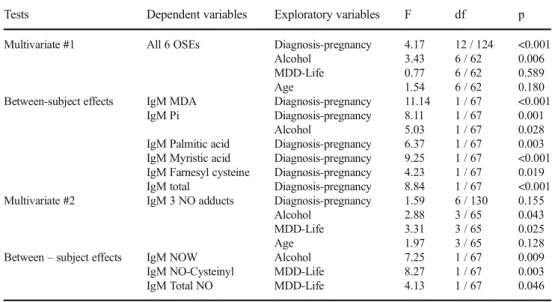
protected post-hoc analyses on the group mean values. All IgM values were significantly lower in pregnant women as compared to nonpregnant women, while there was no icant effect of prenatal depression. The use of alcohol signif-icantly increased IgM responses to Pi. In regression #2 we entered the IgM responses directed to 3 NO-adduct values and IgM NO adducts as dependent variables but we could
not find any significant effect of diagnosis-pregnancy, while there were significant multivariate effects of alcohol use and a lifetime diagnosis of depression. Tests for between-subject effects and Table 3 show that alcohol use lowers the IgM responses to NO-tryptophan (NOW), while a lifetime history of depression was accompanied by significantly increased IgM responses to NO-cysteinyl and IgM NO adducts.
Table 1 Demographic data of non-pregnant and pregnant wom-en, divided into those with higher (>−1.8088 z) and lower (<−1.8088 z) OSE (oxidative specific epitopes) values
Variables Non-pregnanta Pregnant OSE >−1.8088b
Pregnant OSE <−1.8088c
F/X2 df p
Age (years) 28.1 (3.2) 29.3 (6.9) 27.7 (6.6) 0.53 2/70 0.593 Year education 17.7 (1.3)b,c 11.7 (4.6)a 12.8 (2.7)a 24.69 2/67 <0.001 Actual BMI 20.5 (2.7)b,c 26.2 (5.7)a 27.1 (3.9)a 16.57 2/70 <0.001 EPDS end term 4.3 (3.0)b,c 9.4 (6.8)a 8.1 (6.5)a 5.09 2/69 0.009 STAI end term 49.6 (6.3)b,c 43.4 (9.3)a 41.6 (11.7)a 4.88 2/69 0.010 EPDS T2 postnatal 4.3 (3.0)b,c 3.4 (5.1) 2.5 (3.1) 1.22 2/62 0.300 STAI T2 postnatal 49.6 (6.3)b,c 35.0 (8.2)a 33.2 (6.3)a 38.27 2/61 <0.001 Prenatal MDD (N/Y) 24 / 0 12 / 13 13 / 11 NA - -IgM OSE (z score) 3.05 (5.69)c 1.45 (2.96)c -4.55 (2.19)a,b 25.35 2/70 <0.001 IgM NO (z-score) −0.39 (1.59) 0.40 (1.65) −0.03 (2.46) 1.01 2/70 0.369 IgA LPS (z-score) 2.60 (4.93)c 0.11 (3.64)c -2.72 (4.77)a,b 8.49 2/70 0.001 IgM LPS (z-score) 0.21 (1.11)c 0.39 (0.94)c -0.61 (0.60)a,b 8.30 2/70 0.001 IgA TRYCATs (z-score) 1.52 (8.4) −0.43 (0.84) −1.08 (8.37) 0.71 2/70 0.497 IgM TRYCATs (z score) 1.80 (6.61)c 2.70 (5.87)c -4.62 (5.28)a,b 10.94 2/70 <0.001
∆IgA–IgM TRYCATs (z score)
−0.28 (10.75) −3.13 (8.15) 3.54 (9.58) 3.01 2/70 0.056
IgA KYN/TRY (z score) 0.50 (0.82)b, c -0.39 (1.32)a -0.10 (0.66)a 7.08 2/70 0.002 hs CRP (mg/dL) 1.57 (2.04)b, c 5.76 (5.49)a 4.39 (4.03)a 16.92 2/69 <0.001
All data are shown as mean (±SD)
BMIbody mass index,EPDSEdinburgh Postnatal Depression Scale,STAISpielberger’s State Anxiety Inventory, PC PS: first principal component subtracted from the physio-somatic symptoms,IgM OSEsum of z-scores of the IgM responses to all OSE measurements,IgM NOsum of z-scores of the IgM responses to all NO-adduct measurements,IgM LPSsum of z-scores of the IgM responses directed against 6 g-negative bacteria,IgA LPS sum of z-scores of the IgA responses directed against 6 g-negative bacteria,IgM TRYCATssum of z-scores of the IgM responses directed against tryptophan catabolites,IgA TRYCATssum of z-scores of the IgA responses directed against tryptophan catabolites,∆IgA-IgM TRYCATssum of z scores of all IgA responses to TRYCATs
–sum of z scores of all IgM responses to TRYCATs,IgA KYN/TRYz score IgA directed against kynurenine–z score IgA directed against tryptophan
a,b,cDenotes pairwise differences between the three categories
Table 2 Results of multivariate GLM analysis with the IgM responses directed against oxidative specific epitopes (OSEs) and 3 nitric oxide (NO) adducts as dependent variables
Tests Dependent variables Exploratory variables F df p
Multivariate #1 All 6 OSEs Diagnosis-pregnancy 4.17 12 / 124 <0.001 Alcohol 3.43 6 / 62 0.006 MDD-Life 0.77 6 / 62 0.589 Age 1.54 6 / 62 0.180 Between-subject effects IgM MDA Diagnosis-pregnancy 11.14 1 / 67 <0.001
IgM Pi Diagnosis-pregnancy 8.11 1 / 67 0.001 Alcohol 5.03 1 / 67 0.028 IgM Palmitic acid Diagnosis-pregnancy 6.37 1 / 67 0.003 IgM Myristic acid Diagnosis-pregnancy 9.25 1 / 67 <0.001 IgM Farnesyl cysteine Diagnosis-pregnancy 4.23 1 / 67 0.019 IgM total Diagnosis-pregnancy 8.84 1 / 67 <0.001 Multivariate #2 IgM 3 NO adducts Diagnosis-pregnancy 1.59 6 / 130 0.155
Alcohol 2.88 3 / 65 0.043 MDD-Life 3.31 3 / 65 0.025 Age 1.97 3 / 65 0.128 Between–subject effects IgM NOW Alcohol 7.25 1 / 67 0.009 IgM NO-Cysteinyl MDD-Life 8.27 1 / 67 0.003 IgM Total NO MDD-Life 4.13 1 / 67 0.046
Associations between commensal bacteria and IgM responses to OSEs
Using correlation analyses we detected significant correlations between IgA LPS and IgM OSEs (r= 0.375,p= 0.001), IgM responses to MDA (r= 0.401,p= 0.001), IgM responses to azelaic acid (r = 0.233, p = 0.047), IgM responses to Pi (r = 0.472, p < 0.001), IgM responses to palmitic acid (r= 0.279,p = 0.017), and IgM responses to myristic acid (r = 0.376, p = 0.001). There were also highly significant correlations between IgM LPS and IgM OSEs (r= 0.760, p < 0.001) and with all separate OSEs (r > 0.560, p < 0.001). Table 4 shows the outcomes of multivariate GLM analysis #1 and #2 with all IgM responses to OSEs as dependent variables and IgA and IgM LPS as explanatory variables. We found highly significant multivariate effects of IgA and IgM LPS on all OSEs variables. Tests for between-subject effects revealed that all IgM responses to OSEs were positively associated with IgA LPS and IgM LPS. In order to delineate which bacteria are most important we have carried out additional analyses will all 6 Gram-negative bacteria as dependent variables (IgM or IgA). Multivariate GLM analysis #3 shows a multivariate effect of the IgA responses to Morganellaon the IgM OSE values, while univariate analysis showed an effect on IgM responses to Pi and myristic acid. Multivariate GLM analysis #4 shows a multivariate effect of the IgM responses toK. pneumoniaeandC. koseri. Univariate analyses showed that IgM responses toK. pneumoniaewere associated with IgM responses to azelaic acid, Pi and all OSEs together, whileC. koseri was significantly associated with IgM responses to all OSEs.
Associations between commensal bacteria and IgM responses to NO-adducts
Using correlation analyses, we detected significant correla-tions between IgA LPS and IgM responses to NOW (r = −0.307, p = 0.008) but not the other NO-adducts. Correlation analyses showed significant correlations between IgM LPS and IgM responses to NO cysteinyl (r= −0.413,
p< 0.001). Table5, multivariate GLM analysis #1 shows no significant multivariate association between IgA LPS and IgM NO-adducts, while regression #2 shows that there was a sig-nificant multivariate association between IgM LPS and IgM responses to NO-adducts. Univariate analysis showed a sig-nificant association with IgM responses to NO-cysteinyl only. Multivariate analysis #3 shows that IgA responses to C. koserihad a significant multivariate effect on the IgM against NO-adducts while univariate effects shows a significant effect on IgM NO-cysteinyl only. Multivariate analysis #4 shows that IgM responses toC. koserihad a significant multivariate effect, while tests for between-subjects effects showed an effect of IgM responses toC. koserion NO-cysteinyl only.
Associations between the TRYCAT pathway and IgM responses to OSEs and NO-adducts
In order to examine the associations between IgM/IgA against TRYCATs, on the one hand, and IgM/IgA LPS, IgM OSEs and IgM NO-adducts, CRP and a lifetime history of PMS and de-pression, on the other, we performed a multivariate GLM anal-ysis with the TRYCATs as dependent variables (entered as IgM TRYCATs, IgA TRYCATs, ∆IgA - IgM TRYCATs, and IgA
Table 3 Estimated marginal means (SE; in z-values) of IgM response to oxidative specific epitopes (OSEs) and NO-adducts obtained by multivariate regres-sion listed in Table2
Variables Not pregnanta Pregnantb Pregnant + antenatal depressionc
IgM MDA 0.99 (0.25)b,c -0.05 (0.24)a -0.17 (0.19)b IgM Azelaic acid 0.50 (0.27) −0.02 (0.26) 0.22 (0.21) IgM Pi 0.80 (0.26)b,c -0.22 (0.25)a -0.05 (0.20)a IgM Palmitic acid 0.67 (0.27)b,c -0.21 (0.25)a -0.21 (0.20)a IgM Myristic acid 0.83 (0.26)b,c -0.24 (0.25)a -0.14 (0.20)a IgM Farnesyl Cysteine 0.55 (0.27)b,c -0.16 (0.26)a -0.22 (0.21)a IgM Total OSE 4.34 (1.31)b,c -0.90 (1.25)a -0.57 (1.00)a IgM NO-Arginine −0.34 (0.28) 0.39 (0.26) −0.19 (0.21) IgM NOW −0.36 (0.27) 0.08 (0.26) −0.37 (0.21) IgM NO-Cysteinyl 0.36 (0.27) 0.52 (0.26) 0.22 (0.21) IgM Total NO −0.35 (0.52) 0.98 (0.50) −0.34 (0.40) Variables No Alcohol Alcohol
IgM Pi −0.15 (0.16) 0.05 (0.27) IgM NOW 0.20 (0.17) −0.63 (0.29) Variables No MDD-Life MDD-Life IgM NO-Cysteinyl −0.12 (0.16) 0.85 (0.31) IgM Total NO −0.56 (0.31) 0.75 (0.59)
MDAmalondialdehyde,Piphosphatidylinositol,NOWNO-tryptophan,Alcoholconsumption during pregnancy, MDD-Lifelifetime diagnosis of major depression
KYN/TRY). Table6 shows the outcome of this multivariate analysis. We found significant effects of a lifetime history of PMS and major depression, IgM OSEs and IgM NO-adducts, IgA LPS (but not IgM LPS) and CRP. Tests for between-subject
effects showed that IgA TRYCATs was strongly associated with IgA LPS and PMS (both positively) and CRP (inversely). IgM TRYCATs were positively associated with IgM OSEs. The ∆IgA - IgM TRYCAT values were significantly predicted by Table 4 Results of multivariate
GLM analysis with IgM response directed against oxidative specific epitopes (OSEs) as dependent variables
Test Dependent variables Independent variables F df p
Multivariate #1 IgM all OSEs IgA LPS 5.37 6/66 <0.001 Between- subject effects IgM MDA IgA LPS 10.12 1/71 0.002
IgM Azelaic acid IgA LPS 4.71 1/71 0.033 IgM Pi IgA LPS 16.13 1/71 <0.001 IgM Palmitic acid IgA LPS 7.03 1/71 0.010 IgM Myristic acid IgA LPS 14.81 1/71 <0.001 IgM Farnesyl-Cysteine IgA LPS 5.20 1/71 0.026 IgM Total OSEs IgA LPS 13.31 1/71 0.001 Multivariate #2 IgM All OSEs IgM LPS 25.23 6/65 <0.001
Pregnancy 8.59 6/65 <0.001 Between- subject effects IgM MDA IgM LPS 33.23 1/70 <0.001 IgM Azelaic acid IgM LPS 49.73 1/70 <0.001 IgM Pi IgM LPS 130.26 1/70 <0.001 IgM Palmitic acid IgM LPS 33.29 1/70 <0.001 IgM Myristic acid IgM LPS 65.76 1/70 <0.001 IgM Farnesyl-Cysteine IgM LPS 43.50 1/70 <0.001 IgM Total OSEs IgM LPS 16.64 1/70 <0.001 Multivariate #3 IgM All OSEs IgAMorganella morganii 4.48 6/64 0.001 Between-subject effects IgM Pi IgAM. morganii 7.96 1/71 0.006 IgM Myristic Acid IgAM. morganii 7.81 1/71 0.007 Multivariate #4 IgM all OSEs IgMKlebsiella pneumoniae 3.83 6/65 0.002 IgMCitrobacter koseri 5.51 6/65 <0.001 Between- subject effects IgM Azelaic acid IgMK. pneumoniae 11.97 1/70 0.001
IgM Pi IgMK. pneumoniae 16.53 1/70 <0.001 IgM Total OSEs IgMK. pneumoniae 6.23 1/70 0.015 Between- subject effects IgM MDA IgMC. koseri 10.25 1/70 0.006 IgM Azelaic acid IgMC. koseri 5.77 1/70 0.008 IgM Pi IgMC. koseri 26.86 1/70 <0.001 IgM Palmitic acid IgMC. koseri 13.65 1/70 <0.001 IgM Myristic acid IgMC. koseri 25.51 1/70 <0.001 IgM Farnesyl-cysteine IgMC. koseri 15.77 1/70 <0.001 IgM Total OSEs IgMC. koseri 28.15 1/70 <0.001
MDAmalondialdehyde,Piphosphatidylinositol,NOWNO-tryptophan
Table 5 Results of multivariate GLM analysis with IgM response directed against nitric oxide (NO) adducts as dependent variables
Tests Dependent variables Independent variables F df p
Multivariate #1 IgM all NO adducts IgA LPS 2.40 3/67 0.076 MDD-Life 2.73 3/67 0.051 Alcohol 2.49 3/67 0.068 Multivariate #2 IgM all NO adducts IgM LPS 5.33 3/67 0.002 MDD-Life 3.42 3/67 0.022 Alcohol 1.81 3/67 0.155 Between- subject effects IgM NO Arginine IgM LPS 1.51 1/69 0.223 IgM NOW IgM LPS 1.87 1/69 0.176 IgM NO-Cysteine IgM LPS 15.32 1/69 <0.001 IgM Total NO IgM LPS 0.20 1/69 0.659 Multivariate #3 IgM all NO adducts IgACitrobacter koseri 3.82 3/67 0.014 MDD-Life 2.74 3/67 0.050 Alcohol 2.08 3/67 0.111 Between- subject effects IgM NO-Cysteinyl IgAC. koseri 8.72 1/69 0.004 Multivariate #4 IgM all NO adducts IgMC. koseri 7.22 1/69 <0.001
MDD-Life 2.56 3/67 0.062 Alcohol 1.77 3/67 0.162 Between- subject effects IgM NO-Cysteinyl IgMC. koseri 20.50 1/69 <0.001
IgA LPS (positively) and were negatively correlated with CRP and IgM OSEs. The IgA KYN/TRY ratio was predicted by IgM NO-adducts, CRP and a lifetime history of depression.
Best prediction of the TRYCAT pathway biomarkers
Consequently, we have examined which OSEs, NO-adducts and bacteria were most significant in predicting the TRYCAT variables. This analysis showed effects of IgM responses to MDA (F = 6.24, df = 3/63, p = 0.001), myristic acid (F = 6.60, df = 3/63,p= 0.001), and NO-cysteinyl (F = 9.35, df = 3/63,p< 0.001) and IgA responses toP. putida(F = 4.46, df = 3/63, p = 0.007) on the TRYCAT variables. Tests for between-subject effects showed that IgM responses to MDA were associated with IgM TRYCATs (F = 17.98, df = 1/65, p < 0.001, positively) and ∆IgA - IgM TRYCATs values (F = 9.12, df = 1/65,p= 0.002, negatively). Also, the IgM responses to myristic acid were associated with IgM TRYCATs (F = 19.98, df = 1/65,p < 0.001, positively) and ∆IgA - IgM TRYCATs values (F = 7.29, df = 1/65,p= 0.009, negatively). The IgM responses to NO-cysteinyl predicted the IgA KYN/TRY ratio (F = 19.74, df = 1/65,p< 0.001), while IgA responses toP. putidawere positively related to∆IgA - IgM TRYCATs values (F = 4.46, df = 3/63,p= 0.007).
Discussion
The first major finding of this study is that pregnancy is accom-panied by highly significant decreases in IgM responses directed
against OSEs, including MDA, Pi and anchorage molecules, such as myristic and palmitoylic acid and farnesyl cysteine. The lowered IgM-mediated autoimmune responses to these molecules expressed on outer and inner membrane may indicate lowered regulatory IgM autoimmune responses, reflective of impaired normal regulatory responses that neutralize cellular debris, such as apoptotic and dying cells expressing MDA and oxidized low-density lipoprotein (LDL), arising from oxidative stress-induced damage (Rahman et al.2016). Previous data in-dicates that pregnancy is accompanied by increased levels of advanced oxidation protein products, suggesting increased pro-tein oxidation (Fialová et al.2003). Thus, the lowered levels of regulatory IgM responses directed to OSEs could contribute to an enhancement of the detrimental consequences of oxidative stress, thereby promoting more inflammation (Frostegård2013; Rahman et al.2016). Previously, we have discussed the role of IgM-mediated regulatory responses as part of the compensatory (anti-)inflammatory reflex system (CIRS) in neuro-psychiatric disorders (Kanchanatawan et al.2017; Maes et al. 2011a,b; Morris and Maes2013). Moreover, the Th2 cytokine predomi-nance (humoral immunity) in early pregnancy gradually shifts towards a Th1 (cell-mediated immunity) predominance in late gestation (Challis et al.2009). This together with lowered regu-latory IgM-mediated natural autoimmune responses may play a role in the increased incidence of some autoimmune disorders during pregnancy or complicated pregnancies in women who suffer from autoimmune disease (Challis et al.2009).
While the IgM responses to OSEs are significantly sup-pressed during pregnancy, the IgM responses to NO-adducts were unaffected. S-nitrosylation is one of the mechanisms
Table 6 Results of multivariate GLM analysis with the tryptophan catabolite (TRYCAT) data as dependent variables
Tests Dependent variables Exploratory variables
F df p
Multivariate ∆IgA-IgM TRYCATs, IgA TRYCATs, IgM TRYCATs, and IgA KYN/TRY
PMS lifetime 4.16 3/63 0.009 MDD Lifetime 2.95 3/63 0.039 IgM OSEs 29.66 3/63 <0.001 IgM NO-adducts 4.13 3/63 0.010 IgA LPS 8.52 3/63 <0.001 CRP 5.23 3/63 0.003 Between- subject
effects
IgA All TRYCATs PMS lifetime (+) 9.45 1/65 0.003 IgA LPS (+) 24.53 1/65 <0.001 CRP (−) 4.54 1/65 0.037 IgM All TRYCATs IgM Total OSEs (+) 88.66 1/65 <0.001
∆IgA-IgM TRYCATs IgA LPS (+) 22.87 1/65 <0.001 IgM OSEs (−) 44.05 1/65 <0.001 CRP (−) 4.54 1/65 0.037 IgA KYN/TRY MDD lifetime (+) 7.75 1/65 0.007 IgM NO (−) 12.21 1/65 0.001 CRP (−) 14.07 1/65 <0.001
underlying uterine smooth muscles relaxation effects of NO (Ulrich et al.2012). In the guinea pig, the same authors detected protein S-nitrosylation, which plays a role in uterine relaxation and contraction, and are increased independently of raised levels of protein expression. In sheep, pregnancy increases total S-nitrosylation but decreases S-S-nitrosylation of the endothelial NO synthesizing system (Zhang et al.2012).
In the current study, perinatal depression was not associated with IgM responses directed against OSEs and NO-adducts. These results, however, do not preclude that perinatal depression may be accompanied by O&NS. No previous studies have in-vestigated oxidative stress in perinatal depression. Nevertheless, a hypothesis had been proposed describing a possible relation-ship between perinatal depression, oxidative stress, and risk for pregnancy-associated cardiovascular diseases (CVD) (Nicholson et al.2016). An animal study showed an association of lowered maternal care, a possible indicator of maternal emo-tional problems, and increased oxidative stress in the brain of nursing mothers (Nicholson et al.2016). It is not unlikely that lowered IgM-mediated regulatory responses during pregnancy may play a role in the increased incidence of cardiovascular complications during pregnancy and in women of child-bearing age (Mohamed2014). Indeed, attenuation of the regu-latory autoimmune responses, which neutralize apoptotic cells expressing oxidized LDL and MDA (Rahman et al.2016), may be associated with increased expression of oxidized LDL in pregnancy (Ghaneei et al.2015).
Our results show that alcohol abuse affects IgM responses to Pi. This is consistent with a study reporting higher antibod-ies directed against Pi in patients with alcoholic liver disease, especially in alcoholic patients with more severe liver damage (Chedid et al.1994). Moreover, chronic alcohol consumption may enhance reactive oxygen species (ROS) in mitochondria, thereby affecting mitochondrial functions, including raising levels of mitochondrial cytochrome P450 (CYP2E1) (Adam-Vizi2005; Albano2006; Manzo-Avalos and Saavedra-Molina 2010; Ronis et al.1996), thereby contributing to pathological swelling and mitochondrial dysfunction (Wakabayashi2002). Interestingly, Pi may be found in the mitochondria outer mem-brane (Wakabayashi2002) and, therefore, when exposed to alcohol-induced ROS, the outer membrane of mega mito-chondrial complexes may rupture (Manzo-Avalos and Saavedra-Molina 2010; Wakabayashi 2002), leading to in-creased IgM responses to Pi.
Another major finding of this study is that the natural IgM mediated autoimmune responses directed against OSEs are as-sociated with indices of increased IgA/IgM responses to Gram-negative bacteria, especially M. morganii, C. koseri, and K. pneumoniae.This may suggest that natural IgM-mediated immune responses to OSEs are driven by increased bacterial translocation of Gram-negative bacteria and that suppressed IgM-mediated immune responses to OSEs in pregnancy are a consequence of lowered bacterial translocation in pregnancy. In
general, the gut microbial composition changes drastically from early to late pregnancy and the gut mucosal surface may present low grade inflammation (Koren et al.2012), while less inflam-matory responsivity may be present at the placental interface (Mor and Cardenas2010). Future research should examine the associations between bacterial translocation, gut-inflammation, O&NS, IgM-mediated autoimmune responses and placental in-terface immune system activity.
Another major finding of this study is that IgM responses to nitrosylated proteins (NO-adducts) are strongly associated with a lifetime diagnosis of depression and increased bacterial trans-location, as measured with IgM/IgA directed to Gram-negative bacteria, especiallyC. koseri.Importantly, major depressive dis-order is associated with increased IgM responses directed against SNO-cysteinyl, a potential neurotoxic compound (Maes et al.2011a,b). This finding is in agreement with previ-ous research showing increased IgM responses to NO-adducts in general and SNO-cysteinyl in depression (Maes et al.2013a, b). Studies among MS patients found significantly increased IgM-mediated autoimmune responses directed against SNO-cysteine, which is proposed to play a role in the demyelination that characterizes MS (Boullerne et al.1996,1995). Previously, we have shown that increased bacterial translocation (as assessed by increased levels of IgA directed against Gram-negative bacteria) is associated with increased IgM response to NO-adducts (Maes et al.2013a,b).
A further major finding of this study is that the activation of the TRYCAT pathway is strongly predicted by the combined effects of lifetime diagnoses of depression and PMS, bacterial translocation (IgA responses to Gram-negative bacteria) (all three positively) and IgM responses to OSEs and NO adducts and CRP (all three negatively associated). This indicates that major depressive disorder and PMS may be accompanied by a chronic activation of the TRYCAT pathway. The findings are also in agreement with the activation of the TRYCAT pathway by LPS directly, or indirectly by LPS-induced Th1 and M1 macrophagic responses (Martinez et al. 2008). The inverse association between TRYCAT pathway activation and IgM responses to OSEs may indicate that the more general regula-tory functions exerted by these autoimmune responses also modulate the TRYCAT pathway, for example by lowering inflammatory and oxidative responses and/or by regulating the activity of the pathway.
anti-inflammatory effects (Ridker and Lüscher2014) for example, by preventing neutrophil-endothelial adhesion (Thiele et al. 2014) or decreased production of pro-inflammatory and anti-inflammatory cytokines in target areas (Mold and Clos2013). All in all, it appears that the TRYCAT pathway is regulated in a complex manner by many different processes. It should also be borne in mind that the placenta is a significant source of mela-tonin for mother and foetus, which has antioxidant and anti-inflammatory effects, as well as protecting mitochondria at the consequences of CYP2E1 induction (Liang et al.2012).
This paper has some limitations and strengths that should be considered when interpreting the results. A limitation is that this study is a case-control study and thus no inferences can be made on causality. It would have been more informative if we had measured alterations in serum IgM responses to OSEs and NO-adducts 4–6 weeks after delivery. A first strength is that in this study multivariate GLM analyses were employed and that uni-variate associations were only interpreted when there were sig-nificant overall multivariate effects, thereby reducing type I er-rors. Secondly, we adjusted for many different background iables and examined the cumulative effects of the predictor var-iables using multivariate GLM analyses.
Figure1summarizes the findings of this study. Natural IgM-mediated autoimmune responses directed against OSEs are sig-nificantly decreased in pregnancy. It is hypothesized that bacte-rial translocation may drive the IgM-mediated immune re-sponses and that since bacterial translocation is lowered during pregnancy the IgM responses may be attenuated. Alcohol use during pregnancy may increase IgM responses to phos-phatidylinositol (Pi). Increased IgM-mediated autoimmune re-sponses directed against adducts and especially NO-cysteinyl are associated with lifetime major depressive disorder (MDD). Tryptophan catabolite (TRYCAT) pathway activity is regulated by many processes including bacterial translocation and lifetime histories of premenstrual syndrome (PMS) and MDD (upregulation), while different factors may downregulate TRYCAT pathway activity, namely IgM-mediated natural auto-immune responses to malondialdehyde (MDA) and myristic
acid (MA) (possibly via natural regulatory effects), hypernitrosylation (possibly by inhibiting indoleamine-2,3-dioxygenase) and C-reactive protein (CRP) (possibly through its anti-inflammatory effects).
Acknowledgements This research has been supported by the Ratchadaphiseksomphot Endowment Fund 2013 of Chulalongkorn University (CU-56-457-HR) and IDRPHT, Talence, France.
Author contributions CR and MM made the design of the study. Participants were recruited and screened by CR. Biomarker assays were performed by MG and SD. All authors contributed equally to the writing up of the paper. All authors agreed upon the final version of the paper.
Compliance with ethical standards
Conflict of interest The authors have no conflict of interest with any commercial or other association in connection with the submitted article.
References
Abedian Z, Soltani N, Mokhber N, Esmaily H (2015) Depression and anxiety in pregnancy and postpartum in women with mild and se-vere preeclampsia. Iran J Nurs Midwifery res 20(4):454–459 Adam-Vizi V (2005) Production of reactive oxygen species in brain
mito-chondria: contribution by electron transport chain and non-electron transport chain sources. Antioxid Redox Signal 7(9–10):1140–1149 Albano E (2006) Alcohol, oxidative stress and free radical damage. Proc
Nutr Soc 65(3):278–290
Anderson G, Maes M (2014) Oxidative/nitrosative stress and immuno-inflammatory pathways in depression: treatment implications. Curr Pharm Des 20(23):3812–3847
Anderson G, Maes M (2016) How immune-inflammatory processes link CNS and psychiatric disorders: classification and treatment implica-tions. CNS Neurol Disord Drug Targets
Anderson G, Berk M, Dean O, Moylan S, Maes M (2014a) Role of immune-inflammatory and oxidative and nitrosative stress pathways in the etiology of depression: therapeutic implications. CNS Drugs 28(1):1–10
Anderson G, Berk M, Maes M (2014b) Biological phenotypes underpin the physio-somatic symptoms of somatization, depression, and chronic fatigue syndrome. Acta Psychiatr Scand 129(2):83–97 Bayrampour H, Salmon C, Vinturache A, Tough S (2015) Effect of
de-pressive and anxiety symptoms during pregnancy on risk of obstet-ric interventions. J Obstet Gynaecol Res
Boullerne AI, Petry KG, Meynard M, Geffard M (1995) Indirect evidence for nitric oxide involvement in multiple sclerosis by characterization of circulating antibodies directed against conjugated S-nitrosocysteine. J Neuroimmunol 60(1–2):117–124
Boullerne A, Petry KG, Geffard M (1996) Circulating antibodies directed against conjugated fatty acids in sera of patients with multiple scle-rosis. J Neuroimmunol 65(1):75–81
Boullerne AI, Rodriguez JJ, Touil T, Brochet B, Schmidt S, Abrous ND, Le Moal M, Pua JR, Jensen MA, Mayo W, Arnason BG, Petry KG (2002) Anti-S-nitrosocysteine antibodies are a predictive marker for demyelination in experimental autoimmune encephalomyelitis: im-plications for multiple sclerosis. J Neurosci 22(1):123–132 Challis JR, Lockwood CJ, Myatt L, Norman JE, Strauss JF 3rd, Petraglia
F (2009) Inflammation and pregnancy. Reprod Sci 16(2):206–215 Chedid A, Chadalawada KR, Morgan TR, Moritz TE, Mendenhall CL,
Hammond JB, Emblad PW, Cifuentes DC, Kwak JW, Gilman-Sachs
Pregnancy
Bacterial translocaon Gram-negave commensal bacteria
IgM to NO- adducts Incl NO-Cysteinyl
Natural IgM responses to MDA and MA IgM
to Pi
IgM to OSEs
TRYCAT pathway acvity Lifeme PMS Alcohol use
Lifeme MDD
C-Reacve protein
+
+ +
+
+ +
--
+A (1994) Phospholipid antibodies in alcoholic liver disease. Hepatology 20(6):1465–1471
Czarny P, Kwiatkowski D, Toma M, Gałecki P, Orzechowska A, Bobińska K, Bielecka-Kowalska A, Szemraj J, Berk M, Anderson G,Śliwiński T (2016) Single-nucleotide polymorphisms of genes involved in repair of oxidative DNA damage and the risk of recur-rent depressive disorder. Med Sci Monit 22:4455–4474
Del Rio D, Stewart AJ, Pellegrini N (2005) A review of recent studies on malondialdehyde as toxic molecule and biological marker of oxida-tive stress. Nutr Metab Cardiovasc Dis 15(4):316–328
Duleu S, Mangas A, Sevin F, Veyret B, Bessede A, Geffard M (2010) Circulating antibodies to IDO/THO pathway metabolites in Alzheimer's disease. Int J Alzheimers Dis 2010:501541
Eyre HA, Papps E, Baune BT (2013) Treating depression and depression-like behavior with physical activity: an immune perspective. Front Psychiatry 4(4):3
Fialová L, Kalousová M, Soukupová J, Malbohan I, Krofta L, Mikulíková L, Horejsová H, Stípek S, Zima T (2003) Levels of advanced oxidation protein products (AOPP) in the first trimester of pregnancy. Sb Lek 104(1):95–102
Frostegård J (2013) Immunity, atherosclerosis and cardiovascular disease. BMC Med 11:117
Gałecki P, Gałecka E, Maes M, Chamielec M, Orzechowska A, Bobińska K, Lewiński A, Szemraj J (2012) The expression of genes encoding for COX-2, MPO, iNOS, and sPLA2-IIA in patients with recurrent depressive disorder. J Affect Disord 138(3):360–366
Geffard M, Bodet D, Martinet Y, Dabadie MP (2002) Detection of the specific IgM and IgA circulating in sera of multiple sclerosis pa-tients: interest and perspectives. Immuno-Analyse & Biology Specification 17:302–310
Geffard M, Bodet D, Dabadie MP, Arnould L (2003) Identification of antibodies in sera of breast cancer patients. Immuno-Analyse & Biologie Special 18:248–253
Ghaneei A, Yassini S, Ghanei ME, Shojaoddiny-Ardekani A (2015) Increased serum oxidized low-density lipoprotein levels in pregnan-cies complicated by gestational diabetes mellitus. Iran J Reprod med 13(7):421–424
Hucke C, MacKenzie CR, Adjogble KD, Takikawa O, Däubener W (2004) Nitric oxide-mediated regulation of gamma interferon-induced bacteriostasis: inhibition and degradation of human indoleamine 2,3-dioxygenase. Infect Immun 72(5):2723–2730 Kanchanatawan B, Sirivichayakul S, Ruxrungtham K, Carvalho AF,
Geffard M, Anderson G, Maes M (2017) Deficit schizophrenia is characterized by defects in IgM-mediated responses to tryptophan catabolites (TRYCATs): a paradigm shift towards defects in natural self-regulatory immune responses coupled with mucosa-derived TRYCAT pathway activation. Mol Neurobiol
Kittirattanapaiboon P, Khamwongpin M (2005) The Validity of the Mini International Neuropsychiatric Interview (M.I.N.I.)- Thai Version. J Mental Health Thai 13:125–135
Koren O, Goodrich JK, Cullender TC, Spor A, Laitinen K, Bäckhed HK, Gonzalez A, Werner JJ, Angenent LT, Knight R, Bäckhed F, Isolauri E, Salminen S, Ley RE (2012) Host remodeling of the gut microbiome and metabolic changes during pregnancy. Cell 150(3):470–480 Liang YL, Zhang ZH, Liu XJ, Liu XQ, Tao L, Zhang YF, Wang H, Zhang
C, Chen X, Xu DX (2012) Melatonin protects against apoptosis-inducing factor (AIF)-dependent cell death during acetaminophen-induced acute liver failure. PLoS One 7(12):e51911
Maes M, Kubera M, Leunis JC (2008) The gut-brain barrier in major depression: intestinal mucosal dysfunction with an increased trans-location of LPS from gram negative enterobacteria (leaky gut) plays a role in the inflammatory pathophysiology of depression. Neuroendocrinol Lett 29:117–124
Maes M, Mihaylova I, Kubera M, Leunis JC, Geffard M (2011a) IgM-mediated autoimmune responses directed against multiple neoepitopes in depression: new pathways that underpin the
inflammatory and neuroprogressive pathophysiology. J Affect Disord 135(1–3):414–418
Maes M, Galecki P, Chang YS, Berk M (2011b) A review on the oxida-tive and nitrosaoxida-tive stress (O&NS) pathways in major depression and their possible contribution to the (neuro)degenerative processes in that illness. Prog Neuro-Psychopharmacol Biol Psychiatry 35(3): 676–692
Maes M, Mihaylova I, Kubera M, Leunis JC, Twisk FN, Geffard M (2012a) IgM-mediated autoimmune responses directed against an-chorage epitopes are greater in Myalgic encephalomyelitis/chronic fatigue syndrome (ME/CFS) than in major depression. Metab Brain Dis 27(4):415–423
Maes M, Song C, Yirmiya R (2012b) Targeting IL-1 in depression. Expert Opin Ther Targets 16(11):1097–1112
Maes M, Kubera M, Mihaylova I, Geffard M, Galecki P, Leunis JC, Berk M (2013a) Increased autoimmune responses against auto-epitopes modified by oxidative and nitrosative damage in depression: impli-c a t i o n s f o r t h e p a t h w a y s t o impli-c h r o n i impli-c d e p r e s s i o n a n d neuroprogression. J Affect Disord 149(1–3):23–29
Maes M, Kubera M, Leunis JC, Berk M, Geffard M, Bosmans E (2013b) In depression, bacterial translocation may drive inflammatory re-sponses, oxidative and nitrosative stress (O&NS), and autoimmune responses directed against O&NS-damaged neoepitopes. Acta Psychiatr Scand 127(5):344–354
Manzo-Avalos S, Saavedra-Molina A (2010) Cellular and mitochondrial effects of alcohol consumption. Int J Environ Res Public Health 7(12):4281–4304
Martinez FO, Sica A, Mantovani A, Locati M (2008) Macrophage acti-vation and polarization. Front Biosci 13:453–461
Martin-Subero M, Anderson G, Kanchanatawan B, Berk M, Maes M (2016) Comorbidity between depression and inflammatory bowel disease explained by immune-inflammatory, oxidative, and nitrosative stress; tryptophan catabolite; and gut-brain pathways. CNS Spectr 21(2):184–198
Miller AH, Maletic V, Raison CL (2009) Inflammation and its discon-tents: the role of cytokines in the pathophysiology of major depres-sion. Biol Psychiatry 65(9):732–741
Mo X, Pi L, Yang J, Xiang Z, Tang A (2014) Serum indoleamine 2,3-dioxygenase and kynurenine aminotransferase enzyme activity in patients with ischemic stroke. J Clin Neurosci 21(3):482–486 Mohamed TN (2014) Cardiovascular disease and pregnancy. In: Lange
RA (ed) Cardiology. Medscape
Mold C, Clos TW (2013) C-reactive protein inhibits plasmacytoid den-dritic cell interferon responses to autoantibody immune complexes. Arthritis Rheum 65(7):1891–1901
Mor G, Cardenas I (2010) The immune system in pregnancy: a unique complexity. Am J Reprod Immunol 63(6):425–433
Morris G, Maes M (2013) Myalgic encephalomyelitis/chronic fatigue syndrome and encephalomyelitis disseminata/multiple sclerosis show remarkable levels of similarity in phenomenology and neuroimmune characteristics. BMC Med 11:205
Morris G, Berk M, Klein H, Walder K, Galecki P, Maes M (2016a) Nitrosative stress, Hypernitrosylation, and autoimmune responses to Nitrosylated proteins: new pathways in Neuroprogressive disor-ders including depression and chronic fatigue syndrome. Mol Neurobiol
Morris G, Carvalho AF, Anderson G, Galecki P, Maes M (2016b) The many Neuroprogressive actions of tryptophan catabolites (TRYCATs) that may be associated with the pathophysiology of neuro-immune disorders. Curr Pharm Des 22(8):963–977 Moylan S, Berk M, Dean OM, Samuni Y, Williams LJ, O'Neil A, Hayley
AC, Pasco JA, Anderson G, Jacka FN, Maes M (2014) Oxidative & nitrosative stress in depression: why so much stress? Neurosci Biobehav Rev 45:46–62
pregnancy-associated cardiovascular disease. Cardiovasc J Afr 27(2):119–122
Pitanupong J, Liabsuetrakul T, Vittayanont A (2007) Validation of the Thai Edinburgh postnatal depression scale for screening postpartum depression. Psychiatry Res 149(1–3):253–259
Prasad AS (2007) Zinc: mechanisms of host defense. J Nutr 137(5):1345–
1349
Pryor WA, Stanley JP (1975) Letter: a suggested mechanism for the production of malondialdehyde during the autoxidation of polyun-saturated fatty acids. Nonenzymatic production of prostaglandin en-doperoxides during autoxidation. J org Chem 40(24):3615–3617 Rahman M, Sing S, Golabkesh Z, Fiskesund R, Gustafsson T, Jogestrand
T, Frostegård AG, Hafström I, Liu A, Frostegård J (2016) IgM antibodies against malondialdehyde and phosphorylcholine are to-gether strong protection markers for atherosclerosis in systemic lu-pus erythematosus: regulation and underlying mechanisms. Clin Immunol 166-167:27–37
Ridker PM, Lüscher TF (2014) Anti-inflammatory therapies for cardio-vascular disease. Eur Heart J 35(27):1782–1791
Ronis MJJ, Lindros KO, Ingelman-Sundberg M (1996) The CYP2E fam-ily. In: Ioannides C (ed) Cytochromes P450: metabolic and toxico-logical aspects. CRC Press, Boca Raton, pp 211–239
Roomruangwong C, Kanchanatawan B, Sirivichayakul S, Anderson G, Carvalho AF, Duleu S, Geffard M, Maes M (2016) IgA/IgM re-sponses to tryptophan and tryptophan catabolites (TRYCATs) are differently associated with prenatal depression, physio-somatic symptoms at the end of term and premenstrual syndrome. Mol Neurobiol
Schwartz-Albiez R, Monteiro RC, Rodriguez M, Binder CJ, Shoenfeld Y (2009) Natural antibodies, intravenous immunoglobulin and their role in autoimmunity, cancer and inflammation. Clin Exp Immunol 158(Suppl 1):43–50
Spielberger CD, Vagg PR (1984) Psychometric properties of the STAI: a reply to Ramanaiah, Franzen, and Schill. J Pers Assess 48(1):95–97 Thapinta D (1991) Reduction of anxiety of staff nurses working with AIDS patients through cognitive Reconstructuring andMindfulness training. In: Educational Psychology. Chulalongkorn University, Bangkok, p 154
Thiele JR, Habersberger J, Braig D, Schmidt Y, Goerendt K, Maurer V, Bannasch H, Scheichl A, Woollard KJ, von Dobschütz E, Kolodgie F, Virmani R, Stark GB, Peter K, Eisenhardt SU (2014) Dissociation of pentameric to monomeric C-reactive protein localizes and aggra-vates inflammation: in vivo proof of a powerful proinflammatory mechanism and a new anti-inflammatory strategy. Circulation 130(1):35–50
Tsuboi H, Watanabe M, Kobayashi F, Kimura K, Kinae N (2013) Associations of depressive symptoms with serum proportions of palmitic and arachidonic acids, andα-tocopherol effects among male population–a preliminary study. Clin Nutr 32(2):289–293 Ulrich C, Quillici DR, Schegg K, Woolsey R, Nordmeier A, Buxton IL
(2012) Uterine smooth muscle S-nitrosylproteome in pregnancy. Mol Pharmacol 81(2):143–153
Vacharaporn K, Pitanupong J, Samangsri N (2003) Development of the Edinburgh postnatal depression scale Thai version. Journal of Mental Health of Thailand 11(3):164–169
Wakabayashi T (2002) Megamitochondria formation - physiology and pathology. J Cell Mol Med 6(4):497–538
Zhang HH, Feng L, Wang W, Magness RR, Chen DB (2012) Estrogen-responsive nitroso-proteome in uterine artery endothelial cells: role of endothelial nitric oxide synthase and estrogen receptor-β. J Cell Physiol 227(1):146–159