Original Article
Artigo Original
Andréa Regina Nunes Misquiatti1 Maria Claudia Brito2 Ana Gabriela Olivati1 Thais Rosa dos Santos1 Fernanda Dreux Miranda Fernandes3
Descritores
Transtorno Autístico Cognição Relações Interpessoais Linguagem Estudos de Intervenção Keywords
Autistic Disorder Cognition Interpersonal Relations Language Intervention Studies
Correspondence address:
Andréa Regina Nunes Misquiatti Avenida Hygino Muzzi Filho, 737, Marília (SP), Brasil, CEP: 17525-050, Caixa Postal 181.
E-mail: [email protected]
Received: 07/30/2013
Accepted: 07/17/2014
Study carried out at Universidade de São Paulo – USP – São Paulo (SP), Brazil.
(1) Speech Therapy Department, Universidade Estadual Paulista “Júlio de Mesquita Filho” – UNESP – Marília (SP), Brazil.
(2)Special Education Department, Universidade Estadual Paulista “Júlio de Mesquita Filho” – UNESP – Marília (SP), Brazil.
(3) Physical, Speech, and Ocupational Therapies Department, Faculdade de Medicina, Universidade de São Paulo – USP – São Paulo (SP), Brazil.
Conlict of interests: nothing to declare.
Sociocognitive performance in autism spectrum disorders
and interference of the therapeutic environment
Desempenho sociocognitivo nos Transtornos do Espectro do
Autismo e interferência do ambiente terapêutico
ABSTRACT
Purpose: To analyze the sociocognitive performance of children and adolescents with autism spectrum disorders in two environments of language therapy, which differ as to the physical structure. Methods: Ten children and adolescents with ages between 4 and 13 years, of both genders, diagnosed with autism spectrum disorders took part in the study. For data collection, eight ilming sessions were performed during individual language therapy lasting 30 minutes, being four in a room with conventional environmental organization (common room) and four in a room with speciic ambiance [children’s interaction core (CIC) room], interspersed during a month. For the analysis of ilmed situations, the Sociocognitive Performance Protocol was used and obtained data were subjected to statistical analysis. Results: No statistical signiicance was found in sociocognitive performance of 10 subjects in the common and CIC rooms, although speciic differences were observed in some cases. Conclusion: The creation of preestablished physical environments or speciic materials is not and should not be considered essential for language therapy. It is noteworthy, however, that the absence of a large volume of statistically signiicant data does not indicate that the results are not expressive, reiterating the need for further research in the area.
RESUMO
Objetivo: Analisar o desempenho sociocognitivo de crianças e adolescentes com Transtornos do Espectro do Autismo em dois ambientes de terapia de linguagem, que se diferenciam quanto à estruturação do aspecto físico. Métodos: Participaram dez crianças e adolescentes com a faixa etária entre 4 e 13 anos, de ambos os gêneros, com diagnósticos estabelecidos entre os Transtornos do Espectro do Autismo. Para a coleta de dados, foram realizadas oito ilmagens durante sessões de terapia de linguagem individual com duração de 30 minutos, sendo quatro em sala com organização ambiental convencional (sala comum) e quatro em sala com ambientação especíica (sala NIC), intercaladamente, durante um mês. Para a análise das situações ilmadas, foi utilizado o Protocolo de Desempenho Sociocognitivo e os dados obtidos foram submetidos à análise estatística.
Resultados: Veriicou-se que não houve signiicância estatística no desempenho sociocognitivo dos dez sujeitos na sala comum e na sala NIC, embora tenham sido observadas diferenças especíicas em alguns casos.
INTRODUCTION
The sociocognitive aspects of children and adolescents with autism spectrum disorders (ASD) are described in literature as essential for language development(1-6) and speech therapy acting(2,3,5).
In the development process of children, there is a small relation between the cognitive, affective, social, and com-municative areas, which are the foundations for symbol emergency(2). The social and affective deficits in the ASD are associated with cognitive damage that leads to a poor development in the game, therefore the child does not have appropriate emotional and cultural cycles for a typical development(3). For the speech therapy practice, knowl-edge on the existent variations in the relations between the areas is extremely important in the intervention pro-cess, because it shows that peculiarities of the delays in language development may be analyzed under different perspectives(2).
Another aspect that should be considered in speech therapy interventions is related to the variables concern-ing the environmental context of language therapy(7-10). Several researchers, based on a pragmatic perspective of the language, pointed out the importance of the context for communication(7,8).
The context in which communication occurs is com-plex and includes multidimensional aspects; therefore, its analysis is very important to investigate characteristics associated with communication(11) such as the sociocog-nitive performance. For subjects with ASD, development can be favored in environments that are comprehensive and make its evolution easier and can be adjusted to its limita-tions(10), and they can possibly be significantly modified from one context to another(12).
Furthermore, literature mentions the importance that environmental context has on aspects such as behavior, attention, and expressive language in subjects with ASD(13-15).
Thus, scientific investigations are required on the lan-guage and cognitive aspects in the subjects with ASD, which take into consideration the different context ele-ments that may interfere in the development of children with ASD(7,8). Thus, the objective of this study was to ana-lyze the sociocognitive performance of children and ado-lescents with ASD in two language therapy environments, which differ as to the physical structure.
The hypothesis that led us to carry out this study was the result of theoretical referential associated with clinical exercise showing that children with ASD might present a better communication performance in an environment that is structured, functional, and familiar to the child than in a conventional room of speech therapy.
METHODS
This research was approved by the research ethics com-mittee of Faculdade de Filosoia e Ciências of Universidade
Estadual Paulista “Júlio de Mesquita Filho” (UNESP), Marília Campus, under protocol number 968/2003. All people in charge for the participants signed the free informed consent according to resolution 196/96 of the Brazilian National Health Counsel (NHC).
Subjects
Te n c h i l d r e n a n d a d o l e s c e n t s a g e d 4 – 1 3 y e a r s (mean = 7.9 years) were included in this research, six male and four female. All of them were diagnosed with ASD, and diagnoses were performed by a psychiatry fol-lowing specific criteria(16,17). Subjects were going through a speech therapeutic process during a period from 1 to 6 years, and the following criteria were not considered as exclusion characteristics: age, sex, education, use of ver-bal or nonverver-bal communication, and IQ.
Chart 1 presents data concerning age, sex, and speech ther-apy period of each subject.
Data were collected at the end of the school year of the fourth-year therapists; thus, children were receiving treatment with the same therapist for a period of around 9 months.
Procedures
Data were collected inside the Health and Education Study Center (CEES) of Faculdade de Filosoia e Ciências of UNESP, Marília Campus.
This is a cross-sectional study, in which ilming sessions happened in two rooms called common room and children’s interaction core (CIC) room, with different physical structures. The common room presented a conventional environmental organization generally used in speech therapy, measuring 9 m2 including table, chairs, cabinet, small mattress, and toys that were available inside a cabinet for each subject to use. However, the CIC room measured around 30 m2 and had furniture adapted for small children and for its respective environment, such as kitchen (sink, stove, microwave stove, fridge, and table), liv-ing room (armchair and table), bedroom (wardrobe, dressliv-ing table, bed, cradle, and dolls), and other toys with the aim of representing a copy of the house.
Chart 1. Identification of the sample of subjects with autism spectrum disorders
Subjects Age (years) Gender Therapy period (years)
1 5 Male 3
2 11 Male 6
3 5 Male 1
4 5 Female 1
5 6 Male 1
6 12 Male 6
7 9 Female 2
8 9 Female 4
9 13 Female 2
In both rooms, there were also miniatures of domestic appliances, means of transportation, animals, telephone, plastic fruits, stroller and supermarket trolley, iron, doll clothes, doll, ball, beauty salon toys (comb, brush, hair dryer, mirror, and make-up), magazines, paper, and pencil.
In the common room, toys were available inside the cabinet so that the child could use them. In the beginning of every session, the therapist opened the cabinet and the child chose the toys he/she would like to get. The child was free to request or open the cabinet to catch other toys throughout the speech therapy session.
In the CIC room, toys were exposed according to their functionality and they were at children’s disposal. In both situations, therapists were requested to establish a free game situation, providing interaction, according to the interests shown by the child.
All subjects had been previously cared in two routine sessions, in both rooms. Thus, they were acquainted with these ambiances.
For data collection, filming equipment to record the speech therapy sessions was used.
Eight ilming sessions of individual language therapy were recorded for each subject with ASD, during a 1-month period, and four of them were carried out in the common room and four in the CIC room, interposed. Initially, the ilming session were done in the CIC room with all partic-ipants, following the order: CIC room/common room for data collection. Thus, 80 ilming sessions were performed: 40 ones lasting 30 minutes in each room, totalizing 2,400 minutes or 40 hours of observation.
To analyze sociocognitive performance of children with ASD during the ilmed situations, the Sociocognitive Performance Protocol(18) was used. In the analysis using such protocol, collected data were registered with numbers according to the best performance of each child in every area analyzed in the protocol:
1. gestural communicative intention, 2. vocal communicative intention, 3. use of mediator object,
4. gestural imitation, 5. vocal imitation, 6. combinatory game, and 7. symbolic game.
Each area presents a minimum and a maximum score for classification according to child’s performance. The gestural communicative intention, vocal communicative intention, combinatory game, and symbolic game areas pre-sented scores that varied from one to six, that is, the higher the grade is, the better is the performance in that area. In the gestural imitation, vocal imitation, and use of mediator object areas, the scores ranged from one to four, in which the highest classification corresponds to the best perfor-mance. All data were analyzed and transcribed and, later, the interobserver concordance index verification was carried out. The two judges were speech therapists graduated and
experienced in infantile psychiatry and equivalent experi-ence in using the analysis instrument. Therefore, eight film-ing situations were sorted so that each judge could analyze them, four in the CIC room and four in the common room. To calculate the concordance between judges and the first author researcher of this study about the sociocognitive aspects, the following mathematical formula was used: (100-|n1 - n2|/n maximum)x100. The concordance between judges and the researcher was of 99.97%.
For the analysis of results, the best performance of each subject in every studied room was considered. From these data, the statistical analysis was carried out using Student’s
t-test to compare results concerning the sociocognitive per-formance in every room. The 5% signiicance level (p<0.05) was used to apply the statistical test.
RESULTS
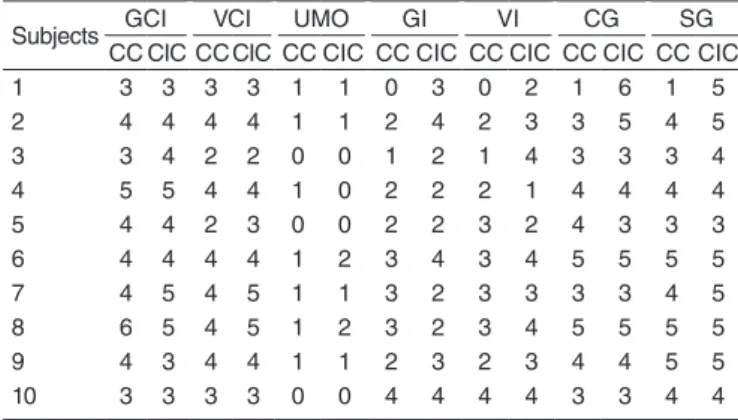
Table 1 presents the score of the best performances in the gestural communicative intention (GCI), vocal communicative intention (VCI), use of the mediator object (UMO), gestural imitation (GI), vocal imitation (VI), combinatory game (CG), and symbolic game (SG) during the eight sessions, in the com-mon and CIC rooms, respectively.
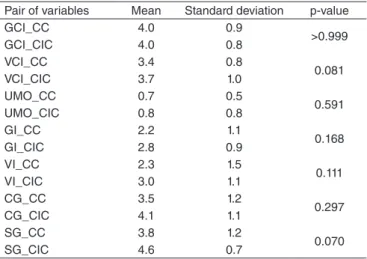
Table 2 shows the scores summary of the sociocognitive performance of the subjects with ASD in the common and CIC rooms through means and standard deviation of scores obtained from the Sociocognitive Performance Protocol. Besides, it also presents results related to the comparative analysis of the sociocognitive performance of 10 subjects in the common and CIC rooms.
It was also seen, after applying the Student’s t-test for paired data, that there was no signiicant difference in the sociocog-nitive performance of 10 subjects in the common and CIC rooms (Table 2).
Table 1. Best performance presented by each subject with autism spectrum disorder related to sociocognitive performance in the common and children’s interaction core rooms
Subjects GCI VCI UMO GI VI CG SG CC CIC CC CIC CC CIC CC CIC CC CIC CC CIC CC CIC 1 3 3 3 3 1 1 0 3 0 2 1 6 1 5 2 4 4 4 4 1 1 2 4 2 3 3 5 4 5 3 3 4 2 2 0 0 1 2 1 4 3 3 3 4 4 5 5 4 4 1 0 2 2 2 1 4 4 4 4 5 4 4 2 3 0 0 2 2 3 2 4 3 3 3 6 4 4 4 4 1 2 3 4 3 4 5 5 5 5 7 4 5 4 5 1 1 3 2 3 3 3 3 4 5 8 6 5 4 5 1 2 3 2 3 4 5 5 5 5 9 4 3 4 4 1 1 2 3 2 3 4 4 5 5 10 3 3 3 3 0 0 4 4 4 4 3 3 4 4
Furthermore, it should be mentioned that no signiicant dif-ferences were seen concerning therapy duration and age of the participants’ variables.
DISCUSSION
Although results have showed that the difference seen in the sociocognitive performance of the subjects with ASD, when both rooms were compared with different kinds of physical organization of the environment, was not statistically signii-cant, it should be pointed out that only the best sociocognitive performances of each participant were considered. These ind-ings are in agreement with those seen by other authors who also mentioned that the subjects with ASD may present simi-lar sociocognitive performance in the different communicative situations studied(2).
In the gestural communicative intention area, most individ-uals presented similar performance in both rooms; therefore, this aspect did not present a variation due to the environment context. A study(18) spontaneously and directly performed also could not ind a difference in this area, probably because the child would not need to make use of gestures to get the toy, because there were several toys at his/her disposal.
In addition, it was seen that 70% of the subjects had similar performance in the vocal communicative intention in the com-mon and CIC rooms, therefore the context did not interfere in this aspect. However, a study(18) states that when the child has verbal language, he/she will probably use it in any moment during the 30 minutes of the ilming session, indicating that such aspect may happen regardless of the environment context.
No mediator object was used in 30% of the subjects, and the worst performance was seen in 40% of the subjects in the common and CIC rooms, being the best one in 20% in the CIC room. Only 4% of the subjects presented better performance in the common room. These data conirm the indings of a study(19)
that emphasized the worst performance of this aspect in spon-taneous communicative situations.
As to the combinatory game, most subjects (70%) presented similar performance in the two studied rooms. These data can be compared to the indings of a study(18) showing that the sponta-neous situation favors the appearance of a combinatory game. Of the 10 studied subjects, 60% presented similar perfor-mance in the symbolic game in both rooms, and the others (40%) had better performance in the CIC room. A study(18) indicates that the subjects with ASD showed better performance for the symbolic game in the test situation than in the spontaneous one. In this study, the CIC room seems to favor the appearance of the symbolic game because materials were exposed according to their functionality and were at children’s reach.
It should be mentioned that a higher number of subjects presented better performance in the CIC room compared to the vocal imitation (60% of the subjects). Half of them (50% of the subjects) for the gestural imitation area, only 20% of the subjects achieved better performance in the common room and 30% presented similar performance in the two rooms, as shown in Table 1. These data conirm the statement(20) that physical contexts such as tables and chairs tend to provide less possi-bilities of gesture expression than large environments such as the CIC room.
According to other authors(10,21), different contexts in situ-ations of individual speech therapy for the subjects with ASD imply differences of performance, but such changes are also related to time and interference of several speakers and not only to the context. Regardless of the physical environment and of the adopted therapeutic proposal, the speech therapist will be in charge of process distinction acting like an ideal speaker and a mediator of the therapeutic process(7).
When analyzing individual tendencies, there were some characteristics that are in agreement with those of the other authors(2,3,5) who saw heterogeneity in the sociocognitive per-formance of the subjects with ASD. It is important to explore individual differences because they are associated with diag-nosis and progdiag-nosis of language and interaction of the children with ASD, besides they help creating strategies of interventions more directed to the needs of each case(22).
Sociocognitive performance can be used as a support instru-ment in the therapeutic process, making the identiication of variables that may interfere in the communicative performance easier(2). Thus, the study on sociocognitive aspects of the sub-jects with ASD can offer subsidies to prepare and use new techniques and procedures that favor the communicative pro-cess eficiently(2,3).
Data presented herein suggest the need of new researches such as longitudinal studies about the interference of the physi-cal context, to better clarify the possible interferences related to the sociocognitive performance of the subjects with ASD in different ambiances of language therapy.
CONCLUSION
Analysis of the relations between sociocognitive performance of children and adolescents with ASD and physical structure
Table 2. Mean, standard deviation, and significance of differences in the sociocognitive performance of 10 subjects in both the rooms
Pair of variables Mean Standard deviation p-value
GCI_CC 4.0 0.9
>0.999
GCI_CIC 4.0 0.8
VCI_CC 3.4 0.8
0.081
VCI_CIC 3.7 1.0
UMO_CC 0.7 0.5
0.591
UMO_CIC 0.8 0.8
GI_CC 2.2 1.1
0.168
GI_CIC 2.8 0.9
VI_CC 2.3 1.5
0.111
VI_CIC 3.0 1.1
CG_CC 3.5 1.2
0.297
CG_CIC 4.1 1.1
SG_CC 3.8 1.2
0.070
SG_CIC 4.6 0.7
Significant value (p<0.05) – Student’s t-test.
in language therapy situations allowed verifying that the dif-ference seen in the room with conventional structure applied in speech therapy clinics and in that with speciic environment was not statistically signiicant.
Thus, the creation of preestablished physical environments or speciic materials is not and should not be considered essen-tial for language therapy. It is noteworthy, however, that the absence of a large volume of statistically signiicant data does not indicate that the results are not expressive, reiterating the need for further research in the area.
*ARNM participated of the study conception and outline, data collection, data analysis and interpretation, and article review; MCB participated of data collection, article writing and review; AGO and TRS participated of article writing; FDMF participated of the study outline and approval of the inal version.
REFERENCES
1. Adams C, Lockton E, Freed J, Gaile J, Earl G, McBean K, et al. The social communication intervention project: a randomized controlled trial of the effectiveness of speech and language therapy for school-age children who have pragmatic and social communication problems with or without autism spectrum disorder. J Lang Commun Disord. 2012;47(3):233-44.
2. Cardoso C, Rocha JFL, Moreira CS, Pinto AL. Desempenho sócio-cognitivo e diferentes situações comunicativas em grupos de crianças com diagnósticos distintos. J Soc Bras Fonoaudiol. 2012;24(2):140-4. 3. Defense DA, Fernandes FDM. Perfil funcional de comunicação
e d e s e m p e n h o s ó c i o - c o g n i t ivo d e a d o l e s c e n t e s a u t i s t a s institucionalizados. Rev CEFAC. 2011;13(6):977-85.
4. Jones LA, Campbell M. Clinical characteristics associated with language regression for children with autism spectrum disorders. J Autism Dev Disord. 2010;40(1):54-62.
5. Sousa-Morato PF, Fernandes FDM. Adaptação sócio-comunicativa no espectro autístico: dados obtidos com pais e terapeutas. Rev Soc Bras Fonoaudiol. 2009;14(2):225-33.
6. Volden J, Coolican J, Garon N, White J, Bryson S. Brief report: pragmatic language in autism spectrum disorder: relationships to measures of ability and disability. J Autism Dev Disord. 2009;39(2):388-93.
7. Misquiatti ARN. A estruturação de ambientes de terapia fonoaudiológica. In: Brito MC, Misquiatti ARN, organizadores. Transtornos do espectro do autismo e fonoaudiologia: atualização multiproissional em saúde e educação. Curitiba: CRV; 2013. p. 127-39.
8. Misquiatti ARN, Fernandes FDM. Terapia de linguagem no espectro autístico: a interferência do ambiente terapêutico. Rev Soc Bras Fonoaudiol. 2011;16(2):204-9.
9. Misquiatti ARN, Brito MC. Terapia de linguagem de irmãos com transtornos invasivos do desenvolvimento: estudo longitudinal. Rev Soc Bras Fonoaudiol. 2010;15(1):134-9.
10. Perissinoto J. Linguagem da criança com autismo. In: Perissinoto J, organizador. Conhecimentos essenciais para atender bem as crianças com autismo. São José dos Campos: Pulso; 2003. p. 39-44.
11. Moreira CR, Fernandes FDM. Avaliação da comunicação no espectro autístico: interferência da familiaridade no desempenho de linguagem. Rev Soc Bras Fonoaudiol. 2010;15(3):430-5.
12. Kanne SM, Abbacchi AM, Constantino JN. Multi-informant ratings of psychiatric symptom severity in children with autism spectrum disorders: the importance of environmental context. J Autism Dev Disord. 2009;39(6):856-64.
13. C a l e S I , C a r r E G , B l a k e l ey - S m i t h A , O w e n - D e S c h r y ve r JS. Context-based assessment and intervention for problem behavior in children with autismo spectrum disorder. Behav Modif. 2009;33(6):707-42.
14. Bara BG, Bucciarelli M, Colle L. Communicative abilities in autism: evidence for attentional deicits. Brain Lang. 2001;77(2):216-40. 15. Meadan H, Halle JW, Watkins RV, Chadsey JC. Examining
communication repairs of 2 young children with autismo spectrum disorder: the inluence of the environment. Am J Speech Lang Pathol. 2006;15(1):57-71.
16. American Psychiatric Association. Manual diagnóstico e estatístico de transtornos mentais - DSM-IV-TR. 4ª ed. Porto Alegre: Artmed; 2002. 17. Organização Mundial da Saúde. Classiicação de transtornos mentais
de comportamento da CID-10: critérios diagnósticos para pesquisa. 10ª ed. Porto Alegre: Artes Médicas; 1993.
18. Molini DR, Fernandes FDM. Teste especíico para análise sócio-cognitiva de crianças autistas: um estudo preliminar. Temas Desenvolv. 2001;9(54):5-13.
19. C a r d o s o C , F e r n a n d e s F D M . R e l a ç ã o e n t r e o s a s p e c t o s sócio-cognitivos e peril funcional da comunicação em um grupo de adolescentes do espectro autístico. Pró-Fono R Atual Cient. 2006;18(1):89-98.
20. Fernandes FDM. Sugestões de procedimentos terapêuticos de linguagem em distúrbios do espectro autístico. In: Limongi SC. Fonoaudiologia - informação para formação: procedimentos terapêuticos em linguagem. Rio de Janeiro: Guanabara Koogan; 2003. p. 54-65.
21. R e s c o r l a L , G o o s s e n s M . S y m b o l i c p l a y d eve l o p m e n t i n toddlers with expressive specific language impairment (SLI-E). J Speech Lang Hear Res. 1992; 35(6):1290-302.