FREE THEMES
1 Departamento de Odontologia Social e Preventiva, Universidade Federal de Minas Gerais. Av. Antônio Carlos 6627, Pampulha. 31270-901 Belo Horizonte MG Brasil. [email protected] 2 Departamento de Odontologia, Centro de Ciências Básicas e da Saúde, Universidade Estadual de Montes Claros.
Assessment of the management of the Family Health Strategy
via the tool Assessment for Quality Improvement
in municipalities of Minas Gerais, Brazil
Abstract The self-assessment of the quality ofthe Family Health Strategy(FHS) was assessed in the context ofmanagement and its correlation with characteristics of FHS and of the municipality. Managers, coordinators and Family Health Unit managers of municipalities in the Northeast re-gion of Minas Gerais replied with tools 1, 2 and 3 of the Assessment for Improving the Quality of Family Health Strategy (AIQ). Scores were defined for each subdimension, according to the number of features compliant with the standards of the AIQ. We tested the correlation of this score with coverage and the deployment time of the FHS, with the municipal population and the HDI (Human Development Index). The lowest scores were for Work Management, Permanent Educa-tion and Inputs, Immunobiologicals and Medi-cines. There was a positive correlation between the municipal population and Strengthening of Coordination, Support for Teams, Permanent Ed-ucation Management and Standardization and a negative one with Infrastructure and Equipment. The use of the AIQ tools permitted the identifica-tion of subdimensions and municipalities which will require greater attention and intervention by the municipal management.
Key words Assessment of health services,
Pri-mary Healthcare, Health management, Family Health Program
Andreza Viana Lopes Cardoso 1
Ana Paula Nascimento Chain 2
Rafael Inácio Pompeu Mendes 2
Efigênia Ferreira e Ferreira 1
Andréa Maria Duarte Vargas 1
Andréa Maria Eleutério de Barros Lima Martins 2
C
ar
d
oso A
Introduction
The expansion of the Family Health Strategy (FHS) has initiated a discussion on questions regarding the qualification of teams and the resolvability of services, highlighting the need for monitoring and
assessment of Primary Healthcare (PHC)1. To this
end, the Ministry of Health (MoH) has begun to argue in favor of the continuous upgrading of as-sessment processes in the routine of management
and of health services2. The Policy of Monitoring
and Assessment of the Basic Healthcareestablished the Assessment for Improving the Quality of the
Family Health Strategy(AIQ)3, in conjunction with
states and municipalities, locating assessment as a permanent instrument for decisionmaking and-quality as a fundamental attribute to be achieved
in the Single Health System (SUS)4.
Donabedian’s model was adopted as a concep-tual reference for the elaboration of the AIQ. This model considers elements of structure, process and results, which are related to the assessment elements of the FHS teams: structure – inputs, teams, materials, human resources, physical en-vironment and normative organization; process – organizational, technical-scientific and inter-personal aspects; result – access, adjustment and effectiveness forthe promotion of changes in the
health of the population4.
As a support for the assessment, the MoH de-veloped self-assessment tools, directed towards the municipal managementof health, the mu-nicipal coordinationof the FHS, the manager re-sponsible for managing the Family Health Units (FHU) and the FHS Teams. They seek a diagnosis for the organization and functioning of the ser-vices and their practices on the basis of the prin-ciples, directives and fields of action of the FHS. The AIQ considers two major integrated units of analysis: Management and Team, containing di-mensions of analysis, which are in turn broken down into subdimensions. Each subdimension has its quality standards, amounting to 300
stan-dards in five tools4.
The AIQ has sought to promote, as the prin-cipal objective of its deployment, the monitoring and assessment of the quality stages of the FHS, making available tools for the diagnosis of prob-lems and stimulating the debate on improve-ments in the field ofhealth, based on the results of the self-assessment processes. These processes may be adhered to freely by themanagers and do not determine financial incentives or sanctions for the municipalities and teams which have
ad-hered to the programme4.
An effort was nevertheless made to facilitate a broader program, which could permit the expan-sion of access and the improvement in the qual-ity ofBasic Healthcare (BH) throughout Brazil, with the guarantee of a quality standard that was comparable, nationally, regionally and locally and greater transparency and effectiveness of the
government actions intended for BH5.
In order to achieve such objectives, the MoH introduced the National Program for Improve-ment of Access and Quality (PIAQ), via Decree No. 1.654 GM/MS, of 19 July 2011, which was the result of an extensive and important pro-cess of negotiation between the three spheres of
management of the SUS5. The PIAQ may also be
adhered to freely, although it links financial re-sources to the meeting of goals, previously
estab-lished by the contractualization of objectives5.
Self-assessment, which is the final objective of the AIQ, is understood is the point of de-parture for the developmentphase of the PIAQ, which possessesthree other phases, which com-plement each other and conform to a continuous cycle (Adhesion and Contractualization; Devel-opment; External Assessmentand
Recontractual-ization)5.
While other assessment instruments have been developed, the AIQ takes into account many of the assessment dimensions contained in the PIAQ, maintaining similar theoretical con-structions, which seek a discussion of the quality of management and of teams as central units of
analysis in the assessment questionnaires4,5. As
such, studies on the AIQ are valid and relevant, since this instrument may generate assessment indicators for the quality of FHS in Braziland even today, only a small number of studies have used this assessment instrument as a central
theme of study6-8.
Minas Gerais is a Brazilian state with social
inequalities between its regions9. TheNortheast
macroregion, composed of 63 municipalities10, is
one of the poorest regions in the State, with ma-jor social inequality and a predominantly rural
population11. Assessing the quality of PHC in this
e C
ole
tiv
a,
20(4):1267-1284,
2015
in the municipalities of the Northeast macrore-gion of Minas Geraisis justified in the context of management.
This study assessed the quality of the FHS, considering the AIQ cited by the managers, mu-nicipal coordinators of the FHS and managers of the FHU in the municipalities of the Northeast macroregion of Minas Gerais, and verified the correlation between the self-assessment scores and the Human Development Index (HDI), the municipal population, coverage and deployment time of the FHS.
Methodology
An ecological study, executed in the 63 munic-ipalities of the healthcare macroregion of the Northeast of Minas Gerais, covering theMucuri and Jequitinhonha Valleys in geographical terms,
subdivided into eight health microregions10. This
macroregion has a territorial area of 56,641 km², a population density of 14.33 inhabitants/km² and an estimated populationin 2011 of 811,856
inhabitants10. In territorial terms, it is similar to
the Centremacro region, in which the capital Belo Horizonte is located. In this latter macro region, however, population density is 105.49
inhabi-tants/km2 with an estimated populationin 2011
of 6,145,218 inhabitants10. The average HDI of
the Northeast macroregion is 0.636, considered as an average human development value. Minas Gerais has a high HDI value, of 0.731; like Brazil,
with a HDI of 0.74412.
The Northeast macroregion covers the Re-gional Health Superintendencies (SRS) of Teó-filo Otoni, Diamantina and the Regional Health Management Area (GRS) of Pedra Azul. The SRS of Teófilo Otoni covers 32 municipalities; 25 mu-nicipalities are under the jurisdiction of the GRS of Pedra Azul and six belong to the jurisdiction of the SRS of Diamantina and comprise the
mi-cro region of Araçuaí13. At the time of collection
of the data, the 63 municipalities had 264 FHS teams (February to April 2011). This included all of the managers, municipal coordinators of the FHS and managers of the FHU of the 63 munic-ipalities, holding the position during the period of February/March2011, forming a group of 63 managers, 63 municipal FHS coordinators and 264 FHU managers.
The quality of the FHS was assessed by the three players involved in the management of the FHS through tools 1, 2 and 3 of the AIQ, which correspond to the threedimensions:
Develop-ment of the FHS, Technical Coordination of
Teams and theFamily Health Unit4.
Tool 1, aimed at the municipal health
man-ager, assessed the dimension Development of the
FHS, with 60 standards, organized into four
sub-dimensions: Deployment/Implementation of the FHS in the municipality; Integration of the Ser-vice Network; Work Management and
Strength-ening of Coordination. The dimension Technical
Coordination of Teams (tool 2), assessed by the coordinators of the FHS, included thesubdimen-sions: Planning and Integration; Support for Teams; Permanent Education Management; Man-agement of the Assessment and Standardization,
distributed across 40 standards. The Family Health
Unit dimension (tool 3), with 40 standards in two subdimensions, Infrastructure and Equipment of the FHU and Inputs, Immunobiologicals and Medicines, was directed towards the managers of the FHU. The quality standards in each sub-dimension are accompanied by their description, which determines the characteristics necessary for ensuring that the FHS is or is not compliant
with that standard4.
Initially, the project was disclosed to theman-agers during the meetings of the Bipartite Inter-manager Commissions (CIB) of the eight health microregions. The questionnaires intended for the managerswere distributed to them, with the managers requested to forward those intended for the coordinators and the FHU managers of the municipalities under their management.
The following information was also collect-ed from the municipalities: population in 2010,
from the Instituto Brasileiro de Geografia e
Es-tatística [Brazilian Institute of Geography and
Statistics] (IBGE)9; HDI in the Atlas of Human
Development of Brazil, of 200012; and time of
de-ployment and population coverage of the FHS, on the website of the MoH/Department of Basic
Healthcare, referring to March 201114.
subdimen-C
ar
d
oso A
sions of each dimension and the variables refer-ring to the municipalities and to the FHS was
investigated by calculating the Spearman
correla-tion coefficient (p < 0.05). The frequency of mu-nicipalities or FHUs in compliance with each of the standards was obtained for all of the assessed dimensions/subdimensions.
The research project was approved by the Re-search Ethics Committee of the State University of Montes Claros. All of the participants signed the free and informed consent form.
Results
There was a response rate of 79.4% (n = 50) and of 76.2% (n = 48) among themanagers and coor-dinators respectively. With regard to the partici-pation of FHU managers, in eight municipalities there was a loss of 100%. All in all, 55 munici-palities (87.3%) and 210 managers of the FHU (79.5%) replied.
Table 1 also demonstrates the management assessment of the FHS with regard to the three
dimensions of the AIQ. In the dimension
De-velopment of the FHS, the managers assessed the subdimensionWork Management and Strength-ening of Coordination more negatively, which presented the lowest average proportional scores. The best average performance was obtained by the Deployment/Implementation subdimension
of the FHS in the municipality. For the
dimen-sion Technical Coordination of Teams, the
max-imum score for compliance with the standards was only missed by the Planning and Integration subdimension. In this dimension, the coordina-tors had a more negative assessment of the Per-manent Education Management subdimension. The best proportional average performance was obtained in the Support for Teams
subdimen-sion. In the Family Health Unit dimension, in
proportional terms the Inputs, Immunobiologi-cals and Medicines subdimension received a bet-ter assessment by the managers of the FHU than the Infrastructure and Equipment of the FHU dimension.
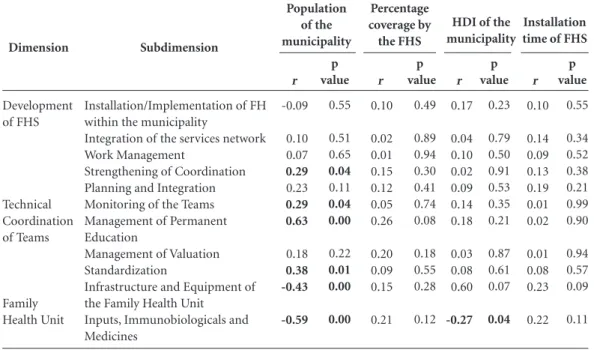
The municipalities with higher population reported significantly higher compliance scores in the subdimension Strengthening of Coor-dination, Support for Teams, Permanent Edu-cation Management and Standardization. The scores for the subdimensions Infrastructure and Equipment of the FHU and Inputs, Immunobi-ologicals and Medicines were significantly lower in municipalities with a higher population. The municipalities with a higher HDI presented low-er scores for the subdimension Inputs, Immuno-biologicals and Medicines (Table 2).
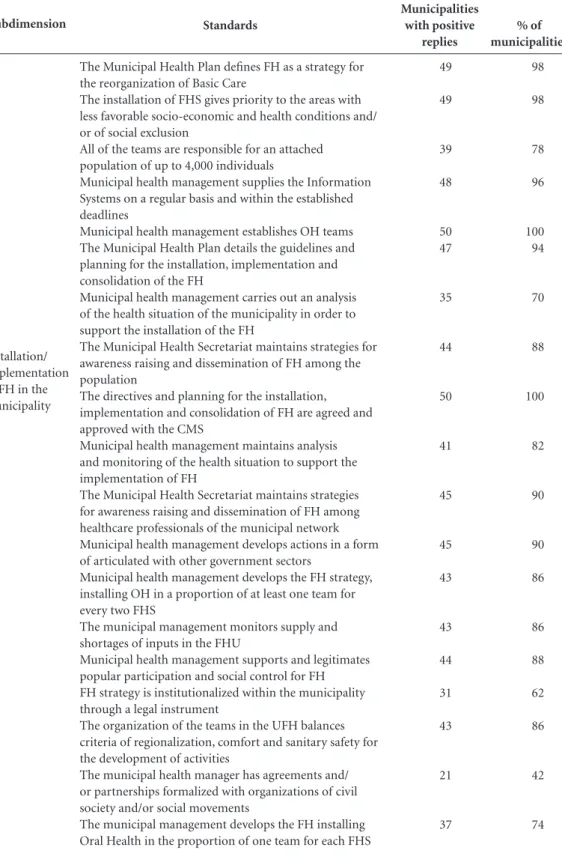
In the Deployment/Implementation subdi-mension for FHS within the municipality, the percentages of municipalities compliant with the standards of the AIQ varied from 42% to 100%,
Dimension*
Development of the Family Health Strategy
Technical Coordination of Teams
Family Health Unit
Subdimension
Installation/Implementation of FH within the municipality
Integration of the services network Work Management
Strengthening of Coordination Planning and Integration Monitoring of the Teams
Management of Permanent Education Management of Valuation
Standardization
Infrastructure and Equipment of the Family Health Unit
Inputs, Immunobiologicals and Medicines
Table 1. Assessment of the Development dimensions of the Family Health Strategy, Technical Coordination of Teams and Family Health Unit by the managers (n = 50), coordinators (n = 48) and managers of the UFH (n = 55) of the Northeast region of Minas Gerais. Minas Gerais. 2011.
Maximum compliance
score
19
19 10 12 8 7 6 10 9 24
16
Minimum
11
5 1 1 0 0 0 0 0 8
6
Maximum
19
19 9 12 7 7 6 10 9 22
16
Average (SD)
16.08 (2.01)
13.50 (13.80) 4.50 (1.88) 7.56 (2.58) 5.00 (1.52) 5.50 (1.52) 3.54 (1.61) 6.77 (2.22) 5.69 (2.23) 14.42 (3.62)
13.23 (2.38)
e C ole tiv a, 20(4):1267-1284, 2015
with the lowest two percentages obtained for the standards “The municipal health manager has formalized agreements and/or partnerships with organizations of civil society and/or social movements” (42%) and “The FHS is institution-alized through a legal instrument” (62%). The percentages of municipalities compliant with the standards of the subdimension Integration of the Service Network varied from 30% to 96%. 30% and 48% of the managers answered in the affirmative to the following standards respec-tively: “The health service network guarantees access to the dental prosthesis laboratory service for the attached population” and “There is plan-ning of the supply of ophthalmologist services of the FHS, based on studies of demand”. For the Work Management subdimension, the percent-ages of managers compliant with the standards varied from 22% to 74%. The standards “Mu-nicipal health management has institutionalized career plans, jobsand salaries regarding Family Health” (22%) and “Municipal management has an incentive program for the FHS, relating to the performance, compliance with goals and results achieved” (26%) had the lowest percentage of compliant features. In the Strengthening of Co-ordination subdimension, there was a variation from 34% to 90% in the percentages of
affirma-tive answers to the standards, with the lowest values obtained for the standards: “Municipal health management and/or the coordination es-tablish or use mechanisms for the monitoring of the degree of satisfaction of users of FH” (34%), “There is decentralized coordination, responsible for the monitoring of at most eight FHS” (38%) and “The coordination of Basic Healthcare (BH)/ FH supports and promotes the training of Local Health Councils in the BHUs” (38%) (Table 3).
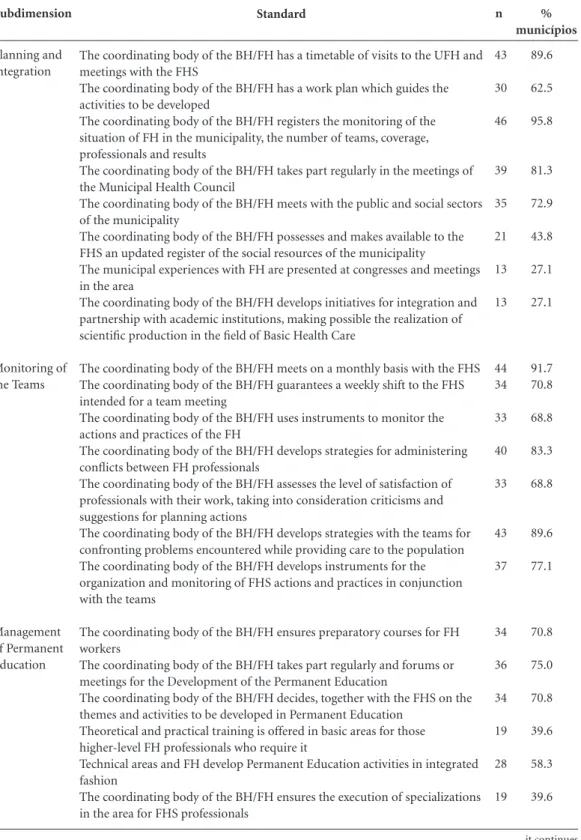
In the Planning and Integration subdimen-sion, from 27.1% to 89.6% of FHS coordinators replied in the affirmative to the standards. There was a lower percentage of affirmative answers to the following standards: “Municipal experiences with family health are presented at congresses and meetings in the area” (27.1%) and “The co-ordination of the BHC/FH is developing integra-tion and partnership initiatives with academic institutions, permitting scientific output in the field of the BHC” (27.1%). The majority of the municipalities answered in the affirmative to the standards of the subdimension “Support for Teams” (68.8% to 91.7%). For the “Permanent Education Management” subdimension, the per-centages of affirmative answers varied from39.6% to 75%. Two standards showed non-compliance for a higher percentage of coordinators:
“Theo-Dimension Development of FHS Technical Coordination of Teams Family Health Unit Subdimension
Installation/Implementation of FH within the municipality
Integration of the services network Work Management
Strengthening of Coordination Planning and Integration Monitoring of the Teams Management of Permanent Education
Management of Valuation Standardization
Infrastructure and Equipment of the Family Health Unit
Inputs, Immunobiologicals and Medicines
Table 2. Spearman Correlation between compliant scores for the Development dimensions of the Family Health Strategy, Technical Coordination of Teams and Family Health Unit and characteristics of the municipality and of FHS. Minas Gerais. 2011.
r -0.09 0.10 0.07 0.29 0.23 0.29 0.63 0.18 0.38 -0.43 -0.59 p value 0.55 0.51 0.65 0.04 0.11 0.04 0.00 0.22 0.01 0.00 0.00 r 0.10 0.02 0.01 0.15 0.12 0.05 0.26 0.20 0.09 0.15 0.21 Population of the municipality p value 0.49 0.89 0.94 0.30 0.41 0.74 0.08 0.18 0.55 0.28 0.12 r 0.17 0.04 0.10 0.02 0.09 0.14 0.18 0.03 0.08 0.60 -0.27 p value 0.23 0.79 0.50 0.91 0.53 0.35 0.21 0.87 0.61 0.07 0.04 r 0.10 0.14 0.09 0.13 0.19 0.01 0.02 0.01 0.08 0.23 0.22 p value 0.55 0.34 0.52 0.38 0.21 0.99 0.90 0.94 0.57 0.09 0.11 Percentage coverage by the FHS
HDI of the municipality
Installation time of FHS
C
ar
d
oso A
Subdimension
Installation/ Implementation of FH in the municipality
Standards
The Municipal Health Plan defines FH as a strategy for the reorganization of Basic Care
The installation of FHS gives priority to the areas with less favorable socio-economic and health conditions and/ or of social exclusion
All of the teams are responsible for an attached population of up to 4,000 individuals
Municipal health management supplies the Information Systems on a regular basis and within the established deadlines
Municipal health management establishes OH teams The Municipal Health Plan details the guidelines and planning for the installation, implementation and consolidation of the FH
Municipal health management carries out an analysis of the health situation of the municipality in order to support the installation of the FH
The Municipal Health Secretariat maintains strategies for awareness raising and dissemination of FH among the population
The directives and planning for the installation, implementation and consolidation of FH are agreed and approved with the CMS
Municipal health management maintains analysis and monitoring of the health situation to support the implementation of FH
The Municipal Health Secretariat maintains strategies for awareness raising and dissemination of FH among healthcare professionals of the municipal network Municipal health management develops actions in a form of articulated with other government sectors
Municipal health management develops the FH strategy, installing OH in a proportion of at least one team for every two FHS
The municipal management monitors supply and shortages of inputs in the FHU
Municipal health management supports and legitimates popular participation and social control for FH FH strategy is institutionalized within the municipality through a legal instrument
The organization of the teams in the UFH balances criteria of regionalization, comfort and sanitary safety for the development of activities
The municipal health manager has agreements and/ or partnerships formalized with organizations of civil society and/or social movements
The municipal management develops the FH installing Oral Health in the proportion of one team for each FHS
Table 3. Frequency of municipalities with positive replies to the AMQ standard for the Development dimension of the Family Health Strategy (n = 50).
Municipalities with positive
replies
49
49
39
48
50 47
35
44
50
41
45
45
43
43
44
31
43
21
37
% of municipalities
98
98
78
96
100 94
70
88
100
82
90
90
86
86
88
62
86
42
74
e C
ole
tiv
a,
20(4):1267-1284,
2015
retical and practical training is offered in the ba-sic areas for those higher-level FH professionals who require it” (39.6%) and “The coordination of the BH/FH permits specializationin the area
for FHS professionals” (39.6%). For the subdi-mension “Management of Assessment” (41.7% to 91.7%), only two standards received affirmative answers from less than 50% of the coordinators:
Subdimension
Integration of the Service Network
Standards
Municipal health management expands and/or makes adaptations to the service network as a function of the installation of FH within the municipality
Municipal health management expands and/or makes adaptations to the network of references, basing itself on studies of the demand verified and/or estimated in the FHS Planning exists for the supply of basic complimentary examinations for the FHS
Municipal health management guarantees the collection and submission of all serology requests for diagnosing dengue fever
Municipal health management develops strategies for ensuring a reference for the population attached to the FH teams for hospitalizations in the basic clinics
Municipal health management guarantees the execution of high-risk prenatal tests for all referred pregnant women Planning exists for the supply of cardiology treatment for the FHS based on studies of demand
Planning exists for the supply of orthopedic treatment for the FHS based on studies of demand
The procedures of fixing tests, procedures and hospitalizations are carried out by a reservation center The municipal health manager monitors and specialized tests, requested by the FHS, which are not provided by the reference
Planning of the supply of rehabilitation services for the FHS based on studies of demand
Planning of the supply of ophthalmologist services for the FHS based on studies of demand
Planning of the supply of a nose and throat treatment for the FHS based on studies of demand
Planning of the supply of neurology treatment for the FHS based on studies of demand
Municipal health management develops strategies for ensuring a reference for the population attached to the FH teams for dentistry specialties
The health services network guarantees access to the dental prosthesis laboratory for the population attached to the FH teams
Municipal health management develops integration strategies between the mental health service and the FHS Municipal health management monitors the use of urgent, emergency and first aid services of the public network for the population covered by the FH
Support by other network professionals for the FH teams is provided systematically, on the basis of an established model
Table 3. continuation
Municipalities with positive
replies
45
36
45
47
48
46
29
30
42
41
33
24
26
26
30
15
36
35
41
% of municipalities
90
72
90
94
96
92
58
60
84
82
66
48
52
52
60
30
72
70
82
C
ar
d
oso A
Subdimension
Work Management
Strengthening of Coordination
Standards
Municipal health management develops strategies for ensuring that labor rights do not become precarious in the FH The criteria of the SMS for the selection and recruitment of FH professionals are described in an official document The criteria for selecting professionals for higher-level FH give value to Residential or Postgraduate Studies in Family Health
The entry of high-level FH professionals is realized through a public competition to fill permanent positions or public sector jobs
The entry of mid-level FH professionals is realized through a public competition to fill permanent positions or public sector jobs
Higher-level FH professionals have been working in the municipality for more than two years
The ACS have been working in the municipality for more than two years
The municipal management has an incentive program for the FHS related to performance, meeting targets and results achieved
Municipal health management has institutionalized career plans, positions and salaries regarding the FH
80% of higher-level professionals in the teams have specific training in the area
The SMS has a specific coordinating body for BH/FH The coordinating body of the BH/FH is formally included in the organizational structure of the Municipal Health Secretariat
Municipal health management involves the coordination of the BH/FH in the process of agreeing on the BH indicators in the Health Pact
Municipal management values the participation of the coordinating body of the BH/FH in congresses and meetings of the area
The technician(s) responsible) for the coordination of the BH/FH has/have specific training in the area
The coordinating body of the BH/FH consists of a multi-professional team for the support, supervision and technical monitoring work of FHS
Decentralized coordination exists, which is responsible for the monitoring of at most 8 FH teams
The SMS has a professional coordinator of the BH/FH, responsible for the area of OH
Municipal health management and/or the coordinating body establish or use mechanisms for the monitoring of the degree of satisfaction of the users of the FH
Technical areas work in an integrated manner with the coordination of the BH/FH
The coordinating body of the BH/FH supports and promotes the training of Local Health Councils in the basic units Municipal health management develops a Humanization policy for the municipal network, in conjunction with the BH/FH coordinating body and other technical areas of the SMS, considering FH
Table 3. continuation
Municipalities with positive
replies
16
37
18
17
28
30
33
13
11
22
41 32
45
43
31
25
19
32
17
42
19
32
% of municipalities
32
74
36
34
56
60
66
26
22
44
82 64
90
86
62
50
38
64
34
84
38
e C
ole
tiv
a,
20(4):1267-1284,
2015
“Are epidemiological surveys of Oral Healthcar-ried out in the municipality” (41.7%) and “The coordination of the BH/FH selects criteria and indicators for assessing with the teams the im-pact on the health conditions of the population” (45.8%). In the “Standardization” subdimension, the percentages of coordinators with affirmative answers to the standardsvaried from 27.1% to 91.7%, with the lowest value attributed to the standard “The coordination of the BH/FH makes available protocols and technical information to the FHS/SB on the approach to urgent situations in Mental Health” (Table 4).
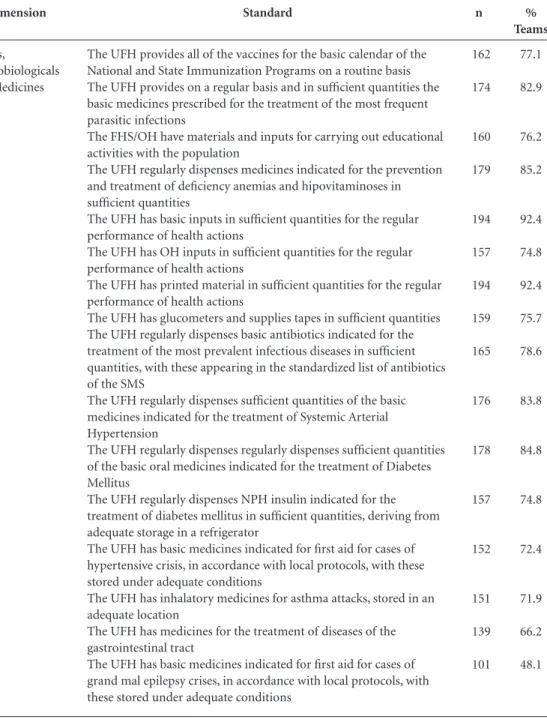
The percentage of the managers of the FHU who replied in the affirmative to the standards of the subdimension Infrastructure and Equipment of the FHU varied from 15.2% to 86.2%. The standards with the lowest percentage of compli-ant replies were: “The FHU has equipment avail-able indicated for first aid in urgent cases and emergencies” (15.2%) and “The FHU has other equipment available for health care by the teams” (17,6%). In the “Inputs, Immunobiologicals and Medicines” subdimension, the percentages of municipalities compliant with the standards varied from 48.1% to 92.4%. The standard with the lowest compliance was: “The FHU has ba-sic medicines available indicated for first aid for cases of grand mal epilepsy crises, in accordance with local protocols, which are stored in a suit-able location” (48.1%) (Tsuit-able 5).
Discussion
In general, the managers, municipal coordinators of the FHS and FHU managers of the munici-palities of the Northeast region of Minas Gerais assessed the quality of the FHS positively, as wit-nessed by the high average values of the compli-ance scores and of the percentages of affirmative answers to the standards. No studies were iden-tified which had used the instruments directed towards management in other Brazilian regions, solely for FHS teams. For example, Montes Claros (Minas Gerais), the Team component of the AIQ was assessed by FHS professionals, with compliance scores exceeding 50% in each of the subdimensions, except for three of them: Com-munity Participation, Social Control and
Adoles-cent Health7.
The limitations of the AIQ have been
previ-ously highlighted6,8,15,16. In the deployment of the
AIQ, in the city of Registro (São Paulo), it was observed that its feasibility depended on the
ef-forts of the managers and that healthcare profes-sionals encountered difficulties in completing the
questionnaires8. The difficulties of analyzing the
data generated by the tools was also highlighted, given that the methodology of the AIQ does not
define it15. Nor can it be stated that the replies
ob-tained comply with the reality of practice, since
direct observation techniques were not used16,17.
The possibility of overestimation of the scores obtained by the AIQ is still subject to debate, since the reply standards are dichotomous and a perception of inefficiency on the part of the team may be generated by a high number of negative
replies16.
In this study, we chose to obtain the sum of the compliance scores for each assessed dimen-sion/subdimension, without considering the quality stages of the standards, with a
methodol-ogy similar to that previously realised7,8,17,18. This
choice was made and the study then identified the non-linearity of the relationship between the quality stages of the AIQ and the complexity of deployment of the work processes
recommend-ed by the quality standards6. One of the
difficul-ties encountered in this study was the return of completed questionnaires, which did not reach 100% of replies for any of the three tools. The lowest rate of response (76.2%) was among the FHS coordinators, which may be explained by the absence of a specific function in municipal-ities with up to three FHS. For the tool targeted at the managers of the FHU, there was a loss of 100% in eight municipalities under the jurisdic-tion of the GRS of Pedra Azul. This loss may be due to the difficulties faced by the managers in distributing and requesting the participation of the FHU managers and the poor efforts made by them in replying to the question and delivered by the manager. The loss of these data did not com-promise the results of the survey, since the real-ity of health management in the municipalities which did not take part in the study is identified with the others with the same level of population.
The results revealed that the FHS were favor-ably assessed by the managers regarding the di-mension Development of the FHS, in particular for the subdimension Deployment/Implementa-tion, which characterizes the political and insti-tutional definition of the FHS as a model of care dispensed to the population. At the same time, the study showed that many of the municipali-ties still needed to establish formal partnerships/ agreements with the organizations of civil soci-ety and/or social movements. This need was also
C
ar
d
oso A
the FHS in their sample included representatives of social movements in their planning of actions. These partnerships will be able to establish
ar-ticulated actions between the municipal health management and the works already developed by entities of civil society, in such a way as to favor
Subdimension
Planning and Integration
Monitoring of the Teams
Management of Permanent Education
Standard
The coordinating body of the BH/FH has a timetable of visits to the UFH and meetings with the FHS
The coordinating body of the BH/FH has a work plan which guides the activities to be developed
The coordinating body of the BH/FH registers the monitoring of the situation of FH in the municipality, the number of teams, coverage, professionals and results
The coordinating body of the BH/FH takes part regularly in the meetings of the Municipal Health Council
The coordinating body of the BH/FH meets with the public and social sectors of the municipality
The coordinating body of the BH/FH possesses and makes available to the FHS an updated register of the social resources of the municipality
The municipal experiences with FH are presented at congresses and meetings in the area
The coordinating body of the BH/FH develops initiatives for integration and partnership with academic institutions, making possible the realization of scientific production in the field of Basic Health Care
The coordinating body of the BH/FH meets on a monthly basis with the FHS The coordinating body of the BH/FH guarantees a weekly shift to the FHS intended for a team meeting
The coordinating body of the BH/FH uses instruments to monitor the actions and practices of the FH
The coordinating body of the BH/FH develops strategies for administering conflicts between FH professionals
The coordinating body of the BH/FH assesses the level of satisfaction of professionals with their work, taking into consideration criticisms and suggestions for planning actions
The coordinating body of the BH/FH develops strategies with the teams for confronting problems encountered while providing care to the population The coordinating body of the BH/FH develops instruments for the organization and monitoring of FHS actions and practices in conjunction with the teams
The coordinating body of the BH/FH ensures preparatory courses for FH workers
The coordinating body of the BH/FH takes part regularly and forums or meetings for the Development of the Permanent Education
The coordinating body of the BH/FH decides, together with the FHS on the themes and activities to be developed in Permanent Education
Theoretical and practical training is offered in basic areas for those higher-level FH professionals who require it
Technical areas and FH develop Permanent Education activities in integrated fashion
The coordinating body of the BH/FH ensures the execution of specializations in the area for FHS professionals
Table 4. Frequency of municipalities with positive replies to the standards of the AMQ for the dimension Technical Coordination of Teams (n = 48).
n
43
30
46
39
35
21
13
13
44 34
33
40
33
43
37
34
36
34
19
28
19
% municípios
89.6
62.5
95.8
81.3
72.9
43.8
27.1
27.1
91.7 70.8
68.8
83.3
68.8
89.6
77.1
70.8
75.0
70.8
39.6
58.3
39.6
e C
ole
tiv
a,
20(4):1267-1284,
2015
Subdimension
Management of Assessment
Standardization
Standard
The coordination evaluates the output of FHS on a monthly basis The coordinating body of the BH/FH uses the information of the SIAB as a management instrument: assessment, planning and monitoring
The coordinating body of the BH/FH analyses the reports of the SIAB on a monthly basis, in conjunction with the FHS
The coordinating body of the BH/FH analyses data and reports of the SUS or health information system
The coordinating body of the BH/FH chooses criteria and indicators for evaluating with the teams the impact on the health conditions of the population
The coordinating body analyses the demand for FH tests and referrals, observing whether there is a match with the estimated requirement The coordinating body of the BH/FH debates the results and plans the objectives of FH with the teams
The coordinating body of the BH/FH meets with the other areas of the SMS to discuss the results achieved in BH.
The coordinating body of the BH/FH evaluates the established goals for the Basic Healthcare indicators of the Health Pact with the FHS Epidemiological surveys of Oral Health are carried out within the municipality
The coordinating body of the BH/FH makes documents available to all of the FHS with the principles and guidelines of the FH strategy The coordinating body of the BH/FH uses a written standard with regard to the physical installation and equipment
The BH/FH coordinating body makes updated information from the municipal reference and counter-reference system available to all of FHS units
The coordinating body of the BH/FH provides a manual of basic pharmacy medicines
The coordinating body of the BH/FH makes supporting technical-scientific material available to the teams on frequent situations in Basic Health Care
The coordinating body of the BH/FH makes supporting technical-scientific material available to the teams on the most prevalent infectious and parasitic diseases in the country.
The coordinating body of the BH/FH has documentation establishing the action of each FH professional
The coordinating body of the BH/FH provides protocols and technical information to the FHS/OH on dealing with urgent situations The coordinating body of the BH/FH provides protocols and technical information to the FHS/OH on dealing with urgent situations in Mental Health
Table 4. continuation
n
42 43
28
35
22
27
38
26
44
20
32
28
32
35
37
44
31
21
13
% municipalities
87.5 89.6
58.3
72.9
45.8
56.3
79.2
54.2
91.7
41.7
66.7
58.3
66.7
72.9
77.1
91.7
64.6
43.8
27.1
an improvement in the quality of life of
munici-pal residents19.
The worst result obtained in the Develop-ment of the FHS dimension was attributed to the Work Management subdimension. The need was detected to develop FHS professionals, since more than 70% of the municipalities were not
compliantwith standards which they confirmed regarding Plans for Positions, Careers and Sal-aries (PCCS) and worker incentive programs. This question has already been discussed, with public policies elaborated, such as the proposal
of PCCS approved at the 14th National Health
C
ar
d
oso A
of incentives and strategies for the gradual incor-poration of management functions by
federat-ed entities21. At the same time, in the Northeast
macroregion, the elaboration of local work man-agement policies has received little discussion at the meetings of the microregional CIBs. Analyz-ing the consolidation agreements realized by the CIB-SUS/MG, we may observe the discussion on great demand for the accreditation of newteams,
the shutting down of units, the qualification for the provision of certain clinical services, the ap-proval of documents; with questions relating to human resources little discussed at these
meet-ings22. This demand must be encouraged, for the
construction of joint solutions and new propos-als regarding work management, not only in the Northeast region, but in the whole of the state of Minas Gerais.
Subdimension
FHU Infrastructure and Equipment
Standard
Each FHS has a clinic with basic equipment for attending its population The UFH clinics permit the visual and auditory privacy of health care Clinics where gynecological examinations are carried out have, as a minimum, screens for dressing and undressing
The ACS have basic equipment for external work
The FHS have complete equipment and orthodontic equipment for the regular performance of its activities
Considering the physical installation, all areas of the UFH have adequate conditions for carrying out basic health actions
The UFH has a covered space, exclusively for reception and waiting, with a number of seats compatible with the expected demand
The UFH has an exclusive refrigerator for vaccines with temperature control for the preservation of immunobiologicals
The UFH plans the use and adaptation of environments for applying bandages, inhalation, sutures and the observation of patients
There are sufficient quantities of gynecological-obstetric equipment for the work of the FHS
The number of clinics of the UFH allows doctors and nurses to provide outpatient FH treatment at the same time
The tensiometers and scales of the UFH are measured in accordance with technical parameters
The ACS have other items of equipment for external work The UFH has a telephone line
The UFH has computer equipment
The UFH has a room for holding team meetings, internal activities of the ACS and Permanent Education activities
The UFH has other items of equipment for treatment by the teams The UFH has equipment recommended for first aid in urgent and emergency cases
Travel by the FH professionals to carry out planned external activities is carried out in a SMS vehicle
The UFH has electronic equipment for educational activities
The dentistry clinics allow the provision of DHT treatment and dental surgery in an integrated manner
The UFH is equipped to treat individuals with special needs: ramps, banisters, width of the doors, restrooms and wheelchairs
The UFH has access to the Internet and makes it available to FH workers on the basis of defined criteria
Clinics where gynecological examinations are carried out have their own
Table 5. Frequency of teams with positive replies to the AMQ standard for the Family Health Unit dimension (n = 210).
n
174 181 179
113 146
118
164
118
146
169
172
81
56 65 97 110
37 32
162
105 93
76
53
148
% Teams
82.9 86.2 85.2
53.8 69.5
56.2
78.1
56.2
69.5
80.5
81.9
38.6
26.7 31.0 46.2 52.4
17.6 15.2
77.1
50.0 44.3
36.2
25.2
70.5
e C
ole
tiv
a,
20(4):1267-1284,
2015
Problems in the area of Work Management within the SUS were listed in the study by the
In-stitute of Social Medicine of the UERJ23.
Regard-ing management strictly speakRegard-ing, state manag-ers highlighted the inadequate remuneration of-workers, increasing work and security, the limits of the Law of Fiscal Responsibility, government insensitivity to the sector, the absence of the PCCS, the absence of planning and the absence of competitions as the principal challenges
re-Subdimension
Inputs,
Imunobiologicals and Medicines
Standard
The UFH provides all of the vaccines for the basic calendar of the National and State Immunization Programs on a routine basis The UFH provides on a regular basis and in sufficient quantities the basic medicines prescribed for the treatment of the most frequent parasitic infections
The FHS/OH have materials and inputs for carrying out educational activities with the population
The UFH regularly dispenses medicines indicated for the prevention and treatment of deficiency anemias and hipovitaminoses in sufficient quantities
The UFH has basic inputs in sufficient quantities for the regular performance of health actions
The UFH has OH inputs in sufficient quantities for the regular performance of health actions
The UFH has printed material in sufficient quantities for the regular performance of health actions
The UFH has glucometers and supplies tapes in sufficient quantities The UFH regularly dispenses basic antibiotics indicated for the treatment of the most prevalent infectious diseases in sufficient quantities, with these appearing in the standardized list of antibiotics of the SMS
The UFH regularly dispenses sufficient quantities of the basic medicines indicated for the treatment of Systemic Arterial Hypertension
The UFH regularly dispenses regularly dispenses sufficient quantities of the basic oral medicines indicated for the treatment of Diabetes Mellitus
The UFH regularly dispenses NPH insulin indicated for the treatment of diabetes mellitus in sufficient quantities, deriving from adequate storage in a refrigerator
The UFH has basic medicines indicated for first aid for cases of hypertensive crisis, in accordance with local protocols, with these stored under adequate conditions
The UFH has inhalatory medicines for asthma attacks, stored in an adequate location
The UFH has medicines for the treatment of diseases of the gastrointestinal tract
The UFH has basic medicines indicated for first aid for cases of grand mal epilepsy crises, in accordance with local protocols, with these stored under adequate conditions
Table 5. continuation
n
162
174
160
179
194
157
194
159
165
176
178
157
152
151
139
101
% Teams
77.1
82.9
76.2
85.2
92.4
74.8
92.4
75.7
78.6
83.8
84.8
74.8
72.4
71.9
66.2
48.1
lating to the execution of a satisfactory policy in
the field of work management within the SUS23.
C
ar
d
oso A
Management subdimension assessed by the AIQ. Strengthening of Coordination obtained the second lowest assessment within the Develop-ment of the FHS dimension, demonstrating the absence of monitoring of satisfaction of the user of the FHS in many municipalities. Verifying the opinion of users of the work developed by the FHS is an important form of assessment for pri-oritizing management actions with the focus on improving care, as well as in promoting popular participation and social control. Assessing the perception of the user with regard to the degree of satisfaction with the care provided by the FHS may contribute to “[...] guaranteeing that the improvements in the services are concentrated on what users want, in opposition to what
deci-sion-makers think that they want”24.
Another critical point of the Strengthening of Coordination subdimension was the absence of support for the training local health councils in the UBS. The FHS has in its work methodolo-gy the incentivizing of social participation, aim-ing to contribute to the reorganization of work
practices on the basis of the PHC25. Local health
councils are privileged tools for enforcing civic
rights26, as spaces which promote the creativity of
users in proposing and collaborating local health policy. Incentivizing social participation, sup-porting and guaranteeing the training of the local health councils is the role of the manager. Such councils may extend community participation in inspection, proposal, execution, monitoring and
support27 for public health policies1, facilitating
the integration of ideas which reconcile the inter-ests of service providers, workers and healthcare professionals, public managers and
representa-tives of popular and union movements28.
There was less compliance with the stan-dards of the “Strengthening of Coordination” subdimension and specifically with the standard relating to the existence of decentralized coordi-nation, responsible for support of at most eight FHS teams. In municipalities with a lower pop-ulation, this is attributed to the fact that some municipalities of the Northeast macroregion of Minas Gerais do not possess a FHS coordina-tor, with this function assumed by themanagers themselves or by a professional who carries out works relating to the local administration of health or by a FHS professional, generally the nurse. This fact generates an overload of work, diversion of functions and the failure to execute or partial execution of the attributes relating to the municipal coordinator of the FHS. The cor-relation encountered is nevertheless in
accor-dance with decision 340/2007 of the CIB-MG, which determines that municipalities with three or more deployed teams must have a municipal
coordinating body responsible for FHS29 and in
many municipalities, three or fewer FHS were observed. It is also possible to highlight that in the municipalities where there is involvement and articulation of advisers, supervisors, coordi-nators and the health secretary in management, there is a change of conduct in the management work with the purpose of organizing and
quali-fying FH30.
The assessment of the Technical Coordina-tion dimension of the FHS highlighted in two subdimensions the unequal access to educational processes among the municipalities, with a high percentage of the coordinators replying negative-ly to questions on the feasibility of theoretical and practical training and of specialization for FHS workers. One of the foundations of the PHC is the development of healthcare professionals, through encouragement and constant
monitor-ing of their trainmonitor-ing and capacity buildmonitor-ing31. On
the other hand, we highlight educational actions, such as capacity building on specific issues, di-rected towards healthcare professionals, which take place in accordance with the need/interest identified by the manager, as well as planned ac-tions introduced by the MoH. Figueiredo et al. observed that permanent education actions re-lating to health management itself are not carried out, with such actions not even cited in
munici-palities with less than 10,000 inhabitants30. The
functions and actions relating to planning and health management are basic premises of the FHS and the poor performance of these func-tions observed in the set of municipalities, both
in this study and in others17,30, indicates the need
to assess the process of permanent education of the teams and the priority attributed to it by the
managers17.
e C
ole
tiv
a,
20(4):1267-1284,
2015
professional training and to the development/
satisfaction of workers of the services32.
Teach-ing-service co-operation relations tend to be concentrated only in those established between large municipalities and the training centers lo-cated within them. According to the Nacional Council of Health Secretaries, the state manager is responsible for permitting and mediating this access for smaller municipalities without
train-ing institutions within their territory33. The MoH
has two initiatives which permit teaching-service integration, the Pró-saúde and the Telessaúde Brasil program, which provide opportunities for learning and assist with improving the
develop-ment of practices in the area of health34,35.
The compliance scores were higher in mu-nicipalities with higher population for the sub-dimensions “Support for Teams”, “Permanent Education Management” and “Standardization of the Technical Coordination of Teams Dimen-sion”. This correlation may be attributed to the presence of the coordinator in municipalities with a higher number of FHS. In Silva’s view, “[...] the coordinators develop relevant man-agement functions in a municipal context, both
for the teams, and for the management [...]”36. A
previous study demonstrated that higher popu-lation coverage and longer deployment times did not necessarily indicate greater maturity in terms of organization of health services, but a higher probability of adjustment of the FHS to the
qual-ity standards of the AIQ17.
The study highlighted deficiencies in the Infrastructure and Equipment of the FHS of the Northeast region of Minas Gerais, with the compliance scores for this subdimension being lower than that of Inputs, Immunobiologicals and Medicines. On analyzing the replies to the standards, deficiencies were perceived with re-gard to the existence of equipment indicated for first aid in urgent and emergency cases and oth-er items, which poth-ermitted care by the teams and consequently an increase in the resolvability of the PHC. This finding may be explained by the few investments allocated to the acquisition of equipment for the PHC, as well as by the historic character of the urgent and emergency care being provided exclusively in hospitals and specialized clinics. According to the CONASEMS, the BHUs which develop PHC actions require adequate physical installations, with the equipment and inputs necessary for the quality of the services
provided31. In this way, adequate and organized
infrastructure and available and functioning equipment are fundamental for receiving users
in a dignified and respectful manner, under salu-brious and biologically safe conditions for health workers.
The smaller municipalities presented higher compliance for the standards of the subdimen-sions Infrastructure and Equipment of the FHU. This correlation may be attributed to two factors: a) standardization of the minimum criteria for physical structure and equipment of the BHUs, within the context of the state of Minas Gerais
(SES Resolution No. 604/2004)37; b) transfer of
financial resources by the state to the municipal-ities for investment in improving the infrastruc-ture and quality of the PHC, with the smaller municipalities being the first to be considered with state resources for the construction and re-form or expansion of BHUs (SES Resolution No.
760/2005)38.
The subdimension “Inputs, Immunobiologi-cals and Medicines” received a better assessment by the FHU managers in the municipalities with a lower HDI. This relationship may be explained by the financial incentives granted to small-scale municipalities; by the high rate of coverage of the
FHS for free dispensing of medicines for PHC17
- Programa Farmácia de Minas [Minas Pharma-cy Program]; as well as by the higher vaccination coverage in populations with higher FHS
cover-age, notably municipalities with a lower HDI39.
The use of the AIQ tools permitted the iden-tification of the subdimensions requiring greater attention and more intervention by the munic-ipal management. In addition to the descriptive analysis of the average scores of features com-pliant with the quality standards of the AIQ, the correlation with the population and with the municipal HDI permitted the identification of inequalities in the assessment pursuant to these indicators, allowing the establishment of prior-ities in the planning of actions. The percentage coverage of the population and the deployment time for the FHS were not significantly correlated with any dimension. This may have occurred as a function of the homogeneity among groups re-garding these two variables, since in the majority of the municipalities,100% coverage and more than 10 years of deployment of the FHS were ob-served. In order for the population of the North-east of Minas to obtain benefits with the better performance of the FHS, management, political and financial encouragement for its PHC net-work is fundamental, with assessment a funda-mental process for promoting this growth.
macrore-C
ar
d
oso A
Collaborators
AVL Cardoso, APN Chain, RIP Mendes, EF Fer-reira, AMD Vargas, AMEB Lima and RC Ferreira also took part in all of the stages of elaboration of this article.
e C
ole
tiv
a,
20(4):1267-1284,
2015
Figueiredo AM, Kuchenbecker RS, Harzheim E, Vigo A, Hauser L, Chomatas ERV. Análise de concordância entre instrumentos de avaliação da Atenção Primária à Saúde na cidade de Curitiba, Paraná, em 2008.
Epide-miol. Serv. Saúde 2013; 22(1):41-48.
Sarti TD, Campos CEAC, Zandonade E, Rushi GEC, Maciel ELN. Avaliação das ações de planejamento em saúde empreendidas por equipes de saúde da família.
Cad Saude Publica 2012; 28(6):537-548.
Silva JM, Caldeira AP. Modelo assistencial e indicadores de qualidade da assistência: percepção dos profissionais da atenção primária à saúde. Cad Saude Publica 2010; 26(6):1187-1193.
Brasil. Ministério da Saúde (MS). Caderno de Auto-a-valiação nº 1: Gestão Municipal da Saúde. 3ª ed. Brasília: MS; 2009.
Brasil. Ministério da Saúde (MS). Conselho Nacional de Saúde. Relatório Final da 14ª Conferência Nacional
de Saúde: todos usam o SUS. Brasília: MS; 2012.
Pierantoni CR, Varella TC, Santos MR, França T, Garcia AC. Gestão do trabalho e da educação em saúde: re-cursos humanos em duas décadas do SUS. Physis 2008; 18(4):685-704.
Minas Gerais. Secretaria de Estado de Saúde (SESMG).
Consolidado de pactuações de CIRs e CIRAs - reunião
ordinária da CIB-SUS/MG - 16 de julho de 2014.
[In-ternet]. Minas Gerais: Brasil, 2014. [acessado 2014 jul 26]. Disponível em:http://www.saude.mg.gov.br/sobre /institucional/apresentacao.
Arias EHL, Vitalino HA, Machado MH, Aguiar-Filho W, Cruz LAM. Gestão do trabalho no SUS. Cad RH
Saúde 2006; 3(1):112-117.
Dinsdale GB, Manson DB, Schmidt F, Strickland T. Me-todologia para medir a satisfação do usuário no Canadá: desfazendo mitos e redesenhando roteiros. Brasília: Esco-la Nacional de Administração Pública; 2000.
Lacerda WA, Santiago IMFL. A participação popular na gestão local do Programa Saúde da Família em Campi-na Grande, Paraíba. Rev. Katálysis 2007; 10(2):197-205. Martins PC, Cotta RMM, Mendes FF, Franceschinni SCC, Priore SE, Dias G, Siqueira-Batista R. Conselhos de Saúde e a Participação Social no Brasil: matizes da utopia. Physis 2008; 18(1):105-121.
Brasil. Ministério da Saúde (MS). Conselho Nacional de Saúde. Diretrizes nacionais para o processo de
educa-ção permanente no controle social do SUS. Brasília: MS;
2006.
Cortes SMV. Construindo a possibilidade de participa-ção dos usuários: conselhos e conferências no Sistema Único de Saúde. Sociologias 2002; 4(7):18-49. Minas Gerais. Deliberação CIB-SUS/MG nº 340, de 19 de abril de 2007. Altera o art. 3º da Deliberação CIB-SUS/MG nº 287 de 17 de agosto de 2006. [Internet]. Minas Gerais: Brasil, 2007. [acessado 2011 out 04]. Dis-ponível em: http://www.saude.mg.gov.br/atos_norma-tivos/deliberacoes/2007/Del%20340%20alteracao%20 da%20Deliberacao%20no%20287.pdf .
Figueiredo PP, Cezar-Vaz MR, Soares JFS, Sena J, Car-doso LS. Processo de trabalho da estratégia saúde da família: a concepção de gestão que permeia o agir em saúde. Physis 2010; 20(1):235-259.
16.
17.
18.
19.
20.
21.
22.
23.
24.
25.
26.
27.
28.
29.
30. References
Souza HM. O PSF como Indutor da Institucionalização da Avaliação na Atenção Básica. Rev Bras Saude Fam
2002; 6(2):10-15.
Bodstein R. Atenção básica na agenda da saúde. Cien
Saude Colet 2002; 7(3):401-412.
Brasil. Ministério da Saúde (MS). Secretaria de Atenção à Saúde. Departamento de Atenção Básica. Coordena-ção de Acompanhamento e AvaliaCoordena-ção. Avaliação da atenção básica em saúde: caminhos da institucionaliza-ção. Brasília: MS; 2005.
Brasil. Ministério da Saúde (MS). Avaliação para a
me-lhoria da qualidade da Estratégia Saúde da Família. 3ª
ed. Brasília: MS; 2008.
Brasil. Ministério da Saúde (MS). Secretaria de Atenção à Saúde. Departamento de Atenção Básica. Programa Nacional de Melhoria do Acesso e da Qualidade da
Aten-ção Básica (PMAQ): manual instrutivo. Brasília: MS;
2012.
Sarti TD, Maciel ELN, Campos CEA, Zandonade E, Ruschi GE. Validade de conteúdo da Avaliação para Melhoria da Qualidade da Estratégia Saúde da Família.
Physis 2011; 21(3):865-878.
Silva JM, Caldeira AP. Avaliação para melhoria da qua-lidade da Estratégia Saúde da Família e a qualificação profissional. Trab. educ. saúde 2011; 9(1):95-108. Venâncio SI, Silva AL, Martins MCFN, Martins PN, Figueiredo R, Rosa TEC, Bastos S. Avaliação para a Melhoria da Qualidade da Estratégia Saúde da Família – AMQ: estudo de implantação no Estado de São Paulo.
São Paulo: Instituto de Saúde; 2008.
Instituto Brasileiro de Geografia e Estatística (IBGE).
Cidades. [Internet]. Rio de Janeiro: IBGE; 2010.
[aces-sado 2010 jul 1]. Disponível em: http://www.cidades. ibge.gov.br.
Minas Gerais. Secretaria de Estado de Saúde. Adscrição e população dos municípios por macrorregião e
microrre-gião de saúde – Estimativa IBGE/TCU 2011. [acessado
2013 jan 26]. Disponível em: http://saude.mg.gov.br. Fundação João Pinheiro. Centro de Estudos em Políti-cas PúbliPolíti-cas. Informativo agosto/2008. [Internet]. Belo Horizonte: Fundação João Pinheiro; 2008. [acessado 2010 jul 1]. Disponível em: http://www.fjp.gov.br Organização das Nações Unidas (ONU). Programa das Nações Unidas para o Desenvolvimento (PNUD).
Atlas de Desenvolvimento Humano no Brasil. [acessado
em 2010 jul 1]. Disponível em: http://www.pnud.org. br/atlas.
Malachias I, Leles FAG, Pinto MAS. Plano Diretor de
Regionalização da Saúde de Minas Gerais. Belo
Hori-zonte: Secretaria de Estado de Saúde de Minas Gerais; 2010.
Brasil. Ministério da Saúde (MS). Secretaria de Aten-ção à Saúde. Departamento de AtenAten-ção Básica. Saúde da Família. [Internet]. Brasília: Brasil, 2011. [acessado 2011 mai 9]. Disponível em: http://dab.saude.gov.br/ atencaobasica.php.
Sarti TD. Avaliação da Estratégia Saúde da Família no Espírito Santo utilizando o instrumento de Avaliação para Melhoria da Qualidade da Estratégia Saúde da
Fa-mília (AMQ) [dissertação]. Vitória: Universidade
Fede-ral do Espírito Santo; 2009. 1.
2. 3.
4.
5.
6.
7.
8.
9.
10.
11.
12.
13.
14.
C
ar
d
oso A
Brasil. Ministério da Saúde (MS). Conselho Nacional de Secretarias Municipais de Saúde (CONASEMS). A
Aten-ção Básica que queremos. Brasília: CONASEMS; 2011.
Ferla AA, Rocha CMF, Santos LM. Integração
ensino-serviço: caminhos possíveis? Porto Alegre: Rede Unida;
2013.
Brasil. Ministério da Saúde (MS). Conselho Nacional de Secretários de Saúde (CONASS). A Gestão do
Tra-balho e da Educação na Saúde. Brasília: CONASS; 2011.
120 p.
Batista MJ, Gibilini C, Kobayashi HM, Ferreira LL, Souza MLR. Relato de experiência da interação entre universidade, comunidade e Unidade de Saúde da Fa-mília em Piracicaba, SP, Brasil. Arquivos em Odontolo-gia 2010; 46(3):144-151.
Campos FC, Haddad AE, Wen CL, Alkmim MBM. Te-lessaúde em apoio à atenção primária à saúde no Brasil. Em: Santos AF, Souza C, Alves HJ, Santos SF, organi-zadores. Telessaúde - um instrumento de suporte
assis-tencial e educação permanente. Belo Horizonte: UFMG;
2006. 59-74 p.
Silva GS. O processo de trabalho do coordenador
mu-nicipal da Estratégia Saúde da Família [dissertação].
Belo Horizonte: Universidade Federal de Minas Gerais; 2009. 96 p.
Minas Gerais. Secretaria de Estado de Saúde de Mi-nas Gerais. Resolução SES N° 604 de 19 de Novembro de 2004. Dispõe sobre o Projeto Físico das Unidades Básicas de Saúde e estabelece outras providências. [Internet]. Minas Gerais: Brasil, 2004. [acessado 2011 out 04]. Disponível em: http://www.saude.mg.gov.br/ index.php?option = com_gmg&controller = docu-ment&id = 478.
Minas Gerais. Secretaria de Estado de Saúde de Minas Gerais. Resolução SES/MG Nº 760, de 06 de outubro de 2005. Estabelece o incentivo, no âmbito do Progra-ma Saúde em Casa, para a melhoria da infra-estrutura e qualidade do Sistema de Atenção Primária à saúde e define critérios para sua concessão. [Internet]. Minas Gerais: Brasil, 2005. [acessado 2011 out 04]. Disponível em: http://www.saude.mg.gov.br/images/documentos/ res_0760.pdf
Brasil. Ministério da Saúde (MS). Departamento de Atenção Básica. Secretaria de Atenção à Saúde. Saúde da Família no Brasil: uma análise de indicadores
selecio-nados: 1998-2005/2006. Brasília: MS; 2008.
Article submitted 07/10/2014 Approved 09/02/2014
Final version submitted 09/23/2014 31.
32.
33.
34.
35.
36.
37.
38.