AR
TICLE
1 Departamento de Ciências da Vida, Universidade do Estado da Bahia. Av. Silveira Martins 2555, Cabula. 41150-000 Salvador BA Brasil. helenafragamaia@ gmail.com
2 Instituto de Medicina Social, Faculdade de Ciências Médicas, Universidade do Estado do Rio de Janeiro.
3 Instituto de Saúde Coletiva, Universidade Federal da Bahia. 4 Faculdade de Medicina da Bahia, Universidade Federal da Bahia (UFBA). 5 Faculdade de Nutrição, UFBA.
Translation, adaptation and validation
of “Community Integration Questionnaire”
Abstract Objective: To translate, adapt, and val-idate the “Community Integration Questionnaire (CIQ),” a tool that evaluates community integra-tion after traumatic brain injury (TBI). Methods: A study of 61 TBI survivors was carried out. The appraisal of the measurement equivalence was based on a reliability assessment by estimating inter-rater agreement, item-scale correlation and internal consistency of CIQ scales, concurrent va-lidity, and construct validity. Results: Inter-rat-er agreement ranged from substantial to almost perfect. The item-scale correlations were generally higher between the items and their respective do-mains, whereas the intra-class correlation coeffi-cients were high for both the overall scale and the CIQ domains. The correlation between the CIQ and Disability Rating Scale (DRS), the Extended Glasgow Outcome Scale (GOSE), and the Rancho Los Amigos Level of Cognitive Functioning Scale (RLA) reached values considered satisfactory. However, the factor analysis generated four fac-tors (dimensions) that did not correspond with the dimensional structure of the original tool. Conclusion: The resulting tool herein may be use-ful in globally assessing community integration after TBI in the Brazilian context, at least until new CIQ psychometric assessment studies are de-veloped with larger samples.
Key words Traumatic brain injury, Community
integration, Questionnaires, Validity
Helena Maria Silveira Fraga-Maia 1
Guilherme Werneck 2
Inês Dourado 3
Rita de Cássia Pereira Fernandes 4
F
rag
a-M
aia HMS
Introduction
Traumatic brain injury (TBI) has been appointed as a serious public health problem, not only be-cause of its magnitude, but also for reaching pre-dominantly young individuals in their economi-cally productive phase of life. Even mild classifi-cations of TBI, including concussions, may affect one’s ability to perform activities of daily living
(ADL) and to resume former functions1-3. It may
also cause temporary or permanent emotional and behavioral disorders, a partial or total
dis-ability, and psychosocial maladjustment1. In
ad-dition to determining death and disability, such trauma can permanently change the abilities and
perspectives of the patient2. It is considered a
ma-jor cause of death and disability worldwide3. In
Brazil, it stands out as the most significant cause of disability among young people, and the most common neurological cause of morbidity and mortality, especially in the cities of São Paulo, Rio
de Janeiro, Brasilia, and Salvador4-6.
According to Rintala et al.7, the increased life
expectancy of people with disabilities, the global trend toward independent living, and the need to justify high rehabilitation costs explain the great interest in the development of long-term health impact assessment tools. The interest in respect to the social integration of people with various types of disabilities has grown, as well as the need for appropriate tools to assess this construct. In this sense, the Community Integration Ques-tionnaire (CIQ) instrument was specifically de-signed by Willer et al. to assess community
inte-gration of TBI victims8. It is considered the most
studied and validated scale to assess integration in this scope, including both the perception of the subject in question as much as the objective indicators that can represent distinct results from
the rehabilitation process9.
The importance of obtaining information re-lating to community integration as a functional recovery indicator of individuals who have suf-fered TBI, and the unavailability of a validated instrument in Portuguese to assess the domains related to this construct, justify the translation endeavor and adaption of instruments devel-oped in another language. However, the aspects related to the concept of community integration, particularly after TBI, depend on social values and perceptions related to health, which may vary among cultures. In order for community in-tegration measurements, offered by instruments developed in other socio-cultural contexts, be relevant in our country, it is necessary to ensure a
cross-cultural equivalence between the different
versions of the tool10. This paper describes the
re-sults of the translation and cultural adaptation of the CIQ, in order to assess the relevance of its use in the local socio-cultural context.
Methods
This study was conducted with a group of TBI
survivors linked to a cohort study (TCESSA)11,
designed to assess factors associated with the res-toration of functional capacity and productive activities, 6 and 12 months after the trauma. It included male individuals, 15 to 65 years of age, whose trauma was caused by accidents or vio-lence that occurred in the Metropolitan Region of Salvador/BA, Northeastern Brazil, and were treated at the main emergency department in the city. However, in order to be included in this co-hort study, these individuals had to present not only a suspected diagnosis of TBI, but also neuro-logical signs and symptoms of head trauma and a confirmed diagnosis by neuroimaging. Hence, the patients recruited had cognitive impairment that was classified less than or equal to 14 on the Glasgow Coma Scale (GCS) with neurological signs and symptoms, and classified as victims of moderate or severe TBI, or mild TBI with medi-um or high risk. Those with a history of the fol-lowing were excluded: intracranial tumor, stroke, multiple sclerosis, epilepsy, Parkinson’s disease, meningitis, Alzheimer’s disease, encephalopathy due to HIV/AIDS, arteriovenous malformation, and brain abscesses. Homeless people were also excluded because of the difficulty to obtain fol-low-up information.
Assessment studies of the consequences of TBI, in which the researchers used the CIQ, ported satisfactory evidence of validity and
re-liability9,12-17. It is an instrument that was
devel-oped to assess disability, regarded as a limitation, resulting from the impairment or inability to per-form appropriate roles based on the person’s age,
gender, and culture18. It assesses the individuals’
level of integration at home and in the commu-nity. There are 15 questions and the total score ranges from 0 to 29, with higher scores indicating greater integration. Three subscales allow for the analysis of integration in specific domains of ev-eryday life: (1) in the home; (2) in the social envi-ronment; and (3) in productive activities such as work, school, and volunteer activities.
aúd
e C
ole
tiv
a,
20(5):1341-1352,
2015
ranges from 0 to 2, and the total sum ranges from 0 to 10. For “integration in the social environ-ment,” six questions are presented and the score for each question ranges from 0 to 2, and the total sum ranges from 0 to 12. Finally, for the domain “integration in productive activities,” four ques-tions are utilized. The first is scored from 0 to 2, and the last three generate a single score ranging from 0 to 5, with the total sum of domain points ranging from 0 to 7.
Contact was initially established with the
main author of the CIQ8, to communicate
in-terest and request authorization for its transla-tion and cultural adaptatransla-tion. After consent, the CIQ was independently translated by two sworn translators, whose mother tongue is Portuguese, yielding two versions of the instrument. Later on, they were unified, and the final version was sent to two other Anglophone sworn translators
to perform the back-translation19. At the end, a
consensual version in Portuguese was sent to the authors of the CIQ, who suggested other chang-es that were adopted. The pre-tchang-est was conduct-ed using this version of the instrument, and it proved to be poorly suited for the local social context. As an outcome, a workshop was held with experts, and the subsequent version was ap-plied in this study.
The appraisal of the measurement
equiva-lence was based on a reliability assessment by
estimating inter-rater agreement, item-total cor-relation and internal consistency of CIQ scales, concurrent validity, and construct validity. The inter-rater reliability was estimated by compar-ing the application results of the instrument from two interviewers to 61 patients. In four sit-uations, the interval between applications was up
to one week. The weighted kappa with
quadrat-ic weights was used to assess agreement among the questionnaire items, considering that each of the items is scored from 0 to 2, setting an ordinal scale, and the intra-class correlation coefficient for the CIQ subscales and total score. These in-dicators were interpreted using the classification
proposed by Landis and Koch20: poor (<0.1);
slight (0.11 to 0.20); fair (0.21 to 0.40); moderate (0.41 to 0.60); substantial (0.61 to 0.80); and al-most perfect (>0.80).
The correlation estimates between the re-sponses of the items and the subscale (item-scale correlation) scores were produced using
the Kendall (Tau-b) coefficient for ordinal data.
The result of >0.4 was considered a satisfactory correlation. The expectation is that the observed correlation be greater between the items and the
subscale to which they belong, than their
correla-tions with other subscales19. Internal
consisten-cy was assessed by Cronbach’s alpha coefficient for the scale as a whole, for each subscale as a whole, and for each subscale – excluding each of the items belonging to it. The point of > 0.7 was considered adequate, and an increase of 0.1 for the value of Cronbach’s alpha when an item was deleted – to indicate that this item negative-ly contributed to the internal consistency of the
subscale19.
We evaluated the convergent validity of the CIQ by estimating the Spearman correlation co-efficient (r) between the overall scores and the subscales of the CIQ with three validated scales and widely used to assess different dimensions of the acquisition of functional and cognitive skills. The Extended Glasgow Outcome Scale (GOSE) was the first scale used, to asses the overall func-tional capacity after head trauma. It classifies in-dividuals into eight categories with a total score ranging from 1 for death to 8 points for full
re-covery21. The second scale used was the Rancho
Los Amigos Level of Cognitive Functioning Scale (RLA). It is an assessment system of cognitive function that was developed to plan treatment, to monitor recovery, and to classify the level of patient outcomes who were victims of TBI. The RLA consists of eight levels that describe pat-terns or typical recovery stages seen after trau-ma, ranging from 1 for no response to 8 points
for a purposeful and appropriate response12-15.
Finally, we used the Disability Rating Scale (DRS). A 30-point scale that measures the
gen-eral functional status, composed of eight items
corresponding to motor responses; level of cog-nitive ability for feeding, hygiene, and grooming; overall level of independence; and employability, including paid employment, school, or domestic activities. Each functioning area is classified on a scale from 0 to 3, or 5. A higher score represents a higher level of disability, or lower level of func-tioning. The scores for each item are added up to produce a total score from 0 to 29, with 29
repre-senting the highest level of disability1.
We assessed the construct validity through factor analysis of polychoric correlations, by ap-plying the principal components method for ex-tracting factors, followed by a varimax rotation. An eigenvalue >1 was used as a criterion for re-tention factors, and the load value of 0.4 to con-sider that a specific item is being represented in
a factor22.
F
rag
a-M
aia HMS
Public Health Institute of the Federal University of Bahia and by the Research Ethics Committee at the Bahia State Health Department. We sought to ensure anonymity and confidentiality of the information obtained, and consent to partic-ipate and autonomy in the study were received through an Informed Consent Form signed by a
relative, as directed by Resolution 196/9623 from
the National Ethics Committee (CONEP).
Results
According to the initial severity of the trauma, estimated upon admission using the Glasgow Coma Scale (GCS), the distribution of sociode-mographic and clinical variables suggests that there are proportionally more young people among those who have suffered severe trauma,
emotional symptoms, and changes in balance –
understood as the ability to maintain an appro-priate relationship between the body segments, and between the body and the environment in performing the tasks – were more common in more severe patients (GCS 3-8). When compared to patients who were hospitalized with moder-ate and mild TBI profiles, these victims also de-veloped greater impairment of cognitive levels (RLA), functional impairment (DRS), and global functioning (GOSE) (Table 1).
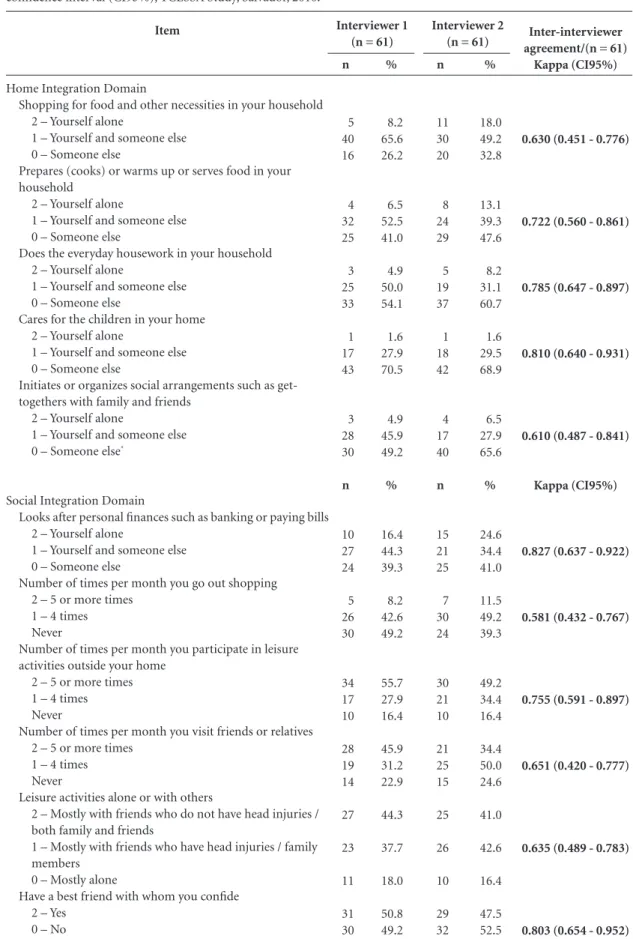
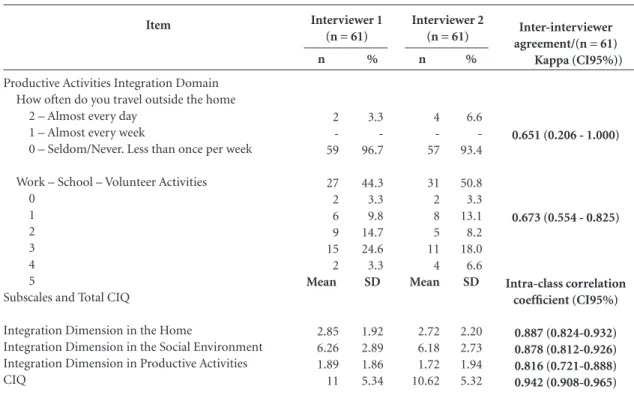
The distribution of responses per CIQ item, according to each interviewer, and the estimates of inter-interviewer agreement and respective 95% confidence interval (CI95%), are shown in Table 2. It is observed that the estimated values
of the weighted kappa were primarily considered
as substantial or almost perfect, and only one of the 13 instrument items had a value assessed as moderate. The intra-class correlation coefficients were high for both the overall scale and the CIQ domains.
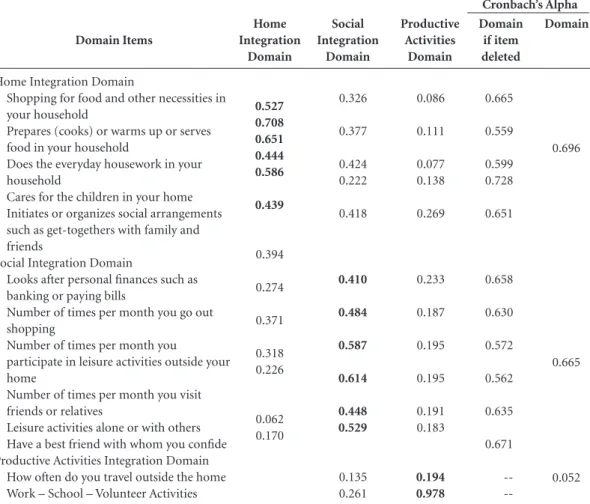
The item-scale correlations were general-ly higher among the items and their respective domains. As for the item “looks after personal finances such as banking and paying bills,” the correlation was high in two domains: integration in the home and social environment. The item “how often travels outside of the home” was the only one that did not show satisfactory correla-tion with any of the domains. Cronbach’s alpha coefficients for each domain, excluding each of
the items belonging to it, indicated that not one item negatively contributed to the internal con-sistency of its domain. The internal concon-sistency estimates that the integration dimensions in the home and social environment were higher than 0.65, but too low for the productive activities domain (Table 3). The alpha coefficient for the whole scale was 0.75 (data not shown in table).
Spearman’s correlation coefficients of the overall scores and CIQ domains using the DRS, GOSE and RLA scales were greater than 0.3 for GOSE and RLA, and less than -0.3 for the DRS scale, all statistically significant. The correlations were stronger for the overall CIQ score and the integration domain in the social environment (Table 4).
The factor analysis yielded four factors (mensions) that did not correspond with the di-mensional structure of the original instrument. Together, these four factors explain 75% of the variability in the data. Based on the original di-mensions of the questionnaire, factor I included five items, two from home integration and three from social integration. Four items in factor II had higher loads, two in the home integration dimen-sion and two in the social integration dimendimen-sion. Three items, one from each of the three original dimensions, presented higher loads in factor III. Finally, in factor IV, a single item “productive ac-tivities” was found to be related (Table 5).
Discussion
The cross-cultural adaptation process of the CIQ reported in this study provides some elements, particularly those derived from the reliability analysis and convergent validity, which justify its use in our culture, even if the originally proposed dimensional structure has not been demonstrat-ed in this population.
In general, it was observed that the inter-in-terviewer agreement varied from substantial to almost perfect for the vast majority of the scale items, especially for the overall CIQ score. Willer
et al.24 and Tepper et al.25 described similar results
for the domains and total scale. In one of the few studies of cross-cultural adaptation of the CIQ,
Rintala et al.7 developed a Spanish version and
aúd e C ole tiv a, 20(5):1341-1352, 2015 Variables Sociodemographic characteristics
Age ***
Monthly family income
Number of persons residing in the home
Skin Color Black Not Black Marital Status Single/Separate/Divorced Married/Stable relationship Education Level Low Moderate High Clinical Characteristics Somatic symptoms Headaches No Yes Dizziness No Yes Cognitive symptoms
Memory difficulties**
No Yes
Impaired concentration No
Yes
Emotional symptoms**
Irritability No Yes
Changes in balance**
No Yes
Cognitive Levels Rancho Los Amigos (RLA)*
Good recovery Moderate disability Severe disability
Functional capacity (DRS)*
Absent functional impairment Moderate functional impairment Severe functional impairment
Functional capacity (GCS)*
Good recovery Moderate disability Severe disability
Severe injury (GCS 3- 8) Mean (SD) 26.2 (7.4) 963.1 (857.6) 2.7 (1.6) n (%) 18 (100.0) 0 (0.0) 12 (66.7) 6 (33.3) 13 (72.2) 4 (22.2) 1 (5.6) 8 (44.4) 10 (55.6) 12 (66.7) 6 (33.6) 4 (22.2) 14 (77.8) 8 (50.0) 9 (50.0) 3 (16.7) 15 (83.3) 6 (33.3) 12 (66.7) 9 (50.0) 7 (38.9) 2 (11.1) 9 (50.0) 6 (33.3) 3 (16.7) 7 (38.9) 8 (44.4) 3 (16.7) Moderate injury (GCS 9- 13)
Mean (SD) 33.6 (11.6) 776.5 (512.9) 3.4 (2.3) n (%) 16 (94.1) 1 (5.9) 9 (52.9) 8 (47.1) 12 (70.6) 5 (29.4) 0 (0.0) 8 (47.1) 9 (52.9) 10 (58.8) 7 (41.2) 10 (58.8) 7 (41.2) 13 (76.5) 4 (23.5) 11 (64.7) 6 (35.3) 11 (64.7) 6 (35.3) 15 (88.2) 2 (11.8) 0 (0.0) 15 (88.2) 2 (11.8) 0 (0.0) 14 (82.4) 3 (17.6) 0 (0.0)
Table 1. Sociodemographic characteristics of TBI victims and six months after clinical evaluation, TCESSA Study, Salvador, 2010.
Total Mean (SD) 31.7 (11.1) 886.7 (668.7) 2.8 (1.9) n (%) 59 (96.7) 2 (3.3) 37 (60.7) 24 (39.3) 41 (67.2) 19 (31.2) 1 (1.6) 28 (45.9) 33 (54.1) 33 (54.1) 28 (45.9) 29 (47.5) 32 (52.5) 40 (65.6) 21 (34.4) 27 (44.3) 34 (55.7) 35 (57.4) 26 (42.6) 48 (78.7) 11 (18.0) 2 (3.3) 47 (77.1) 11 (18.0) 3 (4.9) 43 (70.5) 15 (24.6) 3 (4.9) Mild injury (GCS 14- 15)
Mean (SD) 34.3 (11.8) 906.0 (625.9) 2.5 (1.9) n (%) 25 (96.2) 1 (3.8) 16 (61.5) 10 (38.5) 16 (61.5) 10 (38.5) 0 (0.0) 12 (46.1) 14 (53.9) 11 (42.3) 15 (57.7) 15 (57.7) 11 (42.3) 18 (69.2) 8 (30.8) 13 (50.0) 13 (50.0) 18 (69.2) 8 (30.8) 24 (92.3) 2 (7.7) 0 (0.0) 23 (88.5) 2 (11.5) 0 (0.0) 22 (84.6) 4 (15.4) 0 (0.0)
SD = Standard Deviation; n = Absolute frequency. * P-value < 0.05 (Fisher’s exact test); ** P-value < 0.05 (Pearson’s chi-squared test); *** P-value < 0.05 (Analysis of variance)
F
rag
a-M
aia HMS
Item
Home Integration Domain
Shopping for food and other necessities in your household 2 – Yourself alone
1 – Yourself and someone else 0 – Someone else
Prepares (cooks) or warms up or serves food in your household
2 – Yourself alone
1 – Yourself and someone else 0 – Someone else
Does the everyday housework in your household 2 – Yourself alone
1 – Yourself and someone else 0 – Someone else
Cares for the children in your home 2 – Yourself alone
1 – Yourself and someone else 0 – Someone else
Initiates or organizes social arrangements such as get-togethers with family and friends
2 – Yourself alone
1 – Yourself and someone else
0 – Someone else*
Social Integration Domain
Looks after personal finances such as banking or paying bills 2 – Yourself alone
1 – Yourself and someone else 0 – Someone else
Number of times per month you go out shopping 2 – 5 or more times
1 – 4 times Never
Number of times per month you participate in leisure activities outside your home
2 – 5 or more times 1 – 4 times Never
Number of times per month you visit friends or relatives 2 – 5 or more times
1 – 4 times Never
Leisure activities alone or with others
2 – Mostly with friends who do not have head injuries / both family and friends
1 – Mostly with friends who have head injuries / family members
0 – Mostly alone
Have a best friend with whom you confide 2 – Yes
0 – No
Table 2. Scores by CIQ item according to the interviewer, estimate inter-interviewer agreement, and respective 95% confidence interval (CI95%), TCESSA Study, Salvador, 2010.
it continues n 5 40 16 4 32 25 3 25 33 1 17 43 3 28 30 n 10 27 24 5 26 30 34 17 10 28 19 14 27 23 11 31 30 Interviewer 1 (n = 61)
% 8.2 65.6 26.2 6.5 52.5 41.0 4.9 50.0 54.1 1.6 27.9 70.5 4.9 45.9 49.2 % 16.4 44.3 39.3 8.2 42.6 49.2 55.7 27.9 16.4 45.9 31.2 22.9 44.3 37.7 18.0 50.8 49.2 n 11 30 20 8 24 29 5 19 37 1 18 42 4 17 40 n 15 21 25 7 30 24 30 21 10 21 25 15 25 26 10 29 32 Interviewer 2 (n = 61)
% 18.0 49.2 32.8 13.1 39.3 47.6 8.2 31.1 60.7 1.6 29.5 68.9 6.5 27.9 65.6 % 24.6 34.4 41.0 11.5 49.2 39.3 49.2 34.4 16.4 34.4 50.0 24.6 41.0 42.6 16.4 47.5 52.5 Inter-interviewer agreement/(n = 61)
Kappa (CI95%)
0.630 (0.451 - 0.776)
0.722 (0.560 - 0.861)
0.785 (0.647 - 0.897)
0.810 (0.640 - 0.931)
0.610 (0.487 - 0.841)
Kappa (CI95%)
0.827 (0.637 - 0.922)
0.581 (0.432 - 0.767)
0.755 (0.591 - 0.897)
0.651 (0.420 - 0.777)
0.635 (0.489 - 0.783)
aúd
e C
ole
tiv
a,
20(5):1341-1352,
2015
Item
Productive Activities Integration Domain How often do you travel outside the home
2 – Almost every day 1 – Almost every week
0 – Seldom/Never. Less than once per week
Work – School – Volunteer Activities 0
1 2 3 4 5
Subscales and Total CIQ
Integration Dimension in the Home
Integration Dimension in the Social Environment Integration Dimension in Productive Activities CIQ
Table 2. continuation
* It was considered as zero (0) when there were no children under 17 at home. n
2 -59
27 2 6 9 15 2
Mean
2.85 6.26 1.89 11
Interviewer 1 (n = 61)
%
3.3 -96.7
44.3 3.3 9.8 14.7 24.6 3.3
SD
1.92 2.89 1.86 5.34
n
4 -57
31 2 8 5 11 4
Mean
2.72 6.18 1.72 10.62
Interviewer 2 (n = 61)
%
6.6 -93.4
50.8 3.3 13.1 8.2 18.0 6.6
SD
2.20 2.73 1.94 5.32
Inter-interviewer agreement/(n = 61)
Kappa (CI95%))
0.651 (0.206 - 1.000)
0.673 (0.554 - 0.825)
Intra-class correlation coefficient (CI95%)
0.887 (0.824-0.932) 0.878 (0.812-0.926) 0.816 (0.721-0.888) 0.942 (0.908-0.965)
The internal consistency of the CIQ scale was considered adequate and similar to that found by the authors of the original version, 0.70 and 0.76,
and in two studies by Willer et al.24 and
Rinta-la et al.7 for a Spanish version (0.70). In the first
two domains, the estimates of Cronbach’s alpha were acceptable (0.69 and 0.66, respectively) and poor (0.05) for the productive activities domain.
Rintala et al.7 found values of 0.82, 0.33, and 0.42
for integration domains in the home, social envi-ronment, and productive activities, respectively. Comparing the results of this study with those of
Willer et al.24 and Rintala et al.,7 it can be assumed
that the acceptable estimates of internal consis-tency described here may not indicate weakness-es in the cross-cultural adaptation procweakness-ess of the CIQ into Portuguese, but reflect problems with the original scale.
Instruments that measure functional capac-ity and communcapac-ity integration have been used, often simultaneously in the same population, to evaluate different aspects related to the function-al outcomes of post-TBI rehabilitation processes. Among these instruments, the DRS, GOSE, RLA, and CIQ scales stand out, considered as valid functional measurements and used as behavioral
marker objectives that reflect the ability to
per-form complex activities.12-14,26-29 In the present
study, the correlations between these scales and the overall CIQ score reached values considered satisfactory, the same was not observed in relation to the CIQ domains, except for the integration subscale in the social environment. Note that the correlations, specifically between the CIQ and DRS, were negative because the DRS is scored in the opposite direction, with higher scores
repre-senting greater disadvantages. Rintala et al.7 also
found significant correlations, although gener-ally weaker than those in the present study, be-tween the total scores and subscales of the CIQ and CHART, an instrument developed to assess independence, mobility, occupation, social inte-gration, and economic self-sufficiency. Consid-ering the multidimensional construct assessed by these different scales, the results presented here suggest that there is, at least in relation to the overall scale of the CIQ, a good convergence towards the results produced by different instru-ments, also seeking to assess results related to the post-TBI rehabilitation process.
mor-F
rag
a-M
aia HMS
Domain Items
Home Integration Domain
Shopping for food and other necessities in your household
Prepares (cooks) or warms up or serves food in your household
Does the everyday housework in your household
Cares for the children in your home Initiates or organizes social arrangements such as get-togethers with family and friends
Social Integration Domain
Looks after personal finances such as banking or paying bills
Number of times per month you go out shopping
Number of times per month you
participate in leisure activities outside your home
Number of times per month you visit friends or relatives
Leisure activities alone or with others Have a best friend with whom you confide Productive Activities Integration Domain
How often do you travel outside the home Work – School – Volunteer Activities
Home Integration
Domain
0.527 0.708 0.651 0.444 0.586
0.439
0.394
0.274
0.371
0.318 0.226
0.062 0.170
Social Integration
Domain
0.326
0.377
0.424 0.222
0.418
0.410
0.484
0.587
0.614
0.448 0.529
0.135 0.261
Table 3. Correlation coefficients among items, respective domains, and Cronbach’s alpha coefficients. TCESSA Study, Salvador, 2010.
Domain if item deleted
0.665
0.559
0.599 0.728
0.651
0.658
0.630
0.572
0.562
0.635
0.671
--Productive Activities
Domain
0.086
0.111
0.077 0.138
0.269
0.233
0.187
0.195
0.195
0.191 0.183
0.194 0.978
Cronbach’s Alpha Domain
0.696
0.665
0.052
bid conditions, and provoke changes in family dynamics on different magnitudes, due to dif-ferent variables such as socioeconomic status, education, demographic characteristics, among
others30-32. It is possible that aspects related to
the local population, predominantly made up of individuals with low education and income, may partially justify the discrepancies observed in the dimensional structure originally described in the CIQ scale.
One of the main differences observed relates to an abstraction in the same factor (factor I), in-cluding two items from the integration domain in the home, “does everyday housework” and “prepares meals,” and three items originally be-longing to the integration domain in the social environment, “visits friends or relatives,” “partic-ipates in leisure activities outside of home,” and “participates in leisure activities alone or with others.” One possible explanation for this finding would be based on the social network structure supporting these individuals, which in our social CIQ (Scale)
r p value CIQ (Dimension)
Home Integration r
p value
Social Integration r
p value
Productive Activities r
p value
RLA*
0.614 < 0.001
0.409 0.001
0.640 < 0.001
0.347 0.006
GOSE**
0.619 < 0.001
0.384 0.002
0.615 < 0.001
0.426 < 0.001
Table 4. Spearman’s correlation (r) of the Community Integration Questionnaire (CIQ) with the Rancho Los Amigos Cognitive Levels Scale (RLA), Extended Glasgow Outcome Scale (GOSE), and Disability Rating Scale (DRS). TCESSA Study, Salvador, 2010.
DRS***
-0.588 < 0.001
-0.399 0.001
-0.601 < 0.001
-0.344 0.006
aúd
e C
ole
tiv
a,
20(5):1341-1352,
2015
context, is mainly formed by the family. In this sense, the development of abilities to carry out activities in the home would be strongly influ-enced by the presence and functionality of this social network, which also provides essential sup-port for integration in the social environment. This fact may be related not only to the possible sympathy expected by the family in this situation, but also due to fear that the patient, especially those victimized by violence, return alone to this adverse social environment.
Another point of disagreement concerns the agglutination in the same factor (factor II) for the items “shopping for necessities” and “orga-nizes social arrangements,” originally belonging to the home integration subscale, and the items “goes out shopping” and “looks after person-al finances” in the sociperson-al integration subscperson-ale.
Sander et al.33 already pointed out that the
ques-tions “shopping for necessities” and “goes out shopping” are issues that should be reviewed in the original instrument. According to these au-thors, these items had high loads by more than one factor, due to the equivocal wording in the questions, which does not differentiate shop-ping for necessities by shopshop-ping for leisure. It is also worth mentioning that the use of the term
“shopping” in two items, coming from different domains, could have contributed to this aggrega-tion – that if considered in conjuncaggrega-tion with the item “looks after personal finances,” might sug-gest the capture of some type of latent construct related to financial aspects.
The items “takes care of children,” “a best friend with whom you confide” and “travels out-side of the home” were part of a single factor (fac-tor III), although in the original instrument, be-longed to different domains. This finding seems to emphasize the need to discriminate different types of support that patients with disabilities may require in our culture. The main emergen-cy department in the city of Salvador, regarding to the care and treatment of trauma victims, re-ceives victims from several satellite cities. When patients are discharged from the hospital, they return to their hometowns, but need to return to the capital for reassessments or complemen-tary treatments. Patients who develop somatic, cognitive or emotional symptoms, changes in balance, and functional impairments need help caring for dependents because they cannot take care of them, and traveling to consultations or treatments, therefore, having someone to trust is fundamental in these situations.
Domains and Items
Home Integration Domain
Shopping for food and other necessities in your household Prepares (cooks) or warms up or serves food in your household Does the everyday housework in your household
Cares for the children in your home
Initiates or organizes social arrangements such as get-togethers with family and friends
Social Integration Domain
Looks after personal finances such as banking or paying bills Number of times per month you go out shopping
Number of times per month you participate in leisure activities outside your home
Number of times per month you visit friends or relatives Leisure activities alone or with others
Have a best friend with whom you confide Productive Activities Integration Domain
How often do you travel outside the home Work – School – Volunteer Activities
Eigenvalues before rotation Percentage of explained variance
Factor 1
0.341
0.695 0.803
0.277 0.339
0.078 0.152
0.637
0.794 0.550
0.562
0.000 0.011
4.978 38
Factor 2
0.723 0.474 0.404 0.281
0.585
0.883 0.814
0.070
0.064 -0.009 0.071
0.315 0.186
2.210 17
Table 5. Load factors related to the component items in the domains of the Community Integration Questionnaire – CIQ. TCESSA Study, Salvador, 2010.
Factor 3
0.005 0.090 -0.009 -0.735
0.047
0.042 0.278 -0.053
-0.100 -0.282
0.616
0.933
0.114
1.386 11
Factor 4
-0.150 -0.053 -0.136 0.213 0.390
0.179 0.157 0.538
0.330 0.505 0.118
0.104
0.850
F
rag
a-M
aia HMS
Finally, the item related to productive activi-ties, which brings together the school, work and volunteer activities variables, was allocated sep-arately in factor IV, suggesting that in this social context, the development of skills for returning to productive activities would be a domain rela-tively independent from the other variables.
A general appreciation of the cross-cultural adaptation process of the CIQ for Brazil should consider that the moderately satisfactory results presented here could be derived from inherent
problems in the original version of the instru-ment, since these shortcomings usually cannot be corrected in a translated version. As already
noted by Sander et al.33 and Rintala et al.7, the
English version of the CIQ does not have psycho-metric characteristics as good as it should. Based on the literature and the evidence presented here, it is suggested that this Portuguese version only be used as an overall scale of integration, at least until new psychometric assessment studies of the CIQ are developed with larger samples.
Collaborations
HMS Fraga-Maia participated in the data col-lection, study design, interpretation of findings, initial drafting, and final revision. I Dourado and RCP Fernandes also collaborated in the study, interpretation of findings and final revision. G Werneck participated in the statistical analysis and interpretation of findings. LL Brito partic-ipated in the interpretation of findings, initial drafting, and final revision.
Acknowledgements
aúd
e C
ole
tiv
a,
20(5):1341-1352,
2015
Dijkers M. Measuring the long-term outcomes of trau-matic brain injury: a review of Community Integration Questionnaire studies. J Head Trauma Rehabil 1997; 12:74-91.
World Health Organization (WHO). International Classification of impairments, disabilities, and handcaps: a manual of classification relating to the consequences of disease. Geneva: WHO; 1993.
Streiner DL, Norman GR. Health Measurement Scales: a
practical guide to their development and use. 3rd ed.
Ox-ford: Oxford University Press; 2004.
Landis JR, Koch GG. An application of hierarchical kappa-type statistics in the assessment of majority agreement among multiple observers. Biometrics 1977; 33(2):363-374.
Wilson JT, Pettigrew LE, Teasdele GM. Structured in-terviews for the Glasgow Outcome Scale and the Ex-tended Glasgow Outcome Scale: guidelines for their use. J Neurotrauma 1998; 15(8):573-585.
Manly BFJ. Factor analysis. In: Manly BFJ, editor. Mul-tivariate statistical methods. A primer. London: Chap-man & Hall; 1994. p. 93-106.
Brasil. Ministério da Saúde (MS). Conselho Nacional de Saúde. Resolução nº 196 de 10 de outubro de 1996. Diretrizes e Normas Regulamentadoras de Pesquisas Envolvendo Seres Humanos. Diário Oficial da União 1996; 16 out.
Willer B, Rosenthal M, Kreutzer JS, Gordon WA, Rem-pel R. Assessment of community integration following rehabilitation for traumatic brain injury. J Head Trau-ma Rehabil 1993; 8:75-87.
Tepper S, Beatty P, DeJong G. Outcomes in traumat-ic brain injury: self-report versus report of signiftraumat-icant others. Brain Inj 1996; 10(8):575-581.
Arango-Lasprilla JC, Rosenthal M, Deluca J, Cifu DX, Hanks R, Komaroff E. Functional outcomes from in-patient rehabilitation after traumatic brain injury: how do Hispanics fare? Arch Phys Med Rehabil 2007; 88(1):11-18.
Kashluba S, Hanks RA, Casey JE, Millis SR. Neuropsy-chologic and functional outcome after complicated mild traumatic brain injury. Arch Phys Med Rehabil. 2008 May; 89(5):904-911.
Hall KM, Bushnik T, Lakisic-Kazazic B, Wright J, Cantagallo A. Assessing traumatic brain injury out-come measures for long-term follow-up of commu-nity-based individuals. Arch Phys Med Rehabil 2001; 82(3):367-374.
Seale GS, Caroselli JS, High Jr WM, Becker CL, Neese LE, Scheibel R. Use the Community Integration Ques-tionnaire (CIQ) to characterize changes in functioning for individuals with traumatic brain injury who partic-ipated in a post-acute rehabilitation programme. Brain Inj 2002; 16(11):955-967.
Jumisko E, Lexell J, Söderberg S. Living with moderate or severe traumatic brain injury: the meaning of family members’ experiences. J Fam Nurs 2007; 13(3):353-369.
Backhouse M, Rodger S. The transition from school to employment for young people with acquired brain in-jury: parent and student perceptions. Aust Occup Ther J 1999; 46(3):99-109.
17.
18.
19.
20.
21.
22.
23.
24.
25.
26.
27.
28.
29.
30.
31. References
Horn LJ, Zasler ND. Medical rehabilitation of traumatic train injury. Philadelphia: Hanley & Belfus; 1996. Rao N, Rosenthal M, Cronin-Stubbs D, Lambert R, Barnes P, Swanson B. Return to work after rehabilita-tion following traumatic brain injury. Brain Inj 1990; 4(1):49-56.
Bruns Junior J, Hauser WA. The epidemiology of trau-matic brain injury: a review. Epilepsia 2003; 44(Supl. 10):2-10.
Brasil. Ministério da Saúde (MS). Portaria MS/GM n. 737, de 16/5/2001. Política Nacional de Redução da Morbimortalidade por Acidentes e Violências. Diário Oficial da União 2001; 18 maio.
Brasil. Ministério da Saúde (MS). Secretaria de Vigi-lância em Saúde. Impacto da Violência na Saúde dos Brasileiros. Brasília: MS; 2005. Série B. Textos Básicos de Saúde.
Brasil. Ministério da Saúde (MS). Plano Nacional de Redução da Morbi-mortalidade por Acidentes e Violên-cias. Brasília: MS; 2005.
Rintala DH, Novy DM, Garza HM, Young ME, High Junior WM, Chiou-Tan FY. Psychometric properties of a spanish-language version of the Community In-tegration Questionnaire (CIQ). Rehabil Psychol 2002; 47(2):144-164.
Willer B, Ottenbacher KJ, Coad ML. The Community Integration Questionnaire: a comparative examina-tion. Am J Phys Med Rehabilit 1994; 73(2):103-111. Reistetter TA, Abreu BC. Appraising evidence on com-munity integration following brain injury: a systematic review. Occup Ther Int 2005; 12(4):196-217.
Herdman M, Fox-Rushby J, Badia X. A model of equiv-alence in the cultural adaptation of HRQoL instru-ments: the universalist approach. Qual Life Res 1998; 7(4):323-335.
Fraga-Maia H. Traumatismos craniencefálicos por aci-dentes e violências na Região Metropolitana de Salvador [tese]. Salvador: Instituto de Saúde Coletiva; 2006. Harrison-Felix C, Zafonte R, Mann N, Djikers M, En-glander J, Kreutzer J. Brain injury as a result of violence: preliminary findings from the Traumatic Brain Injury Model Systems Project. Arch Phys Med Rehabil 1998; 79(7):730-737.
Wagner AK, Hammond FM, Sasser HC, Wiercisiewski D. Return to productive activity after traumatic brain injury: relationship with measures of disability, handi-cap and community integration. Arch Phys Med Reha-bil 2002; 83(1):107-114.
Novack TA, Bush BA, Meythaler JM, Cannup K. Out-come after traumatic brain injury: Pathway analysis of contributions from premorbid, injury severity, and recovery variables. Arch Phys Med Rehabil 2001; 82(3):300-305.
Bushnik T, Hanks RA, Kreutzer J, Rosenthal M. Etiolo-gy of traumatic brain injury: characterization of differ-ential outcomes up to 1 year post injury. Arch Phys Med Rehabil 2003; 84(2):255-262.
Kaplan CP. The Community Integration Questionnaire with new scoring guidelines: concurrent validity and need for appropriate norms. Brain Inj 2001; 15(8):725-731.
1. 2.
3.
4.
5.
6.
7.
8.
9.
10.
11.
12.
13.
14.
15.
F
rag
a-M
aia HMS
Perlesz A, Kinsella G, Crowe S. Impact of traumatic brain injury on the family: a critical review. Rehabil Psychol 1999; 44(1):6-35.
Sander AM, Fuchs KL, High Junior WM, Hall KM, Kreutzer JS, Rosenthal M.The Community Integra-tion QuesIntegra-tionnaire Revisited: an assessment of factor structure and validity.Arch Phys Med Rehabil 1999; 80(10):1303-1308.
Article submitted 24/06/2014 Approved 22/11/2014
Final version submitted 24/11/2014 32.