AR
TIGO
AR
TICLE
1 Departamento de Odontopediatria e Ortodontia, Faculdade de Odontologia, Universidade Federal de Minas Gerais (UFMG). Av. Antônio Carlos 6627, Pampulha. 31270-901 Belo Horizonte MG Brasil. [email protected] 2 Departamento de Clínica Patológica e Cirurgia Odontológica, Faculdade de Odontologia, UFMG. 3 Departamento de Odontologia Social e Preventiva, Faculdade de Odontologia, UFMG. 4 Department of Society, Human Development, and Health, Harvard School of Public Health.
Tobacco use and friendship networks:
a cross-sectional study among Brazilian adolescents
Uso do tabaco e rede de amigos entre adolescentes brasileiros:
um estudo transversal
Resumo Objetivo: Determinar a prevalência do uso do tabaco e sua associação com tipos de amigos, condições socioeconômicas e gênero entre adoles-centes brasileiros. Métodos: Um estudo transversal foi conduzido com uma amostra representativa de 905 estudantes de 15 a 19 anos. Informações sobre as redes sociais e o uso do tabaco foram coletadas através do “Questionário para triagem do uso de álcool, tabaco e outras substâncias”, e a questão “Qual é o seu grupo de amigos mais importan-te?”. As condições socioeconômicas foram avalia-das através do Índice de vulnerabilidade social e do tipo de escola. Regressão logística multinomial foi utilizada para testar as associações entre o uso do tabaco e as variáveis independentes. Resulta-dos: A prevalência do uso do tabaco foi de 18.9%. Meninas apresentaram 3.80 vezes mais chances de usarem tabaco na frequência semanalmente a diariamente comparado aos meninos. Os partici-pantes que responderam ser o grupo de amigos da igreja o mais importante tiveram um risco menor de usarem tabaco com maior frequência em com-paração aos adolescentes que consideraram o gru-po de amigos da escola. Conclusões: A prevalência do uso de tabaco foi alta na amostra estudada e foi associada a rede de amigos da escola (em com-paração aos amigos da igreja), gênero feminino e melhores condições socioeconômicas.
Palavras-chave Tabaco, Amizade, Adolescente,
Epidemiologia
Abstract Aim: To determine the prevalence of tobacco use and its association with types of friendship networks, socioeconomic status and gender among Brazilian adolescents. Methods: A cross-sectional study was carried out with a representative sample of 905 students aged 15 to 19 years. Information on social networks and to-bacco use was collected by the self-administered questionnaire ‘Alcohol, Smoking and Substance Involvement Screening Test” and the question “What is your most important group of close friends?’. Socioeconomic status was assessed using an area-based social vulnerability index and type of school. Multinomial logistic regression analy-sis was employed to test associations between to-bacco use and the independent variables. Results: The overall prevalence of tobacco use was 18.9%. Female adolescents had 3.80-fold greater odds of reporting weekly to daily tobacco use compared to male adolescents. Participants who reported that their most important groups of close friends were from church had a lower risk of reporting weekly to daily tobacco use in comparison to those who reported that their best friends were from school. Conclusions: The prevalence of tobacco use was high and was associated with school-based (as compared to church-based) friendship networks, female gender and higher area-level socioeconom-ic status.
Keywords Tobacco, Friendship, Adolescent,
Ep-idemiology
Kelly Oliva Jorge 1 Luís Otavio Cota 2
Efigênia Ferreira e Ferreira 3 Miriam Pimenta do Vale 1 Ichiro Kawachi 4
Jo
rg
Introduction
Cigarette smoking continues to be one of the ma-jor preventable causes of premature death in the
world1 and often starts in adolescence before 18
years of age2. Ninety percent of Brazilian smokers
start smoking before 19 years of age and adoles-cents between 17 and 19 years are identified as the group with the highest proportion of daily
smokers (31.9%)3. Moreover, the prevalence of
smoking is increasing substantially between the
ages of 12 to 16 years4. Hence, adolescents remain
an important focus of studies on smoking. Health behaviors have been studied with re-spect to socio-demographic factors (age and gen-der) and socioeconomic status, but few investiga-tions have focused on the characteristics of social
networks5. A large number of studies have
ana-lyzed the influence of friendship networks on be-havioral problems among adolescents and have demonstrated a significant positive correlation between exposure to the behavior of close friends and the use or probability of the use of psychoac-tive substances, indicating that friendships have a
direct influence on individual behavior5-8. Most
studies have addressed friendship networks in the school environment and the findings con-tribute to the understanding of the structure and size of friendship networks and associations with the use of tobacco. However, many surveys carried out at schools neither include nor com-pare different contexts in the same sample, such as participation in religious groups, sports and
community activities9.
Tobacco use in adolescence is reported to vary
depending on socioeconomic status10,11, but such
findings have not been consistent across studies. Some studies report an association between high
socioeconomic status and tobacco use12,13,
where-as others found that adolescents with a low
socio-economic status smoke more5,11,14.
Despite being predominantly and historical-ly linked to males, the prevalence of tobacco use
among females has been on the rise15,16. Some
Brazilian investigations have found no statistical-ly significant association between gender and
to-bacco use17,18. However, gender may be associated
with social networks and the use of substances. Studies have found an increase in substance use by girls in the presence of problems regarding
social relationships19,20. It has been suggested
that the female gender is more affected by in-terpersonal difficulties and girls may experience emotional imbalance when close friendships are
threatened9. A better understanding of the
smok-ing behavior among Brazilian adolescents is needed. Such information can contribute toward the establishment of more effective prevention programs and public policies directed at reduc-ing access to tobacco, as the growth in the Brazil-ian economy could possibly lead to an increase in the use of this substance by adolescents.
The aim of the present study was to inves-tigate both individual aspects (gender and so-cioeconomic status) and social relationships among the different types of friendship networks (friends from school, sports, theater, dance and music activities) in different social contexts to characterize inequalities regarding tobacco con-sumption among adolescents in Brazil.
Methods
Ethical considerations
This study received approval from the Hu-man Research Ethics Committee of the Universi-dade Federal de Minas Gerais (Brazil). Authoriza-tion was obtained from the schools to undertake the study and all participants and their parents/ guardians signed a statement of informed con-sent.
Study design and participants
A cross-sectional study was carried out ad-dressing social/friendship networks and tobacco use among 936 adolescents aged 15 to 19 years attending public (n = 717; 81.0%) and private (n = 174; 19.0%) schools in the city of Belo Hori-zonte between August 2009 and February 2010. Belo Horizonte is the state capital of Minas Gerais, Brazil, with an approximate population of 2.4 million inhabitants, and is
geographical-ly divided into nine administrative districts21. A
aúd
e C
ole
tiv
a,
20(5):1415-1424,
2015
losses during the data collection (n = 720) and a 1.3 design effect was applied to increase the pre-cision, as multistage sampling was adopted
rath-er than random sampling22. Thus, the final
sam-ple consisted of 936 adolescents. The proportion of refusals and losses resulting from incomplete questionnaires was 4.8% (45 adolescents) and the final sample comprised 891 adolescents.
Administration of questionnaires
A pilot study was first conducted with 101 adolescents. The self-report questionnaire Al-cohol, Smoking and Substance Involvement Screening Test and the question “What is your most important group of close friends?” were tested and the need for possible changes was sug-gested by the adolescents. Previous studies have used similar questions to investigate social
cap-ital/friendship networks23,24. Both questionnaires
were distributed in the classroom by a researcher and an assistant and collected immediately after being filled out. The students were told that the questionnaire would be anonymous and the re-sponses would be treated confidentially. Students could refuse to participate and return incomplete questionnaires in the envelopes.
Assessment of tobacco use
The Alcohol, Smoking and Substance Involve-ment Screening Test (ASSIST) is a brief screening tool addressing the use of psychoactive substanc-es. ASSIST has been validated for use in Brazil
by Henrique et al.25 and has eight questions on
nine different kinds of drugs (tobacco, alcohol, marijuana, cocaine, stimulants, sedatives, in-halants, hallucinogens and opiates). The risk of tobacco consumption was categorized based on the recommendations of the Brazilian version
of ASSIST25, in which a risk score ranging from
0 to 4 is provided for each substance. The total score (sum of the scores for each class of drug) ranges from 0 to 20. Scores are grouped into the following categories: 0 to 3 points, indicating low risk (individuals at low risk of health and other problems from their current pattern of substance use); 4 to 15 points, indicating moderate risk or abuse (individuals at moderate risk of health and other problems from their current pattern of
sub-stance use); and ≥ 16 points, indicating high risk
or dependence (individuals at high risk of experi-encing severe health, social, financial, legal and/or relationship problems as a result of their current pattern of substance use and likely dependence).
Only items related to tobacco use were ana-lyzed in the present study. The dependent vari-able was the item on tobacco use in the previous three months. For the calculation of the score for specific involvement with tobacco, Question 5 (During the past three months, how often have you failed to do what was normally expected of you because of your use of tobacco?), Question 1 (In your life, which of the following substanc-es have you ever used?) and Qusubstanc-estion 8 (Have you ever used any drug by injection?) were not included in the final score, as advocated by the original and validated Brazilian questionnaire.
Assessment of social and friendship networks
To assess social behavior related to member-ship in adolescent peer networks, the following question was posed: “What is your most import-ant group of close friends?” Answers were cate-gorized based on the most frequent responses: friends from school, family, church and others (friends from sports, theater, dance and music activities).
Covariates
The Social Vulnerability Index (SVI) mea-sures social exclusion in the city of Belo Hor-izonte and was used to assess socioeconomic status based on place of residence. The city hall database of SVI scores for each district was used in the present study based on the address of each
family (derived from the survey)26. This index has
20 variables grouped into five “dimensions of cit-izenship”: access to housing and basic infrastruc-ture; access to education; access to income and employment; access to legal assistance; and access
to health, food security and welfare27. Residential
areas are categorized into five classes (I to V); class I families have the highest degree of social vulner-ability and class V families have the lowest degree
of social vulnerability27. The final score
rang-es from zero to one. Each student’s addrrang-ess was collected individually and categorized into one of the five SVI classes. For the bivariate analysis, the SVI was dichotomized as greater
vulnerabili-ty (social classes I and II, scores ≥ 0.5) and lesser
Jo
rg
As wealthy adolescents in Brazil are generally enrolled in private schools, since most Brazilian public schools have fewer educational resources, type of school was also used as a socioeconomic indicator. Private school was coded 0 and public school was coded 1 for the statistical analysis.
Statistical analysis
Data analysis was performed using the Statis-tical Package for Social Sciences (SPSS for Win-dows, version 17.0, SPSS Inc, Chicago, IL, USA). Descriptive and bivariate analyses were carried out using the chi-square test (p < 0.05). Multi-nomial logistic regression was used to evaluate tobacco use in the previous three months and associated variables, comparing “never smoked” to “weekly to daily” and “less than monthly to monthly” tobacco use. “Never smoked” was used as the reference group and separate odds ratios (OR) were calculated, with the exception of the comparison categories.
Results
The final sample comprised 891 adolescents with a mean age of 16.3 years (± 1 year). The prev-alence of lifetime tobacco use was 18.9% (n = 168). A total of 6.2% (n = 55) of the adolescents indicated that they felt a strong craving and a sense of urgency to consume tobacco. Regard-ing the scores for tobacco use, 94.4% of the total sample (n = 841) were in the low risk range (0 to 3 points), 5.4% (n = 48) were in the moderate risk range (4 to 15 points) and 0.2% (n = 1) were
in the high risk range (≥ 16 points).
Table 1 displays the distribution of the re-spondents according to the prevalence of lifetime tobacco use and background characteristics. Life-time tobacco use was not statistically associated with gender, age, type of school or SVI.
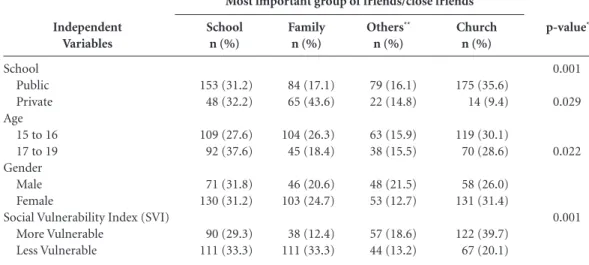
Table 2 displays the distribution of the sam-ple according to the prevalence of friendship net-works and background characteristics.
Table 3 displays the results of the multino-mial logistic regression analysis of tobacco use in the previous three months (weekly to daily/ less than monthly to monthly) according to the independent variables. Female adolescents had a 3.80-fold greater chance (OR: 3.804; 95% CI: 1.28 to 11.2) of using tobacco weekly to daily in comparison to male adolescents. Participants who reported that their most important friends were from church had a lesser chance of using
to-bacco weekly to daily (OR: 0.121; 95% CI: 0.027 to 0.551) in comparison to those who reported that their most important groups of close friends were from school. Adolescents residing in areas of greater vulnerability (SVI classes II and III – worse socioeconomic conditions) reported less tobacco use on a monthly or less than monthly basis in comparison to adolescents from more privileged areas.
Discussion
The prevalence of lifetime tobacco use in the present study was 18.9%, which is somewhat lower than the rate reported in the Fifth Nation-al Survey on the Consumption of Psychotropic Drugs among students in 27 large cities in
Bra-zil (24.9%)28. However, a recent survey involving
the same 27 large cities found a reduction in the number of students who reported tobacco use between 2004 and 2010 in terms of both lifetime use (16.9%) and use in the previous 12 months
(9.6%)29, with similar prevalence rates to those
found in the present study. Madruga et al.30
sug-gest that the reduction in tobacco use is the result of the government practices, as Brazil has been actively restricting tobacco advertising in the media since 2001 and tobacco product
manu-Independent Variables
School Public Private Age
15 to 16 17 to 19 Gender
Male Female
Social Vulnerability Index (SVI
More Vulnerable Less Vulnerable
Yes n (%)
136 (19.0) 32 (18.4)
89 (16.8) 79 (21.8)
66 (18.7) 102 (18.9)
79 (16.6) 89 (21.5)
Table 1. Distribution of sample according to
prevalence of lifetime tobacco use and background characteristics; Belo Horizonte, Minas Gerais, Brazil, 2010.
* chi-square test.
No n (%)
581 (81.0) 142 (81.6)
440 (83.2) 283 (78.2)
286 (81.3) 437 (81.1)
398 (83.4) 325 (78.5)
p-value*
0.861
0.061
0.948
0.061
aúd
e C
ole
tiv
a,
20(5):1415-1424,
2015
Independent Variables
School Public Private Age
15 to 16 17 to 19 Gender
Male Female
Social Vulnerability Index (SVI) More Vulnerable Less Vulnerable
School n (%)
153 (31.2) 48 (32.2)
109 (27.6) 92 (37.6)
71 (31.8) 130 (31.2)
90 (29.3) 111 (33.3)
Table 2. Distribution of sample according to prevalence of friendship networks and background characteristics;
Belo Horizonte, Minas Gerais, Brazil, 2010.
* chi-square test. ** Others (friends from sports, theater, dance, sect and music activities).
Church n (%)
175 (35.6) 14 (9.4)
119 (30.1) 70 (28.6)
58 (26.0) 131 (31.4)
122 (39.7) 67 (20.1)
p-value*
0.001
0.029
0.022
0.001
Most important group of friends/close friends
Family n (%)
84 (17.1) 65 (43.6)
104 (26.3) 45 (18.4)
46 (20.6) 103 (24.7)
38 (12.4) 111 (33.3)
Others**
n (%)
79 (16.1) 22 (14.8)
63 (15.9) 38 (15.5)
48 (21.5) 53 (12.7)
57 (18.6) 44 (13.2)
facturers are currently required by law to include pictorial health warnings on cigarette packages.
While 94.4% of the present sample was clas-sified as at low risk for tobacco use, exposure to tobacco in adolescence is known to have import-ant health consequences, as nicotine dependence
is not limited to the daily use of tobacco17.
Tobacco use by adolescents varies with
socio-economic status10. However, due to differences in
the methodology, sample selection, type of study, age group, cultural factors, geographic character-istics and socioeconomic indicators employed, there is no consensus among studies, which hin-ders the comparison of findings. In the general-ized estimating multinomial logistic regression used in the present study regarding tobacco use in the previous three months (less than monthly to monthly), adolescents from more vulnerable so-cioeconomic classes (classes II and III) had a less-er chance of tobacco use in comparison to those from class V (least socioeconomically vulnerable). It is possible that youths from families with a low-er income may be more price sensitive than their
better-off peers31. However, no significant
associ-ation was found between the SVI and weekly to daily tobacco use, which is consistent with
find-ings reported in previous studies32,33. It is possible
that adolescents who use tobacco weekly to daily have a greater craving for tobacco in comparison to those who use it monthly or less than month-ly. Thus, having a higher or lower socioeconomic status would not be a determinant of such use,
as adolescents can gain access to tobacco through means other than money, such as their network of
friends34,35. On the other hand, adolescents with a
low socioeconomic status are more likely to grow up in a family environment in which smoking is more prevalent and may therefore more easily
pick up the smoking habit5. It has been
suggest-ed that lower class youths could have greater ac-cess to tobacco from family and friends as well as access to cheaper cigarettes from illegal sources. This may explain the curvilinear (U-shaped) re-lationship found between socioeconomic status and tobacco use, in which the extremes represent high and low socioeconomic status.
Female adolescents had a nearly fourfold greater chance of engaging in weekly to daily tobacco use in comparison to male adolescents. Data from 2004 on the prevalence of tobacco use in the city of Belo Horizonte also reveal a higher rate of smoking among female
adoles-cents (25.9%) in comparison to males (24.0%)28.
While a reduction in lifetime tobacco use among adolescents of both genders occurred between 2004 and 2010, the prevalence remains higher among females (18.6%) in comparison to males (17.1%), although there is not statistical
signifi-cance29. A number of authors have reported no
gender differences in smoking habits8,36, whereas
the majority of researchers report greater
tobac-co tobac-consumption among males3,29,37. The lack of
Jo
rg
depending on the socio-cultural context8. In the
group that reported less than monthly to month-ly use of tobacco, no significant association was
found with gender. According to Horta et al.15,
the establishment of smoking behavior is a com-plex phenomenon that cannot be explained by its association with a single variable or a single phenomenon. It is possible that girls have their
first contact with tobacco earlier than boys or there may be the occurrence of the establishment of more frequent smoking among females than males in future generations.
The present study sought to identify the role of friendship networks in tobacco use among students. Adolescents who reported that the ma-jority of their groups of close friends were from
Independent variables
Constant Private School Public School
Age (15 to 16 years old) Age (17 to 19 years old) Male
Female SVI class V SVI class I SVI class II SVI class III SVI class IV
Type of group of best friends/close friends School
Church Family
Others (e.g., sports, music activity, dance group, sects)
Constant Private School Public School
Age (15 to 16 years old) Age(17 to 19 years old) Male
Female SVI class V SVI class I SVI class II SVI class III SVI class IV
Type of group of best friends/close friends School
Church Family
Others (e.g., sports, music activity, dance group, sects)
Coefficient -3.622 (reference) 0.340 (reference) 0.013 (reference) 1.336 (reference) -0.118 -0.321 0.000 0.325 (reference) -2.108 -0.581 -0.308 -1.793 (reference) 0.555 (reference) 0.552 (reference) 0.002 (reference) -1.074 -1.147 -1.124 -0.802 (reference) -0.610 0.005 -0.608
Table 3. Generalized estimating multinomial logistic regression for tobacco use in previous three months and
independent variables comparing “never smoked” (reference) to “weekly to daily” and “less than monthly to monthly” tobacco use among adolescents in Belo Horizonte, Minas Gerais, Brazil (n = 891), 2010.
95% CI
-0.524 – 3.763
-0.446 – 2.303
-1.285 – 11.261
-0.167 – 4.723 0.182 – 2.896 0.260 – 3.841 0.360 – 5.320
-0.027 – 0.551 0.214 – 1.461 0.253 – 2.135
-0.818 – 3.713
-0.962 – 3.138
-0.562 – 1.785
-0.111 – 1.054 0.129 – 0.781 0.129 – 0.818 0.173 – 1.165
-0.256 – 1.154 0.496 – 2.033 0.221 – 1.341
p-value <0.001 -0.500 -0.975 -0.016 -0.889 0.650 1.000 0.636 -0.006 0.236 0.571 <0.001 -0.150 -0.067 -0.995 -0.062 0.013 0.017 0.100 -0.112 0.990 0.186
Tobacco use in previous 3 months (weekly to daily)
OR -1.404 -1.013 -3.804 -0.888 0.726 1.000 1.384 -0.121 0.559 0.735 -1.743 -1.737 -1.002 -0.341 0.318 0.345 0.448 -0.543 1.005 0.545
aúd
e C
ole
tiv
a,
20(5):1415-1424,
2015
church had a lower risk of smoking on a weekly to daily basis in comparison to those whose main groups of close friends were from school. The level of social capital to which an individual may gain access through social networks depends on the structural characteristics of these networks as well as the amount of social capital that other individuals in the network possess. Despite the potential for the diffusion of health-promoting behaviors, the present findings suggest that some types of friendship networks can also exert ad-verse influences on health behavior, depending
on the behavior endorsed by the peer group38.
In the group that reported less than monthly to monthly use of tobacco, no significant asso-ciation was found with type of groups of close
friends. Barreto et al.39 found that the chances of
both experimenting with tobacco and currently using tobacco increase with the weekly exposure of adolescents to other smokers and with the per-ception of family acceptance of the habit. Thus, individuals who smoke less often are less exposed to friends who smoke frequently.
The literature has shown homophily or sim-ilarity in substance use among adolescent peers. This similarity has been attributed to the social-ization process, wherein the peer group influenc-es the substance use behavior of the individual, and to the selection process, wherein individuals associate with peers that are similar to them in
their substance use behavior40. Social network
analysis may offer an explanation for the role
of friends in smoking behavior7. Participation
in religious groups has been associated with a reduced proneness to risky health-related be-havior among adolescents, such as alcohol con-sumption, smoking and the use of illicit drugs. Religious participation may deter risky behavior by helping adolescents develop social networks that provide social support and reinforce widely
accepted social norms41. In line with the present
results, Mellor and Freeborn41 found that
ad-olescents who participated in religious groups with greater frequency were less likely to smoke, participate in binge drinking and use marijuana. However, the non-use of drugs may be more due to the greater exposure to the values and norms of church-going peers who disapprove of drug use rather than religious beliefs per se.
The present study has important limitations that may affect the interpretation of the find-ings. Although some part of the association be-tween different types of friendship networks and smoking can be ascribed to peer influence, one
cannot exclude the possibility of homophily or social selection based upon shared behaviors. Selection can be divided into two conceptually different mechanisms: adolescents may acquire new friends with similar characteristics, attitudes and behaviors or may avoid contact with new friends or even break off friendships because of
differences in opinions and behavior6. Therefore,
the associations found in the present study may have been driven by the tendency of individu-als to influence or select their groups of friends based partly on behavioral preferences rather than the network characteristics per se (e.g., so-cial norms that influence and regulate behavior within certain types of social networks). Second-ly, the present findings may reflect the influence of unmeasured confounding factors that affect both patterns of friendship ties as well as tobacco use. For instance, the strictness of school policies against smoking among students may influence both the formation of different friendship con-nections and the prevalence of smoking. More-over, no information was acquired on the profile of parents, who are known to exert considerable influence over the type of friends their children select as well as the practice of smoking. Anoth-er issue that was not investigated is the influence of religiosity on tobacco use. It is possible that faith in a religion that prohibits smoking and the frequency of participation in religious ac-tivities have an independent effect on the prev-alence of tobacco use, with lower prevprev-alence among adolescents who report that friends from church constitute their most important group of friends. Moreover, the present investigation was a cross-sectional study and causal relationships can therefore not be determined. Information bias may have occurred due to a lack of attention, memory errors, social desirability and a suspi-cion that school authorities could demand access to the questionnaires. Public health promotion and smoking prevention policies aimed at the community, schools and families and targeting adolescents in particular should involve joint ac-tions of the government, educational organiza-tions and society as a whole. Acorganiza-tions on the pri-mary care level regarding education and smoking should be prioritized. Publicizing the chemical content of cigarettes and sharply increasing pric-es for tobacco products may be areas of policy action that hold the greatest promise for altering
smoking behavior42. The prevalence of tobacco
Jo
rg
Conclusions
The prevalence of tobacco use was high in this sample of Brazilian adolescents studied and was associated with school-based friendship net-works, the female gender and higher area-level socioeconomic status. Future studies are needed to investigate the selection processes that deter-mine the formation of adolescent peer networks and how these networks may influence tobacco use behavior. Longitudinal studies are also need-ed to clarify the persistence of smoking habits in these groups over time.
Collaborations
KO Jorge, EF Ferreira, MP Vale and PM Zarzar conceived of the study. KO Jorge collected data and wrote the first version. LO Cota conducted the analysis. LO Cota and I Kawachi contributed substantially to the interpretation of the results. KO Jorge, LO Cota, EF Ferreira, MP Vale, I Kawa-chi and PM Zarzar revised the manuscript for important intellectual content. All authors read and approved the final version of the manuscript.
Acknowledgments
aúd
e C
ole
tiv
a,
20(5):1415-1424,
2015
Kyaing NN, Islam MA, Sinha DN. Social, econom-ic and legal dimensions of tobacco and its control in South-East Asia region. Indian J Public Health 2011; 55(3):161-168.
Barreto SM, Giatti L, Casado L, Moura, L, Crespo C, Malta DC. Smoking children in Brazil. Cien Saude Co-let 2010; 15(Supl. 2):3027-3034.
Moreno RS, Ventura RN, Brêtas JR. The use of alco-hol and tobacco by adolescents in the municipality of Embu, São Paulo, Brazil. Rev Esc Enferm USP 2010; 44(4):966-973.
Wills TA, Sandy JM, Yaeger AM. Stress and smoking in adolescence: a test of directional hypotheses. Health Psychol 2002; 21(2):122-130.
Zahn-Waxler C, Crick N, Shirtcliff E, Woods K. The or-igins and development of psychopathology in females and males. In: Cicchetti D, Cohen DJ, editors. Develop-mental Psychopathology.Theory & Method. Hoboken: Wiley & Sons; 2006. p. 76-138.
Brazilian Institute of Geography and Statistics (IBGE). 2010 population census. [accessed 2013 Jul 20]. Available from: http://www.ibge.gov.br/home/estatistica/populacao /contagem
Kirkwood BR, Stern J. Essentials of medical statistics. London: Blackwell; 2003.
Lindström M. Social capital, the miniaturization of community and high alcohol consumption: a popula-tion-based study. Alcohol Alcohol 2005; 40(6):556-562. Giordano GN, Lindström M. The impact of changes in different aspects of social capital and material con-ditions on self-rated health over time: A longitudinal cohort study. Soc Sci Med 2010; 70(5):700-710. Henrique IF, Micheli D, Lacerda RB, Lacerda LA, For-migoni ML. Validation of the Brazilian version of Al-cohol, Smoking and Substance Involvement Screening Test (ASSIST). Rev AssocMed Bras 2004; 50(2):199-206. Belo Horizonte. The Social Vulnerability Index (SVI). [accessed 2013 Aug 23]. Available from: http://www. portal2.pbh.gov.br/pbh/index.html
Nahas M, Ribeiro C, Esteves O, Moscovitch S, Martins VL. O mapa da exclusão social de Belo Horizonte: met-odologia de construção de um instrumento de gestão urbana. Cad Cienc Soc 2000; 7:75-88.
Galduróz JC, Fonseca AM, Noto AR, Carlini EA. De-crease in tobacco use among Brazilian students: A pos-sible consequence of the ban on cigarette advertising? Addict Behav 2007; 32(6):1309-1313.
Carlini EA, Noto AR, Sanchez S, Carlini CMA, Locatelli DP, Abeid LR, Amato TC, Opaleye ES, Tondowski CS, Moura YG. VI Levantamento Nacional sobre o Consumo de Drogas Psicotrópicas entre Estudantes do Ensino Fun-damental e Médio das Redes Pública e Privada de Ensino nas 27 Capitais Brasileiras – 2010. São Paulo, Brasília: Centro Brasileiro de Informações sobre Drogas Psi-cotrópicas, Universidade Federal de São Paulo, Secre-taria Nacional de Políticas sobre Drogas; 2010. Madruga CS, Laranjeira R, Caetano R, Pinsky I, Zaleski M, Ferri CP. Use of licit and illicit substances among adolescents in Brazil-a national survey. Addict Behav 2012; 37(10):1171-1175.
16.
17.
18.
19.
20.
21.
22. 23.
24.
25.
26.
27.
28.
29.
30. References
Warren CW, Jones NR, Eriksen M, Asma S. Patterns of global tobacco use in young people and implications for future chronic disease burden in adults. Lancet 2006; 367(9512):749-753.
Cai L, Wu X, Goyal A, Han Y, Cui W, Xiao X, He J, Zhao K, Song Y, Jiao F. Patterns and socioeconomic influ-ences of tobacco exposure in tobacco cultivating rural areas of Yunnan Province, China.BMC Public Health 2012; 12:842.
Brazilian Institute of Geography and Statistics (IBGE). National Survey by Household Sample Survey 2008. Smoking. Rio de Janeiro: IBGE; 2008.
Gielkens-Sijstermans CM, Mommers MA, Hoogen-veen RT, Feenstra TL, de Vreede J, Bovens FM, van Schayck OC. Reduction of smoking in Dutch adoles-cents over the past decade and its health gains: a re-peated cross-sectional study. Eur J Public Health 2010; 20(2):146-150.
Huisman C, Bruggeman J. The social network, socio-economic background, and school type of adolescent smokers. Int J Behav Dev 2012; 36(5):329-337. Engels RC, Vitaro F, Bloklandc ED, Kemp R, Scholte Ron HJ. Influence and selection processes in friend-ships and adolescent smoking behaviour: the role of parental smoking. J Adolesc 2004; 27(5):531-544. Hall JA, Valente TW. Adolescent smoking networks: the effects of influence and selection on future smoking. Addict Behav 2007; 32(12):3054-3059.
Sanchez ZM, Opaleye E, Martins S, Ahluwalia JS, Noto AR. Adolescent gender differences in the determinants of tobacco smoking: a cross sectional survey among high school students in São Paulo. BMC Public Health 2010; 10:748.
Mason MJ, Mennis J, Schmidt CD. A social operation-al model of urban adolescents’ tobacco and substance use: A mediational analysis. J Adolesc 2011; 34(5):1055-1063.
Richter M, Leppin A. Trends in socio-economic differ-ences in tobacco smoking among German schoolchil-dren, 1994-2002. Eur J Public Health 2007; 17(6):565-571.
Bortoluzzi MC, Kehrig RT, Loguercio AD, Traebert JL. Prevalence and tobacco user profile in adult population in the South of Brazil (Joaçaba, SC). Cien Saude Colet 2011; 16(3):1953-1959.
Zanini RR, de Moraes AB, Trindade AC, Riboldi J, de Medeiros LR. Smoking prevalence and associated fac-tors among public high school students in Santa Ma-ria, Rio Grande do Sul, Brazil, 2002. Cad Saude Publica 2006; 22(8):1619-1627.
Pinto DS, Ribeiro SA. Variables related to smoking initiation among students in public and private high schools in the city of Belém, Brazil. J Bras Pneumol 2007; 33(5):558-564.
Doku D, Koivusilta L, Raisamo S, Rimpelä A. Do so-cioeconomic differences in tobacco use exist also in de-veloping countries? A study of Ghanaian adolescents. BMC Public Health 2010; 10:758.
Horta RL, Horta BL, Pinheiro RT, Morales B, Strey MN. Tobacco, alcohol, and drug use by teenagers in Pelotas, Rio Grande do Sul State, Brazil: a gender approach. Cad Saude Publica 2007; 23(4):775-783.
1.
2.
3.
4.
5.
6.
7.
8.
9.
10.
11.
12.
13.
14.
Jo
rg
West P, Sweeting H, Young R. Smoking in Scottish youths: personal income, parental social class and the cost of smoking. Tobacco Control 2007; 16(5):329-335. Birmpili E, Katsiki N, Malhotra A, Dimopoulou E, Dimitri P, Mikhailidis DP, Tsiligiroglou-Fachantidou A. Gender and socio-economic differences in daily smok-ing and smoksmok-ing cessation among adult residents in a Greek rural area. Open Cardiovasc Med J 2012; 6:15-21. Filippidis FT, Vardavas CI, Loukopoulou A, Behrakis P, Connolly GN, Tountas Y.Prevalence and determinants of tobacco use among adults in Greece: 4 year trends. Eur J Public Health 2012; 23(5):772-776.
Ramírez-Ortiz G, Caballero-Hoyos R, Ramírez-López G, Valente TW. The effects of social networks on tobac-co use among high-school adolescents in Mexitobac-co. Salud Publica Mex 2012; 54(4):433-441.
Fujimoto K, Valente TW. Decomposing the compo-nents of friendship and friends’ influence on adoles-cent drinking and smoking. J Adolesc Health 2012; 51(2):136-143.
Tavares BF, Béria JU, Lima MS. Drug use prevalence and school performance among teenagers. Rev Saude Publica 2001; 35(2):150-158.
Barros AJD, Cascaes AM, Wehrmeister FC, Martínez-Mesa J, Menezes AMB. Tobacco smoking in Brazil; regional inequalities and prevalence according to occupational characteristics. Cien Saude Colet 2011; 16(9):3707-3716.
Rosenquist J, Murabito J, Fowler J, Christakis N. The spread of alcohol consumption behavior in a large so-cial network. Ann Intern Med 2010; 152(7):426-433. Barreto SM, Giatti L, Oliveira-Campos M, Andreazzi MA, Malta DC. Experimentation and use of cigarette and other tobacco products among adolescents in the Brazilian state capitals (PeNSE 2012). Rev Bras Epide-miol 2014; 17(Supl. 1):62-76.
Andrews JA, Tildesley E, Hops H, Li F. The influence of peers on young adult substance use. Health Psychol 2002; 21(4):349-357.
Mellor JM, Freeborn BA. Religious participation and risky health behaviors among adolescents. Health Econ 2011; 20(10):1226-1240.
Crawford MA, Balch GI, Mermelstein R. Responses to tobacco control policies among youth. Tob Control 2002; 11(1):14-19.
Artigo apresentado em 08/09/2014 Aprovado em 14/09/2014
Versão final apresentada em 16/09/2014 31.
32.
33.
34.
35.
36.
37.
38.
39.
40.
41.