ABSTRACT
BACKGROUND AND OBJECTIVES: he use of electronic
devices as entertainment and recreation means has directly af-fected adolescents’ lives; however their excessive use may bring consequences. his study aimed at observing the prevalence of primary headaches and their possible association with excessive use of computers among adolescents.
METHODS: Participated in the study 262 teenagers aged be-tween 14 and 19 years, students of a public school, who have an-swered a questionnaire to evaluate socio-demographic variables, data on computer use, presence of headache symptoms and level of physical activity. Multiple models of binary and multinomial logistic regression were used to evaluate the association among variables. Signiicance level was 5%.
RESULTS: Prevalence of headache was 87.8%. here has been no signiicant diference in the prevalence of headache between genders, but among classiication types, tension headache was more prevalent among females (35.4%). Females aged between 12 and 15 years and excessive computer use had higher chances of reporting headache. Females have 15.61 times more chance of reporting tension headache. Adolescents reporting excessive computer use had 2.54 times more chance of reporting migraine.
CONCLUSION: Results have shown high prevalence of prima-ry headache among adolescents, being migraine the most preva-lent type. Abusive computer use were considered risk factors for the development of headache.
Keywords: Adolescent, Computer, Headache, Information technology.
Primary headaches among adolescents and their association with
excessive computer use
Cefaleias primárias em adolescentes e sua associação com o uso excessivo de computador
Ingrid Becker Saueressig1, Michelle Katherine Andrade Xavier1,2, Valéria Mayaly Alves Oliveira1,2, Ana Carolina Rodarti
Pitangui1,2, Rodrigo Cappato de Araújo1,2
1. Universidade de Pernambuco, Departamento de Fisioterapia, Petrolina, PE, Brasil. 2. Universidade de Pernambuco, Programa de Mestrado em Hebiatria, Camaragibe, Petro-lina, PE, Brasil.
Submitted in July 17, 2015.
Accepted for publication in October 01, 2015. Conlict of interests: none – Sponsoring sources: none.
Correspondence to: Rodrigo Cappato de Araújo
BR 203, km 02 s/n - Cidade Universitária 56328-903 Petrolina, PE, Brasil. E-mail: [email protected]
© Sociedade Brasileira para o Estudo da Dor
RESUMO
JUSTIFICATIVA E OBJETIVOS: A inclusão de dispositivos eletrônicos como meios de entretenimento e recreação trouxe re-percussão direta na vida dos adolescentes, todavia o uso excessivo pode gerar consequências. Objetivou-se veriicar a prevalência de cefaleias primárias e sua possível associação com o uso excessivo de computador em adolescentes.
MÉTODOS: Participaram do estudo 262 adolescentes com idade entre 14 e 19 anos, estudantes de uma escola pública, que responderam um questionário que visou avaliar variáveis sócio-demográicas, dados sobre uso de computador, presença de sinto-mas de cefaleia e nível de atividade física. Foram utilizados mod-elos múltiplos de regressão logística binária e multinomial para avaliar a associação entre as variáveis. O nível de signiicância adotado foi de 5%.
RESULTADOS: A prevalência de cefaleia foi de 87,8%. Não houve diferença signiicativa quanto à presença de cefaleia entre gêneros, mas dentre os tipos de classiicação, a tensional apre-sentou maior frequência entre o gênero feminino (35,4%). In-divíduos do gênero feminino, faixa etária entre 12 e 15 anos e uso excessivo de computador apresentaram maiores chances de relatar cefaleia. O gênero feminino apresenta 15,61 vezes mais chances de relatar cefaleia do tipo tensional. Adolescentes que referiram uso excessivo do computador apresentaram 2,54 vezes mais chances de relatar migrânea.
CONCLUSÃO: Os resultados mostram alta prevalência de ce-faleia primária entre os adolescentes, sendo a migrânea a mais prevalente. O uso abusivo do computador foi considerado fa-tores de risco para o desenvolvimento de cefaleia.
Descritores: Adolescente, Cefaleia, Computador, Tecnologia da informação.
INTRODUCTION
he inclusion of electronic devices as leisure and recreation means is considerably increasing with technological advances and such insertion is directly afecting daily life of adoles-cents, occupying major space in their lives1. Devices such
as cell phones, computers, electronic games, tablets and TV have been used both for school purposes and leisure2,3.
Due to easy access to electronic devices more time is spent with them and, as a consequence, negative impact on ado-lescents’ health have been reported in the literature, such as sleep changes, tiredness, anxiety, depression, overweight,
creased levels of physical activities, decreased concentration, musculoskeletal pain, stress and headache3-7.
Headache, pointed as an increasing problem among children and adolescents and which is possibly related to changes in lifestyle and stress-related factors8, has been highlighted by
some studies as a major complaint among adolescents due to the excessive use of electronic devices6,9. Recently, Brindova et
al.1 have observed that adolescents referring watching TV for
more than three hours per day have higher chances of report-ing physical and psychological complaints, includreport-ing head-ache. Similarly, those using computers for work or leisure for more than three hours have 70% more chances of presenting headache.
This reality is not different in Brazil where current studies show high prevalence of headache among adolescents, with decreased quality of life10,11, negative impact on daily
activi-ties12 as well as on academic performance11. Brazilian
tech-nological development, both in job market and social com-munications, requires the mastering of electronic devices, regardless of socio-economic conditions. In the attempt to keep pace with this scenario and still aiming at social inclu-sion and amplification of access to information by students, the State Department of Education of Pernambuco has dis-tributed laptops to high school students of state schools in 2012.
However, the question is whether such attitude could imply more time spent with those devices and even cooperate with the appearance of mentioned complaints, including heache. In this context, in light of the increasing number of ad-olescents referring headache, added to the scarcity of national studies on the relationship between the use of electronic de-vices and this complaint, this study aimed at observing the prevalence of headache and its possible association with the use of computers and electronic games among adolescents of a state school of the city of Petrolina/PE.
METHODS
Target population of this study was made up of students enrolled in the 8th grade of basic school and in the first
three years of high school of Colégio de Aplicação Profes-sora Vande de Souza Ferreira, school of the state public net-work of the city of Petrolina-PE. Sample was calculated by the WinPepi program and total population of students of the Escola de Aplicação Professora Vande de Souza Ferreira (n=600), bilateral statistics with α=0.05, power of 80%, es-timated proportion of 50% absolute precision around the estimate of 5% and loss of approximately 10% were taken into consideration, reaching a minimum number of 261 in-dividuals.
The study has included students duly enrolled in the men-tioned school, aged between 14 and 19 years and who have signed, dated and delivered the Free and Informed Consent Term (FICT). Exclusion criteria were adolescents with fill-ing mistakes or incomplete fillfill-ing of the questionnaire. Data were collected in the school, from October 2013 to
March 2014 using a developed and adapted questionnaire, aiming at evaluating socio-demographic variables (age, gen-der, grade, presence of paid activity, and family income in minimum wages), data about computer use, presence of headache symptoms and physical activity level.
Some questions were based on the self-applicable question-naire: Musculoskeletal syndromes and injuries in children and adolescents and their relationship with computers and video-games13. Aiming at assuring further understanding and
cov-erage of the study, some questions were adapted, such as the use of the words Notebook and Tablet instead of Laptop. To indentify whether the individual had headache, criteria was headache complaint at least once in the last year, and to classify the type of headache questions based on the in-ternational classification of headache disorders were used14.
Physical activity level was evaluated by means of the Inter-national Physical Activity Questionnaire (IPAQ) – Short Version15.
To calculate body mass index (BMI) body mass and height were measured using a portable electronic scale with 150kg capacity (brand Camry) and a portable stadiometer (brand Welmy), respectively. Nutritional status of adolescents was classified according to criteria suggested by Cole et al.16.
Statistical analysis
Nine independent variables (gender, age, socio-economic level, professional activity, physical activity level, nutri-tional status and time using computers) and one dependent variable (presence of headache) were considered. To classify the type of headache, tension headache, migraine and other types of headache were taken into consideration. Data were entered in an electronic Microsoft Excel spreadsheet, using the double-entry process. Data were analyzed by the pro-gram SPSS (version 20). Descriptive analysis has included relative and absolute frequency of categorical variables and confidence interval (CI 95%) for proportions. Mean and standard deviation were calculated for numerical variables. Pearson Chi-square or Fisher Exact tests were used to ana-lyze differences between female and male variables. Bivariate logistic regression models were built to check the isolated association between the dependent variable and each inde-pendent variable. These analyses have allowed the analysis of variables which would be part of a multiple regression model, as well as the identification of potential confusion factors and identification of the need to adjust the analysis. Binary logistic regression was used to express the level of association between independent and dependent variables, through odds ratio calculation (OR) and confidence interval of 95%. In the multiple final model, variables with signifi-cance p<0.20 were selected.
Finally, to observe the association between independent variables and different types of headache, multinomial re-gression model was used. Statistical significance was consid-ered when p<0.05 in all tests.
RESULTS
Information of 265 adolescents was collected. However, three volunteers were lost due to poor questionnaire fill-ing, thus totaling a final sample of 262 adolescents (101 males and 161 females). Sample mean age was 15.36±1.56 years; body mass was 56.61±11.21kg and height was 165.45±8.41cm. Most respondents were physically active (160 subjects – 61.1%) and were overweighed or obese (192 subjects – 73.3%). With regard to time spent with com-puters, adolescents had usage mean of 228.75 minutes per week, or 3.83 hours per day.
Table 1 shows the analysis of the frequency of headache and its possible classiication between genders. here has been no
statistically signiicant diference in the presence of headache, but among classiication types, tension headache was more frequent among females (p=0.001).
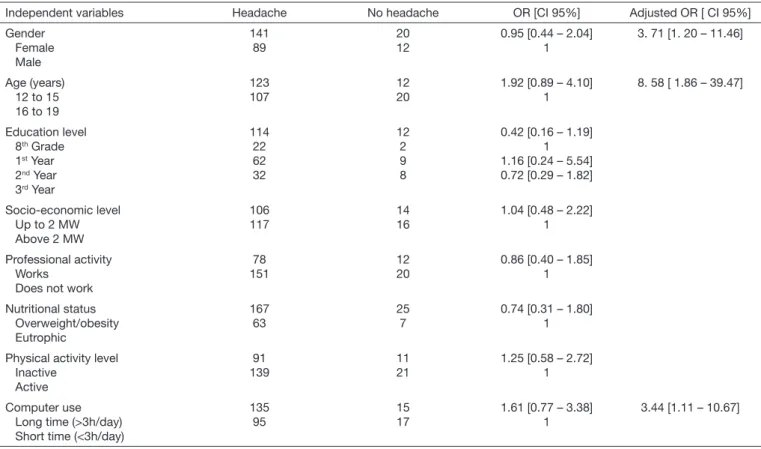
Multiple regression analysis has shown that variables gender, age, and computer use were maintained in the inal model. Females aged between 12 and 15 years and using computers for more than three hours per day had higher chances of re-porting headache (Table 2).
Multinomial regression analysis has shown, for diferent types of headache, that females have 15.61 times more chances of having tension headache and 72% less chances of classifying headache as “other types”. Adolescents referring computer use for more than three hours per day had 2.54 more chances of reporting migraine, as shown in table 3.
Table 2. Association of independent variables and presence and absence of headache among adolescents
Independent variables Headache No headache OR [CI 95%] Adjusted OR [ CI 95%]
Gender Female Male 141 89 20 12
0.95 [0.44 – 2.04] 1
3. 71 [1. 20 – 11.46]
Age (years) 12 to 15 16 to 19
123 107
12 20
1.92 [0.89 – 4.10] 1
8. 58 [ 1.86 – 39.47]
Education level 8th Grade 1st Year 2nd Year 3rd Year
114 22 62 32 12 2 9 8
0.42 [0.16 – 1.19] 1 1.16 [0.24 – 5.54] 0.72 [0.29 – 1.82]
Socio-economic level Up to 2 MW Above 2 MW
106 117
14 16
1.04 [0.48 – 2.22] 1
Professional activity Works
Does not work
78 151
12 20
0.86 [0.40 – 1.85] 1 Nutritional status Overweight/obesity Eutrophic 167 63 25 7
0.74 [0.31 – 1.80] 1
Physical activity level Inactive Active 91 139 11 21
1.25 [0.58 – 2.72] 1
Computer use Long time (>3h/day) Short time (<3h/day)
135 95
15 17
1.61 [0.77 – 3.38] 1
3.44 [1.11 – 10.67]
MW = minimum wage.
Table 1. Description, in absolute frequencies, of the presence of hea-dache and its classiication in adolescents of both genders
Variables Total Male Female p
value Headache Yes No 230 (87.8%) 32 (12.2%) 89 (88.1%) 12 (11.9%) 141 (87.6%) 20 (12.4%) 0,98 Classification of headache Tension Migraine Other types No headache 59 (22.5%) 79 (30.2%) 92 (35.1%) 32 (12.2%) 2 (2.0%) 21 (20.8%) 66 (65.3%) 12 (11.9%) 57 (35.4%) 58 (36.0%) 26 (16.1%) 20 (12.4%) 0,001* *p<0.05.
Table 3. Factors associated to the presence of different types of headache in adolescents of a public school of Petrolina, PE. 2013-2014
Variables OR CI [95%] p value
Tension headache
Gender (Female) 15.61 [3.01-80.93] 0.001
Migraine
Computer use 2.54 [1.02-6.33] 0.045
Other types
Gender (Male) 0.28 [0.11-0.72] 0.008
DISCUSSION
here are still few Brazilian studies evaluating the associa-tion of the use of electronic devices and headache, which has justiied the objective of this study. After observing the high prevalence of headache among 262 evaluated adolescents, it was clear the importance of this study about factors which could be associated to this complaint.
he prevalence of headache in the studied population was 87.8%. Prevalence as high as this has been also reported by oth-er authors17,18, however it is still possible to ind lower igures
(35.1%)19, and such diferences may be explained by diferent
methodological designs and by the ways to evaluate headache, since some studies classify as has having headache people pre-senting at least one headache episode in the last three months and other studies consider one episode in the last year.
Recently, Albers et al.19 have proposed a systematic review on
the prevalence of headache among children and adolescents and have concluded that its increase is proportional to age; however this inding is diferent from our study which has ob-served higher chance of reporting headache in the age group from 12 to 15 years of age as compared to adolescents from 16 to 19 years of age. here are diferent headache trigger-ing factors in diferent age groups, which may explain dif-ferent results, and in this context Juang et al.20 and Tietjen
et al.21 have observed that factors linked to family structure,
such as stress and/or divorce, may be associated to headache in younger adolescents. Such associations were not observed in our study, which was limited to evaluating possible associa-tion with computer use, what has restricted the identiicaassocia-tion of other possible associations.
As to frequency distribution of diferent types of primary head-ache, there has been a prevalence of 30.2% for migraine and 22.5% for tension headache. In a study by Xavier et al.18 with
Brazilian adolescents and similar methodology, migraine was also the most common type of headache (19.3%), followed by tension headache (17.9%). Notwithstanding the similarity of methodological designs, discrepancies among prevalence rates were found, possibly because the recruited sample could be ex-posed to diferent primary headache triggering factors. In our study, females had higher prevalence of tension head-ache as compared to males. Another relevant inding was that girls had 271% more complaints and were 15.61 times more prone to reporting tension headache. Shantakumari et al.22
have also observed that females had 78% more chance of de-veloping headache. Albers et al.19 have reported that from 22
studies on prevalence of primary headache between genders, 15 have reported higher values for females. his association between headache and female gender is already well docu-mented in the literature19,23,24 and a possible reason might be
hormonal issues present during this phase25. Such data
em-phasize the importance of considering headache as a symp-tom associated to gender.
About electronic devices use, it was observed a total usage time of 228.75 minutes per week, or 3.83 hours per day. hese igures show abusive use of such devices by adolescents and
call the attention as possible risk factor for the development of headache. In addition, adolescents using computers for more than three hours per day have 3.44 times more chance of referring headache. Speciically, the use of computers sub-jects individuals to increased migraine complaints in 154%. Conirming such indings, a study carried out with 8042 ado-lescents with mean age of 13.13 years in Finland, has shown that spending more than three hours per day watching TV increases the chances of having headache1.
Xavier et al.18 state that adolescents abusively using electronic
devices have higher chances (OR=1.52) of having headache. he literature also states that overload of visual system and maintenance of inadequate postures for long periods are re-lected in headache reports by adolescents2,9.
Notwithstanding our results being in agreement with most current literature and presenting statistical and social rel-evance, the study was limited by the fact of generalizing re-sults for students of a public school and extending them to private school students. In addition, the use of self-applicable questionnaires could lead both to over and underestimation of values due to memory bias of evaluated subjects. However, results have their importance justiied as risk indicators for headache associated to time of computer use, gender and age. So, it is clear the need for following up adolescents abusively using such devices, aiming at restricting, as much as possible, negative inluences of such use in the daily life of adolescents.
CONCLUSION
Our results show a high prevalence of primary headache among evaluated adolescents, being migraine the most preva-lent type, followed by tension headache. Excessive computer use was considered risk factor for the development of head-ache, especially among females.
REFERENCES
1. Brindova D, Veselska ZD, Klein D, Hamrik Z, Sigmundova D, van Dijk JP, et al. Is the association between screen-based behaviour and health complaints among adoles-cents moderated by physical activity? Int J Public Health. 2015;60(2):139-45. 2. Hakala PT, Saarni LA, Punamäki RL, Wallenius MA, Nygård CH, Rimpelä AH.
Mus-culoskeletal symptoms and computer use among Finnish adolescents--pain intensity and inconvenience to everyday life: a cross-sectional study. BMC Musculoskelet Di-sord. 2012;13:41.
3. Milde-Busch A, von Kries R, homas S, Heinrich S, Straube A, Radon K. he associa-tion between use of electronic media and prevalence of headache in adolescents: results from a population-based cross-sectional study. BMC Neurol. 2010;10:12. 4. Punamäki RL, Wallenius M, Nygard CH, Saarni L, Rimpelä A. Use of information
and communication technology (ICT) and perceived health in adolescence: the role of sleeping habits and waking-time tiredness. J. Adolesc. 2007;30(4):569-85. 5. Anderson CA, Bushman BJ. Efects of violent video games on aggressive behavior,
aggressive cognition, aggressive afect, psychological arousal, and prosocial behavior: a meta-analytic review of the scientiic literature. Psychol Sci. 2001;12(5):353-9. 6. Alexander LM, Currie C. Young people’s computer use: implications for health
educa-tion. Health Educ. 2004;104(4):254-61.
7. Blaauw BA, Dyb G, Hagen K, Holmen TL, Linde M, Wentzel-Larsen T, et al. he relationship of anxiety, depression and behavioral problems with recurrent headache in late adolescence – a Young-HUNT follow-up study. J Headache Pain. 2015;16:10. 8. Ozge A, Termine C, Antonaci F, Natriashvili S, Guidetti V, Wöber-Bingöl C. Over-view of diagnosis and management of paediatric headache. Part I: diagnosis. J Head-ache Pain. 2011;12(1):13-23.
quality of life, nutritional status and headache in school-age children. Nutr Hosp. 2013;28(5):1546-51.
11. Rocha-Filho PA, Santos PV. Headaches, quality of life, and academic performance in schoolchildren and adolescents. Headache. 2014;54(7):1194-202.
12. Lima AS, de Araújo RC, Gomes MR, de Almeida LR, de Souza GF, Cunha SB, et al. [Prevalence of headache and its interference in the activities of daily living in female adolescent students]. Rev Paul Pediatr. 2014;32(2):256-61. English, Portuguese. 13. Jannini SN, Dória-Filho U, Damiani D, Silva CA. [Musculoskeletal pain in obese
adolescentes]. J Pediatr. 2011;87(4):329-35. English, Portuguese.
14. he International Classiication of Headache Disorders: 2nd ed. Cephalalgia.
2004;24(Suppl 1):9-160.
15. Matsudo S, Araujo T, Matsudo V, Andrade D, Andrade E, Oliveira LC, et al. Ques-tionário internacional de atividade física (IPAQ): estudo de validade e reprodutibili-dade no Brasil. Ativireprodutibili-dade Física & Saúde. 2001;6(2):5-18.
16. Cole TJ, Bellizzi MC, Flegal KM, Dietz WH. Establishing a standard deini-tion for child overweight and obesity worldwide: internadeini-tional survey. BMJ. 2000;320(7244):1240-3.
17. Blaschek A, Milde-Busch A, Straube A, Schankin C, Langhagen T, Jahn K, et al. Self-reported muscle pain in adolescents with migraine and tension-type headache. Cephalalgia. 2012;32(3):241-9.
18. Xavier MK, Pitangui AC, Silva GR, Oliveira VM, Beltrão NB, de Araújo RC. Pre-valência de cefaleia em adolescentes e sua associação com uso de computador e jogos
eletrônicos. Ciên Saúde Colet. 2015 [In Press]. http://www.sbp.com.br/trabalhos- de-congressos-da-sbp/13-congresso-brasileiro-de-adolescncia/0092-prevalencia-de-cefaleia-em-adolescentes-e-sua-associacao.pdf.
19. Albers L, von Kries R, Heinen F, Straube A. Headache in school children: is the preva-lence increasing? Curr Pain Headache Rep. 2015;19(3):4.
20. Juang KD, Wang SJ, Fuh JL, Lu SR, Chen YS. Association between adolescent chron-ic daily headache and childhood adversity: a community-based study. Cephalalgia. 2004;24(1):54-9.
21. Tietjen GE, Brandes JL, Peterlin BL, Elof A, Dafer RM, Stein MR, et al. Childhood maltreatment and migraine (part I). Prevalence and adult revictimization: a multi-center headache clinic survey. Headache. 2010;50(1):20-31.
22. Shantakumari N, Eldeeb R, Sreedharan J, Gopal K. Computer use and vision-related problems among university students in ajman, United arab emirate. Ann Med Health Sci Res. 2014;4(2):258-63.
23. Bahrami P, Zebardast H, Zibaei M, Mohammadzadeh M, Zabandan N. Preva-lence and characteristics of headache in Khoramabad, Iran. Pain Physician. 2012;15(4):327-32.
24. Fendrich K, Vennemann M, Pfafenrath V, Evers S, May A, Berger K, et al. Headache prevalence among adolescentes--the German DMKG headache study. Cephalalgia. 2007;27(4):347-54.